

Note: This article contains affiliate links. If you click on these links and make a purchase, I may earn a small commission at no extra cost to you. This helps support my research and content. Read my full affiliate disclosure here.
A well-timed pre-emergent herbicide is one of the most effective tools for stopping grassy and broadleaf weeds before they invade turf. Choosing the right lawn pre-emergent herbicide affects how long your lawn stays weed-free, how often you need to apply treatments, and whether nearby flower beds or ornamentals are at risk. This guide covers six top-rated options shortlisted for common lawn situations and explains how they perform in the garden setting. We evaluate ease of application, residual activity, safety around desirable turf, and timing considerations to help you pick the best fit for your yard. Read on for a clear look at practical tradeoffs and what matters when protecting turf early in the season.
Top Picks at a Glance
| Best Overall The best all-around choice for most situations | The Andersons Barricade Granular Pre-Emergent Weed Control (18 lb, covers 5,800 sq ft) |  |
| Best Quality Built to a higher standard if you want something more solid | The Andersons Barricade DG Pro Pre-Emergent Granules (50 lb) |  |
| Best Value The sweet spot between price and what you get | The Andersons Barricade 18-0-4 Granular Fertilizer with Pre-Emergent (18 lb, 5,000 sq ft) |  |
| Best Budget The cheapest option that still gets the job done reliably | Scotts WeedEx Prevent with Halts Pre-Emergent (10.06 lb) |  |
| Highest Rated A top-rated pick with lots of positive feedback | Quali-Pro Prodiamine Pre-Emergent Herbicide, 5 lb Granules |  |
| Most Popular A crowd favorite that many people choose with confidence | Scotts Halts Crabgrass & Grassy Weed Preventer, 10.06 lb. |  |
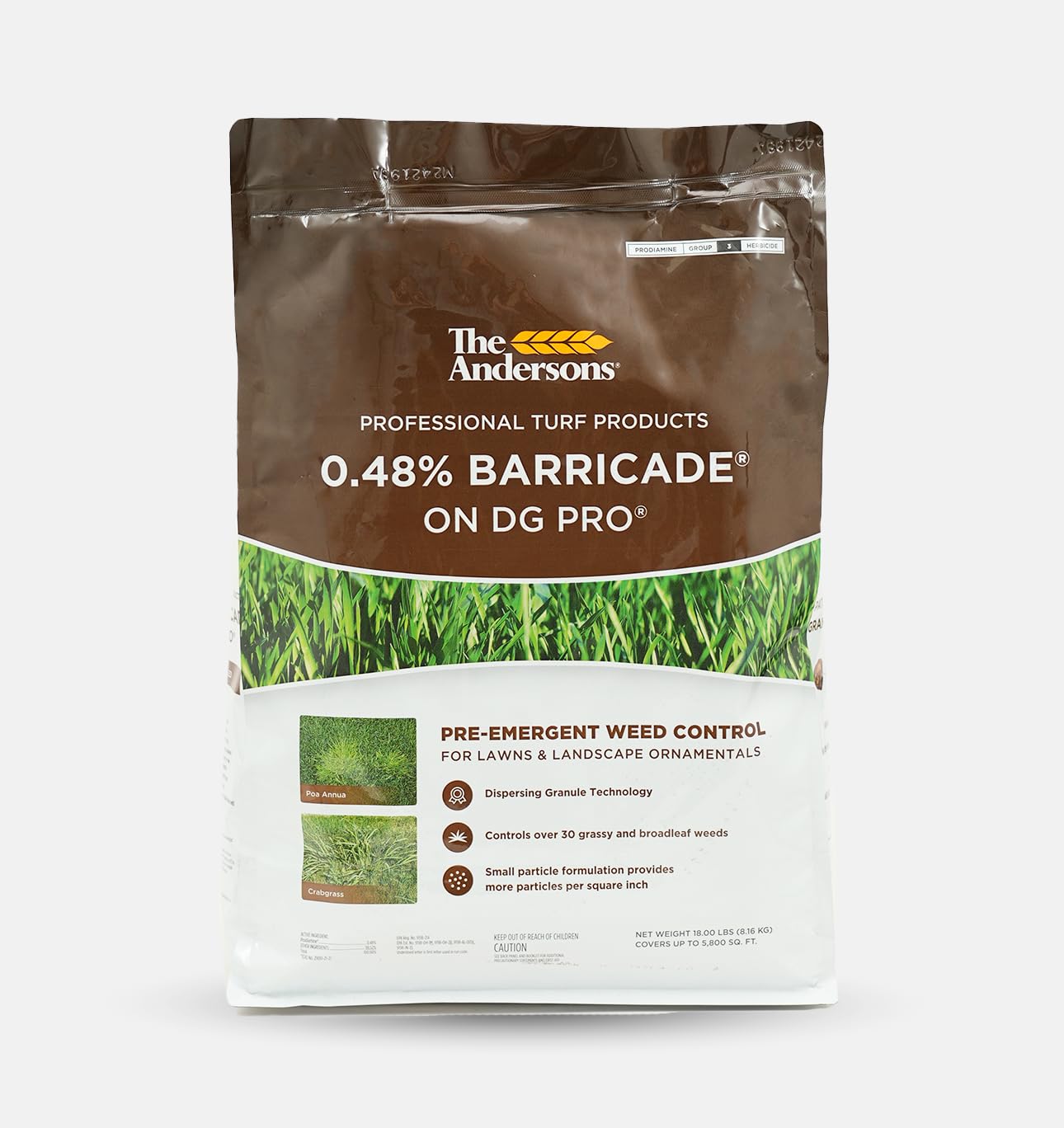
The Andersons Barricade Granular Pre-Emergent Weed Control (18 lb, covers 5,800 sq ft)
| Item Form | Granule |
|---|---|
| Coverage | 5800 square feet |
| Unit Count | 288 Ounce |
| Active Ingredients | Prodiamine 0.48% |
Barricade is a granular pre-emergent that stops common lawn weeds before they emerge, using 0.48% prodiamine in a dispersible granule formula. You apply it across the lawn in early spring or fall and water it in so the small DG Technology particles dissolve and move the active ingredient into the soil. That combination gives broader, more even coverage per square inch and is especially aimed at preventing crabgrass, poa annua and other annual grassy and broadleaf weeds across up to 5,800 square feet from a single 18 pound bag. The product is straightforward to use with a spreader and fits routine seasonal maintenance plans. Important limits are that it will not kill weeds already established and must be timed correctly for best effect. Also, because it is a professional-strength herbicide buyers should follow safety directions closely and keep pets and children off treated areas until safe.
Best for: Homeowners who plan seasonal lawn maintenance and want a single, high-coverage pre-emergent to prevent crabgrass and common annual weeds across medium to large yards.
Less Ideal for: People needing a post-emergent solution for existing weeds, or gardeners who prefer non-chemical weed control methods.
- Designed to prevent both grassy and broadleaf annual weeds including crabgrass and poa annua
- DG Technology dispersible granules dissolve quickly when watered for consistent soil incorporation
- Covers up to 5,800 square feet from a single 18 pound bag, suitable for typical residential lawns
- Contains professional-grade active ingredient prodiamine for season-long pre-emergent control
- Will not control weeds that are already established in the lawn
- Must be applied in the correct seasonal window (early spring or fall) to be effective
- Requires watering after application and careful safety handling around children and pets
Verdict: Pick Barricade when you want a professional-strength, high-coverage pre-emergent that reliably prevents crabgrass and other annual weeds across a typical residential lawn.
The Andersons Barricade DG Pro Pre-Emergent Granules (50 lb)

| Item Form | Granule |
|---|---|
| Coverage | 14,200 square feet |
| Active Ingredients | prodiamine |
Barricade DG Pro is a granular pre-emergent intended to prevent weed seed germination across established turf, landscape beds, and large turf installations. You apply it evenly over the target area in early spring or fall then water it in to activate the prodiamine, which forms a barrier at the soil surface to stop weed seedlings. The DG Pro granule formulation is designed to deliver more particles per square inch, improving coverage and consistency across the labeled 14,200 sq ft coverage. Practical benefits include long-lasting prevention of over 30 common grass and broadleaf weeds and a formulation trusted by turf professionals for large lawns, sports fields, and sod farms. Limitations are that it will not control weeds that are already established and it requires careful timing and follow-up watering to be effective; protective clothing is recommended during application because of the active ingredient. For homeowners focused on performance, it offers professional-level results when used as directed.
Best for: Buyers who prioritize turf performance and long-term weed prevention for large lawns, sports fields, or professional turf areas and who follow seasonal application schedules.
Less Ideal for: Not a good choice for gardeners seeking a quick fix for existing weed patches or for very small container or indoor plantings.
- Professional-grade active ingredient prodiamine for reliable pre-emergent control
- Granular DG formulation provides higher particle count for more uniform coverage
- Labeled coverage large enough for big lawns and turf areas (14,200 sq ft)
- Effective against over 30 common grassy and broadleaf weeds when applied correctly
- Does not kill existing weeds so requires pre-emptive timing and planning
- Requires watering after application to activate which adds a step to treatment
Verdict: Choose Barricade DG Pro when you want a professional-grade pre-emergent that delivers broad, long-lasting weed prevention across large turf areas.
The Andersons Barricade 18-0-4 Granular Fertilizer with Pre-Emergent (18 lb, 5,000 sq ft)

| Item Form | Granule |
|---|---|
| Coverage | 5,000 sq ft |
| Active Ingredients | Prodiamine |
| Unit Count | 288 Ounce |
The Andersons Barricade is a combined pre-emergent weed controller and fertilizer intended for preventive lawn care over roughly 5,000 square feet. You apply it in early spring or fall to establish a chemical barrier that stops weed seeds such as crabgrass, poa annua, and goosegrass from germinating, while the 18-0-4 formulation supplies nitrogen and potassium to promote thicker turf. The product uses a dispersible granule technology so particles dissolve quickly with watering and move into the soil where prodiamine works most effectively. Practical users will appreciate that it is designed specifically for prevention rather than post-emergent weed removal, so it should be part of a seasonal maintenance plan rather than a quick fix for existing infestations. Directions limit application timing to early spring and fall, and it will not kill established weeds, so expect to combine this with spot treatments or mechanical removal if you already have visible weeds. Overall it simplifies routine turf care by pairing nutrition and preventive weed control in one product for landscape-scale yards.
Best for: Homeowners who plan seasonal lawn maintenance and want to prevent weed emergence while supplying nitrogen to encourage thicker turf; good for those who schedule spring and fall treatments into their yard care routine.
Less Ideal for: People needing an immediate solution for visible or mature weed problems or those who require year-round weed control without seasonal applications.
- Combines pre-emergent herbicide and fertilizer so one application both feeds turf and prevents seeded weeds
- Covers up to 5,000 sq ft per bag, suitable for medium to large lawns
- Dispersible granule (DG) technology dissolves quickly and moves active ingredient into the soil after watering
- Targets a broad range of common grassy and broadleaf weeds including crabgrass and poa annua
- Does not control or remove existing weeds because it is a preventive product
- Application is season-limited to early spring and fall for best efficacy
Verdict: A convenient single-bag solution for preventive lawn care that pairs prodiamine weed prevention with 18-0-4 feeding to keep lawns thicker and reduce new weed pressure.
Scotts WeedEx Prevent with Halts Pre-Emergent (10.06 lb)

| Coverage | 5000 square_feet |
|---|---|
| Item Form | Bag |
| Active Ingredients | Pendimethalin |
Scotts WeedEx Prevent with Halts is a granular pre-emergent designed to stop common lawn weeds before they emerge. You apply it in early spring to prevent crabgrass, foxtail, spurge and similar annual grasses for the season, or in late summer to fall to reduce moss and certain cool-season seedlings. The product is delivered in a single 10.06 lb bag that treats up to 5,000 square feet and is intended for most turf types except Dichondra and bentgrass. Practical benefits include seasonal, hands-off control once applied and compatibility with routine spreader use and normal weather events since rain or frost will not reduce effectiveness. Important limitations are that it will not kill established weeds and some targets, such as goosegrass, may require a repeat application in eight weeks; it can also stain hard surfaces so care during spreading is needed. For homeowners managing weed prevention across a modest lawn, this is a straightforward option that integrates with a spring or fall lawn-care plan.
Best for: Buyers who want an affordable, low-effort way to prevent annual lawn weeds across a small to medium yard and prefer a seasonal, preventative approach to lawn care.
Less Ideal for: Homeowners who need to eliminate existing weed infestations, or those with specialty lawns such as bentgrass or Dichondra who should use a product formulated for those turf types.
- Pre-emergent action prevents germination of listed annual grasses and several broadleaf weeds
- Covers up to 5,000 sq. ft. from a single 10.06 lb bag
- Resistant to rain, snow, or freezing weather after application
- Suitable for use on most lawn grass types (excludes Dichondra and bentgrass)
- Does not control established or mature weeds
- Some weeds like goosegrass may need a second application for control
- Can stain concrete, stone, metal, clothing, or shoes if spilled
Verdict: A budget-friendly, weather-tolerant pre-emergent that reliably prevents common annual lawn weeds across up to 5,000 sq ft when used as part of spring or fall lawn care.
Quali-Pro Prodiamine Pre-Emergent Herbicide, 5 lb Granules

| Item Form | Granule |
|---|---|
| Coverage | Pre-emergent grass and broadleaf weed control, season long crabgrass control |
| Active Ingredients | Prodiamine 65% |
Quali-Pro Prodiamine is a granular pre-emergent herbicide designed to prevent germination of common annual grassy and broadleaf weeds across lawns and landscape beds. You apply it before weed seeds germinate in spring or as a fall treatment to build residual control through the growing season. The product contains 65% prodiamine, which is widely used for reliable, long-lasting control of crabgrass, annual bluegrass and several broadleaf weeds, and it mixes readily when tank-mixed with fertilizers or iron. In real-world use it offers predictable, season-long suppression when applied at the labeled rate and incorporated by irrigation or rainfall. Important practical limits are that it is preventive only and will not kill established weeds, and proper timing and rate are essential to avoid reduced effectiveness. For larger areas the 5 lb package covers moderate lawn acreage but may require multiple bags for extensive turf.
Best for: Homeowners and lawn care professionals who prioritize a dependable, season-long preventive solution to keep crabgrass and annual weeds from establishing in turf.
Less Ideal for: Gardeners needing a post-emergent solution for existing weeds or those who prefer liquid ready-to-use products for spot treatments.
- High active ingredient concentration (Prodiamine 65%) for long residual control
- Granular form allows easy broadcast application and tank mixing with fertilizers
- Effective season-long crabgrass and annual weed suppression when applied correctly
- Suitable for spring or fall applications to build preventive control
- Pre-emergent only and will not control established weeds
- 5 lb bag may be insufficient for large lawns without purchasing additional quantity
Verdict: Choose this prodiamine granule when you want a proven, season-long preventive herbicide to reliably stop crabgrass and other annual weeds before they start.
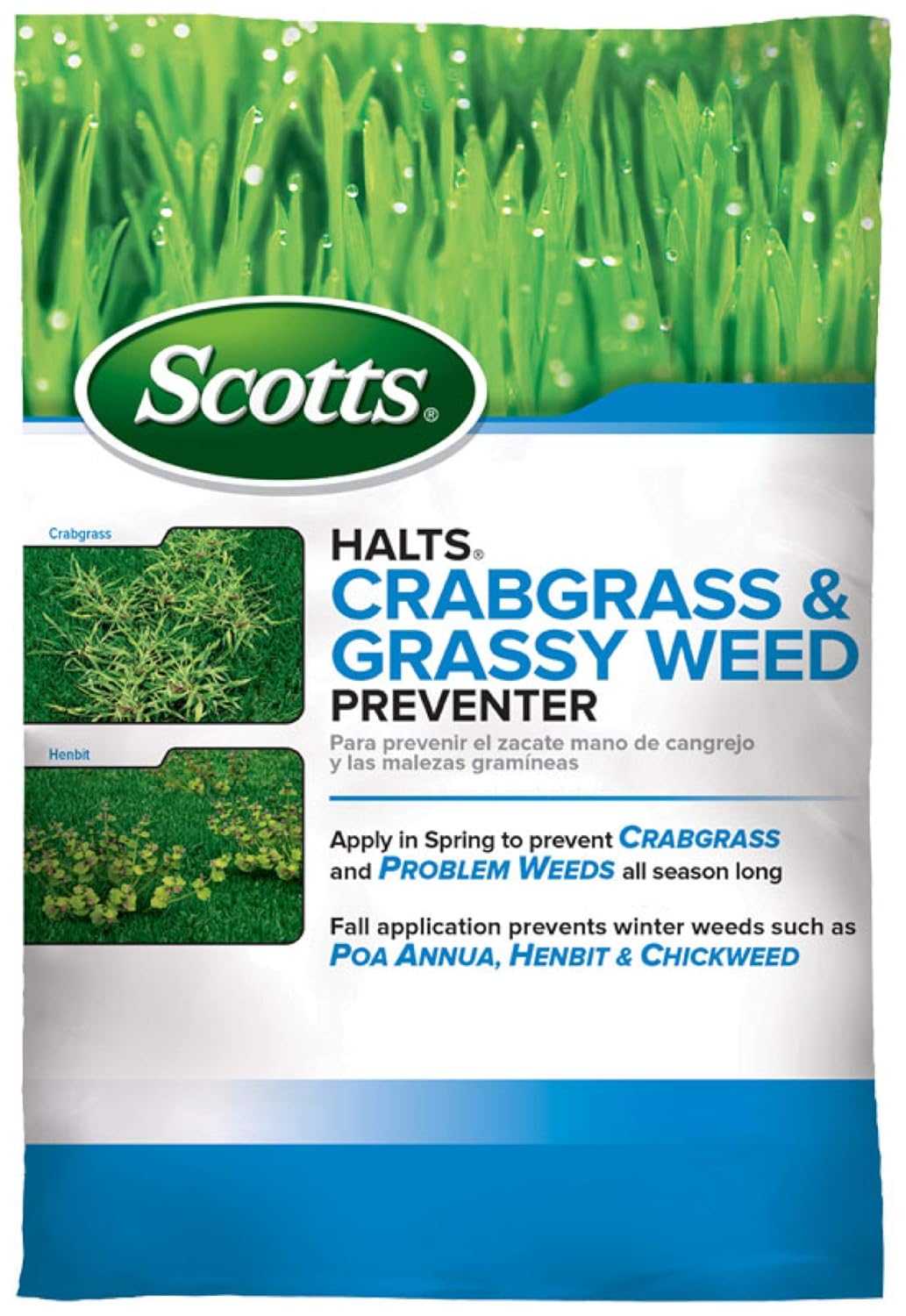
Scotts Halts Crabgrass & Grassy Weed Preventer, 10.06 lb.
| Item Form | Granule |
|---|---|
| Coverage | 5000 square_feet |
| Active Ingredients | Pendimethalin 1.71% |
Scotts Halts is a granular pre-emergent formulated to stop crabgrass and seeded grassy weeds from germinating across established lawns. You apply it dry with a broadcast spreader in early spring or fall, then water it in as directed; the active ingredient pendimethalin forms a soil barrier that prevents weed seedlings from emerging and is advertised as resistant to rain, snow, or freezing after application. This bag treats up to 5,000 square feet and is intended for use on most turf types except Dichondra and Bentgrass. The practical benefits are straightforward: a single timed application protects turf from several common annual weeds without needing spot herbicide treatments, and the granule form makes even coverage with a spreader easy. Important limitations are that it does not kill existing mature weeds and cannot be used on newly seeded or sprigged areas until months later, so timing and measuring lawn area matter. Also repeat applications for certain weeds like goosegrass may be necessary according to label instructions.
Best for: Homeowners who plan lawn care around seasonal timing and want a preventive, low-effort way to stop annual grassy weeds before they emerge.
Less Ideal for: People needing to remove existing weed infestations, those reseeding or establishing new turf within months, or gardeners who require immediate weed knockdown.
- Pre-emergent action prevents crabgrass and listed grassy weeds before they germinate
- Covers up to 5,000 sq ft per bag for single-application protection
- Granule form designed for even spreader application and easy watering activation
- Rain, snow, or freezing after application will not reduce effectiveness
- Does not control existing mature weeds so not useful for established infestations
- Not safe for newly seeded or freshly sprigged lawns for several months
Verdict: Use this granular pre-emergent if you want a seasonal, preventative barrier against crabgrass and common grassy weeds on an established lawn up to 5,000 sq ft.
Choosing the Right Lawn Pre-Emergent Herbicide: Key Factors to Consider
Timing and Local Climate
Pre-emergent herbicides are only effective against weeds before they germinate, so timing is critical. You should apply treatments based on soil temperature cues and local phenology rather than calendar dates alone. For many regions, the window opens in early spring when soil temps consistently reach about 55 degrees Fahrenheit for several days, but in milder climates a fall application may be the key for winter annuals.
Applying too early can leave a protection gap as the chemical degrades before peak germination, while applying too late means seedlings may already be present and unaffected. Consider local frost dates, warming trends, and the typical emergence pattern of target weeds when scheduling applications.
Active Ingredient and Spectrum
Different active ingredients target different groups of weeds and persist for varying lengths of time. Some chemistries are aimed primarily at grassy weeds like crabgrass, while others also suppress certain broadleaf weeds and sedges. Understanding the spectrum matters because a product that controls grasses might not help with dandelions or clover.
Match the active ingredient profile to the weeds you expect in your lawn. If you have a mix of problematic species, you may need a product with broader activity or plan a combined strategy that pairs pre-emergent prevention with targeted post-emergent spot treatments later in the season.
Residual Length and Reapplication Interval
Residual length determines how long a single treatment reduces weed emergence. Longer-residual materials reduce the need for reapplication but may increase the risk to newly seeded turf or nearby non-target plants. If you overseed or plan to put down sod, check the label for safe intervals between application and seeding.
Gardeners should weigh convenience against flexibility. Long-lasting products are better for low-maintenance lawns, while shorter-residual options allow for reseeding and late-season interventions without prolonged restrictions.
Turf Type Compatibility
Not all pre-emergent herbicides are labeled safe for every turfgrass species. Warm-season grasses and cool-season grasses differ in tolerance to some active ingredients, and damaged or thin turf is more likely to show injury. Verify that the product is listed for your specific grass type before application.
If your lawn has a mix of grasses or contains new plantings, choose a formulation with an appropriate label or delay treatment until turf is established and robust enough to tolerate chemical exposure.
Application Method and Equipment
Pre-emergents come in granular and liquid formulations, and each requires different equipment and calibration. Granular products need evenly calibrated spreaders and consistent walking speed for good coverage. Liquids require accurate measuring and, in some cases, back-and-forth spray patterns to avoid streaks.
Equipment compatibility affects how much of the product is actually delivered to the soil. Homeowners should pick a formulation that matches the tools they already own, and they should follow spreader or sprayer calibration steps to ensure even distribution across the lawn.
Environmental Considerations and Runoff Risk
Some pre-emergent herbicides bind tightly to soil, while others are more prone to movement with heavy rainfall or irrigation. Consider proximity to water features, slopes, and drainage paths that could carry product off-target. Choosing a product with lower mobility and adhering to label instructions for application before heavy rain can reduce runoff risk.
Also consider impacts on desirable planting areas. Avoid broadcast applications near vegetable beds, newly planted ornamentals, or areas where you plan to seed annuals, or use targeted application techniques to minimize exposure.
When to Apply Pre-Emergent in Different Climates
Soil temperature is the most reliable trigger for pre-emergent timing. In cool-season climates, early spring applications timed to soil warming prevent spring annuals like crabgrass. In warm-season regions, a late winter to early spring treatment often works best before warm-season weed germination. For areas with mild winters, consider a fall timing to block winter annuals.
Use a soil thermometer or local extension resources to track soil temperatures. If you miss the ideal spring window, a second application or a properly timed post-emergent spot treatment later in the season will help control escaped weeds.
- Track soil temperatures at the 1 to 2 inch depth for consistent timing cues.
- Adjust timing if warm spells or late frosts change typical germination patterns.
- When overseeding, avoid pre-emergents unless the label explicitly allows seeding after a specified interval.
Granular Vs Liquid Formulations
Granular formulations are simple to apply with a broadcast spreader and are less dependent on spray equipment, making them popular for homeowners. They can be easier to calibrate for large, even areas but require dry conditions at the time of application and light irrigation to move the active ingredient into the soil.
Liquid formulations allow for quicker activation into the soil profile when watered in and can be easier for treating irregularly shaped lawns or spot areas. They require careful mixing and even spray coverage. Choose the form that matches your comfort with equipment and the lawn layout.
- Granular: good for open, uniform lawns and simple application.
- Liquid: better for irregular shapes, quicker soil incorporation when irrigated.
Integrating Pre-Emergents With Lawn Care
Pre-emergent use should fit into an overall turf management plan. Healthy, dense turf is the best long-term defense against weeds, so combine pre-emergent treatments with proper mowing height, fertility, and irrigation. Avoid scalping or drought stress after application, which can increase turf vulnerability.
If you plan cultural practices like aeration, topdressing, or overseeding, schedule those around label restrictions. Many pre-emergents restrict seeding windows, so perform corrective cultural work before applying or choose a product compatible with overseeding timelines.
- Mow at recommended heights to encourage dense turf and shade out weeds.
- Time aeration and overseeding to avoid label-imposed seeding restrictions.
- Use targeted post-emergent spot treatments for escapes rather than increasing broadcast application rates.
Safety Precautions for Home Gardeners
Read and follow the label instructions carefully regarding personal protective equipment and buffer distances. Keep children and pets off treated areas until the product has been watered in and any labeled re-entry intervals have passed. Store products in a cool, dry place out of reach of children.
Avoid applying in windy conditions to reduce drift to ornamental beds or edible plantings. When using sprayers, calibrate and test on a small area to ensure even coverage and to check for any unexpected turf sensitivity.
- Wear gloves and protective eyewear during mixing and application.
- Keep treated clippings from composting for products with restricted compost use until label allows.
- Avoid applying before heavy rain unless the label specifies it is safe to do so.
Dealing With Escaped Weeds After Pre-Emergent Use
No pre-emergent is perfect, and some weeds will escape prevention. Address escapes promptly with targeted post-emergent spot treatments, hand pulling before plants set seed, or improving turf density through cultural practices. Spot treatments use less chemistry overall and limit exposure to non-target areas.
Record application dates and products used so you can adjust timing or active ingredient chemistry the next season if the same species reoccur. Combining mechanical removal and improved lawn care often reduces the need for repeat chemical interventions.
- Use targeted spot control for small infestations rather than rebroadcasting pre-emergent.
- Monitor treated areas through the season to catch escapes early.
- Rotate approaches season to season to prevent reliance on a single product type.
How We Chose the Best Lawn Pre-Emergent Herbicide
We shortlisted products that are widely used by gardeners and turf managers and that match realistic seasonal timing and application methods for home lawns. Selection emphasized proven active ingredients for pre-emergent control, consistent residual activity across typical temperate climates, and formulations suited to common homeowner equipment such as broadcast spreaders or hose-end sprayers. Evaluation criteria focused on measurable, garden-relevant dimensions: length of residual control, application simplicity and spreader compatibility, turf safety and selectivity, rainfastness and activation requirements, and label clarity for timing and use rates. We excluded products intended solely for post-emergent spot treatment or those lacking clear lawn-use instructions. We also filtered out products whose labels prohibit use on common turfgrass types. The resulting list favors options that balance long residual protection with straightforward application and clear safety guidance for nearby plants. Where multiple formulations exist, we preferred ones that match typical homeowner equipment to reduce installation errors and improve results.
FAQ
Can I apply pre-emergent herbicide after overseeding my lawn?
Usually not immediately. Most pre-emergent herbicides restrict seeding until a specified interval has passed to avoid preventing grass seed germination. Check the product label for the safe interval between application and seeding; if unsure, delay treatment until the new grass is established.
How long does a single pre-emergent application typically protect the lawn?
Protection varies by active ingredient and environmental conditions but commonly ranges from a few weeks up to several months. Soil microbial activity, rainfall, and UV exposure can reduce residual activity, so follow label recommendations for reapplication intervals if extended control is needed.
Will a pre-emergent herbicide harm my flower beds or vegetable garden?
It can if it moves off-target or the product label does not allow use near those areas. Avoid broadcast applications directly adjacent to gardens, take care on slopes or before heavy rain, and follow buffer guidance on the label. When in doubt, use targeted application techniques to minimize exposure.
Is one application enough for the entire growing season?
That depends on the product's residual length and the weed pressure in your area. Some formulations provide season-long control under moderate conditions, while others need a follow-up application mid-season. Local climate and soil conditions influence whether a second application is warranted.
Can I apply pre-emergent if my lawn has thin or stressed turf?
Caution is advised. Stressed or thin turf is more likely to display herbicide sensitivity. Strengthen the lawn with proper watering, fertilization, and repair work before applying a pre-emergent, or choose a product labeled for use on weaker turf and follow lower rate recommendations.
Final Verdict
Choose a lawn pre-emergent herbicide by matching timing, active ingredient spectrum, and residual length to your site-specific needs. Prioritize a product labeled for your turf type and that fits your equipment and overseeding plans. Plan applications around soil temperatures and cultural practices to avoid conflicts with seeding or aeration. With correct timing and careful application, a pre-emergent is an efficient way to reduce seasonal weeding and maintain a healthier, denser lawn.
