

Note: This article contains affiliate links. If you click on these links and make a purchase, I may earn a small commission at no extra cost to you. This helps support my research and content. Read my full affiliate disclosure here.
Summer is the season when warm temperatures and drought stress put lawns under real pressure, so choosing the right organic lawn fertilizer for summer matters more than in cooler months. The wrong feed can burn turf or waste nutrients, while the right one supports root strength, steady growth, and microbial activity that helps grass cope with heat. This guide shortlists seven top organic options formulated for summer use. We evaluate each choice on nutrient balance, how it behaves in hot, dry conditions, and how it affects soil health, so you can pick the approach that matches your watering, turf type, and maintenance plan.
Top Picks at a Glance
| Best Overall The best all-around choice for most situations | Purely Organic Products Lawn Food 10-0-2, 15 lb |  |
| Best Quality Built to a higher standard if you want something more solid | Jonathan Green Organic Lawn Food 10-0-1 (5,000 sq ft) |  |
| Best Value The sweet spot between price and what you get | Lawnbox Lawn Luxe 7-0-7 Organic Summer Lawn Fertilizer, 14 lb |  |
| Best Budget The cheapest option that still gets the job done reliably | Milorganite Slow-Release Organic Fertilizer, 5 lb |  |
| Highest Rated A top-rated pick with lots of positive feedback | Espoma Turf-Tone All Season Organic Lawn Food with Bio-Tone, 28 lb |  |
| Most Popular A crowd favorite that many people choose with confidence | Scotts Natural Lawn Food, 29.1 lb (covers 4,000 sq. ft.) |  |
| Best Seller A high-volume bestseller chosen again and again | Milorganite 6-4-0 Slow-Release Fertilizer, 32 lb (with Feeding Tips Brochure) |  |
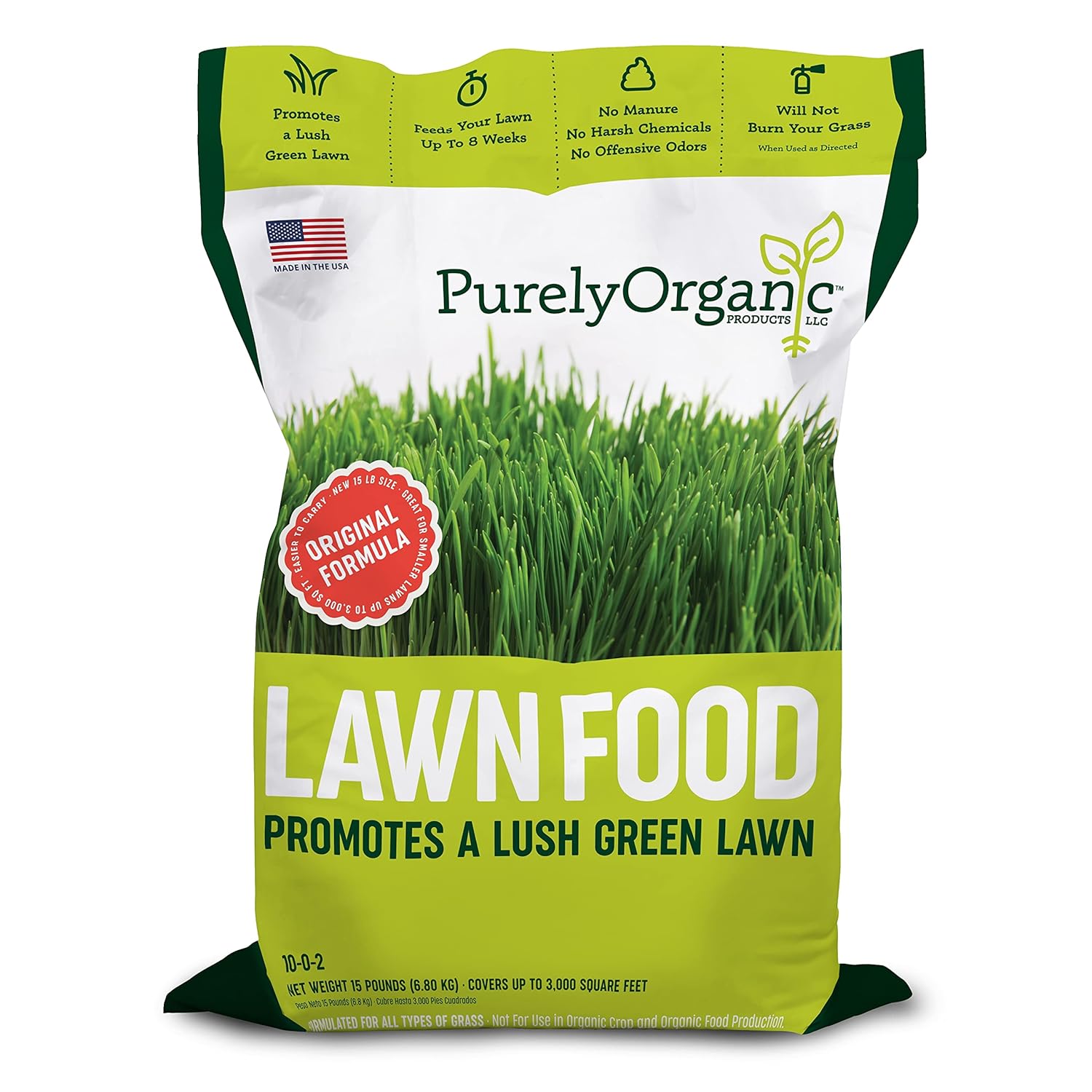
Purely Organic Products Lawn Food 10-0-2, 15 lb
| Item Form | Granules |
|---|---|
| Application Method | Drop or rotary spreader |
| Coverage | 3,000 Square Feet |
| Specific Uses For Product | Plant Growth, Root Development, Soil Conditioning |
| Mixing Ratio | 10:0:2 |
This Purely Organic Lawn Food is a granular, plant-based fertilizer designed for routine lawn feeding on cool- and warm-season grasses. It spreads with a drop or rotary spreader at the recommended 4–8 lbs per 1,000 sq ft and supplies nitrogen-heavy nutrition (10-0-2) for greener leaf growth while also contributing to root development and soil conditioning. The blend uses soybean meal and distillers dried grains instead of synthetic chemicals, which reduces odor and eliminates phosphorus to comply with phosphate-restriction rules in some towns. It is family and pet friendly with no re-entry restrictions noted, making it practical for yards with animals. Expect slower, steady green-up compared with quick-release synthetic fertilizers, so results are gradual rather than instant. Also, coverage is calibrated to the 15 lb bag for roughly 3,000 sq ft, so larger lawns will need multiple bags and more storage space.
Best for: Buyers who want a pet- and family-friendly, plant-based lawn fertilizer that supports steady, natural green-up and prefers practical, regulation-compliant choices over fast-acting chemical feeds.
Less Ideal for: Homeowners who need rapid, dramatic color change or who manage very large lawns and expect each application to cover extensive acreage.
- Plant-based formula using soybean meal and distillers grains instead of synthetic chemicals
- No phosphorus in the 10-0-2 formula to meet phosphate-restriction rules
- Can be applied with common drop or rotary spreaders and covers about 3,000 sq ft per bag
- Family and pet friendly with no re-entry time required
- Slow-release effect means slower visible results compared with synthetic quick-release fertilizers
- 15 lb bag may be insufficient for larger lawns requiring multiple applications or bags
Verdict: Choose this product if you want a practical, pet-safe, plant-based fertilizer that steadily builds greener turf while avoiding phosphorus.
Jonathan Green Organic Lawn Food 10-0-1 (5,000 sq ft)

| Analysis | 10-0-1 |
|---|---|
| Form | Granules |
| Coverage | 5000 sq ft |
| Application method | Spread |
Jonathan Green Organic Lawn Food is a slow-release granular fertilizer designed to feed established and newly seeded lawns for eight to ten weeks. It is spread with a broadcast, drop, or hand-held spreader and supplies steady nitrogen plus iron to improve color without relying on fast-release synthetics. In practice the granules are easy to apply and the formula is gentle enough that it will not burn turf, which makes it suitable for homes with children and pets. The product covers about 5,000 square feet per bag and is described as containing natural ingredients and no sludge- or manure-based fillers. Important limitations are that its nutrient mix is low in phosphorus and potassium so it is mainly a green-up and maintenance fertilizer rather than a one-step solution for soil deficiencies, and feeding is gradual so results are not instant. For typical home lawns looking for an organic maintenance feed this is a practical, low-risk option.
Best for: Homeowners who want an easy, low-risk organic maintenance feed that improves color and sustains turf between major treatments.
Less Ideal for: Gardeners needing rapid greening, immediate repair of nutrient-poor soil, or a complete fertilizer with higher P and K for soil correction.
- Organic, natural ingredient formula that avoids fast-release synthetic nitrogen
- Slow-release feed provides 8–10 weeks of steady nutrition
- Contains iron to promote deeper green color
- Easy-to-spread homogeneous granules compatible with broadcast, drop, or handheld spreaders
- Low phosphorus and potassium content makes it unsuitable as a complete soil correction
- Gradual action means visible improvement can take multiple weeks
Verdict: A reliable organic slow-release lawn food that delivers steady green-up and maintenance for average home lawns.
Lawnbox Lawn Luxe 7-0-7 Organic Summer Lawn Fertilizer, 14 lb

| N-P-K | 7-0-7 |
|---|---|
| Form | Granules |
| Coverage per bag | 2,500 sq ft |
| Feeding duration | Up to 6 weeks |
| Intended use | Summer lawn maintenance |
Lawnbox Lawn Luxe 7-0-7 is an organic granular lawn fertilizer designed for summer use to help turf tolerate heat, traffic, and short droughts. It combines fast-acting and slow-release nitrogen sources plus humic acid so you get an initial green-up and steady feeding for up to six weeks. The bag is set up for spreader application and works with handheld, rotary, or drop spreaders; light watering after application speeds nutrient activation but is not required. Because the formula is OMRI-listed and free of animal byproducts and biosolids it is family-friendly and suitable for lawns where you want to avoid synthetic chemicals. Practical users will appreciate clear spreader guidance and coverages that let one bag treat a typical suburban yard. The main limitations are that it is tailored for maintenance and stress resistance rather than aggressive rapid recovery from severe thinning, and it is not available for sale in some states, so check local restrictions before planning seasonal applications.
Best for: Homeowners who prioritize an organic, family-safe summer lawn program and want straightforward application and steady feeding to maintain turf through heat and higher traffic.
Less Ideal for: Those needing a high-release, aggressive rebuilding fertilizer for severely thin or newly seeded lawns or buyers in states where this product is restricted.
- OMRI listed 100% organic formula without animal byproducts or biosolids
- Balanced mix of quick and slow-release nitrogen for immediate green-up and up to six weeks of feeding
- Includes humic acid to support soil health and nutrient uptake
- Designed for easy application with handheld, rotary, or drop spreaders and provided spreader settings
- Formulated for maintenance and stress tolerance rather than rapid thickening of severely thin lawns
- Not sold in certain states which may limit availability for some buyers
Verdict: Pick this if you want a family-friendly, OMRI-listed summer fertilizer that provides immediate green-up plus steady organic feeding to keep an established lawn resilient.
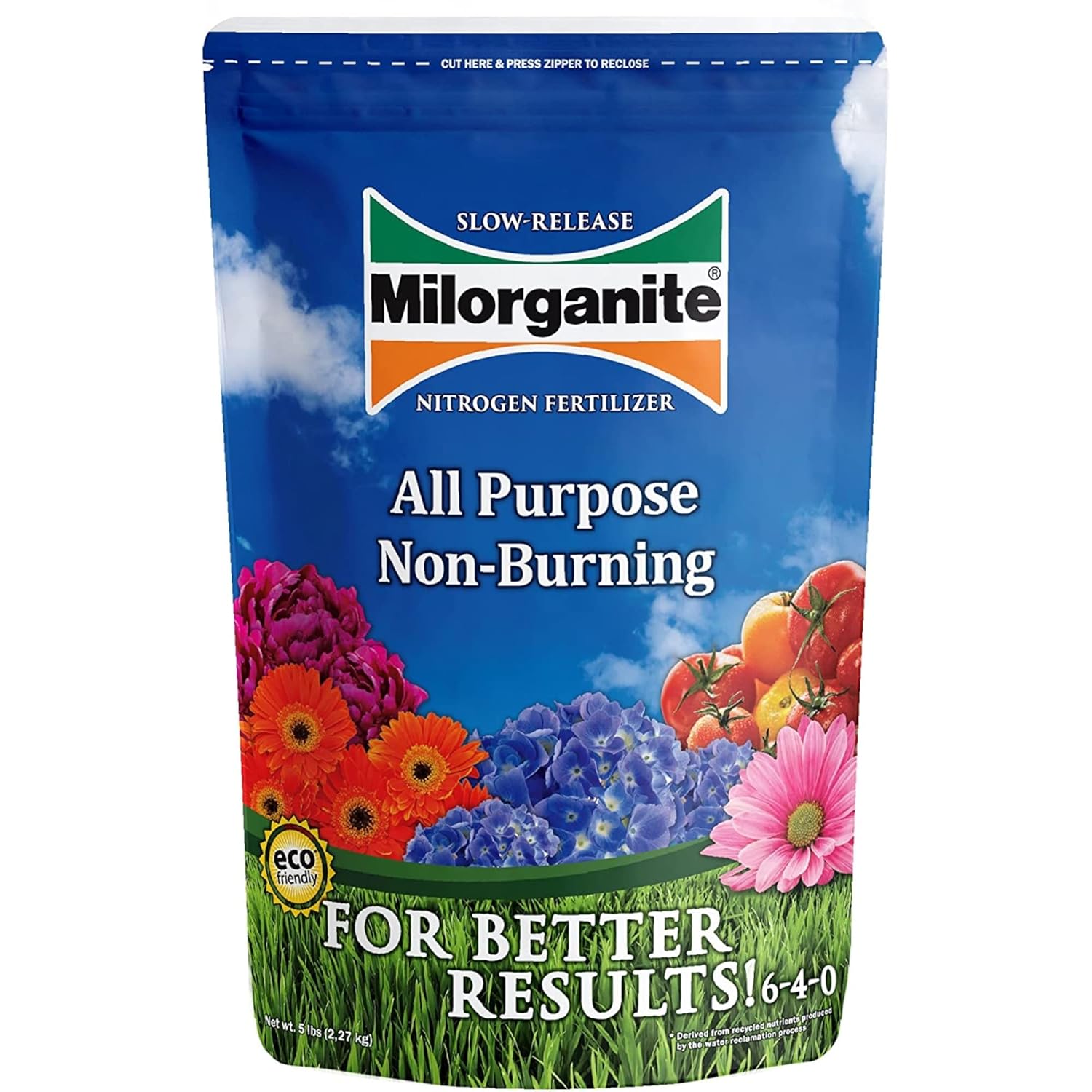
Milorganite Slow-Release Organic Fertilizer, 5 lb
| Item Form | Granules |
|---|---|
| Specific Uses For Product | Lawns, Flowers and Gardens |
| Coverage | 390 Square Feet |
| Ingredients | Nitrogen |
Milorganite is a granular, slow-release organic fertilizer formulated to feed lawns and garden plants for about 8 to 10 weeks per application. It is typically broadcast by hand or with a spreader and does not require immediate watering in, making it easy to fit into routine maintenance. Notable features include a low-salt formula that greatly reduces the risk of burning turf, organically complex iron that greens grass without staining hard surfaces, and about 85% organic matter that helps improve soil structure over time. The product covers roughly 390 square feet from a 5 pound bag and is positioned as safe for use on lawns, shrubs, flowers, trees, and edible gardens. Limitations are that nutrient release is gradual, so it is not a quick fix for severe nitrogen deficiency, and the bag has an earthy odor at first that some pets may find attractive until it dissipates or is watered in. For someone managing Empire Zoysia, use on the recommended schedule and expect steady, low-risk green-up rather than instant color change.
Best for: Gardeners who prioritize steady, low-risk nutrient delivery and soil health and who prefer a hands-off feeding schedule for fine-textured lawns like Empire Zoysia.
Less Ideal for: Homeowners wanting rapid color correction or fast-acting synthetic nitrogen boosts should choose a quick-release fertilizer instead.
- Slow-release nitrogen feeds lawns for 8–10 weeks reducing application frequency
- Low salt formulation minimizes risk of burning sensitive turf like Zoysia
- Provides organically complex iron that greens grass without staining concrete
- High organic matter improves soil structure and water retention over time
- Slow-release action means it will not correct severe yellowing immediately
- Initial earthy odor that may attract some pets until it is watered in or dissipates
Verdict: Choose Milorganite for Empire Zoysia when you want a safe, slow-release organic feed that greens turf steadily without burning or staining.
Espoma Turf-Tone All Season Organic Lawn Food with Bio-Tone, 28 lb

| Item Form | Granules |
|---|---|
| Application Method | Spread evenly on a dry, mowed lawn |
| Target Species | Lawn Grass |
| Unit Count | 448 Ounce |
Espoma Turf-Tone is a 28 lb granular, slow-release lawn fertilizer designed for routine feeding of lawns including Kentucky bluegrass. It supplies a low-rate nitrogen formula that releases slowly to encourage steady greening and reduced frequency of applications. The product is intended to be applied with a drop or broadcast spreader to a dry, mowed lawn and claims coverage up to about 5,000 sq ft. Notable features are its organic ingredients and Bio-Tone microbial formula, which aim to support soil biology while minimizing risk of burn or leaching compared with high-salt synthetic feeds. Practical benefits for bluegrass include gentler, longer-lasting color improvement and less chance of creating quick flushes of top growth that demand more mowing. Important limitations are that its nutrient numbers are modest (9-0-1) so it is not a quick corrective for severe nitrogen deficiency and may require multiple seasonal applications to build vigor; large or very depleted lawns may need supplemental treatments or higher-analysis products for rapid recovery.
Best for: Homeowners who prioritize reliable, low-risk feeding and steady seasonal improvement for cool-season lawns like Kentucky bluegrass and who prefer organic products over synthetic quick fixes.
Less Ideal for: Gardeners needing a fast green-up or immediate corrective treatment for very nutrient-deficient or large commercial lawns should consider higher-analysis or targeted products instead.
- Slow-release nitrogen that promotes steady greening without rapid top growth
- Organic and natural ingredient base that reduces burn risk and supports soil health
- Formulated with Bio-Tone microbes to help root and soil biology
- Easy to apply with a broadcast or drop spreader and suitable for all-season use
- Lower analysis (9-0-1) so it is not ideal for rapid correction of severe nutrient deficiencies
- Coverage claim depends on even spread; may require multiple bags for large or thin lawns
Verdict: Choose this organic, slow-release Turf-Tone when you want dependable, low-risk seasonal feeding that supports Kentucky bluegrass and soil biology.
Scotts Natural Lawn Food, 29.1 lb (covers 4,000 sq. ft.)

| Item Form | Powder |
|---|---|
| Application Method | spreader |
| Coverage | 4,000 square feet |
| Specific Uses For Product | Lawn |
| Target Species | grass |
Scotts Natural Lawn Food is a granular lawn fertilizer designed to thicken and green turf with a mostly natural formulation and OMRI listing. It is applied with a spreader and is intended for use any season on any grass type; Scotts recommends up to four applications per year and feeding every 6 to 8 weeks during the growing season. In real-world use it delivers noticeable greening within one to three weeks and is safe to walk on immediately after application, which makes it convenient for yards with kids and pets. The bag covers 4,000 square feet and has no strong odor, so application is straightforward and unobtrusive. Limitations to consider are that it is intended as lawn food rather than a weed or pest solution and you should avoid applying before heavy rain and sweep product off hard surfaces to prevent runoff. For best distribution use a compatible Scotts drop or rotary spreader to get even coverage across the lawn.
Best for: Homeowners who prioritize pet and child safety and want a straightforward, season-round lawn food that promotes greener, thicker grass with minimal fuss.
Less Ideal for: People needing an all-in-one weed or insect control product or those with very large lawns who want less frequent, higher-coverage bags.
- OMRI listed formulation suitable for natural lawn care practices
- Safe to walk on immediately after application and labeled for use around kids and pets when used as directed
- Covers up to 4,000 sq. ft. from a single 29.1 lb bag
- No strong odor and easy to apply with standard spreaders
- Not formulated to control weeds or pests so additional products may be required
- Requires proper spreader use and care to avoid uneven application or runoff
Verdict: Choose this if you want a pet-friendly, OMRI-listed lawn food that reliably greens and thickens turf with simple spreader application.
Milorganite 6-4-0 Slow-Release Fertilizer, 32 lb (with Feeding Tips Brochure)

| Item Form | Pelletized |
|---|---|
| Application Method | Broadcast, Rotary or Manual |
| Coverage | 2,500 Square Feet |
| Specific Uses For Product | Lawns, Flowers and Gardens, Education |
Milorganite 6-4-0 is an organic, pelletized slow-release fertilizer intended for routine lawn and garden feeding. It is typically broadcast with a rotary or manual spreader and provides nitrogen slowly over 8 to 10 weeks, which reduces the need for frequent applications and lowers burn risk. The product contains organically complex iron for greening without the strong staining associated with iron salts and is low in soluble salts, so it performs well in warm or drier conditions. The 32 lb bag covers roughly 2,500 square feet and comes with a printed feeding and spreader tips brochure to simplify seasonal timing and application rates. Because it is made from heat-dried microbes, it also adds organic matter to improve soil structure in heavy clay or sandy soils. Limitations are that nutrient release is gradual so it is not suited to quick color fixes or rapid turf recovery, and users seeking tightly controlled N-P-K ratios or fast-acting synthetic performance may prefer a different product.
Best for: Buyers who want a low-maintenance, environmentally minded fertilizer that steadily feeds established lawns and mixed garden beds with minimal risk of burn and fewer repeat applications.
Less Ideal for: If you need rapid turf recovery, immediate color correction, or precise synthetic nutrient control for athletic fields or newly sodded lawns, choose a fast-release or specialty fertilizer instead.
- Slow-release nitrogen feeds lawns and plants for 8–10 weeks, reducing application frequency
- Low-salt formulation minimizes fertilizer burn and streaking in hot or dry conditions
- Organically complex iron promotes deep greening without heavy staining of concrete
- Pelletized form works with broadcast, rotary, or manual spreaders for easy application
- Adds organic matter that can improve drainage and soil structure in clay or sandy soils
- Not fast-acting, so it will not deliver an immediate green-up after application
- Contains biosolids which some buyers may prefer to avoid for personal or local reasons
Verdict: Pick this if you want a reliable, low-salt slow-release fertilizer that feeds lawns and gardens for weeks with minimal maintenance.
Choosing the Right Organic Lawn Fertilizer for Summer: Key Factors to Consider
Nutrient Balance and Release Rate
An effective summer fertilizer supplies nitrogen at a moderate, controlled rate to green the lawn without forcing weak, water-hungry top growth. Look for organic sources that release nitrogen slowly through microbial activity rather than a sudden soluble spike. Steady-release feeding helps maintain color and vigor while reducing the need for frequent applications.
Release rate affects how often you must reapply and how the lawn responds to heat. Rapid-release materials can cause short-lived greening followed by stress, while too-slow materials might not provide noticeable benefit during the critical summer months.
Heat-Stress and Drought Resilience
Fertilizers that support root development and osmotic balance help turf survive high temperatures. Ingredients such as potassium-rich components, organic matter that improves moisture retention, and micronutrients that aid stress physiology make a real difference in summer. The goal is to promote deeper roots and steady recovery after heatwaves rather than excessive top growth that wilts quickly.
Consider how the formulation interacts with your irrigation schedule. Infrequent deep watering combined with a fertilizer that promotes root growth will perform better than frequent shallow watering paired with a high-nitrogen quick-release feed.
Impact on Soil Biology
Organic fertilizers often carry added benefits for soil life, feeding microbes that break down organic matter and slowly free nutrients to plants. A product that enhances microbial activity can improve soil structure, nutrient cycling, and drought tolerance over time. Conversely, formulations high in salts or synthetic ingredients can suppress beneficial organisms, especially when soil temperatures are high.
Think beyond immediate green-up and consider long-term soil health. Strong biological activity translates to more resilient turf and reduced dependence on frequent fertilization over multiple seasons.
Application Practicality
How easy a fertilizer is to apply matters for typical summer schedules. Check whether a product is granular or liquid, its compatibility with common broadcast or drop spreaders, and whether it requires special dilution equipment. Granular organic feeds that fit standard spreaders save time, while liquids may deliver faster green-up but need mixing and more precise application.
Also consider odor, tracking onto hard surfaces, and how soon after application you should water the lawn. A product that demands complex handling or multiple immediate follow-ups may not be practical for busy gardeners.
Salt Content and Runoff Risk
High soluble salt levels can increase the risk of scorch during hot weather and can contribute to runoff that harms nearby plantings or waterways. Organic fertilizers vary widely in salt load depending on their source materials and processing. Lower-salt formulations are safer for thin or stressed turf in midsummer.
Evaluate runoff risk in relation to slope, soil type, and local water restrictions. When irrigation is limited, choose formulations that minimize salt buildup and that release nutrients gradually to reduce leaching.
Choosing the Right Formulation for Your Turf Type
Warm-season and cool-season grasses have different growth rhythms in summer. Warm-season grasses are often at peak activity and can use slightly higher nitrogen for maintenance, while cool-season grasses may go semi-dormant in heat and benefit more from conservative feeding that promotes roots rather than top growth. Match the fertilizer's N-P-K balance and release profile to the grass type and your expected watering pattern.
If your lawn is a mix of species or you are unsure of the dominant grass, favor balanced, moderate-rate organic blends that prioritize root-supporting nutrients and soil conditioners.
- Warm-season lawns: moderate nitrogen, emphasis on potassium and organic matter
- Cool-season lawns in heat: lower nitrogen, focus on drought resilience
- Mixed lawns: balanced formulations that do not overstimulate top growth
Timing and Application Strategy During Summer
Timing matters more than frequency in summer. Apply fertilizers during cooler parts of the day and ideally before an irrigation event to help move nutrients into the root zone. Avoid feeding immediately before prolonged heat without adequate watering, which increases scorch risk. Consider lighter, more frequent applications of steady-release organic feeds instead of a single heavy application.
Plan around local watering restrictions and typical heatwaves. A single, well-timed application that supports root depth can be more beneficial than repeated quick feeds that force tender growth.
- Apply during early morning or evening to reduce volatilization
- Light irrigation after application helps incorporation without runoff
- Avoid feeding on days forecast for extreme heat
Combining Fertilizer with Soil Amendments
Pairing organic fertilizer with compost or topdressing can amplify benefits by improving soil structure and moisture retention. Compost provides slow nutrient release and feeds microbes, while targeted organic fertilizers supply a nutrient boost. Use topdressing lightly to avoid smothering grass crowns.
If soil tests show deficiencies in specific micronutrients, choose an organic fertilizer that supplies those elements or plan a supplemental treatment. Avoid over-application of any single nutrient, which can unbalance plant physiology during heat stress.
- Topdress thin lawns with a thin layer of compost before fertilizing
- Use soil test results to guide micronutrient choices
- Avoid heavy amendments that reduce oxygen to roots
Watering Practices That Complement Summer Fertilizing
Irrigation strategy interacts directly with fertilizer performance. Deep, infrequent watering encourages roots to grow deeper and helps organic nutrients reach the root zone. Shallow, frequent watering keeps nutrients near the surface where they can evaporate or be lost and can encourage surface-bound thatch.
Adjust watering after application according to the product instructions. Many organic granular feeds benefit from a moderate irrigation to activate microbial breakdown and nutrient movement without causing runoff.
- Prefer deep soak watering cycles over short daily sprinkling
- Coordinate irrigation with application to reduce salt accumulation
- Monitor soil moisture rather than following a fixed schedule
Interpreting Soil Tests and Choosing Additives
A soil test is the most reliable way to know what your lawn needs. Summer applications should respond to current nutrient levels, especially potassium and micronutrients that influence stress tolerance. Organic fertilizers vary in their inherent nutrient ratios, so match the product to what the soil lacks rather than guessing.
If tests reveal compacted soil or poor organic matter, prioritize amendments that build structure along with your fertilizer. Aeration, when combined with organic feeding, can accelerate recovery and help summer roots penetrate denser soils.
- Test pH and nutrient levels before major summer feeding
- Address compaction with aeration rather than increasing fertilizer alone
- Use targeted micronutrient products when tests show specific shortages
How We Chose the Best Organic Lawn Fertilizer for Summer
We focused on products and formulations suited to summer conditions and real-world lawn maintenance. Key evaluation criteria included nutrient profile and release rate, assessing whether the fertilizer supplies the right ratio of nitrogen, phosphorus, and potassium for steady summer growth without pushing succulent, heat-sensitive top growth. Heat-stress resilience was judged by how formulations support root depth, osmotic balance, and recovery after short dry spells. Soil biology impact considered presence of organic matter, humates, or microbial amendments that maintain microbial activity during warm months. Application practicality covered spreader compatibility, odor, and required watering after application. Environmental safety and runoff risk were evaluated based on soluble salt content and formulation concentration. We excluded products that are primarily synthetic, turf paint treatments, or those intended strictly for winterization or spring pre-emergent blends. The shortlisted fertilizers are those that matched the summer-use scope and met the above dimensions rather than being included for brand recognition or novelty.
FAQ
How often should I apply organic fertilizer during summer?
Frequency often depends on the product's release rate and your lawn's needs. Many organic granular feeds are designed for every 6 to 8 weeks, while liquid organics may be used more frequently at lower rates. Monitor color, growth, and soil moisture to adjust timing.
Will organic fertilizers prevent my lawn from scorching in heat?
Organic fertilizers reduce scorch risk when they supply nutrients gradually and support root health, but they do not eliminate scorch from extreme heat or drought. Proper watering and shade management are still essential for preventing heat damage.
Can I use the same summer fertilizer on all grass types?
It depends. Warm-season and cool-season grasses respond differently to nitrogen and heat. Choose a balanced, moderate-rate organic formulation for mixed lawns, and tailor the nutrient emphasis if your lawn is predominantly one grass type.
Is it safe to fertilize during a drought or water restriction?
Fertilizing during strict drought conditions is usually not recommended because the lawn cannot use nutrients without adequate water, and salts may accumulate. If local restrictions allow limited irrigation, choose low-salt, slow-release organics and apply conservatively.
Do organic fertilizers improve long-term soil health?
Yes, many organic fertilizers contribute carbon and feed soil microbes, which improves structure and nutrient cycling over time. Benefits accumulate gradually rather than producing immediate, synthetic-style spikes.
Final Verdict
Prioritize steady nutrient delivery and soil support when choosing an organic lawn fertilizer for summer. Emphasize formulations that promote root depth, provide balanced nutrients, and feed soil biology while keeping salt load low. Match the product's release profile to your grass type and irrigation routine. Focusing on these tradeoffs-immediate green-up versus long-term resilience-will help you pick an option that keeps turf healthy through heat and drought without creating extra maintenance or scorch risk.
