

Note: This article contains affiliate links. If you click on these links and make a purchase, I may earn a small commission at no extra cost to you. This helps support my research and content. Read my full affiliate disclosure here.
Pruning fruit trees correctly keeps branches healthy, improves fruit size, and reduces disease risk. Choosing the right pruning saw for fruit trees matters because the wrong blade or grip can tear living wood, slow you down, and increase fatigue during longer sessions. This guide covers seven shortlisted pruning saws chosen specifically for fruit-tree work and explains the features that matter in orchards, small backyard plantings, and espaliered trees. We focus on cutting performance, ergonomics, and durability so you can pick a saw that makes seasonal pruning faster and less stressful. Read on for our evaluation criteria and practical notes to help with selection.
Top Picks at a Glance
| Best Overall The best all-around choice for most situations | Corona Tools RazorTOOTH RS 7120 13" Curved Pruning Saw |  |
| Best Quality Built to a higher standard if you want something more solid | Samurai Ichiban 13" Curved Pruning Saw with Scabbard |  |
| Best Value The sweet spot between price and what you get | Fiskars 8 ft Extendable Manual Pole Saw with 12" Saw Blade |  |
| Best Budget The cheapest option that still gets the job done reliably | WEIMELTOY 10" Heavy Duty Folding Pruning Saw with SK5 Blade |  |
| Highest Rated A top-rated pick with lots of positive feedback | Hishika Kyoto Hana Akari Japanese Mini Pruning Saw (6 in) with Sheath |  |
| Most Popular A crowd favorite that many people choose with confidence | REXBETI 11-Inch Folding Pruning Saw (SK5 Steel, 7 TPI) |  |
| Best Seller A high-volume bestseller chosen again and again | BlumeTrec 14.5 ft Manual Pole Saw with Mn Steel Blade and Adjustable Sections |  |
Corona Tools RazorTOOTH RS 7120 13" Curved Pruning Saw

| Blade Length | 13 inches |
|---|---|
| Cut Capacity | Up to 7 inches |
| Blade Material | SK5 high-carbon steel |
| Special Features | RazorTOOTH Saw® technology |
The Corona RS 7120 RazorTOOTH pruning saw is a purpose-built hand saw for tree and yard pruning that puts a curved 13-inch SK5 high-carbon steel blade and aggressive RazorTOOTH geometry into a one-handed design. The curve keeps more teeth engaged on each stroke so cuts go faster and bind less, and the chrome plating plus impulse-hardened teeth help the blade stay sharp and move through wood with lower friction. The ergonomic pistol-grip handle balances the tool for controlled overhead or angled cuts and reduces hand fatigue during longer sessions. In practice it is best used for mid-size limbs, storm cleanup, and routine tree maintenance where a compact, durable saw is preferable to a larger two-person saw or a folding pocket model. Limitations are that it is a solid non-folding saw so it is less packable for travel and the plastic handle is not as premium-feeling as some composite or rubberized grips, though it remains sturdy for typical yard work.
Best for: Buyers who want a reliable, easy-to-use pruning saw for regular tree and branch cutting around the yard and who value efficient one-handed cutting and durability.
Less Ideal for: Not a good choice for ultralight backpacking or carry-in work where a folding saw is preferred, and professional crews wanting a two-person crosscut solution should look at larger saws.
- Curved 13-inch SK5 high-carbon steel blade for fast, efficient cutting
- RazorTOOTH impulse-hardened teeth that remove more material per stroke and hold an edge
- Chrome-plated finish reduces friction for smoother cuts
- Ergonomic pistol-grip handle for one-handed control and reduced fatigue
- Non-folding solid design makes it bulkier to transport or store
- Handle is plastic rather than a softer, higher-grip material
Verdict: A durable, one-handed curved pruning saw that delivers fast, reliable cuts on mid-size branches, ideal for everyday tree maintenance.
Samurai Ichiban 13" Curved Pruning Saw with Scabbard

| Blade Length | 33 centimeters |
|---|---|
| Number of Teeth | 83 |
| Blade Material | Alloy Steel |
| Handle Material | Rubber |
| Included Components | Plastic scabbard with detachable belt clip |
The Samurai Ichiban 13" curved pruning saw is built for cutting limbs with a pronounced curved blade and impulse-hardened teeth that hold an edge through heavy use. In practice the curvature promotes long, full strokes that keep consistent resistance across the cut, which helps the blade slice smoothly through green and dry wood. The 83-tooth configuration (about 6.5 TPI) balances speed and finish so you can remove small to medium branches quickly without excessive tearing. The alloy steel blade and hardened teeth keep cutting performance durable, and the ergonomic rubber handle improves grip during extended work. It ships with a plastic scabbard and detachable belt clip for safe carrying on a ladder or in the truck. The saw is optimized for performance rather than ultra-lightweight carry, so it feels substantial in hand and is aimed at frequent users who need reliable, repeatable cuts rather than casual homeowners seeking the cheapest option.
Best for: A performance-minded gardener or arborist who regularly prunes trees and needs a rugged saw that delivers fast, clean cuts and holds its edge through repeated use.
Less Ideal for: Casual homeowners who only occasionally trim small shrubs and prefer a lighter or lower-cost saw would be better served by a simpler, less robust model.
- Curved 13-inch blade promotes long, consistent cutting strokes for cleaner cuts
- Impulse hardened teeth for extended edge retention under heavy use
- Ergonomic rubber handle provides a secure, comfortable grip during prolonged work
- Includes plastic scabbard with detachable belt clip for safe transport and storage
- Heavier, more substantial feel which may be less comfortable for infrequent users
Verdict: Choose this saw if you need a durable, performance-oriented pruning saw that makes smooth, repeatable cuts on tree limbs.
Fiskars 8 ft Extendable Manual Pole Saw with 12" Saw Blade

| Blade Length | 12 inches |
|---|---|
| Number of Teeth | 5 |
| Blade Material | Alloy Steel |
| Power Source | Corded Electric |
This Fiskars extendable pole saw is a straightforward tool for pruning small to medium branches on fruit trees without needing a ladder. The pole extends from about 3 to 8 feet so you can reach higher limbs while standing on the ground, and the 12-inch triple-ground steel blade is built to cut aggressively through woody stems. In practice it is used by extending the pole, positioning the saw around the branch, and pulling through the cut with steady strokes; the rectangular, five-tooth blade clears wood quickly while the alloy-steel construction resists bending. The compact folding design makes storage easier and the steel handle and pole give the tool a solid feel for repeated backyard use. Limitations are that it is manual so it requires physical effort for thicker limbs and it is best for pruning rather than felling or very large-diameter branches; heavier professional jobs will need a powered or larger saw. For routine fruit-tree maintenance it delivers reach, durable cutting teeth, and straightforward operation.
Best for: Home orchard owners who prioritize safe, low-cost maintenance and want a durable tool to prune fruit trees from the ground without using a ladder.
Less Ideal for: People who regularly need to cut very large limbs or do commercial-scale pruning should choose a powered pole saw or professional equipment instead.
- Extends to reach higher branches from the ground for safer pruning
- Triple-ground 12 inch saw blade designed for efficient cuts through woody branches
- Alloy-steel blade and pole provide durability and resistance to bending
- Compact design that collapses for easier storage
- Manual operation requires noticeable effort on thicker or larger-diameter branches
- Not suited for felling or very heavy pruning tasks
Verdict: A durable, extendable manual pole saw that gives backyard fruit-tree owners safe reach and efficient cuts for routine pruning.
WEIMELTOY 10" Heavy Duty Folding Pruning Saw with SK5 Blade

| Blade Material | Sk5 |
|---|---|
| Blade Length | 10 inches |
| Handle Material | Rubber |
| Power Source | hand |
This WEIMELTOY 10" folding pruning saw is a compact, budget-friendly tool for homeowners and hobby gardeners who need a reliable hand saw for pruning and light tree work. The SK5 curved blade is hardened and triple-sharpened, so it cuts aggressively on both push and pull strokes and handles green or dry wood well; the manufacturer claims it can tackle branches up to about 6 inches. The rubber handle gives a comfortable, non-slip grip for repeated use, and the metal safety lock secures the blade open or closed for transport. Because it folds, it packs easily into a toolkit or backpack for camping, hiking, or landscaping. Limitations to note are that this is a manual saw so larger professional jobs will be slower than powered options, and replacement blades are not listed so expect to sharpen or replace the whole saw long-term. For its price point it delivers strong cutting performance and a practical, travel-friendly design.
Best for: Buyers looking for an inexpensive, portable pruning saw for occasional to moderate yard work, camping, or trimming who prioritize value and practical performance.
Less Ideal for: Professionals or users who need to cut large volumes of thick timber quickly should choose a powered saw or a heavy-duty professional pruning saw instead.
- Durable SK5 blade with triple-cut teeth for fast cutting on push and pull strokes
- Folding design with metal safety lock makes it safe and easy to carry
- Soft rubber handle provides a comfortable, non-slip grip during extended use
- Curved 10" blade is well suited to pruning branches and general outdoor trimming
- Manual saw only, so large-diameter or high-volume cutting is slower than powered tools
- No listed replaceable blade option in product details
Verdict: A compact, low-cost folding saw that delivers aggressive SK5 blade cutting power and safe portability for home gardeners and outdoor enthusiasts.
Hishika Kyoto Hana Akari Japanese Mini Pruning Saw (6 in) with Sheath

| Power Source | Manual |
|---|---|
| Other Special Features of the Product | Foldable |
| Blade Shape | Rectangular |
| Blade Material | High Carbon Steel |
This mini Japanese pruning saw brings pull-cut performance in a compact, work-ready package for orchard and garden pruning. The 6-inch high-carbon steel blade is hand heat-treated and ground with crosscut teeth that bite cleanly through both green and seasoned wood, producing smooth kerfs that help wounds seal. Its small size makes it easy to use inside crowded canopies for thinning, removing deadwood, and finishing precise cuts where loppers or larger saws are awkward. The included sheath protects the edge during transport and when climbing ladders. Because the blade is replaceable, you can maintain sharpness without replacing the whole tool, which lowers long-term ownership cost. Expect a durable, sharply finished tool that favors control and clean cuts over high removal rates on very large limbs; for thick trunks you will still need a larger saw. There is no folding-lock mechanism described, so users should handle and store the blade with the sheath for safety.
Best for: Serious home orchardists and professional pruners who prioritize reliable, clean cuts and durable, low-maintenance tools for fruit tree and shrub care.
Less Ideal for: Owners who need to remove large trunks or very thick limbs frequently should choose a larger or specialty saw instead.
- Hand-finished Japanese pull-cut blade delivers clean, tree-friendly cuts
- High carbon steel with heat treatment for long-lasting sharpness
- Compact 6-inch blade fits crowded canopies and tight pruning positions
- Comes with a protective sheath for safe transport and storage
- Replaceable blade design reduces long-term replacement cost
- Not intended for cutting very large diameter trunks where a full-size saw is more efficient
- No folding-lock or detailed locking mechanism specified which may affect carry convenience
Verdict: Buy this if you want a durable, precision Japanese pull-cut mini saw that delivers consistently clean, tree-friendly cuts for fruit trees and shrubs.
REXBETI 11-Inch Folding Pruning Saw (SK5 Steel, 7 TPI)

| Blade Material | Alloy Steel (SK5) |
|---|---|
| Blade Length | 11 inches |
| Number of Teeth | 7 TPI |
| Handle Material | Rubber coated polymer |
This REXBETI folding pruning saw is built for backyard tree work, camping, and survival kits where portability and reliable cutting matter. The 11-inch SK5 steel blade with aggressive 7 teeth-per-inch staggered cutting pattern slices through green wood and branches efficiently and is rated for branches around 6 to 7 inches in diameter. It folds into a compact profile for easy storage and transport, and the reinforced blade design reduces wobble during heavy cuts. The rubber-coated polymer handle gives a secure, comfortable grip in wet or cold conditions and helps reduce hand fatigue during longer sawing sessions. Because it is a manual hand saw, it is best for medium-duty pruning and firewood prep rather than felling large trunks or continuous heavy logging. The blade is consumable and will blunt with heavy use, though the manufacturer notes good longevity under normal conditions. If you want a portable, well-balanced pruning saw that combines cutting power with a safe fold-away design, this model is a practical choice.
Best for: Buyers who value proven performance and social proof and need a portable, reliable pruning saw for routine tree trimming, campsite wood prep, or emergency kits.
Less Ideal for: People who need a saw for heavy timber work, frequent professional logging, or continuous felling of large-diameter trees should choose a powered saw or larger professional pruning saw.
- SK5 alloy steel blade with 7 TPI staggered teeth for efficient cutting of green wood
- Folding design makes it compact and easy to carry in backpacks or tool kits
- Reinforced blade reduces flex for more stable cutting under load
- Ergonomic rubber-coated polymer handle improves grip and comfort in varied conditions
- Manual saw suitable for medium-duty pruning but not for felling large trunks
- Blade will dull over time and will require sharpening or eventual replacement
Verdict: A compact, well-reviewed folding pruning saw that balances cutting power and portability for everyday tree trimming and camp use.
BlumeTrec 14.5 ft Manual Pole Saw with Mn Steel Blade and Adjustable Sections
| Power Source | Manual |
|---|---|
| Blade Material | Alloy Steel |
| Blade Length | 16.7 inches |
| Included Components | Wrench |
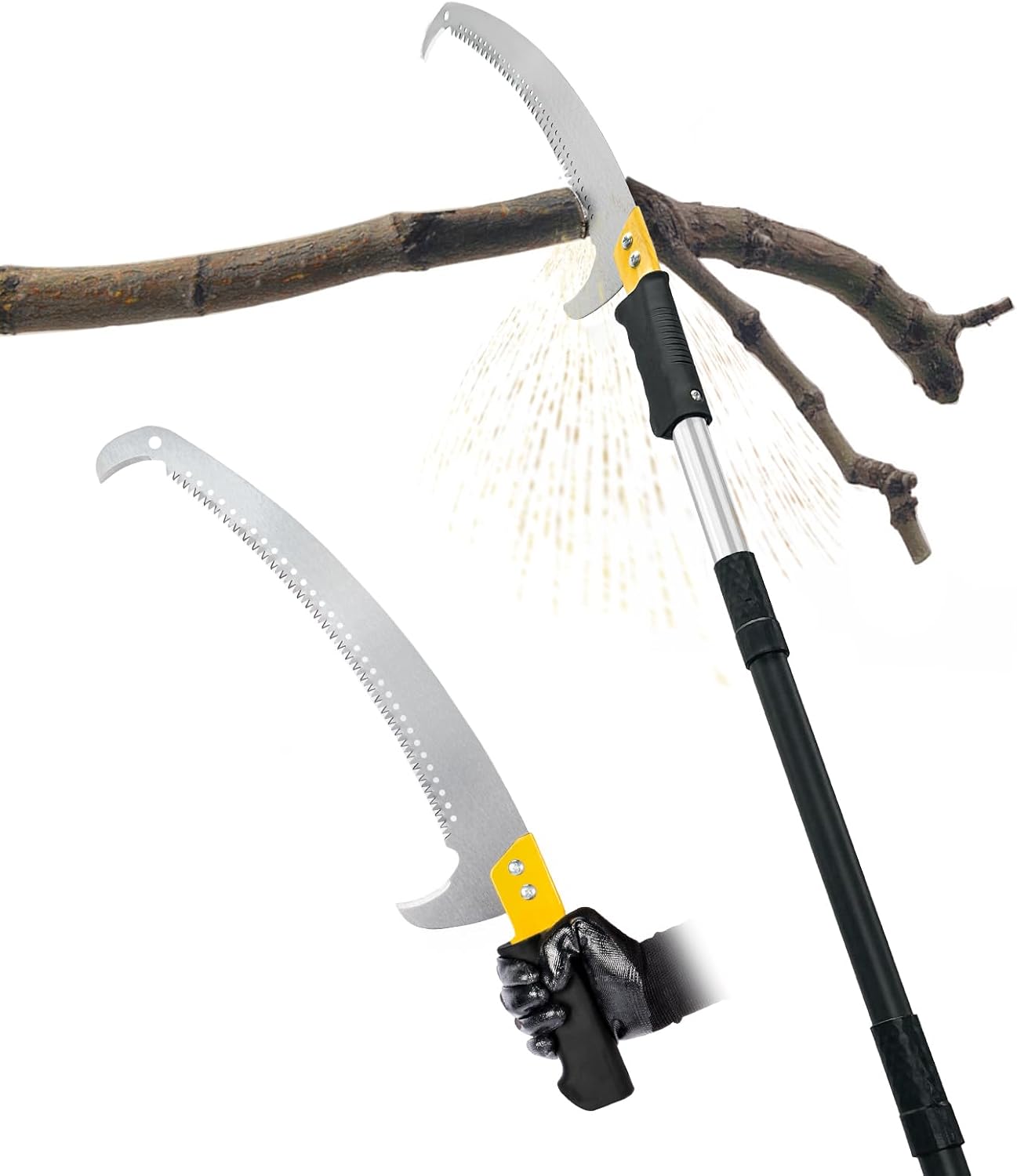
This BlumeTrec pole saw is a manual, multi-section pruning saw designed to let you trim high branches safely from the ground. The pole breaks down into sections so you can assemble it to three fixed lengths (8.5 ft, 11 ft, 14.5 ft) to match the task, and a manganese steel blade with a three-sided edge and double-sided barbs grips and slices branches for cleaner cuts. The stainless steel poles are powder-coated to resist rust and a tightening screw secures the saw head so it stays steady during use. In practice this is a basic, no-power tool that is quiet, low-maintenance, and lighter to carry than most motorized alternatives, making it easier for less experienced users to avoid ladders. Expect quicker work on small to medium branches but slower progress on very thick wood since it is manual. The plastic handle and anti-slip grip improve control but the modular pole means assembly time and storage space should be considered. Overall it is a straightforward, safety-minded option for everyday yard pruning when you want a simple, reliable tool rather than powered equipment.
Best for: Buyers who prioritize safety and simplicity and want to prune high branches from the ground without using power tools or climbing ladders; good for homeowners doing routine yard maintenance.
Less Ideal for: Professional arborists or anyone who needs to cut very large or numerous thick hardwood branches frequently should choose a powered pole saw or chainsaw instead.
- Adjustable multi-section pole offers three fixed reach lengths for flexible use.
- Mn steel blade with three-sided edge and barbs provides secure, clean cuts on small to medium branches.
- Powder-coated stainless poles resist rust for outdoor durability.
- Lightweight manual design reduces noise and maintenance compared with motorized saws.
- Anti-slip grip and extra screw to secure the saw head improve handling and safety.
- Manual cutting limits speed and effectiveness on very thick or hardwood branches.
- Plastic handle may feel less durable under heavy professional use.
Verdict: A simple, rust-resistant extendable manual pole saw that lets risk-conscious homeowners prune high branches from the ground without ladders.
Choosing the Right Pruning Saw for Fruit Trees: Key Factors to Consider
Blade Material and Tooth Geometry
Blade steel affects edge retention and resistance to corrosion. High-carbon steels hold a sharper edge which makes cleaner cuts through live wood, while stainless options resist rust if you prune in wet seasons or store tools outdoors.
Tooth geometry dictates whether the saw cuts on the pull stroke or the push stroke and how aggressively it bites. For fruit trees, a fine-toothed or impulse-hardened tooth pattern that produces smooth cuts is preferable because it minimizes torn cambium and speeds healing. Consider impulse-hardened teeth if you value long-lasting sharpness without frequent sharpening.
Cut Smoothness and Wound Healing
Smooth, tear-free cuts let tree tissue close over faster and reduce the chance of disease entry. Saws designed to slice cleanly with controlled kerf produce smaller wounds that callus quicker compared with coarse-toothed blades that can shred bark.
Observe how a blade behaves on smaller-diameter branches versus larger scaffold limbs. Some blades excel at quick, clean cuts on 1-3 inch branches but stall or chatter on wider wood. For fruit trees, prioritize blades that deliver consistent smoothness across common pruning diameters to encourage reliable wound healing.
Handle Ergonomics and Control
Pruning sessions often involve many cuts and repeated wrist motion. A well-shaped handle reduces fatigue and gives better control when cutting near the trunk or around fruiting spurs. Look for grips that fit your hand size, offer non-slip surfaces, and provide a solid connection to the blade to avoid twisting under load.
If you prune while standing on ladders or using pole attachments, a handle that lets you maintain a neutral wrist position improves accuracy and safety. Consider whether you need two-handed control for heavy cuts or a compact one-handed profile for maneuvering in tight branches.
Blade Length, Reach Options, and Portability
Blade length determines the maximum branch diameter you can cut in one pass and how easily you can position the saw in the canopy. Shorter blades are nimble for dense fruiting areas and close-in pruning, while longer blades let you make single-pass cuts through larger limbs.
Portability is important if you move between trees or use a ladder. Folding blades or quick-release attachments for poles add versatility. Consider whether the saw complements extension poles or requires stepping up to a ladder for higher work.
Sharpening, Replaceability, and Maintenance
A blade that can be easily sharpened or replaced extends the tool's usable life and keeps cutting performance consistent. Some pruning saws have impulse-hardened teeth that cannot be sharpened easily but hold an edge longer, while others are filed back to a sharp edge as part of regular maintenance.
Consider how accessible replacement blades are, whether the blade can be removed without special tools, and how simple it is to clean sap and pitch after a session. Routine cleaning and drying reduce corrosion and maintain cutting efficiency.
Compatibility with Pole Systems and Safety Features
If you often prune tall fruit trees, check whether the saw can attach to standard extension poles. Compatibility reduces ladder use and improves safety. Secure locking mechanisms in pole attachments prevent accidental separation when working at height.
Safety features such as sheath designs that protect the blade in transit and hand stops that prevent the hand slipping toward teeth are practical for orchard work. Evaluate how the saw behaves when paired with a pole, including balance and orientation, to ensure confident cuts from the ground.
When to Use a Pruning Saw Instead of Loppers or a Chainsaw
Pruning saws fill the gap between handheld bypass loppers and power chainsaws. Use a pruning saw when branch diameter is too large for loppers but small enough that a chainsaw would be overkill or unsafe. For many fruit trees, that range is often between about 1.5 and 4 inches depending on blade length and tooth design.
Pruning saws are also ideal when you need control around fruiting spurs and narrow branches where power tools risk collateral damage. They are quieter, lighter, and allow more precise hand placement for shaping and corrective cuts.
- Best for mid-size limbs and scaffold branch removal
- Useful for targeted cuts near fruiting wood
- Safer and less disruptive than powered chains for small orchards
Blade Maintenance and Practical Sharpening Tips
Keep blades clean of sap after each session by wiping with a solvent like rubbing alcohol or citrus-based cleaners. A thin layer of light machine oil after cleaning prevents rust and keeps the saw sliding smoothly.
When sharpening is appropriate, use a tapered triangular file sized for the tooth pitch. Follow the factory tooth angle and file a few strokes per tooth rather than heavy grinding. For impulse-hardened teeth, alternate between light filing of worn areas and replacing the blade when performance drops.
- Regular cleaning prevents sticky buildup that slows cuts
- Match file size to tooth pitch for effective sharpening
- Store in a sheath to protect teeth and prevent accidental cuts
Working Safely in Fruit Trees and Orchard Settings
Prioritize stable footing and avoid overreaching. If using a ladder, secure it and keep three points of contact. When approaching higher limbs, consider a pole-mounted saw to reduce ladder time.
Wear eye protection against falling wood and gloves that balance grip with tactile control. Be mindful of branch tension and spring-back when cutting to avoid pinching the blade or causing sudden falls of heavy limbs.
- Check branch tension before cutting to avoid binding
- Cut in stages on large limbs to control drop and reduce tearing
- Use personal protective equipment: gloves and eye protection
Choosing Teeth Style for Different Fruit Tree Tasks
Aggressive, large teeth remove material quickly and are useful for thicker, dead, or heavily lignified limbs. However, they can produce rougher wounds on living tissue. Fine or medium teeth produce smoother cuts and are generally better for shaping and maintenance pruning on fruit trees.
Consider mixed-tooth patterns for versatility: a coarser front section to start the cut and finer teeth behind for finishing can reduce sawing effort while preserving cut quality. Match tooth style to the task: rough reduction versus careful shaping near fruiting wood.
- Fine teeth: best for small, living shoots and finish cuts
- Coarse teeth: faster on large, tough limbs but rougher
- Mixed patterns: good compromise for varied pruning jobs
Transport, Storage, and Sheath Choices
A sturdy sheath protects the blade during transport and prevents accidental contact with teeth when moving between trees. Rigid sheaths are safer for carrying in a tool belt or bucket, while soft sheaths may be lighter but less protective.
Consider how you will carry the saw during long sessions. Belt sheaths and scabbards keep the saw accessible, while folding designs reduce dangling blades when moving through dense branches. Secure attachment points and quick-release systems improve efficiency when alternating between cutting and repositioning.
- Rigid sheaths for safer transport on ladders
- Belt-mounted scabbards for hands-free movement
- Folding blades reduce snagging in dense canopies
How We Chose the Best Pruning Saw for Fruit Trees
Our shortlist emphasizes tools that suit live-wood pruning on fruit trees instead of general yard saws or specialty timber models. We focused on blade design and tooth geometry because those determine cut quality and healing in fruit trees. Ergonomics and handle design were prioritized for gardeners who prune for extended periods or work on ladders and poles. Durability of the blade finish and ease of re-sharpening or replacement matter because fruit-tree pruning is repeat work year after year. We also considered portability and compatibility with pole extensions for reaching upper canopy without unnecessary climbing. Exclusions: heavy carpentry saws, chainsaws, and multi-tool blades not optimized for live-wood pruning were excluded. Evaluation criteria used: blade material and tooth geometry, cut smoothness and sap sealing, handle ergonomics and grip, blade length and reach options, re-sharpening or replacement ease, and compatibility with pole systems. Those criteria guided selection and order while keeping real-world orchard use central to decisions.
FAQ
What blade length is best for most backyard fruit trees?
For most backyard fruit trees, a blade between 10 and 14 inches covers common scaffold branches while remaining manageable for close-in cuts. Shorter blades are easier to maneuver in tight fruiting areas; longer blades help with larger limbs but are harder to position near the trunk.
Can I use a pruning saw on living and dead wood interchangeably?
You can, but choose tooth style based on the wood. Fine teeth cut living wood more cleanly and promote better healing. Coarser teeth work faster on dead or very hard wood but can tear live tissue, increasing disease risk.
How often should I sharpen a pruning saw used every season?
Sharpening frequency depends on wood type and use, but many gardeners sharpen once per year or when cutting performance noticeably degrades. Some impulse-hardened blades hold an edge for longer and are replaced rather than frequently sharpened.
Is a folding pruning saw less effective than a fixed blade?
Folding saws are slightly less rigid than fixed blades but offer safer transport and compact storage. Modern folding designs lock securely and perform well for typical fruit-tree pruning. For the largest cuts, a rigid fixed blade may provide better leverage.
Should I buy a saw that attaches to an extension pole?
If you have tall trees or prefer to minimize ladder use, a pole-compatible saw is a good choice. Ensure the attachment locks securely and that the combined length remains manageable for control and accurate cuts from the ground.
Final Verdict
When choosing a pruning saw for fruit trees, prioritize blade tooth geometry and smooth cutting action because those factors most influence wound healing and long-term tree health. Balance handle comfort and reach based on the size of your trees and how you work in the canopy. Expect tradeoffs: longer blades increase reach but reduce maneuverability, and impulse-hardened teeth reduce sharpening needs but may require replacement when dull. Focus on the tasks you perform most often-close-in shaping, scaffold removal, or high canopy work-and pick a saw that fits those uses. With the right balance of blade design, ergonomics, and maintenance options, you will get cleaner cuts, less fatigue, and better outcomes for your fruit trees.
