

Note: This article contains affiliate links. If you click on these links and make a purchase, I may earn a small commission at no extra cost to you. This helps support my research and content. Read my full affiliate disclosure here.
Getting pH right across a lawn affects turf color, nutrient uptake, and long-term resilience. The right soil pH meter for lawns helps you identify problem spots fast so you can correct acidity or alkalinity before treatments waste time or harm grass. This guide covers six shortlisted options chosen for lawn-specific use and explains how they perform in common turf situations. We evaluated meters on lawn-focused criteria such as accuracy on shallow turf soils, ease of repeated readings across a yard, and durability for seasonal outdoor use. Read on to find a meter that matches how you manage and maintain your lawn.
Top Picks at a Glance
| Best Overall The best all-around choice for most situations | YINMIK Digital Soil pH Meter (YK-S01P) |  |
| Best Value The sweet spot between price and what you get | Auduto 7-in-1 Soil Test Kit with LCD — Moisture, pH, Fertility, Light, Temp, Humidity |  |
| Best Budget The cheapest option that still gets the job done reliably | Soonkoda S-9 3-in-1 Soil Tester (Moisture, Fertility, pH) |  |
| Highest Rated A top-rated pick with lots of positive feedback | LAWNFUL Digital Soil pH Meter with Dual Stainless-Steel Probes |  |
| Most Popular A crowd favorite that many people choose with confidence | SONKIR MS02 3-in-1 Soil Moisture, pH and Light Tester |  |
| Best Seller A high-volume bestseller chosen again and again | Kelway PHD Soil pH Meter |  |
YINMIK Digital Soil pH Meter (YK-S01P)

| pH range | 0.0-14.0 pH |
|---|---|
| Temperature range | 32.0-140.0 |
The YINMIK Digital Soil pH Meter is a pen-style electronic tester designed to give fast pH readings directly in soil or water without mixing slurries. You insert the tapered probe into potting mix, loam, coco coir or nutrient solution and the meter displays pH immediately, which makes spot-checking beds, containers, and hydroponic reservoirs quick and simple. Notable features include a protective dibber for the electrode, a bundle of calibration powder and cleaning brush in the kit, and an app that can store up to 1,000 readings for monitoring changes over time. The practical benefit is consistent, repeatable pH checks so you can correct soil acidity before nutrient issues appear. Expect routine maintenance: the electrode needs gentle cleaning and periodic calibration to stay accurate, and pen meters like this can be less durable than lab probes if forced into rocky ground. The app and data logging are helpful for gardeners who track changes, but they add complexity if you only need occasional manual checks.
Best for: Gardeners and growers who want a practical, repeatable way to monitor soil acidity across beds, containers, and hydroponic solutions and who value tracking readings over time to guide adjustments.
Less Ideal for: Users who need laboratory-grade precision or who frequently test in heavy rocky ground should consider sturdier bench meters or specialized probes instead.
- Instant pH readings in soil or water without preparing a slurry
- Mobile app with automatic data storage for up to 1,000 measurements
- Includes calibration powder, cleaning brush, and spare dibbers for maintenance
- Tapered protective dibber helps prevent probe damage and eases insertion
- Probe requires regular cleaning and calibration to maintain accuracy
- Pen-style probe can be damaged if used in very rocky or compacted soil
Verdict: Use this app-enabled pen meter when you want fast, repeatable soil pH checks and simple logged history to guide routine garden adjustments.
Auduto 7-in-1 Soil Test Kit with LCD — Moisture, pH, Fertility, Light, Temp, Humidity

| Manufacturer | Auduto |
|---|---|
| Item Weight | 5.3 ounces |
| Package Dimensions | 12.09 x 2.99 x 1.85 inches |
| Product Type | 7-in-1 soil test kit |
This Auduto 7-in-1 soil test kit combines multiple meters into one handheld unit to give a quick, practical snapshot of growing conditions in a vegetable garden. You insert the metal probes into the soil to read moisture, pH and fertility, and the LCD also reports sunlight intensity plus soil temperature, air temperature and humidity. For routine vegetable-bed checks it is fast and easy to use and the metal probes offer good conductivity for responsive readings. The device is best for monitoring trends and catching obvious problems like overly dry beds, extreme pH or poor light rather than replacing laboratory analysis. It is not suitable for very rocky or loose sandy soils and should not be left in the ground or used to test standing water. As a tool for a gardener who wants straightforward, frequent checks to guide watering, feeding and placement of transplants, it delivers clear, immediate data; experienced users should remember its limits for precise nutrient analysis and specialized soils.
Best for: Gardeners who want a practical, regular-check tool to optimize watering, light placement and general fertility in vegetable beds and containers without lab testing. Ideal for people who prefer quick, actionable readings to guide everyday care.
Less Ideal for: Users needing laboratory-grade nutrient analysis, precision pH calibration, or those working primarily in rocky or very sandy soils that prevent proper probe insertion.
- Combines seven measurements in one compact unit for quick, on-the-spot checks
- Metal probes provide responsive, corrosion-resistant readings
- LCD display shows soil and air temperature plus humidity for broader context
- Simple operation suitable for frequent garden monitoring
- Useful for potted plants and garden beds to guide watering and basic fertilization decisions
- Not accurate enough to replace lab soil tests for precise nutrient or pH calibration
- Unsuitable for very rocky ground or loose sandy soils where probes cannot be inserted properly
- Should not be used in water or left permanently in soil which may shorten probe life
Verdict: A single, easy-to-use meter that gives vegetable gardeners fast, practical readings of moisture, pH, light and temperature to guide everyday care.
Soonkoda S-9 3-in-1 Soil Tester (Moisture, Fertility, pH)

| Brand Name | Soonkoda |
|---|---|
| Model | S-9 |
| Included Components | Soil Tester, English Manual, Paper Box |
| Unit Count | 1 Count |
The Soonkoda S-9 is a pocketable analog soil tester that checks moisture, nutrient level (fertility), and soil pH with a single probe. You use it by sliding the mode switch to MOIST, FERTILITY, or PH, inserting the probe about two thirds into the soil and reading the needle position after a few seconds. The meter gives color‑banded results (dry/ok/wet for moisture; low/ok/high for fertility; an acid-to-alkaline range for pH), which makes interpretation straightforward for casual gardeners. It is lightweight, requires no batteries, and comes with a manual and simple cardboard case. Limitations are that it provides approximate, relative readings rather than lab-accurate values, can struggle in very dry soils unless you moisten the sample first, and the single metal probe is not ideal for rocky or compacted beds. For a low-cost, entry-level tool it helps you spot watering mistakes and get a rough sense of soil condition before applying amendments.
Best for: Gardeners on a tight budget who want a quick, easy way to check soil moisture and get a rough sense of pH and nutrient level for lawns, raised beds, or potted plants.
Less Ideal for: Professional soil testing, precise pH management, or heavy clay/rocky sites where a single thin probe cannot be inserted reliably.
- Three-in-one function: moisture, fertility, and pH in one handheld unit
- Color-coded needle scale makes readings easy to interpret without training
- No batteries required and very lightweight for frequent spot checks
- Provides only approximate, relative values not lab-grade measurements
- Requires moist soil for reliable moisture readings in very dry conditions
Verdict: If you want the cheapest practical tool to spot-check moisture, pH, and fertility in the garden, this simple 3-in-1 tester gives fast, easy-to-read guidance.
LAWNFUL Digital Soil pH Meter with Dual Stainless-Steel Probes

| pH measurement range | 3.0 – 9.0 pH |
|---|---|
| Resolution | 0.1 pH |
| Waterproof level | IP54 |
| Operating temperature | -20 to 60℃ |
| Power | 3 × AA batteries (included) |
The LAWNFUL Digital Soil pH Meter is a portable, ready-to-use pen-style tester built for measuring soil acidity between pH 3.0 and 9.0 with 0.1 pH resolution. It uses dual stainless-steel probes and FDR plus AC detection techniques to provide sensitive, corrosion-resistant readings, and the LCD display makes results easy to read in the field. Typical use is straightforward: insert the probes into moist soil, wait for the reading to stabilize and record the result to decide if amendments are needed. The unit is battery powered with low consumption so included batteries can last a long time in regular home-garden use. Notable practical benefits are its industrial-grade sensing algorithm and IP54 splash resistance, which help reliability when testing beds, containers, or greenhouse soil. Limitations are that it is designed for soil only and not liquids, and it does not list calibration procedures or replaceable probe details, so very frequent professional lab-level testing or harsh continuous commercial use may reveal limits over time.
Best for: Gardeners and small-scale growers who prioritize consistent, sensitive soil pH readings for beds, containers, and greenhouse work and want a durable handheld tool they can rely on.
Less Ideal for: Laboratories, commercial soil-testing services, or users who need liquid pH measurement or documented calibration procedures for formal reporting.
- Industrial-grade FDR and AC detection for higher measurement precision
- Double-needled stainless-steel probes that are corrosion-resistant and sensitive
- Broad pH range (3.0–9.0) with 0.1 pH resolution suitable for most garden plants
- IP54 splash resistance and handheld portability for field use
- Low power consumption with batteries included for long service between replacements
- Intended for soil only and cannot measure liquids
- Manufacturer information does not detail calibration steps or probe replacement
Verdict: Buy this meter if you need a reliable, field‑ready soil-only pH tester that delivers sensitive, repeatable readings for home gardens and small-scale growing.
SONKIR MS02 3-in-1 Soil Moisture, pH and Light Tester
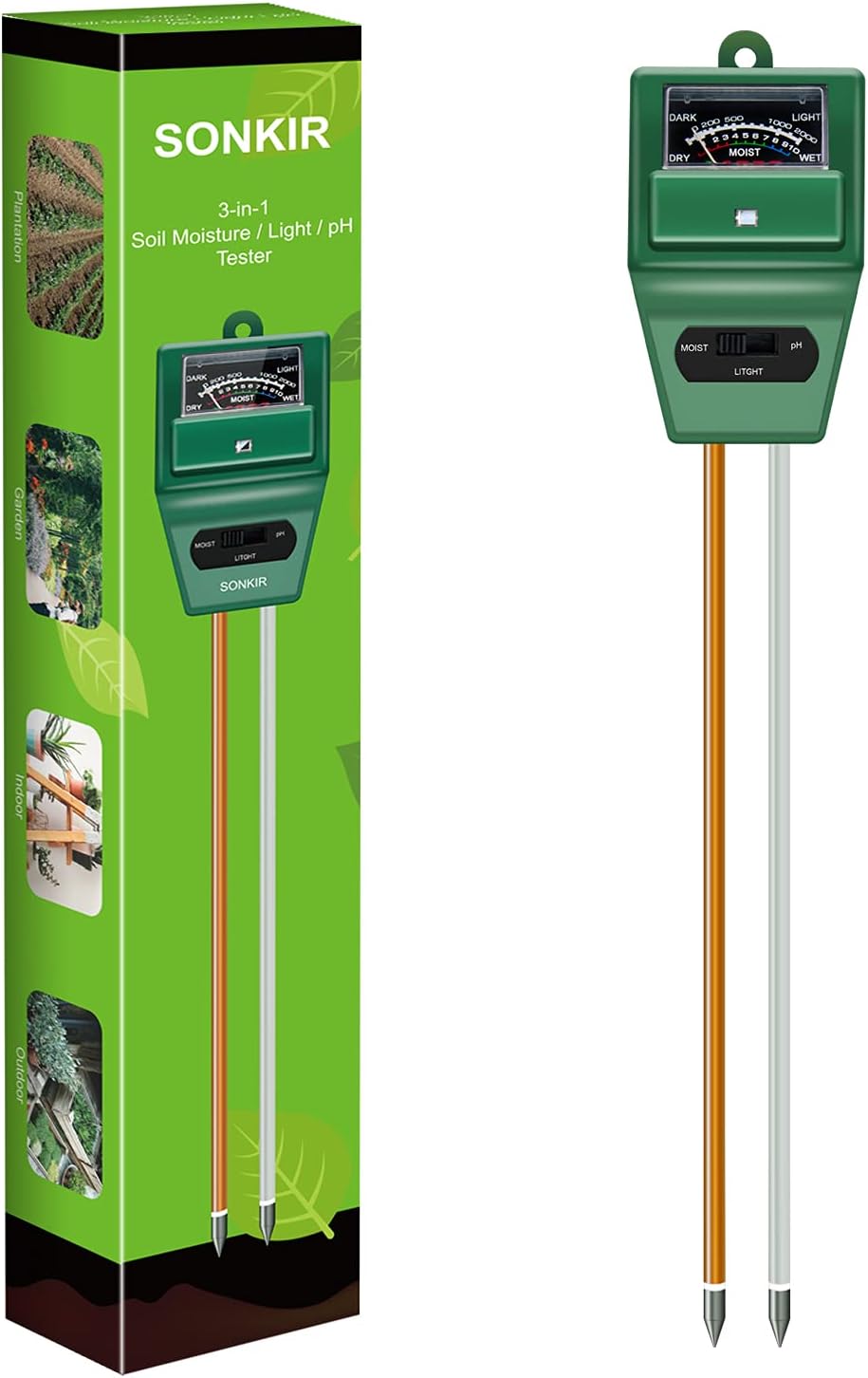
| pH range | 3.5-8 pH |
|---|---|
| Moisture range | 1-10 scale |
| Probe length | 7.9 inches |
| Power | No battery required |
The SONKIR MS02 is a handheld, no-battery soil meter that gives quick, visual readings of moisture, pH and sunlight to help you maintain healthier grass and garden plants. You switch the dial to the desired function, push the probe into the soil about 6 to 7 inches, wait roughly 10 minutes and read the needle on the analog display. The meter covers a practical pH range for lawns and gardens and shows moisture on a 1 to 10 scale so you can decide when to water. Its long probe and compact, lightweight body make it convenient for spot-checking multiple areas of a lawn or garden bed. Important limitations are that the pH probe is intended for soil only and the analog needle can be slow to move in very dry soils or close-to-neutral pH, so readings sometimes require rechecking after moistening the sample or testing several spots. The unit is best for gardeners who want an affordable, easy-to-use tool for routine soil checks rather than laboratory-accurate analysis.
Best for: Someone who wants an inexpensive, easy-to-use tool for routine soil checks across a lawn or garden and values practical, repeatable guidance over laboratory precision.
Less Ideal for: Users who need lab-grade pH or moisture measurements, continuous data logging, or digital readouts for precise record keeping should consider more advanced instruments.
- 3-in-1 functionality measures moisture, pH and sunlight without extra tools
- No battery required so it is always ready to use and low maintenance
- Long probe and compact form factor make spot checks across a lawn or garden quick
- Simple analog dial is straightforward for fast, at-a-glance decisions
- pH function is designed for soil only and cannot test water or other liquids
- Analog needle can be unresponsive in very dry soil or near-neutral pH, requiring repeated tests
Verdict: A straightforward, no-battery 3-in-1 tester that gives fast, practical soil moisture, pH and light checks for everyday lawn and garden care.
Kelway PHD Soil pH Meter

| Manufacturer | Kelway |
|---|---|
| Item model number | PHD |
The Kelway PHD Soil pH Meter is a simple, handheld gauge intended to give quick pH readings for lawns and garden beds without chemicals or batteries. It is used by inserting the probe into moist soil and reading the needle against the 0 to 14 pH scale to decide if lime or sulfur adjustments are needed. notable features include an easy-to-read analog dial, compact handheld size, and a design marketed to nurseries and lawn care professionals. In practice it is useful for routine spot checks across a yard to identify acidic or alkaline areas and guide corrective treatments. The meter is low-maintenance since it needs no power or reagents, but accuracy depends on proper probe contact and moist soil; very dry or rocky soils may require pre-wetting or alternative testing. Readings are instantaneous and intuitive, but users who need laboratory-level precision or digital logging will find this a basic tool rather than a professional instrument.
Best for: Homeowners who want a low-effort, reliable way to spot-check lawn pH and make informed lime or sulfur adjustments without dealing with chemicals or batteries.
Less Ideal for: Users who require laboratory-grade pH accuracy, data logging, or frequent testing across many sites should consider a calibrated digital meter or lab service instead.
- No batteries or chemicals required for operation
- Simple analog dial gives immediate pH readings from 0 to 14
- Compact handheld design for quick spot checks around a lawn
- Used by professional lawn care companies and nurseries so suited to routine field use
- Analog needle gauge is less precise than laboratory or high-end digital meters
- Accuracy depends on moist soil and good probe contact, making readings inconsistent in dry or rocky ground
Verdict: A no-fuss, chemical-free handheld meter that gives quick pH readings to guide routine lawn maintenance decisions.
Choosing the Right Soil Ph Meter for Lawns: Key Factors to Consider
Accuracy and Repeatability
Accuracy matters because small pH shifts can change nutrient availability and turf color. A meter that reports pH within a narrow margin helps you decide whether lime, sulfur, or fertilizer adjustments are necessary. Repeatability is equally important; taking several readings within a few square feet should give nearly identical results so you can trust trend patterns rather than a single anomalous number.
For lawns, shallow probes and good contact with the soil are essential to avoid readings skewed by surface debris or moisture. Consider how the meter performs in wetter and drier patches, since moisture levels affect electrical probes and can change apparent pH.
Probe Shape and Length
Probe design affects how you sample typical lawn soils where grass roots and the most biologically active layer are often within the top few inches. Longer probes are useful for deeper-rooted turf varieties but can be harder to insert in compacted ground. Thin, tapered probes reduce root disturbance and let you test right in the turf without excessive digging.
Also consider probe durability against bending or corrosion. Lawn testing often requires many quick stabs across the yard, so a probe that resists wear and maintains good electrical contact will deliver more consistent field results over the seasons.
Ease of Taking Multiple Readings
A practical lawn survey requires dozens of readings to map variability across a yard. Meters that are quick to reset, show an easy-to-read display, and are comfortable to handle reduce fatigue during these rounds. Features like a hold function, quick warm-up, or tip design that avoids excessive soil sticking make repeated sampling faster.
Consider how the meter records or supports noting results. Some tools pair with apps or offer simple digital displays; others require you to write down values. For larger lawns, think about portability, how the meter fits in a pocket or apron, and whether it is easy to clean between readings.
Calibration and Maintenance
Even accurate meters drift slightly with time and use. Simple, infrequent calibration routines are preferable for lawn care because they keep the tool reliable without creating barriers to regular testing. Look for meters that use standard calibration solutions or an easy field-adjust method.
Maintenance also includes cleaning probes after muddy or sandy tests and protecting electronics from moisture. Meters that allow probe replacement or have corrosion-resistant contacts will stay useful longer when used outdoors seasonally.
Durability and Weather Resistance
Meters used for lawns face mud, moisture, and occasional drops. Weather resistance, solid housing, and good sealing around buttons and displays reduce failures in the field. A meter that tolerates damp storage in a garden shed and resists brief exposure to rain or sprinkler spray will be more practical for routine lawn work.
Consider how common maintenance items such as batteries or protective caps are handled. Ruggedness often trades off with weight; for many homeowners a slightly heavier but more durable meter is worth the extra comfort investment.
Speed of Readings and Response Time
For a homeowner doing a yard survey, response time is a real usability factor. Fast-stabilizing meters let you move quickly from point to point without waiting long for each value. Slower meters can be usable for one-off checks but make it harder to sample many spots and identify patches of acidity or alkalinity.
Response time can be influenced by probe condition, soil moisture, and the meter's electronics. If you plan to test after rain or irrigation, prioritize meters known to stabilize quickly under variable moisture.
When To Test Your Lawn
Test soil pH at least once each growing season and always before applying lime or sulfur. Early spring and early fall are the most useful times because turf is actively growing and the results guide major amendments.
Also test problem areas when you notice uneven color, patchy growth, or poor response to fertilization. Localized acidity or alkalinity can be masked if you only take a single central reading.
- After thaw and before major feeding in spring
- A few weeks before planned lime or sulfur applications
- When mowing results in patchy color despite normal care
How To Take Representative Lawn Readings
Walk the lawn in a grid or random pattern and take multiple readings across different zones. Mix readings from sunny and shaded areas, along compacted paths, and near tree roots to capture variability.
Prepare each sampling spot by removing thatch or loose debris and inserting the probe to a consistent depth. Let the meter stabilize and record the value. Average groups of nearby readings to decide on treatment for larger sections of lawn.
- Remove surface debris before inserting the probe
- Aim for consistent probe depth across tests
- Average at least three readings per distinct lawn area
Interpreting pH Results for Lawn Care
Most turf grasses prefer a slightly acidic to neutral pH range. Results outside that range point to specific corrective measures: lime raises pH, sulfur lowers pH. The size of the adjustment depends on current pH, soil type, and turf species.
Use pH readings alongside visual cues and a soil nutrient test if possible. pH affects nutrient availability, so correcting pH before changing fertilizer programs gives more predictable outcomes.
- Neutral pH often improves nutrient uptake
- Small pH changes can significantly affect micronutrient availability
- Combine pH results with soil texture knowledge for accurate amendment plans
Care and Storage Tips
Clean probes after muddy tests, rinse gently, and dry before storage. Avoid scraping or bending the probe which can damage sensing elements. If the meter uses replacement tips or caps, keep spares on hand.
Store meters in a dry place protected from freezing. Remove batteries if you will not use the meter for an extended period, and follow manufacturer guidance for long-term probe care.
- Rinse probe after each use and towel dry
- Keep a small carry kit with calibration solution and cleaning cloth
- Store away from direct sun and freezing temperatures
Mapping Lawn pH Over Time
Record locations and values to build a pH map of your lawn across seasons. Mapping helps you target amendments to problem zones instead of treating the entire lawn unnecessarily. Over time, repeated mapping reveals trends and the effectiveness of corrective treatments.
Simple methods include photographing marked spots, noting GPS coordinates on a smartphone, or using a garden notebook. Regular maps let you track whether lime or sulfur applications produced the expected change and where follow-up is needed.
- Use consistent sampling points for seasonal comparisons
- Note recent treatments, irrigation changes, or heavy traffic that may affect pH
- Adjust amendment schedules based on mapped trends, not single readings
How We Chose the Best Soil Ph Meter for Lawns
We focused selection on tools that give consistent, lawn-relevant pH readings and are convenient for routine turf work. Key evaluation criteria included field accuracy on typical lawn soils, repeatability between nearby test points, probe design suitable for shallow grass root zones, build durability for outdoor use, and ease of taking and recording multiple readings across a yard. We also considered battery life or passive operation and how straightforward calibration and maintenance are for seasonal users. We excluded lab-only devices and multi-parameter probes that require specialized training or complex maintenance. Tools requiring frequent expensive consumables were also filtered out. The final list emphasizes meters that a gardener or lawn-care hobbyist can rely on for accurate spot testing and simple lawn-wide surveys.
FAQ
How deep should I insert a pH probe in my lawn?
Insert the probe to the depth of most active roots, typically 2 to 4 inches for common turf grasses. Consistent depth across tests gives more reliable comparisons between spots.
Can I use a garden soil tester meant for pots on a lawn?
Many garden testers work fine, but check probe length and accuracy. Pot-focused testers often have shorter or wider probes that may not contact the turf root zone as well, producing less representative lawn readings.
How often do I need to calibrate a soil pH meter used on a lawn?
Calibration frequency varies, but a quick check at the start of each testing season and after any rough handling is sensible. More frequent calibration is wise if you notice inconsistent readings.
Will wet soil affect pH readings on a lawn?
Yes, soil moisture influences probe response. Very wet or very dry patches can shift apparent pH. Aim for moderate moisture and consider averaging multiple nearby readings to compensate for moisture variability.
Is it necessary to test across the whole lawn?
Not every square foot, but sample multiple areas to capture variability. Focus on zones with different sunlight, traffic, soil texture, or turf performance to identify where targeted amendments are needed.
Can pH adjustments damage my lawn if applied incorrectly?
Large or rapid pH changes can stress turf. Follow recommended application rates for lime or sulfur, apply to targeted zones when possible, and retest after a season to measure effects rather than repeating large treatments quickly.
Final Verdict
Choose a soil pH meter for lawns that balances reliable field accuracy with a probe designed for shallow turf sampling. Prioritize ease of taking multiple readings and straightforward calibration so you will actually use the tool across the yard. Durable, weather-resistant construction extends the meter's usefulness through seasons. A meter that is quick to stabilize and comfortable for repeated use will help you map pH variability and make targeted amendments rather than guessing. Focus on the tradeoffs between probe design, durability, and measurement speed to pick the right meter for your lawn care routine.
