

Note: This article contains affiliate links. If you click on these links and make a purchase, I may earn a small commission at no extra cost to you. This helps support my research and content. Read my full affiliate disclosure here.
If you grow vegetables, ornamentals, or houseplants, knowing soil pH helps you match plants to conditions and correct problems before they show. A homeowner soil pH meter saves time versus lab tests and gives on-the-spot information you can act on while working in beds, pots, or raised planters. This guide covers six shortlisted meters selected for backyard and container gardening, focusing on real-world accuracy, ease of calibration, and durability in outdoor use. Read on to see how we evaluated each meter and which features matter most for everyday gardening.
Top Picks at a Glance
| Best Overall The best all-around choice for most situations | YINMIK Digital Soil pH Meter (YK-S01P) |  |
| Best Quality Built to a higher standard if you want something more solid | Bluelab Soil pH Pen Digital Meter (PENSOILPH) |  |
| Best Value The sweet spot between price and what you get | HSLGOVE 2-in-1 Soil Moisture and pH Meter (Battery-Free) |  |
| Best Budget The cheapest option that still gets the job done reliably | Speedinistic 3-in-1 Soil Meter (Moisture, Light, pH) |  |
| Highest Rated A top-rated pick with lots of positive feedback | LUVCOSY Digital Soil pH Meter with Industrial-Grade Probes |  |
| Most Popular A crowd favorite that many people choose with confidence | SONKIR MS02 3-in-1 Soil Moisture, pH and Light Tester |  |
YINMIK Digital Soil pH Meter (YK-S01P)

| pH range | 0.0-14.0 pH |
|---|---|
| Temperature range | 32.0-140.0 |
The YINMIK Digital Soil pH Meter is a pen-style electronic tester designed to give fast pH readings directly in soil or water without mixing slurries. You insert the tapered probe into potting mix, loam, coco coir or nutrient solution and the meter displays pH immediately, which makes spot-checking beds, containers, and hydroponic reservoirs quick and simple. Notable features include a protective dibber for the electrode, a bundle of calibration powder and cleaning brush in the kit, and an app that can store up to 1,000 readings for monitoring changes over time. The practical benefit is consistent, repeatable pH checks so you can correct soil acidity before nutrient issues appear. Expect routine maintenance: the electrode needs gentle cleaning and periodic calibration to stay accurate, and pen meters like this can be less durable than lab probes if forced into rocky ground. The app and data logging are helpful for gardeners who track changes, but they add complexity if you only need occasional manual checks.
Best for: Gardeners and growers who want a practical, repeatable way to monitor soil acidity across beds, containers, and hydroponic solutions and who value tracking readings over time to guide adjustments.
Less Ideal for: Users who need laboratory-grade precision or who frequently test in heavy rocky ground should consider sturdier bench meters or specialized probes instead.
- Instant pH readings in soil or water without preparing a slurry
- Mobile app with automatic data storage for up to 1,000 measurements
- Includes calibration powder, cleaning brush, and spare dibbers for maintenance
- Tapered protective dibber helps prevent probe damage and eases insertion
- Probe requires regular cleaning and calibration to maintain accuracy
- Pen-style probe can be damaged if used in very rocky or compacted soil
Verdict: Use this app-enabled pen meter when you want fast, repeatable soil pH checks and simple logged history to guide routine garden adjustments.
Bluelab Soil pH Pen Digital Meter (PENSOILPH)

| Display Type | Digital |
|---|---|
| Power Source | 1 AAA battery |
| Additional Features | High Accuracy, Waterproof |
| Indoor Outdoor Usage | Indoor |
| Reusability | Reusable |
The Bluelab Soil pH Pen is a handheld digital meter built for growers who need quick, repeatable pH readings in soil and soilless media. It is typically used by pressing the pen into a prepared hole in the substrate or dipping it into nutrient solution to check pH and temperature, with automatic temperature compensation and a backlit LCD for easy viewing. Notable features include a waterproof casing, 0.1 pH resolution, two‑point calibration support and a probe cover that doubles as a dibber to reduce probe wear. Practical benefits are straightforward setup, portability for moving between pots or reservoirs, and the inclusion of initial calibration sachets and an AAA battery so it is ready to use out of the box. Important limitations are that the unit is a single‑parameter pen focused on pH (it does not measure EC or moisture) and the plastic housing and probe design mean regular calibration and probe care are required to maintain accuracy over time. For performance‑minded growers this is a reliable, no‑frills tool for routine pH management when used with proper probe maintenance.
Best for: Growers who prioritize reliable, fast pH checks to optimize nutrient uptake and want a portable tool for routine monitoring across soil and soilless media.
Less Ideal for: Users who need multi-parameter monitoring (EC, TDS, or moisture) or those who prefer an integrated meter with replaceable laboratory-grade electrodes for heavy continuous use.
- Waterproof handheld design suitable for use in damp grow environments
- 0.1 pH resolution with two‑point calibration for accurate, repeatable readings
- Includes calibration sachets and battery so it is ready to use
- Probe cover that doubles as a dibber helps protect the electrode and simplifies spot checks
- Measures pH (and shows temperature) only and does not provide EC or moisture readings
- Probe longevity depends on regular calibration and proper storage
Verdict: Buy this if you want a rugged, ready‑to‑use handheld pH pen that delivers fast 0.1‑pH accuracy for routine soil and soilless monitoring.
HSLGOVE 2-in-1 Soil Moisture and pH Meter (Battery-Free)

| Manufacturer | HSLGOVE |
|---|---|
| Functions | Soil moisture and soil pH |
| Power | No batteries required |
| Probe material | Alloy soil sensing probe |
The HSLGOVE 2-in-1 soil meter combines a moisture probe and a pH dial in a compact, battery-free unit for routine garden checks. You insert the single alloy probe at least three inches into potting mix or garden soil to get a moisture level in seconds and a pH reading within about three minutes. The dual-dial layout shows both measurements simultaneously so you do not need to switch modes, which makes spot checks fast when watering or adjusting soil amendments. The device is simple to use and low maintenance: no batteries, a sturdy metal probe, and a wipe-clean sensor. Practical limits include unreliable results in very hard, extremely loose, or highly uniform single-material media and it should not be used to test liquids. Readings are directional rather than lab-accurate, so use them for routine care decisions instead of precise soil analysis. Follow the instructions about insertion depth and keeping the probe dry between uses to get consistent readings.
Best for: Gardeners who prioritize dependable, low-maintenance tools for routine watering and pH checks and want straightforward guidance for everyday plant care.
Less Ideal for: Users who need laboratory-grade pH or moisture analysis, professional soil labs, or who will test unusual substrates like pure sand, heavy clay blocks, or standing water.
- Two-in-one design gives simultaneous moisture and pH information without changing settings.
- Battery-free operation avoids downtime and ongoing battery costs.
- Simple plug-and-read use with wipe-clean probe makes routine checks fast.
- Sturdy alloy sensing probe is less likely to bend during normal use.
- Not suitable for testing liquids or extremely hard or very loose soils where readings may be unreliable.
- Provides approximate field readings rather than laboratory-accurate measurements.
Verdict: A no-fuss, battery-free field tester that gives quick, reliable moisture and pH guidance for everyday plant care.
Speedinistic 3-in-1 Soil Meter (Moisture, Light, pH)

| Functions | Soil moisture, pH, sunlight |
|---|---|
| Power | No battery required |
| Intended use | Indoor and outdoor soil only |
This compact 3-in-1 soil meter gives quick, on-the-spot readings for moisture, pH, and sunlight without batteries, making it a convenient tool for everyday plant care. You switch modes with a function selector and insert the probe into soil to see results on the small readout panel; it is meant for soil only and recommends moist soil for pH checks. The device is lightweight and portable, so you can move it across pots, raised beds, or lawn patches to spot-check conditions and decide when to water or adjust light exposure. Its biggest benefits are ease of use and no ongoing power cost, which suits casual gardeners wanting fast guidance. Limitations are typical for low-cost analog meters: readings are best interpreted as relative rather than laboratory-accurate pH values, and it is not designed for testing non-soil liquids. Durability appears reasonable for routine use but avoid forcing probes into rocky ground to prevent damage.
Best for: Homeowners who want an affordable, easy-to-use tool for routine spot-checks of garden beds and potted plants to guide watering and light placement decisions.
Less Ideal for: Users who need laboratory-accurate pH measurements, professional soil testing, or frequent testing in rocky or commercial production environments.
- Three functions in one unit for moisture, pH, and light so you can check multiple conditions quickly
- No batteries required so there is no ongoing power cost or downtime
- Portable and simple to operate for fast spot checks around the yard or on houseplants
- Not suitable for testing liquids other than soil such as nutrient solutions
- Readings are relative and less precise than lab-grade meters
- Probe can be damaged if used in very rocky or compacted soils
Verdict: An inexpensive, battery-free 3-in-1 meter that gives quick, practical soil moisture, pH, and light checks for budget-minded homeowners.
LUVCOSY Digital Soil pH Meter with Industrial-Grade Probes

| pH range | 3.0 – 9.0 pH |
|---|---|
| Resolution | 0.1 pH |
| Waterproof level | IP54 |
| Operating temperature | -20 to 60°C |
The LUVCOSY Digital Soil pH Meter is a portable, industrial-grade pen-style tester intended for measuring soil acidity and alkalinity in gardens and lawns. It uses FDR and AC detection techniques and a double-needle stainless-steel probe to deliver 0.1 pH resolution across a 3.0 to 9.0 pH range, so you can check beds, containers, and turf quickly. The LCD readout is calibration-free for basic use and the unit is rated IP54 for light water resistance, making it suitable for outdoor use in typical gardening conditions. Its lightweight, battery-powered design makes it easy to carry and use across multiple planting areas, and the stainless probes resist corrosion for longer life. Limitations to expect are that it is designed specifically for soil only and not for measuring liquids, and advanced users who need lab-grade trace accuracy or broader parameter logging may find the feature set basic. For routine garden pH checks this meter balances ease of use with solid sensor performance.
Best for: Gardeners who want a reliable, easy-to-use pH tester for routine checks across beds, containers, and lawns and prefer a portable tool that delivers consistent measurements without complex setup.
Less Ideal for: Researchers or hobbyists who need laboratory-level accuracy, liquid pH testing, or advanced data recording and analysis should look for more specialized equipment.
- Industrial-grade FDR and AC detection for improved measurement stability
- Double-needle stainless-steel probes that are highly sensitive and anticorrosive
- Calibration-free LCD for simple, ready-to-use operation
- IP54 water resistance suitable for outdoor gardening conditions
- Intended for soil only and cannot measure liquids
- Does not offer advanced data logging or multi-parameter testing
Verdict: A straightforward, durable pH meter that gives gardeners fast, reliable soil pH readings for routine garden care.
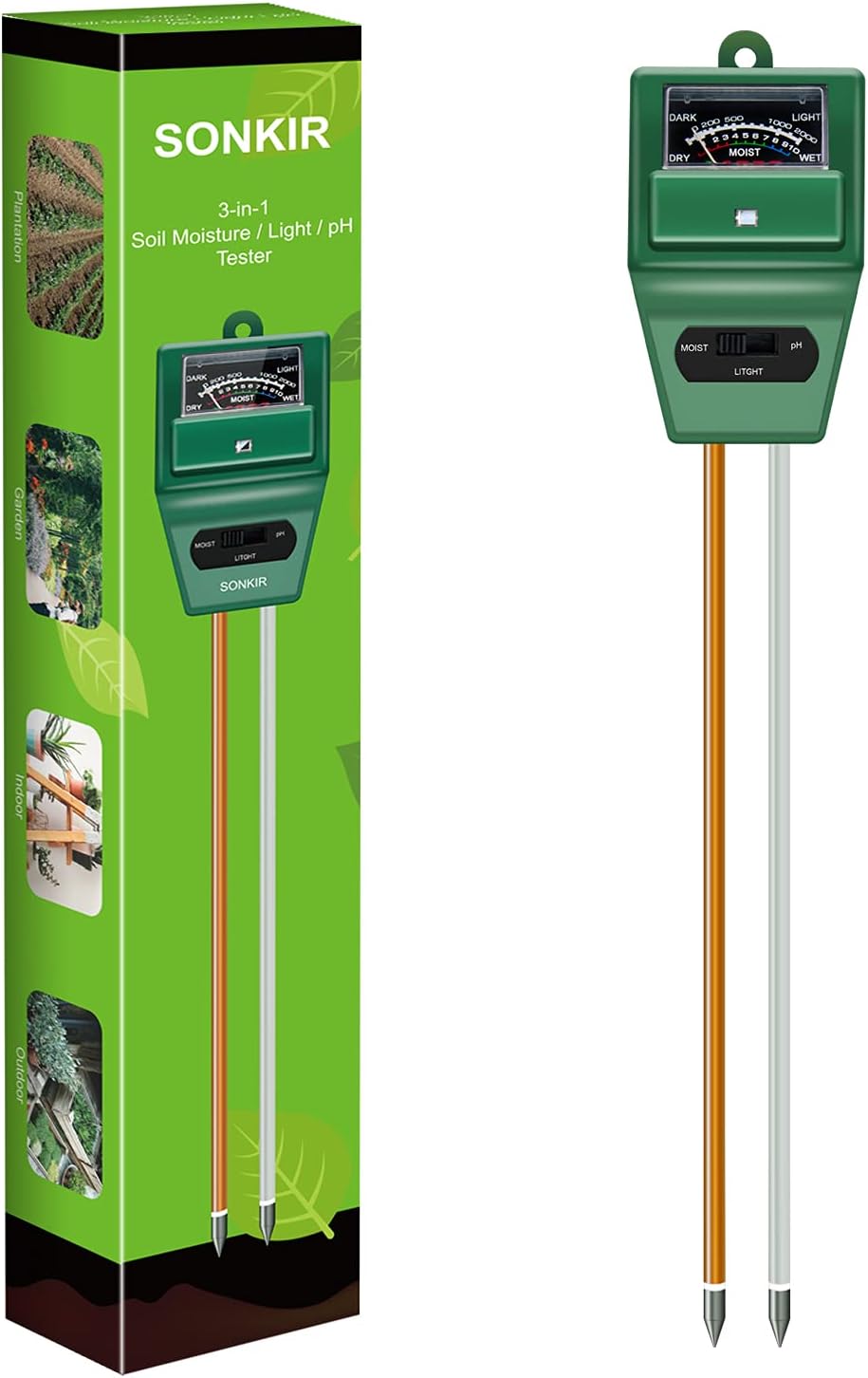
SONKIR MS02 3-in-1 Soil Moisture, pH and Light Tester
| pH range | 3.5-8 pH |
|---|---|
| Moisture range | 1-10 scale |
| Probe length | 7.9 inches |
| Power | No battery required |
The SONKIR MS02 is a handheld, no-battery soil meter that gives quick, visual readings of moisture, pH and sunlight to help you maintain healthier grass and garden plants. You switch the dial to the desired function, push the probe into the soil about 6 to 7 inches, wait roughly 10 minutes and read the needle on the analog display. The meter covers a practical pH range for lawns and gardens and shows moisture on a 1 to 10 scale so you can decide when to water. Its long probe and compact, lightweight body make it convenient for spot-checking multiple areas of a lawn or garden bed. Important limitations are that the pH probe is intended for soil only and the analog needle can be slow to move in very dry soils or close-to-neutral pH, so readings sometimes require rechecking after moistening the sample or testing several spots. The unit is best for gardeners who want an affordable, easy-to-use tool for routine soil checks rather than laboratory-accurate analysis.
Best for: Someone who wants an inexpensive, easy-to-use tool for routine soil checks across a lawn or garden and values practical, repeatable guidance over laboratory precision.
Less Ideal for: Users who need lab-grade pH or moisture measurements, continuous data logging, or digital readouts for precise record keeping should consider more advanced instruments.
- 3-in-1 functionality measures moisture, pH and sunlight without extra tools
- No battery required so it is always ready to use and low maintenance
- Long probe and compact form factor make spot checks across a lawn or garden quick
- Simple analog dial is straightforward for fast, at-a-glance decisions
- pH function is designed for soil only and cannot test water or other liquids
- Analog needle can be unresponsive in very dry soil or near-neutral pH, requiring repeated tests
Verdict: A straightforward, no-battery 3-in-1 tester that gives fast, practical soil moisture, pH and light checks for everyday lawn and garden care.
Choosing the Right Homeowner Soil Ph Meter: Key Factors to Consider
Measurement Accuracy Across Garden Conditions
Accurate pH readings are the core purpose of a soil meter. Accuracy matters because small pH shifts can change nutrient availability and plant performance. Look for meters that specify accuracy in the common garden range (roughly pH 4.0 to 8.5) and that maintain stable readings in both clay and sandy soils. Environmental factors such as soil moisture, temperature, and contact between probe and soil influence results, so choose a meter whose specifications and instructions address those variables.
Regular verification with a known buffer or an occasional lab test helps confirm a device's readings, especially if you rely on pH adjustments for sensitive crops. A meter that gives repeatable results under the conditions you garden in is more valuable than one that is theoretically precise but finicky in real soils.
Calibration Process and Frequency
Calibration brings the meter into alignment with known pH values and is essential for reliable readings. Some meters use single-point calibrations, while others allow two-point calibration for improved linearity across the range. The clarity of calibration steps, availability of calibration solutions or buffer instructions, and how often recalibration is recommended affect usability.
Frequent calibration requirement increases maintenance for casual gardeners. Prefer meters with straightforward instructions and stable calibration so you do not need to recalibrate after every use. A clear calibration procedure also makes it easier to troubleshoot inconsistent readings.
Probe Construction and Longevity
The probe is the part that contacts soil and is exposed to moisture, salts, and mechanical wear. Robust probe construction with corrosion-resistant materials, a reinforced shank, and a sensible length for reaching root zones extends useful life. Thin or fragile probes can bend or break when pushed into compacted soils, while sealed designs resist residue buildup from fertilizers and compost.
Consider whether the probe is replaceable and how well the meter advises on cleaning and storage. A meter with a durable, serviceable probe will remain useful across seasons and reduce the total cost of ownership for a home gardener.
Readability and Field Usability
You will use the meter outdoors in varying light and weather, so screen clarity, button simplicity, and response time matter. Large, high-contrast displays or backlit screens help when working in low light. Intuitive controls reduce mistakes during quick spot checks and when moving between beds and containers.
Also consider how the meter reports values. Some show raw numeric pH only while others include helpful indicators or guidance. Meters that clearly show when a reading has stabilized save time and reduce the risk of recording transient values caused by incomplete probe contact.
Power Source and Battery Considerations
Power design affects long-term convenience. Battery-powered meters should offer reasonable runtime and use common battery types so replacements are easy to find. Rechargeable options are convenient but require charging routines; meters that lose calibration after deep discharge add maintenance complexity.
Look for meters that provide battery indicators and consume little power when idle. For gardeners who perform only occasional checks, low standby drain or the ability to remove batteries for storage are practical advantages.
Compatibility with Different Growing Media
Home gardens include native soils, raised-bed mixes, potting media, and compost-amended blends, each with different textures and moisture-holding properties. A meter that performs well in dense clay and in loose potting mix gives you consistent guidance when switching planting situations.
Check whether the meter's manual addresses use in soilless media and whether probe insertion depth is sufficient for container root zones. Some meters require different techniques for accurate readings in pots versus beds, so usability across media types improves overall value.
Preparing Your Soil Before Measuring
Proper preparation improves the reliability of pH readings. Remove surface mulch, probe to the depth where roots are active, and gently loosen compacted soil to ensure good contact between probe and soil.
Aim for a consistent moisture level rather than completely dry or waterlogged conditions. If soil is very dry, lightly water and wait a day for moisture to equilibrate. Avoid measuring immediately after heavy rain or watering, as diluted soil solution can give transient readings.
- Clear surface debris and expose the measurement zone
- Aim for evenly moist but not saturated soil
- Insert probe slowly to avoid air gaps
Calibrating in the Garden: Practical Tips
Bring calibration buffers or follow the manufacturer guidance for on-site checks. Perform a two-point calibration when possible to improve accuracy across the range you expect to encounter. Use clean containers and distilled water for rinsing between buffer solutions.
Record the calibration date and buffer values in a small garden log. If you notice drift during a season, recalibrate before making major soil adjustments like liming or sulfur application.
- Use fresh buffer solutions and discard contaminated bottles
- Rinse probe between buffers with distilled water
- Keep a simple calibration log
Interpreting pH Readings for Common Garden Tasks
Different crops prefer different pH ranges. Use pH readings as one input in nutrient management decisions. For slow adjustments, choose corrective amendments and re-test after several weeks rather than chasing single readings.
When readings are borderline, repeat tests in several spots and at different depths to build a reliable picture. Averaging multiple readings across a bed reduces the risk of acting on an outlier caused by localized conditions.
- Test multiple spots for representative data
- Retest after any major amendment before adding more
- Consider both pH and organic matter when planning corrections
Maintaining and Cleaning Your Meter
Regular cleaning extends probe life. Wipe away soil after each use and follow any manufacturer instructions for gentle cleaning solutions. Avoid abrasive scrubbing that can damage the sensing surface.
Store the meter according to guidance to prevent probe drying or corrosion. If the device uses a wet storage cap or specific storage solution, follow those steps to preserve the sensor between uses.
- Wipe clean after each use
- Avoid harsh solvents; use mild soap if allowed
- Store probes protected from physical damage
When to Choose a Simple Meter Versus a More Advanced Unit
For casual backyard gardeners who test occasionally, a simple, easy-to-calibrate meter that gives reliable spot readings is often the best choice. Prioritize readability and probe durability if you check containers and beds intermittently.
If you manage many beds, run a community garden, or care for sensitive crops that require precise pH control, consider meters with better calibration options, replaceable probes, or more robust construction. Balance the need for advanced features against the extra maintenance they may require.
- Simple meters suit occasional testing and small gardens
- Advanced units help when you need repeatable precision across many sites
- Assess maintenance demands before choosing higher-end features
How We Chose the Best Homeowner Soil Ph Meter
We focused on attributes that matter to home gardeners who need dependable, repeatable pH readings without specialized training. Key criteria included measurement accuracy across the typical garden pH range, calibration clarity and stability, probe durability and resistance to corrosion, battery life or power simplicity, and ease of reading and interpreting results in the field. We emphasized meters that perform well in both container media and native soils and that tolerate routine exposure to moisture and fertilizer residues. Excluded items included laboratory-only probes and complex bench meters intended for professional labs, plus low-cost novelty testers that lack calibration capability. We also filtered out devices that require proprietary consumables or complex software to operate. The selected meters balance straightforward field use, robust probes that tolerate regular soil insertion, and clear calibration procedures so gardeners can trust repeated readings over a season.
FAQ
How often should I test garden soil with a pH meter?
Often enough to track seasonal shifts and before making amendments. For most homeowner gardens, testing once in spring and again midseason is sufficient. Test more frequently after adding lime or sulfur until the soil stabilizes.
Can I use a soil pH meter in potting mix and compost?
Usually yes, but take care with insertion depth and moisture levels. Loose potting mixes drain quickly and may require a slightly different technique to ensure stable contact between probe and medium. Some meters give guidance for soilless media in their manuals.
Why do readings vary between spots in the same bed?
Soil is heterogeneous. Organic matter, localized amendments, drainage, and root activity create micro-variations. Take several readings across the bed and average them to make informed amendment decisions.
What causes a meter to lose calibration?
Probe contamination, long storage without proper protection, battery issues, or extreme temperature exposure can cause drift. Regular cleaning, following storage instructions, and periodic recalibration reduce the risk of drift.
Are single-point calibrated meters good enough for home gardens?
Single-point calibration can be adequate for casual use when you only need a general sense of acidity or alkalinity. Two-point calibration improves linear accuracy across a wider range and is preferred if you require more precise control.
How do I check if my meter is still accurate?
Use a fresh buffer solution with a known pH to verify readings. Comparing meter results against a lab test occasionally gives added confidence, especially before making large soil amendments.
Final Verdict
Choose a homeowner soil pH meter that matches how you garden. Prioritize measurement accuracy, a stable and simple calibration routine, and a robust probe if you routinely test beds and containers. Consider readability and power design based on how often you test and where you work. A clear tradeoff exists between simplicity and precision. If you test only occasionally, select a straightforward, durable meter with easy calibration. If you manage many planting areas or sensitive crops, opt for a unit with more calibration options and replaceable probes to maintain confidence in repeated measurements.
