

Note: This article contains affiliate links. If you click on these links and make a purchase, I may earn a small commission at no extra cost to you. This helps support my research and content. Read my full affiliate disclosure here.
Getting soil pH right makes a big difference in plant health, nutrient uptake, and which crops thrive in your beds or containers. A reliable garden soil pH meter helps you make small, targeted adjustments-adding lime, sulfur, or choosing fertilizer blends-rather than guessing. This guide covers seven shortlisted meters that perform well in typical garden conditions and explains the practical strengths gardeners should expect. We evaluated accuracy, probe durability, ease of use, and how each option handles different soil types to help you pick the right tool for your plot or patio.
Top Picks at a Glance
| Best Overall The best all-around choice for most situations | LAWNFUL Digital Soil pH Meter with Calibration-Free LCD Display |  |
| Best Quality Built to a higher standard if you want something more solid | Bluelab Soil pH Pen Digital Meter (PENSOILPH) |  |
| Best Value The sweet spot between price and what you get | HSLGOVE 2-in-1 Soil Moisture and pH Meter (Battery-Free) |  |
| Best Budget The cheapest option that still gets the job done reliably | Soonkoda S-9 3-in-1 Soil Tester (Moisture, Fertility, pH) |  |
| Highest Rated A top-rated pick with lots of positive feedback | LAWNFUL Digital Soil pH Meter with Dual Stainless-Steel Probes |  |
| Most Popular A crowd favorite that many people choose with confidence | SONKIR MS02 3-in-1 Soil Moisture, pH and Light Tester |  |
| Best Seller A high-volume bestseller chosen again and again | Luster Leaf Rapitest Soil Test Kit (20 tests) |  |
LAWNFUL Digital Soil pH Meter with Calibration-Free LCD Display

| pH measurement range | 3.0 – 9.0 pH |
|---|---|
| pH resolution | 0.1 pH |
| waterproof level | IP54 |
| operating temperature | -20~60℃ |
The LAWNFUL Digital Soil pH Meter is a portable soil testing pen aimed at gardeners who want a quick, reliable read on soil acidity. It uses dual stainless-steel probes with FDR and AC detection techniques to provide high sensitivity and reported high accuracy without user calibration. You use it by inserting the probe into moist soil and reading the LCD for a pH value between 3.0 and 9.0 at 0.1 pH resolution. The unit is ready to use out of the box, battery powered and described as low consumption so it will run a long time on included AA cells. Its IP54 splash resistance and operating temperature range make it suitable for typical outdoor garden and greenhouse conditions. Limitations to note are the modest resolution compared with laboratory meters and the fixed probe design, which means careful placement and moist soil are required for best results; it is not intended for water testing. For a home gardener seeking straightforward soil pH checks across beds and containers, this meter balances convenience and dependable performance.
Best for: Gardeners who want an easy, ready-to-use tool to check soil pH across beds, containers, and greenhouse plots and who prioritize convenience and reliable field readings over lab-level precision.
Less Ideal for: Users needing laboratory-grade accuracy, water testing, or interchangeable probe types for specialized soil science work should look elsewhere.
- Calibration-free design for immediate use without setup
- Dual stainless-steel probes with FDR and AC detection for sensitive readings
- 0.1 pH resolution across a useful 3.0–9.0 range for most garden plants
- IP54 splash resistance and wide operating temperature range for outdoor use
- Not as precise as lab-grade instruments for fine research measurements
- Fixed probe pen design requires moist soil and careful placement for consistent results
Verdict: A convenient, calibration-free soil pH pen that gives reliable field-level pH readings for everyday gardeners.
Bluelab Soil pH Pen Digital Meter (PENSOILPH)

| Display Type | Digital |
|---|---|
| Power Source | 1 AAA battery |
| Additional Features | High Accuracy, Waterproof |
| Indoor Outdoor Usage | Indoor |
| Reusability | Reusable |
The Bluelab Soil pH Pen is a handheld digital meter built for growers who need quick, repeatable pH readings in soil and soilless media. It is typically used by pressing the pen into a prepared hole in the substrate or dipping it into nutrient solution to check pH and temperature, with automatic temperature compensation and a backlit LCD for easy viewing. Notable features include a waterproof casing, 0.1 pH resolution, two‑point calibration support and a probe cover that doubles as a dibber to reduce probe wear. Practical benefits are straightforward setup, portability for moving between pots or reservoirs, and the inclusion of initial calibration sachets and an AAA battery so it is ready to use out of the box. Important limitations are that the unit is a single‑parameter pen focused on pH (it does not measure EC or moisture) and the plastic housing and probe design mean regular calibration and probe care are required to maintain accuracy over time. For performance‑minded growers this is a reliable, no‑frills tool for routine pH management when used with proper probe maintenance.
Best for: Growers who prioritize reliable, fast pH checks to optimize nutrient uptake and want a portable tool for routine monitoring across soil and soilless media.
Less Ideal for: Users who need multi-parameter monitoring (EC, TDS, or moisture) or those who prefer an integrated meter with replaceable laboratory-grade electrodes for heavy continuous use.
- Waterproof handheld design suitable for use in damp grow environments
- 0.1 pH resolution with two‑point calibration for accurate, repeatable readings
- Includes calibration sachets and battery so it is ready to use
- Probe cover that doubles as a dibber helps protect the electrode and simplifies spot checks
- Measures pH (and shows temperature) only and does not provide EC or moisture readings
- Probe longevity depends on regular calibration and proper storage
Verdict: Buy this if you want a rugged, ready‑to‑use handheld pH pen that delivers fast 0.1‑pH accuracy for routine soil and soilless monitoring.
HSLGOVE 2-in-1 Soil Moisture and pH Meter (Battery-Free)

| Manufacturer | HSLGOVE |
|---|---|
| Functions | Soil moisture and soil pH |
| Power | No batteries required |
| Probe material | Alloy soil sensing probe |
The HSLGOVE 2-in-1 soil meter combines a moisture probe and a pH dial in a compact, battery-free unit for routine garden checks. You insert the single alloy probe at least three inches into potting mix or garden soil to get a moisture level in seconds and a pH reading within about three minutes. The dual-dial layout shows both measurements simultaneously so you do not need to switch modes, which makes spot checks fast when watering or adjusting soil amendments. The device is simple to use and low maintenance: no batteries, a sturdy metal probe, and a wipe-clean sensor. Practical limits include unreliable results in very hard, extremely loose, or highly uniform single-material media and it should not be used to test liquids. Readings are directional rather than lab-accurate, so use them for routine care decisions instead of precise soil analysis. Follow the instructions about insertion depth and keeping the probe dry between uses to get consistent readings.
Best for: Gardeners who prioritize dependable, low-maintenance tools for routine watering and pH checks and want straightforward guidance for everyday plant care.
Less Ideal for: Users who need laboratory-grade pH or moisture analysis, professional soil labs, or who will test unusual substrates like pure sand, heavy clay blocks, or standing water.
- Two-in-one design gives simultaneous moisture and pH information without changing settings.
- Battery-free operation avoids downtime and ongoing battery costs.
- Simple plug-and-read use with wipe-clean probe makes routine checks fast.
- Sturdy alloy sensing probe is less likely to bend during normal use.
- Not suitable for testing liquids or extremely hard or very loose soils where readings may be unreliable.
- Provides approximate field readings rather than laboratory-accurate measurements.
Verdict: A no-fuss, battery-free field tester that gives quick, reliable moisture and pH guidance for everyday plant care.
Soonkoda S-9 3-in-1 Soil Tester (Moisture, Fertility, pH)

| Brand Name | Soonkoda |
|---|---|
| Model | S-9 |
| Included Components | Soil Tester, English Manual, Paper Box |
| Unit Count | 1 Count |
The Soonkoda S-9 is a pocketable analog soil tester that checks moisture, nutrient level (fertility), and soil pH with a single probe. You use it by sliding the mode switch to MOIST, FERTILITY, or PH, inserting the probe about two thirds into the soil and reading the needle position after a few seconds. The meter gives color‑banded results (dry/ok/wet for moisture; low/ok/high for fertility; an acid-to-alkaline range for pH), which makes interpretation straightforward for casual gardeners. It is lightweight, requires no batteries, and comes with a manual and simple cardboard case. Limitations are that it provides approximate, relative readings rather than lab-accurate values, can struggle in very dry soils unless you moisten the sample first, and the single metal probe is not ideal for rocky or compacted beds. For a low-cost, entry-level tool it helps you spot watering mistakes and get a rough sense of soil condition before applying amendments.
Best for: Gardeners on a tight budget who want a quick, easy way to check soil moisture and get a rough sense of pH and nutrient level for lawns, raised beds, or potted plants.
Less Ideal for: Professional soil testing, precise pH management, or heavy clay/rocky sites where a single thin probe cannot be inserted reliably.
- Three-in-one function: moisture, fertility, and pH in one handheld unit
- Color-coded needle scale makes readings easy to interpret without training
- No batteries required and very lightweight for frequent spot checks
- Provides only approximate, relative values not lab-grade measurements
- Requires moist soil for reliable moisture readings in very dry conditions
Verdict: If you want the cheapest practical tool to spot-check moisture, pH, and fertility in the garden, this simple 3-in-1 tester gives fast, easy-to-read guidance.
LAWNFUL Digital Soil pH Meter with Dual Stainless-Steel Probes

| pH measurement range | 3.0 – 9.0 pH |
|---|---|
| Resolution | 0.1 pH |
| Waterproof level | IP54 |
| Operating temperature | -20 to 60℃ |
| Power | 3 × AA batteries (included) |
The LAWNFUL Digital Soil pH Meter is a portable, ready-to-use pen-style tester built for measuring soil acidity between pH 3.0 and 9.0 with 0.1 pH resolution. It uses dual stainless-steel probes and FDR plus AC detection techniques to provide sensitive, corrosion-resistant readings, and the LCD display makes results easy to read in the field. Typical use is straightforward: insert the probes into moist soil, wait for the reading to stabilize and record the result to decide if amendments are needed. The unit is battery powered with low consumption so included batteries can last a long time in regular home-garden use. Notable practical benefits are its industrial-grade sensing algorithm and IP54 splash resistance, which help reliability when testing beds, containers, or greenhouse soil. Limitations are that it is designed for soil only and not liquids, and it does not list calibration procedures or replaceable probe details, so very frequent professional lab-level testing or harsh continuous commercial use may reveal limits over time.
Best for: Gardeners and small-scale growers who prioritize consistent, sensitive soil pH readings for beds, containers, and greenhouse work and want a durable handheld tool they can rely on.
Less Ideal for: Laboratories, commercial soil-testing services, or users who need liquid pH measurement or documented calibration procedures for formal reporting.
- Industrial-grade FDR and AC detection for higher measurement precision
- Double-needled stainless-steel probes that are corrosion-resistant and sensitive
- Broad pH range (3.0–9.0) with 0.1 pH resolution suitable for most garden plants
- IP54 splash resistance and handheld portability for field use
- Low power consumption with batteries included for long service between replacements
- Intended for soil only and cannot measure liquids
- Manufacturer information does not detail calibration steps or probe replacement
Verdict: Buy this meter if you need a reliable, field‑ready soil-only pH tester that delivers sensitive, repeatable readings for home gardens and small-scale growing.
SONKIR MS02 3-in-1 Soil Moisture, pH and Light Tester
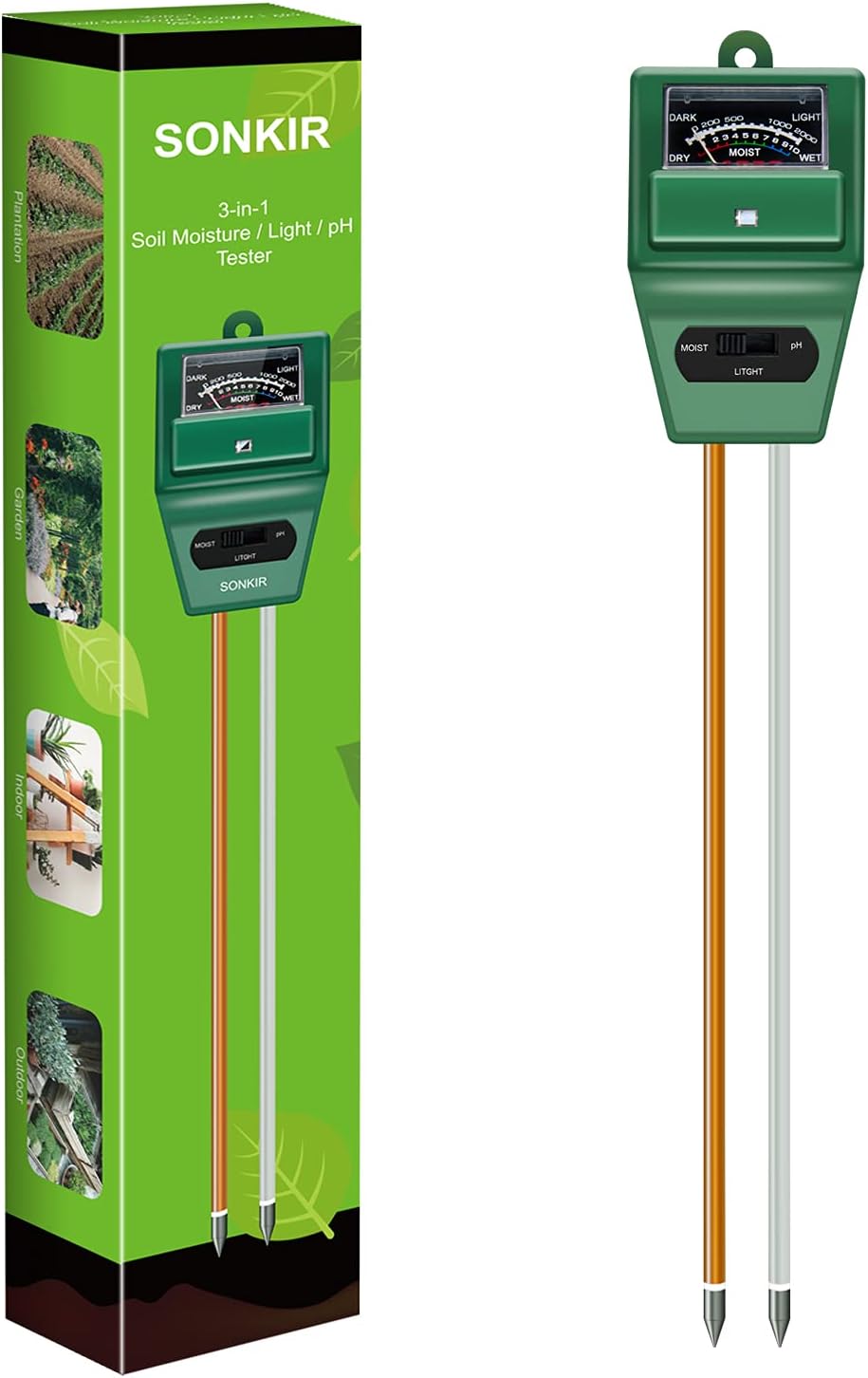
| pH range | 3.5-8 pH |
|---|---|
| Moisture range | 1-10 scale |
| Probe length | 7.9 inches |
| Power | No battery required |
The SONKIR MS02 is a handheld, no-battery soil meter that gives quick, visual readings of moisture, pH and sunlight to help you maintain healthier grass and garden plants. You switch the dial to the desired function, push the probe into the soil about 6 to 7 inches, wait roughly 10 minutes and read the needle on the analog display. The meter covers a practical pH range for lawns and gardens and shows moisture on a 1 to 10 scale so you can decide when to water. Its long probe and compact, lightweight body make it convenient for spot-checking multiple areas of a lawn or garden bed. Important limitations are that the pH probe is intended for soil only and the analog needle can be slow to move in very dry soils or close-to-neutral pH, so readings sometimes require rechecking after moistening the sample or testing several spots. The unit is best for gardeners who want an affordable, easy-to-use tool for routine soil checks rather than laboratory-accurate analysis.
Best for: Someone who wants an inexpensive, easy-to-use tool for routine soil checks across a lawn or garden and values practical, repeatable guidance over laboratory precision.
Less Ideal for: Users who need lab-grade pH or moisture measurements, continuous data logging, or digital readouts for precise record keeping should consider more advanced instruments.
- 3-in-1 functionality measures moisture, pH and sunlight without extra tools
- No battery required so it is always ready to use and low maintenance
- Long probe and compact form factor make spot checks across a lawn or garden quick
- Simple analog dial is straightforward for fast, at-a-glance decisions
- pH function is designed for soil only and cannot test water or other liquids
- Analog needle can be unresponsive in very dry soil or near-neutral pH, requiring repeated tests
Verdict: A straightforward, no-battery 3-in-1 tester that gives fast, practical soil moisture, pH and light checks for everyday lawn and garden care.
Luster Leaf Rapitest Soil Test Kit (20 tests)

| Brand Name | Luster Leaf |
|---|---|
| Unit Count | 20 Count |
| Item Type Name | Soil Test Kit |
| Model Number | 1602 |
The Luster Leaf Rapitest Soil Test Kit provides a simple, low-tech way to check garden soil pH and the three main nutrients gardeners track: nitrogen, phosphorus and potash. The kit includes reagents and comparators for 20 tests total (five tests per measurement), so you can sample several areas across a lawn or vegetable bed. Use involves mixing small soil samples with the provided capsules or solutions, then matching the resulting color against the included chart. That makes it fast and approachable for beginners and steady gardeners who want a practical snapshot before amending or fertilizing. The clear instructions and plant pH preference list for over 450 species are helpful for making actionable adjustments. Limitations are the coarse resolution of color-based readings and the limited number of tests compared with lab analysis, so it is best for routine spot checks rather than precise scientific monitoring.
Best for: Gardeners who want a straightforward, low-cost way to check soil health before amending and prefer practical, easy-to-follow results over lab-level precision.
Less Ideal for: Users who need laboratory-grade accuracy, quantitative nutrient concentrations, or frequent high-volume testing for professional soil management.
- Covers core measurements gardeners need: pH, nitrogen, phosphorus and potash.
- Includes materials for 20 total tests to sample multiple garden spots.
- Patented color comparator system makes results easy to read without special tools.
- Comes with detailed instructions and a plant pH preference list for many common species.
- Color-matching gives approximate results and is less precise than laboratory testing.
- Only five tests per measurement limits long-term or frequent monitoring without repurchasing.
Verdict: Buy this kit if you want an easy, affordable way to spot-check soil pH and basic nutrient levels across your garden before amending.
Choosing the Right Garden Soil Ph Meter: Key Factors to Consider
Accuracy and Calibration
Accurate readings are the primary reason to use a soil pH meter. In a garden setting, small pH differences can change nutrient availability, so look for meters that report stable values and that include an easy calibration procedure. Calibration frequency varies by model and how rough the conditions are, but the ability to perform a quick single- or two-point calibration in the field helps keep results meaningful.
Calibration also affects long-term trust in the tool. Meters that retain calibration between uses are less likely to mislead you into making unnecessary soil amendments. Consider whether the device comes with calibration solutions or clear instructions for using standard buffer solutions.
Probe Design and Durability
The probe is the part of the meter that actually contacts soil and sees the most wear. Probes with thicker stems, reinforced tips, or replaceable sensors last longer in gritty, root-filled garden soils. Thin or exposed electronics at the probe junction are more likely to corrode or break when pushed into heavy clay or through roots.
Think about probe length as well. Longer probes let you check deeper root zones in raised beds or containers while shorter probes are easier to maneuver in small pots. If you expect to test compacted clay or soils with lots of stones, a tougher probe material and a robust connection to the readout unit will reduce the chance of damage.
Soil Moisture and Contact Requirements
Most handheld pH meters require moisture contact between the probe and soil to get a proper reading. Some meters work best in consistently moist soils and struggle in very dry conditions unless you pre-moisten the sample. Others include a moisture sensor or are designed to function reliably across a wider moisture range.
Before buying, consider the typical moisture of your beds and containers. If you test dry areas regularly, choose a meter whose instructions account for dry-soil testing or plan to take small pot samples and add deionized water for testing.
Readout Type and Ease of Interpretation
Readouts range from simple analog dials to backlit digital screens with decimals. A clear, easy-to-read display matters when you are kneeling in the garden. Digital readouts that show pH to two decimal places can be useful, but for many gardeners a single decimal place is sufficient for decision-making.
Also consider whether the meter displays temperature or has hold functions for awkward testing positions. Units with intuitive icons, calibration reminders, or automatic temperature compensation reduce user guesswork and speed up routine testing.
Weather Resistance and Build Quality
Garden tools face dirt, moisture, and occasional drops. Meters with sealed electronics, rubberized grips, and splash-resistant housings stand up better to outdoor use. A model that can be rinsed after testing without damaging the readout will last longer.
Check whether the manufacturer specifies any ingress protection or offers a protective cap for the probe. Even without formal ratings, visibly rugged construction and water-resistant jacketing help a meter survive seasons of use.
Practical Features and Maintenance
Practical features like replaceable probes, included calibration solutions, protective caps, and battery type affect real-world ownership. A replaceable probe saves money over replacing the whole unit if only the sensor wears out. Included calibration solutions or easy access to them locally make maintaining accuracy simpler.
Consider maintenance routines: how often sensors need calibration, whether the unit uses common batteries, and whether the probe tip can be cleaned without special tools. These small conveniences determine whether the meter becomes a regular part of your gardening workflow.
How Soil pH Affects Plant Choices
Soil pH controls nutrient availability and the activity of soil microbes. Some vegetables and ornamentals prefer slightly acidic conditions while others do better near neutral pH. Knowing the pH of a bed or container helps you decide which crops to plant, whether to apply lime or sulfur, and how to adjust fertilizer choice and timing.
Testing different spots in your garden is important because pH can vary between beds, under trees, and inside containers. A portable pH meter lets you map those differences quickly so you can treat only the areas that need amendments.
- Acid-loving plants like blueberries need very different pH than many vegetables
- Container mixes often drift acidic over time and need routine checks
- Raised beds amended with compost may have pH changes over seasons
Testing Technique for Reliable Results
For consistent results, insert the probe at a consistent depth and avoid areas with recent fertilizer or lime applications. If soil is dry, mix a small amount of distilled water into the sample to create contact between the probe and soil particles. Allow the meter to stabilize before recording the value.
Clean the probe tip between tests to avoid cross-contamination. If you test multiple zones, note the location and moisture conditions so you can repeat the test under similar conditions when checking the effectiveness of amendments.
- Test at the root zone depth for the plants you care about
- Pre-moisten very dry soil for better contact
- Rinse and dry the probe between sample sites
Interpreting pH Readings and Making Changes
A reading tells you whether a bed is too acidic, too alkaline, or in the desired range. Small corrections are best: amend gradually and retest after several weeks to monitor drift. For acid soils, gardeners commonly use lime to raise pH; for alkaline soils, elemental sulfur or acidifying fertilizers can lower pH. The amount to add depends on soil type and current pH.
Always adjust one area at a time and keep records of readings and amendments. That way you can see how the soil responds and avoid overcorrecting.
- Small pH shifts can change nutrient availability significantly
- Retest several weeks after amendments before adding more
- Record results to build a seasonal soil pH history
Using Meters with Containers and Potting Mixes
Potting mixes and container soils often behave differently from in-ground beds. They dry faster and can develop localized salt buildup from fertilizer. When testing containers, probe the root zone and be mindful that small volumes respond faster to amendments.
For small pots, you may need a short, narrow probe or to test a moist sample mixed in a cup. Choose a meter appropriate to the container sizes you normally manage to get representative readings without damaging roots.
- Test near plant roots, not just surface mix
- Smaller soil volumes show faster pH changes
- Consider a compact probe for small pots
Storing and Caring for Your pH Meter
After use, wipe the probe clean and store the meter in a dry place out of direct sun. If your meter includes a protective cap, use it to protect the sensor tip. Replace batteries before long storage periods and follow any manufacturer guidance for long-term care.
Regular cleaning and occasional calibration keep readings trustworthy. If the probe is replaceable, keep a spare or know the service path should the sensor fail in-season.
- Wipe and rinse probe after each use
- Store in a dry, shaded area with protective cap on
- Calibrate periodically to maintain accuracy
How We Chose the Best Garden Soil Ph Meter
We focused on meters that produce repeatable, accurate readings in real garden soils rather than lab conditions. Core evaluation criteria included sensor accuracy and calibration stability, probe durability in moist or gritty soils, ease of use and readout clarity, and how well the unit handled different soil textures from potting mix to heavy clay. We also considered build quality and moisture resistance for outdoor use, plus any useful features like automatic temperature compensation or a replaceable probe. Units that required frequent complex calibration, had fragile probes, or lacked clear user guidance were excluded. The final list emphasizes tools that balance field-ready durability with straightforward operation so gardeners can make confident pH adjustments without specialized equipment.
FAQ
How often should I test soil pH in my garden?
Often depends on how actively you amend soils. For most gardens, testing once a season is sufficient. Test more frequently if you are making lime or sulfur adjustments, changing fertilizer regimes, or growing sensitive crops.
Can I use a pH meter in potting mix and raised beds the same way?
Generally yes, but technique differs. Containers dry faster and have smaller volumes, so probe depth and pre-moistening matter more. Use a probe length and tip size appropriate for the container to avoid damaging roots.
What if my meter gives different pH values each time I test the same spot?
Variability can come from inconsistent probe depth, dry soil, or poor probe contact. Ensure the soil is at consistent moisture, insert the probe to the same depth, clean the tip between tests, and perform a calibration check to confirm stability.
Do I need to calibrate a pH meter before every use?
Not usually before every single use, but regular calibration is important. Calibrate when the meter is new, after extended storage, or if readings seem inconsistent. Follow the device instructions for calibration intervals and procedure.
Will fertilizer or recent amendments affect pH readings?
Yes. Fresh applications of lime, sulfur, or soluble fertilizers can temporarily alter pH at the probe site. Avoid testing immediately after application and test at a standard distance from recently treated spots to get representative values.
Final Verdict
Choosing a Garden Soil pH Meter comes down to balancing accuracy, probe durability, and practical features that fit how you garden. Prioritize meters with stable readings and a probe build that withstands your soil texture and testing frequency. Consider moisture behavior in your beds and containers, and pick a readout style that you will actually use while kneeling in the garden. With the right meter and simple routines for calibration and cleaning, you can make measured amendments and track pH changes reliably across the season.
