

Note: This article contains affiliate links. If you click on these links and make a purchase, I may earn a small commission at no extra cost to you. This helps support my research and content. Read my full affiliate disclosure here.
If you manage a large garden, mowing can become a major time sink and a physical chore. A robotic lawn mower for large gardens can take routine cutting off your plate while keeping grass healthy with regular passes. This guide reviews a shortlist of top-performing options built for bigger properties and highlights the practical features that matter in broad lawns, uneven terrain, and long runs. We evaluated machines by how much ground they cover, runtime and recharge behavior, navigation and boundary handling, cutting quality, and durability. Read on to understand which capabilities matter for your situation and why these picks stand out for large gardens.
Top Picks at a Glance
| Best Overall The best all-around choice for most situations | LYMOW One Plus Robot Lawn Mower with RTK+VSLAM Navigation and Tracked Drive |  |
| Best Quality Built to a higher standard if you want something more solid | Husqvarna Automower 550 Robotic Lawn Mower (Commercial, 1.25 Acre) |  |
| Best Value The sweet spot between price and what you get | roborock RockMow X130H Robot Lawn Mower with 4WD and Quad-Vision Navigation |  |
| Highest Rated A top-rated pick with lots of positive feedback | LOPKIN L2500 Robot Lawn Mower with NetRTK, AI Vision and Wi‑Fi HaLow |  |
| Most Popular A crowd favorite that many people choose with confidence | YARBO Y40 Core Robot Lawn Mower Pro (20" Cutting Width, NetRTK + Vision) |  |
LYMOW One Plus Robot Lawn Mower with RTK+VSLAM Navigation and Tracked Drive

| Cutting width | 16 inches |
|---|---|
| Minimum Adjustable Cutting Height | 1.2 inches |
| Maximum Adjustable Cutting Height | 4 inches |
| Power Source | Battery Powered |
The LYMOW One Plus is a purpose-built robotic mower for large, hilly properties that combines high-precision RTK positioning with VSLAM visual mapping and a tracked drive system to handle very steep terrain. Setup is wire-free via smartphone and you define virtual boundaries and no-go zones in the app; once configured it runs autonomously, auto-recharges, and resumes tasks. Notable hardware includes a 16-inch dual-rotary blade deck with adjustable heights from 1.2 to 4 inches, a high-capacity LiFePO4 battery that supports multiple daily cycles, and a heavy-duty track drive that claims 45° slope capability and good obstacle-crossing. The onboard AI vision and ultrasonic sensors provide real-time obstacle detection, while the cyclone airflow and dual blades aim for even cuts and mulching of clippings. Trade-offs are its size and complexity: this is a premium, robust machine intended for large or challenging lawns rather than small plots, and initial mapping plus occasional maintenance of blades and tracks will be required to keep performance consistent.
Best for: Buyers who need a capable, low-supervision mower for large properties with steep slopes and complex boundaries and who value precise mapping and hands-off operation.
Less Ideal for: Those with small, simple lawns or buyers seeking a minimal-maintenance, budget entry-level robotic mower should consider simpler wheeled models instead.
- Tracked drive and reinforced motor enable climbing and stable operation on slopes up to 45°
- RTK plus VSLAM navigation provides precise, wire-free mapping and consistent coverage
- Large-capacity LiFePO4 battery supports multiple cycles per day for wide area coverage
- 16-inch dual rotary blades with airflow lift and mulching reduce missed cuts and return fine clippings to the lawn
- Designed for large, complex lawns so it may be oversized for small yards
- Higher mechanical complexity means more maintenance on tracks and blades than a basic wheeled mower
Verdict: If you need a robust, wire-free robot that can reliably mow steep, uneven lawns with high precision, the LYMOW One Plus is built for that job.
Husqvarna Automower 550 Robotic Lawn Mower (Commercial, 1.25 Acre)

| Power Source | Electric |
|---|---|
| Operation Mode | Automatic |
| Covers | 1.25 acres |
| Maximum Adjustable Cutting Height | 3.5 inches |
| Minimum Adjustable Cutting Height | 2 inches |
The Husqvarna Automower 550 is a heavy-duty robotic mower built for large or divided properties up to roughly 1.25 acres. It uses triple guide wires, five remote start points, and GPS-assisted navigation to find and evenly mow complex lawns while large coarse-tread wheels handle slopes up to 45%. Primary use is autonomous scheduled mowing managed through Husqvarna Fleet Services and the Automower Connect app, with remote start, geofencing and theft tracking for peace of mind. Practical benefits include reduced labor, consistent cut heights between 2 and 3.5 inches, and flexible charging-station placement that simplifies installation on commercial sites. Smart home integration with major voice assistants and fleet controls make it straightforward to coordinate multiple machines or monitor status remotely. Important limitations are that this is a commercial product intended for larger properties and fleet management workflows, so it may be more complex to set up and maintain than consumer models and carries capabilities that exceed simple residential needs.
Best for: Buyers who need a robust, mostly hands-off mower for a large or divided 1-acre-plus lawn and who prioritize reliable coverage and remote fleet-style management.
Less Ideal for: Homeowners with small yards under 0.5 acres or buyers who want a simple plug-and-play consumer robot without fleet features or professional setup.
- Designed for properties up to 1.25 acres so it covers larger lawns without constant intervention
- Triple guide wires and five start points reduce search time on divided or complex sites
- GPS navigation plus geofencing and theft tracking provide reliable location awareness and security
- Large coarse-tread wheels offer traction on slopes up to 45% for hilly terrain
- Commercial-grade features and fleet management add setup complexity compared with consumer models
- Higher operational and maintenance demands typical of professional equipment
Verdict: Choose the Automower 550 when you need a professional, remotely managed robotic mower that reliably covers large or divided lawns up to about 1.25 acres.
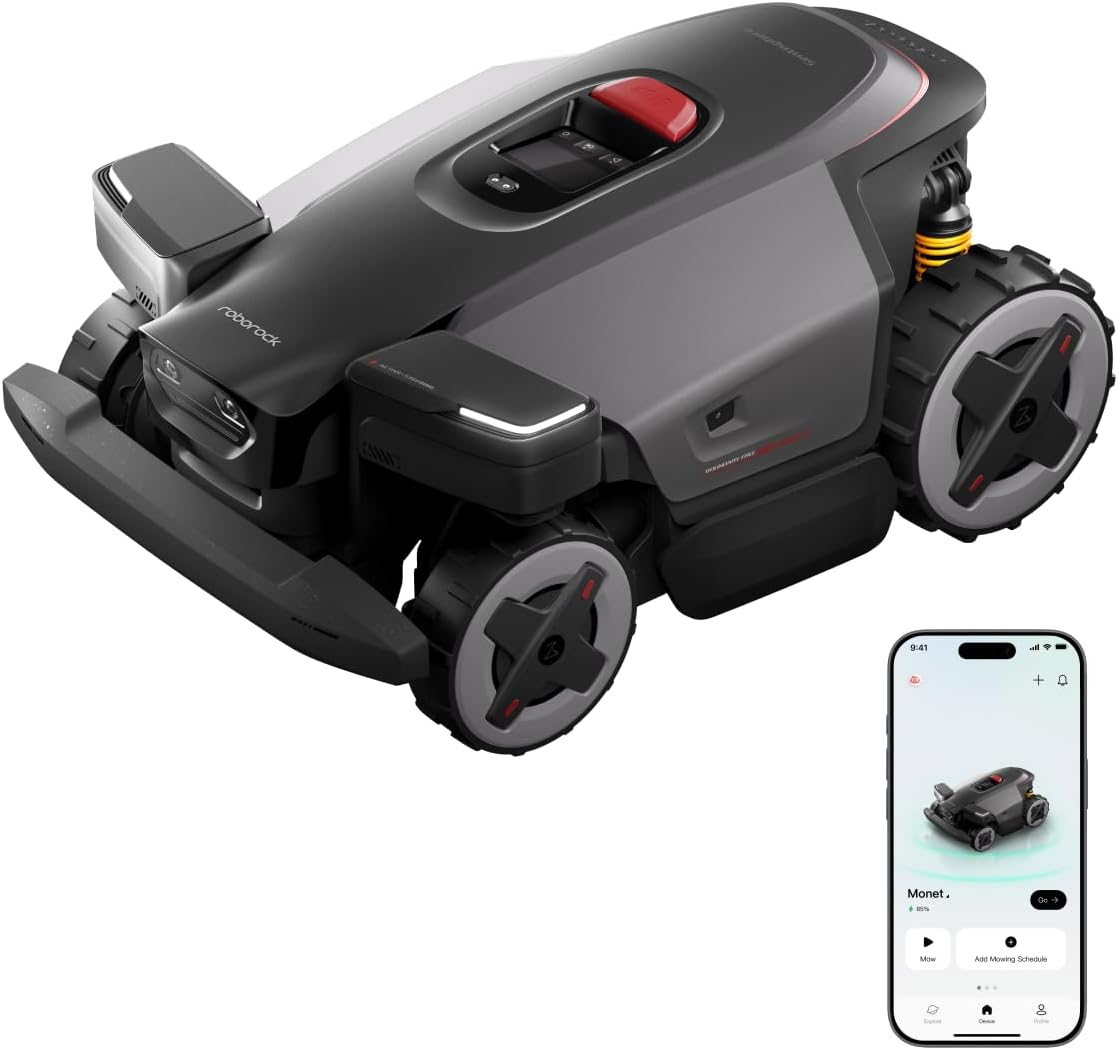
roborock RockMow X130H Robot Lawn Mower with 4WD and Quad-Vision Navigation
| Power Source | Battery Powered |
|---|---|
| Cutting width | 9.5 inches |
| Maximum Adjustable Cutting Height | 3.5 inches |
| Battery Average Life | 140 minutes |
The roborock RockMow X130H is a high-capability robot mower built to handle steep, uneven, and complex lawns without a buried perimeter wire. It uses Full-Band RTK plus a quad-camera AI vision system for precise positioning and dual mapping modes so you can either auto-map open areas or manually trace boundaries from the app. The pro-grade four-wheel drive, active steering, and dynamic suspension let it climb slopes up to 80% and roll over obstacles up to about 3.1 inches while keeping a floating cutting deck for consistent surface-following. Practical benefits include a relatively wide 9.5-inch cut to reduce runtime, multi-zone scheduling and a real-time app dashboard, plus anti-theft features and 4G connectivity. Important limitations are its weight and size for handling and storage, and the advanced navigation and connectivity mean a learning curve during setup and when customizing complex zones. For homeowners with steep or irregular yards who want largely hands-off mowing, this mower brings robust, reliable performance.
Best for: Homeowners with steep, irregular, or obstacle-filled lawns who want a durable, hands-off mower that prioritizes precise navigation and traction over simplicity.
Less Ideal for: Small, flat lawns or buyers who want a very lightweight, simple plug-and-play robot mower with minimal setup and fewer connectivity features.
- Four-wheel drive, active steering, and dynamic suspension that handle slopes up to 80% and 3.1-inch obstacles
- Full-Band RTK plus quad-camera AI vision for accurate positioning under trees and near fences
- Wire-free dual mapping options with app control and multi-zone scheduling for flexible setup
- 9.5-inch cutting width and floating deck for efficient, even mowing across contours
- Built-in anti-theft features including PIN lock, alarm, and GPS tracking
- Heavy and bulky compared with smaller robotic mowers, making manual transport and storage more cumbersome
- Advanced navigation and connectivity increase setup complexity and may require time to fine-tune for complex yards
Verdict: Choose the RockMow X130H if you need a wire-free, high-traction robot mower that can reliably conquer steep, uneven lawns with precise navigation.
LOPKIN L2500 Robot Lawn Mower with NetRTK, AI Vision and Wi‑Fi HaLow

| Power Source | Battery Powered |
|---|---|
| Battery Average Life | 4 hours |
| Maximum Adjustable Cutting Height | 3 inches |
| Minimum Adjustable Cutting Height | 1.2 inches |
| Operation Mode | Automatic |
The LOPKIN L2500 is a wire‑free robotic mower built for large, complex yards that combines NetRTK, GNSS/INS fusion and AI vision to map and mow without a boundary wire. Typical use is app driven: initial mapping takes minutes, then you set schedules, multi‑zone plans and no‑go areas from your phone while the mower handles routine cuts automatically. Notable features include Wi‑Fi HaLow for extended, stable connectivity across large properties, AI vision that recognizes and avoids common obstacles, and a 10Ah battery providing up to four hours of runtime with a 5A fast charger. Practical benefits are precise navigation around trees and structures, multi‑zone management for separate lawn areas, and IP66 protection so it can pause for rain and continue night mowing when appropriate. Limitations to weigh are its relatively narrow cutting width compared with ride‑on options and the need for the dedicated router for HaLow range; very steep or highly debris‑strewn sites may still require occasional human intervention. Installation and daily operation are geared to owners who want mostly hands‑off mowing with strong connectivity across large properties.
Best for: Owners of large, complicated yards who prioritize dependable, hands‑off mowing and precise navigation across multiple zones and signal‑challenging areas.
Less Ideal for: People who need very wide swath cutting for fastest possible full‑acre mowing or who prefer a simple plug‑and‑play device without installing a dedicated long‑range router.
- RTK + GNSS/INS fusion and AI vision enable high‑precision, wire‑free navigation in complex yards
- Wi‑Fi HaLow router provides long‑range, stable connectivity for large properties
- App-based multi‑zone mapping and scheduling for separate lawns and customized plans
- Up to four hours runtime per charge with a 5A fast charger for relatively long continuous operation
- IP66 rating and rain sensor for reliable outdoor operation in wet conditions
- Cutting width is modest, so full‑acre jobs may take longer than larger commercial mowers
- Requires the dedicated HaLow router to realize maximum connectivity range
Verdict: If you need reliable, wire‑free automated mowing across a large, complex yard with strong long‑range connectivity and smart obstacle avoidance, the LOPKIN L2500 is designed for that job.
YARBO Y40 Core Robot Lawn Mower Pro (20" Cutting Width, NetRTK + Vision)

| Cutting width | 20 inches |
|---|---|
| Maximum Adjustable Cutting Height | 4 inches |
| Battery Average Life | 120 minutes |
| Max. Climbing Ability | 70% (35°) |
The YARBO Y40 Core Robot Lawn Mower Pro is built for large, performance-driven properties where long runtime and precise navigation matter. It uses NetRTK/RTK plus binocular vision and multiple sensors to map lawns and avoid obstacles while handling steep slopes up to 70 percent. Twin 300W motors, selectable straight or razor blades, and a 20-inch cutting width let it cut dense, wet, or overgrown grass and eject clippings efficiently to reduce clogging and stops. Battery runtime is listed at about 120 minutes, and the mower supports adjustable heights from 0.8 to 4.0 inches to suit different turf types. Practical benefits for acreage owners include modular options for future attachments, strong traction on uneven or muddy terrain, and largely hands-off operation once set up. Important limitations are the mower's very large physical size and weight that demand two people for assembly and a clear sky view for its RTK data setup, and the complexity of initial installation and mapping compared with simple boundary cable systems.
Best for: Buyers who manage multiple acres or premium properties and prioritize robust cutting power, high-precision navigation, and hands-off, year-round lawn care.
Less Ideal for: Small-lot owners or those who want a simple plug-and-play robot mower without a technical installation process should consider lighter, simpler models instead.
- NetRTK + RTK + binocular vision and multi-sensor navigation for highly accurate mapping and obstacle avoidance
- Dual 300W motors with 20" cutting width suitable for thick, wet, or overgrown grass
- Supports steep slopes up to 70% for use on hilly or uneven acreage
- Adjustable cutting height from 0.8" to 4.0" and two blade types for different turf conditions
- Large, heavy unit that requires two people to assemble and may be difficult to move
- Initial setup requires good sky visibility and more technical configuration than basic robotic mowers
Verdict: If you need a high-performance, RTK-guided robotic mower that can handle steep, rough acreage and heavy grass with minimal supervision, the YARBO Y40 Core Pro is a top choice.
Choosing the Right Robotic Lawn Mower for Large Gardens: Key Factors to Consider
Coverage Area and Mowing Cycle Length
For large gardens, maximum coverage per charge is a foundational decision factor. A mower that advertises a large coverage area will reduce the number of returns to its charging base and lower the chance of unfinished passes during a single cycle.
Consider how manufacturers report coverage: some use ideal conditions that do not reflect slopes, obstacles, or dense grass. Account for interruptions, extra passes along boundaries, and areas that need spot mowing. A mower that can cover your acreage reliably without frequent recharging will deliver the hands-off experience large-plot owners expect.
Battery Capacity, Runtime, and Recharge Behavior
Battery chemistry and capacity determine how long a mower can run before needing a recharge and how quickly it gets back to work. For extensive lawns, look beyond nominal runtime to typical cycle patterns: how long the unit runs, how long it takes to reach the base, and how long it takes to return to full charge.
Some mowers use partial recharge strategies and resume or finish jobs incrementally; others require long charging gaps. Consider whether a mower supports swappable batteries or fast charging if you need continuous coverage over large spaces. Battery longevity and replacement procedures also affect long-term maintenance planning.
Navigation System and Boundary Management
Navigation determines how efficiently a mower traverses wide areas and handles complex layouts. Wired boundary systems remain common and work well for clearly defined perimeters, but they require careful installation across large distances. GPS-assisted and SLAM navigation can simplify management of expansive or irregular gardens by reducing dependence on buried wire and enabling smarter route planning.
Also evaluate how the mower manages narrow corridors, flower beds, slopes, and obstacles. Good boundary handling reduces missed strips and repeated overlap, preserving battery life and producing a cleaner finish. Look for flexible control options for virtual boundaries or map-based no-go zones when your garden includes sensitive plantings.
Cutting Performance and Deck Flexibility
In large gardens you want consistent cut quality across different turf types and mowing conditions. Cut width affects how quickly the mower can cover ground: wider decks shorten total run time but may struggle in tight sections. Adjustable cutting heights and responsive blade systems help adapt to seasonal needs and grass growth rates.
Examine how the deck handles clippings. Some machines disperse grass finely for natural mulching, which benefits soil health but can build up in very long grass. A mower that maintains blade sharpness and offers easy blade replacement will reduce downtime and preserve cutting consistency.
Terrain Handling and Slope Capability
Large gardens often include varied terrain: slopes, uneven ground, and transitions between lawn types. Traction systems, wheel design, and chassis clearance determine how well a mower navigates these conditions without stalling or leaving scuff marks.
Check slope rating specifications and consider machines with traction control or adaptive speed. Good terrain handling reduces the need for manual intervention in steep or rutted areas and improves overall coverage efficiency.
Weather Resistance and Long-Term Durability
A mower used across a large garden will spend considerable time outdoors, so resistance to moisture, dust, and UV exposure matters. Look for sealed electronics, corrosion-resistant fasteners, and robust housings that tolerate the elements and occasional knocks.
Consider the availability and ease of replacing wear parts like blades and wheels. Durable construction reduces maintenance frequency and keeps a mower reliable across seasons, which is especially important when the unit serves a large property.
Planning Installation for a Large Garden
Installation strategy affects long-term convenience. For buried boundary systems in big yards, plan cable runs that avoid frequent garden chores like digging or future landscaping projects. Map out the mower base location so it can access multiple lawn zones quickly and with minimal crossing of pedestrian paths.
If your garden has separate lawn areas, decide whether a single base with long runs or multiple docking points makes more sense. Some layouts benefit from auxiliary guide wires that help the mower find the base from distant corners, reducing roaming time and missed coverage.
- Choose base site with clear approach paths and shelter from sun and rain
- Avoid crossing utility lines or buried irrigation when laying perimeter wire
- Use guide wires or map-based navigation in segmented lawns
Routine Maintenance for Reliable Long-Run Performance
Regular upkeep keeps a mower running across years without surprise failures. Establish a simple maintenance schedule that includes cleaning debris from wheels and underside, checking and sharpening or replacing blades, and inspecting seals and connectors for corrosion.
Battery care is especially important. Store batteries according to manufacturer recommendations when not in use for long periods and monitor charge cycles to detect declining capacity early.
- Clean underside and cutting deck every few weeks during heavy growth
- Rotate or replace blades seasonally depending on wear
- Check wheel treads and replace if traction drops
Adapting Mowing Patterns to Seasonal Growth
Large gardens experience significant seasonal variation in grass growth. In spring and early summer, increase mowing frequency and accept shorter runs as the mower will need more passes. In late summer or drought conditions, raise cutting height and reduce frequency to protect turf health.
Adjust scheduling and cut height rather than relying on a single pass to handle all conditions. Many robotic mowers offer flexible scheduling and adaptive cutting that you can tailor to active growth periods.
- Increase pass frequency during peak growth
- Raise cutting height during heat or drought
- Use staggered schedules to avoid continuous daytime mowing
Managing Obstacles and Sensitive Plantings
Large gardens often include beds, pathways, and decorative plantings. Protect these areas with clearly defined boundaries, either physical edging, buried perimeter wire, or virtual no-go zones if the mower supports map-based limits.
Train the mower by checking early runs and noting problem spots. A few adjustments to boundary placement or navigation settings will reduce accidental intrusions and minimize plant damage.
- Install edging or physical barriers where possible
- Use virtual boundaries for temporary or seasonal restrictions
- Monitor initial runs and tweak boundary layout as needed
Noise, Local Regulations, and Neighborhood Considerations
Robotic mowers are generally quieter than ride-on mowers, but noise can still matter in close neighborhoods or during early morning hours. Check local noise regulations and be considerate of neighbors when scheduling operations.
Some municipalities restrict mowing hours or equipment types. Plan schedules to fit local rules and to avoid conflict during weekends or quiet times.
- Schedule mowing for mid-morning to early evening when allowed
- Use quieter mowing modes for early or late cycles
- Communicate with neighbors if you plan significant schedule changes
How We Chose the Best Robotic Lawn Mower for Large Gardens
We focused on features and performance characteristics that directly affect how well a robotic mower handles a large garden. Primary criteria included maximum coverage per charge and charging behavior, because these determine whether a mower can finish a single mowing cycle or needs multiple interruptions. We assessed navigation systems and guidance accuracy, since reliable route planning reduces missed patches and excessive boundary wire maintenance. Cutting system effectiveness was evaluated by cut width, deck design, and cut height adjustment options to ensure even results across varied turf. Battery durability and expected cycle life were considered to reflect long-term running costs and downtime. We also weighed build quality and weather resistance for machines that will spend long hours outdoors and across seasons. We excluded designs clearly intended only for small yards or constrained patio lawns, and we filtered out units that lack documentation on coverage area or runtime. We prioritized real-world usability over unverified claims, favoring mowers with clear specs for coverage, battery runtime, and navigation features. The scoring focused on measurable specs gardeners can use to match a mower to garden size and layout.
FAQ
How do I determine the right coverage capacity for my garden?
Measure the total lawn area and add buffer for obstacles and repeated passes. Use manufacturer coverage figures as a starting point but reduce them to account for slopes, dense grass, and narrow corridors that increase run time.
Can a robotic mower handle steep slopes in a large garden?
Many models manage moderate slopes, but steep grades reduce traction and increase energy use. Check the slope rating and opt for machines with specialized wheel treads or adaptive speed if your garden has persistent inclines.
Will the mower need constant supervision in a big yard?
Once perimeter and navigation are correctly set, most robotic mowers run autonomously for extended periods. Expect initial monitoring to tune boundaries and schedules, and occasional checks for debris, blade wear, or battery health.
How does weather affect operation across a large lawn?
Rain and wet grass slow mowing and can clog blades, while heavy sun and heat stress batteries. Many machines pause in heavy rain and resume later. Choose a mower with solid weather resistance and plan schedules around typical local conditions.
Are virtual boundaries better than buried wire for large gardens?
Virtual boundaries with GPS or map-based navigation reduce the need for cable installation and simplify changes, but their accuracy can vary. Buried wire is reliable and precise but requires more upfront work. The right choice depends on garden complexity and willingness to install wire.
Final Verdict
For large gardens prioritize machines that deliver generous coverage per charge, reliable navigation, and durable construction. Expect tradeoffs between wider cutting decks that shorten total run time and maneuverability in tight garden features. Battery runtime and recharge behavior will shape whether a mower can complete a full cycle or needs staged returns. Focus on matching coverage specs and navigation style to your layout, maintain blades and batteries, and plan installation to minimize interference with garden features. With those priorities in mind, you can choose a robotic mower that keeps a large lawn consistently neat with minimal ongoing effort.
