

Note: This article contains affiliate links. If you click on these links and make a purchase, I may earn a small commission at no extra cost to you. This helps support my research and content. Read my full affiliate disclosure here.
If you manage a large lawn, driveway strips, or multiple connected turf zones you already know how time-consuming and physically demanding mowing can be. A robotic lawn mower built for large areas can greatly reduce that workload while keeping grass at a consistent height across wide swaths. Choosing the right model matters for runtime, navigation accuracy, and long-term turf health. This guide covers six top shortlisted robotic lawn mowers for large areas and explains the concrete criteria we used to evaluate them, such as battery range, area mapping, and boundary management. Read on to understand the practical tradeoffs so you can pick the machine that fits your property layout and maintenance goals.
Top Picks at a Glance
| Best Overall The best all-around choice for most situations | LYMOW One Plus Robot Lawn Mower with RTK+VSLAM Navigation and Tracked Drive |  |
| Best Quality Built to a higher standard if you want something more solid | Husqvarna Automower 550 Robotic Lawn Mower (Commercial, 1.25 Acre) |  |
| Best Budget The cheapest option that still gets the job done reliably | LOPKIN L2500-NEO Robot Lawn Mower with NetRTK, AI Vision, Wi‑Fi HaLow |  |
| Highest Rated A top-rated pick with lots of positive feedback | LOPKIN L2500 Robot Lawn Mower with NetRTK, AI Vision and Wi‑Fi HaLow |  |
| Most Popular A crowd favorite that many people choose with confidence | Mammotion LUBA 2 AWD 5000HX Robot Lawn Mower with Cleaning Stand |  |
| Best Seller A high-volume bestseller chosen again and again | roborock RockMow X130H Robot Lawn Mower with 4WD and Quad-Vision Navigation |  |
LYMOW One Plus Robot Lawn Mower with RTK+VSLAM Navigation and Tracked Drive

| Cutting width | 16 inches |
|---|---|
| Minimum Adjustable Cutting Height | 1.2 inches |
| Maximum Adjustable Cutting Height | 4 inches |
| Power Source | Battery Powered |
The LYMOW One Plus is a purpose-built robotic mower for large, hilly properties that combines high-precision RTK positioning with VSLAM visual mapping and a tracked drive system to handle very steep terrain. Setup is wire-free via smartphone and you define virtual boundaries and no-go zones in the app; once configured it runs autonomously, auto-recharges, and resumes tasks. Notable hardware includes a 16-inch dual-rotary blade deck with adjustable heights from 1.2 to 4 inches, a high-capacity LiFePO4 battery that supports multiple daily cycles, and a heavy-duty track drive that claims 45° slope capability and good obstacle-crossing. The onboard AI vision and ultrasonic sensors provide real-time obstacle detection, while the cyclone airflow and dual blades aim for even cuts and mulching of clippings. Trade-offs are its size and complexity: this is a premium, robust machine intended for large or challenging lawns rather than small plots, and initial mapping plus occasional maintenance of blades and tracks will be required to keep performance consistent.
Best for: Buyers who need a capable, low-supervision mower for large properties with steep slopes and complex boundaries and who value precise mapping and hands-off operation.
Less Ideal for: Those with small, simple lawns or buyers seeking a minimal-maintenance, budget entry-level robotic mower should consider simpler wheeled models instead.
- Tracked drive and reinforced motor enable climbing and stable operation on slopes up to 45°
- RTK plus VSLAM navigation provides precise, wire-free mapping and consistent coverage
- Large-capacity LiFePO4 battery supports multiple cycles per day for wide area coverage
- 16-inch dual rotary blades with airflow lift and mulching reduce missed cuts and return fine clippings to the lawn
- Designed for large, complex lawns so it may be oversized for small yards
- Higher mechanical complexity means more maintenance on tracks and blades than a basic wheeled mower
Verdict: If you need a robust, wire-free robot that can reliably mow steep, uneven lawns with high precision, the LYMOW One Plus is built for that job.
Husqvarna Automower 550 Robotic Lawn Mower (Commercial, 1.25 Acre)

| Power Source | Electric |
|---|---|
| Operation Mode | Automatic |
| Covers | 1.25 acres |
| Maximum Adjustable Cutting Height | 3.5 inches |
| Minimum Adjustable Cutting Height | 2 inches |
The Husqvarna Automower 550 is a heavy-duty robotic mower built for large or divided properties up to roughly 1.25 acres. It uses triple guide wires, five remote start points, and GPS-assisted navigation to find and evenly mow complex lawns while large coarse-tread wheels handle slopes up to 45%. Primary use is autonomous scheduled mowing managed through Husqvarna Fleet Services and the Automower Connect app, with remote start, geofencing and theft tracking for peace of mind. Practical benefits include reduced labor, consistent cut heights between 2 and 3.5 inches, and flexible charging-station placement that simplifies installation on commercial sites. Smart home integration with major voice assistants and fleet controls make it straightforward to coordinate multiple machines or monitor status remotely. Important limitations are that this is a commercial product intended for larger properties and fleet management workflows, so it may be more complex to set up and maintain than consumer models and carries capabilities that exceed simple residential needs.
Best for: Buyers who need a robust, mostly hands-off mower for a large or divided 1-acre-plus lawn and who prioritize reliable coverage and remote fleet-style management.
Less Ideal for: Homeowners with small yards under 0.5 acres or buyers who want a simple plug-and-play consumer robot without fleet features or professional setup.
- Designed for properties up to 1.25 acres so it covers larger lawns without constant intervention
- Triple guide wires and five start points reduce search time on divided or complex sites
- GPS navigation plus geofencing and theft tracking provide reliable location awareness and security
- Large coarse-tread wheels offer traction on slopes up to 45% for hilly terrain
- Commercial-grade features and fleet management add setup complexity compared with consumer models
- Higher operational and maintenance demands typical of professional equipment
Verdict: Choose the Automower 550 when you need a professional, remotely managed robotic mower that reliably covers large or divided lawns up to about 1.25 acres.
LOPKIN L2500-NEO Robot Lawn Mower with NetRTK, AI Vision, Wi‑Fi HaLow

| Power Source | Battery Powered |
|---|---|
| Cutting width | 9.45 inches |
| Maximum Adjustable Cutting Height | 3 inches |
| Battery Average Life | 4 hours |
| Operation Mode | Automatic |
The LOPKIN L2500‑NEO is a high-capability robotic mower built for large, complex yards where running boundary wire is undesirable. It uses NetRTK plus GNSS/INS fusion and AI vision to map and navigate reliably around trees, buildings, and common obstacles while app-based multi-zone management stores many maps and custom schedules. The mower supports steep slopes, offers adjustable cutting heights, and runs for roughly three hours per charge with an 8Ah battery and fast charger. Practical benefits include precise wire-free positioning, automatic obstacle avoidance that reduces collisions with toys or garden features, and a HaLow router for more consistent remote control across long distances. Important limitations are that effective performance depends on good initial mapping and that advanced features like NetRTK and HaLow add setup steps compared with simpler robot mowers. The unit is IP66 rated and has rain sensing for automatic returns, but users should expect occasional mapping tweaks in very cluttered or heavily shaded areas.
Best for: Homeowners with larger or complicated yards who want a wire-free, app-managed mower that prioritizes accurate navigation and multi-zone automation to minimize hands-on mowing time.
Less Ideal for: Small, simple lawns where a basic, lower-cost robot mower or traditional push mower would be faster to buy and easier to maintain.
- Centimeter-level NetRTK plus GNSS/INS fusion for accurate wire-free navigation
- AI vision obstacle avoidance that recognizes and avoids common objects
- Wi‑Fi HaLow long-range connectivity with included auto-pairing router
- Multi-zone mapping and app scheduling for managing several separated lawn areas
- IP66 weather protection and automatic rain-sensing return
- Advanced navigation and connectivity add setup complexity compared with basic robot mowers
- Performance in very cluttered, heavily shaded, or signal-blocked microenvironments may need occasional map adjustments
Verdict: Choose the LOPKIN L2500‑NEO if you need a wire-free robot mower that reliably handles large, complex yards with precise navigation and long-range connectivity.
LOPKIN L2500 Robot Lawn Mower with NetRTK, AI Vision and Wi‑Fi HaLow

| Power Source | Battery Powered |
|---|---|
| Battery Average Life | 4 hours |
| Maximum Adjustable Cutting Height | 3 inches |
| Minimum Adjustable Cutting Height | 1.2 inches |
| Operation Mode | Automatic |
The LOPKIN L2500 is a wire‑free robotic mower built for large, complex yards that combines NetRTK, GNSS/INS fusion and AI vision to map and mow without a boundary wire. Typical use is app driven: initial mapping takes minutes, then you set schedules, multi‑zone plans and no‑go areas from your phone while the mower handles routine cuts automatically. Notable features include Wi‑Fi HaLow for extended, stable connectivity across large properties, AI vision that recognizes and avoids common obstacles, and a 10Ah battery providing up to four hours of runtime with a 5A fast charger. Practical benefits are precise navigation around trees and structures, multi‑zone management for separate lawn areas, and IP66 protection so it can pause for rain and continue night mowing when appropriate. Limitations to weigh are its relatively narrow cutting width compared with ride‑on options and the need for the dedicated router for HaLow range; very steep or highly debris‑strewn sites may still require occasional human intervention. Installation and daily operation are geared to owners who want mostly hands‑off mowing with strong connectivity across large properties.
Best for: Owners of large, complicated yards who prioritize dependable, hands‑off mowing and precise navigation across multiple zones and signal‑challenging areas.
Less Ideal for: People who need very wide swath cutting for fastest possible full‑acre mowing or who prefer a simple plug‑and‑play device without installing a dedicated long‑range router.
- RTK + GNSS/INS fusion and AI vision enable high‑precision, wire‑free navigation in complex yards
- Wi‑Fi HaLow router provides long‑range, stable connectivity for large properties
- App-based multi‑zone mapping and scheduling for separate lawns and customized plans
- Up to four hours runtime per charge with a 5A fast charger for relatively long continuous operation
- IP66 rating and rain sensor for reliable outdoor operation in wet conditions
- Cutting width is modest, so full‑acre jobs may take longer than larger commercial mowers
- Requires the dedicated HaLow router to realize maximum connectivity range
Verdict: If you need reliable, wire‑free automated mowing across a large, complex yard with strong long‑range connectivity and smart obstacle avoidance, the LOPKIN L2500 is designed for that job.
Mammotion LUBA 2 AWD 5000HX Robot Lawn Mower with Cleaning Stand

| Cutting width | 15.7 inches |
|---|---|
| Operation Mode | Automatic |
| Number of Positions | 7 |
| Power Source | Battery Powered |
| Battery Capacity | 12 Ah |
The Mammotion LUBA 2 AWD 5000HX is built for demanding yards: its four-wheel 165 W drive and all-wheel traction let it tackle steep slopes and uneven terrain while the dual-blade disk and 15.7-inch cutting width deliver efficient, clean cuts. It uses UltraSense AI vision plus RTK positioning to map lawns precisely, mow close to edges, and avoid more than 200 object types without a physical boundary wire. You can manage up to 50 zones, set planned patterns, and control the mower remotely via 4G/Wi‑Fi/Bluetooth and the Mammotion app; it also offers GPS tracking and anti-theft safeguards. Charge time and area-per-charge figures indicate this is sized for roughly 1.25 acres per the spec sheet, and automatic return-and-resume behavior keeps large multi-zone jobs moving. Expect a setup and learning curve for mapping complex properties and reliance on app connectivity for advanced features, plus periodic maintenance on blades and sensors like any robotic mower. For performance-focused owners this mower prioritizes terrain capability, precise routing, and autonomy over the simplicity of basic consumer models.
Best for: Buyers who prioritize robust off-road performance and precise autonomous control for large, varied lawns and steep terrain and who are comfortable using app-driven features to optimize mowing patterns.
Less Ideal for: Small, flat lawns where a simpler, lower-cost robotic mower or push mower would be more practical or for buyers who want a fully plug-and-play device with minimal setup.
- True all-wheel-drive and 165 W motors provide strong traction for steep slopes and rough terrain
- UltraSense AI Vision with RTK navigation enables precise mapping, edge cutting, and obstacle recognition
- Supports management of up to 50 mowing zones and multiple mowing patterns for complex properties
- Connectivity via 4G, Wi‑Fi, and Bluetooth plus app control allows remote monitoring and customized schedules
- GPS tracking and anti-theft features help protect investment on larger properties
- Requires app connectivity and initial mapping that can be complex for intricate landscapes
- Plastic bodywork may need careful handling in very rough environments
Verdict: Choose the LUBA 2 AWD 5000HX when you need a heavy-duty, terrain-capable robotic mower that delivers precise AI-guided mowing and full multi-zone control for challenging large lawns.
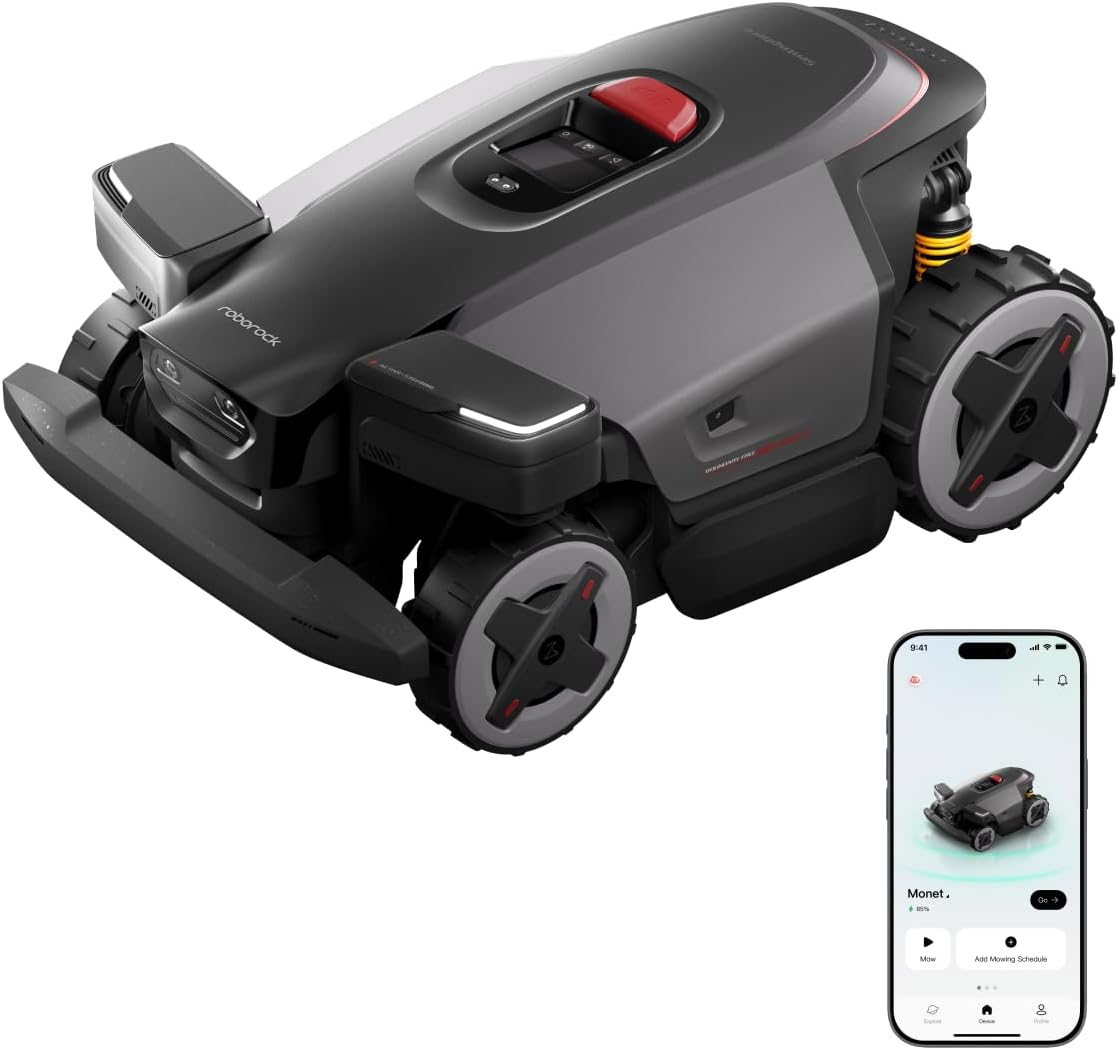
roborock RockMow X130H Robot Lawn Mower with 4WD and Quad-Vision Navigation
| Power Source | Battery Powered |
|---|---|
| Cutting width | 9.5 inches |
| Maximum Adjustable Cutting Height | 3.5 inches |
| Battery Average Life | 140 minutes |
The roborock RockMow X130H is a high-capability robot mower built to handle steep, uneven, and complex lawns without a buried perimeter wire. It uses Full-Band RTK plus a quad-camera AI vision system for precise positioning and dual mapping modes so you can either auto-map open areas or manually trace boundaries from the app. The pro-grade four-wheel drive, active steering, and dynamic suspension let it climb slopes up to 80% and roll over obstacles up to about 3.1 inches while keeping a floating cutting deck for consistent surface-following. Practical benefits include a relatively wide 9.5-inch cut to reduce runtime, multi-zone scheduling and a real-time app dashboard, plus anti-theft features and 4G connectivity. Important limitations are its weight and size for handling and storage, and the advanced navigation and connectivity mean a learning curve during setup and when customizing complex zones. For homeowners with steep or irregular yards who want largely hands-off mowing, this mower brings robust, reliable performance.
Best for: Homeowners with steep, irregular, or obstacle-filled lawns who want a durable, hands-off mower that prioritizes precise navigation and traction over simplicity.
Less Ideal for: Small, flat lawns or buyers who want a very lightweight, simple plug-and-play robot mower with minimal setup and fewer connectivity features.
- Four-wheel drive, active steering, and dynamic suspension that handle slopes up to 80% and 3.1-inch obstacles
- Full-Band RTK plus quad-camera AI vision for accurate positioning under trees and near fences
- Wire-free dual mapping options with app control and multi-zone scheduling for flexible setup
- 9.5-inch cutting width and floating deck for efficient, even mowing across contours
- Built-in anti-theft features including PIN lock, alarm, and GPS tracking
- Heavy and bulky compared with smaller robotic mowers, making manual transport and storage more cumbersome
- Advanced navigation and connectivity increase setup complexity and may require time to fine-tune for complex yards
Verdict: Choose the RockMow X130H if you need a wire-free, high-traction robot mower that can reliably conquer steep, uneven lawns with precise navigation.
Choosing the Right Robotic Lawn Mower for Large Areas: Key Factors to Consider
Coverage Capacity
Coverage capacity determines how much turf a robotic mower can handle between charges. For large areas you want models that list high maximum coverage or that have proven long runtime in real conditions. Consider both the battery amp-hours and the manufacturer's effective coverage figure, but also understand that steep slopes, frequent stops for obstacle negotiation, and denser grass all reduce effective coverage.
If your property is made of several separate lawn zones, check whether the mower supports multiple home points or easy boundary reconfiguration. A unit with strong coverage capacity reduces the frequency of manual interventions and charging cycles, leading to less hands-on maintenance over a season.
Battery Performance And Recharge Strategy
Battery chemistry and capacity affect how long the mower runs and how quickly it recovers at the charging dock. Lithium-ion packs are standard for long-range models because they offer better energy density and charge retention than older chemistries. Look for realistic runtime estimates rather than idealized numbers; actual runtime varies with grass height, terrain, and ambient temperature.
Also evaluate the recharge strategy: some mowers return to base only when low and resume where they left off, while others park and restart routines can create coverage gaps. Fast recharge times are helpful, but so is a smart charge-and-resume algorithm that minimizes time spent idle while covering a large property.
Navigation And Zoning Features
Navigation determines how efficiently a mower moves across a big lawn. GPS-assisted mapping and virtual fencing let the mower plan efficient routes and prevent it from getting stuck in isolated patches. Random-cut patterns may work for small yards but become inefficient on large properties with distinct zones.
Multi-zone scheduling is valuable if you want different cut frequencies for front lawns, backyards, and high-traffic strips. Also consider how boundaries are defined: perimeter wire systems are reliable but require installation, while GPS or beacon systems simplify setup but can be sensitive to signal issues in tree-shaded areas.
Cutting System And Turf Health
Consistent cut quality matters across wide areas to avoid an uneven, striped appearance or scalping. Blade design, cutting width, and the availability of adjustable cut heights all affect how the mower handles various grass species and seasonal growth. For large properties, a slightly wider cutting path can reduce overall mowing time but may struggle in narrow passages.
Also consider mulching ability and how clippings are dispersed. Regular mulching returns fine clippings to the turf as nutrients, but heavy clippings can smother grass if not managed with proper cut height and frequency. An adjustable cutting system helps you adapt to seasonal growth patterns and maintain healthy turf.
Terrain Compatibility
Large properties often include slopes, drainage swales, and uneven surfaces. A mower that can manage steeper gradients and maintain traction on wet or soft ground will be more reliable. Look at specified maximum slope ratings, wheel or track design, and weight distribution.
Also think about low-clearance obstacles like irrigation heads, rock beds, and garden edging. Good obstacle detection and a forgiving chassis reduce the chance of damage and the need for manual rescue operations across a large site.
Maintenance Needs And Serviceability
Frequent use across many acres increases wear on blades, wheels, and electronic components. Choose mowers with simple blade replacement procedures, easy access to battery compartments, and clear maintenance intervals. Removable covers and modular parts make field servicing faster if you need to swap wheels or replace sensors.
Check the availability of diagnostic tools or app-based alerts that indicate when routine maintenance is due. Lower maintenance complexity saves time and keeps the mower running reliably across a busy season.
Planning The Layout For Large Properties
Before installing a robotic mower, map your property with attention to access points, narrow passages, and isolated turf islands. Sketch routes that connect zones logically and note any fixed obstacles that may require protective edging or small fencing.
If your yard includes separated patches of lawn, consider how the mower will travel between them. Some installations use multiple charging stations or temporary connectors to let a single unit handle disconnected zones. Planning helps minimize time spent rescuing the machine and ensures even coverage.
- Identify narrow gaps under fences and measure them against mower dimensions.
- Mark areas with frequent foot traffic to reduce unnecessary crossings.
- Note locations of irrigation heads and garden beds to protect them.
Installation Tips And Boundary Setup
Installation choices impact day-to-day reliability. When using perimeter wire, run the wire close to edging and secure it with staples to prevent uplift. Test boundary runs during different times of day to verify GPS or signal-based systems behave consistently under tree canopy and near structures.
Position the charging dock on level ground with a low-profile approach so the mower can return reliably after long runs. Keep the dock area clear of debris and overhanging branches that could interfere with docking or charging.
- Ensure the dock has a reliable power source and minimal water pooling.
- Label boundary wire segments to simplify future repairs.
- Run a few trial cycles to fine-tune virtual fences or no-go zones.
Seasonal Use And Winter Storage
In large areas, seasonal change affects how often the mower runs and what maintenance it needs. During periods of rapid growth you may need to increase cut frequency to prevent power-hungry tall grass. In dry spells, reduce frequency to avoid scalping the turf.
For winter storage, clean blades and undercarriage, fully charge the battery, and store the unit in a frost-free, dry location. Some owners leave a lightweight cover over the dock to protect it from snow and debris while keeping airflow around electronics.
- Schedule a deep clean before long storage periods.
- Rotate blades or replace them at the start of peak season.
- Keep firmware updated to ensure the latest navigation improvements.
Managing Safety And Neighborhood Concerns
Robotic mowers operating on large properties cross public borders less often, but safety remains important. Enable lift and tilt sensors that stop blade rotation if the unit is moved. Set restricted operation hours during peak pedestrian times if the mower can access shared spaces.
Communicate with neighbors when the mower will be active near common boundaries, and consider fencing or visual markers to reduce the chance of pets or people entering the mower work area.
- Use audible alerts or lights when the mower is in operation near paths.
- Configure PIN locks or geofencing features to prevent unauthorized use.
- Check local ordinances about autonomous machinery if you mow near public walkways.
Troubleshooting Common Issues On Large Sites
When a mower routinely gets stuck, examine terrain for hidden low spots or buried objects and adjust boundary definitions accordingly. Frequent stops often indicate a need to raise cut height or clear thick thatch.
If coverage becomes patchy, review scheduling and whether the unit is returning for recharge too frequently. Adjusting mowing windows and re-evaluating area coverage settings usually restores even performance across a large property.
- Inspect wheel treads for wear that reduces traction on slopes.
- Replace worn blades promptly to maintain cut quality.
- Use app logs or onboard diagnostics to identify repeating faults.
How We Chose the Best Robotic Lawn Mower for Large Areas
We narrowed candidates by focusing on capabilities that matter for large lawns and complex layouts. Key evaluation filters included battery capacity and effective runtime to ensure continuous coverage; area management features such as GPS-assisted mapping or multi-zone scheduling to handle separated turf; obstacle handling and gradient capability for safety and reliable routing on variable terrain; cutting system performance including blade design and adjustable cut heights for consistent turf health over large areas; and durability plus weather resistance for long service life when units run frequently. We excluded models designed only for small yards, units with limited warranty support, and machines lacking any form of area-mapping or multi-zone scheduling. We favored machines that provide clear documentation for boundary setup and remote or app-based control because these features reduce installation time and ongoing maintenance work. Pricing tiers were considered only to ensure broad market representation; performance and real-world coverage metrics were primary. The criteria above align with the scorecard metrics used to evaluate each mower.
FAQ
How big of an area can a robotic mower handle reliably?
It depends on battery capacity, navigation system, and recharge behavior. Many large-area models list high coverage figures, but real-world performance varies with slope, grass density, and how often the mower needs to navigate obstacles. Look for units with GPS mapping or multi-zone scheduling for more consistent results on wide properties.
Will a robotic mower damage sprinkler heads or garden edging?
Good installations protect vulnerable features by setting boundaries or using physical edging. Many mowers have obstacle detection that avoids collisions, but shallow or low-profile irrigation components can still be vulnerable. Mark and protect these areas during setup and monitor the first few runs to adjust.
How often do batteries need replacement on heavily used machines?
Battery life depends on chemistry and usage patterns. With frequent cycles across large areas, expect gradual capacity loss over several seasons. Regular maintenance and avoiding deep discharges extend life, and some units allow battery swaps for easier long-term service.
Can one robotic mower manage multiple separate lawn zones?
Yes, if the mower supports multi-zone scheduling, multiple home stations, or reliable transit paths between patches. Some setups use guides or temporary connectors to link zones. For highly separated areas, adding a second unit or an extra dock can reduce downtime and improve coverage.
How do robotic mowers perform on slopes and uneven ground?
Performance varies by model. Mowers with higher slope ratings, robust traction systems, and low center-of-gravity designs handle inclines better. Check the specified maximum gradient and consider how wet conditions affect traction on your property.
Are robotic mowers safe around pets and children?
Most models include safety features like lift and tilt sensors and automatic blade-stop mechanisms. However, supervision and boundary controls are still recommended, especially in areas with small children or curious pets. Scheduling operation during low-traffic times further reduces risks.
Final Verdict
For large properties, prioritize battery runtime, reliable area mapping, and terrain handling when choosing a robotic lawn mower. Wider cutting paths and efficient navigation reduce overall operating time, while adjustable cut systems and durable construction protect turf health and reduce maintenance. Balance coverage capacity against installation complexity and serviceability. If your property has separated zones or steep slopes, favor mowers with multi-zone support and higher slope ratings. With the right priorities, you can choose a machine that minimizes hands-on mowing while keeping your large lawn healthy and well groomed.
