

Note: This article contains affiliate links. If you click on these links and make a purchase, I may earn a small commission at no extra cost to you. This helps support my research and content. Read my full affiliate disclosure here.
Choosing the right organic soil conditioner can change how your beds perform from season to season. The right material improves texture in clay and sandy soils, increases water-holding capacity, and supplies microbial food that supports steady nutrient cycling. This guide shortlists six top organic soil conditioners that suit a range of garden situations, from raised beds and container mixes to large vegetable plots. We evaluated products on how they alter soil structure and their contribution to plant nutrition and microbial health. Read on to understand the key tradeoffs and which characteristics to prioritize for your garden.
Top Picks at a Glance
| Best Overall The best all-around choice for most situations | Nature's Wonder Plant & Turf Booster Organic Soil Conditioner (60 oz) |  |
| Best Quality Built to a higher standard if you want something more solid | The Andersons HumiChar Organic Soil Amendment with Humic Acid and Biochar (40 lb) |  |
| Best Value The sweet spot between price and what you get | R&M Organics Cow Manure Compost Soil Amendment (10 lb) |  |
| Best Budget The cheapest option that still gets the job done reliably | Live Earth Humate Soil Conditioner Granules, 3 × 5 lb Bags (15 lb) |  |
| Highest Rated A top-rated pick with lots of positive feedback | Brut Worm Farms Organic Worm Castings, 30 lb |  |
| Most Popular A crowd favorite that many people choose with confidence | Fish Head Farms Organic Liquid Soil Conditioner (250 ml) |  |
Nature's Wonder Plant & Turf Booster Organic Soil Conditioner (60 oz)

| Item Form | Liquid |
|---|---|
| Specific Uses For Product | Soil Conditioning |
| Target Species | plants, flowers, lawns, trees |
| Liquid Volume | 60 fluid ounces |
| Mixing Ratio | 1:2 or 1:3 |
Nature's Wonder Plant & Turf Booster is a concentrated liquid biostimulant and soil amendment intended to boost the effectiveness of fertilizer and improve soil and plant resilience. You dilute the concentrate (manufacturer notes mixing ratios around 1:2 or 1:3 and a common recommendation of 3 oz per gallon) and add it to watering or feeding routines every 2 to 4 weeks for tasks like seed starting, transplanting, propagation, and general maintenance. Key features include an OMRI-listed organic formulation based on peat humic substances and fulvic/humic acids that enhance nutrient retention, water mobility, and root recovery after transplanting. In practice that means better uptake of nutrients, reduced wilting during dry spells, and less transplant shock when used alongside regular fertilizers. It is non-GMO and marketed for broad use on vegetables, flowers, lawns, shrubs and trees. Limitations are that it is a supplement rather than a standalone fertilizer so you still need appropriate feeding and correct dilution, and users should follow safety guidance to avoid skin or eye contact.
Best for: Buyers who want a reliable, organic booster to get more from their existing fertilizers and reduce transplant stress in a mixed home garden or lawn.
Less Ideal for: Growers who need a standalone fertilizer program or those who prefer granular soil amendments exclusively.
- Certified organic and OMRI listed for use in organic systems
- Concentrated liquid formula mixes with water and fertilizer for flexible application
- Designed to improve nutrient uptake, water movement, and reduce transplant shock
- Suitable for a wide range of plant types including vegetables, flowers, lawns, shrubs and trees
- Not a complete fertilizer so it must be used with regular plant food or soil amendments
- Requires correct dilution and application frequency to avoid wasted product or ineffective results
Verdict: A concentrated OMRI-listed liquid biostimulant that reliably boosts nutrient uptake and reduces transplant shock when used alongside your regular fertilizer.
The Andersons HumiChar Organic Soil Amendment with Humic Acid and Biochar (40 lb)

| Unit Count | 640 Ounce |
|---|---|
| Brand Name | The Andersons |
| Ingredients | Humic Acid, Wood Biochar, Leonardite, Proprietry Binding Agent, Water |
| OMRI Listed | Yes |
HumiChar is a granular organic soil amendment designed to boost soil structure and long-term health by combining high-concentration humic acid with granulated biochar. It is typically applied as a topdressing or blended into existing soil when dressing lawns, mixed into planting holes, or used alongside a regular fertilizer program. The dispersible granule formulation reduces dust and breaks down more quickly than raw biochar, so you get some immediate benefits from humic acids while the biochar contributes lasting carbon and improved soil porosity. The product is OMRI listed and formulated to be blended with fertilizers or used on its own, which makes it practical for routine lawn maintenance. Important limitations are regulatory: it is not for sale in California or Oregon, and the label warns of inhalation and skin contact risks so you should wear a mask and gloves during application. For someone who prioritizes steady, science-backed soil improvement, this product offers a low-maintenance way to strengthen soil over multiple seasons.
Best for: Homeowners and lawn care pros who want a reliable, low-maintenance amendment to strengthen soil biology and structure as part of a regular lawn dressing program.
Less Ideal for: Buyers who need an immediate fertilizer-style nutrient boost or who cannot comply with regional sale restrictions should consider other products or local alternatives.
- Contains 30% humic acid for more immediate soil nutrient mobilization
- 43% granulated biochar provides long-term carbon and improved soil structure
- Dispersible granule formulation reduces dust and breaks down efficiently
- OMRI listed so it fits organic lawn and garden programs
- Not available for sale in California or Oregon due to regulatory restrictions
- Contains fine particles that require protective equipment during application
Verdict: Choose HumiChar when you want a dependable organic amendment that delivers immediate humic benefits and durable biochar-driven soil improvement for lawn topdressing.
R&M Organics Cow Manure Compost Soil Amendment (10 lb)

| Item Form | Solid |
|---|---|
| Specific Uses For Product | Organic |
| Application Method | Apply a thin layer around plants or mix into soil |
| Coverage | All-purpose |
| Target Species | fruits, vegetables, flowers, lawns, trees |
This 10 lb bag of R&M Organics compost is a straightforward, all-purpose soil amendment aimed at improving soil health in garden beds, containers, and raised beds. Made from cured cow manure and fully composted, it is low-odor and easy to work with — apply a thin quarter-inch layer around established plants or mix into planting soil at the recommended 5:1 ratio for new beds. The compost enhances moisture retention, aeration, and organic matter, which helps roots establish and reduces watering frequency. Its small bag size and modest weight make it convenient for small to medium projects and for gardeners who prefer incremental soil improvements. Because the product is pure compost rather than a balanced fertilizer, it is best used as a long-term soil builder rather than a quick nutrient fix; you may still need targeted fertilizers for heavy-feeding vegetables or to correct specific nutrient deficiencies. The simplicity and low odor make it a practical choice for backyard growers who want a reliable organic amendment without handling fresh manure or bulk deliveries.
Best for: Gardeners who prefer incremental, low-effort soil improvement for beds and containers and who prioritize organic, low-odor amendments for everyday maintenance.
Less Ideal for: Large-scale gardeners or landscapers who need bulk amendments or immediate corrective fertilizers for specific nutrient deficiencies should look for bulk compost or formulated plant foods.
- Fully composted cow manure reduces pathogens and minimizes odor compared with raw manure
- Improves soil structure and moisture retention for beds, containers, and raised beds
- Small 10 lb bag is easy to carry, store, and apply for small to medium gardens
- Versatile all-purpose amendment suitable for fruits, vegetables, flowers, lawns, and trees
- Not a formulated fertilizer so it may not supply immediately available nutrients for heavy feeders
- Bag size is small for larger beds or bulk soil rebuilding projects
Verdict: A convenient, low-odor organic compost that steadily improves soil structure and moisture retention for small to medium garden beds.
Live Earth Humate Soil Conditioner Granules, 3 × 5 lb Bags (15 lb)

| Item Form | Granules |
|---|---|
| Specific Uses For Product | Soil Conditioning |
| Coverage | Full |
| Target Species | lawns, turf, vegetable gardens, flowers, trees, shrubs |
This humate soil conditioner supplies concentrated humic and fulvic acids in granular form to improve soil organic matter and nutrient retention. It is typically broadcast or raked into soil for lawns, raised beds, vegetable gardens, trees, and shrubs; the product page lists application rates for new and established turf, garden beds, and trees so you can match the dose to your soil type. Because it is OMRI-listed and made from mined humic shale, it functions as a gentle, low-risk soil amendment that can be applied before or after fertilization without burning plants. Practical benefits for heavy clay include improved structure, increased water infiltration and retention, and enhanced microbial activity that helps roots establish. The format of three 5 lb bags makes it easy to handle and apply in small yards or raised beds. Limitations are that humates work gradually and are not a quick fix for severely compacted clay where mechanical loosening or larger-volume organic amendments may be needed, and recommended application rates for large areas can require significant material to see major change.
Best for: Home gardeners looking for an affordable, low-risk organic amendment to improve clay soil structure and boost plant root development in small to medium beds and lawns.
Less Ideal for: Gardeners who need immediate structural correction of heavily compacted clay or who prefer a single high-volume compost or tillage solution for large acreage.
- Contains humic and fulvic acids that improve nutrient retention and soil biology
- OMRI-listed natural source suitable for organic gardens and safe around kids and pets
- Granular bags are easy to spread by hand or with a spreader and can be raked into beds
- Includes application guidance for turf, vegetables, trees, and shrubs
- Effects are gradual and require repeat applications to build measurable organic matter
- Not a substitute for mechanical tilling or large-volume compost when correcting severely compacted clay
Verdict: A budget-friendly organic humate conditioner that steadily improves clay soil structure and nutrient holding capacity for home gardens.
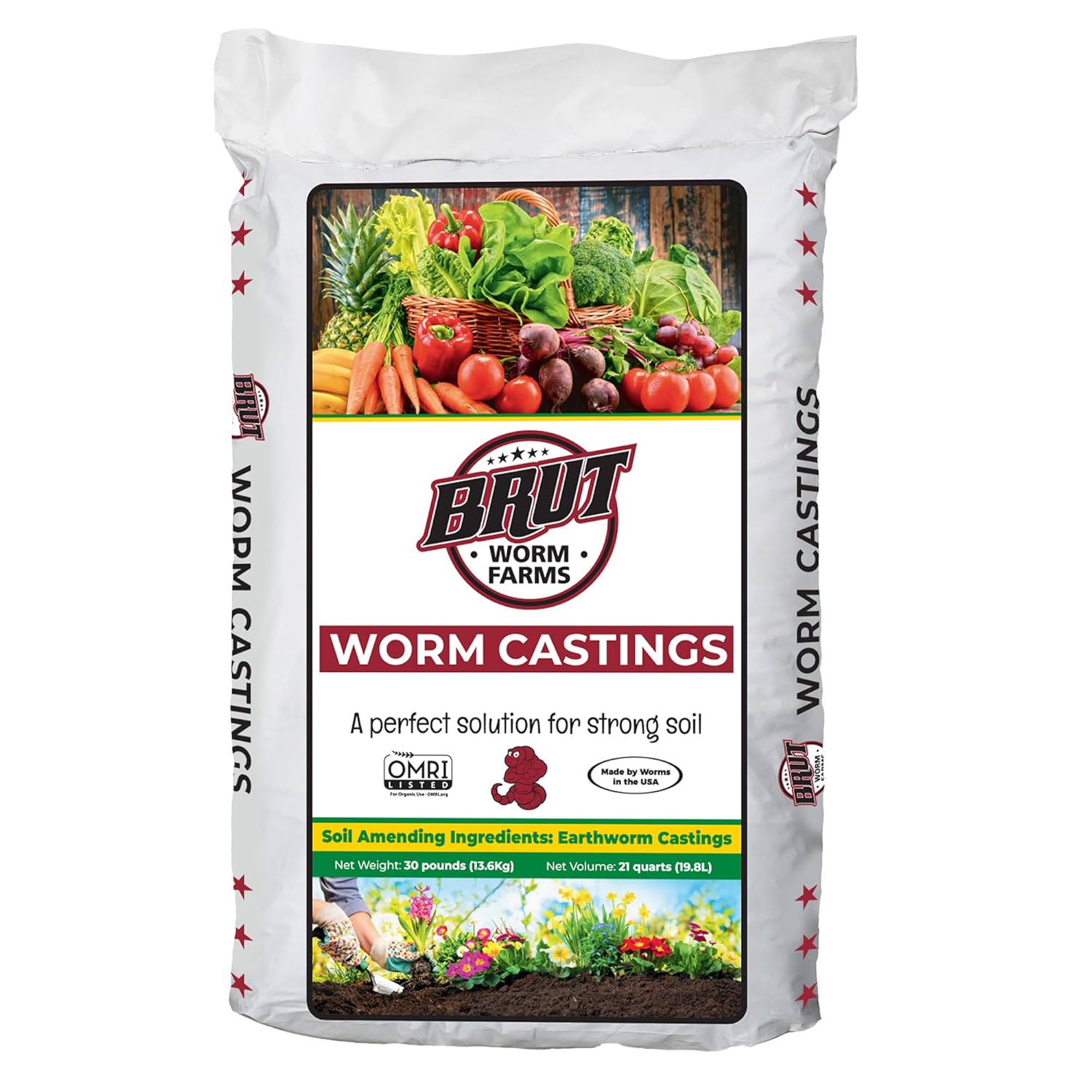
Brut Worm Farms Organic Worm Castings, 30 lb
| Item Form | bag |
|---|---|
| Specific Uses For Product | Gardening,Potting |
| Coverage | 30 |
| Target Species | houseplants, plants, shrubs, vegetables |
| Mixing Ratio | 1:5 |
Brut Worm Farms Organic Worm Castings are a ready-to-use soil amendment sold in a large 30 lb bag for gardeners who want to add nutrient-dense organic matter to potting mixes, containers, and garden beds. Use it as a top dressing, mix into potting soil at the recommended 1:5 ratio, or work a light amount into existing garden soil to improve aeration and water retention. The product is made from earthworm-processed organic material, so it delivers beneficial microbes and soluble nutrients without the risk of burning plants. Practical benefits include improved seedling vigor, healthier root development, and better moisture management in both indoor houseplants and outdoor vegetables or shrubs. Limitations are mostly logistical: a 30 lb bag is bulky to store and handle, and results are gradual since castings release nutrients slowly rather than providing a quick NPK spike. Also, users should follow handling guidance to avoid inhaling dust and keep the bag dry to preserve microbial life.
Best for: Gardeners seeking a reliable, organic soil amendment to steadily improve soil health and support a wide range of plants in containers and beds.
Less Ideal for: People who need a fast-acting chemical fertilizer for immediate greening or those who prefer small, easy-to-handle packages for occasional houseplant use.
- High in beneficial microbes and soluble nutrients that support root health
- Versatile application as a mix-in, top dressing, or soil amendment for indoor and outdoor plants
- Organic, slow-release nutrient profile that reduces risk of fertilizer burn
- Large 30 lb bag covers multiple containers or garden beds for season-long use
- Large bag can be heavy and awkward to move or store
- Nutrient delivery is gradual, so it is not a quick fix for severely deficient plants
Verdict: A large, organic worm-casting product that steadily builds healthier soil and stronger plants across indoor and outdoor gardens.
Fish Head Farms Organic Liquid Soil Conditioner (250 ml)

| Item Form | Liquid |
|---|---|
| Specific Uses For Product | Hydroponics |
| Application Method | Watering |
| Liquid Volume | 250 ml |
| Mixing Ratio | 2:1 |
Fish Head Farms Organic Liquid Soil Conditioner is a concentrated microbial product intended to strengthen soil biology and improve plant uptake of nutrients. It is mixed with water (mixing ratio 2:1 or 2 teaspoons per gallon as directed) and applied through regular watering, so it fits easily into established garden routines. The formula emphasizes microbial diversity and claims thousands of species per dose, which in practice can help break down compacted clay over time by enhancing aggregation and root development rather than directly changing soil texture overnight. It is OMRI-listed and described as safe for organic systems, making it suitable for vegetable beds, potted plants, and hydroponic setups. Practical benefits include easier nutrient availability, support for root vigor, and a low-odor, no-residue application that can be used routinely. Limitations are that biological conditioners work gradually and require repeated applications and good cultural practices to see marked improvement in heavy clay; this product does not replace physical amendments like gypsum or coarse organic matter for rapid decompaction.
Best for: Gardeners seeking a low-maintenance, biology-first approach to improve nutrient availability and root vigor across vegetable beds, containers, and small lawns. This fits owners who plan to use recurring biological inputs alongside regular cultural care.
Less Ideal for: People who need immediate physical decompaction of dense clay or want a single quick fix for compaction; those should prioritize bulk organic matter or physical amendments instead.
- Concentrated living microbial formula that supports nutrient mineralization and root health
- OMRI-listed and described as safe for organic use and multiple growing methods
- Easy to apply with normal watering routines and low odor
- Works in both soil and hydroponic systems so it fits varied garden setups
- Biological improvement is gradual and requires repeat applications to affect heavy clay
- Does not directly change physical soil structure as a substitute for coarse organic amendments
Verdict: Choose this product if you want a certified organic, microbe-rich liquid conditioner to steadily improve root health and nutrient availability in clay soils when used as part of a regular biological program.
Choosing the Right Organic Soil Conditioner: Key Factors to Consider
Organic Matter Content
The percentage and quality of organic matter determine how much a conditioner will increase soil water retention and cation-exchange capacity. High organic matter improves crumb structure in heavy soils and raises moisture-holding ability in sandy soils. Look for materials that list percent organic matter or provide composition details so you can estimate long-term benefits.
Quality matters as much as quantity. Well-composted inputs are stable and feed microbes slowly, while fresh materials can draw nitrogen during decomposition. Consider how soon you need results and whether you can accept a short-term nutrient tie-up when selecting a conditioner.
Particle Size and Texture
Particle size affects how easily a conditioner mixes into existing soil and how it influences drainage and aeration. Fine, crumbly compost integrates quickly and smooths soil surface, while chunkier materials like wood chips improve aeration but take longer to break down.
Match texture to your use. For seedbeds and containers, choose finer particles to avoid air pockets and uneven settling. For paths, mulch, or surface topdressing, coarser textures can protect soil and reduce erosion while slowly contributing organic matter.
Decomposition Rate and Longevity
Different organic conditioners break down at different rates, which affects how long structural benefits last and when they release nutrients. Fast-decomposing materials like leaf mold and well-rotted manure release nutrients sooner and improve tilth quickly. Slow-decomposing materials such as aged bark or biochar provide longer-term bulk and aeration.
Think about planting schedules and whether you prefer immediate improvement or a long-term amendment. Mixing fast and slow materials can offer an early boost while maintaining lasting structure.
Effect on Soil Nutrient Balance
Some conditioners contribute significant nutrients, while others mainly change physical properties. Composts and manures add nitrogen, phosphorus, and potassium as they mineralize, whereas inert materials mainly improve porosity and moisture retention.
Assess your soil test results if available. Use nutrient-rich conditioners to correct deficiencies, but avoid repeated heavy applications that can unbalance soil salts. Consider the carbon-to-nitrogen ratio of the amendment to predict short-term nitrogen demand during decomposition.
Microbial and Biological Support
A conditioner that feeds beneficial microbes will improve soil aggregation and nutrient cycling over time. Well-aged composts, worm castings, and diverse plant-based amendments increase microbial diversity and provide substrates for fungi and bacteria.
Products that encourage biology reduce the need for repeat interventions because they help soil self-regulate. Avoid materials treated with biocides or heavy chemical residues that can suppress beneficial organisms.
Application Practicalities
Consider how you will apply the conditioner. Some materials are dusty or heavy and require protective equipment or machinery to spread. Bagged products may be easier for small yards, while bulk deliveries suit larger areas. Storage stability and odor during wet periods also affect usability.
Think about seasonality too. Certain conditioners are best incorporated in fall so decomposition proceeds over winter, while others can be topdressed just before planting. Choose a product that fits your labor capacity and timing.
Best Use Cases by Garden Type
Different gardens need different conditioner profiles. Raised beds and containers benefit from light, fine-textured conditioners that keep mixes airy without compacting. Vegetable plots often benefit from nutrient-rich composts that support heavy feeders, while ornamentals and native plantings may do better with low-nutrient, structure-focused materials.
For large landscape beds or erosion-prone slopes, choose bulk organic matter that resists washout and gradually builds soil. Small urban plots may need compact, low-odor options that are simple to store and apply.
- Raised beds and containers: fine-textured, well-aged compost
- Vegetable plots: balanced compost or well-rotted manure
- Ornamentals and native plantings: low-nutrient, high-structure amendments
- Large areas and topdressing: bulk, coarse organic matter mixed with seedbed work
How to Incorporate Conditioners Into Existing Soil
For a quick improvement in tilth, lightly fork or till a few inches of conditioner into the top 6 to 8 inches of soil. This is appropriate for annual vegetable beds and new planting areas. Avoid overworking wet soil to prevent compaction.
When building long-term soil health, layer organic matter on the surface as mulch and let worms and weather incorporate it over seasons. This no-till approach preserves soil structure and encourages biological activity.
- Light incorporation: fork in 2 to 4 inches for annual beds
- Deep incorporation: mix to 8 inches when preparing new beds or correcting heavy clay
- Topdressing: apply 1 to 3 inches and allow natural incorporation for perennial beds
Combining Conditioners with Fertility Plans
Use conditioners as part of an overall fertility strategy rather than the sole source of nutrients. Test soil first to identify specific deficiencies. Pair nutrient-rich conditioners with cover crops or targeted organic fertilizers when fast nutrient availability is needed.
For steady, low-maintenance gardens, choose conditioners that slowly release nutrients and feed microbes so supplemental feeding is minimized. Match the conditioner to crop needs and planting timelines.
- Use soil test results to prioritize amendments
- Combine fast-release and slow-release materials for balanced feeding
- Avoid excessive nitrogen-demanding raw materials near young transplants
Timing and Seasonal Considerations
Fall is an ideal time to add conditioners that will decompose over winter and be ready for spring planting. Spring applications work too but may require choosing more stable materials to avoid nitrogen drawdown during the growing season.
In summer, focus on surface mulches to conserve moisture rather than deep incorporation. Cold climates benefit from late-summer or fall soil building so biological activity peaks before winter dormancy.
- Fall application: allows winter decomposition and soil conditioning
- Spring application: use stable, well-aged materials to prevent nutrient tie-up
- Summer: prioritize mulching and moisture conservation
Safety, Sourcing, and Sustainability
Know the source of your organic material. Well-produced composts should be free of persistent contaminants and weed seeds. Ask for production details when buying bulk; for bagged products, read composition statements to ensure materials are appropriate for edible gardens.
Consider sustainability: locally produced composts reduce transport impacts and often provide a more diverse feedstock. Avoid inputs that may contain biosolids or unprocessed municipal waste unless you have clear assurances about treatment and testing.
- Check for weed seeds and contaminants in source material
- Prefer locally produced or certified organic inputs when possible
- Store materials off the ground and cover to prevent nutrient leaching
How We Chose the Best Organic Soil Conditioner
We focused on attributes that directly affect how a soil conditioner performs in a working garden. Our evaluation emphasized soil-structure improvement and long-term nutrient contribution, because those determine how quickly soil becomes easier to cultivate and how well it supports crops. We also considered organic matter content and decomposition rate, since fast-decomposing materials act differently than slow-release sources when mixed into beds or topdressed. Particle size and consistency were included because they influence incorporation and erosion risk. Soil biology support was a distinct filter, looking for conditioners that feed microbial communities rather than just diluting soil. Practical handling characteristics such as dustiness, odor, and ease of spreading were weighed for gardeners who work with the material by hand or with a spreader. Products were excluded if they relied primarily on synthetic additives, contained unprocessed contaminants, or lacked clear composition information. We also set minimum expectations for traceability and declared organic inputs. The final shortlist balances immediate physical improvements with lasting biological benefits to help gardeners choose materials that work in real planting situations.
FAQ
How much organic soil conditioner should I add to my vegetable bed?
A common approach is to incorporate 2 to 4 inches of conditioner into the top 6 to 8 inches of soil for an annual bed. For long-term improvement, topdress 1 to 3 inches annually and let biology gradually integrate the material.
Can I use fresh manure as a soil conditioner?
Fresh manure can be high in nitrogen and may contain weed seeds or pathogens. Well-aged or composted manure is safer and less likely to cause nitrogen drawdown. Composting manure before application reduces risks and stabilizes nutrients.
Will adding organic conditioner change my watering needs?
Yes. Organic matter increases water-holding capacity in sandy soils and can improve drainage in heavy soils. Expect some change to irrigation frequency as your soil's moisture-holding properties evolve, and monitor moisture rather than relying on fixed schedules.
How quickly will I see benefits after applying a conditioner?
Physical improvements like better crumb structure and easier digging can appear within weeks for fine, well-aged materials. Biological and nutrient-related benefits often develop over months to seasons as organic matter breaks down and microbes increase.
Is it safe to use soil conditioner in containers and pots?
Yes, when you choose fine-textured, well-aged conditioners designed for container mixes. Avoid coarse or high-carbon materials that can create air pockets or tie up nitrogen in confined root spaces.
Can I over-apply organic conditioner?
Over-application can create overly rich or hydrophobic layers and may temporarily immobilize nitrogen with very high-carbon materials. Aim for modest yearly additions or blend conditioners with native soil to avoid creating imbalances.
Final Verdict
Prioritize conditioners that match your garden goals: choose nutrient-rich, fast-decomposing materials when you need immediate fertility and fine texture, or select coarse, stable amendments for long-term structure and aeration. Balance particle size, decomposition rate, and biological support to avoid short-term nutrient tie-up or handling issues. By aligning your choice with garden type, planting schedule, and labor capacity, you can steadily rebuild soil health and reduce the need for frequent interventions.
