

Note: This article contains affiliate links. If you click on these links and make a purchase, I may earn a small commission at no extra cost to you. This helps support my research and content. Read my full affiliate disclosure here.
A pressurized pond filter can dramatically cut pond upkeep by combining mechanical and biological filtration inside a weatherproof housing. For ponds with fish, waterfalls, or heavy plantings, the right pressurized pond filter maintains clarity, supports beneficial bacteria, and simplifies winter care so you spend less time cleaning and more time enjoying the water. This guide covers seven shortlisted pressurized pond filters chosen for different pond sizes and setups and explains the features that matter most to homeowners and hobbyist pond keepers. Read on for the evaluation criteria we used and practical buying guidance to match a filter to your pond.
Top Picks at a Glance
| Best Overall The best all-around choice for most situations | VIVOHOME 2640 GPH Auto‑Cleaning Pressurized Bio Pond Filter with 18W Light |  |
| Best Quality Built to a higher standard if you want something more solid | Danner Pondmaster Clearguard Pressurized Pond Filter (5,500 gal capacity) |  |
| Best Value The sweet spot between price and what you get | CNZ CPF-2500 Pressure Pond Filter with 720 GPH Pump and 13W Clarifier |  |
| Best Budget The cheapest option that still gets the job done reliably | Jebao CF-10 Pressurized Pond Bio Filter with 13W UVC Clarifier |  |
| Highest Rated A top-rated pick with lots of positive feedback | The Pond Guy SimplyClear Pressurized Filtration System, 2500 |  |
| Most Popular A crowd favorite that many people choose with confidence | TotalPond Complete Pressurized Pond Filter with 9W UV Clarifier |  |
| Best Seller A high-volume bestseller chosen again and again | VIVOHOME VH515 Pressurized Biological Pond Filter with 13W UV Light |  |
VIVOHOME 2640 GPH Auto‑Cleaning Pressurized Bio Pond Filter with 18W Light

| Max flow | 2640 GPH |
|---|---|
| Suitable pond capacity | Up to 3170 gallons (ornamental) / 1585 gallons (koi) |
| Light power | 18W |
| Filter media | 20 PPI and 25 PPI sponges plus bio-balls |
The VIVOHOME 2640GPH pressurized bio pond filter is built to keep medium-sized freshwater ponds clear with minimal fuss. It combines coarse and fine sponge pads plus bio-balls for mechanical and biological filtration, and an internal 18W lamp with a simple 0/12/24-hour timer to help control algae and maintain water clarity. Installation is straightforward: attach the pump hose using the included adapters, set the timer, and use the FILTER/CLEAN lever when prompted. Cleaning is genuinely easier than many gravity filters because the motorized auto-clean cycle spins and flushes the sponges at the flip of a switch, then signals completion with a beep. The unit is weather-resistant and intended for ponds up to the stated capacities, so it suits decorative and koi setups in that range. Limitations to note are freshwater-only use and reliance on a compatible pump (pump not included). The light has a finite lifespan and will need replacement after several months of regular use, but a spare bulb and replacement guide are provided.
Best for: Homeowners who want a low-maintenance, reliable filter that balances automatic cleaning, biological filtration, and an integrated light for medium ornamental or koi ponds.
Less Ideal for: People maintaining saltwater systems or those who need filtration for very large koi ponds beyond the stated capacity should look at more heavy-duty or saltwater-rated solutions.
- Auto-cleaning motorized flush cycle reduces manual maintenance
- Multi-stage filtration (coarse and fine sponges plus bio-balls) for mechanical and biological clarity
- Built-in 18W lamp with 0/12/24H timer to help limit algae growth
- Includes multiple hose adapters for broad pump compatibility
- Durable ABS construction with IP44 splash protection for outdoor use
- Not suitable for saltwater ponds due to corrosion risk
- Requires a separate compatible pump which is not included
Verdict: Choose this filter if you want an easy-to-maintain, pressurized biological system with auto-cleaning and a timed light for medium-sized freshwater koi or ornamental ponds.
Danner Pondmaster Clearguard Pressurized Pond Filter (5,500 gal capacity)

| Capacity | 5,500 Gallons |
|---|---|
| Maximum Pressure | 15 PSI |
| Recommended Pump | Up to 6000 GPH |
| Fittings | 1 1/2" & 2" PVC Slip and ABS Barb |
The Danner Pondmaster Clearguard is a heavy-duty pressurized pond filter designed to keep pond water clear by combining reusable foam pad polishing with Bio-Matrix spherical media for biological filtration. It is typically installed inline with a pump and can be buried for a discreet setup; the multi-function valve lets you switch quickly between filter, backwash, rinse, winterize, empty, circulate and close without disassembling the unit. Practical benefits include effective removal of fine debris via the foam pad and a substantial biological surface area from the media that supports clearer, healthier water. The unit accepts 1 1/2" and 2" fittings and supports pumps up to about 6,000 GPH while handling up to 15 PSI, making it suitable for performance-focused systems. Limitations include its large physical footprint and weight which affect siting and handling, and the need for occasional backwashing or pad maintenance to retain peak performance. The optional backwash air kit can improve cleaning but is sold separately.
Best for: Buyers who prioritize robust biological and mechanical filtration for medium to large outdoor ponds and want a pressurized, buryable unit that supports high-flow pumps and easy valve-driven maintenance.
Less Ideal for: Casual pond owners with very small water features or those who need a lightweight, portable filter for temporary setups.
- Combines mechanical foam polishing with Bio-Matrix spherical media for dual-action filtration
- Multi-function valve with selectable modes for filtering, backwashing, rinsing and winterizing
- Pressurized, buryable canister allows flexible, discreet installation
- Accepts common 1 1/2" and 2" fittings and works with pumps up to ~6,000 GPH
- Large and heavy unit that can be awkward to move or site
- Optional backwash air kit is not included and must be purchased separately
Verdict: A performance-focused, buryable pressurized filter that pairs mechanical polishing with substantial biological media to keep medium to large ponds clear.
CNZ CPF-2500 Pressure Pond Filter with 720 GPH Pump and 13W Clarifier

| Flow Rate | 12 gpm |
|---|---|
| Maximum Lifting Height | 9.2 feet |
| Horsepower | 0.07 hp |
| Material Type | Polypropylene (PP), Stainless Steel |
| Suitable Pond Size | Up to 1,600 gallons |
The CNZ CPF-2500 is a pressurized canister filter paired with a 720 GPH submersible pump and an integrated 13W clarifier, designed to support circulation and water quality in small to medium garden ponds. Installation is straightforward: the pump sits submerged while the filter can be recessed at the pond edge and connects with stepped adapters for 1/2 to 1-1/4 inch tubing. Inside, separate mechanical and biological chambers trap solids and promote beneficial bacteria, and a top-mounted quick-handle cleaning mechanism plus a contamination indicator make routine maintenance faster and less messy. The included pump is rated for a 9.2 foot lift so it will handle modest waterfalls or stream runs, though actual flow will drop with longer tubing or higher lifts. The filter itself accepts higher maximum flows than the supplied pump, which gives flexibility to upgrade the pump later. Expect a compact footprint and durable plastics and stainless components, but plan for occasional cleaning and to match tubing and lift to your pond layout for best performance.
Best for: Buyers who want a practical, all-in-one pressurized filter and pump that simplifies pond maintenance and supports modest water features without complicated installation.
Less Ideal for: Large ponds with heavy fish loads or extensive waterfalls that need higher sustained flow or very large filtration capacity should consider a larger commercial-grade system.
- Combined mechanical and biological filtration with an integrated clarifier for clearer water
- Includes a 720 GPH submersible pump with up to 9.2 feet lift suitable for small waterfalls or stream features
- Quick-handle top cover and contamination indicator simplify routine cleaning and monitoring
- Stepped hose adapters support multiple tubing sizes for flexible pondside installation
- Included pump flow will decline with lift and long hoses, limiting performance for larger or higher-featured ponds
- Filter is compact and may require more frequent cleaning in heavily stocked or heavily planted ponds
Verdict: A compact, easy-to-maintain pressurized filter-and-pump combo that delivers combined mechanical and biological filtration plus a clarifier for practical pond upkeep and small water features.
Jebao CF-10 Pressurized Pond Bio Filter with 13W UVC Clarifier

| Cleans ponds up to | 1000 gallons (goldfish), 500 gallons (koi) |
|---|---|
| Recommended pump flow | 850 to 1250 GPH |
| UV wattage | 13W |
| Inlet/outlet size | 1/2", 3/4", 1" (recommend 1" hose) |
The Jebao CF-10 is a pressurized external pond filter that combines mechanical foam filtration, bio-ball biological media, and a 13W UVC clarifier in one unit. It is typically used with a pump that moves 850 to 1250 GPH and is intended to clarify ponds up to roughly 1000 gallons for goldfish ponds or up to 500 gallons for heavier fish loads. Installation is straightforward: connect inlet and outlet hoses, place the unit below the pond water level or in-line with a suitable pump, and use the viewing window to monitor the UV. Notable features include two foam discs for staged mechanical filtration, bio-balls for nitrifying bacteria, a quartz-covered UV lamp to improve clarity, and a backwash port for easier cleaning. In practice this yields clearer water and reduced maintenance compared with simple skimmers, and the pressurized design lets you bury or hide the unit. Limitations are the modest flow recommendations and UV size, which mean it is best for small to medium ponds rather than large koi systems, and occasional lamp replacement and proper pump matching are required to get peak performance.
Best for: A practical pond owner looking for an affordable, all-in-one pressurized filter to cut maintenance and improve clarity on small to medium backyard ponds.
Less Ideal for: Owners of large koi ponds or heavily stocked ponds should choose a higher-capacity filtration system designed for greater flow and larger UV clarification.
- Integrated 13W UVC clarifier for reducing suspended algae and improving water clarity
- Combined mechanical and biological filtration with foam discs and bio-balls for multi-stage cleaning
- Backwash facility and viewing window simplify maintenance and monitoring
- Pressurized design allows semi-buried or concealed installation
- Rated flow and stated pond capacities limit use to small and medium ponds with light to moderate fish loads
- Requires matching pump capacity and periodic UV lamp replacements to maintain effectiveness
Verdict: A budget-friendly, compact pressurized filter that delivers mechanical, biological, and UV clarification for small to medium backyard ponds.
The Pond Guy SimplyClear Pressurized Filtration System, 2500

| Pond capacity | Up to 2,500 Gallons |
|---|---|
| Max flow rate | 2200 GPH |
| Filtration types | Mechanical, Biological, Ultraviolet (UVC) |
| UV clarifier | 9-Watt |
The Pond Guy SimplyClear 2500 is an all-in-one pressurized filtration unit that pairs multi-stage mechanical and biological media with a 9-watt UVC clarifier to keep larger ponds clear. It is installed outside the pond on a solid surface or partially buried and connects to standard kink-free tubing sizes from 3/4" to 1 1/2". Daily use is straightforward: water passes through alternating high- and low-density filter pads that trap debris and host beneficial bacteria, then flows through the UV chamber for algae and microscopic clearing. Maintenance is designed to be low effort thanks to the backflush lever and clear discharge fitting for visual flushing. Practical benefits include reduced pond maintenance, a compact footprint for a 2,500 gallon rating, and integrated UV polishing to cut green water. Limitations are that the UV bulb needs seasonal replacement to stay effective and the unit should be removed or fully drained in freezing climates to avoid ice damage, and peak flow guidance means you must match pump output to the filter's recommended range for best results.
Best for: Buyers who prioritize a dependable, low-maintenance pond filter that consolidates mechanical, biological, and UV treatment into one compact, install-and-forget system for medium to large outdoor ponds.
Less Ideal for: People who need a filter system that runs year-round in freezing climates without winter removal or those who want the highest possible flow rates for large waterfalls without matching pump control.
- 3-in-1 filtration combines mechanical, biological, and UV clarification in one pressurized unit
- Backflush lever and clear discharge fitting simplify cleaning and reduce hands-on maintenance
- Supports ponds up to 2,500 gallons, suitable for moderate to large backyard ponds
- Works with common kink-free tubing sizes for flexible plumbing and easy integration
- UV bulb requires seasonal replacement to maintain effectiveness
- Must be drained and removed in freezing conditions to prevent ice damage
Verdict: A reliable, low-maintenance pressurized filter that delivers combined mechanical, biological, and UV cleaning for ponds up to 2,500 gallons.
TotalPond Complete Pressurized Pond Filter with 9W UV Clarifier

| Capacity | 1200 gallons |
|---|---|
| Other Special Features of the Product | UV Clarification |
| Purification Method | Ultraviolet |
| Power Source | Ac/DC |
| Included Components | Filter body, 9W UV Clarifier, 2 filter pads, 12 bio-balls |
The TotalPond Complete Pressurized Pond Filter combines mechanical pads, bio-balls and a 9W ultraviolet clarifier into a single freestanding unit for ponds and waterfalls up to 1200 gallons. You install your own pump and route water through the inlet so it passes the UV chamber, then two filter pads and the bio-ball chamber where beneficial bacteria establish. The enclosed, pressurized design keeps water moving and reduces clogging compared with open-media boxes, and the included stepped adapters accept 3/4 or 1 inch ID tubing for common pond setups. Practical benefits include simpler maintenance from the removable lid and preloaded media, plus UV-treated flow that helps clear green water and controls single-cell algae. Limitations are that the unit requires a separate pump sized to your pond and the 9W UV is modest for very high sunlight or larger koi ponds, so heavy algae pressure may need a stronger clarifier or supplemental filtration. The plastic housing is lightweight and easy to hide but not as rugged as heavy-duty commercial filters.
Best for: Buyers who want a single, compact filter that simplifies startup and maintenance while improving water clarity for backyard koi or decorative ponds and who prefer choices supported by established product reviews.
Less Ideal for: Large commercial koi collections, very high-biomass ponds, or owners who want an all-in-one pump-plus-filter solution without adding a pump.
- Integrated 9W UV clarifier to reduce green water and microscopic algae
- Pressurized design promotes steady flow and helps prevent debris settling
- Includes mechanical filter pads and bio-balls for combined mechanical and biological filtration
- Fits common tubing sizes with stepped adapters for straightforward plumbing
- Removable watertight lid and included media make initial setup and routine cleaning easier
- Requires a separate pond pump so additional cost and pump sizing are necessary
- 9W UV output is limited for very large or high-algae ponds
Verdict: A compact pressurized filter with UV and biological media that reliably improves clarity for backyard koi ponds up to 1200 gallons.
VIVOHOME VH515 Pressurized Biological Pond Filter with 13W UV Light
| Power Source | Electric |
|---|---|
| Voltage | 110 volts |
| Horsepower | 13 watts |
| Material Type | Acrylonitrile Butadiene Styrene (ABS) |
| Included Components | Filter, UV sterilizer light (13W) |
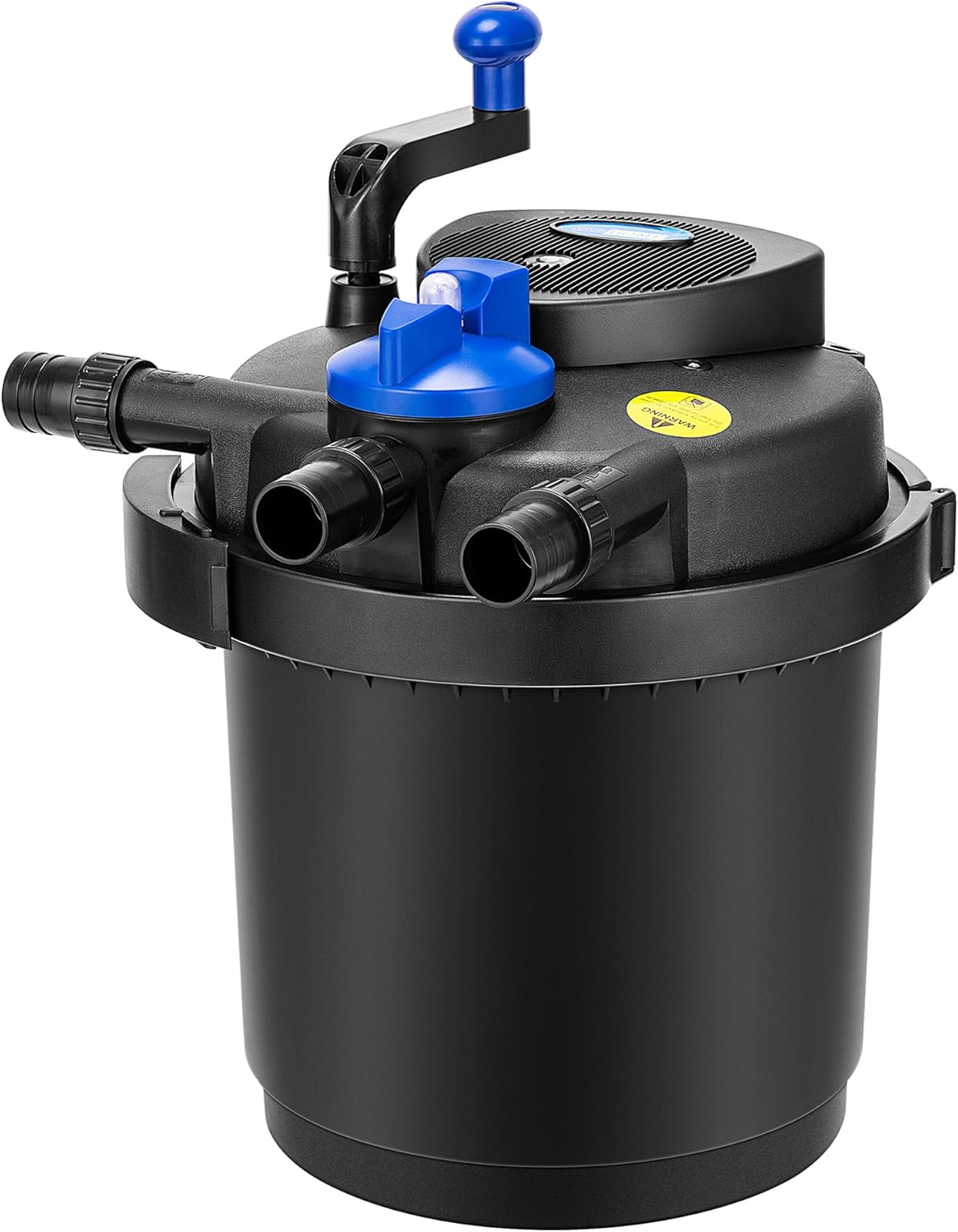
The VIVOHOME VH515 is a pressurized biological filter intended to keep koi and decorative ponds clear by combining mechanical sponge filtration with a 13W UV clarifying lamp. It is installed inline with a separate water pump and connects via the included multi-size hose adapters. Water passes through coarse and fine reusable sponges that trap debris while the lamp reduces free-floating algae, and a simple handle-driven backwash lets you switch to Clean mode and flush accumulated muck without disassembling the unit. The ABS, weather-resistant housing and clear inlet/outlet labels make outdoor siting straightforward and reduce installation guesswork. Practical benefits include low ongoing consumable cost because sponges are reusable, simple routine maintenance signaled by a red float, and compatibility with ponds up to about 1,600 gallons (ornamental) or 800 gallons with fish. Important limits are that the unit requires a separate pump and the UV bulb has a finite lifespan and must be replaced if water breaches the lamp seal; performance also depends on matching pump flow and hose size for steady filtration.
Best for: Buyers who want a low-maintenance, reliable filter for a small to mid-size koi or ornamental pond and prioritize simple installation and predictable upkeep.
Less Ideal for: Not the best choice for very large or heavily stocked ponds where industrial-scale filtration or integrated pumping is needed; pond owners who prefer fully submersible combo units should look elsewhere.
- Combined mechanical and UV clarification reduces both debris and free-floating algae
- Reusable coarse and fine sponge media lowers ongoing replacement costs
- Handle-driven backwash makes routine cleaning quick and tool-free
- Includes multiple hose adapters and clear inlet/outlet labeling for easier installation
- Weather-resistant ABS housing suited for year-round outdoor use
- Requires a separate water pump so total system cost and compatibility must be planned
- UV lamp has limited life and can fail if the lamp compartment seal is compromised
Verdict: A straightforward, low-maintenance pressurized biofilter that pairs with your pump to deliver clear water and easy weekly backflushing for small to mid-size koi and ornamental ponds.
Choosing the Right Pressurized Pond Filter: Key Factors to Consider
Flow Rate and Pond Size Compatibility
Matching filter flow rate to your pond and pump determines how effectively water circulates through the media. A filter with insufficient flow capacity will not process enough water to control ammonia and suspended solids, while an overspecified unit can create excessive turnover that stresses plants and some fish.
Look for clear GPH or LPH ratings and recommended pond sizes. Account for elevation and waterfalls by factoring head height into pump selection so the pump and pressurized filter operate within compatible ranges.
Filter Media Volume and Type
The internal volume available for mechanical and biological media affects how much debris the filter can trap and how many beneficial bacteria it can support. Larger media capacity generally extends time between cleanings and improves nitrification.
Consider media configuration: layered mechanical foam or pads followed by bio-media increases efficiency. Some pressurized filters accept a mix of loose media and cartridges; others use dedicated trays. Choose a design that supports the biological load typical of your stocking and plant cover.
Maintenance Access and Cleaning Frequency
How easily you can reach the media and remove trapped solids will determine how often you actually clean the system. Pressurized designs vary between tool-free quick-release tops and units that require partial disassembly. Filters that permit rinsing media without disturbing beneficial bacteria save time and protect pond stability.
Also consider whether included components like pre-filter pads are replaceable and how straightforward cartridge swaps are. Systems that minimize downtime and mess are better for backyard gardeners who prefer low-maintenance equipment.
Plumbing, Seal Durability, and Leak Risk
Because these filters operate under pressure, the quality of fittings, O-rings, and hose or pipe connectors matters. Robust seals prevent air intrusion and leaks that can disrupt pressure balance and reduce filtration effectiveness. Metal clamps, reinforced hose barbs, or threaded unions tend to last longer than thin plastic connectors.
Evaluate the ease of accessing and replacing seals, and whether the unit supports standard pipe sizes for simple plumbing compatibility. A well-sealed pressurized filter also simplifies winter shutdowns and reduces the chance of burst fittings.
Backwashing and Debris Handling
Some pressurized pond filters include integrated backwash valves or purge ports to flush trapped solids without full disassembly. This feature can dramatically reduce maintenance time and extend media life. Filters without backwash options rely on manual rinsing, which is more labor intensive.
Consider the types of debris your pond produces. Leaf-heavy ponds or those with large solids benefit from pre-filters and easy-to-access mechanical stages that trap debris before it reaches bio-media.
Cold-Weather Performance and Winter Care
In climates with freezing temperatures, pressurized filters must either be installed in frost-protected locations or have a clear wintering procedure. Entrapped water in housings and fittings can freeze and crack components if not drained properly. Filters that permit full drainage of internal volume and have accessible removeable media trays are easier to winterize.
Assess whether the unit's design allows you to keep beneficial bacteria alive in place or if you should store media indoors. Reliable wintering reduces spring workload and protects equipment lifespan.
Sizing a Pressurized Filter for Different Pond Types
Pond type influences filter sizing beyond surface area. Stocked fish ponds need higher turnover for waste removal than plant-dominated ponds, while water features with waterfalls require additional pump head and higher flow capability. Estimate the total pond volume, then aim for a filter and pump combination that cycles that volume at least once every two to four hours depending on stocking density.
Also factor in additional flow losses from valves, tubing, and elevation changes. When in doubt, prioritize a slightly larger filter media volume and check that the manufacturer's flow curve aligns with your pump's head output.
- Heavily stocked ponds: aim for faster turnover and larger media capacity
- Plant-heavy ponds: moderate turnover supports plants while preserving clarity
- Waterfalls and elevated features: size pump and filter for additional head loss
Installation Tips for Reliable, Leak-Free Plumbing
Use the recommended pipe sizes and support unions to minimize stress on fittings. Apply plumber-grade thread tape where threaded fittings are used and avoid overtightening plastic nuts which can crack. If the unit uses hose connections, choose reinforced tubing and secure with stainless steel clamps to prevent slippage under pressure.
Position the filter on a stable base to prevent movement and use flexible connectors to absorb minor shifts from freeze-thaw cycles. Clear access around the filter makes winterizing and routine maintenance faster and safer.
- Mount on a level, compacted base to avoid tipping
- Use unions or quick-disconnects for easier removal
- Label inlets and outlets to avoid installation errors
Media Options and How They Affect Water Quality
Mechanical media captures particles, while biological media provides surface area for nitrifying bacteria. High-density foams and layered pads handle larger solids well, while porous ceramic or plastic biomedia supports a high bacteria population. Some systems include chemical media for specific water issues but these are seldom necessary in most backyard ponds.
Think about service intervals: media that can be rinsed in pond water preserves bacteria colonies, whereas disposable cartridges require replacement and can increase ongoing maintenance tasks.
- Rinsable foam pads extend service intervals
- Porous bio-rings maximize nitrifying surface area
- Chemical media used sparingly for targeted issues
Routine Maintenance Schedule and Winterizing
Establish a seasonal maintenance rhythm: inspect and rinse mechanical media every 2 to 8 weeks depending on debris load, check seals and fittings monthly, and monitor biological media activity during warm months. Use backwash or purge functions where available to remove settled solids quickly.
Before freezing weather, follow the unit's draining instructions and either store removable media indoors or ensure it drains fully. Avoid running pumps into a frozen discharge as pressure buildup can damage fittings.
- Inspect seals monthly
- Rinse mechanical media regularly, less often for bio-media
- Drain and secure components before hard freezes
Troubleshooting Cloudy Water and Algae Issues
Cloudy water is often a sign of inadequate mechanical filtration, excess organic load, or an imbalance in biological processing. Start by confirming flow rates and cleaning mechanical media. If flow is fine but clarity remains poor, check biological media for clogging and consider adding more bio-surface area.
Algae blooms usually point to high nutrient levels and sunlight exposure. Reduce nutrient input through regular debris removal and consider shading or plantings to limit sunlight. A properly functioning pressurized filter reduces dissolved waste that fuels algae growth.
- Verify pump and filter flow compatibility
- Clean or backwash mechanical stages first
- Manage nutrients and light to control algae
How We Chose the Best Pressurized Pond Filter
We focused on attributes that directly affect everyday performance and long-term pond health. Key evaluation criteria included flow rate capacity to match pond size and pump output, filter media volume and access for biological colonization, ease of maintenance including lid and cartridge access, build and plumbing durability for outdoor exposure, and wintering capability for colder climates. We prioritized models that offer clear specifications for gallons per hour and recommended pond size so gardeners can pair the filter with their pump and water features. Filters that required frequent or complex cleaning or that lacked accessible media trays were excluded. We also evaluated how well units handle debris and whether they support effective beneficial bacteria colonization. Any item without clear filtration flow specs, inadequate media capacity, or weak sealing for pressurized plumbing was not considered for the shortlist.
FAQ
How do I size a pressurized pond filter for my pond?
Size by pond volume and stocking level. Aim to turn the full volume every two to four hours for fish-heavy ponds and slower for plant-dominant setups. Also match the filter's flow rating to the pump's flow at the actual head.
Can I run a pressurized filter all winter?
Running through winter depends on climate and design. In mild areas you can often run continuously, but in freezing climates you should drain and winterize the unit or keep it in a frost-free location. Ensure fittings can be fully drained to prevent freeze damage.
How often should I clean the filter media?
Cleaning frequency depends on debris load. Check mechanical media every 2 to 8 weeks and rinse when flow drops or pads look clogged. Biological media should be cleaned far less often and preferably rinsed in pond water to preserve bacteria.
Do pressurized filters need backwash valves?
Backwash valves simplify maintenance by flushing solids without full disassembly, and they reduce handling of beneficial bacteria. They are not strictly necessary, but they significantly cut cleaning time for debris-heavy ponds.
Will a pressurized filter remove algae?
Pressurized filters help by removing suspended particles and reducing dissolved nutrients that feed algae. They are part of an overall strategy that also includes shading, plant competition, and nutrient control rather than a standalone algae cure.
What pipe connections work best for pressurized filters?
Unions or threaded connections sized to the pump outlet are preferred for ease of maintenance. Reinforced hoses can be used with quality clamps, but avoid undersized tubing that restricts flow and increases fitting stress.
Final Verdict
Choose a pressurized pond filter that matches your pond's volume, debris load, and seasonal climate. Prioritize clear flow specifications, ample media volume, and thoughtful maintenance access to reduce chores and protect water quality. Remember the tradeoffs: compact units save space but may need more frequent servicing, while larger media capacity reduces maintenance at the cost of footprint. Focus on plumbing durability and wintering capability to ensure reliable, long-term performance.
