

Note: This article contains affiliate links. If you click on these links and make a purchase, I may earn a small commission at no extra cost to you. This helps support my research and content. Read my full affiliate disclosure here.
Picking the right Wifi water watering timer changes how you manage irrigation across containers, raised beds, and lawns. The correct timer keeps soil consistently moist, prevents overwatering, and lets you adjust schedules from a phone when weather or plans change. This guide looks at six shortlisted options built for home gardeners and light landscaping, focusing on how they behave in real garden conditions. We assess program flexibility, connection reliability, leak resistance, and watering capacity to help you choose a unit that fits your layout and routine. Read on for a practical overview of what matters and why these models made the cut.
Top Picks at a Glance
| Best Overall The best all-around choice for most situations | GoveeLife H5901 Smart WiFi Sprinkler Timer with Gateway (1‑Outlet) |  |
| Best Quality Built to a higher standard if you want something more solid | Orbit B-hyve XD 2‑Port Smart Hose Watering Timer |  |
| Highest Rated A top-rated pick with lots of positive feedback | RAINPOINT 2-Zone WiFi Garden Water Timer with Brass Inlet & Outlet |  |
| Most Popular A crowd favorite that many people choose with confidence | RAINPOINT WiFi Hose Timer with Smart Hub and Flow Meter |  |
| Best Seller A high-volume bestseller chosen again and again | Orbit B-hyve XD 1-Port Smart Hose Watering Timer |  |
GoveeLife H5901 Smart WiFi Sprinkler Timer with Gateway (1‑Outlet)

| Gateway‑device range | 1640 ft |
|---|---|
| Water pressure operating range | 7.25–116.03 PSI |
| Number of schedules | 10 |
| Watering modes | Continuous, intermittent, custom |
| Material type | Brass, Plastic |
The GoveeLife H5901 is a smart hose timer kit designed to replace a manual spigot with app-based, scheduled watering and basic water‑usage reporting. It installs on a standard 3/4‑inch threaded spigot and pairs to the included gateway so you can control the timer from anywhere within the gateway range. The system offers three watering modes (continuous, intermittent, custom) and up to 10 schedules, plus weather‑adaptive adjustments that skip rain or increase runtime in heat and low humidity. Brass inlet fittings and an IP67-rated housing aim to reduce leaks and stand up to outdoor conditions. The app shows charts of recent watering and supports Alexa and Google voice commands for hands‑free starts. Important limitations: the gateway requires 2.4 GHz Wi‑Fi, the valve needs a minimum starting pressure to operate properly, and only one outlet is controlled per timer so multi‑zone gardens require multiple units or devices.
Best for: Gardeners who prioritize reliable, data‑driven irrigation and want automated, weather‑responsive schedules controlled remotely or by voice.
Less Ideal for: People with multi‑zone irrigation needs who do not want to deploy multiple timers or those limited to 5 GHz‑only home networks.
- Weather‑adaptive scheduling that adjusts runtimes based on local rain and temperature data
- Gateway supports long range and multiple devices so you can centralize control across a property
- Brass connectors and IP67‑rated body reduce risk of leaks and stand up to outdoor exposure
- Up to 10 programmable schedules and three watering modes for flexible irrigation plans
- App provides watering charts and integrates with Alexa and Google Assistant for voice control
- Requires the separate gateway and 2.4 GHz Wi‑Fi which may limit some network setups
- Only a single water outlet per timer so larger multi‑zone systems need extra units or a different controller
Verdict: Choose this timer when you want a weather‑adaptive, remotely managed irrigation solution built for outdoor durability and centralized control.
Orbit B-hyve XD 2‑Port Smart Hose Watering Timer

| Brand Name | Orbit |
|---|---|
| Item Type Name | Sprinkler Timer |
| Item Highlight | Dual Outlet Irrigation Control, App Controlled, Weatherproof |
| Number of settings | 5 |
The Orbit B-hyve XD 2-Port Smart Hose Watering Timer automates outdoor watering for two separate hose lines, letting you run independent schedules for different garden zones. It is typically attached to an outdoor faucet and either programmed directly on the device or via the B-hyve mobile app over Bluetooth, with additional remote smart features unlocked when paired to Orbit’s Wi‑Fi hub. Key features include dual outlets for simultaneous but independent watering, WeatherSense weather-based adjustments that reduce unnecessary watering, and an IPX5 weatherproof housing suited to outdoor use. In practice this means less manual watering and smarter timing that responds to rainfall and local drought alerts. The unit is battery powered for easy installation and has a simple app workflow for scheduling. Important limitations are that full remote control and some WaterSense benefits require purchasing Orbit’s separate Wi‑Fi hub, and advanced users who need multi-zone central irrigation support should consider larger zone controllers instead.
Best for: Homeowners who want a straightforward, weather-aware smart timer to automate watering for a couple of distinct garden areas without running wires or complex controllers.
Less Ideal for: People managing large, multi-zone irrigation systems or those who need built-in Wi‑Fi remote control without buying an additional hub.
- Dual independent outlets let you water two areas with separate schedules
- WeatherSense automatically adjusts run times based on local weather data
- Bluetooth app control for local programming with optional Wi‑Fi hub for remote access
- IPX5 weatherproof design suitable for outdoor installation
- Full smart, remote features require a separately sold Wi‑Fi hub
- Limited to two outlets so not ideal for larger multi-zone irrigation systems
Verdict: A practical two-outlet smart hose timer that saves water with weather-aware scheduling and easy app control for typical home gardens.
RAINPOINT 2-Zone WiFi Garden Water Timer with Brass Inlet & Outlet

| Number of settings | 3 |
|---|---|
| Material Type | Brass Inlet & Outlet |
| Item Highlight | Long-Range WiFi Gateway, Smart Weather-Based Watering, Water Usage Tracking |
| Number of Items | 1 |
The RAINPOINT 2-zone WiFi water timer is a reliable smart hose timer built for routine garden and greenhouse watering. It connects to a long-range HWG023 gateway so you can place the hub near your router while the timer sits at the back of the yard, and the unit controls two independent zones from the mobile app. Notable features include solid brass inlet and outlet fittings that resist leaks under household water pressure, an IP65-protected battery compartment for outdoor durability, and a built-in flow meter that records water use for 30 days and up to 12 months of history. Weather-based watering and seasonal adjustment simplify schedules for travel or changing seasons, while three watering modes including cycle-and-soak and misting let you tailor irrigation for lawns, clay soils, seedlings, or greenhouse humidity. Expect straightforward everyday use and meaningful water savings, though setup requires the gateway for long-range WiFi and the unit depends on battery power and the app for advanced scheduling.
Best for: Gardeners who prioritize dependable, low-maintenance automatic watering and want durable plumbing connections plus actionable water-use data to avoid surprises.
Less Ideal for: People who need a completely wired, mains-powered controller or those who prefer a single simple mechanical timer without app-based scheduling.
- Brass inlet and outlet reduce risk of leaks and handle typical household pressure
- Long-range gateway supports placement far from the router for reliable connectivity
- Built-in flow meter logs water usage for 30 days and up to 12 months for tracking
- Weather-based scheduling and seasonal adjustment automate watering around forecasts
- Two independent zones and three watering modes offer flexible irrigation control
- Requires the separate HWG023 gateway for maximum long-range connectivity
- Runs on batteries so regular battery changes are necessary for uninterrupted operation
Verdict: Choose this timer when you want a durable, app-controlled two-zone system that reliably automates watering and tracks water use for better long-term management.
RAINPOINT WiFi Hose Timer with Smart Hub and Flow Meter

| Zones | 2 |
|---|---|
| Programs per zone | 1-3 daily |
| WiFi | 2.4 GHz only |
| Flow meter | Built-in |
The RAINPOINT WiFi Hose Timer is a two-zone irrigation controller that connects to a small WiFi hub to let you schedule, run, and monitor watering from your phone or with Alexa voice commands. Each zone supports up to three daily programs with independent start times, durations and frequency, and the controller includes an internal flow meter so you can track water usage in gallons or liters and review watering history in the app. The hub acts as a range extender and can manage multiple timers, and there is a manual on/off option as well as rain delay and weather-sync features to pause schedules when needed. In practice this is a good fit for homeowners who want automated hose or drip irrigation control and real-time consumption data to reduce waste. Limitations to note are the requirement for 2.4 GHz WiFi only and the need to place the hub within range of the timers, which could complicate installs at larger properties or where 2.4 GHz coverage is poor.
Best for: Buyers who want reliable, remotely controlled watering for home gardens or drip systems and who value water-use data to reduce waste and verify system performance.
Less Ideal for: Large properties without dependable 2.4 GHz WiFi coverage or users who need a single standalone timer without a separate hub.
- Two independent zones with up to three customizable programs per zone for flexible scheduling
- Built-in flow meter provides real-time water usage and historical reports in gallons or liters
- Smart hub enables remote control and can connect multiple timers while offering Alexa voice control
- Rain delay and weather-sync features help avoid unnecessary watering during wet conditions
- Only supports 2.4 GHz WiFi which can limit compatibility with some home networks
- Hub-to-timer range and need for a central hub can complicate setups on larger properties
Verdict: Choose this timer if you want two-zone remote scheduling plus real-time water-use monitoring to save water and verify irrigation performance.
Orbit B-hyve XD 1-Port Smart Hose Watering Timer
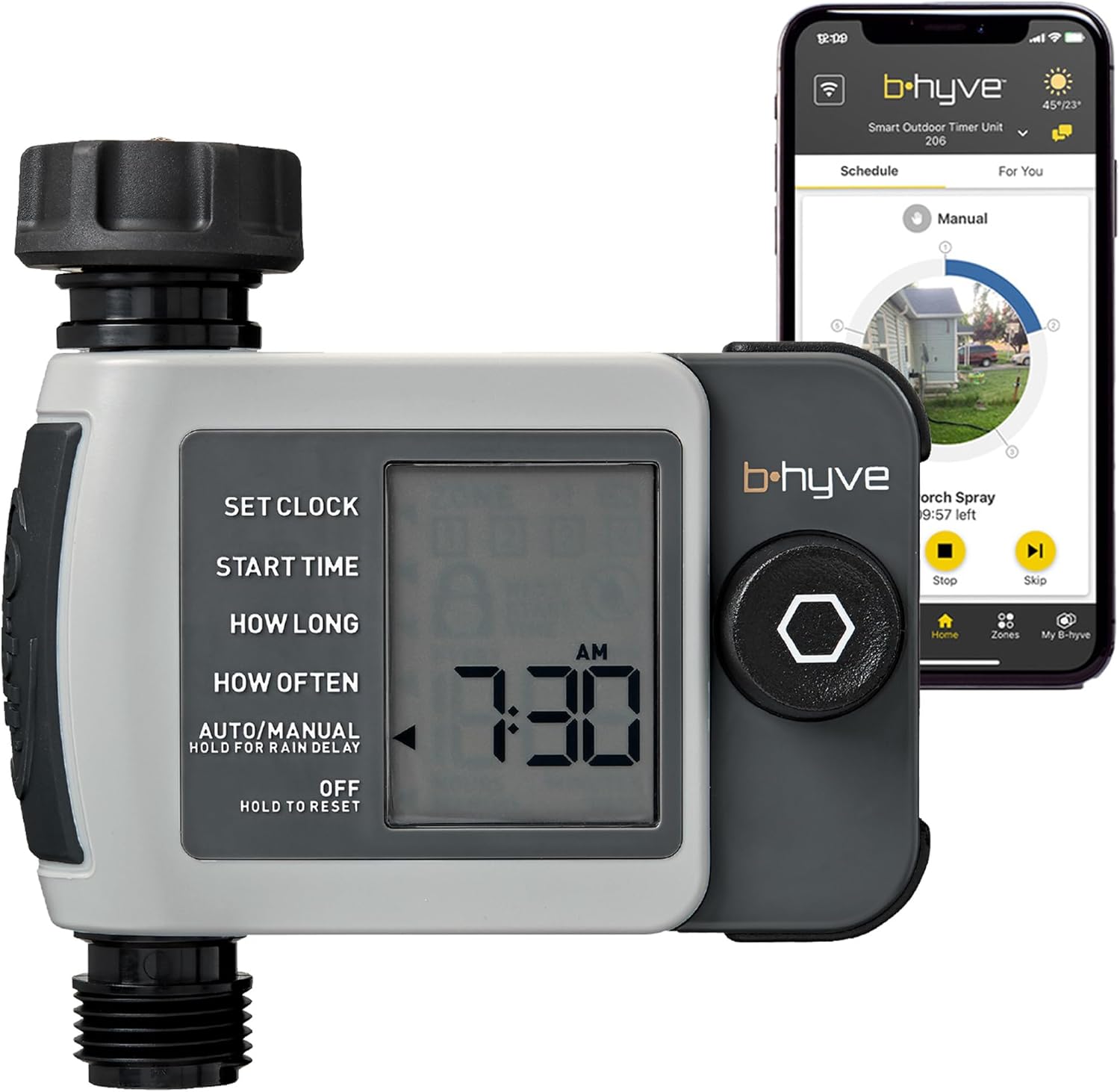
| Item Highlight | App Controlled Single Outlet Irrigation Timer, Smart WeatherSense Auto Watering, Weatherproof Battery Powered |
|---|---|
| Material Type | Plastic or Rubber |
| Number of settings | 5 |
| IP Rating | IPX-5 waterproof protection |
The Orbit B-hyve XD is a single-outlet smart hose timer designed to automate routine watering with local weather adjustments. It installs at a faucet and can be programmed directly on the unit, over Bluetooth, or remotely when you add the optional Wi‑Fi Hub to unlock full smart features. WeatherSense uses hyper-local data and drought-level information to reduce overwatering and help comply with local restrictions, and pairing with the hub makes the timer EPA WaterSense compliant. The unit is IPX-5 rated so it tolerates outdoor exposure to spray and rain, and the battery-powered design keeps it independent of mains power. Practical benefits include reliable basic scheduling from the device itself, automatic adjustments for changing conditions when connected to Wi‑Fi, and a compact single-outlet form for small yards or container gardens. Limitations are that advanced remote control and the WaterSense certification require purchasing and installing the Wi‑Fi Hub, and this model only controls one outlet so larger multi-zone systems need a different controller.
Best for: Buyers who want a simple, dependable smart hose timer that reduces watering guesswork and prioritizes conservative, water-conscious operation for a single faucet or small yard.
Less Ideal for: Homeowners needing multi-zone control or those who want full remote features without adding a separate Wi‑Fi hub should consider other controllers.
- App and local programming options let you control schedules from the device, by Bluetooth, or remotely with a hub.
- WeatherSense automatically adjusts watering using high-precision local weather and drought data.
- IPX-5 waterproof rating designed for outdoor use and resistance to spray and rain.
- Battery-powered operation avoids needing electrical hookups and keeps installation simple.
- Remote smart functions and EPA WaterSense compliance require purchasing the separate Wi‑Fi Hub.
- Only a single outlet so it is not suitable for multi-zone irrigation without additional controllers.
Verdict: If you want a low-risk, weather-adjusting smart hose timer for a single faucet, the Orbit B-hyve XD delivers reliable automatic watering with simple local controls and optional remote automation.
Choosing the Right Wifi Water Watering Timer: Key Factors to Consider
Program Flexibility
How many different schedules, start times, and seasonal adjustments a timer supports matters because garden water needs change throughout the year. A flexible schedule lets you set multiple runs per day for new transplants, daily morning-only cycles for lawns, or less frequent deep soakings for established beds.
Look for options that support interval schedules, weekly rules, and temporary rain delays. The ability to set different programs for separate zones or drip lines is useful when you run more than one watering circuit.
Connection Reliability and Local Backup
A Wifi timer is only useful if it stays connected when you need it. Connection reliability includes how well the unit holds onto your home network in varied signal conditions and how it behaves during outages.
Good devices provide local manual controls or a fallback mode so watering continues on a set schedule even when the app cannot reach the timer. Consider how the timer reconnects after a network drop and whether it provides confirmations or logs you can check.
Leak Resistance and Outdoor Durability
These timers live outside and face sun, rain, and temperature swings, so durable housings, quality seals, and solid hose-thread connections are essential. Poorly sealed units often drip from the inlet or outlet threads and can allow moisture into electronics over time.
Check for weatherproof ratings, reinforced gasket designs, and protected control buttons. Materials that resist cracking in sunlight and fittings that tighten securely reduce the chance of persistent leaks or early failure.
Flow Capacity and Compatibility
Different irrigation setups demand different flow rates. A timer must handle the combined flow of the downstream valves, drip lines, or sprinklers without restricting pressure excessively.
Confirm the timer's maximum flow rating matches your system, and consider whether it fits commonly used hose and pipe sizes. Some timers work better with low-flow drip but struggle with multiple sprinklers operating simultaneously.
App Usability and Remote Features
The mobile app is the main way most gardeners interact with a Wifi timer, so an intuitive interface makes scheduling and adjustments quick. Useful app features include program templates, weather-based skip options, runtime editing, and push or email notifications for failures.
Also consider account sharing for multiple users, voice assistant compatibility if you use smart-home gear, and whether the app supports firmware updates to keep the device secure and feature-complete.
Planning Your Timer Layout
Map out where water will flow and how many independent circuits you need before choosing a timer. Determine if a single timer will control all outlets or if you need one per zone. Measure hose lengths and note any elevation changes that could affect pressure.
Place the timer where you can reach it for occasional maintenance while keeping it in range of your Wifi network. If coverage is marginal, try relocating the router or adding a Wifi extender rather than positioning the timer where it will get wet or be hard to access.
- Sketch zones and list which plants or areas each zone serves
- Check physical hose-thread types and fittings for compatibility
- Consider future expansion when choosing the number of outlets
Weather-Based Scheduling
Many modern timers offer weather-based skip or rain sensors to prevent unnecessary runs. These features can save water and protect shallow-rooted plants from overwatering after storms. Understand how the timer sources weather data-local sensors, forecast services, or linked weather stations-and whether you can override automatic skips.
For temperate climates, set seasonal adjustments so runtimes shorten during cool months. In hot, dry spells, increase frequency or add shorter mid-afternoon cycles for container plants that dry quickly.
- Use forecast-based skips for automatic rain avoidance
- Adjust seasonal settings rather than rewriting schedules daily
- Manually suspend programs for special events or heavy rainfall
Installation and Winter Care
Install the timer on a stable faucet post or dedicated manifold with proper sealing tape where appropriate. Avoid over-tightening plastic fittings and check connections for drips after the first run. If the unit mounts on a spigot near a house foundation, ensure drainage won't cause water pooling against building materials.
In climates with freezing winters, remove or thoroughly drain the timer before the first hard freeze to avoid cracking solenoids and housings. Some gardeners install a short hose and leave the timer in a protected shed for winter storage after flushing lines.
- Test all fittings for leaks under full flow
- Drain or store timers before freeze seasons
- Keep the unit accessible for manual operation and battery changes
Battery and Power Options
Some Wifi water timers run on replaceable batteries, while others include rechargeable packs or optional hardwired power. Battery models offer simple installation but require periodic battery checks. Rechargeable or mains-powered units remove the chore of battery changes but may need weatherproofing at the power connection.
When choosing battery-operated models, look for low-battery alerts in the app and consider units that retain settings during battery swaps. For remote sites without power, long battery life is a key practical advantage.
- Select power type based on access to electricity and maintenance willingness
- Prefer devices with low-battery notifications and settings retention
- Note how power choice affects installation flexibility
Integrating With Other Garden Tech
If you already use soil moisture sensors, weather stations, or smart-home platforms, check for integration options. Timers that accept external sensors or link with home automation can automate irrigation based on measured soil moisture rather than fixed schedules alone. This can prevent wasted water and reduce plant stress.
Consider whether the timer supports data logging so you can review watering history. Logs help diagnose overwatering or under-watering trends and make seasonal adjustments easier.
- Look for sensor inputs if you want moisture-based control
- Prefer timers that support routines in your existing smart-home system
- Use logs to refine run times and seasonal settings
How We Chose the Best Wifi Water Watering Timer
We shortlisted Wifi water watering timers by applying garden-focused, measurable filters that reflect everyday use. We evaluated program flexibility by testing how many independent schedules and seasonal adjustments each unit supports, and whether it can handle multiple start times per day. Connection reliability was judged by how consistently the product maintained a Wifi link during normal home networking conditions and how it recovered from outages. Water delivery capacity and flow handling were assessed by rated outlet flow and durability of solenoid components for typical home irrigation pressures. Leak resistance and build quality were inspected for robust hose-thread seals and weatherproof housings suited to outdoor exposure. User interface and remote control were measured by app responsiveness, local manual controls, and the presence of backup control modes. We excluded products designed only for commercial irrigation or low-pressure greenhouse misting because they do not match typical home garden plumbing and user expectations. The combined filters produced a set of practical, gardener-focused candidates that balance reliability, flexibility, and outdoor durability.
FAQ
Will a Wifi timer continue to run if my internet goes down?
Many timers keep a local schedule that continues during short internet outages, but behavior varies. Choose a unit with documented local fallback or manual controls to ensure watering continues when the app cannot connect.
Can I control multiple zones from one Wifi water timer?
Some models support multiple independent outlets or zone control, while others only handle a single faucet. Match the number of outputs to your irrigation layout or use multiple timers when you need separate schedules for distinct areas.
How do I prevent freezing damage in winter?
Drain and remove the timer before freezing temperatures arrive, or install it in a protected, insulated location. Leaving devices full of water risks cracked housings and failed solenoids when ice forms.
Are weather-based skips accurate for my microclimate?
Weather services provide general forecasts that may not reflect small-scale differences in sun exposure or shade. For best results combine forecast-based skips with local observations or a soil moisture sensor to tune watering for your garden's specific conditions.
What should I check if the timer leaks after installation?
First confirm fittings are tightened to recommended torque and that gaskets or washers are seated correctly. Replace damaged washers, use proper thread sealing tape where advised, and avoid over-tightening plastic connections which can crack fittings.
Final Verdict
Choose a Wifi water watering timer that matches the size and complexity of your irrigation layout and provides reliable connectivity with sensible fallback options. Prioritize program flexibility if you have diverse planting needs, and favor robust seals and materials if the unit will be exposed year-round. Balancing app convenience, flow capacity, and outdoor durability will lead to fewer surprises and healthier plants. Focus on the dimensions that matter most for your garden and pick the configuration that fits your zones, power availability, and winter care plans.
