

Note: This article contains affiliate links. If you click on these links and make a purchase, I may earn a small commission at no extra cost to you. This helps support my research and content. Read my full affiliate disclosure here.
If spurge has taken over patches of your lawn, bed edges, or pathways, choosing the right herbicide matters for quick control and minimal harm to desired plants. This guide focuses on options formulated for spurge control and explains how they behave in real garden settings so you can match the product to your situation. We shortlisted seven top-performing herbicides for spurge and evaluated them across application safety, weed kill reliability, and ease of use. Read on to understand which attributes matter for your lawn or planting area and how to apply products responsibly.
Top Picks at a Glance
| Best Overall The best all-around choice for most situations | Monterey Spurge Power Post Emergent Herbicide, 16 oz (2 Pack) |  |
| Best Quality Built to a higher standard if you want something more solid | Select Source Triad TZ 4-Way Post-Emergent Herbicide (32 fl oz) |  |
| Best Value The sweet spot between price and what you get | Monterey Spurge Power Herbicide Concentrate, 1 Pint (16 fl oz) |  |
| Best Budget The cheapest option that still gets the job done reliably | Image Herbicides Crabgrass, Nutsedge & Weed Killer for Lawns, 24 fl oz |  |
| Highest Rated A top-rated pick with lots of positive feedback | Bayer Celsius WG Herbicide, 10 oz |  |
| Most Popular A crowd favorite that many people choose with confidence | Ortho Nutsedge Killer for Lawns Ready-To-Spray, 32 fl. oz. |  |
| Best Seller A high-volume bestseller chosen again and again | Roundup Weed & Grass Killer4 with Pump 'N Go 2 Sprayer, 1.33 gal. |  |
Monterey Spurge Power Post Emergent Herbicide, 16 oz (2 Pack)

| Item Form | Liquid |
|---|---|
| Coverage | 16000 square feet |
| Unit Count | 32 Fluid Ounces |
| Number of Packs | 2 |
Monterey Spurge Power is a two-pack liquid herbicide designed for spot or broadcast application with a lawn sprayer to remove broadleaf weeds such as spurge, dandelions, clover, chickweed, and wild violet. Its three-way formula combines MCPA, triclopyr, and dicamba to attack a wide range of stubborn broadleaves, which makes it effective when weeds are actively growing in spring or early fall. The product covers a large area per unit and is labeled for use on common lawn grasses like bluegrass, fescue, rye, bermuda, and zoysia, so homeowners can treat problem patches without replacing turf. Practical considerations: it must be mixed with water and applied carefully to avoid drift onto desirable plants, and the label warns not to apply when temperatures exceed 85°F. For routine lawn maintenance this provides reliable broadleaf control, but users should follow safety and timing instructions to protect desirable plants and get the best results.
Best for: Homeowners who want a robust, multi-ingredient post-emergent solution to control spurge and other broadleaf weeds in established lawns and prefer treating with a sprayer for targeted or area applications.
Less Ideal for: People seeking an all-season pre-emergent or a non-chemical weed control method, or those who need a ready-to-use spray rather than a concentrate to mix.
- Three active ingredients (MCPA, triclopyr, dicamba) target a broad spectrum of stubborn broadleaf weeds including spurge
- Formulated for established lawn grasses such as bluegrass, fescue, rye, bermuda, and zoysia
- Two 16 oz bottles provide extended coverage suitable for treating multiple areas
- Liquid concentrate mixes with water for even application using a standard lawn sprayer
- Requires careful mixing and application to avoid drift damage to desirable plants
- Not to be applied when temperatures exceed 85°F which limits use on hot days
Verdict: A powerful, multi-ingredient post-emergent concentrate that effectively targets spurge and other broadleaf weeds in established lawns when applied correctly.
Select Source Triad TZ 4-Way Post-Emergent Herbicide (32 fl oz)
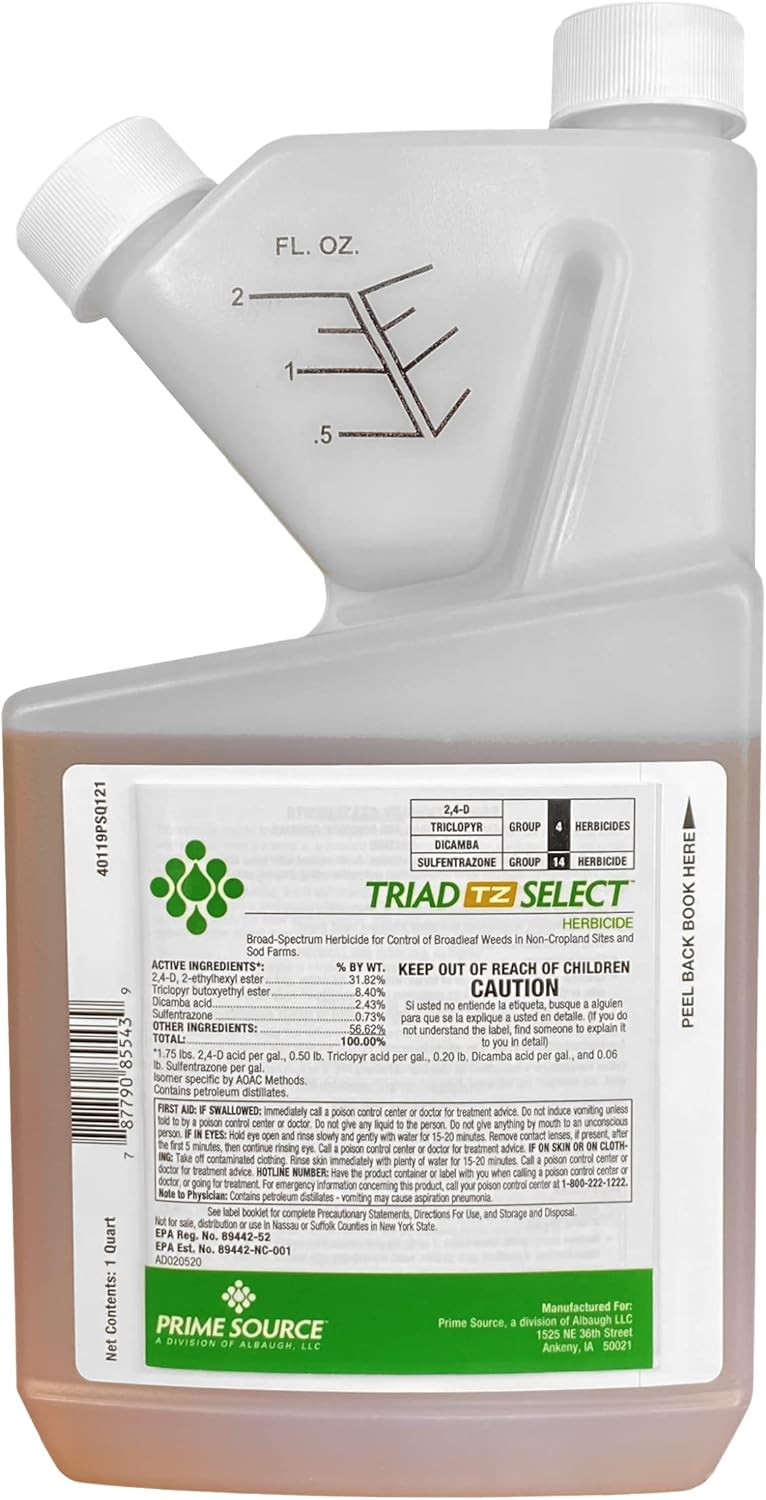
| Unit Count | 32 Fluid Ounces |
|---|---|
| Item Form | Liquid |
| Coverage | 48 to 96 fluid_ounces per acre |
| Active Ingredients | triclopyr |
Select Source Triad TZ is a 32 fl oz liquid herbicide designed for post-emergent control of broadleaf weeds in turf. It combines 2,4-D, dicamba, triclopyr, and sulfentrazone to provide two modes of action that quickly translocate through leaves and stems, causing growth to stop within hours and visible decline over days to weeks. Typical use is with a calibrated sprayer at recommended rates (1.5 to 3 quarts per acre), applied when weeds are actively growing and before mowing for two to three days. Notable features include broad-spectrum activity that lists dandelion, spurge, clover, plantain, ground ivy, and suppression of yellow nutsedge, plus labeled use on lawns, sports fields, and sod production. Practical benefits are dependable knockdown on tough broadleaves and flexible coverage rates for different infestation levels. Important limitations are the need for proper protective equipment and careful application timing to avoid off-target damage, and the product requires several days to weeks for complete weed death depending on species and conditions.
Best for: Buyers who prioritize dependable, fast-acting control of broadleaf weeds in turf and want a concentrated product that covers large areas when mixed and applied correctly.
Less Ideal for: Homeowners seeking a ready-to-use, low-precision solution or those unwilling to follow pesticide safety precautions should consider alternative spot treatments or professional services.
- Four active ingredients with two modes of action for stronger post-emergent control
- Rapid uptake by foliage so treated weeds stop growing within hours
- Labeled for a wide range of turf sites including lawns, athletic fields, and sod production
- Effective against common tough broadleaves listed on the label including spurge
- Requires a calibrated sprayer and careful follow‑through with label directions to be safe and effective
- Not for use on food crops and poses exposure risks so protective equipment is required
Verdict: Choose Triad TZ when you need a concentrated, multi‑ingredient post-emergent herbicide that delivers reliable, fast control of tough broadleaf weeds like spurge in turf.
Monterey Spurge Power Herbicide Concentrate, 1 Pint (16 fl oz)

| Unit Count | 16 Fluid Ounces |
|---|---|
| Item Form | Liquid |
| Coverage | 16000 square feet |
| Included Components | Measuring Spoon |
Monterey Spurge Power is a concentrated liquid herbicide designed to target spurge and a wide range of broadleaf weeds in lawns. It mixes using the included measuring spoon and is applied with a handheld or tank sprayer to treat areas such as patches of dandelion, oxalis, creeping charlie, clover, and wild violet. Notable features are the three active ingredients — MCPA, triclopyr, and dicamba — and a stated coverage of up to 16,000 square feet from a 16 fl oz bottle, which makes it efficient for treating larger lawns. It is labeled for use on both warm- and cool-season turf varieties, which adds flexibility for many yards. Important limitations are that it is a nonselective broadleaf control for target weeds only and must be applied carefully to avoid contact with desirable plants; follow label directions for timing and buffer zones. Users should plan spray applications when weeds are actively growing for best uptake and keep pets and people off treated areas until safe per label guidance.
Best for: Buyers who want a cost-effective, concentrated herbicide to tackle persistent spurge and other broadleaf weeds across large lawns and different turf types. Ideal for homeowners who plan targeted spray applications and follow label safety and timing instructions.
Less Ideal for: People who need an all-purpose weed-and-feed product or who prefer non-chemical weed control methods. Not a fit for users who will be spraying near desirable ornamentals or mixed flower beds.
- Three active ingredients (MCPA, triclopyr, dicamba) for broadleaf weed efficacy
- Concentrated 16 fl oz formula covers up to 16,000 sq ft, reducing how often you need to buy product
- Labeled for use on both warm- and cool-season lawns for wide turf compatibility
- Includes measuring spoon to help mix accurate application rates
- Contains multiple strong active ingredients that require careful handling and strict label adherence
- Not selective for non-target broadleaf plants so risk of damage if overspray occurs
Verdict: A concentrated, three-ingredient herbicide built to quickly knock back spurge and other broadleaf lawn weeds across large warm- or cool-season lawns.
Image Herbicides Crabgrass, Nutsedge & Weed Killer for Lawns, 24 fl oz

| Item Form | Liquid |
|---|---|
| Coverage | 6000 square feet |
| Active Ingredients | Sulfentrazone; Quinclorac |
| Unit Count | 24 Fluid Ounces |
This ready-to-spray Image Herbicides formula is a water-based lawn herbicide designed to kill annual grasses, sedges, and broadleaf weeds without harming established turf when used as directed. It is typically used by spraying trouble spots or broadcasting over small to medium lawn areas while weeds are actively growing and temperatures are moderate. Notable features include a dual active-ingredient mix (sulfentrazone and quinclorac) that works on tough weeds to the root and a coverage claim suitable for treating several thousand square feet per bottle. Practical benefits are immediate visible wilting on many weeds, broad species control that includes spurge and nutsedge, and the convenience of a ready-to-spray liquid that avoids mixing. Important limitations are that it is labeled for use only on established turfgrass types listed on the label, effectiveness is best on small actively growing weeds rather than mature infestations, and safety directions must be followed to avoid turf injury or off-target damage.
Best for: Homeowners looking for a straightforward, no-mix herbicide to control spurge and other common lawn weeds across an established turf who prioritize convenience and broad-spectrum coverage.
Less Ideal for: People needing a treatment for non-turf beds, very large commercial lawns with specialized programs, or those seeking an organic or non-chemical approach to spurge control.
- Ready-to-spray liquid for easy application without measuring or mixing
- Contains sulfentrazone and quinclorac for broad control of sedges, crabgrass, and many broadleaf weeds including spurge
- Formulated to be safe on listed established turfgrasses when used as directed
- Coverage listed to treat up to 6000 square feet, useful for treating whole lawns or larger patches
- Only labeled for use on specific established turf types so not suitable for every lawn or non-turf areas
- Best performance on small, actively growing weeds rather than large, established infestations
Verdict: A convenient ready-to-spray option that reliably controls spurge and a wide range of lawn weeds on established turf without mixing.
Bayer Celsius WG Herbicide, 10 oz

| Unit Count | 10 Fluid Ounces |
|---|---|
| Item Form | Granule |
| Coverage | selective |
| Active Ingredients | Thiencarbazone-methyl; odosulfuron-methyl-sodium; Dicamba |
Celsius WG is a granular, post-emergent herbicide designed to control more than 150 weeds, including several spurge species and other broadleaf weeds common in warm-season lawns. It is typically mixed and applied with a sprayer as a wettable granule formulation and is sold in a 10-ounce bottle for small to medium treatment areas. Notable features include selective turf safety on St. Augustine and centipede grasses and no high-temperature application limit, which gives flexible timing for treatments. The label recommends using a nonionic surfactant such as Pen-A-Trate II to boost uptake except when air temperature exceeds 90 degrees F. Practical benefits include strong activity on hard-to-control weeds and a convenient application window for many climates. Important limitations are that it contains multiple active ingredients including dicamba, so care is needed to avoid off-target movement and follow label directions closely; it also suppresses but may not fully eliminate certain grasses like Dallisgrass, and is packaged in a small volume that may require multiple bottles for larger lawns.
Best for: Buyers who prioritize dependable, label-driven weed control for warm-season turf and need a product that handles stubborn broadleaf weeds with flexible application timing.
Less Ideal for: Homeowners managing large-acreage turf who need bulk coverage or those with many nearby sensitive broadleaf ornamentals that could be harmed by herbicide drift.
- Selective formulation safe on St. Augustine and centipede grasses when used as directed
- Wettable granule form mixes for sprayer application and good coverage
- Effective on many hard-to-control broadleaf weeds including spurge species
- No high-temperature application restriction increases scheduling flexibility
- Small 10 oz bottle may not cover large lawns without multiple purchases
- Contains dicamba which requires careful application to avoid drift and damage to nearby sensitive plants
Verdict: Choose Celsius WG when you want a reliable, selective post-emergent herbicide that controls spurge and other tough broadleaf weeds in warm-season lawns.
Ortho Nutsedge Killer for Lawns Ready-To-Spray, 32 fl. oz.

| Unit Count | 32 Fluid Ounces |
|---|---|
| Coverage | 5000 square_feets |
| Item Form | Spray |
| Active Ingredients | Sulfentrazone |
Ortho Nutsedge Killer for Lawns is a hose-end ready-to-spray herbicide designed to target nutsedge, kyllinga and a long list of other sedge and broadleaf weeds while leaving established turfgrass intact. You connect your garden hose to the built-in sprayer, flip the thumb activation on and apply evenly over the affected area; a 32 fl. oz. bottle treats up to about 5,000 sq. ft. The active ingredient is sulfentrazone, which is effective on stubborn sedges and several broadleaf weeds such as spurge, dandelion and plantain. Practical benefits include the convenience of a no-mix hose applicator, clear directions for common lawn grasses and coverage suitable for medium lawns. Important limitations are that it must not be used on newly planted or sodded turf, and it should not be sprayed on ornamentals, flowers or vegetables; treated areas must stay off-limits to children and pets until dry and application in windy conditions is discouraged. For homeowners who prefer an easy hose-end solution, this product simplifies spot and area treatments for spurge and similar weeds.
Best for: Homeowners who want a convenient, low-effort spray to control nutsedge and spurge in established lawns and who prioritize products with clear label directions and documented performance.
Less Ideal for: Gardeners establishing new turf, those who need a herbicide for ornamentals or edible beds, and users wanting a granular or non-chemical option for spurge control.
- Ready-to-spray hose-end applicator for simple, no-mix application
- Active ingredient sulfentrazone targets nutsedge, kyllinga and many broadleaf weeds including spurge
- Covers up to 5,000 sq. ft. from one 32 fl. oz. bottle
- Label lists both cool- and warm-season turfgrasses where product is safe to use
- Not safe for newly planted, plugged or sodded turf or for use on ornamentals, flowers or vegetable beds
- Requires keeping children and pets off treated areas until sprays have dried
Verdict: A convenient hose-end sulfentrazone formula that makes targeting nutsedge and spurge in established lawns quick and easy.
Roundup Weed & Grass Killer4 with Pump 'N Go 2 Sprayer, 1.33 gal.

| Unit Count | 170 Fluid Ounces |
|---|---|
| Item Form | Spray |
| Coverage | 300 Square_Feet |
| Active Ingredients | Triclopyr; Fluazifop-P-Butyl; Diquat Dibromide |
This Roundup kit combines a pre-mixed herbicide concentrate with a Pump 'N Go 2 sprayer so you can treat patches of spurge and other broadleaf weeds without mixing chemicals or hauling a separate sprayer. It is formulated to kill common tough weeds and grasses to the root, is rainproof in about 30 minutes, and the extendable wand gives more accurate application without bending. Typical use is spot treatment around flower beds, along foundations, on driveways or mulch beds where spurge appears. Practical benefits include easy continuous spray for up to 10 minutes, visible decline of weeds within hours, and the ability to replant in a short window after application. Important limitations are that it contains multiple active herbicides so you must follow safety directions closely, keep people and pets away until the spray dries, and it is not selective for grass versus broadleaf plants so avoid contact with desirable vegetation. This product is best for homeowners wanting a straightforward, portable solution for persistent spurge where careful spot application is possible.
Best for: Homeowners who prioritize a low-hassle, controllable method to eliminate spurge patches and other broadleaf weeds and who prefer a ready-to-use sprayer for spot treatments.
Less Ideal for: People who need a selective product for lawns with desirable grasses or who prefer an organic or nonchemical approach to spurge control.
- Ready-to-use system with integrated Pump 'N Go sprayer so no mixing or separate equipment needed
- Kills broadleaf weeds and grasses to the root with visible results in hours
- Rainproof in about 30 minutes which reduces the chance of wash-off after light rain
- Extendable wand provides targeted application and up to 10 minutes of continuous spray
- Contains multiple active herbicides and requires protective clothing and careful handling
- Nonselective formula can damage desirable plants if contacted
Verdict: A convenient ready-to-use herbicide with an onboard Pump 'N Go sprayer that makes targeted, fast-acting spurge control simple for risk-conscious homeowners.
Choosing the Right Herbicide for Spurge: Key Factors to Consider
Efficacy Against Spurge Species
Different spurge species respond differently to active ingredients. A good herbicide will list spurge or Euphorbia spp. on the label and provide expected timing for visible control. Contact herbicides give fast burn-down but often require repeat applications for regrowth, while systemic products move into the plant and its roots for longer control. Consider how quickly you need visible results and whether you need single-application control or planned follow-ups.
Soil conditions and plant size also change outcomes. Young, actively growing spurge is generally easier to control than established, woody-rooted patches. Adjust expectations based on plant stage and local growing conditions.
Selectivity and Risk to Desired Plants
Selectivity refers to how much the product will harm non-target turf or ornamentals. Some herbicides are selective in established lawns but will damage garden beds or new seedlings. Others are non-selective contact burn-downs that kill any green tissue they contact. Read label guidance and choose an option that fits where spurge is growing: within a lawn, between pavers, or amid desirable groundcovers.
Buffering tools like shields, wipers, or spot-spray techniques reduce off-target exposure. When treating near ornamentals, consider lower-pressure nozzles and avoid broadcast application on windy days to protect sensitive plants.
Application Method and Ease of Accurate Dosing
Herbicides come as ready-to-use sprays, pump-up concentrates, or hose-end mixtures. Ready-to-use bottles are simplest but can be expensive for large infestations. Concentrates allow economical coverage but require careful measuring and mixing. Application equipment quality affects accuracy; a calibrated pump sprayer gives better coverage than an improvised bottle. For spot treatments, products compatible with wiper applicators or hand sprayers provide convenience and reduce waste.
Accurate dosing impacts safety and results. Overdosing can harm non-targets and the environment, while underdosing may leave surviving plants that rebound. Check label rates for the weed stage and follow mixing instructions precisely.
Timing and Weather Considerations
Temperature, rainfall, and plant growth stage determine when treatments will work best. Many herbicides are most effective when spurge is actively growing and not drought-stressed. Avoid applications before heavy rain because rain can wash away contact products and dilute soil-applied materials. Hot, windy days increase the risk of volatilization or drift that could injure nearby vegetation.
Plan treatments during calm, moderate-temperature conditions and allow recommended drying time before irrigation or forecasted precipitation.
Safety, Protective Equipment, and Environmental Impact
Personal protective equipment and precautions vary by formulation and active ingredient. Concentrates usually require gloves, eye protection, and sometimes long sleeves to avoid skin contact. Consider the proximity of children, pets, and water features when selecting a product; some active ingredients have specific setbacks from drinking water or aquatic habitats.
Also evaluate persistence in soil and potential effects on beneficial organisms. Choose products with label guidance that fits your property layout and be prepared to follow disposal and re-entry interval instructions to minimize environmental risk.
Resistance Management and Mode of Action
Repeated use of products with the same mode of action increases the chance of resistant weed populations. Rotate active ingredients or combine contact and systemic approaches when label directions allow. Products with multiple modes of action or those that can be tank-mixed under label guidance help reduce selection pressure.
For persistent or recurrent spurge, integrate herbicide use with cultural controls such as improved turf density, mulching, and manual removal to reduce reliance on chemical control alone.
When to Use Spot Treatment Versus Broadcast Applications
Spot treatments concentrate product on small patches to limit non-target exposure and reduce chemical use. They work best for isolated spurge patches or in mixed plantings where broadcast sprays would harm desirable species.
Broadcast applications suit widespread infestations in turf where selectivity is labeled and safe. For large areas, ensure uniform coverage and correct dilution rates to avoid patchy results. Consider dividing the area and treating during favorable weather to reduce drift and ensure consistent dosing.
- Spot treatment: lower product volume, reduced off-target risk, good for edges and cracks
- Broadcast: efficient for uniform lawn infestations, requires careful calibration
- Wiper or wipe-on: useful on hardscapes and dense patches to limit contact with nearby plants
Integrating Cultural Practices to Reduce Reinfestation
Herbicides are most effective when combined with cultural practices that make the environment less favorable for spurge. Improve lawn health by mowing at the recommended height, overseeding bare spots, and adjusting irrigation to promote deep root growth of turf rather than shallow-rooted weeds.
For beds and mulched areas, maintain a generous organic mulch layer and hand-remove seedlings before they set seed. Regular monitoring and early intervention reduce the number of chemical treatments needed over a season.
- Mow properly and leave clippings where acceptable to shade out seedlings
- Fill bare patches promptly to deny weeds establishment
- Maintain mulch depth of at least 2 to 3 inches in planting beds
Safe Mixing, Storage, and Disposal Practices
Always mix herbicide concentrates in a well-ventilated, contained area using clean measuring tools labeled for chemical use only. Prepare only the amount you will apply that day to avoid storage of mixed solutions. Rinse application equipment and triple-rinse containers following label instructions to prevent contamination.
Store concentrates in their original, labeled containers in a locked, dry place away from children and pets. Follow local regulations for disposal of empty containers and leftover product; many municipalities treat pesticide waste differently from household trash.
- Use dedicated measuring jugs and never mix chemicals in food containers
- Triple-rinse and puncture containers if label allows before recycling
- Keep records of application dates, rates, and weather conditions for future reference
Protecting Pollinators and Water Sources
Apply herbicides when pollinators are least active, such as early morning or late evening, and avoid spraying blooming plants. Choose product formulations and application techniques that reduce drift toward flower beds and native plantings that support pollinators.
Keep a buffer from ponds, streams, and storm drains. Read label directions for aquatic setbacks and avoid treating within the restricted zones. Consider non-chemical controls in sensitive riparian areas whenever possible.
- Avoid treating flowering plants and active foraging times
- Maintain labeled setback distances from water bodies
- Use shielded sprayers or wipers near sensitive vegetation
Timing Follow-Up Treatments and Monitoring
Expect that some approaches require follow-up sprays, especially for dense or long-established spurge. Schedule a recheck of treated areas two to four weeks after application to assess control and catch any regrowth early. For systemic products, allow enough time for translocation before judging efficacy.
Record what worked and what did not in each area so you can adjust subsequent applications and avoid repeating ineffective methods. Consistent monitoring reduces the likelihood of a small problem becoming a widespread infestation.
- Inspect treated patches at 2 to 4 weeks for signs of regrowth
- Repeat spot treatments as needed rather than broad retreatment
- Rotate actives over seasons to slow resistance development
How We Chose the Best Herbicide for Spurge
We prioritized products formulated or commonly used for spurge control and assessed them against practical gardener needs. Evaluation centered on efficacy on common spurge species, selectivity toward turf and ornamentals, labeled application rates and tank-mix flexibility, and user safety measures like PPE guidance and drift potential. We also considered mode of action diversity to reduce resistance risk, packaging and delivery formats that affect accurate dosing, and real-world ease of application such as ready-to-use versus concentrate options. We excluded products without label recommendations for spurge or without clear application instructions for lawns, beds, or hardscape areas. We did not consider generic brand popularity alone; instead we focused on documented label directions and product characteristics that influence performance in yard and garden conditions. The criteria below reflect the dimensions that most affect a gardener's success when tackling spurge.
FAQ
Can I use a non-selective herbicide to kill spurge without harming my lawn?
Non-selective herbicides will damage any green plant they contact, including lawn grass. They are best reserved for cracks, driveways, or bare patches. For use in lawns choose products labeled as selective for broadleaf weeds or follow spot-treatment techniques to protect turf.
How soon after application will I see spurge dieback?
Contact products often produce visible burn within a few days but may need repeat applications for regrowth. Systemic herbicides can take one to several weeks for full plant decline as the active ingredient moves to the roots. Results depend on weed size, growing conditions, and product type.
Is it safe to use herbicides for spurge near vegetable gardens or water features?
Safety depends on the active ingredient and label restrictions. Maintain recommended setbacks from water and avoid drift toward edible plantings. Consider hand-pulling or mulching near vegetables and choose products with low leaching potential when groundwater or surface water is nearby.
Will a single treatment prevent spurge from returning next season?
A single treatment may not prevent return, especially if seed or root fragments remain. Long-term control usually requires a combination of herbicide applications at the right growth stages, cultural practices that reduce establishment, and monitoring to address new seedlings promptly.
Can I mix different herbicides to improve control of spurge?
Tank-mixing can be effective but should be done only when permitted by both product labels. Some mixes improve spectrum or uptake, while incompatible combinations can reduce effectiveness or increase crop injury. When in doubt, follow label guidance or consult extension resources.
Final Verdict
Choosing the right herbicide for spurge depends on where the weed is growing, how extensive the infestation is, and how much risk you can accept for nearby desirable plants. Prioritize products labeled for spurge, match selectivity to the treatment area, and plan applications when plants are actively growing. Combine chemical control with cultural practices and resistance-management tactics to achieve the most durable results. Focus on safe application, accurate dosing, and monitoring follow-up to reduce repeat treatments. With thoughtful selection and care, you can regain control of spurge patches while protecting the rest of your lawn and garden.
