

Note: This article contains affiliate links. If you click on these links and make a purchase, I may earn a small commission at no extra cost to you. This helps support my research and content. Read my full affiliate disclosure here.
Choosing the right yard fertilizer affects how fast your lawn green-up, how well it resists weeds and drought, and how much maintenance you will need. The right formula and delivery method make a big difference in real garden conditions, from sun-baked patches to shady growth under trees. This guide covers our seven shortlisted yard fertilizers chosen for common home-lawn situations and explains the testing criteria we used. Below you will find clear guidance on nutrient mixes, application timing, and product features that matter most to gardeners. Use the evaluation notes to pick an option that fits your soil, grass type, and maintenance plan.
Top Picks at a Glance
| Best Overall The best all-around choice for most situations | Milorganite 6-4-0 Slow-Release Fertilizer, 32 lb (with Feeding Tips Brochure) |  |
| Best Quality Built to a higher standard if you want something more solid | Yard Mastery Flagship Granular Lawn Fertilizer 24-0-6, 45 lb |  |
| Best Value The sweet spot between price and what you get | Scotts Turf Builder Lawn Food, 37.5 lb |  |
| Best Budget The cheapest option that still gets the job done reliably | O.M. Scott & Sons Natural Grass Food, 12.72 lb |  |
| Highest Rated A top-rated pick with lots of positive feedback | The Andersons PGF Balanced 10-10-10 Granular Fertilizer (covers 5,000 sq ft) |  |
| Most Popular A crowd favorite that many people choose with confidence | Scotts Turf Builder Weed & Feed (42.87 lb) |  |
| Best Seller A high-volume bestseller chosen again and again | Scotts Turf Builder WinterGuard Fall Lawn Food, 10 lb. |  |
Milorganite 6-4-0 Slow-Release Fertilizer, 32 lb (with Feeding Tips Brochure)

| Item Form | Pelletized |
|---|---|
| Application Method | Broadcast, Rotary or Manual |
| Coverage | 2,500 Square Feet |
| Specific Uses For Product | Lawns, Flowers and Gardens, Education |
Milorganite 6-4-0 is a pelletized, slow-release organic fertilizer intended for wide garden use, from lawns to vegetables. It is typically broadcast with a rotary or manual spreader and supplies nitrogen and organically complex iron that promotes steady greening without the strong salts found in many synthetics. The product releases nutrients over roughly 8 to 10 weeks so you do not need to water it in after application, and a single 32 lb bag is labeled to cover about 2,500 sq ft. Practical benefits include gentle feeding that reduces the risk of burn, added organic matter that helps improve soil structure in both clay and sandy soils, and a printed brochure with seasonal timing and spreader settings that helps first-time users apply it correctly. Limitations to consider are that it is a low analysis fertilizer so you may need larger volumes or more frequent applications to match high-nutrient synthetic programs, and some people notice an earthy odor on application that fades after watering or rainfall. This product is best used as a regular maintenance feed or as part of an organic-focused program rather than for rapid, high-nitrogen results.
Best for: Gardeners seeking an easy, low-risk maintenance fertilizer for mixed landscapes who prefer an organic, slow-release approach and value guidance on correct application.
Less Ideal for: Users who need fast, high-nitrogen green-up for turf sports fields or those who prefer concentrated synthetic fertilizers for rapid results.
- Slow-release nitrogen feeds for about 8–10 weeks, reducing frequency of applications
- Low-salt formula minimizes risk of fertilizer burn and visible streaking
- High organic matter content helps improve soil structure and microbial activity
- Organically complex iron promotes deep greening without staining concrete
- Includes a feeding and spreader tips brochure for seasonal timing and application guidance
- Lower N-P-K ratio means you may need larger quantities or more frequent applications for quick, high-growth results
- Has an earthy odor on fresh application that can attract pets until it is watered or dissipates
Verdict: A dependable, low-salt organic fertilizer that delivers steady, maintenance feeding and improves soil health across lawns and garden beds.
Yard Mastery Flagship Granular Lawn Fertilizer 24-0-6, 45 lb

| Item Form | Granules |
|---|---|
| Application Method | Spread and water-in |
| Coverage | 15000 |
| Target Species | all grass types |
Yard Mastery Flagship is a performance-oriented granular lawn fertilizer designed to deliver steady, visible results on large turf areas. The 24-0-6 NPK with 24% slow-release nitrogen supplies prolonged feeding so grass greens up and grows without frequent reapplications, while 6% potassium helps with stress and drought tolerance. The included 3% iron and a suite of micronutrients promote deep green color, and the Bio-Nite biosolid adds organic matter to support soil microbial health and root development. It is applied with a broadcast spreader at the recommended rate (3 lb per 1,000 sq ft) and should be watered in within 48 hours. Practical benefits include coverage of up to 15,000 sq ft per 45 lb bag and a reduced application cadence thanks to the slow-release formulation. Limitations are that it is a straight nitrogen-potassium product with no phosphorus, so it is not a one-size-fits-all solution for new sod or phosphorus-deficient soils, and the large bag requires handling space and a spreader for even application.
Best for: Buyers who prioritize measurable, performance-driven lawn results and want a professional-style, slow-release fertilizer to maintain and improve established turf across medium to large yards.
Less Ideal for: Homeowners starting new lawns, seeding, or correcting phosphorus-poor soils should consider a product with phosphorus or a starter fertilizer instead.
- High 24% slow-release nitrogen provides extended feeding and fewer applications
- Includes 3% iron and multiple micronutrients for deeper green color
- Bio-Nite biosolid adds organic matter to support soil microbes and root health
- Covers up to 15,000 sq ft per 45 lb bag, suitable for large lawns
- No phosphorus in the 24-0-6 formula, so it may not address phosphorus deficiencies or initial establishment needs
- Large 45 lb bag can be cumbersome to lift and requires a spreader for best results
Verdict: Choose this if you want a pro-grade, slow-release fertilizer that boosts color and sustained growth across large, established lawns.
Scotts Turf Builder Lawn Food, 37.5 lb

| Item Form | Granules |
|---|---|
| Specific Uses For Product | Lawn |
| Coverage | 15000 |
| Mixing Ratio | 32:0:4 |
Scotts Turf Builder Lawn Food is a granular fertilizer designed for routine lawn feeding to thicken grass, build deeper roots, and help lawns absorb water and nutrients more effectively. Typical use is to broadcast with a spreader across spring, summer, or fall; the bag lists spreader settings for Scotts broadcast, drop, and Wizz models and notes it can be applied to wet or dry turf. The 32:0:4 mixing ratio and pesticide-free formula focus on nitrogen-driven greening and root development without herbicide action. Practical benefits are large coverage from a single 37.5 lb bag and straightforward application for DIY homeowners who want a seasonal maintenance product. Limitations are that it does not control weeds or pests, so expect to pair it with a weed-control product if that is a concern, and results depend on proper spreader settings and occasional watering for faster greening. This product works best as part of a regular feeding plan rather than a one-time fix for heavily damaged or weed-infested lawns.
Best for: Homeowners who want a simple, cost-effective seasonal feed to strengthen and green a lawn across a large area and who plan regular maintenance rather than spot treatment.
Less Ideal for: Gardeners seeking a combined fertilizer plus weed- or pest-control solution or those needing immediate repair of heavily damaged turf should look at targeted products instead.
- Large single-bag coverage up to 15,000 sq ft reduces repeat purchases
- Granular formula can be applied to wet or dry lawns for flexible scheduling
- Provided spreader settings simplify even application with compatible spreaders
- Pesticide-free formulation focuses on feeding and root development
- Does not include weed or insect control so additional products may be needed
Verdict: Choose this if you want an easy-to-apply, high-coverage lawn food that reliably feeds and builds stronger roots across a large yard.
O.M. Scott & Sons Natural Grass Food, 12.72 lb

| Item Type Name | O.M. Scott and Sons Natural Grass Food |
|---|---|
| Material Features | Natural lawn fertilier, feeds up to 10 weeks. |
| Apply Instructions | Use Scotts spreader, water after application; feed every 8 to 10 weeks, up to 4 times a year. |
| Coverage | One 12.72 lb. bag covers up to 2,000 sq. ft. |
This natural grass food from O.M. Scott & Sons is a straightforward granular fertilizer intended for routine lawn feeding. You apply it with a broadcast spreader following the bag dial, water lightly afterward for immediate uptake, and it releases nutrients for up to 8 to 10 weeks. The formula is marketed without added artificial ingredients or pesticides and is safe for people and pets when used as directed, making it suitable for yards where families and animals play. One 12.72 lb bag covers roughly 2,000 square feet, which fits small-to-medium lawns or spot treatments. Practical benefits include recyclable paper packaging and simple spreader-based application that fits a typical seasonal program of feeding up to four times a year. Limitations are its single-bag coverage for modest areas and lack of specified N-P-K breakdown on the listing, so serious lawn rehab or precise nutrient management will require additional products or testing.
Best for: Homeowners watching their lawn budget who want a simple, natural-feeling fertilizer for routine maintenance on small to medium yards.
Less Ideal for: Those needing targeted nutrient management, fast lawn renovation, or large properties where per-bag coverage and precise N-P-K information are priorities.
- Feeds up to 8–10 weeks after watering for less frequent applications
- Formulated without added artificial ingredients or pesticides
- Safe to reenter lawn immediately for people and pets when used as directed
- Easy to apply with a standard Scotts spreader and recyclable paper bag
- No explicit N-P-K ratio or guaranteed analysis provided in the product details
- 12.72 lb bag only covers about 2,000 sq ft which may require multiple bags for larger yards
Verdict: A simple, family- and pet-friendly lawn food that delivers up to 10 weeks of feed per application and is a practical low-cost choice for small to medium yards.
The Andersons PGF Balanced 10-10-10 Granular Fertilizer (covers 5,000 sq ft)

| Item Form | Granules |
|---|---|
| Application Method | spreader |
| Coverage | 5000 square feet |
| Target Species | Lawns and Gardens |
| Mixing Ratio | 10-10-10 |
The Andersons PGF Balanced 10-10-10 is a professional-grade granular fertilizer formulated for even, reliable feeding across lawns and planted areas. Its very fine particle size gives more than double the coverage of typical granular fertilizers, so it spreads evenly with a broadcast spreader and reduces patchy results. The formula is quick-release nitrogen with balanced phosphorus and potassium plus micronutrients and 2% iron for deeper greening, making it useful for spring and fall applications, new seedbeds, and routine maintenance. Typical use is broadcasting over dry turf, sweeping paved areas clear, then watering to activate the nutrients. Practical benefits include predictable, uniform feeding over up to 5,000 square feet from one 18 lb bag and flexible use in gardens, flower beds, trees, and shrubs. Limitations are that it is a quick-release product rather than slow-release, so nutrient availability is immediate but not extended, and the iron content can stain sidewalks if not removed. Store unused product dry and sealed to maintain performance.
Best for: Buyers who prioritize consistent, dependable results across a whole yard and want a straightforward, easy-to-apply fertilizer for routine seasonal feeding and establishment tasks.
Less Ideal for: Gardeners who need long-duration slow-release feeding or who require an organic-certified fertilizer should consider other products tailored to those needs.
- Very fine particle size for more even coverage and reduced patchiness
- Balanced 10-10-10 formula with micronutrients and 2% iron for deeper greening
- Covers up to 5,000 sq ft from a single 18 lb bag, suitable for lawns and beds
- Designed for use with a spreader for quick, uniform application
- Quick-release nutrients provide immediate feed but shorter residual effect compared with slow-release options
- Contains iron that can stain driveways and sidewalks if not swept off
Verdict: Choose this for reliable, uniform feeding across lawns and beds when you want quick visible greening and dependable coverage.
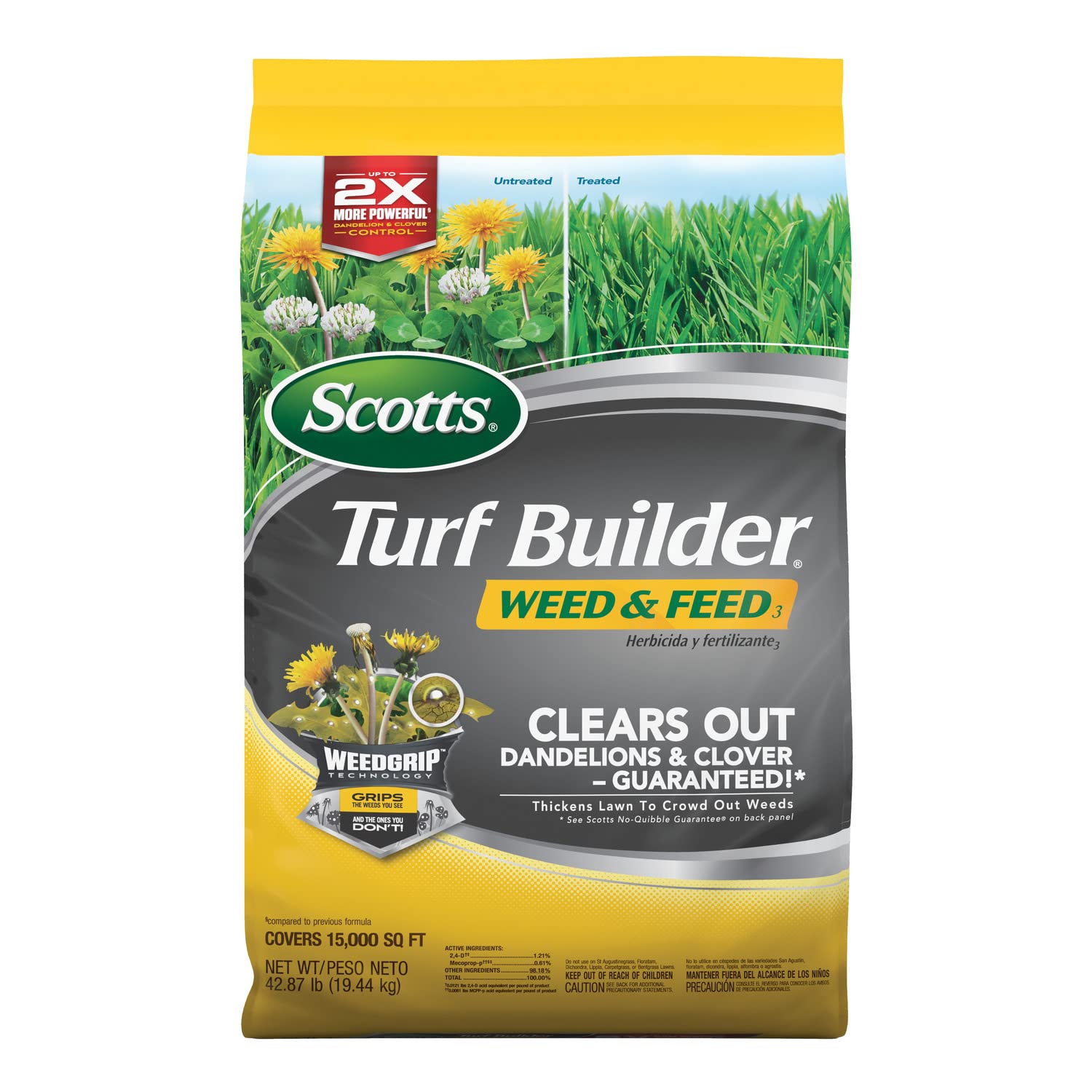
Scotts Turf Builder Weed & Feed (42.87 lb)
| Item Form | Granule |
|---|---|
| Coverage | 15000 square_feet |
| Active Ingredients | 24-D Mecoprop-p |
Scotts Turf Builder Weed & Feed combines a granular fertilizer with a weedkiller designed to remove common broadleaf weeds such as dandelion and clover while feeding turf to encourage thicker growth. It is applied with a broadcast or drop spreader to a moist lawn when weeds are actively growing and daytime temperatures are between 60 and 90°F. Notable features include WeedGrip Technology for better herbicide adhesion and instructions tuned to Scotts spreader settings to help ensure even coverage. In practice the product is convenient for homeowners managing mid-to-large lawns who want a one-step application to reduce visible weeds and promote denser grass. Important limitations: it is not safe for certain grass types including St. Augustine, bentgrass, carpetgrass, dichondra, and lippia and should not be used if rain is expected within 24 hours; it also requires keeping people and pets off the treated area until dust settles. Follow the label carefully for timing and application rates to avoid plant injury and to get the best results.
Best for: Homeowners who want a single, proven product to both kill common broadleaf weeds and feed a lawn across a mid-to-large yard and who will follow label directions and timing carefully.
Less Ideal for: Owners of sensitive turf varieties or small lawns who need a fertilizer-only product or who cannot prevent foot or pet traffic during the post-application settling period.
- Combines weed control and fertilization in one granular product for fewer applications
- WeedGrip Technology improves particle adhesion to weed leaves for more effective control
- Covers up to 15,000 sq ft per bag, suitable for medium to large yards
- Clear application guidance with recommended spreader settings to help achieve even coverage
- Not safe for use on several turf types including St. Augustine and bentgrass
- Requires specific weather conditions and 24-hour dry period after application to be effective and safe
- Contains active herbicide ingredients so users must restrict access to treated areas until dust settles
Verdict: A reliable one-step weed-and-feed for homeowners who want proven broadleaf weed control plus lawn feeding across a large yard.
Scotts Turf Builder WinterGuard Fall Lawn Food, 10 lb.

| Item Form | Granules |
|---|---|
| Specific Uses For Product | Lawn Fertilizer |
| Application Method | spread |
| Coverage | 4000 |
| Target Species | lawn grasses |
Scotts Turf Builder WinterGuard is a straightforward granular lawn food designed for a fall application to build stronger, deeper roots ahead of winter. It is used by spreading the granules evenly over the lawn with a broadcast or drop spreader (Scotts provides recommended settings) and can be applied to wet or dry grass; light watering afterward speeds activation but is not required. The formula is labeled for all grass types and focuses on root development and recovery from heat, drought, and wear rather than weed control. A 10 lb. bag covers about 4,000 square feet, making it suitable for small to medium yards or as a spot treatment on larger lawns. The product is easy for DIY homeowners to apply and comes in a familiar, widely used formulation. Limitations are that it does not list weed or insect control and the coverage means you may need multiple bags for larger properties, so plan quantities accordingly.
Best for: Buyers who want a simple, reliable fall fertilizer to strengthen turf roots and help lawns recover from summer stress without complicated application steps.
Less Ideal for: Homeowners who need a combined weed or insect control product or who manage very large lawns where bulk coverage is a priority.
- Formulated for fall use to strengthen roots and prepare lawns for winter
- Compatible with any grass type for flexible application
- Easy to apply with standard spreader and works on wet or dry turf
- Covers about 4,000 sq. ft. per 10 lb. bag, convenient for small to medium yards
- Does not include weed or insect control in this formulation
- 10 lb. bag may require multiple purchases for larger lawns
Verdict: A no-nonsense fall lawn food that strengthens roots and helps lawns recover from summer stress, ideal for homeowners seeking a reliable, easy-to-use winter prep fertilizer.
Choosing the Right Yard Fertilizer: Key Factors to Consider
N-P-K Ratio and Micronutrients
The N-P-K numbers indicate how much nitrogen, phosphorus, and potassium the fertilizer supplies and directly affect outcomes you will see: nitrogen for green growth, phosphorus for root development, and potassium for stress tolerance. Different lawns and soil tests call for different balances, so matching a product to your soil's needs prevents overfeeding or nutrient lockout.
Micronutrients such as iron, manganese, and sulfur can correct common turf deficiencies without excessive nitrogen. A bag that lists micronutrients and their concentrations allows you to target visible issues such as yellowing or slow recovery after stress.
Release Profile and Timing
Fast-release fertilizers give a quick green-up but increase the risk of burn and require more frequent applications. Slow-release formulas spread nutrient delivery over weeks to months, reducing burn risk and smoothing growth, which is helpful if you prefer fewer visits to the yard.
Blended products that combine immediate and controlled-release sources let you get instant color while feeding the grass for longer. Consider your maintenance schedule and local climate to choose a release profile that fits your lawn care rhythm.
Application Method and Spreader Compatibility
Fertilizers come as granules, pellets, or liquids, and each format behaves differently in the garden. Granular products are often the most convenient for homeowners using standard broadcast or drop spreaders. Pelletized materials may flow differently and require spreader setting adjustments.
Liquid fertilizers can give uniform coverage and work well for spot treatments or when you already use a hose-end sprayer. Always check whether the product includes suggested spreader settings and how it instructs you to calibrate equipment for accurate application.
Coverage Rate and Bag Size
Coverage information tells you how much lawn area a bag will treat at the recommended application rate. A bag that covers twice your yard will reduce handling time but may leave you storing partially used material. Smaller packages are easier to handle and less likely to degrade in storage.
Think about the typical area you treat, whether you will do full-yard applications or spot treatments, and seasonal plans. Coverage affects cost-per-application planning and can influence how often you need to buy product.
Safety for People, Pets, and Plants
Safety labeling and instructions for re-entry and watering are important for households with children or pets. Some fertilizers require irrigation after application to move nutrients into the soil and reduce residue on grass blades. Clear safety directions reduce the risk of accidental contact and environmental runoff.
Also consider whether a product contains ingredients that might stress nearby ornamentals or vegetable beds if granules drift during spreading.
Salt Index and Environmental Impact
The salt content of a fertilizer affects its potential to desiccate roots and foliage, especially on sensitive grasses or newly established turf. Low-salt formulations are safer for high-frequency applications and for use on stressed or recently sodded lawns.
Environmental considerations include phosphorus content where local regulations limit its use, and whether the product minimizes soluble nutrients that can run off into storm drains. Choosing lower-salt and low-phosphorus options can protect both turf and the surrounding ecosystem.
Understanding N-P-K Labels
N-P-K labels can look technical but you can read them as a simple roadmap. The first number is nitrogen, which drives top growth and color. The second is phosphorus, which supports roots and establishment, while the third is potassium, helping with stress resistance and hardiness.
For typical established lawns, a balanced nitrogen-focused mix helps maintain color without encouraging excessive thatch. If you have a soil test, use the numbers to match deficiencies. If you do not have a test, choose conservative nitrogen rates and consider a slow-release formula to avoid overfeeding.
- Higher nitrogen increases green-up but can require more mowing
- Phosphorus is often unnecessary in established lawns unless a deficiency is shown
- Potassium improves drought and cold tolerance
When to Fertilize Through the Seasons
Timing depends on grass type and climate. Cool-season grasses benefit most from applications in early spring and early fall, while warm-season grasses respond best to late spring through summer feeding. Tailor your schedule to peak growth periods for your turf.
Avoid heavy nitrogen applications late in the fall on cool-season grasses, as that can reduce winter hardiness. For warm-season lawns, focus on building strong summer growth and reserve fertilization in early fall for recovery.
- Spring: encourage green-up with moderate nitrogen
- Summer: use maintenance rates and consider slow-release to reduce stress
- Fall: support root recovery and carbohydrate storage for cool-season lawns
Applying Fertilizer Correctly
Proper application is crucial. Calibrate your spreader so the product is distributed evenly. Uneven application results in streaks of lush growth or burned patches. Follow label spreader settings as a starting point and test on a small area while watching for clumping.
Watering after application is often recommended to move nutrients into the root zone and reduce residue on blades. Light irrigation also reduces the chance of burn with fast-release fertilizers and helps granules dissolve evenly.
- Calibrate spreader on a flat surface before use
- Apply with overlapping passes to avoid gaps
- Irrigate lightly after applying unless product instructions advise otherwise
Dealing with Problem Areas
Spot-treat thin or bare patches with targeted applications and consider a starter or higher-phosphorus mix for establishing new turf. For weed-heavy areas, address weeds first; broadleaf control is often best done before or after fertilizer depending on the herbicide used.
If you notice burn or discoloration after feeding, flush the area with water to dilute residues. Reassess application rate and timing to prevent repeat problems, and check whether soil compaction or poor drainage could be limiting nutrient uptake.
- Use starter blends for establishing new grass
- Treat weeds with appropriate herbicide timing relative to feeding
- Flush burned spots and adjust future application rates
Storage and Handling Best Practices
Store fertilizer in a cool, dry place out of direct sunlight and where moisture cannot clump the granules. Keep bags sealed and elevated from concrete floors to avoid moisture wicking. Proper storage preserves product performance and reduces handling mess.
When handling, wear gloves and avoid inhaling dust. Keep granules away from garden beds for sensitive plants and clean spreaders after use to prevent cross-contamination between products.
- Seal partially used bags with clips or store in airtight containers
- Keep product away from drains and watercourses
- Rinse spreader and application tools after using phosphorus-containing products
How We Chose the Best Yard Fertilizer
We focused on features that matter in everyday lawn care: nutrient formulation, release profile, ease of application, safety for people and pets, and how well a product performs across common turf conditions. Each candidate had to list clear N-P-K ratios and supply information about whether nutrients are fast-release, slow-release, or a blend. We prioritized fertilizers that include guidance for common grass types and that are compatible with common spreader settings. Practical usability filters removed products with ambiguous application instructions, unverified safety labeling, or inconsistent nutrient guarantees. We excluded specialty blends intended only for specific turf species or professional landscapers to keep the list useful for typical homeowners. Final consideration included packaging sizes appropriate for small to medium yards and whether the product supports standard seasonal programs such as spring green-up and fall recovery. Evaluation criteria used in scoring reflect these priorities: nutrient balance and release, application ease, coverage consistency, safety and residue, and seasonal versatility. We also noted clear exclusions so readers understand which options were not considered and why.
FAQ
How often should I fertilize my yard?
Frequency depends on grass type and product release profile. Slow-release formulas usually need fewer applications, often two to four times per year. Fast-release products may require more frequent, lighter feedings to avoid burn.
Can I apply fertilizer after seeding?
For new seed, a starter fertilizer designed for establishment is best because it supplies phosphorus for roots. Avoid heavy nitrogen on seed until seedlings are established. Follow label timing to protect young roots.
Is phosphorus always necessary for lawns?
Phosphorus is important for root development but is often unnecessary for established lawns if soil tests show adequate levels. Local regulations sometimes limit phosphorus use, so check recommendations before choosing a product.
Will fertilizer burn my lawn?
Fertilizer can burn if applied at too high a rate or without adequate irrigation, especially fast-release formulas. Choose appropriate application rates, use slow-release where possible, and water lightly after applying to reduce burn risk.
How do I match fertilizer to my grass type?
Match timing and nitrogen rates to whether you have cool-season or warm-season grass. Cool-season lawns need spring and fall attention, while warm-season lawns benefit from more summer-focused feeding. Consult product directions for recommended rates by grass type.
Can I use the same fertilizer on flower beds and vegetable gardens?
Not always. Lawns often require higher nitrogen levels than flowering or edible beds, which may need different nutrient balances. Avoid broadcasting lawn blends over vegetable beds unless the label indicates it is safe for edible plants.
Final Verdict
Pick a yard fertilizer based on your soil needs, grass type, and how much maintenance you want to do. Prioritize clear N-P-K labeling, an appropriate release profile, and products that provide spreader guidance and safety instructions. Accept tradeoffs: fast-release gives quick color but requires caution, while slow-release reduces risk and frequency of application. Use the scoring criteria above to match a product to your seasonal plan and equipment so you get consistent, healthy turf with minimal surprises.
