

Note: This article contains affiliate links. If you click on these links and make a purchase, I may earn a small commission at no extra cost to you. This helps support my research and content. Read my full affiliate disclosure here.
Picking the right tree food for palm trees matters because palms have different nutrient needs than most landscape trees. The right fertilizer helps correct common palm problems such as yellowing fronds, slow growth, or poor root development while avoiding excess salts that can damage sensitive palms. This guide presents seven shortlisted palm-specific tree food fertilizers that performed well by key gardener-focused measures. We evaluated these options for nutrient balance, ease of application, and suitability across common palm species and site conditions. Read on for what to expect from each type and how to match a feed schedule and formulation to your palms.
Top Picks at a Glance
| Best Overall The best all-around choice for most situations | Carl Pool Palm Food 12-4-12, 4 lb |  |
| Best Quality Built to a higher standard if you want something more solid | Perfect Palm Dual Action Palm Tree Fertilizer, 7 lb. Pail with Measuring Scoop |  |
| Best Value The sweet spot between price and what you get | PERFECT PALM Dual Action Palm Tree Fertilizer, 14 lb. Pail with Measuring Scoop |  |
| Best Budget The cheapest option that still gets the job done reliably | Jobe's Organics Granular Palm Tree Fertilizer, 4 lb |  |
| Highest Rated A top-rated pick with lots of positive feedback | 8-2-12 Slow-Release Palm, Tree & Shrub Fertilizer (25 lb) |  |
| Most Popular A crowd favorite that many people choose with confidence | Miracle-Gro Shake 'N Feed Palm Plant Food (4.5 lb) |  |
| Best Seller A high-volume bestseller chosen again and again | Miracle-Gro Shake 'N Feed Palm Plant Food, 8 lb |  |
Carl Pool Palm Food 12-4-12, 4 lb

| NPK | 12-4-12 |
|---|---|
| Net weight | 4 lbs |
| Release duration | 3-4 month nitrogen release |
| Manufacturer | Carl Pool Products |
Carl Pool Palm Food is a purpose-built granular fertilizer for established palm trees that supplies a balanced 12-4-12 NPK with added magnesium and manganese palms commonly need. It uses three nitrogen sources, including a water-insoluble fraction that releases over three to four months to reduce leaching and provide both an immediate and sustained nutrient supply. Typical use is a surface application under the canopy from the drip line outward, followed by thorough watering, and reapplication every 3 to 4 months as directed. The inclusion of extra magnesium and manganese helps correct micronutrient deficiencies that show as yellowing or poor growth in palms, and the product is used by professional growers so it is straightforward for home gardeners seeking reliable results. Important limitations are that it is labelled only for established palms and should not be used on new plantings, and the 4 lb bag is small if you have multiple or large trees so you may need more frequent purchases for larger properties.
Best for: Gardeners who want a palm-specific, easy-to-use fertilizer that corrects common palm nutrient shortfalls and delivers both quick and extended feeding for established trees.
Less Ideal for: People establishing new palm transplants or those needing a large-quantity product for many mature trees should consider alternatives.
- Formulated specifically for palms with extra magnesium and manganese to address common palm micronutrient needs
- Three nitrogen sources including a water-insoluble fraction for both immediate and 3–4 month sustained feeding
- Simple application method suited to home gardeners and professionals
- Resistant to leaching which lowers risk of nutrient runoff
- Label advises use only on established palms so not suitable for new transplants
- Small 4 lb bag may be insufficient for multiple or mature palms
Verdict: Choose this if you want a palm-targeted fertilizer that supplies extra magnesium and manganese plus staged nitrogen feeding for established trees.
Perfect Palm Dual Action Palm Tree Fertilizer, 7 lb. Pail with Measuring Scoop

| Item Form | Granules |
|---|---|
| Specific Uses For Product | Palm Tree Health and Growth |
| Application Method | Sprinkle |
| Coverage | Resealable |
| Mixing Ratio | 7:14:40 |
Perfect Palm 7 lb. Dual Action is a granular palm-specific fertilizer designed for straightforward, repeatable feeding. It is used by scooping the measured amount, sprinkling the granules evenly around the root zone within about 5 feet of the trunk, then irrigating; the included scoop and application chart make dosing by trunk width and temperature easy. Notable features include a polymer-coated control-release component for extended feeding, a higher potassium formulation to boost stress tolerance, and added micronutrients such as iron and magnesium to correct common palm deficiencies. In practice the product simplifies a regular feed-every-6-weeks routine and the resealable pail keeps granules dry between applications. Limitations to consider are that it is a surface-applied granular fertilizer so results depend on adequate irrigation to move nutrients into the root zone and it is formulated specifically for palms rather than as a general tree or shrub fertilizer. For someone focused on keeping palms green and vigorous with predictable, low-effort applications, this fertilizer delivers a pragmatic balance of sustained release and targeted nutrition.
Best for: Gardeners and landscapers who prioritize measurable performance and consistent results for palm health and want an easy-to-use, repeatable feeding program.
Less Ideal for: People seeking a multi-purpose fertilizer for mixed-species plantings or those who prefer liquid or foliar feed methods.
- Palm-specific NPK (7-14-40) with extra potassium to improve stress tolerance
- Includes measuring scoop and application chart for simple, repeatable dosing
- Polymer coated control-release granules provide nutrient release over several weeks
- Resealable pail protects granules from moisture and makes storage easy
- Requires regular irrigation to move surface granules into the root zone
- Formulated specifically for palms and not intended as an all-purpose tree fertilizer
Verdict: Choose this if you want a palm-focused, easy-to-apply granular fertilizer that delivers sustained nutrients and measurable, repeatable feeding for healthier, greener palms.
PERFECT PALM Dual Action Palm Tree Fertilizer, 14 lb. Pail with Measuring Scoop

| Item Form | Granules |
|---|---|
| Specific Uses For Product | Palm Tree Fertilizer |
| Application Method | Sprinkle |
| Coverage | Resealable |
| Unit Count | 224 Ounce |
Perfect Palm Dual Action is a granular palm fertilizer formulated for easy, economical feeding of palms. The product is supplied in a resealable 14 pound pail with a measuring scoop so you can directly apply measured granules around the root zone without weighing or mixing. Its dual-action formula uses polymer and sulfur coatings for both immediate and slow-release nutrition and includes iron, magnesium and micronutrients specifically for palms. Typical use is to fill the scoop to the recommended level, sprinkle evenly within the root zone up to about five feet from the trunk, then irrigate as usual; repeat roughly every six weeks. The resealable pail and scoop make regular maintenance straightforward and reduce waste or moisture damage. Practical benefits are measurable: it feeds many small-to-medium palms per pail and claims controlled-release granules to lower risk of overfeeding. Limitations are that you must avoid contact with concrete or hard surfaces to prevent staining, and application guidance is trunk-width based rather than weight-based so users managing mixed or nonstandard planting layouts may need to plan coverage carefully.
Best for: Buyers who want a straightforward, low-fuss palm fertilizer that stretches across many trees and simplifies recurring maintenance with a scoop-and-sprinkle routine.
Less Ideal for: People who need a broadcast fertilizer for mixed-species beds or who prefer liquid or foliar feeding methods for spot treatments.
- Includes a measuring scoop and resealable pail for easy, low-mess application and storage
- Dual-action polymer and sulfur coated granules provide both immediate and slow-release feeding
- Formulated with iron, magnesium and micronutrients tailored for palm health
- Feeds a large number of palms per pail when applied at recommended rates
- Granules can stain concrete or hard surfaces if not cleaned promptly
- Application schedule and rates are based on trunk width which may require extra planning for mixed-size plantings
Verdict: A practical, scoop-ready palm fertilizer that makes feeding many small-to-medium palms simple and economical.
Jobe's Organics Granular Palm Tree Fertilizer, 4 lb

| Form | Granules |
|---|---|
| NPK | 4-2-4 |
| Target Species | palm trees and plants |
| Unit Count | 64 Ounce |
Jobe's Organics Granular Palm Tree Fertilizer is a 4 lb bag of slow-release granules designed to feed palms and other house and landscape plants on a maintenance schedule. It is OMRI listed and made from natural inputs such as feather meal and bone meal, so it can be used in organic gardens and around children and pets when applied as directed. Typical use is simple: broadcast the granules around the root zone every 2 to 3 months during the growing season and water in. The balanced 4-2-4 NPK plus secondary nutrients like calcium and magnesium supports foliage color and steady root development without quick spikes of growth. Because it is granular and slow release, you get longer-lasting feeding compared with liquid fertilizers and lower risk of burning when measured properly. The main limitations are that the bag is small for larger landscapes and granular products act more slowly than soluble feeds, so it is better for steady maintenance than for an immediate recovery of a stressed palm.
Best for: Buyers who want an affordable, low-maintenance organic palm fertilizer for routine feeding of potted palms or small landscape plantings and prefer products that are safe for family settings.
Less Ideal for: Those who need fast corrective feeding for severely nutrient-deficient or stressed mature palms or who manage large-scale plantings requiring bulk quantities.
- OMRI listed for organic gardening and made from natural nutrient sources
- Slow-release granular formula provides steady feeding and lower burn risk
- Balanced 4-2-4 NPK with added calcium and magnesium for foliage and root support
- Easy to apply every 2–3 months with simple measurements
- 4 lb bag is small for large yards or multiple mature palms
- Slower to show results compared with liquid or soluble fertilizers
Verdict: A budget-friendly organic granular fertilizer that delivers steady, low-risk feeding for palm trees and small plantings.
8-2-12 Slow-Release Palm, Tree & Shrub Fertilizer (25 lb)

| Item Form | Granules |
|---|---|
| Specific Uses For Product | Landscape |
| Application Method | Spread |
| Coverage | 100 square feet |
| Mixing Ratio | 8:2:12 |
This 8-2-12 granular fertilizer is designed for routine feeding of palms and landscape trees and shrubs, delivering a steady supply of nitrogen, potassium and slow-release magnesium from kieserite. Typical use is broadcasting up to 1.5 pounds per 100 sq ft of canopy or bed area every 2 to 3 months with a standard spreader. The slow-release magnesium helps correct and prevent yellowing in palms while the balanced N and K support steady growth and improved vigor. It is marketed as a professional-grade formula suited to low pH soils common in Florida and similar climates. Practical benefits include long-lasting feed intervals, compatibility with common spreaders, and coverage appropriate for medium-to-large yard areas from a single 25 lb bag. Important limitations are that the label gives a general mixing ratio but not detailed rates for very young or container plants, and the granules can irritate skin or eyes so basic protective gear is advised when handling. Also it may stain hard surfaces if spilled during application.
Best for: Buyers who prioritize reliable, repeatable feeding for landscape palms and trees and want a slow-release professional-style formula that reduces the need for frequent applications.
Less Ideal for: People who grow small container palms or who need highly customized micronutrient mixes should consider products formulated specifically for containers or specialty diagnostics.
- Slow-release magnesium from kieserite to correct and prevent palm yellowing
- Balanced 8-2-12 N-K-Mg ratio suited to palms, trees, shrubs and turf
- Granular formula works with standard broadcast spreaders for easy application
- 25 lb professional-size bag provides multiple applications for a typical yard
- Label does not provide specific rates for very young or potted plants
- Can cause skin, eye, or respiratory irritation if handled without protection
Verdict: A dependable slow-release 8-2-12 fertilizer with kieserite magnesium that keeps landscape palms and trees fed for 2–3 months per application.
Miracle-Gro Shake 'N Feed Palm Plant Food (4.5 lb)

| Item Form | Powder |
|---|---|
| Application Method | shake onto soil |
| Coverage | 4.5 pounds |
| Target Species | Palm plants |
| Mixing Ratio | 8:2:12 |
Miracle-Gro Shake 'N Feed Palm Plant Food is a granular, shake‑on fertilizer designed for palms, cycads, and other tropical plants in containers or in-ground. You apply it by shaking the powder onto soil under the canopy, working it into the top 1–3 inches, and watering to activate the feed. The formula lists an 8-2-12 N-P-K balance with added magnesium, iron and manganese to help reduce yellowing fronds and support greener growth, and it includes compost to encourage microbial activity around roots. Its continuous‑release action means single applications can feed plants for up to three months, which reduces how often you treat established specimens. Important limitations are that it must be applied carefully to avoid contact with trunks and foliage, and like any granular fertilizer it can burn plants if overapplied or used at improper rates; follow the label rates for new plantings versus established palms. For gardeners who want a straightforward palm-specific option, this product simplifies seasonal feeding and pairs well with regular watering and good soil preparation.
Best for: Gardeners who want a low-effort, palm-specific fertilizer that feeds for months and addresses common nutrient deficiencies in palms and tropicals. Ideal for owners who prefer clear, routine seasonal feeding over frequent liquid applications.
Less Ideal for: People who need an all-purpose fertilizer for many plant types or those who require immediate, fast-acting liquid feeding for stressed specimens.
- Palm-focused N-P-K formula (8-2-12) with magnesium, iron and manganese to address yellowing fronds
- Continuous-release granules feed up to three months per application reducing maintenance frequency
- Contains compost to support soil microbes and root health
- Works for both container and in-ground palms following simple shake-and-water application
- Requires careful application to avoid trunk or foliage contact
- Risk of plant burn if overapplied or used at incorrect rates
Verdict: An easy, palm-specific shake‑on fertilizer that feeds palms for up to three months and helps correct yellowing fronds.
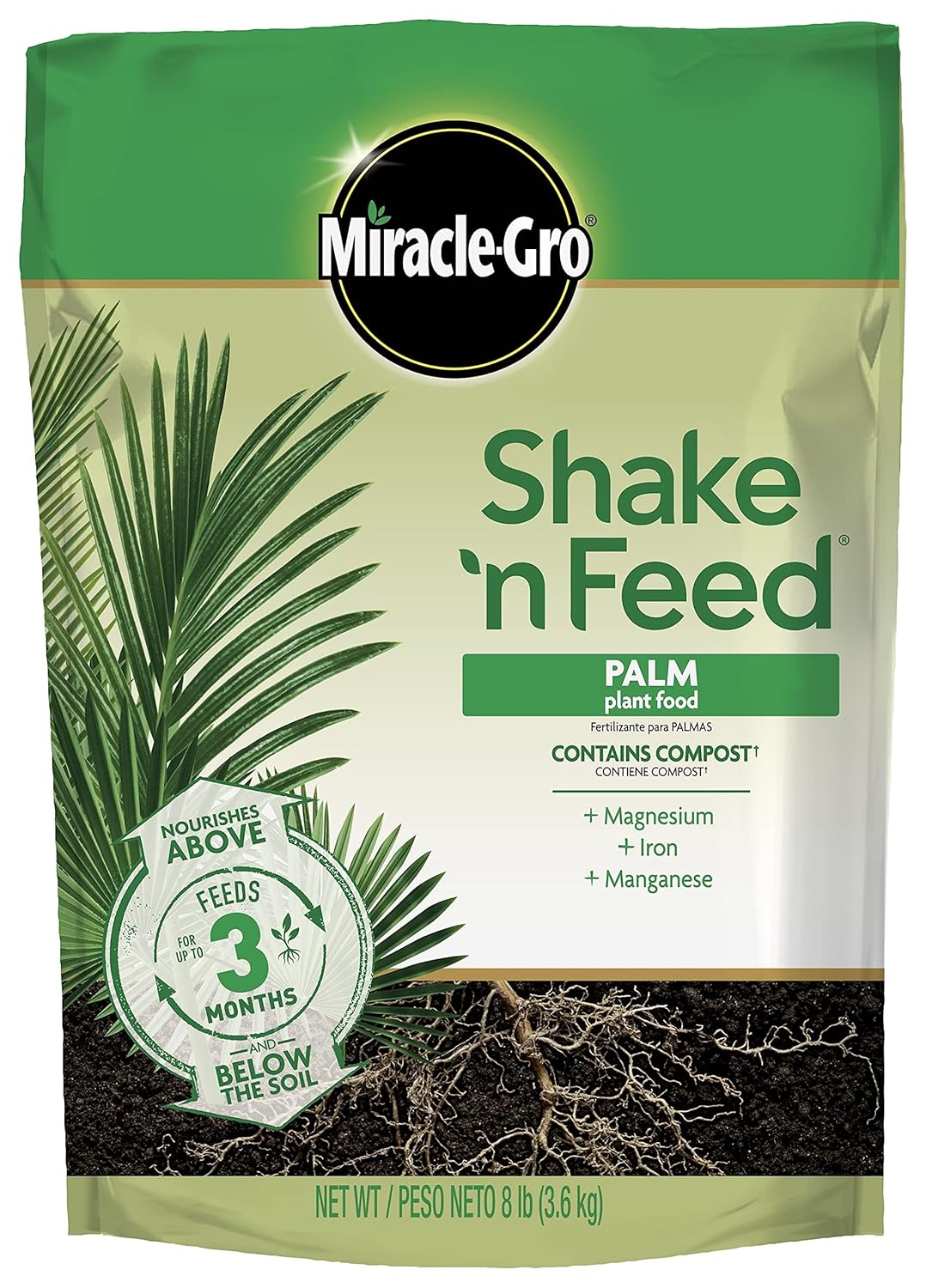
Miracle-Gro Shake 'N Feed Palm Plant Food, 8 lb
| Item Form | Powder |
|---|---|
| Target Species | palms, cycads and tropical plants |
| Unit Count | 128 Ounce |
| Mixing Ratio | 8:2:12 |
| Item Type Name | Feeds up to 3 Months |
Miracle-Gro Shake 'N Feed Palm Plant Food is a granular, slow-release fertilizer designed for palm trees, cycads and other tropical plants in containers or planted in the ground. You apply it by shaking or sprinkling the powder evenly under the canopy, working it into the top 1 to 3 inches of soil and watering to activate the nutrients. The formula includes nitrogen, phosphorus and potassium at an 8-2-12 mixing ratio plus magnesium, iron and manganese to help reduce yellowing fronds and support greener growth. It also contains compost to encourage beneficial microbial activity around roots and improve water efficiency. A single 8 lb bag claims coverage up to about 533 sq ft and feeds plants for roughly three months, so routine quarterly applications keep established palms maintained without frequent feeding. Limitations: it is a general-use palm fertilizer rather than a tailored treatment for specific deficiencies, and granular application requires careful placement to avoid contact with trunks or foliage.
Best for: Buyers who want a low-maintenance, quarterly feeding plan for established palms or tropical plants and prefer a straightforward granular product that supports steady growth.
Less Ideal for: Gardeners seeking immediate correction of nutrient deficiencies, tailored soil-specific blends, or those who prefer liquid feeds or foliar sprays for fast results.
- Slow-release formula that feeds up to three months to reduce reapplication frequency
- Includes micronutrients (magnesium, iron, manganese) to help prevent yellowing fronds
- Contains compost to support soil microbes and root health
- Suitable for both in-ground and container palms and tropical plants
- Not a liquid or foliar treatment so it cannot correct acute nutrient deficiencies quickly
Verdict: A simple, slow-release granular feed that keeps palms and tropical plants greener with only quarterly applications.
Choosing the Right Tree Food Fertilizer for Palm Trees: Key Factors to Consider
Nutrient Formula and Ratios
Palms benefit from fertilizer ratios that supply adequate potassium and often slightly higher potassium relative to nitrogen. A balanced N-P-K alone is not enough; you need to check how much potassium and magnesium are present since deficiencies show as yellowing or frayed fronds.
Look for clear analysis on the label and instructions that spell out grams or tablespoons per inch of trunk or per gallon of potting mix. For palms, avoid formulations with disproportionately high nitrogen unless correcting a clear N deficiency, because excess nitrogen can encourage soft growth that is more drought sensitive.
Micronutrients and Trace Elements
Iron, manganese, and boron are among micronutrients palms often need in measurable amounts. Deficiencies in these elements cause specific discolorations and structural problems, so a fertilizer intended for palms should list these micronutrients and their concentrations.
Chelated forms can improve uptake in alkaline soils, and slow-release micronutrient packages reduce the chance of sudden imbalances. If your soil test shows a specific deficiency, choose a product that addresses that nutrient rather than using a generic mix.
Release Type and Timing
Granular slow-release fertilizers give steady feeding across weeks or months, which reduces the risk of salt spikes and the need for frequent reapplication. Water-soluble or liquid feeds deliver a faster correction for acute deficiencies but require more frequent scheduling.
Consider your climate and growth season when choosing release type. In warm climates where palms grow year-round, a slow-release product that feeds over several months is useful. In contrast, targeted liquid feeds are better for immediate color correction or container palms that show quick symptoms.
Application Method and Ease
How you apply tree food affects whether the palm actually receives the nutrients. Granules spread on the soil surface should be distributed under the canopy and lightly watered in to reach feeder roots. Tablets or spikes offer tidy installation but may not distribute nutrients evenly across a large root zone.
Labels that provide clear rates based on trunk diameter or canopy spread reduce guesswork. Also consider whether the product works with your existing tools, such as spreaders, measuring scoops, or hose-end injectors.
Salt Content and Root Safety
Palms are sensitive to soluble salts; products with high salt indexes can stress roots and cause tip burn. Lower-salt slow-release formulas are generally safer, especially in poor-draining soils or containers.
If using higher-soluble feeds, plan to irrigate thoroughly after application to flush salts and monitor soil conductivity over time. For potted palms, choose low-salt options or apply reduced rates to avoid root damage.
Suitability for Site Type and Palm Species
Different palms and planting situations demand different approaches. Large landscape palms with extensive root zones tolerate broadcast granular applications, while container palms need controlled-release tablets or diluted liquid feeds to avoid salt buildup.
Also consider mature versus newly planted palms: young transplants benefit from gentler, lower-rate formulas that encourage root establishment rather than top growth, while established specimens can handle standard rates and longer-release products.
When to Feed Palm Trees
Timing matters for effective feeding. In warm climates, palms often grow through most of the year but show the most active uptake in spring and summer. Apply a measured feed at the start of the growing season and repeat according to the product release schedule or label directions. Avoid heavy late-season feeding in areas with cold winters, because new tender growth can be damaged by frost.
For container palms, split applications into smaller, more frequent doses to reduce salt stress. If you need a quick correction for yellowing fronds, a targeted liquid feed can be applied and followed by regular slow-release maintenance.
- Time slow-release granules for the beginning of growth flushes.
- Use liquid feeds for rapid correction, then switch to slow-release.
- Avoid late-season high-nitrogen applications in cold climates.
How to Apply Tree Food to Palms Safely
Apply fertilizer evenly under the canopy where the majority of feeder roots are located. For trunk-based recommendations, many labels give rates per inch of trunk diameter; for canopy-based approaches, measure the spread and distribute accordingly. After applying granular products, water thoroughly to move nutrients into the root zone.
Keep fertilizer away from direct contact with the trunk and crown to prevent burning. Use gloves and follow label safety directions, and store unused product in a dry, sealed container to maintain effectiveness.
- Measure canopy or trunk before calculating application rates.
- Water in granular feeds to reduce salt concentration on the surface.
- Avoid piling granules against the trunk or crown.
Interpreting Palm Deficiency Symptoms
Leaf color and pattern give clues about which nutrient is lacking. Yellowing across older fronds often signals potassium or magnesium deficiency, while new fronds with interveinal chlorosis point to iron or manganese shortages. Brown tips and collapsing leaflet tissue can indicate salt stress or overfertilization.
Address symptoms by matching the nutrient profile to the disorder. A soil or tissue test is the most reliable way to confirm deficiencies before making large changes to your feeding program.
- Yellowing older fronds: suspect potassium or magnesium issues.
- New frond chlorosis: check iron and manganese availability.
- Tip burn: evaluate salt exposure and irrigation practices.
Feeding Schedules for Common Situations
Established landscape palms in warm areas often do well with a slow-release application two to three times during the growing season or a single application of an extended-release product rated for several months. Newly planted palms benefit from lighter, more frequent applications to support root growth without shocking young roots.
Container palms require reduced rates and more frequent, diluted feeds because containers hold salts and have limited root volume. Adjust schedules based on observed growth rate and any deficiency symptoms.
- Established in-ground palms: slow-release every few months or seasonal applications.
- New transplants: lower rates more frequently to promote roots.
- Containers: small, frequent liquid feeds or low-rate slow-release tablets.
Soil Testing and Adjusting Your Plan
A simple soil test gives information on pH, available potassium, magnesium, and micronutrients so you can pick a product that addresses real needs rather than guessing. Palm problems often stem from imbalanced pH or micronutrient lockup, so correcting soil chemistry can be as important as adding fertilizer.
If a soil test is not possible, observe plant response after targeted feeds and adjust rates or switch formulations if deficiencies persist. Remember that changes in soil nutrient status can take weeks to show in palm frond coloration.
- Test soil for pH and nutrient levels before major changes.
- Use soil results to prioritize potassium, magnesium, or micronutrient additions.
- Monitor response over weeks rather than days after feeding.
How We Chose the Best Tree Food Fertilizer for Palm Trees
We focused on attributes that directly affect palm health and how gardeners use tree food in the landscape. Key evaluation criteria included nutrient formulation and ratio to ensure adequate potassium and magnesium levels, the presence and balance of essential micronutrients like manganese and iron, and the release profile whether slow-release granules or soluble options so feeding matches seasonal needs. Application practicality was assessed by ease of measuring and distributing the fertilizer, compatibility with common spreaders or injectors, and the clarity of label instructions for palms. Salt index and soluble salt content were considered because palms are sensitive to salt buildup in root zones. We also evaluated packaging sizes and resealability for typical yard use and whether formulations were suitable for container palms as well as in-ground plantings. Exclusions: products aimed only at general lawn use without palm-specific nutrient balance were excluded, as were fertilizers that lacked clear analysis or directions for palm species. We did not include experimental blends without established gardener use or products missing micronutrient information.
FAQ
How often should I feed my palm trees with specialized tree food?
Frequency depends on the product and site. Slow-release granular formulas are often applied two to three times per year or once for extended-release types. Liquid feeds are used more often for quick corrections or container palms.
Can I use general-purpose tree fertilizer on palms?
General-purpose fertilizers sometimes lack the higher potassium and specific micronutrients palms need. Using a palm-specific formulation or one that lists potassium, magnesium, and iron is usually a better choice.
What are signs of overfertilizing palms?
Signs include brown leaf tips, sudden frond collapse, and salt crusting on the soil surface. Overapplication can raise soluble salts and damage feeder roots, so follow label rates and water in granular feeds.
Are liquid feeds better than granular for container palms?
Liquid feeds let you control concentration and correct deficiencies quickly, which is useful in containers. However, they require more frequent application and careful dosing to avoid salt buildup; low-rate slow-release products can also work well.
Do palms need different fertilizer in sandy versus clay soils?
Yes. Sandy soils drain quickly and may leach nutrients, so more frequent, lower-rate applications or slow-release formulations are helpful. Clay soils hold nutrients but can lock up micronutrients depending on pH, so soil testing and targeted amendments are useful.
Should I water after applying tree food to palms?
Yes. Watering after applying granular fertilizers moves nutrients into the root zone and reduces salt concentration at the soil surface, lowering the risk of root or crown damage.
Final Verdict
Choose a palm-specific tree food based on nutrient balance, micronutrient content, and release type that fits your planting situation. Prioritize formulations with sufficient potassium and magnesium, clear label directions, and a low salt index for containers or poor-draining sites. Match application frequency to the release profile and your climate, and use soil testing or visible symptoms to fine-tune feeding for healthy fronds and steady growth.
