

Note: This article contains affiliate links. If you click on these links and make a purchase, I may earn a small commission at no extra cost to you. This helps support my research and content. Read my full affiliate disclosure here.
Getting sod to establish quickly and develop a durable root system is different than routine lawn feeding. For Bermuda sod you need fertilizers that encourage rapid root growth, supply the right balance of nitrogen and starter nutrients, and release predictably under warm soil conditions. This guide covers seven top Bermuda sod fertilizers shortlisted for establishment, root development, and ease of application. We'll explain the evaluation criteria used and highlight practical considerations for timing, rate, and homeowner application methods so you can pick the right product for your yard.
Top Picks at a Glance
| Best Overall The best all-around choice for most situations | Scotts Turf Builder Starter Food for New Grass, 15 lb. |  |
| Best Quality Built to a higher standard if you want something more solid | The Andersons Professional PGF Complete 16-4-8 Lawn Fertilizer with Humic DG |  |
| Best Value The sweet spot between price and what you get | Scotts Green Max Lawn Food — Granular Lawn Fertilizer with Iron, 5,000 sq. ft. |  |
| Best Budget The cheapest option that still gets the job done reliably | Central Sod Starter Fertilizer 10-10-10 for Sod and Seed (covers 600 sq ft) |  |
| Highest Rated A top-rated pick with lots of positive feedback | Espoma Turf‑Tone Lawn Starter Organic Fertilizer 4-6-3, 30 lb |  |
| Most Popular A crowd favorite that many people choose with confidence | Scotts Turf Builder Starter Food for New Grass, 42 lb |  |
| Best Seller A high-volume bestseller chosen again and again | Scotts Turf Builder Lawn Food, 37.5 lb |  |
Scotts Turf Builder Starter Food for New Grass, 15 lb.

| Formula (NPK) | 24-25-4 |
|---|---|
| Form | Powder/granular |
| Application method | Spreader |
| Coverage | 5,000 square feet |
Scotts Turf Builder Starter Food is a powdered granular starter fertilizer designed for use when planting new grass, reseeding, or laying sod. With a 24-25-4 NPK ratio it delivers a high phosphate dose to encourage root development during the first 2–4 weeks. Typical use is to apply with a broadcast or drop spreader at planting, water to keep soil surface moist until seedlings reach about 2 inches, then reapply after 2–4 weeks to sustain establishment before switching to regular lawn food. The product is safe for all grass types and is sold in a 15 lb. bag that the label states covers roughly 5,000 sq. ft. Practical benefits include faster germination and denser turf from stronger roots and straightforward application using common spreaders. Limitations are that it is a short-term starter feed rather than a season-long fertilizer and you must follow spreader settings and watering closely for best results; it also requires a follow-up maintenance program after establishment.
Best for: Homeowners and DIY gardeners planting or reseeding mid-size lawns who want a focused starter feed to speed root establishment and thicken turf quickly.
Less Ideal for: Gardeners who need an all-season fertilizer program or who prefer liquid feeds and those managing very small patch repairs where a smaller package or precision product would be more convenient.
- High phosphate 24-25-4 formula targeted to build strong roots for new lawns
- Designed for immediate use at planting and compatible with common broadcast and drop spreaders
- Covers up to 5,000 sq. ft. per 15 lb. bag for mid-size lawn projects
- Works on all grass types including seed, sod, plugs, and sprigs
- Starter formulation is intended for initial establishment and not as a long-term maintenance fertilizer
- Requires correct spreader settings and consistent watering to achieve advertised results
Verdict: Use this 24-25-4 starter formula when planting Bermuda sod or seed to accelerate root development and achieve thicker turf during the first weeks of establishment.
The Andersons Professional PGF Complete 16-4-8 Lawn Fertilizer with Humic DG

| NPK ratio | 16-4-8 |
|---|---|
| Item Form | Granules |
| Specific Uses For Product | Soil Conditioning |
| Target Species | lawn grasses |
| Mixing Ratio | 4-1-2 ratio |
This granular 16-4-8 fertilizer is formulated to give lawns both an immediate nitrogen boost and a sustained feed for up to eight weeks, making it suited to performance-minded care of warm-season grasses like Bermuda. The super-fine particles increase particle count per square foot for more even spread and the Humic DG component is designed to help move nutrients into the soil after light watering. It also supplies iron and micronutrients that support color and turf vigor. Typical use is broadcast application with a rotary or drop spreader at the recommended setting, walking at a steady pace and overlapping slightly for full coverage; the label notes to apply to dry foliage and water in with at least 0.2 inches. Practical benefits are fast green-up, longer-lasting feeding and improved nutrient uptake in poorer soils. Limitations are that it is a concentrated fertilizer requiring careful spreader calibration and protective gear during handling, and it is not approved for sale in California which restricts availability for some buyers.
Best for: Gardeners and turf managers focused on high-performing Bermuda sod who want a product that delivers fast color and multi-week feeding without frequent reapplication.
Less Ideal for: Casual homeowners who prefer low-maintenance, slow-application products or those in jurisdictions where this formulation is restricted or not sold.
- Balanced quick- and slow-release nitrogen for immediate green-up plus longer feed (up to 8 weeks)
- Super-fine granules promote even distribution and consistent coverage
- Includes iron and micronutrients to improve color and turf vigor
- Humic DG helps move nutrients into soil for better uptake after watering
- Requires precise spreader settings and careful application to avoid uneven feeding
- Contains concentrated nutrients so protective equipment is recommended during handling
- Not for sale in California which limits where it can be used
Verdict: Choose this fertilizer when you need a performance-oriented 16-4-8 granular formula that delivers quick green-up and sustained feeding for Bermuda turf.
Scotts Green Max Lawn Food — Granular Lawn Fertilizer with Iron, 5,000 sq. ft.

| Item Form | Granules |
|---|---|
| Coverage | 5000 square feet |
| Specific Uses For Product | Lawn |
| Target Species | lawn grass |
| Unit Count | 266.67 Ounce |
Scotts Green Max is a granular lawn fertilizer formulated to feed turf and boost color quickly thanks to a 2-in-1 formula that includes 5% iron. It is applied with a broadcast or drop spreader following the label settings, then lightly watered in for faster results. The product is intended for any grass type and promises deeper greening in about three days without staining hard surfaces when used as directed. A single 16.67 lb. bag covers 5,000 square feet, which makes it convenient for medium-sized yards and routine seasonal applications. Practical users will appreciate that each granule is described as concentrated nutrition rather than filler, and the directions include spreader settings to get an even application. Limitations are that it is a straight lawn food plus iron rather than a combined fertilizer and weed control solution, and Florida users should check label exceptions noted by the brand. Also homeowners who prefer liquid feeds or need specialized nutrient ratios for a diagnosed deficiency may need a different product.
Best for: Homeowners who want a straightforward, no-nonsense fertilizer to quickly improve turf color and maintain a healthy Bermuda lawn with predictable application steps.
Less Ideal for: Gardeners seeking a combined weed-and-feed product, a tailored fertilizer for specific soil test results, or those who prefer liquid feeding regimens.
- Fast visible greening in about three days due to 5% iron
- Covers up to 5,000 sq. ft. from one 16.67 lb. bag, suitable for medium lawns
- Formulated as concentrated granules with minimal filler for efficient nutrient delivery
- Includes clear spreader settings for consistent application
- Safe to re-enter lawn immediately after application
- Does not include weed control or insect control in the same bag
- Label notes region-specific exceptions for Florida users
- Product is granular only so not ideal for those preferring liquid applications
Verdict: Choose Scotts Green Max when you want a reliable granular fertilizer that delivers rapid deep greening and easy spreader-based application for medium-sized Bermuda lawns.
Central Sod Starter Fertilizer 10-10-10 for Sod and Seed (covers 600 sq ft)

| Item Form | Granules |
|---|---|
| Application Method | spread |
| Coverage | 600 square feet |
| Target Species | grass |
| Mixing Ratio | 10-10-10 |
This Central Sod 10-10-10 starter fertilizer is designed for use before laying new sod or seeding and comes in a bag sized to cover one 600 sq ft pallet. The granules supply quick-release nutrients that are immediately available to young turf, helping roots establish during the first few weeks. Application is straightforward: broadcast or rotary spread the product over prepared soil then lay sod or seed on top; there is no need to incorporate it into the soil. The formulation is presented as safe for warm- and cool-season grasses, so it works well for Bermuda sod when applied to actively growing turf. Practical benefits include the convenient bag size for single-pallet jobs and the simple mixing ratio listed for gardeners who may dilute or blend for smaller areas. Limitations are that it is a quick-release 10-10-10 mix rather than a slow-release or specialty turf formula, so nutrient availability is short term and multiple follow-up feeds may be needed for sustained growth, and the product is intended for use only when grass is actively growing, not on dormant sod.
Best for: Buyers installing a single pallet or small areas of Bermuda sod who want an affordable, easy-to-apply starter fertilizer to help new turf establish.
Less Ideal for: Gardeners looking for a long-term, slow-release lawn fertility program or those treating large acreages where a bulk commercial product would be more economical.
- Ready-to-use 10-10-10 formulation tailored for new sod and seed
- Bag sized to cover 600 square feet matches a typical sod pallet for easy planning
- Quick-release granules provide immediate nutrients to help root establishment
- Simple application with a broadcast or rotary spreader and no soil incorporation needed
- Fast-release nutrients mean shorter feeding duration compared with slow-release fertilizers
- Not formulated as a specialty turf fertilizer for ongoing maintenance
Verdict: A simple, budget-friendly 10-10-10 starter fertilizer sized for a single 600 sq ft sod pallet that helps new Bermuda sod establish quickly.
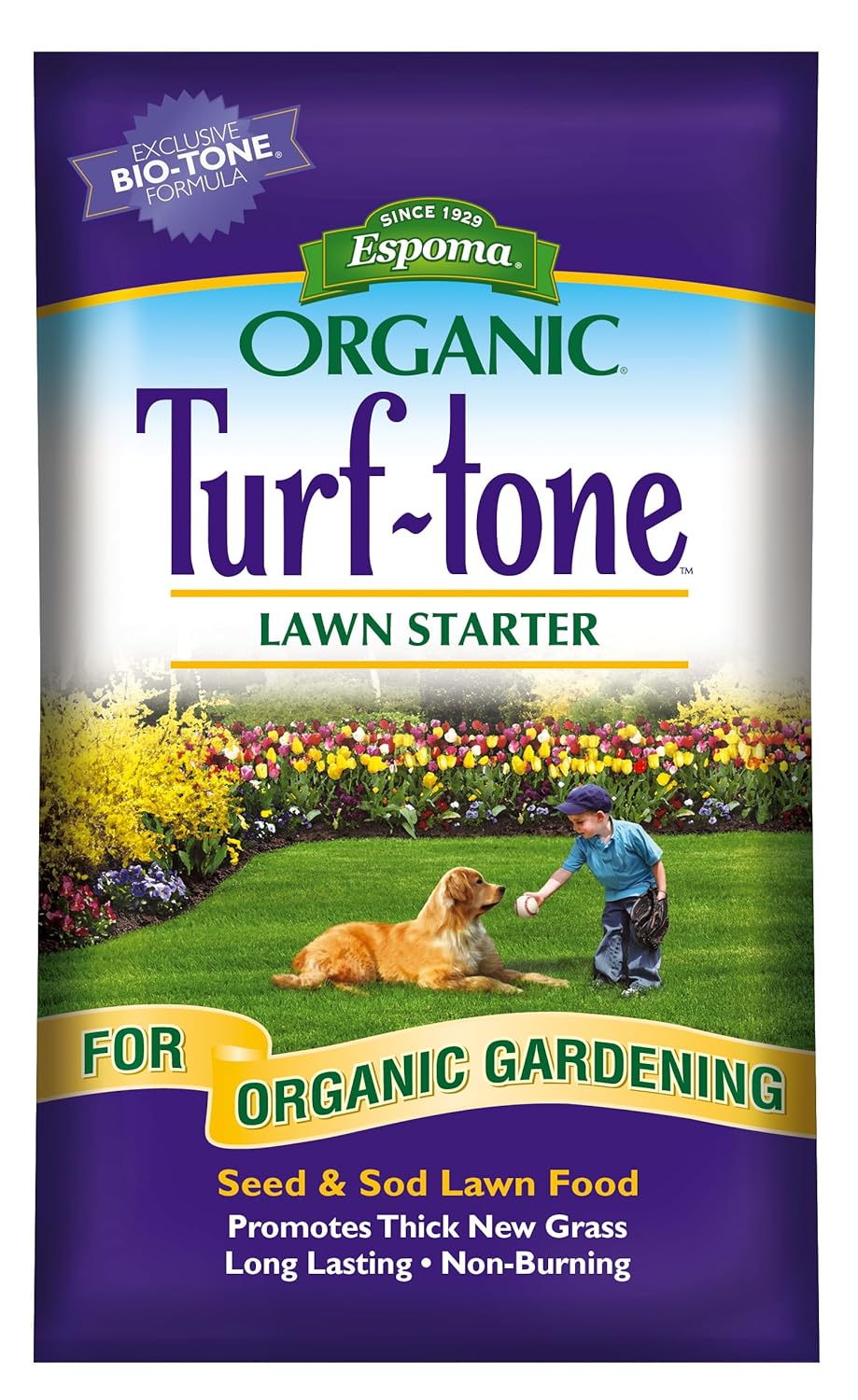
Espoma Turf‑Tone Lawn Starter Organic Fertilizer 4-6-3, 30 lb
| Item Form | Granules |
|---|---|
| Application Method | Drop or broadcast spreader |
| Target Species | Lawn Grass |
| Mixing Ratio | 4:6:3 |
This granular starter fertilizer is designed specifically for establishing new lawns, overseeding and fresh sod installations. It supplies a higher phosphorus ratio for root development along with long‑lasting nitrogen and Espoma's Bio‑Tone microbial formula to help young Bermuda and other warm‑season grasses get established. Application is simple: broadcast or drop spreader use covers up to about 3,000 sq ft from a 30 lb bag, and the granules are suitable for routine lawn starter timing. The organic inputs such as feather meal and poultry manure provide steady nutrient release rather than a rapid spike, which reduces burn risk but means results take longer to appear compared with synthetic starters. This product is best when you want dependable, soil‑friendly feeding for new sod or seed and prefer slower, sustained nutrient delivery over instant greening.
Best for: Buyers who prioritize reliable, soil-friendly establishment for new Bermuda sod or overseeding projects and prefer steady nutrient release over rapid greening.
Less Ideal for: Homeowners who need immediate, quick green-up or who prefer precise, fast-acting synthetic fertilizers for instant results.
- Formulated for new turf with a 4-6-3 starter analysis that supports root development
- Contains Bio-Tone microbial formula to encourage soil health and establishment
- Organic nutrient sources provide steady, low-burn nutrient release
- Suitable for application with common drop or broadcast spreaders and covers up to 3,000 sq ft per bag
- Slower visible results compared with fast-release synthetic starters due to organic ingredient release rates
Verdict: Choose this organic starter if you want a dependable, low-risk fertilizer focused on healthy root establishment for new Bermuda sod.
Scotts Turf Builder Starter Food for New Grass, 42 lb

| Mixing Ratio | 24-25-4 (N-P-K) |
|---|---|
| Item Form | Granules |
| Specific Uses For Product | Lawns |
| Coverage | 14000 |
| Target Species | new grass |
Scotts Turf Builder Starter Food is a granular starter fertilizer formulated for seed, sod, plugs, and sprigs to help new lawns establish faster. It uses a 24-25-4 N-P-K blend with a relatively high phosphate content to encourage root development, and Scotts recommends two applications spaced 2–4 weeks apart during establishment. In practice you spread it with a broadcast or drop spreader, water to keep the soil surface moist until seedlings reach about 2 inches, then follow with regular lawn food after eight weeks. The product covers large areas per bag so it is useful for treating an entire Bermuda sod installation. Notable features include Scotts All-in-One Particles technology for even nutrient distribution and clear spreader settings for predictable application. Limitations are that it is a starter-only formula so it is not intended for ongoing fertility needs and careful watering is required after seeding to avoid washout or uneven emergence.
Best for: Homeowners installing or overseeding Bermuda sod who prioritize predictable establishment and want a product designed specifically to jump-start roots and young blades.
Less Ideal for: Gardeners seeking an all-season maintenance fertilizer or a slow-release program for mature lawns should choose a general-purpose lawn food or a tailored program instead.
- High phosphate 24-25-4 formula designed to promote strong root development in new lawns
- Large 42 lb bag covers up to 14,000 sq. ft., suitable for full-sod installations
- Granular All-in-One particles help deliver consistent nutrient distribution across the spread area
- Starter formula only so you will need to switch to a maintenance fertilizer after establishment
- Requires two timed applications and regular watering during germination for best results
Verdict: If you need a proven starter fertilizer to speed root development and establish Bermuda sod quickly, this Scotts starter food is a straightforward, large-coverage choice.
Scotts Turf Builder Lawn Food, 37.5 lb

| Item Form | Granules |
|---|---|
| Specific Uses For Product | Lawn |
| Coverage | 15000 |
| Mixing Ratio | 32:0:4 |
Scotts Turf Builder Lawn Food is a granular fertilizer formulated for use on any grass type to thicken turf, promote deeper roots, and improve nutrient and water uptake. Typical use is broadcast with a spreader over a lawn up to the listed coverage, applied in spring, summer, or fall to wet or dry turf; Scotts includes recommended spreader settings for consistent application. The product’s high-nitrogen formula (mixing ratio listed as 32:0:4) encourages fast greening and denser blades, while being pesticide-free so it focuses strictly on nutrition. Practical benefits include large coverage from a single bag and straightforward application instructions that reduce guesswork. Limitations are that it is a general-purpose fertilizer rather than a Bermuda-specific blend and it does not include weed or pest control, so you may need additional products for broadleaf weeds or insects. Also the granular form requires a spreader for even results and careful cleanup around hard surfaces.
Best for: Homeowners who want a low-risk, proven lawn fertilizer that makes feeding routine simple and reliable for maintaining a thicker, greener Bermuda lawn.
Less Ideal for: Buyers seeking an all-in-one product that controls weeds or pests or those who prefer a fertilizer tailored specifically to Bermuda's seasonal nutrient needs.
- Covers up to 15,000 sq. ft. from one 37.5 lb bag
- Designed for any grass type so can be used across different lawns
- Provides high-nitrogen nutrition to encourage greening and thicker turf
- Clear spreader settings and simple application instructions reduce application errors
- Not formulated specifically for Bermuda so may lack nutrients tailored to that grass type
- No weed or insect control included, so other treatments may be required
Verdict: A straightforward, high-coverage granular lawn food that reliably greens and strengthens turf for homeowners who want a low-risk feeding solution.
Choosing the Right Bermuda Sod Fertilizer: Key Factors to Consider
Nutrient Ratio And Starter Phosphorus
Young Bermuda sod needs a nutrient profile that promotes root establishment more than top growth. A starter fertilizer typically has a higher phosphorus level relative to standard maintenance feeds because phosphorus supports root initiation and early vigor. Check the label for an N-P-K ratio that includes starter phosphorus; too little phosphorus can slow root penetration into the soil, while excessive nitrogen early on can push blade growth at the expense of roots.
Consider also secondary and micronutrients. Calcium and magnesium affect soil structure and root function, while iron and manganese influence green-up without forcing excessive leaf elongation. A well-formulated starter will balance primary and supporting nutrients for steady root-focused development.
Release Type And Timing
How a fertilizer releases nutrients determines establishment outcomes. Quick-release sources give an immediate nutrient boost that helps green the sod, but they can burn delicate roots if applied too heavily or if watering is inconsistent. Controlled-release formulas offer steady feeding over days or weeks and reduce the risk of scorch, which is useful in hot, sunny conditions where Bermuda is typically laid.
Match release type to your installation plan. If you can irrigate frequently and evenly after laying sod, a soluble starter can work well for early green-up. If irrigation is less consistent, a slow- or controlled-release option reduces risk and prolongs nutrient availability during the critical rooting window.
Application Rate And Spreadability
Achieving the correct application rate is essential for safe, effective establishment. Labels should give clear per-1000-square-foot rates for sod installation rather than generic lawn maintenance directions. Physical properties like granule size and flowability affect how evenly fertilizer spreads from a walk-behind or tow-behind spreader. Clumping or very fine dust can lead to uneven patches that overfeed or underfeed sections of newly laid sod.
Also check how forgiving the product is to slight overlaps when spreading and whether it requires immediate incorporation with watering. An easy-to-apply product lowers the chance of human error during a labor-intensive installation day.
Compatibility With Watering Practices
After sod is laid, frequent gentle watering is usually needed to keep roots moist and help the sod knit to the soil. Your fertilizer choice should align with that schedule. Quick-release materials rely on prompt irrigation to move nutrients into the root zone and to avoid leaf scorch. In contrast, some controlled-release granules break down with soil moisture and soil temperature, offering a buffer if watering intervals vary.
Consider whether the fertilizer requires immediate water-in and how long it advises delaying heavy irrigation or mowing. Products that tolerate the common homeowner pattern of light, frequent watering are often more practical for sod establishment.
Soil Interaction And pH Effects
Soil chemistry influences nutrient availability and therefore establishment success. Some fertilizers can alter soil salinity or temporarily change local pH at the granule-soil interface, affecting young roots. If your soil test indicates extreme pH or high soluble salts, choose a formulation designed to minimize salt stress and avoid high-concentration surface salts.
Think about how the product works with your existing soil amendment plan. If you will be using starter amendments like gypsum, compost, or lime, select a fertilizer that complements those inputs and does not cause nutrient antagonism.
Safety And Re-entry Guidelines
Newly laid sod is fragile and may be sensitive to heavy foot traffic and immediate treatments. Fertilizer labels should list safe re-entry times and any precautions for pets and children. Granular fertilizers that leave visible residue may require a prompt, light irrigation to move materials into the soil and minimize contact.
Also assess the need for protective equipment during application and the clarity of label directions regarding over-application consequences. Choosing a product with straightforward, safety-conscious instructions helps prevent common installation mistakes that can compromise establishment.
When To Fertilize Bermuda Sod After Installation
Timing your first and follow-up fertilizer applications affects how quickly sod roots into the underlying soil. Most installation plans start with a starter application at time of laying, followed by a light feed when you see initial root contact and again several weeks later once the sod is actively rooting.
Be cautious of applying high-nitrogen feeds too early. Early applications should favor root-building nutrients and predictable release. Adjust timing based on soil temperature and moisture: warmer soils speed nutrient release and root growth while dry conditions require gentler feeding and closer attention to irrigation.
- Initial starter applied at laying to support root initiation
- Follow-up applications timed with visible rooting and soil warmth
- Avoid heavy nitrogen until the root system is established
Interpreting N-P-K Labels For Sod Establishment
The three numbers on a bag give a shorthand for what the fertilizer will supply. For sod starters, look for a balanced approach that does not overemphasize the first number alone. The middle number indicates phosphorus, which is critical for root establishment.
Also consider how the product lists nutrient sources. Readable labels will break down the quick-release and slow-release portions of nitrogen and state the actual phosphate form. This information helps you match the product to desired release behavior and to any soil test recommendations.
- Phosphorus supports root development and is key for starters
- Label transparency on release components improves predictability
- Match N-P-K to soil test results when possible
Preparing Soil Before Laying Bermuda Sod
Even the best fertilizer cannot compensate for poorly prepared soil. Proper grading, removing debris, and lightly amending with organic matter create a hospitable medium for sod roots to penetrate. A soil test will indicate pH and nutrient shortfalls that you should address before installation.
Apply starter fertilizer according to label directions after final raking and just before unrolling the sod so nutrients sit at the soil surface for rapid root access when watered in.
- Grade and smooth the bed to avoid air gaps under sod
- Address pH and major nutrient deficiencies pre-install
- Apply starter at recommended rate right before laying sod
Watering Strategies That Complement Fertilizer
New sod requires consistent moisture to encourage roots into the soil and to dissolve fertilizer granules. Start with frequent, short watering sessions the first week to keep the root zone moist but not saturated. As roots develop, gradually shift to deeper, less-frequent waterings.
Coordinate watering with the fertilizer's recommended water-in timing. Some starter products ask for immediate gentle irrigation, while others tolerate delayed watering because they release slowly with soil moisture and temperature.
- Frequent light watering initially to keep roots moist
- Increase irrigation depth as sod roots establish
- Adjust schedule to match fertilizer release behavior
Common Mistakes To Avoid When Fertilizing Sod
Over-application is a frequent error that can burn fragile roots or force too much top growth. Follow label rates closely and measure the area precisely to avoid applying more than recommended. Uneven spreading leads to patchy rooting and color differences across the lawn.
Another mistake is rushing heavy maintenance feeds before the sod has a functional root network. Delay high-nitrogen, turf-strengthening applications until the sod shows consistent rooting and resilience to mowing and foot traffic.
- Do not exceed starter application rates
- Avoid uneven spread patterns and overlapping passes
- Postpone maintenance-strength fertilizers until roots are strong
How We Chose the Best Bermuda Sod Fertilizer
We focused on attributes that matter for establishing Bermuda sod instead of general lawn maintenance. Primary evaluation criteria included nutrient formulation and starter ratios, release type and predictability in warm soils, root development support, and application practicality for homeowners laying sod. We prioritized fertilizers with nutrient blends targeted to young turf-balanced nitrogen with sufficient phosphorus and potassium at starter-appropriate ratios-and products whose release characteristics match warm-season soil conditions to avoid scorching or nutrient lockup. We also considered ease of application: granule size, spreader compatibility, clear label instructions for sod establishment rates, and safe re-entry timing. Longevity of nutrient release and compatibility with post-install watering schedules were weighted as well. Exclusions: products formulated only for cool-season grasses, turf paint or colorants, and mixed-use blends lacking clear starter guidance were removed. The final shortlist contains fertilizers that meet establishment-focused nutrient and handling requirements and suit typical homeowner sod installation practices.
FAQ
How soon can I mow Bermuda sod after applying starter fertilizer?
Mowing depends more on root establishment than fertilizer timing. Wait until the sod has rooted enough to stay in place when you lift a corner, and follow label guidance on mowing intervals. Usually a light first mow is safe after two to three weeks if rooting is visible, but delay heavy mowing if the turf pulls up easily.
Can I use a general lawn fertilizer on new Bermuda sod?
General lawn fertilizers may be formulated for maintenance rather than establishment. They can contain higher quick-release nitrogen and lower phosphorus than a starter formulation, which may favor leaf growth over roots. For best results, use a product with starter ratios or follow a soil test recommendation.
What if my soil test shows low phosphorus before laying sod?
If soil phosphorus is low, apply a starter fertilizer that supplies additional available phosphorus at the installation rate recommended on the label. Incorporate any other soil amendments before laying sod to give roots the best chance to access nutrients immediately.
Should I water immediately after spreading fertilizer on sod?
Most starter fertilizers benefit from a gentle water-in to move nutrients into the root zone and reduce surface salt contact. However, follow the specific product instructions. Some controlled-release products are designed to work with routine watering patterns and do not require immediate heavy irrigation.
How many applications are needed during the first growing season?
Establishment plans typically include an initial starter at installation and one or two follow-up feeds as roots develop. The exact number depends on the product's release profile, soil fertility, and how rapidly the sod matures. Monitor rooting and turf vigor before scheduling additional applications.
Are organic starters appropriate for Bermuda sod?
Organic starters can support establishment but often release nutrients more slowly than synthetic starters. They work well when combined with consistent irrigation and when soil organic matter is being built up. For rapid rooting in very warm soils, some gardeners prefer formulations with a predictable release profile.
Final Verdict
Prioritize starter nutrient balance and predictable release behavior when choosing a fertilizer for Bermuda sod. Focus on products that support root development, offer clear application rates, and fit your watering routine. Expect tradeoffs between rapid green-up and burn risk; if irrigation is reliable, quicker-release starters can help early color, while controlled-release options reduce scorch risk. Make decisions based on your soil test, installation timeline, and how much hands-on irrigation you can provide. Emphasize root-building nutrients and gradual feeding during the first weeks so your Bermuda sod develops a deep, resilient root system.
