

Note: This article contains affiliate links. If you click on these links and make a purchase, I may earn a small commission at no extra cost to you. This helps support my research and content. Read my full affiliate disclosure here.
If you keep large indoor plants, the right grow light changes how those specimens look and grow. Large foliage and taller canopies need wider, deeper light penetration and a spectrum that supports both leaf expansion and strong stems. A mismatched fixture can cause stretched stems, uneven foliage color, or wasted energy. This guide summarizes seven top grow lights chosen for large indoor plants. We shortlisted fixtures that offer broad coverage, tunable spectrum or full-spectrum output, efficient power use, and robust thermal design. Below you will find the practical pros and cons of different approaches and the evaluation criteria we used to compare options.
Top Picks at a Glance
| Best Overall The best all-around choice for most situations | GLOWRIUM 48W Dual‑Head Full Spectrum Tall LED Grow Light |  |
| Best Quality Built to a higher standard if you want something more solid | chiphy 85" Tall Full-Spectrum LED Grow Light, 60W |  |
| Best Value The sweet spot between price and what you get | LBW Tri-Head Full Spectrum LED Grow Light with Adjustable Tripod Stand |  |
| Best Budget The cheapest option that still gets the job done reliably | yadoker Bamboo LED Full-Spectrum Grow Light with Telescoping Pole and Timer |  |
| Highest Rated A top-rated pick with lots of positive feedback | LYCBY2 FC-08 Sunrise & Sunset Full-Spectrum Grow Light for Large Indoor Plants |  |
| Best Seller A high-volume bestseller chosen again and again | Aokrean 6.3in Full Spectrum Halo Grow Light, 2-Pack |  |
GLOWRIUM 48W Dual‑Head Full Spectrum Tall LED Grow Light

| Wattage | 48 watts |
|---|---|
| Light Source Type | LED |
| Number of Light Sources | 268 |
| Power Source | Corded Electric |
| Additional Features | Adjustable Arm, Adjustable Height, Dimmable, Full Spectrum, Timer |
This GLOWRIUM floor lamp is built to support large indoor plants from seedling through flowering. It has two 7.87‑inch lamp heads with 268 high‑efficiency LEDs and selectable Seedling, Vegetative, and Flowering spectrum modes so you can match wavelengths to each growth stage. The pole extends to a tall height and each head uses a 360° flexible gooseneck for targeted coverage over wide pots or multiple plants. Controls are simple: a push‑button inline controller offers a timer (3, 9, 12, 16 hours), six preset dim levels and press‑and‑hold stepless dimming for fine adjustment. The unit is corded electric, rated 48 watts, and claims a long LED lifespan and tested PPFD suitable for close operation. Practical benefits include strong coverage for taller specimens, easy angle adjustment without extra mounts, and automated daylength via the timer. Expect a sturdy metal base and straightforward assembly, but note it is not water resistant and is intended for indoor use only, so place it away from humid areas or wet trays.
Best for: Buyers who want a practical, no‑frills grow lamp that delivers strong, adjustable light for taller indoor plants and multiple pots in a living room or dedicated grow corner.
Less Ideal for: People who need outdoor or moisture‑resistant fixtures or who prefer smart app control and remote scheduling should look elsewhere.
- Full spectrum with dedicated S/V/F modes to support all plant stages
- Tall freestanding design and 360° gooseneck heads for wide coverage of large plants
- Built‑in timer and multi‑level dimming for automated, precise light schedules
- High LED count and stated high efficiency for strong output and long life
- Not water resistant, so unsuitable for wet or greenhouse environments
- Manual push‑button control only on this model rather than app or remote control
Verdict: A tall, dual‑head full‑spectrum LED floor lamp that gives reliable, adjustable coverage for large indoor plants and multi‑pot setups.
chiphy 85" Tall Full-Spectrum LED Grow Light, 60W

| Wattage | 60 watts |
|---|---|
| Light Source Type | LED |
| Number of Light Sources | 288 |
| Color Temperature | 2300–6500K adjustable |
| Timer | 1–23H & 8/12/16H presets |
The chiphy 85" Grow Light is built to give large houseplants consistent top-down light across every growth stage. Its 288 high-density LEDs produce a 60W output with a wide 120° beam from a 9.2" lamp head, and the five-section pole extends up to 85" so you can place the lamp over seedlings or tall specimens like monstera and fiddle‑leaf figs. Controls include touch, remote, and compatibility with smart plugs plus timers (1–23H and preset cycles), 10 brightness levels and 10 spectrum presets (2300–6500K) to tune light for veg or bloom. Practical features include a high CRI for accurate plant inspection, UV-free flicker-free output for comfortable living spaces, and a heavy steel base with aluminum pole for stability. Assembly is quick and heat dissipation is improved by the aluminum panel for longer LED life. The main compromises are that it is freestanding so needs floor space and it is designed for indoor use only, not for outdoor-exposed setups or integrated multi-panel commercial racks.
Best for: A performance-minded indoor gardener with large, tall houseplants who needs powerful, even top-down lighting and precise spectrum and timer control to support vigorous growth and flowering.
Less Ideal for: People who need a compact desktop or hanging fixture for very small plant collections or those who plan to use lighting outdoors or in unprotected wet locations.
- Tall adjustable height up to 85" suits seedlings through very large houseplants
- Wide 120° beam and 288 LEDs give even top-down coverage with minimal shadowing
- 10-level dimming plus 10 spectrum presets and timers let you fine-tune light for stages from seedling to flowering
- High CRI 95+ and UV-free, flicker-free output make it comfortable to use in living spaces and easy to assess plant health
- Aluminum panel and steel base improve heat dissipation and stability for long LED lifespan
- Freestanding floor design requires clear floor space and may not fit small crowded rooms
- Not rated for outdoor/exposed use so cannot be used in patios or unprotected greenhouse environments
Verdict: If you grow large indoor plants and want powerful, even, fully adjustable full‑spectrum light from seedling through mature stages, this 85" lamp delivers the control and coverage to drive performance.
LBW Tri-Head Full Spectrum LED Grow Light with Adjustable Tripod Stand

| Wattage | 39 watts |
|---|---|
| Light Source Type | LED |
| Additional Features | Dimmable, Full Spectrum |
| Number of Light Sources | 641 |
| Control Method | Remote |
This LBW tri-head grow light is built for larger indoor plants that need adjustable, high-PPFD lighting. The three rectangular LED panels mount on a 63-inch adjustable tripod so you can change height and angle to suit seedlings through mature foliage. Each panel uses a mix of cold and warm white plus red and supplemental wavelengths for a full spectrum that supports photosynthesis across growth stages. The unit includes a remote, six dim levels and a 3/6/12 hour timer which makes routine scheduling and energy management simple. The aluminum light panels and plastic housing keep the fixture relatively light while the tripod provides stability for tall pots. It runs at 39 watts with an advertised 50,000-hour lifetime and is marked waterproof for occasional damp environments. Limitations are the single fixed wattage per unit and reliance on the tripod position for aiming rather than individual long goosenecks, so very irregular canopies may need repositioning or multiple units for even coverage.
Best for: Gardeners who prioritize efficient, programmable lighting for single large indoor plants or a small grouping of tall specimens and who want a simple, stable stand solution they can adjust by height.
Less Ideal for: Growers needing pinpoint lighting for many widely spaced plants or large multi-shelf setups that require distributed fixtures and higher total wattage.
- Full spectrum LEDs including red, blue, white, UV and IR to support multiple growth stages
- Adjustable tripod stand (27.8–63 inches) lets you set optimal distance for tall plants
- Remote control with six dim levels and 3/6/12-hour timer for easy scheduling and energy savings
- Lightweight aluminum panels for stability and long rated lifetime (50,000 hours)
- Fixed 39W power per unit may require multiple fixtures for very large or dense canopies
- No individually articulated long goosenecks on each panel, so precise targeting needs repositioning
Verdict: A practical, height-adjustable full-spectrum LED fixture that makes scheduled, energy-conscious lighting simple for large indoor plants.
yadoker Bamboo LED Full-Spectrum Grow Light with Telescoping Pole and Timer

| Number of Light Sources | 72 |
|---|---|
| Wattage | 10 watts |
| Voltage | 5 volts |
| Control Method | Remote |
| Additional Features | Adjustable Height, Dimmable, Timer |
This yadoker grow light is a stake-in floor lamp designed for larger indoor plants and grouped planters. It uses 72 LEDs across a full 380–800 nm spectrum and a telescoping pole that extends to keep the halo at the right distance as plants grow. Setup is simple: push the stake into soil or a deep pot, plug the USB-powered 5V cord into a charger, then use the inline controller or remote to pick one of ten brightness levels and an 8/12/16-hour timer cycle. The bamboo finish and round shade make it blend with living spaces while the low-voltage operation keeps the head cool during long daily runs. Practical strengths are the wide coverage from the full-spectrum disc, the easy height adjustment, and the programmable timer for hands-free schedules. Limitations include a modest 10-watt output that may not satisfy very light-demanding specimens at long distances and the stake-in installation which requires planting in soil or a stable pot rather than flexible clamp mounting.
Best for: Buyers who want an affordable, attractive full-spectrum light that is easy to set up for single large pots or clusters of medium-sized indoor plants and prefer low-voltage, low-heat operation.
Less Ideal for: Growers needing very high light intensity for multiple large sun-loving specimens or those who require non-soil mounting options like clamps or hanging fixtures.
- Full 380–800 nm spectrum with 72 LEDs to support all growth stages
- Telescoping pole for easy height adjustment as plants grow
- Built-in 8/12/16-hour timer and ten dimming levels for hands-free scheduling
- Low 5V USB power keeps the lamp cool for long daily use
- Bamboo-style design that integrates into home decor
- Stake-in mounting limits placement to pots or planters with soil and is not suitable for clamp or shelf mounting
- 10-watt output may be underpowered for very large, high-light plants at greater distances
Verdict: A budget-friendly, full-spectrum floor grow light with adjustable height and built-in timer that is ideal for single large pots or small plant groupings.
LYCBY2 FC-08 Sunrise & Sunset Full-Spectrum Grow Light for Large Indoor Plants

| Light Output Maximum | 2000 lumens |
|---|---|
| Wattage | 24 watts |
| Light Source Special Features | Adjustable Spectrum, Dimmable, Energy Efficient, Full Spectrum, Timer Function, Uv And Ir Light |
| Color Rendering Index | 95 |
| Mounting Type | Hanging |
This LYCBY2 FC-08 grow light is built for steady, long-term indoor plant care rather than occasional spotlighting. It delivers 24 watts and about 2000 lumens from a dense LED array and includes a 12-hour sunrise-to-sunset cycle that gradually ramps brightness up and down to mimic natural daylight. Typical use is hanging or clamping the lamp over a larger specimen such as a monstera, fiddle leaf fig, palm or bird of paradise, then setting the 4/8/16 hour timer and one of ten dimming levels to match your plant needs. The telescoping pole and 360° gooseneck make positioning simple as the canopy grows, and the included UL-certified adapter and energy-efficient LED design support reliable daily operation. Practical benefits are broad, even coverage from the enlarged ring head and flexible scheduling so plants get consistent light without daily intervention. Limitations are that the lamp is single-unit output at 24W so very large multi-shelf setups may need multiple fixtures and the color temperature leans natural-white rather than customizable warm/cool presets.
Best for: Buyers who prioritize a dependable, set-and-forget lighting solution for single large houseplants and want predictable daily cycles without frequent adjustments.
Less Ideal for: People building large-scale grow racks, multi-shelf propagation setups, or those who need highly tunable color-spectrum control for specific growth stages.
- Sunrise/sunset 12-hour cycle and repeat timer for consistent, hands-off daily lighting
- 24W full-spectrum output with 124 LEDs for broad, even coverage over large canopies
- Telescoping pole plus 360° gooseneck for precise positioning as plants grow
- UL-certified power adapter and energy-efficient LEDs support dependable continuous use
- Single 24W unit may be insufficient as the sole light for very large or multi-tiered setups
- Color temperature is fixed near natural white rather than offering separate warm/cool spectrum presets
Verdict: Choose this lamp if you want a reliable, energy-efficient full-spectrum light with automatic sunrise/sunset cycling for hands-off care of single large indoor plants.
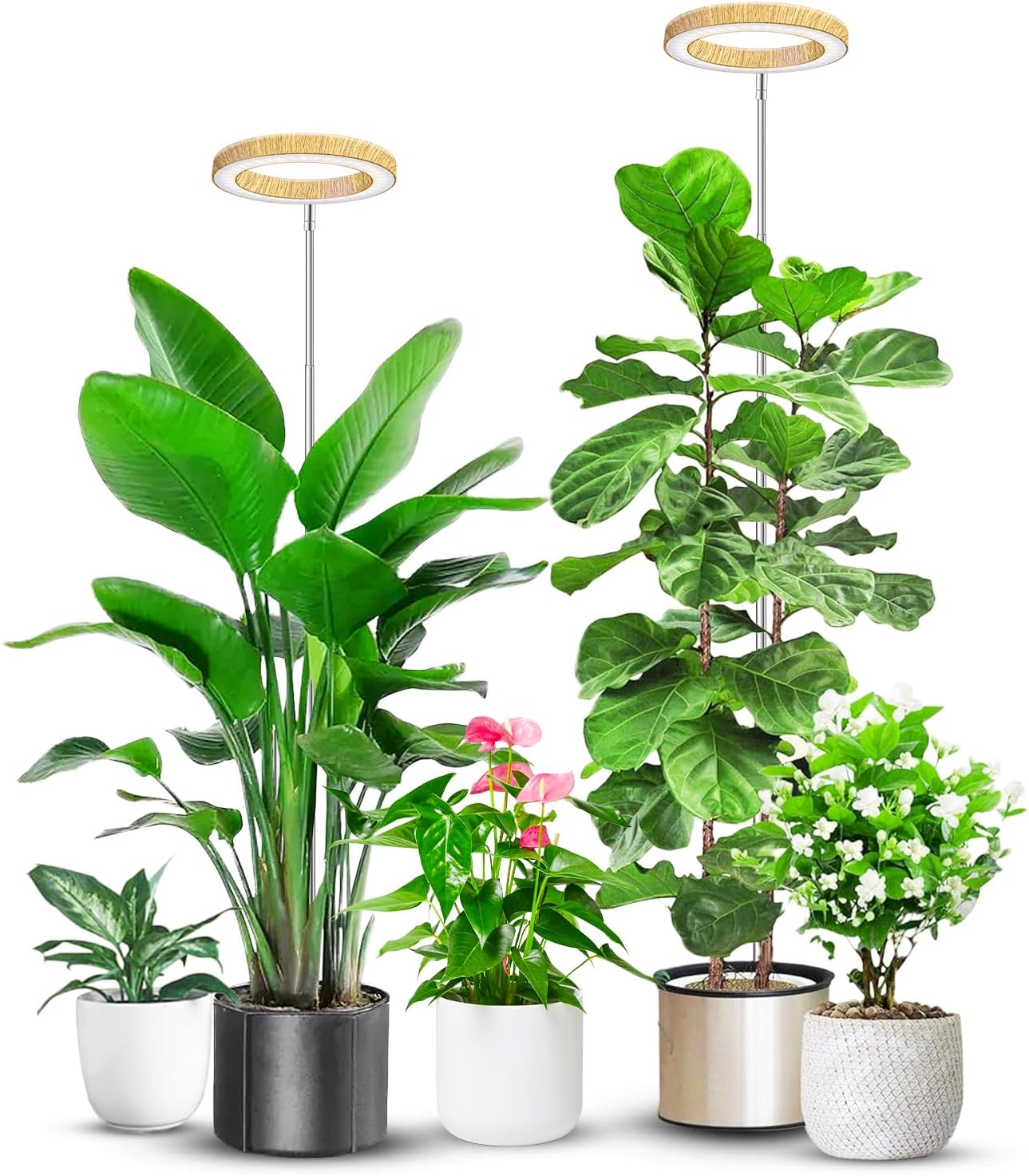
Aokrean 6.3in Full Spectrum Halo Grow Light, 2-Pack
| Number of Light Sources | 80 |
|---|---|
| Wattage | 15 watts |
| Lighting Method | LED |
| Power Source | Corded Electric |
| Height Adjustable | 10-65 inch |
This Aokrean 2-pack of 6.3-inch halo grow lights is designed to provide steady, flexible light for indoor plants from seedling to maturity. Each lamp uses 80 LEDs and a 5V/3A adapter to deliver a brighter full-spectrum output than many small desk lamps. The telescopic pole adjusts from 10 to 65 inches and the included ground stakes give a secure soil-mounted option for larger potted specimens, while a 90 degree adjustable neck helps aim light across broad canopies. Touch controls offer three color modes and five brightness levels plus 6/12/16 hour timers so you can set consistent daily schedules without additional timers. Practical benefits include improved coverage for taller plants, easy dimming to avoid leaf burn, and a faux wood grain ring that blends with home decor. Limitations are typical for compact halo-style fixtures: the light is concentrated in a ring rather than a wide flat panel so very large specimens may need multiple units for full canopy coverage, and the product is intended for indoor tabletop or stake mounting only.
Best for: For someone who wants a dependable, easy-to-set-up indoor grow light that supports tall or developing houseplants and prioritizes consistent schedules and stable mounting.
Less Ideal for: Not the best choice for growers needing broad, wall-to-wall coverage for very large specimens or outdoor use.
- 80 LEDs with 5V/3A adapter provide brighter full-spectrum output than many small grow lamps
- Height adjustable from 10 to 65 inches with ground stakes for stable soil anchoring
- Touch controls with 3 lighting modes, 5 brightness levels, and 6/12/16 hour auto timers
- Included 90 degree adjustable neck lets you aim light across tall plant canopies
- Faux wood grain design that resists peeling and fits indoor decor
- Ring-shaped halo concentrates light; very large plants may require multiple fixtures for even coverage
- Not waterproof and designed for indoor tabletop or stake use only
Verdict: Aokrean's adjustable, timer-equipped halo lights are a reliable, easy-to-use option for giving large indoor plants consistent full-spectrum illumination.
Choosing the Right Grow Light for Large Indoor Plants: Key Factors to Consider
Coverage Footprint and Mounting Height
Large indoor plants need light that reaches across an extended canopy and deep into the foliage. Consider the specified coverage footprint at a realistic mounting height for tall plants rather than only the manufacturer's close-range diagram. A fixture that claims high intensity over a tiny area will leave outer leaves shaded or force you to mount multiple units.
Mounting height affects how evenly light spreads. Fixtures with wide-angle optics or multiple LEDs spaced across a frame produce more uniform distribution at hanging heights typical for large plants. Also account for suspension hardware, clearance above the plant, and the ability to raise or lower the light as the plant grows.
Spectrum and Plant Growth Stage
Spectrum influences leaf size, color, and stem strength. For large indoor plants maintained for foliage and structure, you want a broad spectrum rich in blue wavelengths for compact, sturdy growth and red to far-red balance for overall photosynthesis. Fixtures that offer adjustable spectrum let you favor vegetative tones while avoiding extremes that promote unnecessary stretching.
Avoid lights that only emit narrow bands unless you are targeting a specific response. Full-spectrum or multi-channel fixtures give predictable results for mature plants kept for long-term display, since they support both chlorophyll activity and accessory pigments that affect leaf color.
Light Intensity and PAR Distribution
Intensity measured as photosynthetic photon flux (PPF) and its distribution as photosynthetic photon flux density (PPFD) at canopy level are key for large plants. Higher PPFD supports robust growth but must be distributed so lower leaves also receive usable light. Look for manufacturers that publish PPFD maps at different heights so you can assess usable intensity across the plant's footprint.
Consider the daily light integral your plant type prefers and choose a fixture that can supply that photon budget with reasonable daily runtime. If the light only supplies adequate PPFD directly under the center, you will need multiple fixtures to avoid shaded zones.
Energy Use and Running Costs
Large plants often require many hours of light daily, so fixture wattage and its photon output per watt matter. Energy-efficient LEDs deliver more usable photons for the same electricity draw, lowering operating cost over months or years. Compare the PPF per watt and consider whether the fixture requires external drivers or fans that add to standby and running power.
Also account for dimming features or timers that let you reduce intensity during lower-demand periods. Efficient fixtures with good thermal design also tend to maintain output over time, avoiding performance degradation that increases effective energy cost.
Thermal Design and Plant Safety
Large fixtures operating at high output can generate heat that affects leaf temperature and nearby structures. Good thermal management-through heatsinks, passive cooling, or well-designed airflow-keeps LED junction temperatures lower and preserves light output and lifespan. It also reduces the risk of heat stress on the upper canopy when lights are hung close.
Check whether the fixture requires active fans, and if so, whether the noise and maintenance fit your indoor environment. For densely foliated plants, ensure the fixture's heat signature will not dry or scorch leaves when mounted at the recommended height.
Build Quality and Installation Options
Durable construction is important for fixtures that will be mounted for long periods above heavy plants. Look for solid frames, corrosion-resistant hardware, and easy-to-use hanging points that allow secure adjustment as plants change height. A dependable power delivery system and robust connectors reduce the chance of intermittent operation in humid indoor conditions.
Consider whether the fixture offers modular panels or expansion options if you plan to scale to more or larger specimens. Ease of cleaning and simple cable management also matter when dealing with dust and plant debris over time.
How Light Needs Differ Between Large and Small Indoor Plants
Large indoor plants present different challenges than small pots because their leaves sit at multiple heights and their canopy can cast significant shade. Small lights that work well for seedlings will not provide the uniform coverage that a tall ficus or large philodendron needs. Instead, you should prioritize fixtures designed to spread photons broadly and to penetrate deeper canopy layers.
A common approach is to use wider panels, multiple fixtures spaced above the canopy, or adjustable mounts to manage distance as the plant grows. Think in terms of footprint plus depth when evaluating a fixture, not just peak intensity at a single point.
- Wide panels reduce hot spots and shaded edges
- Multiple fixtures can be spaced for even lateral coverage
- Mounting height impacts how uniform and deep the light reaches
Placement Strategies for Tall Canopies
Position lights so the uppermost leaves receive the intended PPFD while lower leaves still get enough light for maintenance. For very tall specimens, consider an array of smaller panels staggered vertically or a single large panel mounted high enough to cover the canopy footprint evenly.
Test placement by observing leaf orientation and new growth. If new leaves are small and stems elongate, the plant likely needs higher intensity or closer placement. If upper leaves show heat stress or bleaching, raise the fixture or reduce intensity.
- Start with manufacturer PPFD maps and adjust in real conditions
- Use dimmers or timers to fine-tune daily light totals
- Rotate plants occasionally when coverage is one-sided
Managing Heat and Humidity Beneath Fixtures
Large plants often trap humidity and can create microclimates under their canopies. Fixtures with poor ventilation or high radiant heat can raise leaf temperature and increase disease risk. Favor fixtures with passive cooling or well-placed airflow that avoids blasting the canopy with hot air.
Also account for the impact of lights on local humidity. Higher leaf temperatures can increase transpiration, which may require adjustments to watering or humidity control systems in the room.
- Keep a few inches clearance as an initial safety margin from leaves
- Monitor leaf undersides for signs of heat stress after installation
- Use environmental controls when lights increase room temperature or decrease relative humidity
Practical Wiring and Mounting Tips
Secure suspension hardware and plan cable routes before final installation to reduce the chance of accidental knocks or strain on connectors. Use hardware rated for the fixture weight and allow for future adjustments as plants grow taller.
If using multiple fixtures, group their power feeds through a single reliable circuit where possible and avoid overloading household wiring. Consider plug timers or smart controllers that handle runtime scheduling and dimming features to automate routine light cycles.
- Use ratchet hangers for easy height adjustment
- Label cables and use cable ties to keep the setup tidy
- Place timers or controllers where they are easy to access for seasonal adjustments
When to Combine Natural and Artificial Light
If you have partial natural light, supplementing with grow lights can fill gaps in duration or spectrum. Combining sources can lower energy needs because the artificial fixture does not need to supply the entire photon budget. Position fixtures to even out shadows that natural light creates during the day.
Be mindful of photoperiod. Large foliage plants often respond to daylength as well as intensity, so match artificial schedules to the plant's preferred seasonal rhythm to avoid disrupting flowering or dormancy behaviors.
- Use artificial light to extend short winter days
- Shade or shift fixtures seasonally to balance with changing sun angles
- Adjust spectrum seasonally if fixtures allow tuning
How We Chose the Best Grow Light for Large Indoor Plants
We focused on attributes that matter for growing large indoor plants rather than small seedlings or compact houseplants. Selection criteria prioritized uniform light coverage to reach upper and lower leaves, spectrum flexibility or full-spectrum output for healthy foliage and stem strength, and output intensity measured across a practical mounting height for tall specimens. We also weighed energy efficiency to keep running costs reasonable for long daily runtimes, and thermal management to ensure fixtures can run at higher intensities without heat damage to leaves. We excluded lights designed only for seedlings, microgreens, or very small pots where footprint and intensity needs are much lower. Fixtures without published coverage patterns or lacking clear spectral data were removed because they do not provide the predictability large plants require. The final shortlist balances usable photon flux across a broad area, durable construction for mounting over tall plants, and features that let you tune light for vegetative growth and maintenance.
FAQ
How far should a grow light be from very large indoor plant leaves?
Distance depends on fixture intensity and optics. Many panels work well 18 to 36 inches above a tall canopy for even coverage, but check PPFD maps and start higher if you see leaf bleaching. Use a gradual approach: raise the light if leaves look stressed or lower it if lower leaves remain shaded.
Can a single grow light cover multiple large plants?
Often yes if the fixture's footprint and intensity match the combined canopy area. Wide panels or arrays can serve several specimens, but watch for edge drop-off where outer leaves may receive less usable light. You may need multiple fixtures for very wide groupings.
Is spectrum tuning necessary for maintaining large foliage plants?
Spectrum tuning is helpful but not always required. A full-spectrum fixture typically supports healthy foliage, while tuning lets you emphasize blue for compact growth or adjust red balance for overall vigor. Tuning gives more control when you manage diverse species under one fixture.
How much does runtime affect plant health for large indoor plants?
Daily light integral matters more than individual runtime. Large plants often need many hours of moderate-intensity light. Running a fixture at lower intensity for longer can be as effective as brief high-intensity bursts, depending on the species. Use timers to provide consistent daily totals.
Will grow lights increase pest or disease risk?
Grow lights themselves do not cause pests, but they can change microclimate conditions. Increased leaf temperature and altered humidity under lights may influence fungal growth or insect activity. Maintain good airflow and monitor plants to catch issues early.
Final Verdict
For large indoor plants, prioritize fixtures that produce broad, even light distribution and a usable spectrum that supports strong leaves and stems. Balance intensity with coverage so that lower foliage receives enough photons without forcing excessive heat or energy use. Choose based on the plant's light budget, the mounting height available, and whether you want spectrum control. Focus on long-term running efficiency and thermal design to keep plants healthy and maintenance simple.
