

Note: This article contains affiliate links. If you click on these links and make a purchase, I may earn a small commission at no extra cost to you. This helps support my research and content. Read my full affiliate disclosure here.
Choosing the right pre emergent fertilizer matters because timing, coverage, and compatibility with your lawn type determine whether crabgrass and other weeds ever get established. If you apply the wrong material at the wrong time you can waste effort and stress desirable turf and ornamental plantings. This guide covers seven top pre emergent fertilizer options that made our shortlist for typical home turf and garden situations. We evaluate each option for how long control lasts, how safe it is for common lawn grasses and ornamentals, and how easy it is to apply correctly. Read on to find the approach that fits your climate and maintenance routine.
Top Picks at a Glance
| Best Overall The best all-around choice for most situations | Lesco/Lawn Synergy 0-0-7 Stonewall Pre-Emergent Granules, 50 lb |  |
| Best Quality Built to a higher standard if you want something more solid | The Andersons Barricade Professional-Grade Granular Pre-Emergent Weed Control (40 lb) |  |
| Best Value The sweet spot between price and what you get | The Andersons Barricade Pre-Emergent Fertilizer 18-0-4, 18 lb (covers 5,000 sq ft) |  |
| Best Budget The cheapest option that still gets the job done reliably | Scotts WeedEx Prevent with Halts Pre-Emergent (10.06 lb) |  |
| Highest Rated A top-rated pick with lots of positive feedback | AgChimp 18-0-9 Pre-Emergent Herbicide & Precision Lawn Fertilizer, 15 lb |  |
| Most Popular A crowd favorite that many people choose with confidence | Scotts Halts Crabgrass & Grassy Weed Preventer, 10.06 lb. |  |
Lesco/Lawn Synergy 0-0-7 Stonewall Pre-Emergent Granules, 50 lb

| Item Form | Granule |
|---|---|
| Coverage | 12,500 sq. Ft. |
| Active Ingredients | Prodiamine |
| Included Components | BAG |
This granular pre-emergent combines 0-0-7 fertilizer with a prodiamine-based herbicide to prevent annual weeds in turf and landscape beds. It is typically broadcast over established lawns in early spring and again in fall for warm season timing, applied at about 4 to 5 lb per 1,000 sq. ft., and provides up to roughly four months of weed control when used as directed. The product includes potassium and iron for turf health while the Stonewall active ingredient delivers consistent pre-emergent performance. Because it is a large 50 lb bag that covers up to 12,500 sq. ft., it is convenient for homeowners with medium to large yards and reduces the need for frequent reapplication. Important practical limits are that it must be applied according to label directions to avoid crop injury, it cannot be used on sod farms or through irrigation systems, and it prevents desirable seed germination while active so do not overseed treated areas until label-allowed intervals have passed.
Best for: Homeowners with medium to large lawns who want a single product that prevents common annual weeds while supporting turf health and reduces return trips for reapplication.
Less Ideal for: People planning to overseed or establish new lawns soon or commercial growers who need application through irrigation or use on sod farms should choose a different product.
- Contains prodiamine (Stonewall) for reliable pre-emergent weed control
- Includes potassium and added iron to support turf color and vigor
- Large 50 lb bag covers up to 12,500 sq. ft., suitable for medium to large lawns
- Granular form spreads easily with standard broadcast or drop spreaders
- Will inhibit germination of seeded lawns so not suitable when overseeding
- Label restrictions prohibit use on sod farms and through irrigation systems
Verdict: A practical, large-coverage prodiamine pre-emergent that prevents weeds and supports turf health for homeowners with established lawns.
The Andersons Barricade Professional-Grade Granular Pre-Emergent Weed Control (40 lb)

| Item Form | Granule |
|---|---|
| Coverage | 12880 square_feet |
| Active Ingredients | Herbicide (prodiamine 0.48%) |
| Unit Count | 640 Ounce |
The Andersons Barricade is a granular pre-emergent designed to stop common weeds before they emerge rather than kill existing plants. It contains 0.48% prodiamine and uses a dispersible granule formulation that dissolves quickly with watering so the active ingredient moves into the soil where seeds germinate. Typical use is a broadcast application across established turf and ornamental beds in early spring or fall following label rates to cover up to the listed square footage. Notable features include small particle granules for broader coverage and a professional-strength active ingredient used to prevent crabgrass, poa annua, goosegrass and many broadleaf weeds. The practical benefits are long-lasting prevention when timed correctly and efficient coverage for larger yards thanks to the 40 lb bag. Limitations to plan for are that it will not remove existing weeds, it requires precise application timing and watering to activate, and safety precautions are necessary because the product is harmful if ingested or contacts skin.
Best for: Buyers who prioritize proven, professional-strength prevention for medium to large lawns and want a product backed by many user reviews and established performance.
Less Ideal for: Gardeners who need to eliminate established weeds, have very small yards where large-volume packaging is impractical, or prefer non-chemical weed control methods.
- Dispersible granule formula that dissolves quickly with water to move the active ingredient into the soil
- Professional-grade active ingredient prodiamine effective against common grassy and broadleaf weeds
- Small particle size for broader coverage per square inch
- Large 40 lb bag intended to cover a wide area without frequent repurchasing
- Does not control or kill existing weeds, only prevents new ones
- Requires correct timing and follow-up watering to be effective
- Contains herbicide active ingredients that require careful handling and adherence to safety directions
Verdict: Choose Barricade when you need a reliable, professional-strength pre-emergent to prevent common lawn weeds across a large area.
The Andersons Barricade Pre-Emergent Fertilizer 18-0-4, 18 lb (covers 5,000 sq ft)

| Item Form | Granule |
|---|---|
| Coverage | 5,000 sq ft |
| Active Ingredients | Prodiamine |
This product combines a pre-emergent herbicide (prodiamine) with an 18-0-4 granular fertilizer to prevent common grassy and broadleaf weeds while feeding turf over a 5,000 square foot area. It is applied in early spring and fall to create a soil barrier that stops weed seeds such as crabgrass and poa annua from germinating rather than killing established weeds. The dispersible granule technology helps the product dissolve quickly after watering so the active ingredient moves into the root zone, which simplifies activation after application. For practical lawn care routines this offers two functions in one bag: season-specific weed prevention plus slow-release nutrient support to promote thickness and recovery. Limitations are that it will not remove existing weeds and timing is important; mis-timed application reduces efficacy. Users should follow the seasonal directions and water in after spreading for best results.
Best for: Homeowners who prioritize efficient, no-nonsense lawn maintenance and want a combined weed-prevention plus fertilizer product to simplify seasonal care.
Less Ideal for: Those needing a product to spot-treat or remove existing weeds or gardeners who require year-round weed control rather than seasonal prevention.
- Includes prodiamine pre-emergent to prevent a wide range of grassy and broadleaf weeds
- Combined 18-0-4 fertilizer feeds turf while providing weed prevention
- Covers up to 5,000 sq ft per bag for single-season treatment
- Dispersible granule technology that dissolves quickly after watering for faster activation
- Does not control or remove established weeds
- Effective only when applied at the correct seasonal window
Verdict: A practical two-in-one pre-emergent and fertilizer for homeowners who want reliable seasonal weed prevention with lawn feeding in a single application.
Scotts WeedEx Prevent with Halts Pre-Emergent (10.06 lb)

| Coverage | 5000 square_feet |
|---|---|
| Item Form | Bag |
| Active Ingredients | Pendimethalin |
Scotts WeedEx Prevent with Halts is a granular pre-emergent designed to stop common lawn weeds before they emerge. You apply it in early spring to prevent crabgrass, foxtail, spurge and similar annual grasses for the season, or in late summer to fall to reduce moss and certain cool-season seedlings. The product is delivered in a single 10.06 lb bag that treats up to 5,000 square feet and is intended for most turf types except Dichondra and bentgrass. Practical benefits include seasonal, hands-off control once applied and compatibility with routine spreader use and normal weather events since rain or frost will not reduce effectiveness. Important limitations are that it will not kill established weeds and some targets, such as goosegrass, may require a repeat application in eight weeks; it can also stain hard surfaces so care during spreading is needed. For homeowners managing weed prevention across a modest lawn, this is a straightforward option that integrates with a spring or fall lawn-care plan.
Best for: Buyers who want an affordable, low-effort way to prevent annual lawn weeds across a small to medium yard and prefer a seasonal, preventative approach to lawn care.
Less Ideal for: Homeowners who need to eliminate existing weed infestations, or those with specialty lawns such as bentgrass or Dichondra who should use a product formulated for those turf types.
- Pre-emergent action prevents germination of listed annual grasses and several broadleaf weeds
- Covers up to 5,000 sq. ft. from a single 10.06 lb bag
- Resistant to rain, snow, or freezing weather after application
- Suitable for use on most lawn grass types (excludes Dichondra and bentgrass)
- Does not control established or mature weeds
- Some weeds like goosegrass may need a second application for control
- Can stain concrete, stone, metal, clothing, or shoes if spilled
Verdict: A budget-friendly, weather-tolerant pre-emergent that reliably prevents common annual lawn weeds across up to 5,000 sq ft when used as part of spring or fall lawn care.
AgChimp 18-0-9 Pre-Emergent Herbicide & Precision Lawn Fertilizer, 15 lb

| N-P-K | 18-0-9 |
|---|---|
| Active ingredient | Prodiamine (0.29%) |
| Slow-release nitrogen | 30% polymer-coated |
| Iron | 2% |
This 18-0-9 granular from AgChimp pairs a low-rate pre-emergent herbicide (prodiamine) with 30% slow-release nitrogen, potassium and 2% iron so you both prevent common annual weeds and feed your lawn in one application. It is applied with a broadcast spreader and must be watered in to form the soil-surface barrier that blocks weed germination while polymer-coated nitrogen particles release steadily to avoid growth spikes. Practical benefits include coverage up to about 5,000 sq ft from the 15 lb bag, improved turf color from added iron, and built-in stress support from potassium. Important limitations are that it prevents seed germination while active so you should not overseed shortly before or after application, and it targets annual weeds rather than curing established perennial weeds. It also requires correct timing and follow-through watering for reliable performance. For someone who values dependable, season-long weed prevention and steady nutrition, this product simplifies routine spring or fall lawn care into one step.
Best for: Buyers who prioritize a reliable, low-maintenance program to prevent annual weeds and maintain steady turf nutrition across a typical lawn area.
Less Ideal for: Homeowners planning to overseed or establish new turf within weeks of application or those needing a product to eradicate long-established perennial weeds.
- Combines pre-emergent weed control with fertilization in a single application
- 30% slow-release nitrogen provides long-lasting, controlled feeding
- Contains 0.29% prodiamine effective against common annual weeds
- Includes 2% iron for improved turf greening and potassium for stress resistance
- Pre-emergent prevents grass seed germination so not suitable around recent overseeding
- Not formulated to eliminate established perennial weeds
Verdict: Choose this product if you want a dependable one-step pre-emergent plus slow-release fertilizer to prevent annual weeds while feeding your lawn.
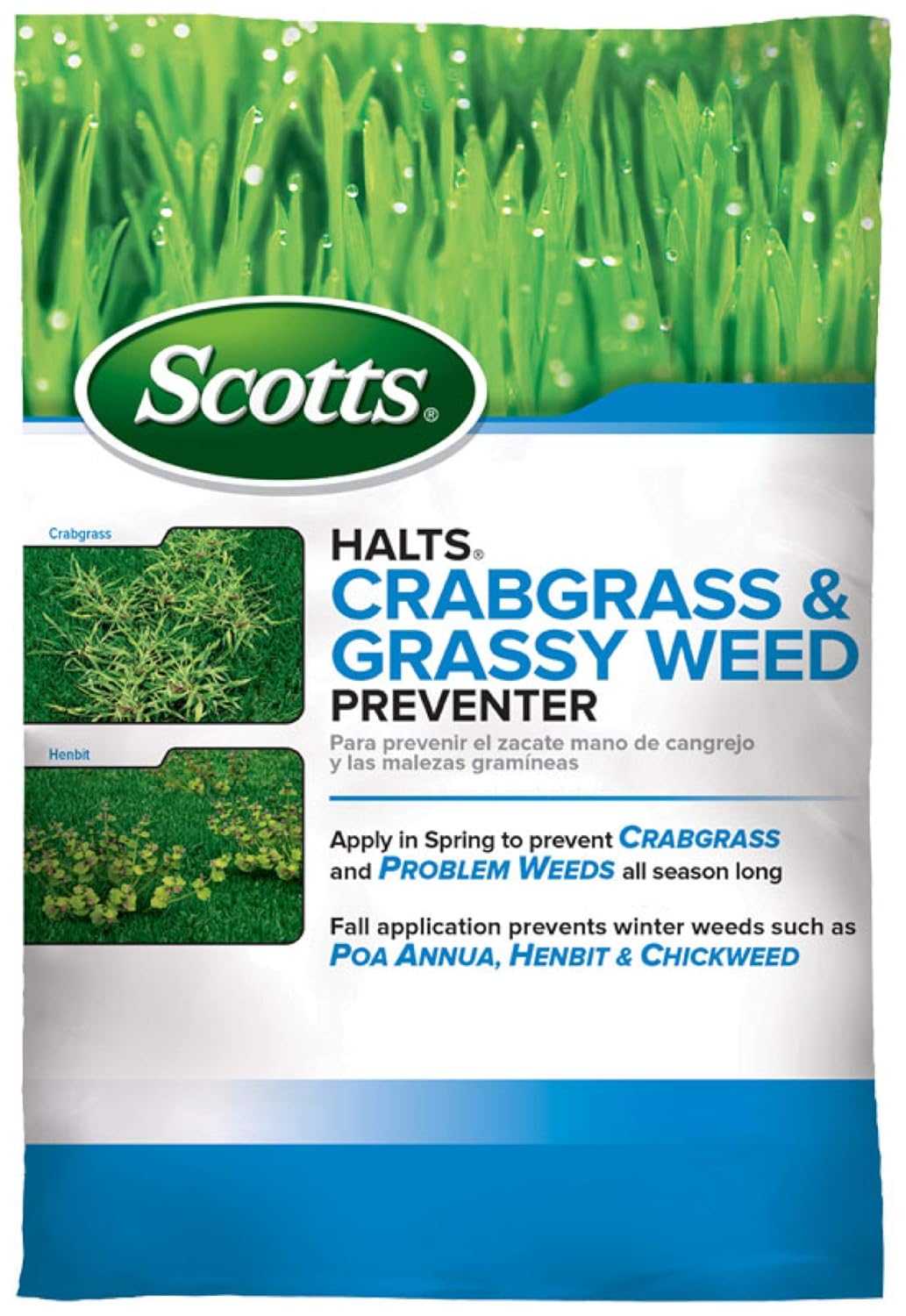
Scotts Halts Crabgrass & Grassy Weed Preventer, 10.06 lb.
| Item Form | Granule |
|---|---|
| Coverage | 5000 square_feet |
| Active Ingredients | Pendimethalin 1.71% |
Scotts Halts is a granular pre-emergent formulated to stop crabgrass and seeded grassy weeds from germinating across established lawns. You apply it dry with a broadcast spreader in early spring or fall, then water it in as directed; the active ingredient pendimethalin forms a soil barrier that prevents weed seedlings from emerging and is advertised as resistant to rain, snow, or freezing after application. This bag treats up to 5,000 square feet and is intended for use on most turf types except Dichondra and Bentgrass. The practical benefits are straightforward: a single timed application protects turf from several common annual weeds without needing spot herbicide treatments, and the granule form makes even coverage with a spreader easy. Important limitations are that it does not kill existing mature weeds and cannot be used on newly seeded or sprigged areas until months later, so timing and measuring lawn area matter. Also repeat applications for certain weeds like goosegrass may be necessary according to label instructions.
Best for: Homeowners who plan lawn care around seasonal timing and want a preventive, low-effort way to stop annual grassy weeds before they emerge.
Less Ideal for: People needing to remove existing weed infestations, those reseeding or establishing new turf within months, or gardeners who require immediate weed knockdown.
- Pre-emergent action prevents crabgrass and listed grassy weeds before they germinate
- Covers up to 5,000 sq ft per bag for single-application protection
- Granule form designed for even spreader application and easy watering activation
- Rain, snow, or freezing after application will not reduce effectiveness
- Does not control existing mature weeds so not useful for established infestations
- Not safe for newly seeded or freshly sprigged lawns for several months
Verdict: Use this granular pre-emergent if you want a seasonal, preventative barrier against crabgrass and common grassy weeds on an established lawn up to 5,000 sq ft.
Choosing the Right Pre Emergent Fertilizer: Key Factors to Consider
Timing and Local Climate
Pre-emergent fertilizers only work if they are applied before weed seeds germinate. Local climate and soil temperature largely determine that window. In cool regions, spring timing often coincides with soil warming to a specific degree-day threshold, while in warm climates there can be multiple windows through the year. Missing the timing by even a few weeks will reduce effectiveness because seeds that have already germinated will not be stopped.
Gardeners should consult regional soil temperature targets and use local extension guidance to pick application dates. Consider also the timing of other cultural tasks such as aeration and seeding. Core aeration and overseeding typically break the chemical barrier of pre-emergents, so if you plan to reseed, factor that into when and whether to apply a barrier product.
Active Ingredient and Mode of Action
Different active ingredients act on different weed spectrums and have varying persistence in soil. Some chemistries target grassy weeds such as crabgrass while others have broader activity that includes certain broadleaf species. Persistence influences how long a single application provides control and how it interacts with crop rotations or newly seeded turf.
Understand the mode of action so you can match it to the common weeds in your lawn. Review label statements about residual life and breakdown pathways. This helps avoid applying a material that either will not control your target weeds or will remain in the soil long enough to interfere with planned plantings.
Compatibility With Lawn and Garden Plants
Not all pre-emergent fertilizers are safe for every grass type or for adjacent beds of ornamentals, vegetables, or new plantings. Labels often list safe turf species and vulnerable crops. Applying a product that is incompatible with your grass type can cause chlorosis, stunting, or poor recovery after stress.
When treating edges near flower beds or vegetable gardens, choose materials with lower off-target movement and follow buffer guidelines. If you maintain mixed plantings, prioritize products with explicit clearance for both your turf species and nearby ornamentals.
Application Method and Equipment Needs
Uniform distribution is critical because missed strips allow weeds to establish. Granular products require a calibrated broadcast spreader and consistent walking speed to achieve even coverage, while liquid or sprayable options may need a different sprayer setup and attention to nozzle selection. Each method also has different risks for drift or clumping.
Consider the equipment you already own and your comfort with calibrating spreaders or sprayers. Look for products with clear calibration charts and labeled spreader settings. Smaller properties may prefer handheld spreaders or hose-end applicators for ease, while larger lawns often benefit from walk-behind spreader compatibility.
Persistence Versus Reapplication Needs
Longer persistence reduces how often you need to reapply, which can be convenient but may increase the risk of affecting subsequent plantings. Shorter-lived products let you time control windows more tightly around seeding or landscape changes but require more frequent maintenance visits.
Weigh convenience against flexibility. If you plan on overseeding or installing new plants later in the season, select a product with a shorter residual or a documented safe interval before planting. For minimal-maintenance lawns, prioritize longer-residual materials that provide continuous coverage through the peak germination period.
Environmental Impact and Runoff Risk
The landscape position relative to water features and slopes affects the likelihood that a pre-emergent can move off-site. Some active ingredients are more prone to runoff or leaching, especially on compacted soils or steep grades. Runoff can harm aquatic ecosystems and make a product inappropriate for certain properties.
Evaluate label precautions about buffer zones and runoff mitigation. Use best management practices such as avoiding application before heavy rain, incorporating products into the soil where recommended, and maintaining vegetated buffers near waterways to reduce transport.
When to Apply in Spring and Fall
Spring application should be timed before weed seeds begin germinating, which for most regions is tied to consistent soil temperatures rather than calendar dates. Use local soil temperature thresholds and watch for biological cues such as blooming of common indicator plants.
Fall applications can be effective against winter annuals if your climate has a distinct cool-season germination window. Plan fall treatments with attention to expected precipitation and your maintenance calendar so you do not inadvertently interfere with late-season seeding or fall renovations.
- Track soil temperature with a simple probe to pick the right application window.
- Avoid applying immediately before heavy rain to reduce runoff risk.
- Delay application if you plan to overseed within the product's restricted planting interval.
Granular Versus Liquid Options
Granular formulations are convenient for many homeowners and pair well with common broadcast spreaders. They often have less drift risk but require careful spreader calibration and even walking speed for uniformity.
Liquid or soluble formulations can offer faster activation and more uniform coverage when applied correctly. They require proper sprayer setup and attention to nozzle selection and water volumes to avoid streaking or plant contact.
- Granular: easier handling, lower drift, depends on spreader calibration.
- Liquid: potentially more uniform coverage, needs sprayer skills and clean mixing.
Managing Treated Areas After Application
After applying a pre-emergent, avoid core aeration or heavy cultivation that breaks the chemical barrier unless you are intentionally planning to reseed. Light watering can help activate some products according to label directions, but excessive irrigation increases runoff risk.
If you plan on overseeding, check the product's established replanting interval. There are techniques for seeding into treated turf that reduce interference, but in many cases you will need to delay seeding until the product has degraded to safe levels.
- Light irrigation may be recommended to move granules into the soil surface.
- Delay aeration or renovation until the labeled safe interval has passed.
- Mark treated zones to avoid accidental cultivation that reduces efficacy.
Integrating Pre Emergents With Cultural Practices
Pre-emergent treatments are most effective when combined with good cultural practices such as proper mowing height, adequate fertility, and targeted overseeding. Healthy turf outcompetes weeds, reducing reliance on chemical control alone.
Use pre-emergents as one component of an integrated plan that includes hand weeding, spot treatments for escaped weeds, and soil improvement. This reduces the volume of chemical applications needed across seasons and supports longer-term lawn health.
- Raise mowing height slightly to shade the soil and suppress weed germination.
- Address bare or thin patches with appropriate overseeding at safe intervals.
- Improve soil structure and drainage to reduce conditions that favor weed establishment.
Safety and Storage Best Practices
Follow label directions for personal protective equipment during mixing and application. Keep children and pets off treated areas until the product requirement window has passed.
Store leftover material in a cool, dry place in its original container with the label intact. Proper storage prevents accidental contamination of non-target areas and maintains product stability for future seasons.
- Wear recommended protective gear when handling concentrates or powders.
- Keep products sealed and out of reach of children and pets.
- Dispose of empty containers according to local regulations and label instructions.
How We Chose the Best Pre Emergent Fertilizer
We shortlisted products that deliver dependable pre-emergent control while fitting the practical needs of homeowners and gardeners. Our editorial filters prioritized proven active ingredient stability and labeled control window length, because longevity determines how often you need to reapply in a season. We also weighed lawn safety for cool- and warm-season grasses and compatibility with common ornamental beds to avoid damage from off-target movement. Application method and spreader compatibility were included as concrete selection criteria since accurate coverage is essential for uniform weed control. Ease of use and clarity of label instructions matter for timing-sensitive products, so we favored items with clear seasonal timing guidance and straightforward calibration information. Environmental considerations such as runoff risk and leaching potential were evaluated where data were available. We excluded any products without clear application rates or that lack standard active-ingredient disclosure. The resulting list focuses on materials that balance duration of control, turf safety, and practical application for gardeners.
FAQ
Can I apply a pre-emergent and overseed in the same season?
It usually depends on the product's replanting interval. Many pre-emergents prevent seed germination for several weeks to months, so overseeding is often delayed until the product has degraded or a compatible short-residual product is used. Check label intervals and consider timing overseeding before applying a long-residual barrier.
Will a pre-emergent harm my garden beds or vegetables?
Some pre-emergents can harm sensitive ornamentals and vegetable transplants if they move off-target or are applied directly to beds. Using products labeled safe for adjacent plantings, applying buffer zones, and avoiding application before heavy rain reduces risk. Always read label precautions for vulnerable species.
How long after application should I expect results?
Pre-emergents prevent new seedlings from establishing rather than killing existing weeds. You will not see immediate die-off of established weeds; control is observed as reduced new weed emergence through the labeled residual period. The exact timeline depends on the active ingredient and environmental activation factors such as moisture.
Can I use a pre-emergent on newly installed sod?
New sod can be sensitive to some pre-emergent materials. Many labels specify a safe waiting period after installation before applying a pre-emergent. If you have just installed sod, follow the product label and the sod supplier's care instructions to avoid interfering with root establishment.
What should I do if rain is forecast after I apply a product?
Light rain can activate many granular pre-emergents as intended, but heavy rain shortly after application increases runoff risk and can reduce efficacy. If heavy precipitation is likely, delay application until a more stable weather window, or follow label guidance about incorporation and irrigation timing.
Final Verdict
Choosing among pre-emergent fertilizers means balancing how long you need protection with the safety requirements of your turf and nearby plantings. Prioritize products that match your local weed spectrum, provide clear timing guidance, and are compatible with your lawn species and renovation plans. If you expect to overseed or work in beds near treated areas, select shorter-residual options or plan work around labeled planting intervals. With correct timing, accurate application, and sound cultural practices, a pre-emergent is a practical tool to reduce seasonal weed pressure and preserve lawn health.
