

Note: This article contains affiliate links. If you click on these links and make a purchase, I may earn a small commission at no extra cost to you. This helps support my research and content. Read my full affiliate disclosure here.
If you keep potted citrus or overwinter young trees indoors, the right grow light can make the difference between sparse, leggy growth and a healthy, fruiting tree. Light intensity, spectrum, and how the fixture covers your tree canopy all affect flowering, fruit set, and winter leaf retention. This guide highlights seven carefully shortlisted grow lights for citrus tree that suit different spaces and gardener needs. We evaluated options for spectrum accuracy, coverage, heat management, and ease of mounting so you can match a fixture to your tree size and winter routine. Read on for practical guidance to pick the best fit for your citrus.
Top Picks at a Glance
| Best Overall The best all-around choice for most situations | Orchbloom 4-Head 100W LED Grow Light with Adjustable Stand |  |
| Best Quality Built to a higher standard if you want something more solid | SANSI 45W Full-Spectrum LED Grow Light with Adjustable Stand and Timer |  |
| Best Value The sweet spot between price and what you get | Yehsence 10-Head Full-Spectrum LED Grow Light with Tripod Stand |  |
| Best Budget The cheapest option that still gets the job done reliably | LBW Full-Spectrum Grow Light with Adjustable Tripod Stand |  |
| Highest Rated A top-rated pick with lots of positive feedback | LYCBY2 FC-08 Sunrise & Sunset Full-Spectrum Grow Light for Large Indoor Plants |  |
| Most Popular A crowd favorite that many people choose with confidence | LBW Tri-Head Full Spectrum LED Grow Light with Adjustable Tripod Stand |  |
Orchbloom 4-Head 100W LED Grow Light with Adjustable Stand

| Light Source Type | LED |
|---|---|
| Light Output Maximum | 8000 lumens |
| Wattage | 100 watts |
| Color Temperature | 4000 Kelvin |
| Light Source Special Features | Grow light with timer |
The Orchbloom 4-Head 100W LED grow light is a floor-standing full-spectrum panel designed to deliver high output for taller houseplants such as citrus trees. It uses 832 LEDs to produce up to 8000 lumens while running cool and includes a 24"–64" adjustable stand plus a 360° gooseneck to aim light across multiple pots. Built-in timer presets (4/8/12/16/20 hours) make hands-free daily schedules simple, and the plug-and-play corded design avoids extra adapters. For citrus seedlings through small indoor fruiting trees the bright, natural 4000 K light and high PPE promise good vegetative growth and flowering when placed at an appropriate distance. Practical limitations are that the unit is a single 100W panel rather than a multi-panel array, so very large or heavily canopied citrus specimens may need multiple fixtures for even coverage; the listing also does not specify measured PPFD at canopy level, so users must experiment with placement and runtime for optimal results.
Best for: For plant owners who want a high-output, easy-to-use full-spectrum lamp for a small to medium indoor citrus tree and prefer an adjustable, hands-off setup with timers.
Less Ideal for: Not the best choice for growers needing measured light-output data or for very large citrus specimens that require multiple fixtures or wider arrays.
- High light output (100W, ~8000 lumens) suitable for taller indoor plants and flowering stages
- Adjustable 24"–64" stand and 360° gooseneck let you direct light across multiple pots
- Built-in timer with five presets for convenient automated daily schedules
- Full-spectrum LED at 4000 K provides a natural, eye-friendly light for long care sessions
- No listed PPFD or coverage footprint, so optimal mounting height requires trial and error
- Single-panel design may not provide uniform light for very large citrus trees
Verdict: A powerful, easy-to-use full-spectrum stand light that gives small to medium indoor citrus trees strong, automated daily illumination.
SANSI 45W Full-Spectrum LED Grow Light with Adjustable Stand and Timer

| Wattage | 45 watts |
|---|---|
| Light Source Type | LED |
| Switch Type | Dimmer, Timer |
| Mounting Type | Floor Mount |
| Power Source | Corded Electric |
This SANSI grow light is built for growers who need strong, controllable light for larger indoor plants. The unit provides a full-spectrum 4000K output with a reported high PPFD at one foot, a 360° rotatable three-section gooseneck for precise targeting, and a triangular stake/stand that helps keep taller pots stable. It is typically used by positioning the lamp over a single large specimen, adjusting height as the tree grows, setting the 4/8/12 hour timer and dialing one of four brightness levels to match citrus light needs. Notable features are the ceramic heat-sink technology for improved thermal reliability, a high CRI for accurate foliage assessment, and a dimmer plus timer for automated daily cycles. Practical benefits include flexible beam placement, a stable stake design for large pots, and easier maintenance of consistent light schedules. Limitations are that the product is intended for single-plant use rather than whole-canopy coverage and the stated lifespan and PPFD figures are manufacturer claims that users should verify in their setup.
Best for: Growers who prioritize measurable light performance and precise control for a single large indoor specimen and want automated scheduling to support steady growth.
Less Ideal for: People who need broad, multi-plant canopy coverage or a full rack/garden lighting solution should consider a wider-area fixture instead.
- Full-spectrum 4000K output with high reported PPFD to support photosynthesis in light-hungry plants
- Height-adjustable stand and 360° rotatable gooseneck allow precise positioning as the plant grows
- Built-in timer (4/8/12 hr + 24-hour cycle) and 4-level dimming for automated, customizable light schedules
- Ceramic heat-sink design intended to improve heat conduction and component reliability
- Designed for single-plant or localized lighting so it may not uniformly cover a large citrus canopy
- Manufacturer PPFD and lifetime numbers are claims that may vary in real-world conditions
Verdict: Choose this lamp if you want a performance-focused, adjustable full-spectrum light with timer and dimming tailored to a single indoor citrus tree.
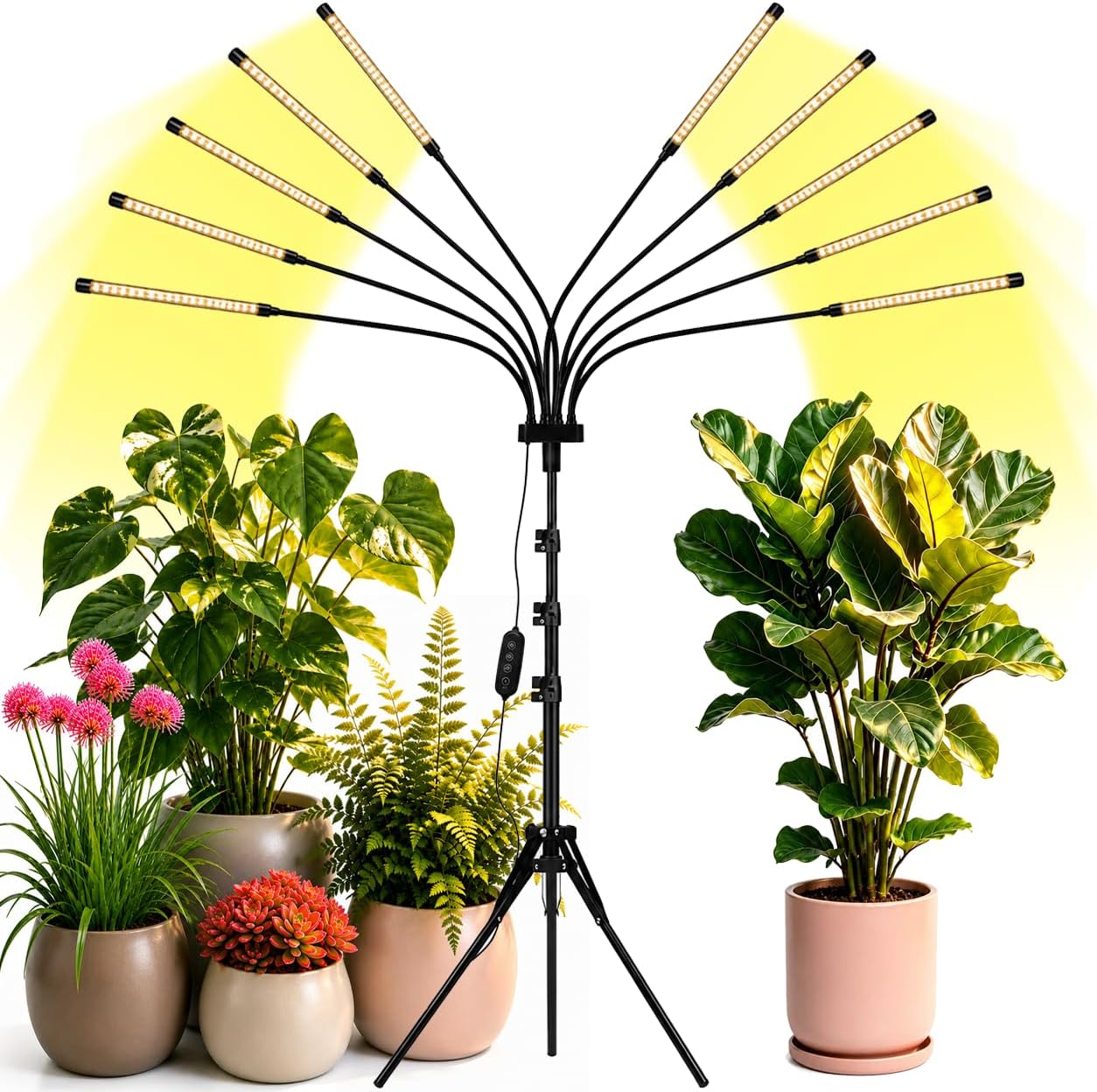
Yehsence 10-Head Full-Spectrum LED Grow Light with Tripod Stand
| Light Source Type | Light Emitting Diode |
|---|---|
| Power Source | Corded Electric |
| Light Source Special Features | Full Spectrum, Auto On/Off Timer |
| Color Temperature | 3500 Kelvin |
| Color Rendering Index | 95 |
This Yehsence grow light is built around ten adjustable lamp heads with a combined 500 LEDs to deliver broad, even illumination for indoor plants. You set the height on a reinforced tripod and angle each flexible head where you need it, which helps light a taller specimen like a potted citrus tree from multiple directions. The built-in 4/8/12 hour timer automates daily on/off cycles so young trees get a consistent photoperiod without manual intervention. Practical details such as a wire organizer and standard plug make setup quick and tidy. The full-spectrum output targets the blue and red bands plants use for photosynthesis while appearing as soft white light for comfortable indoor use. Limitations to consider are the plastic construction and that the spec sheet lists color temperature and CRI but not measured PAR or lumen output at canopy level, so you may need to test placement for larger or very light-hungry citrus varieties. For small to medium potted citrus that need supplemental light during darker months, this unit gives flexible coverage and simple automation.
Best for: Buyers who want a practical, easy-to-install supplemental light for small to medium potted citrus trees and value adjustable coverage and automated daily scheduling.
Less Ideal for: Growers who need verified intensity metrics for large citrus trees or commercial-scale cultivation should choose a fixture with published PAR data and heavier-duty construction.
- Ten adjustable heads and 500 LEDs provide broad, multi-angle coverage for taller plants.
- Full-spectrum output that mixes blue and red wavelengths important for photosynthesis while remaining soft white for indoor use.
- 4/8/12-hour auto timer for consistent daily light cycles without manual scheduling.
- Reinforced tripod and built-in wire organizer make setup stable and tidy.
- Manufacturer does not publish PAR or lumen measurements, so exact light intensity at canopy level is unclear.
- Main body is plastic which may be less durable than metal fixtures in high-use setups.
Verdict: A flexible ten-head full-spectrum floor grow light that gives small to medium citrus trees consistent, multi-angle supplemental light with simple timer automation.
LBW Full-Spectrum Grow Light with Adjustable Tripod Stand

| Light Source Type | Light Emitting Diode |
|---|---|
| Power Source | Corded Electric |
| Voltage | 12 volts |
| Light Source Special Features | dimmable |
| Mounting Type | Floor Mount |
This LBW grow light is a floor-mount LED lamp on an adjustable tripod that delivers a full spectrum (380–800 nm) intended to mimic natural sunlight for indoor plants. It is typically used beside tall houseplants or placed above potted specimens; the tripod extends from about 15 to 63 inches and includes a flexible gooseneck so you can aim light at a citrus canopy. The lamp offers 48 LEDs in mixed red blue warm white and cold white arrays, six dimming levels and a 3-setting daily timer (4/8/12 hours) so you can tailor light intensity and duration to growth stage without constant supervision. Practical benefits include wide coverage for taller trees, energy-efficient LED output with long rated life, and simple controls for routine schedules. Limitations are that PPFD and lumen figures are manufacturer-stated for close range so you may need higher output or multiple units for large citrus with dense canopies, and the single-head design concentrates light rather than evenly bathing large crowns.
Best for: Buyers who want an affordable, easy-to-use grow light to supplement sunlight for a single indoor citrus tree or smaller citrus varieties and prefer simple controls and an adjustable stand.
Less Ideal for: Growers with multiple large citrus trees or growers needing uniform, high-intensity coverage for heavy fruiting should consider higher-output panels or multiple lamps.
- Full spectrum LEDs (red, blue, warm and cold white) to support photosynthesis, flowering and fruiting
- Adjustable tripod and gooseneck let you aim and position light for taller plants
- Six dimming levels and 3 timer settings for automated daily schedules
- Lightweight aluminum construction with a compact footprint for small indoor spaces
- Single-head output may not evenly cover large citrus canopies without repositioning or additional units
- Manufacturer power and PPFD specs are optimized for close distance and may be insufficient for heavy-fruiting trees
Verdict: A budget-friendly, full-spectrum LED on an adjustable tripod that makes it easy to give a single indoor citrus tree targeted supplemental light with convenient dimming and timer controls.
LYCBY2 FC-08 Sunrise & Sunset Full-Spectrum Grow Light for Large Indoor Plants

| Light Output Maximum | 2000 lumens |
|---|---|
| Wattage | 24 watts |
| Light Source Special Features | Adjustable Spectrum, Dimmable, Energy Efficient, Full Spectrum, Timer Function, Uv And Ir Light |
| Color Rendering Index | 95 |
| Mounting Type | Hanging |
This LYCBY2 FC-08 grow light is built for steady, long-term indoor plant care rather than occasional spotlighting. It delivers 24 watts and about 2000 lumens from a dense LED array and includes a 12-hour sunrise-to-sunset cycle that gradually ramps brightness up and down to mimic natural daylight. Typical use is hanging or clamping the lamp over a larger specimen such as a monstera, fiddle leaf fig, palm or bird of paradise, then setting the 4/8/16 hour timer and one of ten dimming levels to match your plant needs. The telescoping pole and 360° gooseneck make positioning simple as the canopy grows, and the included UL-certified adapter and energy-efficient LED design support reliable daily operation. Practical benefits are broad, even coverage from the enlarged ring head and flexible scheduling so plants get consistent light without daily intervention. Limitations are that the lamp is single-unit output at 24W so very large multi-shelf setups may need multiple fixtures and the color temperature leans natural-white rather than customizable warm/cool presets.
Best for: Buyers who prioritize a dependable, set-and-forget lighting solution for single large houseplants and want predictable daily cycles without frequent adjustments.
Less Ideal for: People building large-scale grow racks, multi-shelf propagation setups, or those who need highly tunable color-spectrum control for specific growth stages.
- Sunrise/sunset 12-hour cycle and repeat timer for consistent, hands-off daily lighting
- 24W full-spectrum output with 124 LEDs for broad, even coverage over large canopies
- Telescoping pole plus 360° gooseneck for precise positioning as plants grow
- UL-certified power adapter and energy-efficient LEDs support dependable continuous use
- Single 24W unit may be insufficient as the sole light for very large or multi-tiered setups
- Color temperature is fixed near natural white rather than offering separate warm/cool spectrum presets
Verdict: Choose this lamp if you want a reliable, energy-efficient full-spectrum light with automatic sunrise/sunset cycling for hands-off care of single large indoor plants.
LBW Tri-Head Full Spectrum LED Grow Light with Adjustable Tripod Stand

| Wattage | 39 watts |
|---|---|
| Light Source Type | LED |
| Additional Features | Dimmable, Full Spectrum |
| Number of Light Sources | 641 |
| Control Method | Remote |
This LBW tri-head grow light is built for larger indoor plants that need adjustable, high-PPFD lighting. The three rectangular LED panels mount on a 63-inch adjustable tripod so you can change height and angle to suit seedlings through mature foliage. Each panel uses a mix of cold and warm white plus red and supplemental wavelengths for a full spectrum that supports photosynthesis across growth stages. The unit includes a remote, six dim levels and a 3/6/12 hour timer which makes routine scheduling and energy management simple. The aluminum light panels and plastic housing keep the fixture relatively light while the tripod provides stability for tall pots. It runs at 39 watts with an advertised 50,000-hour lifetime and is marked waterproof for occasional damp environments. Limitations are the single fixed wattage per unit and reliance on the tripod position for aiming rather than individual long goosenecks, so very irregular canopies may need repositioning or multiple units for even coverage.
Best for: Gardeners who prioritize efficient, programmable lighting for single large indoor plants or a small grouping of tall specimens and who want a simple, stable stand solution they can adjust by height.
Less Ideal for: Growers needing pinpoint lighting for many widely spaced plants or large multi-shelf setups that require distributed fixtures and higher total wattage.
- Full spectrum LEDs including red, blue, white, UV and IR to support multiple growth stages
- Adjustable tripod stand (27.8–63 inches) lets you set optimal distance for tall plants
- Remote control with six dim levels and 3/6/12-hour timer for easy scheduling and energy savings
- Lightweight aluminum panels for stability and long rated lifetime (50,000 hours)
- Fixed 39W power per unit may require multiple fixtures for very large or dense canopies
- No individually articulated long goosenecks on each panel, so precise targeting needs repositioning
Verdict: A practical, height-adjustable full-spectrum LED fixture that makes scheduled, energy-conscious lighting simple for large indoor plants.
Choosing the Right Grow Light for Citrus Tree: Key Factors to Consider
Spectrum Suitability for Flowering and Fruit
Citrus trees respond to a mix of blue light for leaf growth and red light for flowering and fruit set. A balanced full spectrum that includes both wavelengths in realistic proportions helps promote compact, healthy foliage while supporting blossom development. Fixtures that publish spectral distribution or provide white light supplemented by targeted red channels give you predictable plant responses.
Using a grow light with only narrow red and blue diodes can force rapid stretch or unusual leaf color; citrus typically benefits from broader spectrum light that mimics daylight patterns. Look for fixtures rated for flowering or that list photosynthetic active radiation data when possible.
Canopy Coverage and Light Distribution
Match the fixture footprint to your tree size. A small seedling or bonsai citrus needs a tight, concentrated beam; a mature potted lemon or orange with a wider canopy requires a broader, even output so lower branches receive usable light. Uneven coverage leads to top-heavy growth with lower leaf drop, which reduces fruit production.
Consider how many fixtures you need and whether the manufacturer provides recommended hanging heights and PPFD or lux maps. Fixtures with adjustable spread or reflectors make it easier to tune light for multi-branch canopies and reduce the need to reposition the tree frequently.
Heat Management and Distance to Foliage
Citrus leaves are sensitive to both excessive heat and dry air. Good fixtures dissipate heat away from the diodes and offer a safe working distance so you can hang lights close enough for efficient delivery without scorching leaves. Active cooling or well-designed passive heatsinks keep canopy temperatures stable under the lamp.
Also account for how heat affects potting media and humidity. Fixtures that run hot increase evaporation and may require more frequent watering or supplemental humidity. Look for units with manufacturer guidance on minimum distance to foliage and consider choosing models with lower surface temperatures for close-canopy setups.
Dimming, Timers, and Control Options
Citrus trees need different light intensities through the season and during flowering. Dimmable fixtures let you reduce intensity for seedlings or raise it for fruiting phases without changing fixtures. Built-in timers or compatibility with external controllers simplifies daily schedules and reduces manual adjustment.
Variable spectrum or programmable cycles can simulate seasonal changes, which helps prevent shock when moving trees indoors. Practical controls let you adapt light duration and intensity to match supplemental natural light and to fine-tune for flowering windows.
Mounting Flexibility and Fixture Positioning
Indoor citrus setups range from single tabletop pots to stands and greenhouse benches. Fixtures that offer multiple hanging options, included adjustable ratchet hangers, or compatibility with standard mounting hardware make installation straightforward. Adjustable mounting also allows you to lower the light as the tree grows without redoing the whole setup.
Consider fixtures that can be angled or have modular panels so you can direct light into dense branch clusters. Ease of installation reduces the chance of improper placement, which is a common cause of uneven growth in potted citrus.
Durability and Moisture Resistance
Citrus care often involves foliar sprays, misting, and elevated humidity during certain seasons. Fixtures that offer IP-rated protection or sealed drivers are less likely to fail from incidental water exposure. Durable housings and corrosion-resistant hardware extend service life in humid indoor environments.
Also factor in warranty terms and ease of replacing components like drivers or hangers. A robust fixture minimizes downtime during a key flowering or fruiting period and reduces the need to move a delicate tree for maintenance.
How Much Light Does a Citrus Tree Need
Citrus trees are light-hungry compared with many houseplants. During active growth and fruiting you should aim for higher daily light integral values than for foliage-only plants. Practically, that means running a grow light long enough or at high enough intensity to achieve steady leaf color, frequent new flushes, and consistent flowering.
If your space provides some natural sun, use the grow light to supplement and avoid continuous high-intensity schedules. For fully indoor situations the fixture should deliver enough usable photons across the canopy rather than simply producing a high lumen number aimed at a small footprint.
- Seedlings and young trees: lower intensity, longer duration
- Mature potted trees: higher PPFD focused across the canopy
- Flowering stage: brief increases in intensity and possible targeted red boost
Setting Up Lights Around a Potted Citrus
Start by measuring the canopy spread and estimating hanging height. Install the fixture so the light plane covers the majority of leaves; if the canopy is larger than the recommended footprint, use multiple fixtures or move the tree periodically to even exposure.
Monitor leaves closely for stretch, pale color, or scorched tips after you first install the light. Adjust height and dimming over a two-week acclimation period. Keep the fixture at the recommended minimum distance during the initial days and lower gradually if no heat stress appears.
- Check foliage daily for the first week after installation
- Use a simple timer to establish consistent photoperiods
- Rotate the pot or tree a little each week if coverage is imperfect
Managing Humidity and Watering Under Grow Lights
Grow lights can increase evaporation from the potting mix and lower relative humidity near leaves. Keep an eye on soil moisture and adjust watering frequency rather than sticking to a fixed schedule. Shallow pots dry faster and may need more frequent, lighter waterings.
If humidity is low, use trays, room humidifiers, or group plants to create a microclimate. However, avoid persistent leaf wetness directly under a warm fixture, which can raise disease risk. Balance humidity control with airflow to keep foliage healthy.
- Raise humidity gradually when moving plants indoors
- Water based on soil moisture, not a fixed calendar
- Ensure good air circulation around the canopy
Timing Light Cycles for Flowering and Fruit
Citrus typically need long days during the growing season and a slight change in day length or temperature to trigger bloom in some varieties. For indoor growers, maintaining a stable cycle of 12 to 14 hours of light during active growth is a common starting point. Shorter, cooler periods can be used to mimic seasonal cues where needed.
Use timers to keep schedules consistent and avoid sudden changes in photoperiod. Gradual adjustments over several weeks are less disruptive than abrupt switches, which can cause flower drop or leaf stress.
- Standard photoperiod: 12 to 14 hours during active growth
- Reduce hours gradually to simulate seasonal change if needed
- Combine light schedule with slight temperature shifts for bloom induction
Placement Options for Small Spaces and Balconies
If you keep citrus on a balcony or near a window, choose low-profile fixtures or adjustable panels that work well with limited ceiling height. Vertical racks with multiple small fixtures can light several pots without taking much horizontal space.
For compact apartments, consider fixtures that integrate reflectors to reduce side spill and direct more light into the canopy. Portable stands that allow light to be moved with the pot are useful for rotating plants to follow seasonal sun.
- Use narrow-profile fixtures where vertical clearance is limited
- Modular panels suit multi-pot setups on shelves
- Choose low-heat units for close-proximity installations
How We Chose the Best Grow Light for Citrus Tree
We focused on features that directly affect citrus health indoors: spectral output tuned to flowering and fruiting, fixture coverage that aligns with typical citrus canopy sizes, and heat management to avoid leaf scorch or drying. Light intensity and dimming control were included because citrus in different stages need varying PPFD levels. Mounting flexibility and ease of height adjustment matter for pot-grown trees and multi-tiered setups. Construction quality and waterproofing were considered for humid indoor environments where watering and foliar sprays are common. Energy efficiency and expected lumen-per-watt helped us favor fixtures that run cooler and cost less to operate over a season. Products were excluded if they lacked clear spectral data, offered only a single narrow red-blue output, or failed to provide information about coverage footprint. We also excluded fixtures that could not be reasonably mounted above a small tree or did not offer any height adjustment. Final selections balanced practical gardener needs rather than lab-only performance numbers.
FAQ
Can I use a regular LED bulb for a citrus tree?
Often a regular LED provides some light but usually lacks the spectrum and intensity citrus need for flowering and fruiting. A dedicated grow light with broader spectrum and higher usable output will produce more reliable results.
How far should a grow light be from citrus leaves?
It depends on the fixture and its heat output. Many modern LEDs can be placed closer than legacy lamps, but follow manufacturer minimum distances and monitor for leaf tipping or discoloration. Start higher and lower gradually while watching foliage.
Do citrus trees need a different spectrum during bloom?
Citrus benefit from a balance of blue for foliage and red for flowering. Some gardeners increase the relative red component during bloom, but maintaining a broad spectrum avoids overly stretched growth and supports healthy fruit development.
How many hours of light does an indoor citrus tree need?
Citrus usually do well with 12 to 14 hours of light during active growth. Seedlings may tolerate longer photoperiods at lower intensity, while quiet or rest periods should be shorter and cooler depending on the variety.
Will a grow light increase pest or disease risk?
Indirectly, yes. Lights that dry foliage rapidly or increase humidity without airflow can stress plants and make them more vulnerable. Maintain good air circulation and monitor for pests when you change the plant's environment.
Can I leave grow lights on overnight?
Continuous light is usually not beneficial. Citrus need a dark period for normal physiological processes. Use timers to provide consistent day-night cycles aligned with the plant's growth phase.
Final Verdict
Choose a grow light that matches your citrus tree size and the primary objective, whether that is leaf health, flower induction, or fruit set. Prioritize spectrum suitability and even canopy coverage first, then confirm the fixture offers safe heat characteristics and practical mounting options. Tradeoffs are common: higher intensity fixtures cover more area but may need better cooling and closer attention to humidity. Focus on fixtures that provide clear spectral data, adjustable output, and durable construction to get steady, season-long results for potted or indoor citrus.
