

Note: This article contains affiliate links. If you click on these links and make a purchase, I may earn a small commission at no extra cost to you. This helps support my research and content. Read my full affiliate disclosure here.
Picking the right natural insect killer matters because garden pest control is as much about protecting plants as it is about preserving beneficial insects and soil life. The wrong product can harm pollinators, stress plants, or leave residue that affects future plantings. This guide collects seven shortlisted natural insect killers suited for common garden use and evaluates them against practical gardener priorities. You will find concise notes on how each option performs for effectiveness against target pests, safety for flowers and vegetables, ease of application, and longevity of control. Read on to understand which natural approach fits your bed, container, or greenhouse situation before you choose.
Top Picks at a Glance
| Best Overall The best all-around choice for most situations | Bonide Captain Jack's Deadbug Brew Ready-to-Use Spray, 32 oz |  |
| Best Quality Built to a higher standard if you want something more solid | Bonide Captain Jack's Ready-to-Use Neem Oil Spray, 32 oz |  |
| Best Value The sweet spot between price and what you get | Garden Safe Crawling Insect Killer Diatomaceous Earth, 4 lb |  |
| Best Budget The cheapest option that still gets the job done reliably | STEM Plant-Based Bug Spray for Ants, Roaches and Flies, 12 fl oz |  |
| Highest Rated A top-rated pick with lots of positive feedback | Migdracy Plant-Based Bed Bug Spray, 16 oz |  |
| Most Popular A crowd favorite that many people choose with confidence | Mighty Mint Peppermint Oil Insect Repellent Spray, 16 oz |  |
| Best Seller A high-volume bestseller chosen again and again | Summit Mosquito Bits BTI Granules, 30 oz |  |
Bonide Captain Jack's Deadbug Brew Ready-to-Use Spray, 32 oz

| Item Form | Spray |
|---|---|
| Target Species | Insects |
| Liquid Volume | 32 fluid ounces |
| Active Ingredients | Spinosad 0.5% |
Bonide Captain Jack's Deadbug Brew is a 32 oz ready-to-use spinosad spray formulated for organic gardening and aimed at controlling chewing and some leaf-feeding insects. You use it like a typical foliar spray, shaking the bottle and applying thoroughly to the tops and undersides of leaves on vegetables, fruit trees, and ornamentals. The active ingredient spinosad is effective against caterpillars, beetles, loopers, thrips, and similar pests and is labeled to spare many predatory beneficial insects when used as directed, which helps maintain biological control in the garden. The built-in spray nozzle makes application quick for small to medium beds and container crops. Limitations are that it is a contact and stomach poison so thorough coverage is required and repeat applications may be necessary for heavy infestations; it is not systemic and will not protect new growth after application. Also users must follow safety directions and avoid use when pollinators are active.
Best for: Gardeners who prioritize practical, low-fuss pest control for vegetables and fruit and who want an organic-approved spray they can apply quickly without mixing.
Less Ideal for: Large acreage growers or those who need long-lasting systemic protection should look for professional or systemic options instead.
- Contains spinosad, an approved active ingredient for organic gardening that targets many chewing pests
- Ready-to-use spray with integrated nozzle for simple, no-mixing application
- Label supports use on a wide variety of vegetables and fruit crops
- Designed to have limited impact on many predatory beneficial insects when used properly
- Works by contact and ingestion so thorough coverage and repeat applications are necessary
- Not systemic, so new growth after treatment is unprotected
Verdict: A convenient, organic-approved spinosad spray that delivers effective contact control of common foliage-feeding pests on cucurbits and other garden crops.
Bonide Captain Jack's Ready-to-Use Neem Oil Spray, 32 oz

| Item Form | Liquid |
|---|---|
| Target Species | Insects |
| Liquid Volume | 32 fluid ounces |
| Active Ingredients | Clarified Hydrophobic Extract of Neem Oil |
This ready-to-use neem oil spray is a multipurpose garden treatment that kills insects at all life stages while also serving as a miticide and preventative fungicide. Packaged in a 32-ounce trigger bottle, it is applied by shaking and thoroughly spraying plant surfaces, including leaf undersides, at the first sign of pests or disease and reapplying every 7 to 14 days as needed. The active ingredient is a clarified hydrophobic extract of neem oil, which is approved for organic gardening and labeled safe to use on vegetables up to the day of harvest. Practical benefits include broad pest coverage (aphids, whiteflies, spider mites and others), disease suppression such as powdery mildew, and convenience from a ready-to-use sprayer. Important limitations are that results are slower than synthetic contact insecticides and application timing matters to avoid leaf burn in full sun; repeated applications may be needed for heavy infestations. Follow label safety directions and keep the product away from children and pets.
Best for: Gardeners who want a single, organic-approved product to manage common vegetable garden pests and fungal problems and who prefer products with strong user feedback.
Less Ideal for: Growers needing rapid knockdown of severe infestations or commercial producers who require fast-acting, high-throughput treatments.
- Kills multiple pest stages including eggs, larvae and adults for more complete control.
- Also acts as a fungicide and miticide so one product covers pests and common fungal issues.
- Ready-to-use trigger bottle requires no mixing and is easy to apply to leaves and undersides.
- Approved for organic gardening and can be used on vegetables up to day of harvest.
- Slower-acting than many synthetic contact insecticides, so it may take several applications to see control.
- Must avoid spraying in peak sunlight to reduce risk of leaf burn.
Verdict: A convenient, organic-approved all-in-one neem spray that controls common vegetable garden pests and fungal issues with minimal fuss.
Garden Safe Crawling Insect Killer Diatomaceous Earth, 4 lb

| Item Form | Powder |
|---|---|
| Target Species | Insects |
| Active Ingredients | Silicon Dioxide |
| Specification Met | EPA |
Garden Safe Crawling Insect Killer is a powdered diatomaceous earth formulation intended for outdoor, plant-side use to control crawling pests. It is applied as a thin dust to soil around plants or directly onto insects where the fine granules abrade and absorb oils from exoskeletons, causing dehydration and death. Typical uses include edging vegetable beds, dusting under potted plants, and treating areas where ants, fleas, cockroaches, beetles, and mealybugs are active. The product is labeled for organic gardening and meets EPA specification guidance, so it is a low-chemical option for routine garden pest control. Practical benefits are persistence in dry, calm conditions and a non-spray, hands-on application that targets contact exposures. Important limitations are that it must stay dry to remain effective, can be dusty to apply so ventilation and a mask are advised, and it is not effective against insects that are not contacted by the dust or for wood-destroying beetles and certain ant species listed on the label. Follow label directions and reapply after heavy rain or disturbance for continued protection.
Best for: Gardeners who prefer practical, low-chemical pest control and want a contact-based solution for crawling insects around plants and beds.
Less Ideal for: People seeking a fast-acting, systemic treatment for flying pests or infestations inside structures should consider other control methods.
- Works by physical action so no chemical insecticides are required
- Approved for use in organic gardening and meets EPA specification guidance
- Can be applied directly to soil and plants to target crawling pests
- Long-lasting when kept dry and undisturbed
- Ineffective if the treatment area becomes wet or is washed away
- Creates airborne dust during application so respiratory protection is recommended
Verdict: A practical, organic-friendly diatomaceous earth powder for gardeners who want a non-chemical contact treatment for crawling garden pests.
STEM Plant-Based Bug Spray for Ants, Roaches and Flies, 12 fl oz

| Active ingredients | Geraniol 6.2%, Lemongrass Oil 0.5% |
|---|---|
| Other ingredients | White Mineral Oil, Isopropyl Myristate, (+)-Ethyl Lactate 93.9% |
| Form | Trigger spray |
| Use | Indoor and outdoor spot treatments |
This STEM bug spray is a trigger-spray insecticide formulated with plant-derived actives such as geraniol and lemongrass oil to kill ants, roaches and flies on contact. It is intended for targeted indoor and outdoor spot treatments: shake, hold about a foot from the insect and spray directly on or where insects congregate. The product’s botanical formula and absence of added dyes or strong chemical fragrances make it a reasonable choice for homes where users prefer less synthetic-smelling options. The trigger bottle gives control for spot application and repeated short bursts, and the directions note it is oil-based so spills should be cleaned promptly. Important limitations are that it is not for spraying on people, pets or plants and requires direct hits for best effect rather than long-range fogging. For persistent infestations you may need supplemental measures because this is designed for surface and contact kills rather than residual baiting or area-wide control.
Best for: Buyers who want an affordable, low-odor botanical spray for quick spot control of common household pests and who prioritize a simple, easy-to-use trigger bottle for targeted treatments.
Less Ideal for: People facing large or hidden infestations who need long-lasting residual control or bait-style solutions should consider professional products or integrated pest control approaches.
- Plant-based active ingredients (geraniol and lemongrass oil) that reduce strong chemical odor
- Trigger-spray bottle for controlled, targeted application
- Labeled for both indoor and outdoor spot treatments when used as directed
- No added dye or fragrance listed, which minimizes residue and scent
- Oil-based formula can leave slippery residue if spilled
- Requires direct spraying of insects for effectiveness and offers limited residual control
- Not safe to spray on people, pets or plants
Verdict: A budget-friendly, low-odor plant-based trigger spray that provides quick, targeted kills of ants, roaches and flies for everyday spot treatments.
Migdracy Plant-Based Bed Bug Spray, 16 oz

| Volume | 16 oz |
|---|---|
| Scent | Light citrus |
| Intended use | Bed bugs and eggs |
| Formulation | Plant-based, non-toxic |
The Migdracy 16 oz plant-based bed bug spray is a ready-to-use treatment aimed at reducing bed bug activity in mattresses, furniture, baseboards, and other common hiding spots. Its spray bottle makes spot treatments straightforward: apply to seams, crevices, and surrounding areas where bugs hide and repeat as directed to disrupt the pest life cycle. The formula is based on naturally derived ingredients and is marketed as safe for homes with children and pets when used according to instructions, and it leaves a mild lemon-orange scent rather than strong chemical fumes. Practical benefits include easy application, suitability for routine home maintenance, and a formulation designed to target both adults and eggs to lower chances of reinfestation. Important limitations are that this is a consumer spray intended for localized treatment rather than full structural eradication, and persistent or heavy infestations may still require professional inspection or complementary methods such as laundering, vacuuming, or heat treatment.
Best for: Buyers who prioritize a safer, low-odor option for routine spot treatment and want a product they can use themselves to reduce bed bug activity around the home.
Less Ideal for: People facing a heavy or widespread infestation or who want a single-step structural solution should consult professionals or use integrated methods beyond a consumer spray.
- Ready-to-use 16 oz spray for simple spot treatments
- Plant-based, naturally derived ingredients suited for household use
- Formulated to target bed bugs and their eggs to help reduce recurrence
- Light citrus scent that avoids strong chemical odors
- Not designed as a standalone solution for large or severe infestations
Verdict: A convenient, plant-based spray for homeowners who want a low-odor, family-friendly product to treat and help control light bed bug activity.
Mighty Mint Peppermint Oil Insect Repellent Spray, 16 oz
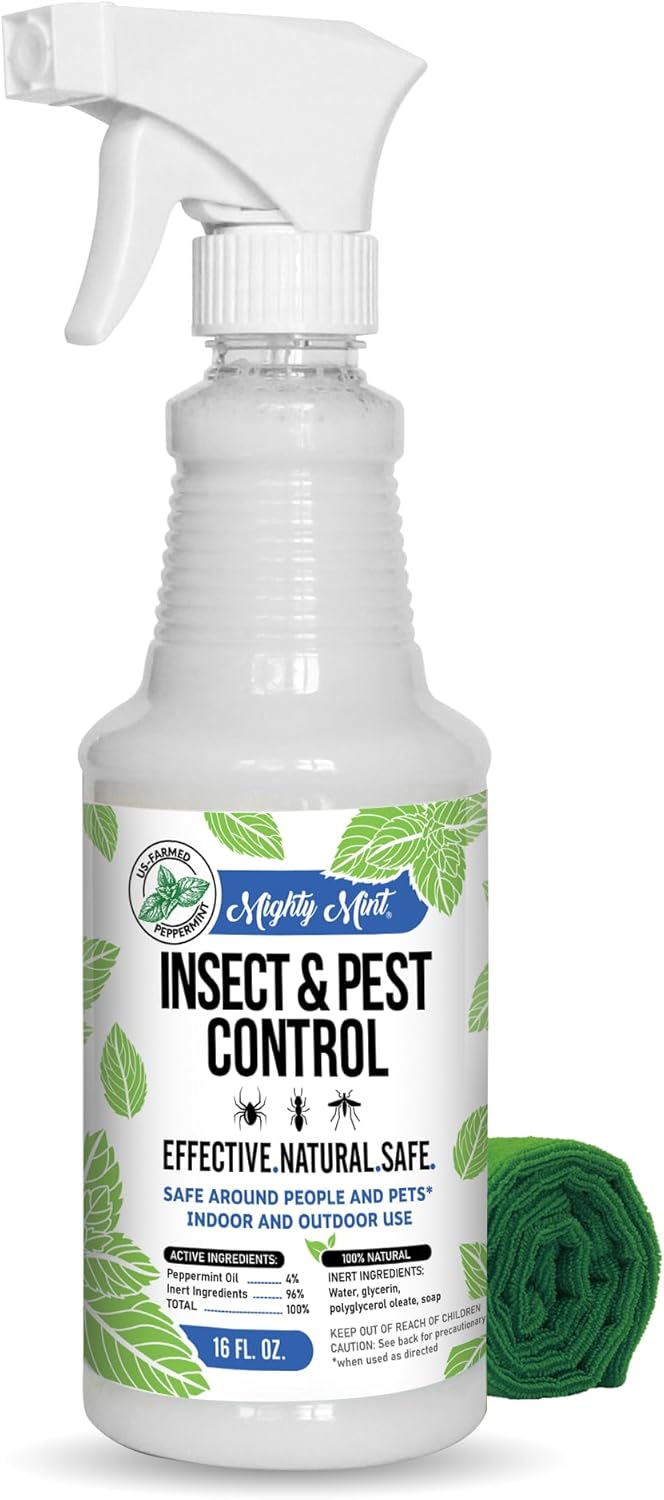
| Ingredients | Water, Glycerine, Polyglycerol oleate, Soap, Peppermint oil |
|---|---|
| Use Areas | Indoor / Outdoor |
| Size | 16 oz |
Mighty Mint is a plant-based, ready-to-use spray that uses concentrated peppermint oil to repel a broad range of household and patio pests. You apply it directly to problem areas such as baseboards, entryways, patios and around outdoor seating; the manufacturer recommends shaking and spraying until surfaces are covered and repeating applications two or more times per week for best results. Notable features include a peppermint-only scent profile, a formulation that avoids synthetic fragrances and the convenience of a 16 oz spray bottle for targeted spot treatments. Practical benefits are that it is safe to use around people and pets when dry and does not leave obvious stains on most surfaces, and the scent can make treated areas smell fresher than chemical alternatives. Important limitations are that it is a repellent rather than a pesticide so it works by discouraging pests rather than killing them, effectiveness depends on regular reapplication and it should not be applied when pollinators are present or to skin or food-contact surfaces.
Best for: Buyers who prioritize natural, low-toxicity solutions and want a targeted spray to reduce insects around patios and entryways while keeping family and pets in mind.
Less Ideal for: Anyone needing a one-time extermination or long-term residual pesticide for severe infestations should consider professional treatments or products formulated to kill pests rather than repel them.
- Plant-based peppermint formula that avoids synthetic fragrances
- Ready-to-use spray for quick, targeted indoor and outdoor applications
- Safe for people and pets when used as directed and allowed to dry
- Nonstaining on most surfaces and leaves a fresh mint scent
- Repels rather than kills insects so regular reapplication is needed to maintain protection
- Strong peppermint concentration may bother scent-sensitive individuals and requires keeping children and pets away until dry
Verdict: Choose Mighty Mint when you want a pet-friendly, plant-based spray to reduce patio and entryway insects with a fresh peppermint scent.
Summit Mosquito Bits BTI Granules, 30 oz

| Unit Count | 30 Ounce |
|---|---|
| Item Form | Granules |
| Target Species | Insects |
| Active Ingredients | Bacillus thuringiensis subsp. israelensis, 2.86% |
These Mosquito Bits are a granular formulation of Bacillus thuringiensis israelensis intended for treating small areas of standing water to prevent mosquito larvae from developing. You sprinkle or scatter the granules into birdbaths, clogged gutters, ponds, tree holes, and other stagnant water where mosquitoes breed; the active bacteria target larvae but are formulated to be safe for people and most pets when used as directed. The 30 ounce container supplies multiple treatments for small to medium sites and is EPA registered for use across states. Practical benefits include quick application without mixing, targeted control of larvae before they become biting adults, and long-standing use of BTI as a low-risk biological option. Important limitations are that this product does not repel adult mosquitoes and must reach standing water where larvae are present to work, so it is not a standalone solution for immediate adult mosquito relief in activity areas.
Best for: Buyers looking for a low-risk, science-backed way to prevent mosquitoes from breeding in backyard water features and other small standing-water sites; especially appropriate for cautious homeowners who prefer targeted biological products over broad chemical sprays.
Less Ideal for: Not a good fit for someone needing immediate relief from adult mosquitoes in living or entertaining areas or for large acreage mosquito control where larval habitats are impractical to treat.
- Contains BTI, a targeted biological larvicide effective against mosquito larvae
- Granular form is easy to apply directly to small or irregular water sources
- EPA registered for use in all 50 states
- 30 ounce size provides multiple treatments for repeat applications
- Only controls larvae and will not reduce adult mosquitoes already present
- Requires identifying and treating standing water sources to be effective
Verdict: Use these BTI granules to reliably stop mosquitoes at the larval stage in backyard standing-water sources so you prevent future adult infestations.
Choosing the Right Natural Insect Killer: Key Factors to Consider
Target Pest Spectrum
Different natural insect killers vary widely in what they control. Some are broad-spectrum and will reduce a range of soft-bodied and chewing pests. Others are very specific, such as those aimed only at larvae or sap-sucking insects. Knowing the pests you commonly encounter will determine whether you need a generalist product or a targeted treatment.
Choosing the right spectrum reduces unnecessary applications and helps protect beneficial predators that keep pest populations down between treatments.
Safety For Pollinators And Beneficials
Gardeners often use natural options to protect pollinators and predators, but not all natural actives are benign. Some botanical oils and dusts can smother bees or beneficial insects if applied indiscriminately during bloom or at high concentrations. Look for products with clear guidance on avoiding application during flowering or that decompose quickly on foliage.
Consider timing and application method as part of safety. Foliar sprays applied in early morning or late evening typically reduce direct exposure to bees, while soil drench or targeted trunk treatments often pose less risk to foraging insects.
Residue On Edibles And Reapplication Interval
If you grow edibles, residue and pre-harvest interval matter. Natural does not automatically mean no residue. Some mineral-based products and plant oils can leave a film or require a wait time before harvest. Check typical reapplication intervals too; an effective product that requires frequent respraying may increase labor and plant exposure.
Balance the need for quick control against how long residues persist and how often you will need to treat. Options that break down naturally with sunlight or rain are often preferable in vegetable beds.
Mode Of Action And Resistance Management
Using the same mode of action repeatedly can lead to reduced effectiveness over time. Natural insect killers include physical modes, like desiccants, and biological modes, like bacterial toxins or insect growth regulators. Rotating between different modes helps prevent pests from becoming tolerant and maintains long-term control in the garden.
Understand whether a product kills on contact, interferes with development, or deters feeding. Combining knockdown sprays with preventive cultural methods reduces reliance on any single approach.
Application Practicality
Consider how easy the product is to mix, measure, and apply in a typical home garden. Ready-to-use sprays are convenient for small beds and containers. Concentrates require dilution and may be better for larger lawns or orchard patches but add mixing time and opportunity for error.
Also think about the equipment you'll use. Sprayers with adjustable nozzles help reach undersides of leaves where pests hide. Dusts and granules have their place for soil-dwelling pests but can be messier to apply.
Environmental Constraints And Non-Target Risks
Some natural insect killers pose risks to aquatic life or can accumulate in compost if overused. If your garden is near water or you compost large volumes of treated plant material, choose products with low runoff and rapid breakdown. Wind, temperature, and rain can also affect how well a treatment works and its off-target movement.
Plan treatments around weather and site conditions, and follow label guidance to minimize environmental impact and protect wildlife.
When Natural Options Make The Most Sense
Natural insect killers are best when you need targeted garden protection without resorting to conventional synthetic pesticides. They are especially useful in vegetable and herb beds, pollinator-attracting borders, and small-scale fruit trees where preserving beneficial insects and soil life is a priority. For light to moderate infestations or early detection, many natural approaches provide fast suppression with lower non-target impact.
If you face heavy infestations of hard-bodied or highly mobile pests, natural products can be part of an integrated plan rather than the sole tactic. Use them alongside cultural controls and mechanical methods to reduce pest pressure before applying treatments.
- Ideal for edible gardens and pollinator-friendly plantings
- Good for spot treatments and early-season use
- Often used in rotation with cultural controls
Integrating Natural Treatments Into An IPM Routine
Integrating natural insect killers into an integrated pest management routine makes them more effective. Start with regular scouting to identify pest hotspots early. Use cultural practices such as crop rotation, sanitation, and appropriate spacing to reduce pest harborage. When thresholds are exceeded, select a natural option aligned with the target pest, time applications to avoid blooms, and pair sprays with biological releases or trap crops where feasible.
- Scout weekly for eggs, larvae, and feeding damage
- Target treatments to hotspots rather than blanket-spraying
- Rotate modes of action to slow resistance
Application Tips To Improve Performance
Coverage matters. For contact-based natural insect killers, spray until foliage is evenly wetted and focus on undersides of leaves and stem crevices where pests hide. For soil-applied or systemic options, follow mixing directions carefully and apply at recommended intervals to maintain control without overuse.
Avoid applying during the heat of the day to reduce plant stress and volatile losses. If treating edibles, note recommended pre-harvest intervals and wash produce before eating. Use personal protective equipment as instructed even with natural products, and keep pets and children out of treated areas until surfaces have dried.
- Aim sprays at undersides of leaves and node junctions
- Apply in the cool parts of the day to reduce phytotoxic risk
- Observe labeled crop-specific instructions for edible plants
Common Mistakes Gardeners Make With Natural Killers
Treating too late is a frequent error. Many natural options work best against early life stages. Waiting until populations explode makes control harder and sometimes impossible without broader measures. Overapplication is another issue; repeated blanket sprays can harm beneficials and disrupt biological control.
Misidentifying pests leads to poor choices. For instance, a product that targets larvae will not control adult beetles. Spend time confirming the pest life stage and identity before choosing a natural approach.
- Do not assume natural equals harmless to all insects
- Match treatment timing to pest life stage for best results
- Avoid excessive blanket applications that harm beneficials
How We Chose the Best Natural Insect Killer
We focused on real-garden performance and safety when assembling the shortlist of seven natural insect killers. Selection began with products and formulas that rely on botanicals, microbial agents, or mineral-based actives permitted for edible crops and home landscapes. We excluded synthetic chemical-only formulations and anything labeled for industrial or non-gardening use. Evaluation emphasized measurable, gardener-relevant criteria: broad-spectrum control against common pests, minimal harm to pollinators and beneficial arthropods, residue and persistence on edible plants, ease and safety of application for home gardeners, and compatibility with common organic practices. We also considered label directions and typical reapplication intervals because frequency affects workload and plant exposure. Formulations that required special equipment or posed elevated risks to pets or aquatic life were filtered out. The final list balances short-term knockdown with longer-term management, favoring options that integrate cleanly into IPM-style routines. Where a product has narrow-target efficacy it was retained only if that niche fills a common gardener need, such as treating soft-bodied pests without harming beneficial predators.
FAQ
Are natural insect killers safe to use on vegetable plants?
Often yes, but it depends on the active ingredient and the labeled pre-harvest interval. Many natural options are permitted for use on vegetables with short wait times, but some can leave residues or require a gap before harvest. Follow label directions and rinse produce before eating.
Will natural insect killers harm bees and other pollinators?
Some natural actives can harm pollinators if applied during bloom or when bees are actively foraging. To reduce risk, avoid spraying flowering plants, apply in the early morning or late evening, and choose products with low persistence on flowers.
How quickly do natural insect killers work?
Response time varies by mode of action. Contact sprays often produce knockdown within hours, while biological or growth-regulating options can take days to show effects. Expect faster visible results with products that act on contact and longer timelines with those that interrupt development.
Can I use natural insect killers preventively?
Yes, some gardeners use preventive treatments in high-risk areas or on tender transplants, but preventive use increases exposure of non-targets and may not be necessary everywhere. Preventive strategies work best when combined with other cultural measures and limited to identified problem zones.
Do natural insect killers need any special equipment to apply?
Most are compatible with common garden sprayers or watering can applicators. Concentrates require careful dilution and measuring, while ready-to-use sprays are simpler for small jobs. Use a sprayer that allows good coverage and follow label mixing instructions.
Final Verdict
Natural insect killers can be highly effective when chosen to match the pest, crop, and timing. Prioritize plant safety and pollinator protection by selecting products with appropriate spectra of control and short persistence on foliage. Balance quick knockdown options with longer-term biological controls and cultural practices to reduce repeat treatments. Make choices based on the pest species, the life stage you observe, and the garden setting. When you follow label guidance, rotate modes of action, and integrate treatments into broader IPM habits, natural insect killers offer a practical way to manage pests while keeping the garden ecosystem healthy.
