

Note: This article contains affiliate links. If you click on these links and make a purchase, I may earn a small commission at no extra cost to you. This helps support my research and content. Read my full affiliate disclosure here.
Grubs feed on roots and can quickly weaken or kill vegetables, reducing yield and stressing plants during the growing season. Picking the right grub killer for vegetable gardens matters because some treatments control beetle larvae quickly but can harm earthworms or beneficial microbes, while others act more gently over time. This guide shortlists six top options suited to vegetable beds and patios and explains how each type behaves in the soil. We'll evaluate effectiveness against larvae and the safety profile for soil life and crops, plus ease of application and persistence. Read on to see which approach fits your planting style and pest pressure.
Top Picks at a Glance
| Best Overall The best all-around choice for most situations | St. Gabriel Organics Milky Spore Granular Grub Control, 15 lb |  |
| Best Quality Built to a higher standard if you want something more solid | BioAdvanced Fruit, Citrus & Vegetable Insect Control Concentrate, 32 oz |  |
| Best Value The sweet spot between price and what you get | The Environmental Factor Grub Busters Beneficial Nematodes (covers 3,000 sq ft) |  |
| Best Budget The cheapest option that still gets the job done reliably | Hi-Yield Vegetable & Ornamental Insect Control Granules, 4 lb |  |
| Highest Rated A top-rated pick with lots of positive feedback | Sevin Garden Perimeter Insect Killer Granules II (3 lb) |  |
| Most Popular A crowd favorite that many people choose with confidence | NaturesGoodGuys Triple Blend Beneficial Nematodes, 15 Million |  |
St. Gabriel Organics Milky Spore Granular Grub Control, 15 lb

| Unit Count | 240 Ounce |
|---|---|
| Included Components | 15lb bag |
| Item Form | Granules |
| Target Species | Japanese Beetle |
| Active Ingredients | Bacillus Popilliae |
St. Gabriel Organics Milky Spore Granular is a 15 lb ready-to-use granular treatment that delivers a biological control for Japanese beetle grubs. You apply it with a spreader or by hand to unfrozen soil in spring, summer, and fall; the spores are picked up by feeding grubs, multiply inside them, and spread back into the soil. The product is USDA-organic, non-toxic to people and pets, and safe around vegetable beds when used as directed. Notable features are its long-lasting activity over multiple years and a simple application schedule that covers large areas per bag. Expect gradual population reduction rather than immediate disappearance because the spores establish in the soil and require repeat applications over two years for best results. It works specifically on Japanese beetle grubs and will not control other soil pests, so you may need complementary measures for different invaders. For gardeners seeking an eco-conscious, low-toxicity approach to grub control this product integrates easily into an organic vegetable garden program.
Best for: Home gardeners who prioritize an organic, low-toxicity approach and want a biological, long-term solution for Japanese beetle grubs in vegetable garden soil.
Less Ideal for: Gardeners who need fast knockdown of a variety of soil pests or immediate visible results should consider faster-acting chemical options or targeted treatments for other grub species.
- Uses Bacillus popilliae for biological control of Japanese beetle grubs, safe for people and pets
- Ready-to-use granules that can be applied with a spreader or by hand
- USDA-organic formulation suitable for use near food crops when directions are followed
- Provides long-term suppression as spores establish and recycle in soil
- Requires multiple applications over two years and time for the soil population to build, so results are gradual
- Effective only against Japanese beetle grubs and not other turf or garden soil pests
Verdict: A safe, USDA-organic granular Milky Spore treatment for gardeners who want a long-term, biological solution to Japanese beetle grubs in vegetable beds.
BioAdvanced Fruit, Citrus & Vegetable Insect Control Concentrate, 32 oz
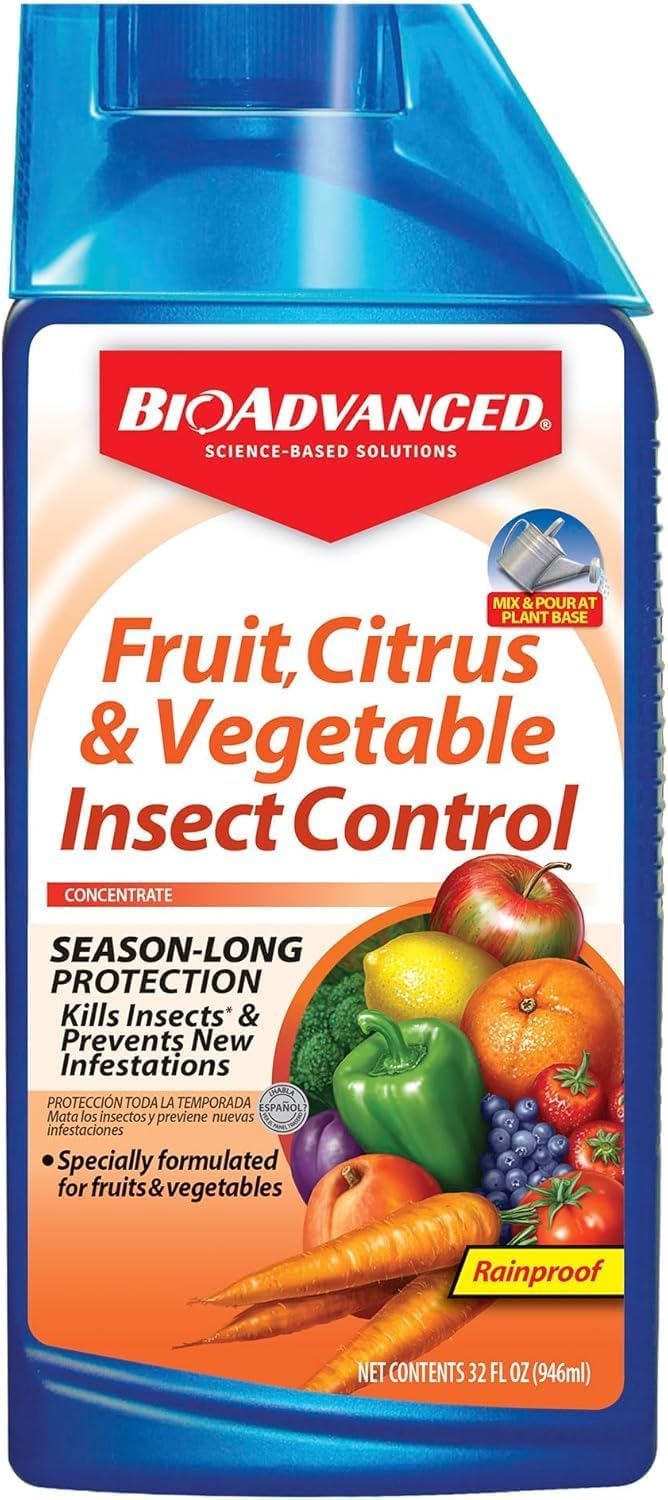
| Item Form | Concentrate |
|---|---|
| Target Species | Aphid, Whiteflies, Japanese Beetles, Mealybugs, Asian Citrus Psyllid |
| Liquid Volume | 32 fluid ounces |
| Specification Met | EPA |
| Active Ingredients | avocado |
This BioAdvanced concentrate is designed as a season-long, systemic insect control for edible gardens. You mix the concentrate with water and pour it around the root zone, so no foliar spraying is required; after uptake the product protects plants from feeding pests such as aphids, whiteflies, leafhoppers, scale and Japanese beetles and is rainproof after one hour. A single application covers large areas and the label states protection for up to two months, which makes it useful for producers who want durable control without repeated sprays. Because it is systemic the active ingredient is taken up by the plant, protecting new growth as well as existing foliage. Important limitations are regulatory restrictions in several U.S. states and the fact that systemic chemistry can affect nontarget insects, so follow label directions and harvest intervals carefully. For gardeners focused on strong, low-effort insect control for edible crops, this product delivers predictable season-long protection when used as directed.
Best for: Gardeners and small-scale growers who prioritize reliable, low-effort, season-long protection for edible vegetables and fruit and who want a pour-in-root treatment instead of repeated foliar sprays.
Less Ideal for: People who prefer organic contact-only treatments or who manage pollinator-heavy plantings where nontarget exposure must be minimized should consider alternative products.
- Systemic mode of action protects new growth and does not require foliar spraying
- Provides rainproof protection one hour after application
- Single application gives season-long control for up to two months
- Covers a wide range of listed pests relevant to vegetables and fruit
- Not permitted for sale or use in several U.S. states and some New York counties
- Contains systemic insecticide chemistry that can impact nontarget insects if misused
Verdict: Choose this concentrate if you want dependable, season-long systemic protection for vegetables and fruit with a single pour-in application.
The Environmental Factor Grub Busters Beneficial Nematodes (covers 3,000 sq ft)

| Item Form | Spray (hose-end mix) |
|---|---|
| Target Species | Insects (white grubs, billbugs, flea larvae) |
| Covers | 3,000 sqft |
| Active Organism | H. bacteriophora (20 million nematodes) |
This product supplies live beneficial nematodes (H. bacteriophora) intended to kill white grubs, billbugs, flea larvae and similar soil pests across roughly 3,000 sq ft. You mix the powder into a hose-end sprayer, wet the target area and spray evenly; treated zones must be kept moist for several days to let the nematodes move through the soil. The formula is organic and safe for people, pets and pollinators, which makes it suitable for vegetable garden use where chemical residues are a concern. Practical strengths are the straightforward hose-end application and broad soil-pest coverage without refrigeration. Important limitations are that results depend on timing, soil temperature and moisture so treatments may need repeat applications for heavy infestations, and the product requires a separate sprayer and careful evening or cloudy-day application to avoid UV and heat stress on the nematodes. Expect slower, biological control rather than instant kill.
Best for: Gardeners who prioritize practical, low-toxicity solutions for protecting vegetable beds and want a biological option they can apply themselves rather than a quick chemical knockdown.
Less Ideal for: People who need immediate, visible pest knockdown or who cannot keep treated soil consistently moist after application should consider faster-acting alternatives.
- Targets common soil pests like white grubs and billbugs biologically without harsh chemicals
- Covers approximately 3,000 square feet per pack for wide-area treatment
- Safe for people, pets and pollinators, making it suitable for food-growing areas
- Easy hose-end application that mixes with water and sprays directly onto turf or garden beds
- Effectiveness depends heavily on correct timing, soil temperature and maintaining moisture
- Requires a compatible hose-end sprayer which is not included
- Not an instant solution—biological control can take days to weeks and may need repeat treatments
Verdict: A practical, low-toxicity biological grub control for vegetable gardens when applied at the right time and kept moist, covering large areas per pack.
Hi-Yield Vegetable & Ornamental Insect Control Granules, 4 lb

| Unit Count | 64 Ounce |
|---|---|
| Item Form | Granules |
| Target Species | Insects |
| Item Weight | 4 pounds |
Hi-Yield Vegetable & Ornamental Insect Control is a granular insecticide intended for use around home perimeters, flower and ornamental beds, and vegetable gardens. Applied with a hand or rotary spreader, it is fast acting and labeled to control ants, grubs, cutworms, earwigs, crickets, wireworms and other common pests. For vegetable beds you can work a single application into the top 4 to 6 inches of soil prior to planting or after emergence, and the bag size is suitable for treating up to roughly 3,000 square feet at recommended rates. The product is odor free and simple to use without specialized equipment beyond a spreader and a trowel for incorporating into soil. Limitations to note are that repeat applications are restricted to no more than once every seven days and you must follow label safety instructions carefully when applying near edible crops. If you need a basic, easy-to-apply granular option to reduce common garden pests on a budget, this is a practical choice.
Best for: Gardeners looking for a low-cost, easy-to-apply granular insect control for vegetable beds and ornamental borders who prioritize straightforward application over specialty formulations.
Less Ideal for: Those seeking organic or non-chemical grub controls or users who want long residual commercial-strength treatments that require fewer reapplications.
- Targets a broad range of surface and soil insects common in vegetable and ornamental gardens
- Fast acting formula that begins killing insects within about 24 hours
- Simple granular form that applies with standard hand or rotary spreaders
- Odor free, making it easier to use near outdoor living areas
- Requires careful adherence to label directions for use around edible plants
- Repeat applications are limited and may be needed if activity returns
Verdict: A budget-friendly, easy-to-apply granular insect control that handles common vegetable garden pests effectively for routine home garden use.
Sevin Garden Perimeter Insect Killer Granules II (3 lb)

| Unit Count | 48 Ounce |
|---|---|
| Item Form | Granules |
| Target Species | Insects |
Sevin Garden Perimeter Insect Killer Granules is a ready-to-use granular insecticide sold in an easy-to-shake container for treating garden beds, ornamentals, shrubs and the area around a home. You apply it by lightly shaking the granules over the target area then thoroughly watering the treated soil so the product reaches insects at and below the surface. The formula claims contact control of more than 100 listed pests including ants, aphids, caterpillars and Japanese beetles and is labeled for use on more than 175 fruits and vegetables. A single application is intended to provide up to three months of control, which reduces the need for frequent reapplication. Practical benefits include the shaker can for simple spot or perimeter treatments and coverage that protects both foliage and soil-dwelling pests. Important limitations are that this is a broad-contact insecticide rather than a targeted grub-only product and it requires watering-in after application to activate, so timing and following label directions are essential for safety and effectiveness in vegetable beds.
Best for: Gardeners who prioritize a dependable, broad-spectrum insect control they can apply quickly to protect vegetable beds and surrounding perimeter areas.
Less Ideal for: Those who need a specialist grub-focused systemic treatment for established root-feeding larvae or who prefer non-chemical biological control methods for vegetables.
- Kills or controls a wide range of garden insects by contact, including common vegetable pests
- Ready-to-use shaker can makes application quick and simple for perimeter or spot treatments
- Provides up to three months of residual control from one application when used as directed
- Labeled for use on many fruits and vegetables and ornamentals so it can be used in vegetable beds and around plants
- Not a grub-specific systemic product so it may be less effective against established root-feeding grubs compared with targeted grub killers
- Requires watering-in after application and adherence to label directions for safe use in edible gardens
Verdict: Choose this product if you want a reliable, easy-to-apply granular insect killer that gives broad, multi-month protection around vegetable gardens and the home perimeter.
NaturesGoodGuys Triple Blend Beneficial Nematodes, 15 Million

| Unit Count | 15 Count |
|---|---|
| Target Species | Insects |
| Active Ingredients | Heterohabditis bacteriophora; Steinernema carpocapsae; Steinernema feltiae |
This product supplies three species of beneficial nematodes—Heterohabditis bacteriophora, Steinernema carpocapsae, and Steinernema feltiae—packaged as 15 million infective juveniles for soil application. It is designed to be activated with water and released with a watering can or hose-end applicator onto moist soil where grubs, root-feeding larvae, and other target insects live. The included storage instructions let you refrigerate the unactivated nematodes for up to 30 days, and once mixed they must be applied within six hours, which encourages planning applications on cool, overcast days or early morning. In practical use the mix is safe around people, pets, and plants and fits into an integrated organic pest program, reducing reliance on chemical insecticides. Important limitations are the short window after activation and the need to maintain soil moisture and cool temperatures for best results, so timing and proper storage are essential to achieve the expected control.
Best for: Gardeners who prefer biological, low-toxicity solutions for grub and root-feeding pests and who plan applications carefully to meet storage and activation timing.
Less Ideal for: Those who need immediate, one-time rapid knockdown regardless of temperature or moisture or who cannot apply treatments shortly after activation.
- Contains three complementary nematode species to target a broad range of soil insect pests
- Safe to use around people, pets, and garden plants
- Can be stored unactivated in the refrigerator for up to 30 days
- Simple activation and application with watering can or hose-end sprayer
- Once activated the nematodes must be applied within six hours, limiting application flexibility
- Performance depends on soil moisture and cool conditions, so reduced efficacy in hot dry weather
Verdict: Use this triple-species beneficial nematode mix when you want an organic, pet-safe biological control for soil grubs and root-feeding pests and can apply it within the product's storage and activation constraints.
Choosing the Right Grub Killer for Vegetable Gardens: Key Factors to Consider
Mode of Action
How a grub killer works determines where it acts in the soil and which organisms it affects. Chemical contact insecticides kill larvae they touch and may require thorough soil mixing or drenching to reach deep-feeding grubs. Systemic products move through plant tissues or soil water and can protect roots from feeding but may leave residues that affect soil microbes.
Biological controls use living organisms or naturally derived bacteria that target grubs specifically and often spare earthworms and beneficial insects. Understanding mode of action helps you choose a treatment that fits bed depth, root zone location, and your tolerance for impacts on soil ecology.
Soil Life and Beneficial Organisms
Vegetable gardens rely on earthworms, microbial communities, and beneficial insects to maintain soil structure and nutrient cycling. Some grub killers are harsh on these organisms, reducing long-term soil health even if they remove grubs quickly. Others are formulated to minimize non-target harm but may act slower or require repeat applications.
Consider whether you prioritize rapid eradication or preserving soil biology. If you use compost teas, cover crops, or rely on pollinators nearby, choose options with lower toxicity to non-target species and follow label guidance to protect beneficials during application.
Crop Safety and Harvest Timing
Not all grub control products are labeled safe for use around edible crops, and some require a waiting period between application and harvest. Residual chemicals can persist in root zones and potentially be taken up by vegetables, so checking crop compatibility is essential.
Organic-approved or biological options often have shorter or no harvest restrictions, making them attractive for kitchen gardens. When using products with specified intervals, plan treatments earlier in the season or after main harvests to avoid conflicts with eating the produce.
Application Method and Bed Type
Vegetable gardens come in many forms: in-ground beds, raised planters, containers, and mixed ornamental-vegetable borders. Some grub killers are granular and best worked into soil, while others are liquid drenches, sprays, or ready-to-use formulations. Granules can be easier for large beds; drenches can penetrate deep root zones in smaller plots or containers.
Think about access, how much soil disturbance you can tolerate, and whether you need a product suitable for tight rows or potted plants. Application flexibility also matters if you prefer spot treatments over whole-bed applications.
Persistence and Re-treatment Needs
How long a product remains active affects both control and ecological footprint. Short-lived options may require multiple applications to catch late-hatching larvae but reduce long-term residue. Longer-lasting treatments can cover multiple larval stages but increase potential exposure to non-target organisms.
Assess expected grub pressure and seasonality in your area. In areas with several generations or extended egg hatch windows, persistence can reduce repeat work. For annual vegetable rotations, short persistence may be preferable to avoid carryover into the following crop.
Ease of Use and Safety Precautions
Practical application features determine whether a treatment is usable in small-scale vegetable plots. Look for formulations that are straightforward to measure and apply, with clear personal protective equipment recommendations and minimal need for specialized equipment.
Also consider storage stability and whether the product is compatible with common garden practices like mulching or irrigation. Clear label instructions for protecting pollinators, children, and pets during and after application are important for home vegetable gardeners.
Timing Treatments for Best Results
Treating at the right time in the grub life cycle improves control and reduces unnecessary applications. Most interventions are most effective when larvae are actively feeding near the soil surface, often in late summer and early fall, or in spring when soils warm and plants begin active growth.
- Monitor for yellowing or thinning plants and inspect root systems for chewed roots and soft white larvae.
- Apply treatments when eggs have hatched and grubs are small and near the surface for greater efficacy.
- Consider follow-up checks in a few weeks and reapply only if grub pressure persists.
Integrating Cultural Controls
Non-chemical measures reduce grub populations over time and can complement targeted treatments. Practices include improving drainage, maintaining healthy turf or groundcover around beds to reduce adult beetle egg-laying, and encouraging natural predators such as birds and ground beetles.
- Rotate susceptible crops and avoid continuous planting in known hot spots.
- Keep beds well mulched with finished compost to support soil predators and microbial competition.
- Hand removal and spot digging around affected plants can reduce local infestations in small plots.
Using Biological Versus Chemical Options
Biological agents, such as certain bacteria or nematodes, can specifically target grub larvae and usually have minimal effects on earthworms and pollinators. They may require particular soil temperatures and moisture to establish and can act slower than chemical options.
Chemical treatments can offer rapid reduction of large populations but often have broader ecological impacts. Weigh the urgency of control against potential harm to soil life and adjacent pollinator habitat when selecting a product.
- Biologicals often need multiple applications or favorable soil conditions to be effective.
- Chemicals can be more forgiving of application timing but may carry harvest or safety restrictions.
Protecting Pollinators and Soil Wildlife
When treating beds near flowering plants, follow label guidance to avoid spraying blossoms and to avoid peak pollinator activity. Even soil-applied products can drift or wash into neighboring areas if overapplied or misused.
Buffer treated areas from vegetable flowers and bee foraging zones and water in products only as directed to reduce runoff. Consider timing applications for late evening or when pollinators are not active if the product label permits.
- Avoid applying treatments during bloom or when bees are actively foraging.
- Use targeted spot applications rather than blanket treatments when practical to limit non-target exposure.
Post-Treatment Garden Care
After treatment, monitor plants for recovery and signs of new root growth. For biological controls, maintain soil moisture and moderate temperatures to help the beneficial organisms establish and persist.
If you used a product with a harvest interval, track timing carefully and keep treated soil turned or covered as directed. Rebuild soil biology over time with compost, cover crops, and minimal soil disturbance.
- Record application dates and any restrictions to coordinate with planting and harvest schedules.
- Avoid excessive tilling immediately after biological treatments to let beneficial organisms work.
How We Chose the Best Grub Killer for Vegetable Gardens
We selected products that address grub infestations specifically in vegetable-growing situations and prioritized options that balance larval control with protection for soil biology and crops. Our editorial filters focused on modes of action relevant to kitchen gardens: contact versus systemic activity, biological versus chemical approaches, and targeted application methods that limit exposure to non-target areas. Evaluation emphasized effectiveness against common grub species found in vegetable beds and the speed of visible turf and root recovery. Safety measures included toxicity to earthworms and pollinators, withdrawal or harvest intervals where applicable, and potential residue persistence in soil. Practical gardeners also need treatments that are easy to apply in tight beds or raised planters, so application flexibility and formulation type were considered. We excluded broad lawn-only treatments and products labeled exclusively for ornamental or turf use that do not list vegetable or edible garden compatibility. Products requiring specialized licensing or commercial-only application were also excluded. The final list reflects options that a typical home vegetable gardener can reasonably use with appropriate precautions.
FAQ
Can I use grub killers in raised beds and containers?
Often you can, but check the product label for use in containers and edible gardens. Some granular treatments are intended for lawns only, while certain drenches or biologicals are formulated for small beds and planters.
Are there grub control options safe to use right before harvest?
Some biologicals and organic-approved materials have little or no harvest interval, but many chemical options require a waiting period. Always read the label for specific harvest interval information and follow guidance for edible crops.
Will treating for grubs harm earthworms and composting activity?
It depends on the product. Broad-spectrum chemicals can reduce earthworm activity and microbial diversity, while targeted biological controls and selective materials are designed to spare beneficial soil fauna when applied correctly.
How quickly will I see results after applying a grub killer?
Response time varies: chemical treatments can reduce feeding within days to weeks, while biological controls may take longer as they establish and spread. Inspect root systems to verify reduced feeding rather than relying solely on top growth recovery.
Can I prevent future grub outbreaks with cultural practices?
Yes. Improving soil health, encouraging predators, rotating crops, and avoiding continuous high-risk ground covers can reduce egg-laying and lower grub populations over the long term. Cultural controls complement targeted treatments.
Are beneficial nematodes a good option for vegetable beds?
Beneficial nematodes can be effective when soil temperatures and moisture are within the recommended range and when applied where grubs are present. They are a biological tool with minimal non-target effects but may need repeat applications.
Final Verdict
Choosing a grub killer for vegetable gardens is about balancing effective larval control with protecting soil life and crop safety. Prioritize products with an appropriate mode of action for how deeply grubs feed in your beds, and match persistence to your seasonal planting and harvest schedule. If maintaining soil biology and minimizing harvest restrictions are critical, lean toward biological or organic-approved options and use targeted applications. For heavy infestations that threaten roots immediately, faster-acting treatments can be justified if you follow label precautions to protect pollinators and soil organisms.
