

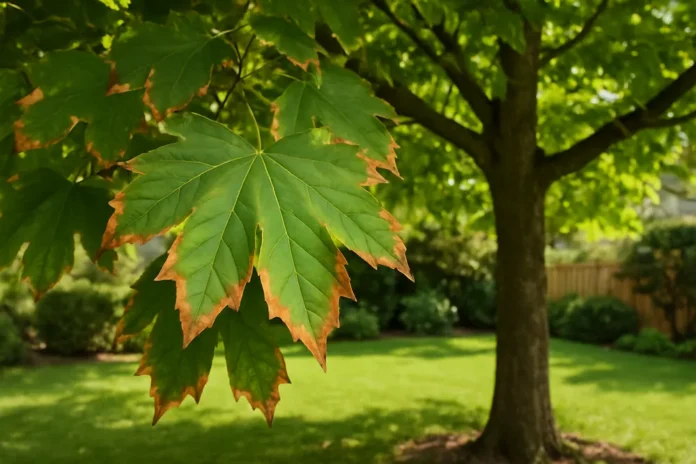
Maple tree leaves usually get brown edges from leaf scorch caused by heat, drought, wind, root stress, or excess salts in the soil. In some cases, transplant shock, trunk injury, or compacted soil can also keep the tree from moving enough water to the leaf margins.
Brown edging on maple leaves is one of the most common tree symptoms I see in summer, especially after hot, dry, or windy weather. On maple leaves with brown edges, the damaged tissue is often the part of the leaf farthest from the water supply, so the margins dry out first.
That does not always mean your tree is simply thirsty. Maple leaf scorch can be triggered by several stresses that all lead to the same result: the roots cannot deliver water fast enough to keep up with the leaves. Soil compaction, transplant shock, excess fertilizer, deicing salt, and root damage can all play a role.
The good news is that brown edges are often more of a stress signal than a death sentence. If you focus on the pattern, timing, and site conditions around the tree, you can usually narrow down the cause and help the next flush of growth come in healthier.
What Brown Leaf Edges Usually Mean on Maples
When a maple leaf turns brown only along the outer rim, the problem is usually called leaf scorch. Scorch is not one single disease. It is a symptom that appears when the tree loses moisture from the leaves faster than the roots can replace it. The edges and tips dry first because they are the farthest points from the leaf veins carrying water.
On many maples, scorched leaves start with a yellowish or pale band near the edge, then become tan or crispy brown. In mild cases, only a few leaves on the sunny side of the canopy are affected. In more severe cases, much of the tree can look burned by midsummer.
- Browning starts at the leaf edge or tip and moves inward
- The dead tissue often feels dry, thin, or crisp
- Symptoms may be worse on outer, upper, or west-facing branches
- Leaves can curl slightly as they dry
- The veins often stay greener than the margins at first
When I am diagnosing a maple, I compare leaves from several parts of the canopy before deciding anything. If the damage is heaviest on the sunniest, most exposed side, I lean toward scorch or root stress long before I suspect a leaf disease.
Common Causes of Brown Edges on Maple Leaves
Drought and Uneven Watering
Dry soil is one of the biggest reasons maples develop brown edges. A mature tree needs deep moisture in the root zone, not just a quick surface sprinkle. If rainfall has been light, the top inch of soil may look normal while deeper roots are struggling. Young or newly planted maples are especially vulnerable because their root systems are still limited.
Heat, Sun, and Wind Exposure
Hot afternoons, reflected heat from pavement, and drying winds can push a maple beyond what its roots can supply. This is common with Japanese maples and red maples planted in spots with intense afternoon sun. Even when the soil is not bone dry, the leaves may still scorch if moisture loss is extreme.
Soil Compaction and Root Restriction
Maples have broad, fairly shallow root systems that dislike compacted soil. Foot traffic, parked vehicles, heavy clay, or construction around the tree can squeeze out air pockets and limit root growth. When roots cannot spread or breathe properly, water uptake drops and the leaf edges show it.
Transplant Shock
A recently planted maple often shows brown margins during its first one to three growing seasons. The canopy may be larger than the reduced root ball can support, so the tree struggles through heat spells. This is common even when the tree was planted correctly.
Salt Injury
Road salt, sidewalk deicers, and even salty irrigation water can damage maple roots or pull moisture away from them. Salt injury often appears as browning around the leaf margins, especially on trees near driveways, streets, and winter runoff paths. Sugar maples are particularly sensitive to salt.
Excess Fertilizer or Chemical Burn
Too much lawn fertilizer, especially high-nitrogen products spread over the root zone, can burn feeder roots and cause marginal browning. Herbicide drift can also stress nearby trees. If leaf damage follows a recent application, that timing matters.
Root Damage, Girdling Roots, or Trunk Injury
Cut roots from trenching, mower injury to the trunk, and circling roots left from container planting can all interfere with water movement. In these cases, the leaves may scorch because the plumbing system of the tree is compromised, not because the weather alone is harsh.
How to Tell Which Cause Is Most Likely
Because several problems can lead to the same brown edge symptom, look for clues in the pattern. Timing, location, and recent changes around the tree are often more useful than the leaf color alone.
- If symptoms began after a heat wave, drought, or windy stretch, leaf scorch from weather stress is likely.
- If the tree was planted within the last few years, transplant stress rises to the top of the list.
- If the tree sits near a road, driveway, or sidewalk, salt injury becomes more likely.
- If only one side of the canopy is affected, look for reflected heat, root disturbance, or localized soil problems.
- If the lawn around the tree is heavily used or recently graded, compaction may be limiting root function.
- If browning followed fertilizing or weed treatment, chemical injury deserves a closer look.
Also consider the species. Japanese maples commonly show brown edges from sun and wind stress. Red maples often struggle in hot, compacted urban sites. Sugar maples can react strongly to salt and poor drainage. Knowing your maple type can sharpen the diagnosis.
Do not judge recovery by damaged leaves already on the tree. I watch for whether new growth stays cleaner after I correct watering or mulch problems, because scorched tissue rarely turns green again.
Signs It May Be More than Simple Scorch
Brown edges are often tied to environmental stress, but sometimes the tree has a deeper health issue. If the symptom keeps returning year after year, or worsens even in moderate weather, it is worth looking beyond routine summer scorch.
- Branches are dying back at the tips
- Leaves are unusually small across much of the canopy
- The tree leafs out late or sparsely in spring
- The trunk has wounds, cracks, or cankers
- Mushrooms or fungal growth appear near the base
- The tree has a large amount of dead wood
- The canopy is thinning noticeably from one season to the next
These signs can point to chronic root problems, vascular disease, severe planting issues, or long-term site stress. A tree under that kind of strain may show brown edges as one symptom among several.
What to Do when Your Maple Leaves Have Brown Edges
Water Deeply, Not Frequently
Give the root zone a slow, thorough soaking when the soil is dry several inches down. For young trees, this may mean watering once or twice a week during hot spells. Established trees generally need less frequent but deeper watering. The goal is to moisten the soil where the feeder roots actually live.
Mulch the Root Area Correctly
A 2 to 3 inch layer of wood-chip mulch helps conserve moisture and moderate soil temperature. Keep mulch a few inches away from the trunk so it does not stay wet against the bark. Extend the mulch ring as wide as practical, since maple roots spread well beyond the trunk flare.
Reduce Competition From Turf
Grass is a strong competitor for water, especially around young maples. Replacing turf with a mulch ring can noticeably improve moisture availability. It also reduces the risk of trunk injury from mowers and string trimmers.
Avoid Unnecessary Fertilizer
If a maple is stressed, more fertilizer is not automatically the answer. In fact, adding fertilizer to a drought-stressed tree can make root injury worse. Unless a soil test shows a need, focus first on watering, mulching, and root-zone care.
Protect the Roots
Avoid digging, trenching, or repeated traffic over the root zone. If the soil is badly compacted, an arborist may recommend air spading or other root-zone improvement methods. For container-grown trees with likely girdling roots, a professional evaluation can be important.
Flush Salts when Possible
Where salt exposure is likely, deep watering can help leach some salts below the root zone if drainage is decent. Redirect runoff when possible and switch to less harmful deicing materials around sensitive trees.
One of the most helpful fixes I make is widening the mulch ring and stopping shallow lawn irrigation from being the tree's only water source. Maples often look like they are being watered because the grass is green, but the tree roots may still be drying out deeper down.
What Not to Do
A stressed maple can decline faster when well-meaning care misses the real problem. Avoid quick fixes that add more strain.
- Do not keep the soil constantly soggy in an effort to reverse scorch. Waterlogged roots cannot function well either.
- Do not pile mulch against the trunk in a volcano shape.
- Do not prune heavily during hot stress unless you are removing dead, broken, or hazardous limbs.
- Do not assume every brown edge means disease and start spraying fungicide.
- Do not fertilize repeatedly just because the leaves look damaged.
- Do not cover the root zone with landscape fabric plus rock if the tree is already heat stressed.
Can Brown-edged Maple Leaves Recover?
The brown parts of a leaf will not turn green again. Once that tissue has dried and died, it stays damaged until the leaf drops. What matters is whether the tree can keep enough healthy foliage to support itself through the season and produce better growth later.
Many maples recover well if the stress was temporary and the roots remain basically healthy. A single summer of scorched leaves is often cosmetic. Repeated severe scorch, however, can weaken the tree over time and make it more vulnerable to pests, winter injury, and branch dieback.
When to Call an Arborist
Home gardeners can correct a lot of watering and mulch issues on their own, but some situations deserve a closer professional look. A certified arborist can inspect the trunk flare, root zone, and canopy for structural or long-term health problems.
- The canopy is thinning or dieback is spreading year after year
- Large branches are dying
- The tree was damaged during construction or excavation
- You suspect girdling roots or planting depth problems
- Salt exposure is severe and decline is ongoing
- The trunk has cracks, decay, or repeated bark injury
- The tree is mature, valuable, or close to a house
For established shade trees, getting the diagnosis right early can save years of decline. It is especially worthwhile if the maple provides major cooling, privacy, or curb appeal in your landscape.
FAQ
Should I Cut Off Maple Leaves with Brown Edges?
Usually no. Damaged leaves can still photosynthesize with their remaining green tissue, and removing many leaves can stress the tree more. Only remove leaves if they are badly tattered, diseased, or part of routine cleanup on a small ornamental maple.
Will Extra Watering Fix Brown Edges on Maple Leaves Right Away?
It can prevent the problem from getting worse if drought is the cause, but it will not repair the brown tissue already there. Improvement shows up in how the tree holds the rest of its leaves and in the quality of later growth.
Can Too Much Water Cause Brown Edges on Maple Leaves?
Yes. Waterlogged soil can suffocate roots, which limits water uptake just as effectively as drought does. The leaves may still scorch because stressed roots cannot move enough moisture to the canopy.
Are Japanese Maples More Likely to Get Brown Leaf Edges?
Yes, especially in hot inland climates or sites with harsh afternoon sun and wind. Many Japanese maples prefer some protection from peak summer exposure, along with evenly moist but well-drained soil.
Does Fertilizer Help a Maple with Scorched Leaves?
Not usually unless a soil test confirms a nutrient problem. If the tree is stressed by drought, salts, or root issues, fertilizer can make things worse rather than better.
Can Road Salt Cause Brown Edges on Maple Leaves Months After Winter?
Yes. Salt that accumulates in the soil can injure roots and show up later as marginal browning once the tree is actively growing. The pattern is especially common near roads, sidewalks, and plowed driveways.
Is Leaf Scorch a Disease That Spreads to Other Trees?
Most of the time, no. Leaf scorch on maples usually describes environmental stress rather than a contagious disease. The same weather or site conditions can affect nearby trees, but the symptom itself is not typically spreading from leaf to leaf.
How Long Does It Take a Stressed Maple to Look Normal Again?
That depends on the cause and the tree's overall health. Mild seasonal scorch may not fully disappear until the next flush of growth or the next year, while trees with root damage or chronic compaction can need much longer to improve.
Want the best tools and treatments for stressed trees? Check out our guide to deep-watering tools, mulch options, and tree-care products that help maples recover faster.
