

Note: This article contains affiliate links. If you click on these links and make a purchase, I may earn a small commission at no extra cost to you. This helps support my research and content. Read my full affiliate disclosure here.
Ground ivy can spread quickly across lawns and shaded areas, forming low mats that choke desirable grasses and make maintenance harder. Picking the right herbicide for ground ivy matters because some treatments control creeping stems but injure nearby turf, while others act slowly and require repeat applications. This guide covers five top shortlisted herbicides for ground ivy, chosen for different lawn types and management styles. We evaluate each option for how it controls the vine, how it affects common turfgrasses, and what cultural steps are needed after application. Read on to understand the practical tradeoffs and find a product that matches your lawn situation.
Top Picks at a Glance
| Best Quality Built to a higher standard if you want something more solid | Atticus Torocity Mesotrione Herbicide, 8 oz |  |
| Best Budget The cheapest option that still gets the job done reliably | Liquid Harvest Mesotrione Concentrate (8 oz) – Pre- and Post-Emergent Lawn Herbicide |  |
| Highest Rated A top-rated pick with lots of positive feedback | Monterey Turflon Ester Specialty Herbicide Concentrate, 8 oz |  |
| Most Popular A crowd favorite that many people choose with confidence | Ortho Weed B Gon Chickweed, Clover & Oxalis Killer for Lawns Concentrate, 16 fl. oz. |  |
| Best Seller A high-volume bestseller chosen again and again | Syngenta Tenacity Turf Herbicide, 8 oz |  |
Atticus Torocity Mesotrione Herbicide, 8 oz

| Active Ingredients | Mesotrione |
|---|---|
| Item Form | Liquid |
| Coverage | 1000 square feet |
| Unit Count | 8 Ounce |
Torocity is a liquid herbicide concentrate built around 40% mesotrione that works as both a pre-emergent and post-emergent treatment for lawns. You measure and dilute the concentrate in a sprayer or watering can, then apply to target areas to prevent weed germination or to knock back existing infestations. The product lists coverage of roughly 1000 square feet per bottle and specifically names problem plants such as crabgrass, clover, dandelion, nutsedge and ground ivy, making it suitable when you need targeted control of stubborn broadleaf and grassy weeds. It is also labeled for use on newly seeded Kentucky bluegrass, tall fescue, perennial ryegrass and centipedegrass, which helps when renovating turf. Important limitations are that it is not labeled for some turf types like bentgrass, zoysiagrass and actively growing bermudagrass and it requires following application timing and watering instructions on the label for effective control. Users should follow safety and label directions when mixing and applying concentrated herbicides.
Best for: Gardeners and lawn-care pros who prioritize strong, reliable control of persistent lawn weeds and want a single product that works both before and after weeds emerge.
Less Ideal for: Homeowners seeking an all-purpose, ready-to-use spot treatment or those who have turf species not listed as tolerant should look for alternate options.
- Dual action formula provides both pre-emergent and post-emergent control
- Contains mesotrione, a proven active ingredient for broadleaf and grassy weeds including ground ivy
- Concentrated liquid form is easy to measure and mix for spray applications
- Label permits use on newly seeded common lawn grasses, aiding turf renovation
- Not labeled for use on certain turf types such as bentgrass, zoysiagrass, and active bermudagrass
- Requires careful dilution, application timing, and post-application watering for best results
Verdict: If you need performance-grade control of ground ivy and other difficult lawn weeds, Torocity delivers reliable pre- and post-emergent action with a mesotrione concentrate.
Liquid Harvest Mesotrione Concentrate (8 oz) – Pre- and Post-Emergent Lawn Herbicide

| Active Ingredients | Mesotrione |
|---|---|
| Unit Count | 8 Ounce |
| Item Form | Liquid |
| Coverage | Full |
Liquid Harvest Mesotrione is a concentrated liquid herbicide that prevents photosynthesis in susceptible weeds and is labeled for both pre- and post-emergent use on several turfgrass types. Typical use is mixing the concentrate with water and a surfactant then applying it as a spot treatment or broadcast spray; the label gives mix rates for covering from a few thousand square feet up to an acre. It starts working on contact and may take two to three weeks for full weed death, and it must be activated by rainfall or irrigation if no rain occurs within 10 days. Notable features include its broad-spectrum activity against common ground-level broadleaf weeds and ability to suppress crabgrass germination. Practical benefits are flexible application options for spot or large-area treatment and compatibility with the brand surfactant and spray indicator for easier coverage. Limitations are turfgrass restrictions and sensitivity on certain grasses, plus the need for careful mixing, protective gear, and following the label to avoid damage to non-target turf.
Best for: Homeowners looking to control persistent broadleaf weeds like ground ivy on a budget who are comfortable mixing concentrate, following label directions, and treating targeted lawn areas.
Less Ideal for: People who want an immediate visual kill, who have sensitive turfgrass species listed as exclusions, or who prefer ready-to-use formulations without mixing.
- Concentrated formula allows treating spot areas or up to an acre with proper dilution
- Controls a wide range of broadleaf weeds and helps prevent crabgrass germination
- Works as both pre-emergent and post-emergent for flexible timing
- Can be paired with a surfactant and spray indicator to improve coverage and effectiveness
- Restricted on certain turfgrasses and can damage sensitive species if misapplied
- Requires rainfall or irrigation within 10 days for activation or manual watering
- Takes up to 2–3 weeks for full weed death, not an instant visual fix
Verdict: A cost-effective mesotrione concentrate for homeowners who need flexible pre- and post-emergent control of broadleaf weeds like ground ivy when used carefully according to the label.
Monterey Turflon Ester Specialty Herbicide Concentrate, 8 oz

| Unit Count | 8 Ounce |
|---|---|
| Item Form | Liquid |
| Coverage | 20,000 square feet per pint |
| Active Ingredients | Turflon |
Monterey Turflon Ester is a liquid concentrate designed to kill actively growing broadleaf weeds such as wild violet, oxalis, ground ivy and clover in cool-season turf. You dilute the concentrate with water and apply it with a spray tank over the lawn; one pint claims coverage up to 20,000 square feet, so small bottles treat a lot of turf when mixed correctly. Notable features are its active Turflon ingredient targeted at problematic weeds and its label directions that emphasize post-emergent timing and avoiding spray drift onto ornamentals. In practice this product works best when weeds are actively growing and applications are made on calm days to prevent damage to nearby flowerbeds. Limitations include that it is for cool-season grasses only and will not control weeds that are not emerged at the time of spray, so timing and careful mixing are important. Users should read label directions and use proper protective equipment when measuring and spraying concentrates.
Best for: Homeowners who prioritize strong, targeted control of persistent broadleaf weeds in cool-season lawns and who are comfortable mixing and applying concentrated herbicides safely.
Less Ideal for: Gardeners with warm-season turf or mixed planting beds where spray drift could harm flowers or desirable broadleaf plants should choose a different option.
- Effective on common broadleaf weeds including wild violet when applied to actively growing plants
- Concentrated formula provides high coverage per pint, reducing number of purchases for larger lawns
- Formulated specifically for cool-season turf to limit turf damage when used as directed
- Clear label directions for dilution and spray application simplify backyard mixing and use
- Not suitable for warm-season grasses or lawns with adjacent vulnerable ornamentals due to spray drift risk
- Only controls emerged weeds so repeat applications or complementary pre-emergent strategies may be needed
Verdict: Choose Turflon Ester when you need a concentrated, performance-focused post-emergent herbicide to eliminate wild violets and other broadleaf weeds from cool-season lawns.
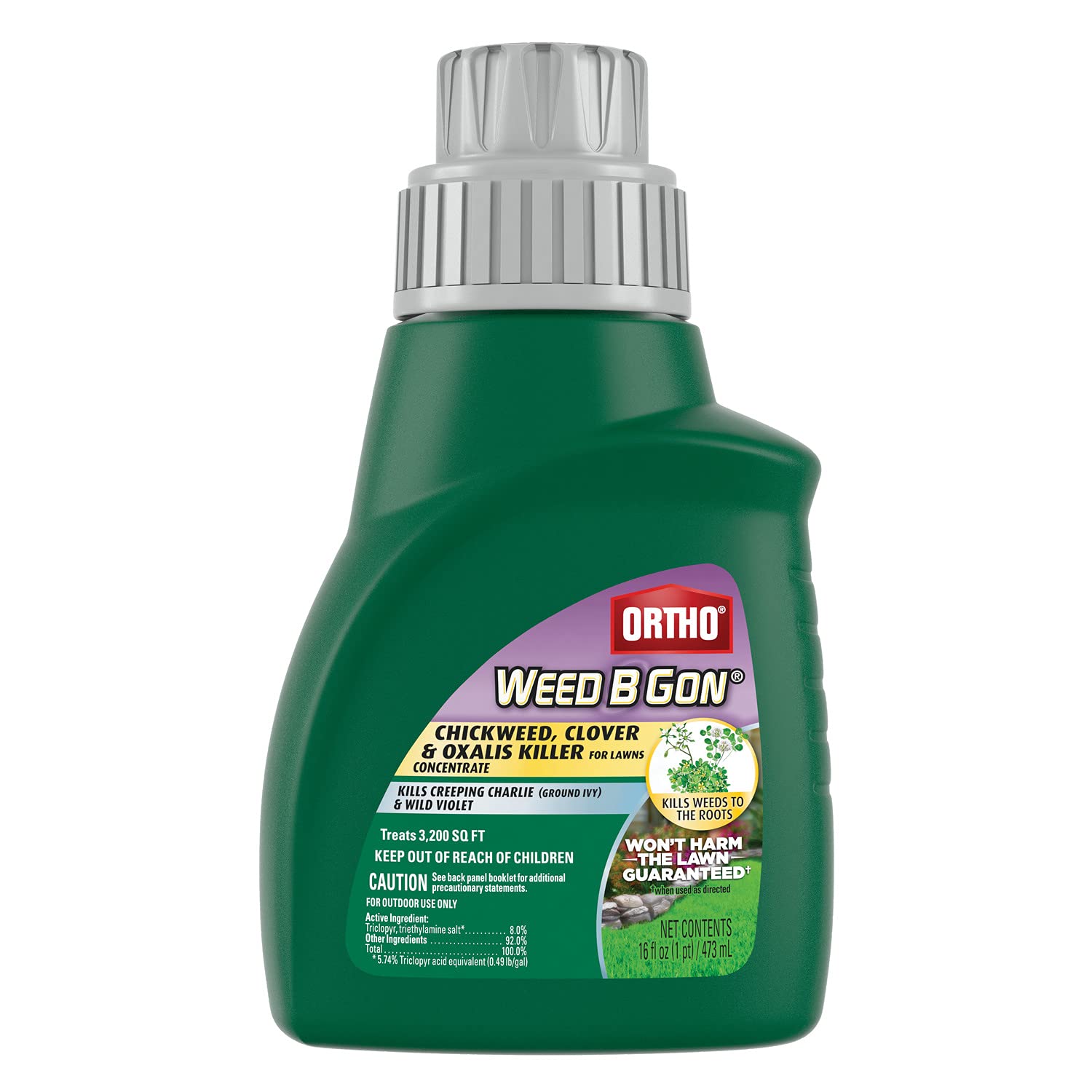
Ortho Weed B Gon Chickweed, Clover & Oxalis Killer for Lawns Concentrate, 16 fl. oz.
| Item Form | Concentrate, Liquid |
|---|---|
| Coverage | 3200 square_feet |
| Active Ingredients | Triclopyr, Triethylamine salt |
| Liquid Volume | 16 fluid ounces |
Ortho Weed B Gon Chickweed, Clover & Oxalis Killer is a liquid concentrate designed to treat lawn broadleaf weeds, including creeping Charlie. You mix the 16 fl. oz. bottle with water and apply with a tank sprayer or a compatible hose-end sprayer to wet the lawn surface; one bottle treats up to about 3,200 sq. ft. The formula contains triclopyr and is labeled to kill weeds to the root and become rainproof in six hours, which helps ensure effective control after a single properly timed application. It is intended for use on several common grass types when label directions are followed, and the product notes avoid mowing for one to two days after treatment and not applying above 90°F. Practical benefits are targeted control of persistent broadleaf weeds and compatibility with common sprayers, but you must follow safety guidance, avoid application in windy conditions to prevent drift, and keep people and pets off treated areas until dry. Also this is a concentrate, so you need to mix correctly and have a sprayer to use it effectively.
Best for: Buyers who prioritize reliable, proven weed control for persistent broadleaf weeds in turf and who are comfortable measuring and applying a concentrate with a sprayer.
Less Ideal for: Users who want a ready-to-spray product or who need a non-chemical approach; also not suited for people unwilling to follow safety and mixing instructions.
- Targets creeping Charlie and other tough broadleaf weeds down to the root
- Concentrate treats up to 3,200 sq. ft., reducing frequency of purchases
- Becomes rainproof in six hours, allowing faster window to resume outdoor activities
- Compatible with common tank and hose-end sprayers for flexible application
- Requires careful mixing and a sprayer; not ready-to-use
- Contains triclopyr which requires following protective measures to avoid drift and exposure
Verdict: A dependable concentrated herbicide that delivers targeted control of creeping Charlie and other tough broadleaf lawn weeds when mixed and applied correctly.
Syngenta Tenacity Turf Herbicide, 8 oz

| Unit Count | 8 Fluid Ounces |
|---|---|
| Item Form | Liquid |
| Coverage | 2000 ft^2 per 1sp of product |
| Active Ingredients | Mesotrione |
Tenacity Turf Herbicide is a concentrated mesotrione-based liquid designed for both pre-emergent and post-emergent control of common lawn weeds including crabgrass, clover, chickweed and dandelions. You apply it diluted according to label rates with a handheld or hose-end sprayer to target problem areas or broadcast across the lawn; when used as a pre-emergent it is taken up as weeds emerge and when applied post-emergent it acts systemically for selective control. The product covers a large area per bottle and the active ingredient provides residual control so you can expect longer suppression than a contact-only herbicide. Important practical points are that it is turf-selective so follow the label for grass species and mixing instructions to avoid turf injury, and results can take several days to appear. Also this is a concentrated chemical intended for careful, measured application rather than spot-use by people who prefer non-chemical methods.
Best for: Gardeners focused on strong, reliable crabgrass and broadleaf weed control who are comfortable using concentrated herbicides and following label directions for turf safety.
Less Ideal for: People seeking organic, mechanical, or spot-only solutions or those unwilling to follow detailed mixing and application instructions should consider other options.
- Systemic mesotrione active ingredient controls both pre- and post-emergent weeds
- Selective to turf when used per label, allowing treatment without killing desirable grass species
- Concentrated 8 oz liquid provides wide coverage per bottle
- Provides residual suppression, reducing frequency of repeat applications
- Requires careful mixing and adherence to label for turf safety
- Not a non-chemical or organic option for weed control
Verdict: Choose Tenacity when you want a concentrated, turf-selective herbicide that delivers pre- and post-emergent control of crabgrass and other common lawn weeds.
Choosing the Right Herbicide for Ground Ivy: Key Factors to Consider
Mode of Action and Symptom Timeline
Understanding a herbicide's mode of action matters because it determines how the ground ivy responds and how quickly results appear. Contact-active chemistries scorch foliage fast but often require complete coverage and repeat treatments to hit all stems. Systemic actives move inside the plant and can control roots and creeping stolons, producing slower visible symptoms but longer-term control.
Matching symptom timing to your tolerance for visible damage is practical. If you need rapid aesthetic improvement, a contact product will brown leaves quickly but may not stop regrowth. If you prefer fewer applications and deeper control of the mat, a systemic option is usually better even though the lawn may show signs of stress for several days to weeks after treatment.
Turfgrass Compatibility
Not all herbicides labeled for ground ivy are equally safe on every lawn type. Cool-season grasses such as Kentucky bluegrass, perennial ryegrass, and tall fescue tolerate some broadleaf herbicides better than warm-season grasses like bermudagrass, zoysia, or St. Augustine.
Read label directions about use rates, seasonal timing, and temperature limits. Applying at the wrong growth stage or during heat stress increases the risk of turf injury. When in doubt, use spot treatments and test a small area first, especially on sensitive turf varieties or newly established lawns.
Application Method and Coverage Needs
Ground ivy spreads low to the ground with dense mats and stems that root at nodes, so thorough wetting of foliage is essential for most treatments. Consider whether you will apply herbicide as a spot spray, wand-applied treatment, or broadcast application over larger areas.
Sprayer calibration, nozzle choice, and the use of a nonionic surfactant influence efficacy. Spot applications can reduce turf exposure and cost but require careful coverage to saturate all stems. Broadcast treatments are faster for widespread infestations but increase turf exposure and the need to respect label directions for watering and mowing intervals after application.
Residual Activity and Re-Treatment Planning
Some herbicides leave a residual effect in the soil or plant that suppresses new shoots for a period, while others only control existing foliage and allow regrowth from dormant buds. Residual control reduces the need for immediate follow-up but can limit overseeding or planting desirable species for a defined window.
Plan re-treatment timing based on label re-application intervals and on seasonal growth patterns of ground ivy. After treating, monitor the area for several weeks and be prepared to reapply at labeled intervals to catch regrowth before the mat re-establishes.
Environmental and User Safety Considerations
Herbicides vary in toxicity to non-target plants, pollinators, pets, and people. Check the label for restrictions about application near edible plants, flower beds, water features, and wildlife habitat. Some products require buffer zones or prohibit use when bees are foraging.
Also consider practical user-safety details such as required personal protective equipment, closed-system mixers, and re-entry or irrigation delays. Choosing a product with manageable safety requirements makes proper application more likely and reduces the chance of mistakes that harm the lawn or surrounding plants.
When to Treat Ground Ivy in the Season
Timing affects control success. Treat ground ivy during active growth in spring and fall when plants are pulling nutrients and translocation of systemic herbicides is most effective. Applications during dormancy or extreme heat reduce uptake and increase the chance of retreatment.
For cool-season lawns, early spring after green-up and mid-September to October are often the best windows. For warm-season lawns, target spring growth before summer dormancy and again in early autumn if the plant remains active.
- Avoid treating during drought or heat stress to reduce turf injury.
- Do not mow immediately before treatment; slightly taller foliage improves contact with herbicide.
- Check label directions for temperature and growth-stage guidance.
Spot Treatment Techniques That Minimize Turf Damage
Spot treatments let you target dense ground ivy mats while protecting the surrounding turf. Use a hand-held sprayer with a narrow nozzle or a paintbrush technique for small patches to control splatter.
Apply just enough solution to wet foliage without drenching soil. For contact products, multiple targeted passes that thoroughly cover stems work best. For systemic products, ensure full coverage of leaves and avoid overlapping into desirable plants.
- Test a small area first to observe turf response.
- Use cardboard or shields to protect adjacent ornamentals when spraying.
- Record application locations to avoid double-applying during follow-up.
Cultural Steps to Reduce Reinfestation
Herbicide treatment is most durable when combined with cultural practices that reduce ground ivy competitiveness. Improving lawn vigor through appropriate fertilization, correcting soil compaction, and increasing sunlight by pruning overhanging branches all help desirable grasses outcompete ground ivy.
Address thin or bare patches promptly with overseeding or spot-sodding after labeled waiting periods. Removing the conditions that favor ground ivy, such as persistent shade and moisture, reduces the need for repeated chemical treatments.
- Core aerate compacted areas to improve root growth.
- Match grass type to site conditions for long-term resilience.
- Maintain a mowing height that favors turf density over low-growing weeds.
Interpreting Label Language and Legal Use
Labels are legal documents that dictate rates, application methods, buffer zones, and restrictions. Follow label instructions precisely for safe and legal use. Pay attention to mixing instructions and any required surfactant recommendations to ensure both efficacy and turf safety.
If you encounter unclear label language, seek clarification from local extension services or regulatory agencies before applying. Labels also indicate whether treatments are allowed near water features or sensitive areas.
- Keep a copy of the label and application records for reference.
- Respect re-entry and irrigation intervals to avoid exposure and wash-off.
- Use only labeled application equipment to stay within legal requirements.
Post-Treatment Lawn Care
After treating ground ivy, adjust routine care to support turf recovery. Wait the label-specified interval before mowing, irrigating heavily, or overseeding. Light irrigation may be required only if the label allows it and to reduce stress on turfgrass.
Resume normal fertilization only after the lawn shows recovery and the label permits it. Over-fertilizing early can stress recovering turf and encourage other weeds.
- Record re-treatment windows and monitor treated patches weekly.
- Delay overseeding until the herbicide residual has dissipated per label guidance.
- Use post-treatment observations to choose a follow-up strategy: more cultural care, repeat spot treatment, or broadcast application if infestation persists.
How We Chose the Best Herbicide for Ground Ivy
We started by filtering herbicides that explicitly list ground ivy or similar creeping broadleaf weeds on their labeled species list and that are registered for use in residential lawns. Key evaluation criteria included mode of action and symptom timing to understand how quickly a product suppresses ground ivy; turf safety across cool-season and warm-season grasses, since injury risk varies by grass species; application flexibility, meaning whether a product can be used as a spot treatment, broadcast spray, or mixed with surfactants; residual activity and re-treatment interval, which affect how long the yard needs monitoring after application; and user safety and environmental restrictions, such as buffer zones, re-entry intervals, and restrictions near desirable plants. We excluded garden-strength weed killers not labeled for ground ivy or lawn use and any products with unclear or overly restrictive residential labeling. The resulting shortlist prioritizes reliability on ground ivy, clear application instructions, and minimized turf injury when used as directed.
FAQ
Will a single herbicide application eliminate ground ivy?
Often a single application reduces visible growth but does not permanently eliminate well-established ground ivy mats. Systemic products can take several weeks to kill roots and stolons, and follow-up treatments at label intervals are commonly needed to catch regrowth.
Is it safe to overseed a lawn after treating ground ivy?
That depends on the herbicide used and the product's residual activity. Many labels require waiting a specified number of days before overseeding. Follow the label timeline to avoid reduced seedling establishment or herbicide damage to new grass.
Can I use a nonselective lawn weed killer to get rid of ground ivy?
Nonselective products will kill desirable turf as well as ground ivy, so they are not a good option for established lawns. They can be used for patch clearing followed by replanting, but expect to reseed or resod treated areas afterward.
Are natural remedies effective against ground ivy?
Home remedies such as repeated boiling water or vinegar applications may suppress small patches but often fail to control deep-rooted mats long-term. These methods also risk harming surrounding turf and usually require frequent repeat treatments.
How soon can I let pets back on the lawn after application?
Re-entry intervals vary by product and label. Some allow pet access once the spray has dried, while others specify longer wait times. Check the label for exact instructions and keep pets off treated areas until the specified re-entry period has passed.
Final Verdict
Choosing the right herbicide for ground ivy is about balancing effective plant control with preserving the health of your turf. Prioritize products whose mode of action matches your patience for symptom development, and pick application methods that limit turf exposure when working on mixed or sensitive lawns. Combine chemical control with cultural fixes such as improved light, soil health, and overseeding to reduce reinfestation risk. With a plan for timing, safe application, and follow-up care, you can regain dense turf without repeated, indiscriminate treatments.
