

Note: This article contains affiliate links. If you click on these links and make a purchase, I may earn a small commission at no extra cost to you. This helps support my research and content. Read my full affiliate disclosure here.
If you manage turf, a large yard, or multiple properties, a commercial-grade fire ant control option can save time and reduce repeat treatments. The right commercial fire ant killer works differently than homeowner granular baits or casual sprays: it treats entire colonies, interrupts foraging, and is formulated for heavier infestations and broader application rates. This guide shortlists five top commercial options selected for use against large or persistent fire ant mounds. We explain the practical differences you will notice in the field, including application method, rate of colony decline, and worker safety considerations. Read on to understand the tradeoffs and the evaluation criteria used to make these picks.
Top Picks at a Glance
| Best Overall The best all-around choice for most situations | Spectracide Triazicide Large-Plot Insect Killer Concentrate, 1 Gallon |  |
| Best Quality Built to a higher standard if you want something more solid | Talstar XTRA Granular Insecticide, 25 lb |  |
| Best Value The sweet spot between price and what you get | Extinguish Plus Fire Ant Killer, 25 lb Bag |  |
| Highest Rated A top-rated pick with lots of positive feedback | Syngenta Demon Max Insecticide |  |
| Best Seller A high-volume bestseller chosen again and again | Atticus Talak 7.9% Bifenthrin Indoor/Outdoor Insecticide Concentrate, 32 oz |  |
Spectracide Triazicide Large-Plot Insect Killer Concentrate, 1 Gallon

| Item Form | Spray |
|---|---|
| Target Species | Insects |
| Liquid Volume | 1 gallons |
| Unit Count | 128 Fluid Ounces |
This Spectracide Triazicide concentrate is designed for treating large lawns and landscape areas; you mix it with water and apply with a tank sprayer to target surface and foliar pests. It kills ants plus a long list of insects on contact and claims residual protection for up to two months, which makes it useful for seasonal perimeter treatments and spot applications around trees, shrubs, flower beds and vegetable gardens when label directions allow. The concentrate format lets you cover very large areas from a single gallon and the label notes it is non‑staining when used correctly. Important practical points are that it must be diluted and applied with separate sprayer equipment, and standard PPE and label precautions are required to protect people, pets and desirable plants. It is best suited for homeowners managing broad pest problems across turf and planting beds who want a single, high‑coverage product rather than many targeted sprays.
Best for: Homeowners who want a single, high‑coverage insecticide to manage ants and mixed insect problems across lawns and landscapes rather than spot treatments.
Less Ideal for: People who prefer ready‑to‑use sprays, those without sprayer equipment, or gardeners who need insecticides labeled for continuous use on edible crops without restrictions.
- Broad spectrum that lists 180+ target pests including ants and common lawn insects
- Concentrate formula covers large areas from one gallon, reducing trips to buy more product
- Provides up to two months of residual control when applied according to the label
- Non-staining when used as directed, suitable for use around many landscape surfaces
- Requires a separate tank sprayer and mixing, which adds setup time and equipment
- Contains pesticides that require protective clothing and careful handling to avoid exposure
Verdict: A single 1‑gallon concentrate that delivers broad, long‑lasting control for ants and many other lawn pests over large properties.
Talstar XTRA Granular Insecticide, 25 lb

| Item Form | Granules |
|---|---|
| Target Species | Insects |
| Item Type Name | Talstar XTRA Granular Insecticide – 25 lbs. |
| Specification Met | EPA |
Talstar XTRA granular insecticide is designed for heavy-duty outdoor pest control, especially fast knockdown of fire ant colonies. Applied to lawns and landscaped areas, the granules deliver an active ingredient to target mounds and foraging ants while also suppressing other common lawn insects. The formulation claims to eliminate fire ant colonies within hours, making it useful for commercial or large-property applications where quick results matter. Practical benefits include straightforward broadcast or spot treatments over large areas and an EPA-recognized label for outdoor use around residential, institutional, and recreational sites. Limitations to consider are regulatory sale restrictions in several states and the need to follow label directions for application rates and timing to avoid non-target impacts. It is not a systemic soil amendment, so repeat or follow-up treatments may be needed for long-term suppression depending on infestation pressure and site conditions.
Best for: Buyers who need a fast, high-performance solution for fire ant infestations on large lawns, commercial properties, or athletic fields and who prioritize quick colony elimination.
Less Ideal for: Small-plot gardeners, organic growers, or users seeking long-term systemic control should consider alternatives better suited to those priorities.
- Rapid action against fire ant colonies as claimed by the manufacturer
- Granular form allows broadcast or targeted mound treatments over large areas
- Label specifies use across many outdoor settings including parks and athletic fields
- EPA-recognized product intended for professional-strength outdoor use
- Not approved for sale in several states, limiting availability and legal use areas
- Granules require correct application rate and technique to be effective and safe
Verdict: Choose Talstar XTRA when you need a proven, fast-acting granular product to quickly eliminate fire ant colonies across large outdoor areas.
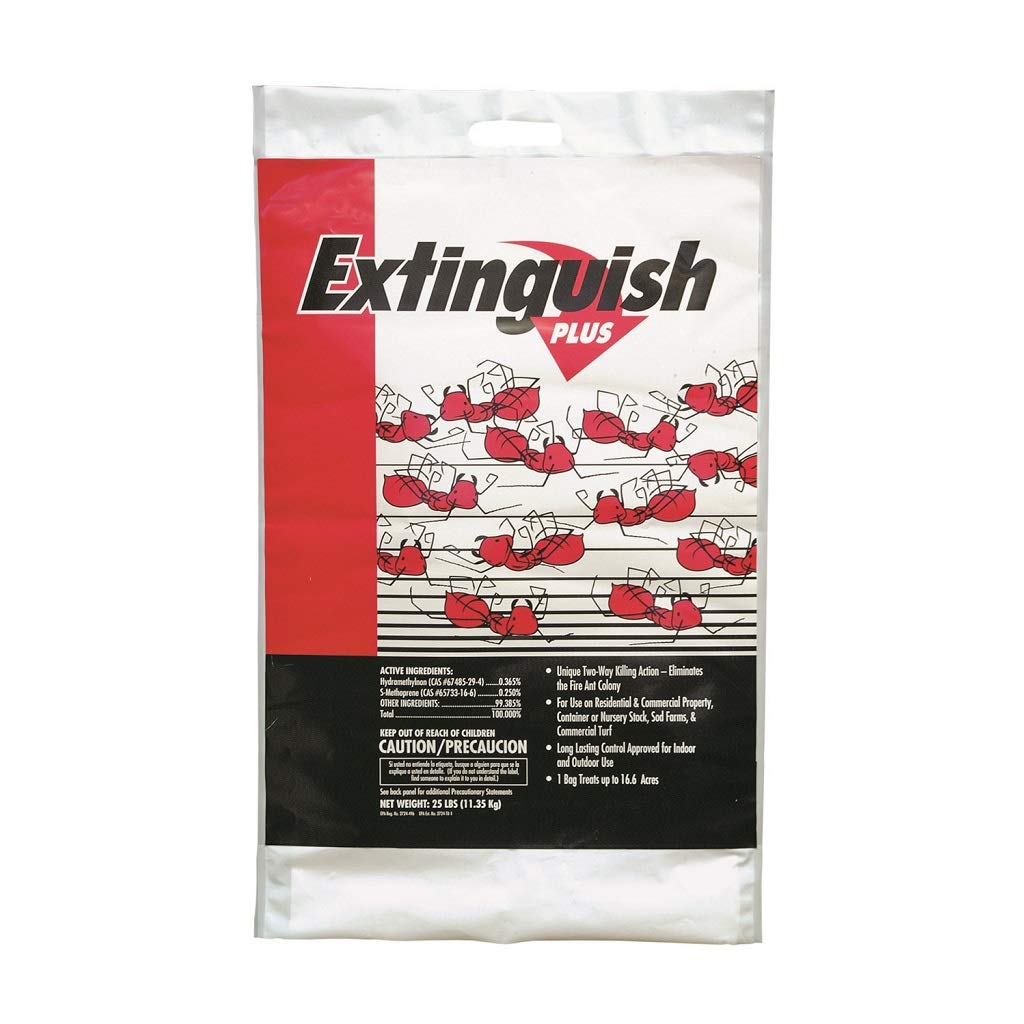
Extinguish Plus Fire Ant Killer, 25 lb Bag
| Item Form | Granules |
|---|---|
| Target Species | Insects |
| Active Ingredients | Hydramethylnon 0.365%, S‑Methoprene 0.250% |
Extinguish Plus is a granular fire ant bait formulated to attract and eliminate entire colonies by combining a fast-acting adulticide (hydramethylnon) with an insect growth regulator (s‑methoprene) that prevents queen reproduction. It is applied as a broadcast treatment or to individual mounds when ants are actively foraging, making it practical for treating large yards, pastures, or other broad outdoor spaces. Notable features include a dual-action formula that provides both quick knockdown and longer-term suppression and a 25 lb bag size that covers substantial area between applications. Practical benefits are straightforward application, suitability for use around grazing livestock when used as directed, and instructions that help time treatments for best uptake. Important limitations are that it should only be used outdoors, it is toxic to fish and aquatic environments, and effectiveness depends on correct timing when ants are feeding, which may require multiple observations and repeat applications for complete control across very large or heavily infested properties.
Best for: Buyers who need a broadly effective, easy-to-apply solution for controlling fire ants across large lawns, pastures, or acreage and who prioritize both immediate knockdown and longer-term suppression.
Less Ideal for: People needing a non-toxic or water-safe option or those managing small indoor infestations should consider different products or targeted treatments.
- Dual-action formula gives rapid worker kill plus long-term colony suppression
- Large 25 lb bag suitable for treating extensive areas or multiple applications
- Granular form can be used as broadcast treatment or applied to individual mounds
- Approved for use in areas with grazing cattle and horses when directions are followed
- Toxic to fish and aquatic environments so cannot be used near water
- Needs ants to be actively foraging for bait uptake which may require timing checks and repeat visits
Verdict: A large 25 lb granular bait that combines fast worker kill with an IGR for practical, long-lasting fire ant control over large outdoor areas.
Syngenta Demon Max Insecticide

| Item Form | Spray |
|---|---|
| Target Species | Insects |
| Liquid Volume | 1 fluid ounces |
Demon Max is a concentrated professional insecticide designed for long residual control of many pests common to commercial and large‑scale properties. It is applied as a spray and is intended for treating mounds, perimeter zones, turf and around structures to knock down ants, termites, cockroaches, fleas, ticks and dozens of other species listed on the label. Key features are its low water solubility, which reduces leaching, and a formulation that provides extended residual protection so reapplications are less frequent. In practice this makes it useful for commercial users who need dependable, long‑lasting suppression of subterranean and surface pests. The product is potent and targeted, but because it is a concentrated insecticide it requires careful handling, correct mixing and adherence to label directions and safety precautions. It is not a ready‑to‑use consumer spray and will be best used by trained staff or experienced applicators.
Best for: Property managers and commercial applicators who prioritize dependable, long‑lasting control of fire ants and multiple pest species and who can follow professional mixing and safety procedures.
Less Ideal for: Casual gardeners or homeowners looking for a consumer ready‑to‑spray product or anyone unwilling to follow professional safety and application instructions.
- Long residual activity that reduces frequency of reapplication
- Low water solubility to limit leaching into water supplies
- Broad label coverage including fire ants, subterranean termites and many turf and structural pests
- Formulated for professional/commercial use where reliability matters
- Concentrated formulation requires proper mixing, protective equipment and label compliance
- Not a ready‑to‑use product for casual home users
Verdict: Choose Demon Max when you need a professional, long‑residual insecticide that reliably controls fire ants and a wide range of pests on commercial sites.
Atticus Talak 7.9% Bifenthrin Indoor/Outdoor Insecticide Concentrate, 32 oz

| Active Ingredient | Bifenthrin |
|---|---|
| Formulation | Suspension Concentrate |
| Liquid Volume | 32 fluid ounces |
| Length of Control | Up to three months |
| Target Species | Insects |
Talak 7.9% is a liquid concentrate for treating lawns, landscaping, outdoor living areas and indoor perimeter spots like baseboards and cabinets. You dilute the concentrate with water to create a spray for barrier treatments, spot applications or lawn mixes; label rates explain how much to mix per gallon depending on the use. The product uses bifenthrin, a proven broad-spectrum active ingredient, and the manufacturer states it controls over 75 species and can give residual control for as long as three months. Its water-based formula dries clear, leaves no odor or visible residue, and is not phytotoxic on plants when used per label. Practical benefits include flexible indoor and outdoor use, clear drying, and a bottle designed for easier pouring. Important limitations are that solutions should be mixed only for same-day use, it is not registered for sale in a few states, and it is not approved for fogger application, so professional-style misting methods are not appropriate.
Best for: Buyers who want a single, reliable product to protect yards, patios and building perimeters from a wide range of common pests and prefer conservative, label-driven application practices.
Less Ideal for: People seeking ready-to-use sprays or fogger-compatible products or those in states where this formulation is not registered should look at alternatives.
- Broad-spectrum control listed for 75+ indoor and outdoor pest species
- Water-based formula that dries clear and leaves no odor or residue
- Flexible label directions for lawns, landscapes, hardscapes and indoor perimeter treatments
- Long residual activity up to three months when applied at recommended rates
- Mixed spray solutions cannot be stored and must be used the same day
- Not approved for fogger application and not available for sale in some states
Verdict: A versatile, water-based bifenthrin concentrate that delivers long-lasting, broad-spectrum outdoor (and perimeter indoor) control when used according to the label.
Choosing the Right Commercial Fire Ant Killer: Key Factors to Consider
Active Ingredient and Mode of Action
Different active ingredients work in distinct ways against fire ants. Some act as fast contact killers that quickly reduce visible worker numbers but may not stop queen reproduction unless the active ingredient penetrates the mound. Others are slow-acting baits designed to be carried into the nest by worker ants and fed to the queen and brood, producing colony collapse over days to weeks.
Knowing the mode of action matters because it influences timing and follow-up. Fast contact treatments give immediate relief from aggressive foragers but may require follow-up baiting for long-term control. Delayed baits take longer to show visible results but are often more effective at colony elimination. In commercial settings, combining methods in a planned schedule can balance immediate safety concerns with durable suppression.
Application Rate and Coverage
Commercial labels specify application rates per acre, per 1,000 square feet, or per mound. For large properties, products with efficient labeled coverage reduce labor and handling time. Broadcast baits and liquid concentrates often have different spreader or sprayer calibration needs, and understanding those rates helps you estimate material needs and reapplication frequency.
Coverage also impacts cost-efficiency and environmental exposure. Overapplication can increase non-target risk, while underapplication reduces efficacy and can encourage resistance. Choose a product whose labeled coverage fits your acreage and the equipment you use, and always calibrate spreaders or sprayers before a treatment.
Speed of Observed Control Vs Long-term Suppression
In commercial contexts you will often need both quick visible control and durable suppression. Speed of observed control is the decline in surface activity after treatment, which affects immediate comfort and liability. Long-term suppression refers to reduced colony re-establishment and lower mound counts over months.
These outcomes do not always correlate. A rapid knockdown product may leave the queen alive, allowing recovery, while a slow-acting bait could take weeks but produce longer suppression. Evaluate expected timelines on the label and plan follow-up inspections to confirm colony decline.
Worker Safety, PPE, and Application Practicalities
Commercial applications frequently involve larger volumes and repeated treatments, so applicator safety is a major consideration. Labels define required personal protective equipment, re-entry intervals, and handling precautions. Products with simpler PPE needs may speed operations but may not be appropriate for every situation.
Application practicality also includes packaging sizes, compatibility with common commercial spreaders or boom sprayers, and storage stability. Consider whether your crews have the mixing and equipment capacity to apply a liquid concentrate correctly or whether a granular or bait product better fits your workflow.
Environmental and Non-target Risk
Fire ant treatments can affect beneficial insects, pollinators, and aquatic life if misapplied or overused. Commercial labels provide guidance on buffer zones, watering before or after treatment, and restrictions near sensitive areas. Products vary in toxicity and persistence in soil and surface water.
Minimizing non-target impact requires following label instructions closely, choosing the right formulation for the site, and timing applications to avoid peak pollinator activity. For sites near water or desirable native insect habitat, select products with clearer mitigation instructions and lower runoff risk.
Reapplication Interval and Monitoring
No single application guarantees permanent control. Labels list reapplication intervals and conditions requiring retreatment. Effective commercial programs include scheduled monitoring of treated areas, recording mound counts, and adjusting strategy based on results.
Monitoring helps detect reinvasion from adjoining properties and identifies whether a different mode of action or sequential treatment approach is needed. Factor in labor for inspections and potential follow-up treatments when estimating program cost and scheduling.
When to Use Contact Treatments Versus Baits
Contact treatments provide immediate reduction of surface workers and are useful when people, pets, or equipment are at immediate risk. Use contact options for spot treatments around high-traffic areas, building perimeters, and active work zones where rapid knockdown reduces stings and interruptions.
Baits are more appropriate when your objective is colony elimination over time across large areas. They rely on worker foraging and brood feeding to move the active ingredient into the nest. For large properties, broadcast baiting can suppress population pressure and reduce the number of mounds requiring local control.
- Combine contact treatments for urgent control with baits for long-term suppression.
- Avoid applying contact drenches directly over broadcast bait placements.
- Timing affects bait acceptance; avoid baiting right after recent irrigation or heavy rain.
Calibrating Equipment for Commercial Applications
Proper calibration of spreaders and sprayers ensures labeled rates and even coverage. For granular baits, confirm the spreader setting on a test run over a measured distance, then weigh or collect output to verify application rate. For liquid concentrates, measure nozzle output and travel speed to calculate gallons per acre.
Calibration reduces waste, lowers non-target exposure risk, and helps predict material needs. Keep calibration logs and recheck settings when switching product formulations or when environmental conditions change.
- Test spreaders on a marked 1000 sq ft area to confirm rate.
- Check nozzle condition and pressure for liquid applications before each job.
- Record calibration numbers with each product batch for consistent application.
Timing Treatments Around Weather and Activity
Weather influences bait acceptance and contact treatment efficacy. Avoid baiting immediately before heavy rain or irrigation that will wash baits away or reduce worker pickup. Early morning or late afternoon can be better for bait uptake when foragers are active and temperatures are moderate.
Contact drenches and sprays may be more effective during warm periods when ants are active on the surface, but high temperatures can also increase volatility and non-target exposure. Check label instructions for weather-related guidance and recommended application windows.
- Plan baiting when rain is not forecast for at least 24 to 48 hours.
- Apply contact treatments when surface activity is visible for best strike rate.
- Avoid treatments during windy conditions that could disperse sprays.
Managing Non-targets and Sensitive Sites
When treating near pollinator beds, ornamental plantings, or water features, choose products and timing that reduce exposure. Many commercial labels provide buffer distances and restrictions for aquatic areas. Spot-treating mounds rather than broadcasting over sensitive zones often reduces collateral impact.
If nearby habitats host beneficial insects, schedule treatments for times of low pollinator activity and consider physical mound removal where feasible. Document mitigation steps to demonstrate due diligence when working on managed landscapes or client properties.
- Establish no-treatment buffers where labels require them.
- Inform clients or occupants about planned treatments and re-entry intervals.
- Use least-risk application methods in planted or irrigated beds.
Operational Planning for Large Properties
Commercial programs become efficient with preplanned routes, material staging, and crew briefings. Map high-priority zones such as play areas, equipment pads, and high-traffic corridors for first-pass contact treatments and schedule broadcast or perimeter baiting on a rotated timetable.
Keep inventory of consumables like bait, mixing water, PPE, and spare nozzle parts. Plan follow-up inspections at regular intervals post-treatment to evaluate efficacy and reduce the chance of reinfestation going unnoticed.
- Use maps to prioritize initial high-risk zones.
- Stage materials to minimize travel time between treatment sites.
- Schedule rechecks 10 to 30 days after baiting depending on label timelines.
How We Chose the Best Commercial Fire Ant Killer
We focused on product attributes that matter when treating large or persistent fire ant infestations. Key evaluation points included active ingredient efficacy against Solenopsis species, mode of action (immediate contact versus delayed bait uptake), labeled application rates for large-area treatments, and how reliably a product eliminates queen activity. We also considered formulation practicality: whether the product is a broadcast bait, mound drench, granular blend, or liquid concentrate and how that affects coverage and labor. Safety and environmental guidance were another filter. We prioritized products with clear handling and PPE requirements, low risk to non-target beneficials when used as directed, and transparent re-entry or irrigation restrictions. Ease of use in a commercial setting was factored in through packaging sizes, storage stability, and equipment compatibility. We excluded consumer-only formulations with low labeled application rates for large properties and products lacking clear commercial labels. The final selection balances rapid colony reduction, long-term suppression, worker safety, and operational practicality.
FAQ
How long until I see results after using a commercial bait?
Results vary by bait type and activity but you can often expect reduced surface activity within one to three weeks. Full colony collapse can take several weeks as bait moves through the nest; plan follow-up monitoring on the schedule recommended by the product label.
Can I use contact drenches and baits at the same time?
You can combine methods, but avoid applying contact drenches directly over baited areas because that can reduce bait uptake. Sequence treatments so baits have time to be gathered by foragers before spot drenching nearby mounds.
What precautions should applicators take when using commercial formulas?
Follow the label for required personal protective equipment and mixing instructions. Use gloves, eye protection, and respirators if specified, and ensure crews understand re-entry intervals. Proper storage and spill response plans are also important for commercial volumes.
How often should treated areas be inspected for reinfestation?
Inspect treated zones at least once within two to four weeks after treatment, and then periodically over the following months. Frequency depends on site risk, neighboring properties, and previous infestation levels.
Are there special considerations for treating turf versus landscaped beds?
Yes. Turf typically tolerates broadcast baiting better, while landscaped beds often need spot treatments to protect desirable plants and pollinators. In beds, use targeted mound applications or physically remove mounds if label options are limited.
Final Verdict
For large or persistent infestations, prioritize products and practices that balance immediate worker safety with strategies that eliminate the queen and brood. Evaluate active ingredient mode of action, labeled application rates, and practical handling needs before committing to a program. Plan treatments with careful calibration, weather awareness, and monitoring to confirm suppression. By matching application method to site conditions and scheduling follow-up inspections, you can achieve durable control while minimizing non-target impacts.
