

Note: This article contains affiliate links. If you click on these links and make a purchase, I may earn a small commission at no extra cost to you. This helps support my research and content. Read my full affiliate disclosure here.
If you manage fields, pastures, or large lawn acreage, the right tractor fertilizer spreader changes how evenly nutrients are applied and how quickly jobs finish. You need a machine that feeds a consistent rate, handles the material you use, and survives season after season in outdoor conditions. This guide covers the top shortlisted spreaders suitable for tractor mounting and larger-scale spreading tasks and explains the practical tradeoffs gardeners and land managers face. We evaluated ease of calibration, hopper capacity and build, spreading pattern consistency, and durability under real‑world load and terrain conditions. Read on for the features that matter and what to expect from the best options for large properties.
Top Picks at a Glance
| Best Overall The best all-around choice for most situations | Agri-Fab 185 lb Tow-Behind Broadcast Spreader (45-0547) |  |
| Best Quality Built to a higher standard if you want something more solid | CHAPIN 8400C Professional 100‑Pound Turf Broadcast Spreader |  |
| Best Value The sweet spot between price and what you get | Yard Commander 125 lb Tow-Behind Broadcast Spreader |  |
| Highest Rated A top-rated pick with lots of positive feedback | BEAUCOM C102 ATV/UTV 150 lb Broadcast Spreader with 12V Motor and Receiver Hitch Mount |  |
| Most Popular A crowd favorite that many people choose with confidence | Agri-Fab 130 lb Pull-Behind Broadcast Spreader (Model 45-0463) |  |
Agri-Fab 185 lb Tow-Behind Broadcast Spreader (45-0547)

| Weight capacity maximum | 185 pounds |
|---|---|
| Spread width | Up to 12 ft |
| Tire type | Pneumatic Tires |
| Material type | Metal, Polypropylene (PP) |
The Agri-Fab 185 lb tow-behind broadcast spreader is designed to handle larger lawn jobs without frequent refills. You hitch it to a riding mower or ATV, load seed, fertilizer, salt, sand or ice melt into the rustproof poly hopper, set the flow with the seat-accessible on/off rod, and tow across the lawn for up to 12 ft of broadcast coverage. Heat-treated steel gears and a poly spreader plate aim to give durable, consistent operation while 13 x 5 in pneumatic turf tires smooth towing over uneven ground. The large 185 lb capacity is useful for roughly one acre per fill, cutting the number of passes and time spent refilling. Expect some assembly out of the box and basic maintenance of the gearbox and tires for long life. The spread pattern is broad but broadcast spreaders are inherently less precise than drop-style units, so careful calibration is needed for even application of granular products. Overall it is a practical, heavy-duty option for routine lawn and property maintenance when you need to cover medium to large areas efficiently.
Best for: Buyers who need a robust, low-maintenance spreader to cover medium to large lawns quickly and prefer convenience features like seat-mounted flow control.
Less Ideal for: Not the best choice for small lawns or applications that require very precise, spot-by-spot granular placement or very lightweight, occasional use.
- Large 185 lb hopper reduces frequency of refills for up to about one acre of coverage
- On/off flow control reachable from the mower seat for convenient operation
- Rustproof polypropylene hopper and spreader plate resist corrosion for year-round use
- Heat-treated steel gears and pneumatic turf tires improve durability and smooth towing over uneven terrain
- Broadcast spread pattern is less precise than a drop spreader so calibration and overlap are required
- Some assembly required before first use
Verdict: Choose this Agri-Fab model when you want a heavy-duty tow-behind spreader that covers up to an acre per fill and simplifies larger lawn jobs with seat-mounted control.
CHAPIN 8400C Professional 100‑Pound Turf Broadcast Spreader

| Load Capacity | 100 pounds |
|---|---|
| Wheel Type | Rubber |
| Number of Wheels | 2 |
| Material Type | Polyethylene, Stainless Steel |
The CHAPIN 8400C is a workhorse broadcast spreader aimed at serious homeowners and pros who need consistent coverage across lawns or larger properties. It pushes like a traditional walk‑behind spreader and uses a 100‑pound poly hopper on a stainless steel frame, an enclosed gearbox and cast agitator to keep material flowing without frequent clogging. The adjustable rotary gate and steel linkage let you control application pattern and rate for fertilizers, seed, and weed control products, while the 14‑inch pneumatic tires provide stability on uneven turf and moderate slopes. Practical touches include a rain cover, hopper grate to stop clumping, molded grips and a T‑handle for easier pushing. The unit requires assembly and is not recommended for salt, sand, or lime powders, so it is best for granular lawn products. Size and 38‑pound weight make it substantial to maneuver in tight beds, but that robustness is exactly what delivers steady, professional spread performance over larger areas.
Best for: Buyers who prioritize reliable, even application and durability for frequent use across lawns, acreage, or professional jobs where uptime and consistent coverage matter.
Less Ideal for: If you only need an occasional small‑yard spreader or must regularly apply salt, sand, or fine lime powders, a lighter-duty or specialty spreader would be a better fit.
- Large 100‑pound hopper reduces refill frequency for big yards
- Stainless steel frame and enclosed gearbox improve durability and reduce weather exposure
- Adjustable rotary gate and directional control for accurate application with different granular products
- 14‑inch pneumatic tires provide traction and stability on uneven terrain
- Included rain cover and hopper grate help prevent clumping in damp conditions
- Not recommended for salt, sand, lime or powderized materials
- Relatively heavy and sizeable which can make storage and maneuvering in tight spaces harder
Verdict: Choose the CHAPIN 8400C when you need a durable, high‑capacity broadcast spreader that delivers consistent professional‑grade coverage across larger lawns and properties.
Yard Commander 125 lb Tow-Behind Broadcast Spreader

| Capacity | 125 lb |
|---|---|
| Spread radius | 10–12 ft |
| Tire type | 12-inch pneumatic tires |
| Hopper | Corrosion-resistant composite with cover |
| Gears | Cast aluminum |
The Yard Commander 125 lb tow-behind broadcast spreader is built to handle large lawns and heavier materials like fertilizer, seed, and ice melt. It mounts to tractors, riding mowers, ATVs, or UTVs via a universal hitch and uses premium cast aluminum gears to deliver a steady 10–12 foot spread radius. The corrosion-resistant composite hopper and included weather cover keep materials dry and prevent clumping during light precipitation. Large 12-inch pneumatic tires improve flotation and traction across uneven or soft turf so you can tow it over rough ground without frequent stoppages. Flow is controlled with a simple gate lever for dosing adjustments so you can tune application rate for different materials. Expect basic assembly and occasional maintenance on moving parts, and note capacity varies by material so very dense mixes may not reach the full 125 lb in practice. The unit is practical for large properties where tow-behind performance, corrosion resistance, and a wide spread pattern matter most.
Best for: Gardeners and property owners who prioritize performance and efficiency on large lawns and need a tow-behind spreader that handles varied terrain and heavier materials.
Less Ideal for: Small-lot homeowners who prefer a walk-behind unit or users who want a completely maintenance-free, plug-and-play spreader.
- Large 125 lb composite hopper resists corrosion and holds enough material to cover up to 25,000 sq ft in one fill
- Premium cast aluminum gear drive provides smoother, durable spreading and supports a 10–12 ft broadcast width
- Universal hitch fits most lawn tractors, riding mowers, ATVs, and UTVs for versatile tow-behind use
- 12-inch pneumatic tires improve flotation and traction on rough or soft terrain
- Included hopper cover reduces clumping and allows light-rain operation
- Requires assembly and periodic maintenance of moving parts
- Actual capacity and coverage depend on material density and may be less than rated with heavy mixes
Verdict: Choose this spreader if you need a durable, tow-behind broadcast unit that covers large lawns efficiently while handling rough terrain and damp conditions.
BEAUCOM C102 ATV/UTV 150 lb Broadcast Spreader with 12V Motor and Receiver Hitch Mount
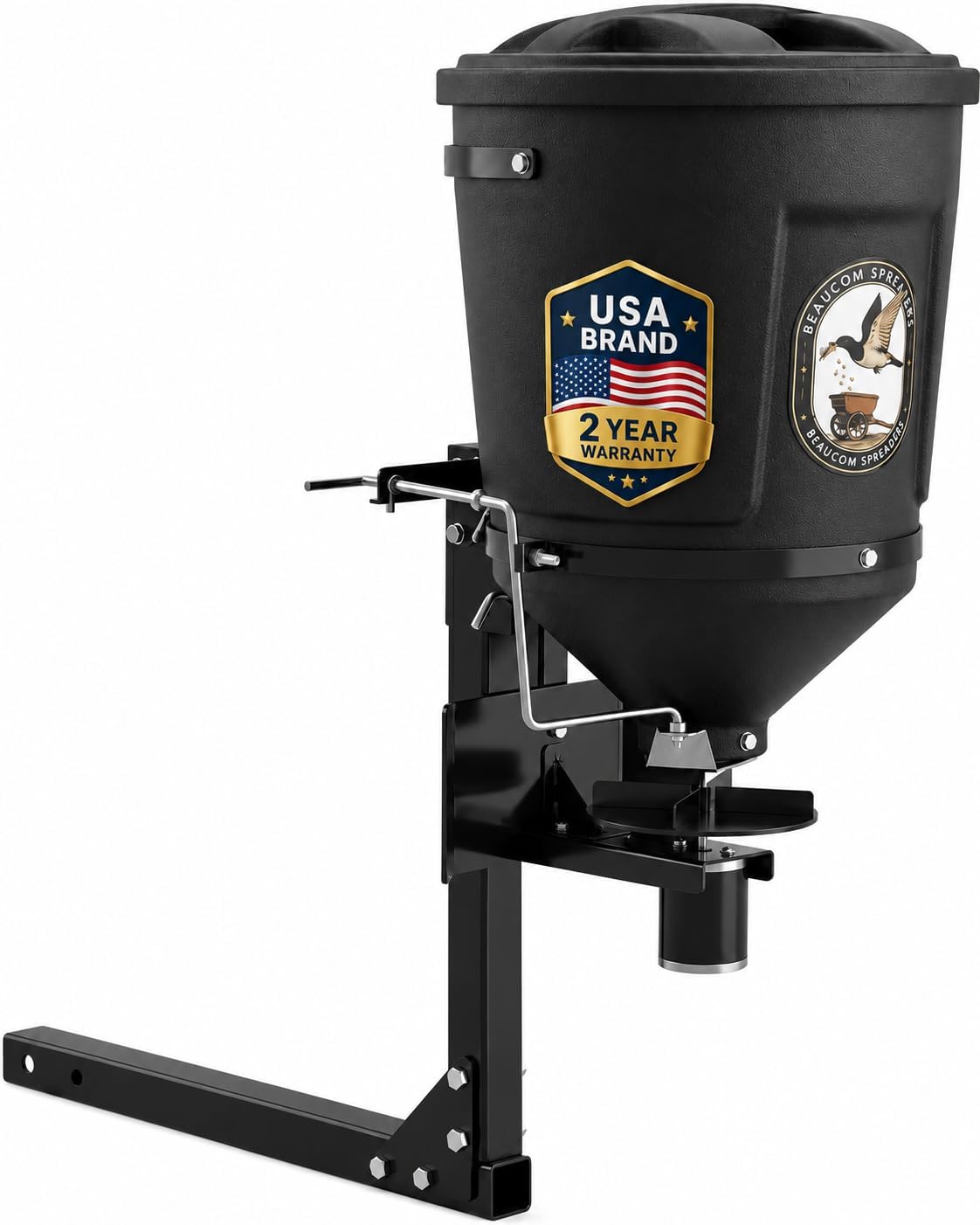
| Capacity | 150 LBS |
|---|---|
| Power | 12V motor |
| Hopper material | Polyethylene |
| Hitch fit | 2" receiver |
The BEAUCOM C102 is a receiver-mounted broadcast spreader built to handle medium-duty land management tasks from the seat of your UTV or ATV. It uses a sealed high-torque 12V motor to drive a precision spreader plate, so you get powered, clog-resistant distribution of seed, fertilizer, feed, or rock salt without hand-cranking. The roto-molded polyethylene hopper resists corrosion and cold-weather cracking, and the unit mounts to a standard 2-inch hitch with a quick-release bracket and an 8.5-foot wiring harness for tool-free installation. The adjustable flow gate lets you control application rate and the spread pattern claims up to about 30 feet, which speeds work across lawns, food plots, and driveways. Practical limitations to note are the single-year warranty and the need to confirm hitch compatibility and battery connection on some machines. For reliability-minded buyers this spreader emphasizes durable materials and a sealed motor, but it is a straightforward, utilitarian tool rather than a commercial-grade system.
Best for: Buyers who prioritize a dependable, low-maintenance spreader to operate from their ATV or UTV for routine seeding, fertilizing, and winter salting across acreage and driveways.
Less Ideal for: Operators needing a commercial-scale spreader for very large farms or those who require extended factory support and long-term warranties should consider heavier-duty alternatives.
- Sealed high-torque 12V motor provides powered, consistent spreading without manual effort
- Polyethylene hopper resists corrosion from fertilizer and rock salt and tolerates cold weather
- Quick-release 2" hitch mount and included 8.5 ft wiring harness enable tool-free installation
- Adjustable flow gate and precision plate allow controlled, clog-resistant distribution up to ~30 ft
- Covered by only a one-year warranty
- Designed for standard 2" receiver hitches so may need adapters for nonstandard mounts
Verdict: A rugged, seat-operated ATV/UTV spreader that delivers powered, corrosion-resistant spreading for year-round property maintenance.
Agri-Fab 130 lb Pull-Behind Broadcast Spreader (Model 45-0463)
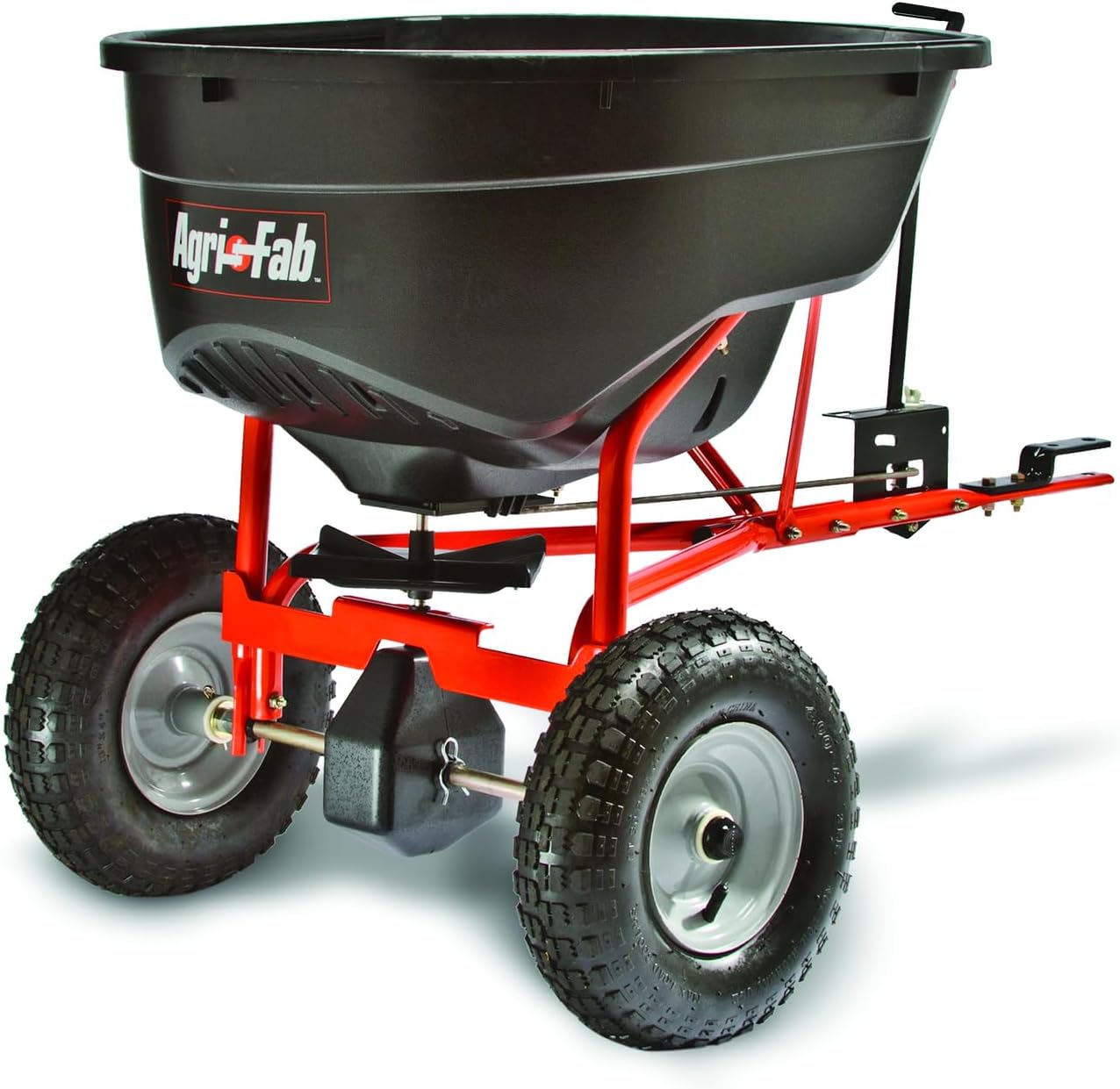
| Weight Capacity Maximum | 130 pounds |
|---|---|
| Spread Width | 10-12 ft |
| Tire Type | Pneumatic |
| Material Type | Alloy Steel, Polypropylene (PP), Rubber |
The Agri-Fab 130 lb pull-behind broadcast spreader is built for straightforward, dependable lawn care on larger yards. It mounts to most riding mowers with a universal hitch and holds up to 130 pounds, letting you cover roughly half an acre per fill to reduce interruptions. The wide 10 to 12 foot spread pattern and enclosed gear box promote more even dispersal and protect internal parts from dirt and moisture. A simple steel-rod flow control is reachable from the tractor seat so you can change application rates without stopping. The construction combines a poly hopper with alloy steel frame tubing and pneumatic tires for durability and smoother towing over uneven ground. Expect easy seasonal use for grass seed, fertilizer, granular lawn treatments, and salt. The main limitations are that it is a basic broadcast design, so very precise banding or ultra-fine calibration for specialty seed mixes may require additional passes or a different spreader type, and some assembly is required before first use.
Best for: Homeowners or property managers who want a reliable, no-nonsense tow-behind spreader to cover medium to large lawns efficiently and with minimal fuss.
Less Ideal for: Gardeners who need highly precise application patterns or small-plot users who prefer a handheld or walk-behind drop spreader for tight spaces.
- Large 130 lb hopper covers up to about 25,000 sq ft per fill to reduce refills on bigger lawns
- Universal hitch fits most riding mowers and lawn tractors for quick hookup
- Wide 10–12 ft spread width delivers even coverage with fewer passes
- Enclosed gear housing and steel frame improve durability and protect moving parts
- Seat-accessible steel-rod flow control lets you change settings without dismounting
- Broadcast design is less suited to precision banding or very narrow applications
- Requires assembly before first use
Verdict: A durable, easy-to-use tow-behind spreader that reliably covers larger lawns with fewer refills and minimal operator adjustments.
Choosing the Right Tractor Fertilizer Spreader: Key Factors to Consider
Spread Consistency and Pattern
Spread pattern consistency determines how uniformly nutrients reach all parts of a field. Uneven application creates patchy growth and may cause overapplication in some areas and underapplication in others. Look at how the discharge mechanism distributes pellets or granules across the swath and whether the spreader offers adjustable deflectors or dual-distribution discs for wider or narrower patterns.
Weather and forward speed also influence consistency. A unit that maintains the same drop rate across a range of tractor speeds and that allows straightforward calibration will produce more predictable results during actual field work.
Hopper Capacity and Construction
Hopper size affects how often you need to refill during a job and whether the spreader matches the scale of your acreage. Larger hoppers reduce downtime but add weight and require stronger mounting points and compatible tractor lift capacity. Consider the balance between capacity and the tractor's rated rear axle and hitch limits.
Construction materials matter for durability. Thick polyethylene or powder-coated steel resists abrasion from fertilizer granules. Look for reinforced hopper shapes that avoid bridging and allow consistent flow to the metering system.
Calibration and Metering Mechanisms
Accurate metering is essential to apply the correct nutrient rate. Simple, clearly marked settings and graduated rate charts make it easier to match spread output to product bag directions and field recommendations. Mechanical gates, variable-speed augers, or adjustable orifice plates each behave differently with varying particle sizes.
Ease of access to calibration controls reduces the chance of user error in the field. A spreader that comes with a clear calibration method or a straightforward procedure for measuring application rate will save time and ensure more accurate nutrient delivery.
Mounting, Hitch Type, and Stability
How the spreader mounts to your tractor affects safety and handling. Three-point hitch compatibility, PTO-driven units, or pull-type frames each require different tractor features and affect ground clearance and maneuverability. Ensure your tractor's hitch category and lift capacity match the spreader's requirements.
Stability while operating on slopes or uneven terrain is also critical. A well-designed frame and hitch geometry keep the hopper level and the distribution consistent when crossing small gullies or headlands.
Corrosion Resistance and Maintenance
Fertilizer is often corrosive and abrasive. Materials and finishes that resist rust and wear extend service life and reduce downtime. Stainless fasteners, sacrificial anodes in contact areas, and UV-resistant plastics slow degradation when equipment is stored outdoors.
Maintenance considerations include how easily the hopper and metering area can be rinsed and dried, how accessible wear parts are for replacement, and whether common parts like bearings and seals use standard sizes. A model that is easy to clean will minimize cross-contamination between different product types.
Spread Width and Application Speed
Spread width determines how quickly you can treat an area. Wider spread patterns cover more ground but may require finer calibration to avoid edge overlap and striping. Consider the typical tractor forward speed you operate at and choose a spreader whose effective swath performs well at that speed.
Also account for wind conditions in your location. Wider swaths are more susceptible to drift in breezy conditions, and you may need to reduce speed or narrow the pattern to maintain accuracy.
Preparing Fertilizer and Loading Tips
Load fertilizer into the hopper on a level surface to avoid uneven flow and spillage. If you are dealing with multiple product types, clean and dry the hopper between loads to prevent chemical interactions and clogging.
Measure and pre-weigh a sample load when calibrating for the first time. Keep a small, clean scoop and a marked container to replicate the same loading technique each time you set rates.
- Avoid overfilling past the maximum fill line to preserve hitch balance.
- Rake or break up clumps in bulk bags before loading to minimize bridging.
- Consider filling from a raised platform or using a funnel to reduce spillage.
Field Calibration Routine
Establish a simple calibration routine you repeat whenever you change product type or application rate. Drive a measured pass at the intended working speed, collect the discharged fertilizer for a fixed distance or time, and weigh or measure the sample to calculate the actual application rate.
Record settings and conditions such as tractor speed, gate position, particle size, and weather. A small notebook or phone photo of the calibrated setting saves time on repeat jobs.
- Calibrate with the same hopper fill level you will use in the field.
- Repeat calibration on slopes similar to your work area if terrain varies.
Common Mounting and Safety Checks
Before each use, inspect hitch pins, mounting bolts, and any safety chains. Make sure the spreader is level and that lift arms or pull bars are secure. Check for worn or bent components that could change discharge geometry.
Verify that guards around moving parts are intact and that any PTO driveline has appropriate shielding. When working near people or animals, shut off discharge and keep bystanders at a safe distance while operating.
- Confirm PTO shields are in place and that driveline angles are within spec.
- Tighten loose fasteners and replace missing safety hardware before starting work.
Managing Different Fertilizer Types
Not all fertilizers behave the same. Coated or unusually shaped granules may meter differently than standard pellets. Fine powders can bridge or flow too quickly. Adjust metering and test the spread pattern for each new material.
When switching from lime or seed to fertilizer, perform a complete clean of the metering assembly to prevent abrasion or contamination. Some materials settle and harden if exposed to moisture, so store products under cover when possible.
- Use flow agents or agitators if recommended for sticky or damp materials.
- Check product particle size on the bag and consult calibration charts for closest match.
Seasonal Storage and Off-Season Care
Empty and thoroughly clean the hopper and metering parts before long-term storage. Dry all components to prevent corrosion and apply light protective coatings to exposed metal if storage is damp.
Inspect bearings, seals, and rubber parts for wear and replace them before the next season. Store indoors or under a breathable cover to reduce UV damage and chemical corrosion.
- Remove and lubricate moving parts per the maintenance schedule.
- Store the unit on blocks to relieve tire or hitch load during downtime.
How We Chose the Best Tractor Fertilizer Spreader
We selected spreaders that perform reliably across the everyday demands of acreage fertilizer work. Primary evaluation criteria included spread consistency and calibration accuracy because even distribution is the main goal of a fertilizer spreader. We also weighed hopper capacity and load handling to match tractors and the scale of the job. Durability and corrosion resistance were judged for machines that sit outside and deal with abrasive and corrosive materials. Mounting and hitch compatibility were inspected to ensure the units attach securely to common tractor setups. Finally we assessed ease of maintenance and access to settings, since adjustments and cleaning happen frequently. Excluded from the list were compact broadcasters and handheld models that are not suitable for tractor mounting, and any equipment intended purely for seed-only applications without fertilizer metering options. We focused on units designed to handle common fertilizer types, pellet sizes, and simple calibration routines so the final picks are practical for working gardens, farms, and large turf areas.
FAQ
What tractor hitch type do I need for a tractor fertilizer spreader?
It depends on the spreader design. Many large spreaders use a three-point hitch while others are pull-type frames. Match the spreader's hitch category and lift capacity to your tractor and confirm needed PTO connections if applicable.
How often should I calibrate my spreader?
Calibrate whenever you change fertilizer type, application rate, or working speed. It is also wise to recheck calibration after any maintenance or if you notice uneven growth patterns.
Can I use the same spreader for lime and granular fertilizer?
Often yes, but lime is heavier and more abrasive, which affects wear and may require different metering settings. Clean the hopper and metering area between materials to avoid contamination and check that the spreader's materials are compatible with lime.
How does wind affect spreading accuracy?
Wind can cause drift and irregular pattern edges, especially with wider swaths. Reduce driving speed or narrow the spread pattern in breezy conditions to maintain accuracy, and perform calibration checks under typical local wind conditions.
What maintenance prevents clogging and corrosion?
Rinse and dry metering areas after use, remove product residues, and lubricate moving parts. Replace corroded fasteners and inspect seals regularly. Storing the unit under cover reduces exposure to moisture and salts that accelerate corrosion.
Final Verdict
Choosing the right tractor fertilizer spreader comes down to matching spread pattern and hopper capacity to your acreage and tractor capabilities. Prioritize consistent metering and a corrosion-resistant build if you apply abrasive or high-volume materials. Think about ease of calibration and how the unit mounts to your tractor to avoid surprises during operation. Balance the tradeoffs between larger capacity and added load on your tractor, and keep a regular calibration and maintenance routine to maintain even coverage year after year. With those priorities in mind you can confidently select a spreader that reduces rework and gives more uniform results across your fields.
