

Note: This article contains affiliate links. If you click on these links and make a purchase, I may earn a small commission at no extra cost to you. This helps support my research and content. Read my full affiliate disclosure here.
If you manage acres, pastures, or large vegetable plots, the right fertilizer spreader for tractor changes how consistently nutrients reach your soil. A machine with the right tank volume, hitch configuration, and spreading mechanism saves passes, reduces overlap, and keeps application rates steady across changing terrain. This guide shortlists six top-rated options suited to tractor mounting, and it explains the practical tradeoffs that matter to gardeners and small-acreage farmers. We evaluate capacity, spread accuracy, build durability, hitch and PTO compatibility, and maintenance needs to help you pick the right implement for your property and workload.
Top Picks at a Glance
| Best Overall The best all-around choice for most situations | CHAPIN TurfPro 8622B 2.2 cu ft Tow-Behind Spreader with Auto-Stop |  |
| Best Quality Built to a higher standard if you want something more solid | Yard Commander 125 lb Tow-Behind Broadcast Spreader |  |
| Best Value The sweet spot between price and what you get | GarveeLife Tow-Behind Broadcast Spreader, 130 lb Capacity |  |
| Best Budget The cheapest option that still gets the job done reliably | MAXSA Tow-Behind Broadcast Spreader, 110 lb Capacity |  |
| Most Popular A crowd favorite that many people choose with confidence | Agri-Fab 130 lb Pull-Behind Broadcast Spreader (Model 45-0463) |  |
| Best Seller A high-volume bestseller chosen again and again | AugFir Tow-Behind Broadcast Spreader — 130 lb Capacity, 12 ft Spread Width |  |
CHAPIN TurfPro 8622B 2.2 cu ft Tow-Behind Spreader with Auto-Stop

| Hopper capacity | 2.2 cubic feet |
|---|---|
| Max operating speed | 3.5 mph |
| Tire type | 14-inch wide-tread pneumatic |
| Frame | Powder-coated steel |
The CHAPIN TurfPro 8622B is a tow-behind spreader intended for medium-to-large lawns, acreage, and professional turf use. It connects to a standard hitch on compatible ATVs, UTVs, or lawn tractors and uses a 2.2 cubic foot poly hopper feeding dual impellers to deliver even coverage. The standout feature is its auto-stop system that halts material flow when the vehicle stops, which reduces piling and waste at turnarounds. Eleven incremental gate settings and a spiked auger let you fine-tune flow for different granular fertilizers and seed, while the powder-coated steel frame, enclosed gearbox, and pneumatic wide-tread tires make it durable across uneven terrain. It is built to be operated at speeds up to 3.5 mph for consistent spread patterns. Limitations include incompatibility with zero-turn mowers and with abrasive or heavy materials such as sand, lime mixes, or rock salt, and the unit requires a compatible hitch and towing vehicle to be useful. For routine fertilizer and seed work across acres, it balances capacity and control well.
Best for: Buyers who need a durable, tow-behind spreader for treating medium to large properties with fertilizer or seed and who value controlled, low-waste application over very compact or ZTR-mounted solutions.
Less Ideal for: People who only use zero-turn mowers, want a push spreader for small lawns, or need to apply heavy abrasive materials should consider other options.
- Auto-stop dual impeller stops material flow when you stop to prevent overapplication at turnarounds
- 2.2 cu ft poly hopper reduces refill frequency for larger lawns and acreage
- Eleven gate settings plus spiked auger let you adjust flow for different granular materials
- Durable build with powder-coated steel frame, enclosed gearbox, and wide-tread pneumatic tires for rough terrain
- Not recommended for sand, lime mixes, rock salt, or similarly abrasive/heavy materials
- Requires a compatible ATV, UTV, or lawn tractor hitch and is not suited to zero-turn mowers
Verdict: Choose the TurfPro 8622B when you need a tow-behind spreader that combines a sizable hopper with auto-stop flow control for accurate, low-waste fertilizer and seed application across acreage.
Yard Commander 125 lb Tow-Behind Broadcast Spreader

| Capacity | 125 lb |
|---|---|
| Spread radius | 10–12 ft |
| Tire type | 12-inch pneumatic tires |
| Hopper | Corrosion-resistant composite with cover |
| Gears | Cast aluminum |
The Yard Commander 125 lb tow-behind broadcast spreader is built to handle large lawns and heavier materials like fertilizer, seed, and ice melt. It mounts to tractors, riding mowers, ATVs, or UTVs via a universal hitch and uses premium cast aluminum gears to deliver a steady 10–12 foot spread radius. The corrosion-resistant composite hopper and included weather cover keep materials dry and prevent clumping during light precipitation. Large 12-inch pneumatic tires improve flotation and traction across uneven or soft turf so you can tow it over rough ground without frequent stoppages. Flow is controlled with a simple gate lever for dosing adjustments so you can tune application rate for different materials. Expect basic assembly and occasional maintenance on moving parts, and note capacity varies by material so very dense mixes may not reach the full 125 lb in practice. The unit is practical for large properties where tow-behind performance, corrosion resistance, and a wide spread pattern matter most.
Best for: Gardeners and property owners who prioritize performance and efficiency on large lawns and need a tow-behind spreader that handles varied terrain and heavier materials.
Less Ideal for: Small-lot homeowners who prefer a walk-behind unit or users who want a completely maintenance-free, plug-and-play spreader.
- Large 125 lb composite hopper resists corrosion and holds enough material to cover up to 25,000 sq ft in one fill
- Premium cast aluminum gear drive provides smoother, durable spreading and supports a 10–12 ft broadcast width
- Universal hitch fits most lawn tractors, riding mowers, ATVs, and UTVs for versatile tow-behind use
- 12-inch pneumatic tires improve flotation and traction on rough or soft terrain
- Included hopper cover reduces clumping and allows light-rain operation
- Requires assembly and periodic maintenance of moving parts
- Actual capacity and coverage depend on material density and may be less than rated with heavy mixes
Verdict: Choose this spreader if you need a durable, tow-behind broadcast unit that covers large lawns efficiently while handling rough terrain and damp conditions.
GarveeLife Tow-Behind Broadcast Spreader, 130 lb Capacity

| Capacity | 130 lbs |
|---|---|
| Tire type | 10" pneumatic tires |
| Frame | Powder-coated steel |
The GarveeLife tow-behind broadcast spreader is a straightforward, work-focused machine for covering medium to large lawns and driveways. It mounts to a lawn tractor, ATV, or UTV via a durable tow bar and uses a powder-coated steel frame and rust-resistant poly hopper to resist corrosion in seasonal outdoor use. The adjustable flow handle and spreader plate let you control material output and achieve even coverage up to about 10 feet wide, making it usable for seed, fertilizer, ice melt, and sand. Ten-inch pneumatic tires give good traction and a smoother roll across uneven turf or gravel. Practical additions like a waterproof cover and sieve help keep materials dry and prevent clumping. Downsides are that it is a simple mechanical spreader without powered agitation, so very wet or compacted material may still clog, and assembly or hitching can take a little time for first-time users. For routine lawn maintenance and winter deicing this spreader performs the basic tasks reliably.
Best for: Buyers who want a practical, no-frills tow-behind spreader to cover medium to large lawns and driveways efficiently and reduce repeated trips to refill.
Less Ideal for: People who need a motorized or high-capacity commercial spreader for continuous heavy use or those who only have a small hand-push spreader need.
- Rust-resistant poly hopper and powder-coated steel frame resist corrosion for seasonal outdoor use
- Adjustable flow control and spreader plate deliver even distribution up to about 10 feet wide
- 10" pneumatic tires provide stable rolling and traction over uneven turf and gravel
- Large 130 lb capacity hopper reduces refill trips for larger yards
- No powered agitation system, so very wet or compacted materials can clog
- Requires hitching and some initial assembly which may be awkward for a single user
Verdict: A durable, easy-to-use tow-behind spreader that handles seed, fertilizer, and ice melt for homeowners who want efficient coverage without fancy electronics.
MAXSA Tow-Behind Broadcast Spreader, 110 lb Capacity

| Capacity | 110 lbs |
|---|---|
| Tire type | 10-inch pneumatic |
| Frame | Powder-coated steel |
| Hopper | Rust-resistant poly |
This MAXSA tow-behind spreader is a simple, work-focused unit for treating large yards from a tractor, ATV, or UTV. The 110 pound poly hopper and powder-coated steel frame give weather resistance for seasonal use, and the included waterproof cover helps keep materials dry while loading. Large 10" pneumatic tires smooth towing across lawns, gravel, and uneven ground so you can cover more area without constant stopping. Flow is controlled with an adjustable handle that changes output and spread width up to about 10 feet, which helps reduce waste and fill in bare spots more evenly than hand spreading. Setup is straightforward with a long tow bar and quick-hitch compatibility. Expect a basic, utilitarian product rather than precision commercial equipment: there is no electronic metering or advanced calibration and the unit relies on manual adjustments and vehicle speed for spread consistency. For routine lawn fertilizing, seeding, or winter salt spreading this model is a practical, lower-cost option for tractor owners who need a durable, easy-to-use tow spreader.
Best for: Owners of lawn tractors, ATVs, or UTVs who want a rugged, no-frills spreader to cover large lawns and driveways efficiently on a budget.
Less Ideal for: Users needing laboratory-level accuracy or small-plot gardeners who require a compact hand-held spreader for tight spaces.
- 110 lb poly hopper resists rust and protects materials from moisture
- Powder-coated steel frame offers all-weather durability
- 10-inch pneumatic tires provide smooth towing over uneven terrain
- Adjustable flow control and up to 10 ft spread width for broader coverage
- No electronic or precision calibration for exact application rates
- Relies on vehicle speed and manual adjustment for consistency
Verdict: A durable, budget-friendly tow-behind spreader that lets tractor owners quickly cover large areas with seed, fertilizer, or salt without complex setup.
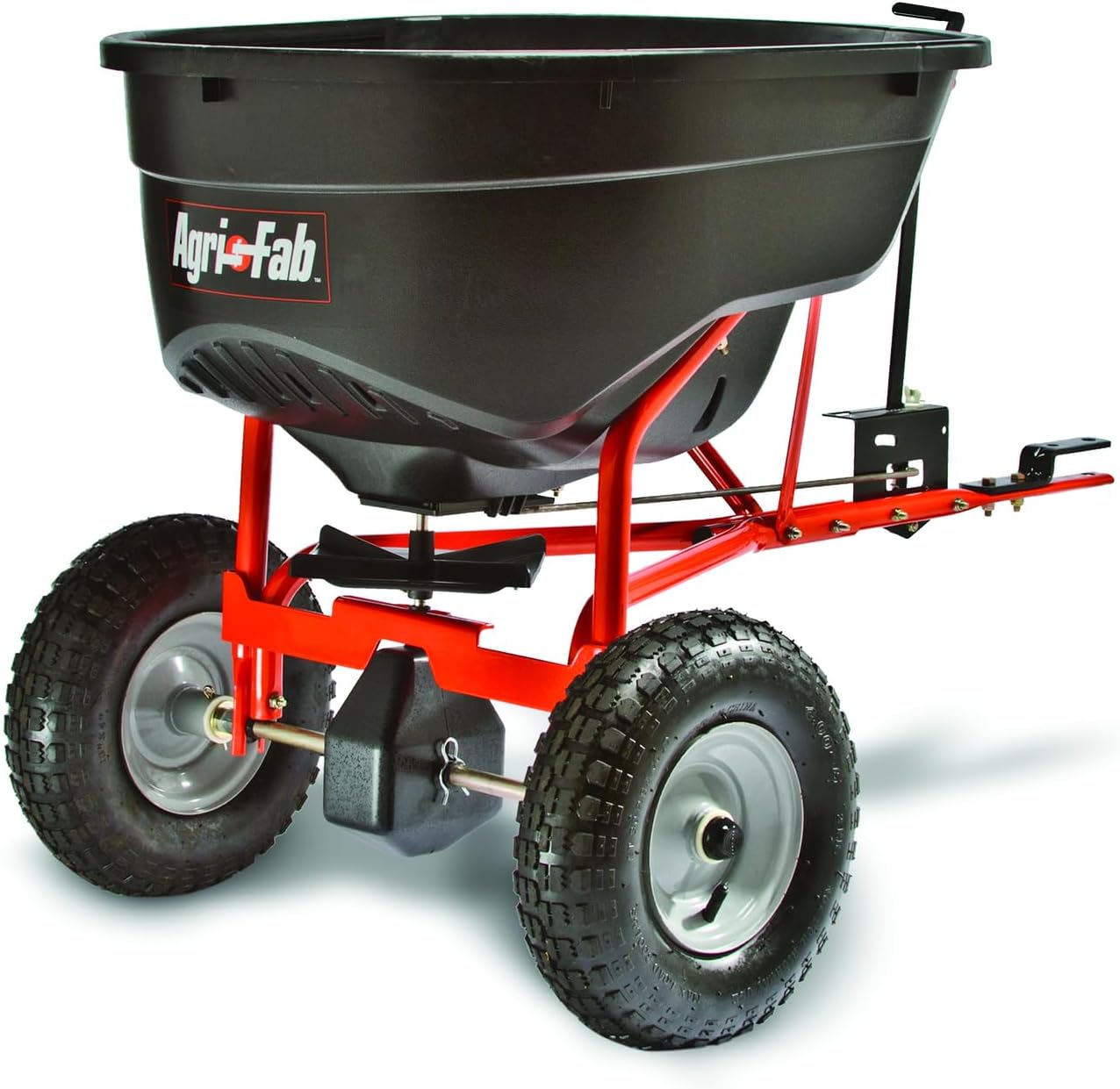
Agri-Fab 130 lb Pull-Behind Broadcast Spreader (Model 45-0463)
| Weight Capacity Maximum | 130 pounds |
|---|---|
| Spread Width | 10-12 ft |
| Tire Type | Pneumatic |
| Material Type | Alloy Steel, Polypropylene (PP), Rubber |
The Agri-Fab 130 lb pull-behind broadcast spreader is built for straightforward, dependable lawn care on larger yards. It mounts to most riding mowers with a universal hitch and holds up to 130 pounds, letting you cover roughly half an acre per fill to reduce interruptions. The wide 10 to 12 foot spread pattern and enclosed gear box promote more even dispersal and protect internal parts from dirt and moisture. A simple steel-rod flow control is reachable from the tractor seat so you can change application rates without stopping. The construction combines a poly hopper with alloy steel frame tubing and pneumatic tires for durability and smoother towing over uneven ground. Expect easy seasonal use for grass seed, fertilizer, granular lawn treatments, and salt. The main limitations are that it is a basic broadcast design, so very precise banding or ultra-fine calibration for specialty seed mixes may require additional passes or a different spreader type, and some assembly is required before first use.
Best for: Homeowners or property managers who want a reliable, no-nonsense tow-behind spreader to cover medium to large lawns efficiently and with minimal fuss.
Less Ideal for: Gardeners who need highly precise application patterns or small-plot users who prefer a handheld or walk-behind drop spreader for tight spaces.
- Large 130 lb hopper covers up to about 25,000 sq ft per fill to reduce refills on bigger lawns
- Universal hitch fits most riding mowers and lawn tractors for quick hookup
- Wide 10–12 ft spread width delivers even coverage with fewer passes
- Enclosed gear housing and steel frame improve durability and protect moving parts
- Seat-accessible steel-rod flow control lets you change settings without dismounting
- Broadcast design is less suited to precision banding or very narrow applications
- Requires assembly before first use
Verdict: A durable, easy-to-use tow-behind spreader that reliably covers larger lawns with fewer refills and minimal operator adjustments.
AugFir Tow-Behind Broadcast Spreader — 130 lb Capacity, 12 ft Spread Width

| Hopper capacity | 130 lb |
|---|---|
| Spread width | Up to 12 ft |
| Tire type | 12.5 in pneumatic |
| Frame | Powder-coated steel |
This AugFir tow-behind broadcast spreader is built for covering large lawns quickly without constant refills. It mounts to most riding mowers, tractors, ATVs and UTVs via a universal hitch and includes an extender and handle rod so you can open the hopper from the seat. The trapezoidal 130 lb hopper and five-position flow control give precise, even distribution for seed, fertilizer, salt or ice melt across up to a 12 foot swath, which reduces passes and saves time on bigger properties. Rugged powder-coated steel construction, a gearbox and 12.5 inch pneumatic tires make it suitable on grass, gravel and light snow. Assembly is supported by step-by-step instructions and a video. Expect a bit of setup and the need to avoid overfilling the hopper to maintain consistent flow, and the unit does require a tow vehicle rather than hand operation. For a practical lawn owner focused on efficiency, this spreader turns several refill trips into one and handles varied seasonal tasks reliably.
Best for: Owners of large lawns, small farms, or properties who prioritize efficiency and want a tow-behind spreader that covers wide passes and reduces refill frequency while handling seasonal tasks.
Less Ideal for: If you have a small yard, need a handheld spreader, or want a unit for occasional sidewalk-only work, this tow-behind model is more capacity and setup than needed.
- Large 130 lb hopper reduces the number of refills on big lawns
- Adjustable five-position flow control and trapezoidal hopper deliver more even spreading up to 12 ft wide
- Universal hitch plus hitch and handle extenders allow convenient operation from the vehicle seat
- Powder-coated steel frame and gearbox with 12.5 in pneumatic tires for durable use on varied terrain
- Requires a tow vehicle so not usable for small yards or by hand
- Hopper must not be overfilled to avoid uneven application
Verdict: A high-capacity, tow-behind spreader that saves time on large lawns by delivering wide, even application across multiple seasonal tasks.
Choosing the Right Fertilizer Spreader for Tractor: Key Factors to Consider
Tank Capacity and Material
Tank capacity determines how much area you can cover per fill. Larger tanks reduce time spent refilling on big properties but add weight that affects tractor balance and ground compaction. Consider the size of your fields and how often you want to stop to reload.
Material matters for chemical compatibility and longevity. Polyethylene is lightweight and resists many fertilizers and corrosion, while stainless or coated steel tanks are stronger but heavier and may need extra paint or coatings to resist rust. Match tank material to the types of fertilizers you use and how often equipment will be stored outdoors.
Spread Mechanism and Accuracy
How a spreader meters and projects fertilizer directly affects application uniformity. Spinner or broadcast mechanisms throw material broadly and are simple, while drop or pneumatic systems can deliver more precise bands or targeted rows. Think about whether you need wide, even broadcast or controlled placement for row crops.
Consistency of flow is also critical. Look for adjustable gates, anti-bridging features, and evenly sized openings so granules do not clump or funnel. Better metering reduces overlap, prevents streaks, and helps you hit target application rates reliably across varying ground speeds.
Hitch Compatibility and Mounting
A spreader that does not fit your tractor mounting system creates extra work or unsafe field conditions. Check whether the implement mounts as a three-point hitch, tow-behind, or front-mounted unit and confirm category compatibility with your tractor's hitch class. Also assess clearance and how the attachment affects visibility and turning radius.
Consider how quickly the spreader can be attached or removed and whether any additional brackets or weight redistribution are needed. Easy mounting reduces downtime and makes seasonal tasks such as planting and harvesting simpler to schedule.
Calibration and Rate Control
Accurate dosing depends on straightforward calibration and reliable rate controls. A good spreader offers clear rate charts or adjustable gates with fine increments and simple instructions for matching ground speed to application rate. Electronic metering or variable-speed feed options add precision for mixed fertilizer types or when switching between crops.
Frequent recalibration may be needed with different granule sizes, moisture levels, or when operating at varied tractor speeds. Units with accessible controls and visible indicators save time and reduce the risk of misapplication.
Maintenance and Corrosion Resistance
Field implements see dirt, moisture, and corrosive fertilizers, so maintenance needs and corrosion resistance shape long-term ownership costs. Inspectability of wear parts, ease of replacing meters, and availability of service components matter when choosing a spreader.
Look for sealed bearings, replaceable spinner plates or vanes, and protective coatings on metal frames. Routine cleaning, winterizing, and greasing points should be easy to access so you can preserve performance season after season.
Matching Spreader Type to Crop and Ground
Different spreader types suit different tasks. Broadcast spinners are efficient for lawns, pasture maintenance, and general fertilizing where uniform wide coverage matters. Drop spreaders or pneumatic band systems work better for row crops, nurseries, or orchards where precise placement minimizes waste and avoids contact with foliage.
Soil texture and topography also influence choice. On hilly or uneven ground, look for metering systems that resist bridging and maintain consistent flow despite changes in pitch. For coarse or irregular granules, adjustable gates and anti-bridging plates help maintain steady output.
- Broadcast: wide coverage, less precise placement
- Drop or band: controlled placement for rows
- Pneumatic: precise placement over longer distances
Tips for Calibrating on the Tractor
Calibrating a tractor-mounted spreader starts with understanding the manufacturer's rate table and then confirming output in the field. Use a small test strip at your typical working speed and collect material for a fixed time to measure actual application rate. Adjust the gate or feed until the measured mass matches the target rate.
Repeat calibration after changing fertilizer type or when operating on different slopes. Keep a simple log of settings and conditions so you can quickly return to accurate rates across the season.
- Test at normal working speed
- Measure output over a fixed time interval
- Adjust and re-test when changing materials
Protecting Equipment Between Seasons
Proper off-season storage extends the life of a spreader. Clean out all fertilizer residues, flush moving parts if compatible with the unit, and dry components thoroughly to prevent corrosion. Remove or cover spinners and moveable metering parts to a sheltered location if possible.
Inspect seals, hoses, and bearings for wear and replace small parts before issues escalate. A basic winterization routine reduces downtime in spring and preserves calibration settings.
- Thoroughly clean tanks and metering areas
- Dry completely and store under cover when possible
- Replace small wear parts before next season
Safety and Environmental Considerations
Applying fertilizer safely reduces risk to people, animals, and nearby waterways. Maintain correct application rates and avoid broadcasting near water sources or on frozen ground where runoff risk is high. Use shields or directed placement when working near sensitive areas.
Wear appropriate PPE when filling and calibrating, and keep spill kits and clean-up tools on hand. Good maintenance and accurate calibration also reduce the chance of over-application and nutrient loss to the environment.
- Avoid spreading near water or on frozen ground
- Use shields for directed placement near sensitive areas
- Follow PPE and spill-response best practices
Accessory Options That Improve Usability
Consider accessories that make field use easier. Flow agitators, anti-bridge plates, and extension hoppers increase reliability with problematic materials. Remote rate controls and electronic monitors reduce manual adjustments and help maintain accuracy as speed varies.
Look at mounting brackets, transport locks, and lighting or marking options if you regularly move equipment on roads or between fields. Small add-ons can save time and lower the chance of operator error.
- Agitators and anti-bridge plates for consistent flow
- Remote or electronic rate controls for convenience
- Transport locks and visibility options for road moves
How We Chose the Best Fertilizer Spreader for Tractor
We looked for implements that make tractor-based fertilizer application predictable, durable, and easy to maintain. Selection prioritized capacity and delivery system because tank size determines how much ground you cover per fill and the spread mechanism affects distribution uniformity. Mechanical reliability and corrosion-resistant materials were next, since many users apply wet or granular fertilizers and need parts that stand up to weather and chemicals. Hitch and power compatibility were required filters so each candidate fits common tractor categories and mounting systems. Ease of calibration and adjustment was also essential, because accurate rates and adaptable spread patterns reduce waste and environmental risk. We excluded handheld and ATV-sized units, broadcast-only attachments not sized for tractors, and implements without clear capacity or calibration data. Final picks balanced real-world handling with measurable specs: tank volume, spread width and uniformity, metering control, and structural durability. These are the dimensions that matter most when comparing tractor-mounted fertilizer spreaders for routine field use.
FAQ
What tractor size is needed for a typical tractor spreader?
It depends on the spreader capacity and mounting style. Smaller three-point hitch units can work with compact tractors, while larger tow-behind or heavier three-point models require mid-size or larger tractors. Check hitch class and lifting capacity rather than horsepower alone.
How often should I calibrate my spreader?
Calibrate whenever you change fertilizer type, adjust application rate, or alter working speed. Many operators also check calibration at the start of each season and after significant maintenance. Frequent quick checks help avoid systematic over- or under-application.
Can I use the same spreader for lime and granular fertilizer?
Sometimes, but particle size and dust content differ between materials and can affect metering and wear. Use anti-bridging features and confirm manufacturer guidance. Thorough cleaning between materials prevents contamination and corrosive reactions.
Will a larger tank always save me time?
A larger tank reduces refill stops, but it adds weight that affects tractor balance and may increase compaction. On small or irregular fields the extra capacity may be unnecessary. Balance tank size with the area you typically cover and transport constraints.
How do I reduce streaks or overlap when spreading on slopes?
Maintain consistent ground speed and use adjustable metering to compensate for downhill flow. Anti-bridging and flow-control options help keep output steady. Conduct test passes and observe the pattern, then make incremental adjustments to gate settings or overlap.
What maintenance tasks prevent corrosion on spreaders?
Rinse tanks and remove residual fertilizer promptly, dry exposed metal surfaces, and apply protective coatings to scratched or worn areas. Grease bearings, inspect seals, and replace vulnerable parts before the next season to limit corrosion-related failures.
Final Verdict
Choosing the right fertilizer spreader for tractor use is about balancing capacity, accuracy, and durability against how you farm or garden. Prioritize a spreader whose tank size and mounting fit your tractor and field layout, and favor metering systems that let you calibrate precisely for different materials. Regular maintenance and simple calibration checks keep application consistent and reduce waste. Ultimately, choose the implement that matches your coverage needs and operating habits. That focus will deliver the best combination of time savings and even nutrient distribution across your acreage.
