

Note: This article contains affiliate links. If you click on these links and make a purchase, I may earn a small commission at no extra cost to you. This helps support my research and content. Read my full affiliate disclosure here.
You want reliable ant control on patios, flower beds, and around foundation edges without harsh chemicals that harm beneficial insects or nearby plants. Picking the right natural ant killer for outdoors matters because product form, the active botanical or biological ingredient, and application method determine whether the treatment stops trails, nests, or just scatters workers. This guide shortlists six top-rated, low-toxicity options suited to outdoor use. We evaluate safety for pets and plants, how long control lasts, and practical things like ease of application. Read on for what to expect from each type and which features match common yard and patio scenarios.
Top Picks at a Glance
| Best Overall The best all-around choice for most situations | Wondercide Outdoor Pest Control Spray — 32 oz Ready-to-Use |  |
| Best Quality Built to a higher standard if you want something more solid | EcoVenger Ant & Crawling Insect Killer Spray, 16 oz (Plant-Based) |  |
| Best Value The sweet spot between price and what you get | Mighty Mint Peppermint Oil Insect Repellent Spray, 1 Gallon |  |
| Best Budget The cheapest option that still gets the job done reliably | Garden Safe Crawling Insect Killer Diatomaceous Earth, 4 lb |  |
| Highest Rated A top-rated pick with lots of positive feedback | NCSIFDD Ant Away Ant Repellent Gel, 6-Pack |  |
| Most Popular A crowd favorite that many people choose with confidence | Mighty Mint Peppermint Oil Insect Repellent Spray, 16 oz |  |
Wondercide Outdoor Pest Control Spray — 32 oz Ready-to-Use

| Format | Pre-mixed, hose-end spray |
|---|---|
| Active ingredients | Cedarwood Oil 12.63%, Sesame Oil 2.73% |
| Coverage | Up to 5,000 sq ft (general); 2,500 sq ft (ticks/mosquito repel) |
Wondercide Ready-to-Use Outdoor Pest Control is a hose‑end spray designed for treating yards up to 5,000 sq ft for general pests and 2,500 sq ft for ticks and mosquito repellency. You attach the bottle to a garden hose, sweep the nozzle across lawns, patios, and foundation lines, and the cedarwood‑based formula delivers quick coverage with no dry time required. Notable features include plant-powered active ingredients (cedarwood and sesame oils), ready-to-use convenience, and instructions for both active infestations and preventative maintenance. Practical benefits are that it is safe to use around people and pets when directions are followed, residues are reported to be non-harmful to pollinators, and the hose attachment makes treating large areas fast. Important limitations are that effectiveness depends on water pressure, walking speed, and weather, heavy rain may require reapplication, and spraying in temperatures above 90°F or direct sun can cause plant burn. Users who need an all‑season, high‑durability pesticide for heavy infestations should plan on repeated applications and follow label precautions to protect sensitive plants.
Best for: Buyers who prioritize effective, plant‑based mosquito and tick control for medium to large yards and want a fast hose‑attached solution that is safe around families and pets when used as directed.
Less Ideal for: Gardeners who need a single, long‑lasting professional‑grade pesticide for severe, persistent infestations or who cannot reapply after rain should consider alternative, heavier‑duty treatments.
- Ready-to-use hose-end applicator for fast coverage of large yards
- Plant-based active ingredients (cedarwood and sesame oils) that target common yard pests
- No dry time required so kids and pets can re-enter treated areas quickly
- Covers up to 5,000 sq ft for general pest control and 2,500 sq ft for ticks/mosquito repellency
- May cause phytotoxic burning if applied in direct sun or temperatures above 90°F
- Performance depends on water pressure and user walking speed which can lead to uneven coverage
- Heavy rain can wash it away and requires reapplication
Verdict: If you want a fast, family- and pet-friendly plant‑based spray to reduce mosquitoes and ticks across a medium to large yard, this ready‑to‑use hose‑end formula delivers practical, repeatable results.
EcoVenger Ant & Crawling Insect Killer Spray, 16 oz (Plant-Based)

| Unit Count | 16 Fluid Ounces |
|---|---|
| Item Form | Spray |
| Target Species | Odorous House Ants, Fire Ants, Roaches, Fleas, Spiders |
| Active Ingredients | Citronella Oil, Geraniol, Cedarwood Oil, Sodium Lauryl Sulfate |
| Liquid Volume | 480 ml |
EcoVenger Ant & Crawling Insect Killer is a ready-to-use, botanical spray designed to eliminate ants and other crawling pests quickly while leaving a light citrus/woody scent. In practice you spray active ants and their trails for immediate knockdown and treat entry points, baseboards, and mounds to create a residual barrier that the manufacturer says lasts up to four weeks. The formula lists plant-derived actives such as geraniol, citronella and cedarwood oils rather than traditional neurotoxic insecticides, which makes it suitable for use around homes with pets when directions are followed. Notable features include fast kill times (claims of house ants in about a minute and fire ants in minutes), a non-staining finish safe for carpets and fabrics, and a fine spray nozzle for targeted treatment. Limitations: botanical products can require thorough application to reach nests and deep queen chambers, so severe infestations may need repeat or professional intervention; effectiveness versus every species and in every environment will vary compared with conventional synthetics. For pet-safe indoor control and perimeter work this provides a practical, lower-toxicity option with measurable residual effects.
Best for: Buyers who prioritize effective, lower-toxicity pest control for indoor use around pets and family and want a product that acts fast and leaves a short-lived pleasant scent.
Less Ideal for: People facing very large or established colonies who need a single heavy-duty chemical solution or those who prefer synthetic pesticides for guaranteed uniform efficacy across all pest species.
- Plant-based active ingredients suitable for homes with children and pets when used as directed
- Fast on-contact knockdown of ants and other crawling pests according to product claims
- Leaves no oily residue and is labelled non-staining for use on carpets and fabrics
- Provides residual repellency for up to four weeks when applied to trails and entry points
- May require thorough application into nest chambers for complete colony elimination, which can be labor-intensive
- Performance can vary by species and infestation severity compared with conventional chemical pesticides
Verdict: A fast-acting, plant-based spray that delivers pet-friendly indoor ant control with several weeks of residual protection.
Mighty Mint Peppermint Oil Insect Repellent Spray, 1 Gallon

| Volume | 128 oz |
|---|---|
| Ingredients | Water, Glycerin, Polyglycerol Oleate, Soap, Peppermint Oil |
| Use areas | Indoor / Outdoor |
| Scent | Peppermint |
Mighty Mint’s 1-gallon peppermint oil spray is a plant-based insect repellent intended for broad indoor and outdoor use. The product is supplied as a large ready-to-use bottle with a detachable nozzle for spraying around entryways, baseboards, patios, and gardens or for refilling smaller spray bottles. Its formula lists peppermint oil along with water, glycerin, and soap, so it works by delivering a strong peppermint scent that repels spiders, ants, roaches and similar pests without synthetic pesticides. Practical benefits include the large 128 oz volume for extended coverage and a scent that many households find more pleasant than chemical sprays. The label notes it is safe for use around people and pets when used as directed, and the concentrate-style packaging simplifies repeat applications. Limitations to keep in mind are that it is a deterrent rather than a lethal insecticide, so it may not eliminate established infestations, and effectiveness can vary by pest and environmental conditions. Users should follow safety directions and reapply after heavy rain or watering for outdoor use.
Best for: Buyers who prioritize safer, plant-based pest control and want a proven, widely used product with visible social proof for routine outdoor and perimeter pest prevention.
Less Ideal for: People facing severe infestations who need a fast-acting, residual insecticide or professional pest control should consider stronger, targeted treatments instead.
- Large 128 oz ready-to-use gallon provides long-lasting coverage and value
- Plant-based formula using peppermint oil rather than synthetic pesticides
- Versatile for indoor and outdoor application and can refill smaller bottles
- Pleasant mint scent that is less intrusive than chemical alternatives
- Designed as a repellent and deterrent so it may not eradicate heavy or established infestations
- Performance can be inconsistent depending on pest type and weather conditions
Verdict: Choose this gallon peppermint spray if you want a plant-based, widely adopted repellent for routine outdoor perimeter and home pest prevention.
Garden Safe Crawling Insect Killer Diatomaceous Earth, 4 lb

| Item Form | Powder |
|---|---|
| Target Species | Insects |
| Active Ingredients | Silicon Dioxide |
| Specification Met | EPA |
Garden Safe Crawling Insect Killer is a powdered diatomaceous earth formulation intended for outdoor, plant-side use to control crawling pests. It is applied as a thin dust to soil around plants or directly onto insects where the fine granules abrade and absorb oils from exoskeletons, causing dehydration and death. Typical uses include edging vegetable beds, dusting under potted plants, and treating areas where ants, fleas, cockroaches, beetles, and mealybugs are active. The product is labeled for organic gardening and meets EPA specification guidance, so it is a low-chemical option for routine garden pest control. Practical benefits are persistence in dry, calm conditions and a non-spray, hands-on application that targets contact exposures. Important limitations are that it must stay dry to remain effective, can be dusty to apply so ventilation and a mask are advised, and it is not effective against insects that are not contacted by the dust or for wood-destroying beetles and certain ant species listed on the label. Follow label directions and reapply after heavy rain or disturbance for continued protection.
Best for: Gardeners who prefer practical, low-chemical pest control and want a contact-based solution for crawling insects around plants and beds.
Less Ideal for: People seeking a fast-acting, systemic treatment for flying pests or infestations inside structures should consider other control methods.
- Works by physical action so no chemical insecticides are required
- Approved for use in organic gardening and meets EPA specification guidance
- Can be applied directly to soil and plants to target crawling pests
- Long-lasting when kept dry and undisturbed
- Ineffective if the treatment area becomes wet or is washed away
- Creates airborne dust during application so respiratory protection is recommended
Verdict: A practical, organic-friendly diatomaceous earth powder for gardeners who want a non-chemical contact treatment for crawling garden pests.
NCSIFDD Ant Away Ant Repellent Gel, 6-Pack

| Unit Count | 12 Count |
|---|---|
| Number of Pieces | 1 |
This ant repellent gel is a concentrated applicator product intended for targeted spot treatments around entry points, baseboards, window frames, and known ant trails. You remove the cap, attach the precision tip, and apply pea‑sized drops into crevices or along trails; the manufacturer notes it can take 3–5 days to work through a colony and helps keep ants away for up to 60 days in treated areas. Practical benefits include the narrow applicator for neat placement in tight gaps, suitability for both indoor and outdoor problem spots, and a formulation presented as family and pet safe when used as directed. Important limitations are that results are not instantaneous and multiple applications or placements may be needed to control larger or multiple colonies, and effectiveness depends on correctly locating trails and nest access points. For someone who wants a low‑mess, targeted solution rather than broad broadcast treatments, this gel is a convenient option.
Best for: Buyers who prioritize dependable, low‑mess spot treatment for recurring ant sightings and prefer a product they can place precisely where ants travel.
Less Ideal for: People needing rapid elimination of very large or widespread infestations or those who prefer broadcast sprays or professional colony eradication services.
- Precision applicator allows neat, pea‑sized placements in tight crevices and along ant trails
- Labeled for both indoor and outdoor use so the same product can treat kitchens, baseboards, and patios
- Formulation described as family and pet safe when used according to directions
- Single placements can provide protection in treated areas for up to 60 days
- Not an immediate knockdown—can take 3–5 days to affect a colony
- May require several placements and correct trail identification to fully control larger infestations
Verdict: Use this precision gel when you want a neat, family‑safe spot treatment that targets ant trails and entry points rather than a broad spray solution.
Mighty Mint Peppermint Oil Insect Repellent Spray, 16 oz
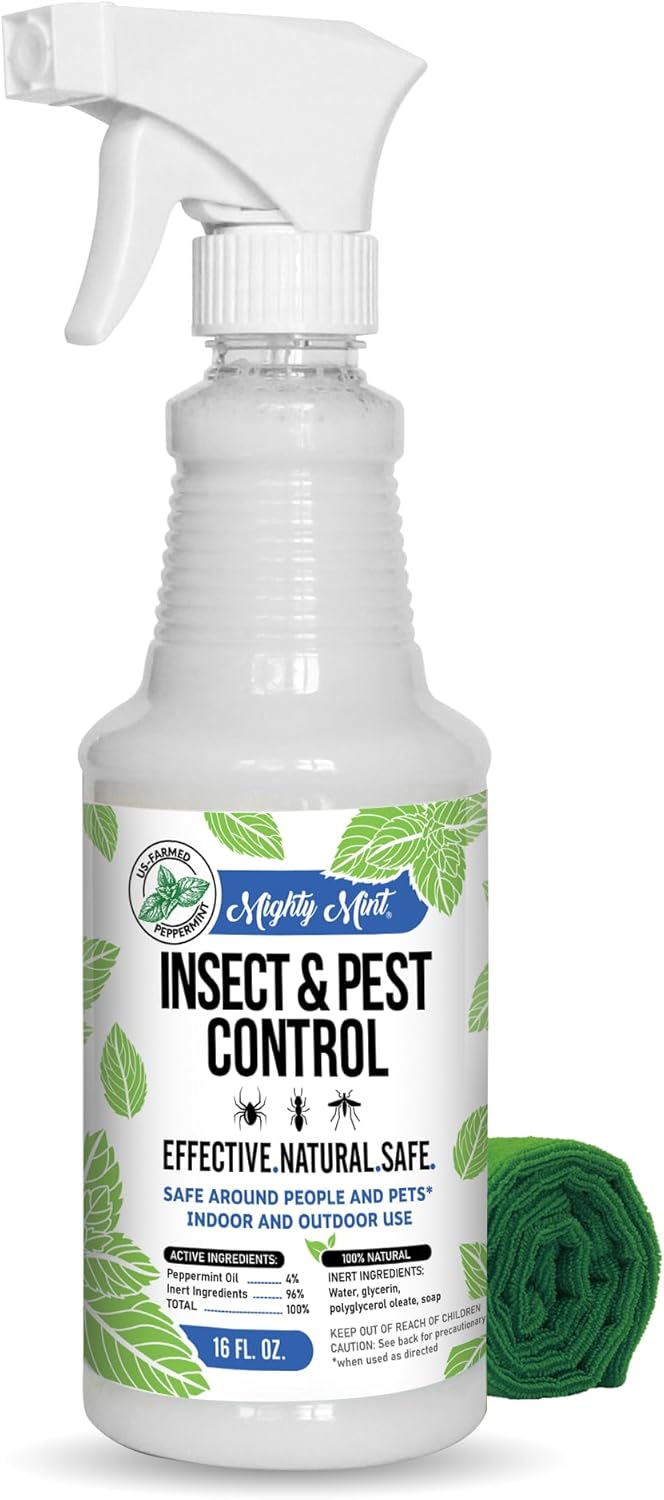
| Ingredients | Water, Glycerine, Polyglycerol oleate, Soap, Peppermint oil |
|---|---|
| Use Areas | Indoor / Outdoor |
| Size | 16 oz |
Mighty Mint is a plant-based, ready-to-use spray that uses concentrated peppermint oil to repel a broad range of household and patio pests. You apply it directly to problem areas such as baseboards, entryways, patios and around outdoor seating; the manufacturer recommends shaking and spraying until surfaces are covered and repeating applications two or more times per week for best results. Notable features include a peppermint-only scent profile, a formulation that avoids synthetic fragrances and the convenience of a 16 oz spray bottle for targeted spot treatments. Practical benefits are that it is safe to use around people and pets when dry and does not leave obvious stains on most surfaces, and the scent can make treated areas smell fresher than chemical alternatives. Important limitations are that it is a repellent rather than a pesticide so it works by discouraging pests rather than killing them, effectiveness depends on regular reapplication and it should not be applied when pollinators are present or to skin or food-contact surfaces.
Best for: Buyers who prioritize natural, low-toxicity solutions and want a targeted spray to reduce insects around patios and entryways while keeping family and pets in mind.
Less Ideal for: Anyone needing a one-time extermination or long-term residual pesticide for severe infestations should consider professional treatments or products formulated to kill pests rather than repel them.
- Plant-based peppermint formula that avoids synthetic fragrances
- Ready-to-use spray for quick, targeted indoor and outdoor applications
- Safe for people and pets when used as directed and allowed to dry
- Nonstaining on most surfaces and leaves a fresh mint scent
- Repels rather than kills insects so regular reapplication is needed to maintain protection
- Strong peppermint concentration may bother scent-sensitive individuals and requires keeping children and pets away until dry
Verdict: Choose Mighty Mint when you want a pet-friendly, plant-based spray to reduce patio and entryway insects with a fresh peppermint scent.
Choosing the Right Natural Ant Killer for Outdoors: Key Factors to Consider
Active Ingredient and Mode of Action
The active ingredient determines how the product affects ants and the surrounding environment. Botanical extracts, biological agents, or low-toxicity minerals act differently than synthetic chemicals. Some act as stomach poisons that worker ants carry back to the nest, which can reduce colony numbers, while others are contact treatments that quickly immobilize workers but may not reach the queen.
Understanding the mode of action helps set realistic expectations. A bait that relies on delayed toxicity is better for nest elimination when workers transport it, whereas a quick-contact spray is more useful for clearing visible trails. Also consider non-target impacts: ingredients that are broad-spectrum can harm beneficial insects, so pick options that limit exposure to pollinators and predators.
Formulation and Application Method
Formulation affects how and where you can use a product. Granules and baits allow targeted placement along ant trails and around nests, whereas sprays and concentrates cover larger surface areas quickly. Gels and paste baits excel in tight spots like crevices or patio joints. Ready-to-use applicators reduce mixing mistakes but may cost more per treatment.
Application method ties directly to safety and practicality. A granular product spread across mulch might be safer around flowering plants than a broadcast spray. Conversely, a hose-end or pump sprayer may be better for treating large foundation perimeters. Think about what tools you already have and how precise you need the placement to be.
Pet and Plant Safety
Outdoor ant control often happens where children, pets, and ornamentals are present. Check whether the active ingredient has known toxicity to mammals, birds, or aquatic life and whether label directions recommend keeping animals away during and immediately after application. Some natural ingredients break down quickly and pose minimal risk, while others can still be hazardous if applied incorrectly.
Consider placement strategies as well. Baits placed in weatherproof stations limit access to pets and beneficial wildlife. For treatments near flowering plants, avoid broadcast sprays during bloom and choose baiting or spot treatments instead. When in doubt, create physical barriers or wait to reintroduce pets until surfaces are dry.
Durability and Weather Tolerance
Outdoor conditions can quickly reduce the effectiveness of many ant control products. Rain, heavy dew, and intense sun can wash away or degrade active ingredients, especially water-soluble or volatile botanicals. Products designed for outdoor use will note rainfastness or offer forms that adhere to soil or surfaces better.
Predictability over several days is valuable. If you have frequent summer storms, favor granular or encapsulated formulations that resist breakdown. Also plan reapplication intervals according to exposure; more durable products reduce the need for repeat treatments and lower the total amount of material you must handle.
Target Species and Behavior
Different ant species behave differently and respond to treatments in various ways. Some species forage widely and are more likely to collect bait, while others defend a nest aggressively and may be less interested in sugar- or protein-based lures. Knowing which ant types you are dealing with helps select an appropriate bait matrix and placement strategy.
When species identification is uncertain, use a combination approach: targeted baits along active trails plus spot-treatment of nest openings. Observe activity patterns-time of day, foraging routes, and whether ants are recruiting to a food source-to adapt placement and bait type for better uptake.
Reapplication and Integrated Practices
No single product is a permanent solution for outdoor ant pressure. Expect to integrate sanitation, habitat modification, and physical exclusion alongside chemical or natural treatments. Remove food sources, seal entry points on structures, and manage mulch depth or irrigation practices that favor ant nesting.
Understand the reapplication schedule recommended for the product and plan to monitor treated areas. Reapplication may be needed after heavy rain or seasonal population spikes. Combining nonchemical tactics with targeted products reduces reliance on repeat treatments and leads to more sustainable control over time.
When to Use Baits Versus Contact Treatments
Baits are best when you can get ants to accept a food source and carry it back to the nest. They work well for species that forage broadly and are effective for knocking down colony numbers over days to weeks. Use baits along foraging trails, near nest entrances, and in sheltered spots where rain is less likely to leach the active ingredient.
Contact treatments, including sprays and dusts, are useful for quickly reducing visible worker numbers or treating exposed nest openings. These are more immediate but may not solve a colony problem unless applied to the nest itself. For long-term control, combine contact treatments for rapid knockdown with baits to address the colony core.
- Place baits out of direct sun and away from rain to improve uptake
- Use contact treatments for high-traffic areas where immediate reduction is needed
- Combine methods when species are unknown or infestations are extensive
Best Placement Strategies for Outdoor Use
Pay attention to ant trails and the base of structures. Ants often follow edges, cracks in patios, and gaps where mulch meets soil. Placing treatments along these natural travel lanes increases the chance of uptake. For baits, set multiple small placements rather than one large pile to avoid scaring ants with crowding.
Protect applications from pets, wildlife, and rain. Use bait stations or tuck baits under pavers and behind planters. For sprays, target soil perimeters and baseboards rather than broadcasting over flower beds during bloom.
- Target edges and seams where ants concentrate
- Use several small bait points along a trail
- Avoid placing baits directly on flowering plants
Nonchemical Measures That Reduce Ant Pressure
Cultural and physical controls reduce the need for frequent applications. Keep food and drink spills cleaned up, store pet food indoors, and clear debris that creates nesting sites. Trim branches and remove wood-to-soil contact around foundations to reduce sheltered corridors for ants.
Barrier tactics such as sealing cracks, installing door sweeps, and spacing mulch away from foundations limit easy access to structures. Reducing soil moisture through targeted irrigation scheduling also makes areas less attractive for some species.
- Eliminate food sources and tidy up landscaping
- Seal structural entry points to reduce indoor migration
- Adjust irrigation and mulch to discourage nesting
Safety Tips for Applying Natural Products
Even natural ingredients require careful handling. Read label directions for personal protective equipment and keep children and pets away during application and until surfaces are dry. Use gloves when placing baits or handling concentrated formulas.
Store products in labeled containers out of direct sunlight and away from food. When using sprays near water features or drainage, avoid runoff and consider alternative spot treatments to protect aquatic life.
- Follow label guidance for PPE and reentry times
- Keep baits in secure stations to protect non-target animals
- Avoid applying during wind or imminent rain
Timing Treatments for Best Results
Treat during peak foraging times for the species present. Many ant species are most active in the early morning or evening when temperatures are moderate. Applying baits at those times increases uptake because workers are actively foraging.
Avoid treating during very hot, dry periods or during heavy rainfall. Extreme heat can cause baits to dry out or volatilize, while rain can wash away surface treatments. Plan follow-up inspections a few days after treatment to assess progress and reapply if necessary.
- Apply baits at peak foraging times for better uptake
- Avoid treatments right before expected rain
- Inspect treated areas after 48 to 72 hours for activity changes
How We Chose the Best Natural Ant Killer for Outdoors
Our selection focused on products and formulations that are designed specifically for outdoor ant control while minimizing environmental harm. We prioritized materials with documented low mammalian toxicity or naturally derived active ingredients that target ants without broadly killing pollinators. Practical effectiveness in blocking trails, reducing colony activity, and treating nest sites was a key filter. We assessed ease of application across common outdoor settings such as patios, lawn edges, and garden beds, looking for formats that allow precise placement and minimal drift. Longevity of control and resistance risk were considered by preferring modes of action that deliver sustained suppression rather than brief repellency. We also checked how well formulations tolerate outdoor conditions like sun and rain, and whether reapplication is straightforward. Excluded from the shortlist were indoor-only products, highly toxic conventional insecticides, and items intended solely for structural treatments. The final picks reflect a balance of environmental safety, field durability, user-friendly application, and documented efficacy against common outdoor ant species.
FAQ
Are natural ant killers safe for pollinators and beneficial insects?
Often natural formulas are less harmful than broad-spectrum synthetics, but safety depends on the ingredient and how it is used. To protect pollinators, avoid applying treatments directly to flowering plants and prefer contained baits or spot treatments.
How long until I see results after applying a natural ant control?
It usually takes a few days to a couple of weeks to see meaningful reduction when using baits that require worker transfer to the nest. Contact treatments produce immediate knockdown of visible workers but may not eliminate the colony without follow-up.
Will rain wash away outdoor natural ant treatments?
Depends on the formulation. Granules and encapsulated baits are generally more rain-resistant than water-soluble sprays or exposed gels. If heavy rain is expected, wait for a dry window or use protected bait placements.
Can I use natural ant products around edible garden beds?
Yes, but choose products labeled safe for use near edibles and follow all withholding or harvest interval instructions. Prefer targeted bait stations or placements away from edible plants to minimize contact.
How often should I reapply treatments outdoors?
Reapplication frequency varies by product durability and environmental exposure. Many natural options need retreatment after heavy rain or every few weeks during high activity seasons. Inspect activity and follow label guidance for timing.
What if baits do not work on my ant species?
If baits are ignored, try a different bait matrix or switch to targeted contact treatments at nest openings. Also reassess placement and timing to ensure the bait matches the ants' preferred food type and foraging schedule.
Final Verdict
For outdoor ant control, prioritize products and strategies that match the ants' behavior while minimizing risks to pets, pollinators, and plants. Choose a bait-based approach when you can target foragers and expect colony-level suppression, and use contact or spot treatments for immediate reductions in visible workers. Balance durability against environmental safety by selecting formulations suited to your weather and landscape. Pair any treatment with sanitation and habitat changes to reduce reoccurrence. With the right mix of placement, timing, and nonchemical measures, you can get long-lasting control while protecting your outdoor environment.
