

Note: This article contains affiliate links. If you click on these links and make a purchase, I may earn a small commission at no extra cost to you. This helps support my research and content. Read my full affiliate disclosure here.
Ant infestations can be persistent and frustrating, especially when trails reappear days after treatment. Choosing a long lasting ant killer matters because you want control that keeps working across common entry points and nesting sites without frequent reapplication. This guide covers seven top contenders shortlisted for persistent ant problems, and it explains the practical tradeoffs you should expect in real indoor and outdoor use. We evaluate products on how long they remain effective, how easy and safe they are to apply, and how they fit different garden and home settings. Read on to understand the factors we used to pick these options and which features matter most for lasting control.
Top Picks at a Glance
| Best Overall The best all-around choice for most situations | Ortho Home Defense Max Indoor Insect Barrier, 1 gal. (Wand Ready) |  |
| Best Quality Built to a higher standard if you want something more solid | Ortho Home Defense Insect Killer for Indoor & Perimeter, 1.33 gal. with Comfort Wand |  |
| Best Value The sweet spot between price and what you get | FLODTEEK 80-Pack Slow-Acting Ant Gel Bait Stations |  |
| Best Budget The cheapest option that still gets the job done reliably | Raid Ant Killer Baits, 8 Count (Child-Resistant) |  |
| Highest Rated A top-rated pick with lots of positive feedback | ROUTADE 48-Pack Slow-Acting Ant Gel Bait Stations |  |
| Most Popular A crowd favorite that many people choose with confidence | TERRO Liquid Ant Bait Stations, 18 Count (3 Pack) |  |
| Best Seller A high-volume bestseller chosen again and again | Atticus Talak 7.9% Bifenthrin Indoor/Outdoor Insecticide Concentrate, 32 oz |  |
Ortho Home Defense Max Indoor Insect Barrier, 1 gal. (Wand Ready)

| Unit Count | 128 Fluid Ounces |
|---|---|
| Item Form | Spray |
| Target Species | Insects |
| Liquid Volume | 1 gallons |
| Active Ingredients | bifenthrin 0.05% |
Ortho Home Defense Max is a one-gallon, ready-to-use indoor insect spray that creates a barrier to kill and prevent common household pests including spiders, ants, roaches and more. It is applied using the included Extended Reach Comfort Wand so you can treat baseboards, doorframes and hard-to-reach corners without bending. The formula is fast-drying, advertised as non-staining and low-odor so treated rooms are usable once surfaces dry. For indoor spider control it works as both a spot treatment where you see activity and as a preventative band along entry points; outdoor perimeter applications are also recommended every three months to reduce re-entry. The active ingredient is bifenthrin 0.05%, a standard synthetic pyrethroid effective on crawling insects. Important limitations are that it is for nonporous indoor surfaces and perimeter use only and it requires following label safety instructions around children and pets until dry. Expect reliable seasonal suppression rather than complete elimination of all spiders in heavily infested structures.
Best for: Homeowners who want a straightforward, long-lasting indoor perimeter treatment to reduce spider activity without frequent reapplication and who prefer an easy-to-use wand for spot and barrier treatments.
Less Ideal for: People seeking an organic or insecticide-free option or those needing rapid knockdown for very heavy indoor infestations should consider alternative products or professional services.
- Ready-to-use gallon with an Extended Reach Comfort Wand for easier application in corners and along baseboards
- Fast-drying, low-odor formula that claims no stains so rooms can be reoccupied soon after treatment
- Provides up to 12 months of protection against ants, roaches and spiders on treated nonporous indoor surfaces when used as directed
- Contains bifenthrin so it is a synthetic insecticide and must be used with care around children, pets and sensitive areas
- Not formulated for porous surfaces or as a direct fogging solution for heavy indoor infestations
Verdict: A convenient, wand-ready indoor barrier spray that delivers long-lasting, low-odor protection against spiders and other common household insects.
Ortho Home Defense Insect Killer for Indoor & Perimeter, 1.33 gal. with Comfort Wand

| Item Form | Spray |
|---|---|
| Target Species | Insects |
| Liquid Volume | 1.33 gallons |
| Active Ingredients | Bifenthrin 0.05%, Zeta-Cypermethrin 0.0125% |
This 1.33 gallon Ortho Home Defense spray is designed to treat both indoor problem spots and the outdoor perimeter of a home to reduce ants, roaches, spiders and many other crawling and flying insects. It comes with a battery-powered Comfort Wand that delivers a continuous spray so you can apply a uniform band around foundations, patios and entry points without bending or pumping. The formula with bifenthrin and zeta-cypermethrin is intended to kill on contact and establish a barrier that the manufacturer says lasts up to 12 months for ants, roaches and spiders on non-porous indoor surfaces. In real-world use that means fewer repeat treatments in busy yard perimeters and around doors and windows. The spray dries clear with minimal fumes which helps for indoor use near kitchens and living areas. Limitations are that this is a chemical insecticide so users should follow safety directions around children, pets and plants and it is not a specific solution for pests not listed on the label. For homeowners focused on strong, perimeter-level protection this product simplifies application and covers a large area per container.
Best for: Homeowners who want a performance-focused perimeter treatment to reduce recurring yard and entry-point insect problems and prefer a ready-to-use product that is easy to apply.
Less Ideal for: People seeking organic or non-chemical control methods or those who need a targeted solution for pests not listed on the label should consider alternative products.
- Includes battery-powered Comfort Wand for continuous, fatigue-free application
- Ready-to-use 1.33 gallon container covers large perimeters without mixing
- Formula creates a barrier claimed to provide up to 12 months protection against ants, roaches and spiders on non-porous indoor surfaces
- Dries clear and gives off minimal fumes, making indoor use more practical
- Contains synthetic insecticides so precautions are required around children, pets and ornamentals
- Protection claims are specific to certain species and surfaces so results vary by pest and conditions
Verdict: A powerful, ready-to-use perimeter and indoor spray for homeowners who want long-lasting, performance-oriented protection against common yard and household insects.
FLODTEEK 80-Pack Slow-Acting Ant Gel Bait Stations

| Unit Count | 80 Count |
|---|---|
| Target Species | Ant |
| Included Components | 80 ant gel bait |
This 80-piece FLODTEEK ant gel bait kit is a simple, no-mess solution for reducing carpenter ants and other common household species by using a slow-acting formulation that worker ants carry back to the colony. Each station is prefilled and ready to place around kitchens, basements, patios and entryways; the brand suggests visible reduction in 5 to 7 days when placed in active trails. The pack size supports covering multiple hotspots at once and replacing stations over time, which helps with longer-term prevention. Setup uses an included double-sided tape so stations stay put on floors, walls or inside cabinets without pouring or mixing. Important limitations are that it is not an instant-contact spray so results take several days and success depends on ants feeding on the bait and bringing it to the nest, and heavy or hard-to-locate nests may need additional control methods.
Best for: Buyers who want a practical, low-effort approach to reduce carpenter ants across multiple rooms or outdoor entry points and prefer stocking enough bait to treat recurring hotspots.
Less Ideal for: People needing immediate knockdown of visible ants or those dealing with a very large or hard-to-find nest that likely requires professional intervention.
- Slow-acting formula designed for colony elimination rather than surface-only kills
- Large 80-piece pack lets you deploy multiple stations to cover a whole house and outdoor entry points
- Ready-to-use stations with included double-sided tape for quick, no-mess placement
- Labeled for both indoor and outdoor use so the same product can protect kitchens, basements, patios and porches
- Requires several days of continuous placement before noticeable reduction in ant activity
- Effectiveness depends on ants accepting the bait and transporting it to the nest
Verdict: A convenient bulk kit for homeowners who want an easy, long-term baiting strategy to reduce carpenter ant colonies across indoor and outdoor hotspots.
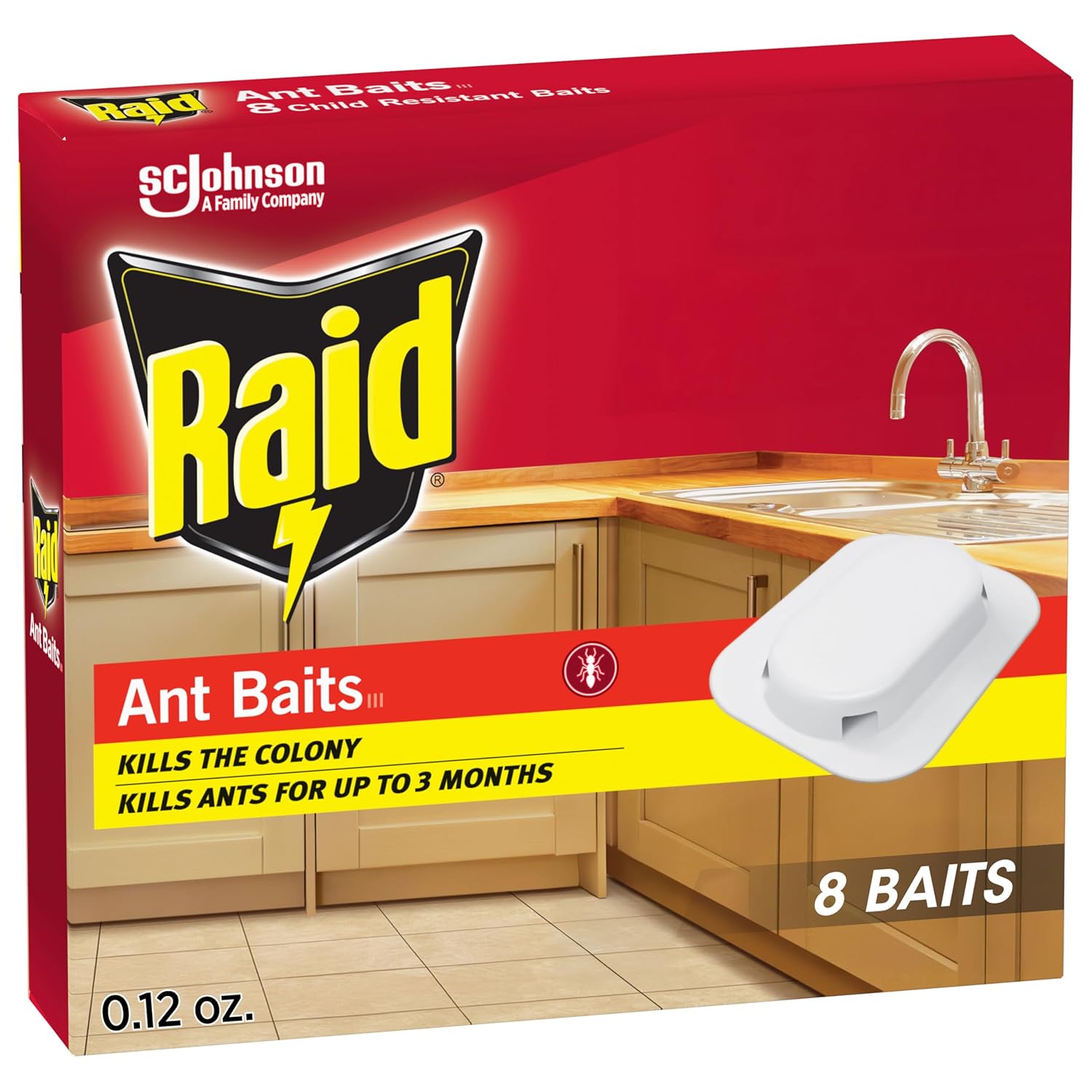
Raid Ant Killer Baits, 8 Count (Child-Resistant)
| Package quantity | 8 Count |
|---|---|
| Child safety | Child-resistant |
| Intended use | Indoor |
| Effect duration | Up to 3 months |
These Raid Ant Killer Baits are small, ready-to-use indoor stations that dispense an attractive liquid bait ants carry back to the colony, which can eliminate the nest over time. You place the bait along walls, in corners, and near entry points where small ants forage; after ants feed, the active ingredient is shared with other colony members, including the queen, and protection can last for weeks. The child-resistant design reduces accidental access in homes with children while the compact stations are low-profile and easy to position. Because they are prefilled and disposable, there is no mixing or measuring, which makes them convenient for quick treatment in kitchens, pantries, and baseboards. Limitations are that the product is for indoor use only and may be less effective if competing food sources are left available or if multiple heavy infestations require broader perimeter treatment. For someone looking for a simple, no-fuss bait to try first, these are a practical option.
Best for: Budget-minded homeowners or renters who want an easy, low-effort indoor solution to control small ant trails and try baiting before calling for broader treatments.
Less Ideal for: People needing immediate knockdown for very large or outdoor ant colonies or those who prefer non-chemical mechanical control methods.
- Ready-to-use prefilled bait stations that require no setup
- Child-resistant design reduces accidental access
- Bait formula is transferred through the colony to target the queen
- Compact, low-profile stations are easy to place along walls and entry points
- Intended for indoor use only, not suited for outdoor colony control
- May be less effective if other food sources are available or in very large infestations
Verdict: A low-cost, no-fuss indoor bait station that effectively targets small ant colonies by having foragers carry bait back to the nest.
ROUTADE 48-Pack Slow-Acting Ant Gel Bait Stations

| Unit Count | 48 Count |
|---|---|
| Item Form | Gel |
| Target Species | Ants |
| Included Components | Ant gel bait |
This 48-pack of ROUTADE slow-acting ant gel bait stations is built for systematic, long-term ant control in and around the kitchen. Each station contains a gel formula that worker ants consume and carry back to the nest, which helps reduce the entire colony rather than only visible foragers. The product is supplied in ready-to-use stations with adhesive tape so you can place them along baseboards, in cabinets, near sinks, and on entry thresholds without messy sprays or frequent repositioning. The large pack lets you deploy multiple stations in high-traffic areas and replace them over time for continuous coverage. Because the formula is slow-acting, it is effective against a range of common household species including carpenter ants and sugar ants, but it requires several days to weeks to knock down a colony and will not give instant removal of visible ants. Also the stations are small and contain gel rather than a tamper-resistant hard block, so keep them away from children and pets. For someone wanting a low-maintenance, colony-focused approach to kitchen ant problems, this kit makes it easy to set and forget while the bait works.
Best for: Homeowners who prioritize reliable, long-term elimination of ant colonies in kitchens and want a low-maintenance bait they can deploy across multiple hotspots.
Less Ideal for: People who need an immediate knockdown of visible ants or who require childproof solid bait stations should consider alternatives.
- Slow-acting gel designed for worker ants to carry bait back to the nest for colony-level control
- Ready-to-use bait stations with adhesive for easy placement along baseboards and in cabinets
- 48-count pack provides broad coverage around a kitchen and enough replacements for extended use
- Versatile for indoor and outdoor placement to block entry points and high-traffic ant routes
- Slow-acting formula takes days to weeks to eliminate a colony so visible results are not immediate
- Gel in small stations may require careful placement to keep away from children and pets
Verdict: A practical, deploy-and-forget gel bait kit for reliable colony-level control of kitchen ant infestations.
TERRO Liquid Ant Bait Stations, 18 Count (3 Pack)

| Unit Count | 18 Count |
|---|---|
| Item Form | Liquid |
| Target Species | Insects |
| Active Ingredients | Sodium Tetraborate Decahydrate (Borax) |
| Specification Met | EPA |
TERRO Liquid Ant Bait Stations are compact, ready-to-use traps that use a sweet liquid bait containing borax to attract foraging ants and carry the poison back to the colony. Typical use is placing the small stations along baseboards, in corners, behind appliances, or on counters where you see ant trails; no mixing or setup is required beyond opening the tab. The kit includes 18 bait stations (three packs of six) and the liquid formula is kept from drying by the sealed station design so it stays attractive for extended periods. Practical benefits include quick visible reduction in worker ants within a few days and the potential to eliminate the colony if placements are maintained until the bait is gone. Limitations: it is for indoor use only and works on ants that take sweet baits, so species that prefer greasy or protein foods may be less affected; results can take up to two to four weeks for full control and you should remove competing food sources for best results.
Best for: Homeowners or renters who want a low-effort, evidence-backed way to target kitchen ant trails and remove colonies without sprays, and who prefer products with a strong track record and social proof.
Less Ideal for: People needing immediate knockdown of visible ants or those dealing with species that avoid sweet baits should consider fast-acting sprays or alternative bait types instead.
- Ready-to-use stations require no mixing or tools
- Sealed liquid design resists drying so bait remains attractive over time
- Attracts worker ants that share bait, which can eliminate the colony
- Includes multiple stations for widespread placement around a kitchen
- Indoor-only product not formulated for outdoor use
- Relies on ants accepting a sweet bait so may be less effective on non-sugar-seeking species
Verdict: A ready-to-use, proven liquid bait kit that targets kitchen ant trails and can eliminate colonies with minimal effort.
Atticus Talak 7.9% Bifenthrin Indoor/Outdoor Insecticide Concentrate, 32 oz

| Active Ingredient | Bifenthrin |
|---|---|
| Formulation | Suspension Concentrate |
| Liquid Volume | 32 fluid ounces |
| Length of Control | Up to three months |
| Target Species | Insects |
Talak 7.9% is a liquid concentrate for treating lawns, landscaping, outdoor living areas and indoor perimeter spots like baseboards and cabinets. You dilute the concentrate with water to create a spray for barrier treatments, spot applications or lawn mixes; label rates explain how much to mix per gallon depending on the use. The product uses bifenthrin, a proven broad-spectrum active ingredient, and the manufacturer states it controls over 75 species and can give residual control for as long as three months. Its water-based formula dries clear, leaves no odor or visible residue, and is not phytotoxic on plants when used per label. Practical benefits include flexible indoor and outdoor use, clear drying, and a bottle designed for easier pouring. Important limitations are that solutions should be mixed only for same-day use, it is not registered for sale in a few states, and it is not approved for fogger application, so professional-style misting methods are not appropriate.
Best for: Buyers who want a single, reliable product to protect yards, patios and building perimeters from a wide range of common pests and prefer conservative, label-driven application practices.
Less Ideal for: People seeking ready-to-use sprays or fogger-compatible products or those in states where this formulation is not registered should look at alternatives.
- Broad-spectrum control listed for 75+ indoor and outdoor pest species
- Water-based formula that dries clear and leaves no odor or residue
- Flexible label directions for lawns, landscapes, hardscapes and indoor perimeter treatments
- Long residual activity up to three months when applied at recommended rates
- Mixed spray solutions cannot be stored and must be used the same day
- Not approved for fogger application and not available for sale in some states
Verdict: A versatile, water-based bifenthrin concentrate that delivers long-lasting, broad-spectrum outdoor (and perimeter indoor) control when used according to the label.
Choosing the Right Long Lasting Ant Killer: Key Factors to Consider
Residual Effectiveness
How long a product continues to affect ants after it is applied determines how often you must reapply. Residual activity varies by active ingredient and formulation; some treatments create a persistent barrier at entry points while others rely on baits that take the toxin back to the nest. Longer residual periods reduce follow-up work but can also increase exposure windows in highly trafficked areas.
When assessing longevity, consider whether the labeled duration aligns with your problem frequency. For outdoor use, evaluate how exposure to sun, rain, and irrigation may shorten residual action. For indoor spots, look for products that retain efficacy on dry surfaces and within cracks or wall voids where ants travel.
Bait Attractiveness and Foraging Behavior
A long lasting product that is not attractive to local ant species will fail to eliminate nests. Different species prefer sugars, proteins, or greasy baits, and seasonality can alter preferences. Effective ant control depends on choosing a formula that the foragers will actually carry back to the colony.
Consider whether the product offers multiple bait types or has evidence of broad palatability. Placement matters too: put baits where workers are actively foraging, along trails and near nests, rather than randomly across a yard. Tracking bait take over several days helps you confirm whether the bait is being accepted and transported to the nest.
Application Flexibility and Ease
How you apply a product influences both effectiveness and safety. Ready-to-use stations, granular barrier products, and liquid concentrates each have practical pros and cons. Stations limit non-target exposure and are simple to place indoors, while granular and liquid formulas may cover larger areas but require more precision and mixing.
Gardeners should consider how easily the product can be used in the specific problem areas they have, such as under mulch, along foundation edges, in planter beds, or inside cabinets. Products that offer clear labeling and straightforward instructions reduce the chance of misuse and improve consistent performance.
Indoor and Outdoor Safety Profile
Safety considerations affect where and how you can use a long lasting ant killer. Some formulations are labeled for both indoor and outdoor use, while others are restricted to exterior perimeter applications. Look for specific guidance about pets, children, edible plant proximity, and whether treated areas must be kept dry or covered during application.
Ensure the product's precautions match your home environment. If you have pets that forage outside or children who play in treated areas, choose formats and placement strategies that minimize exposure while preserving control. Proper storage and disposal instructions also fall under safety and are essential for responsible use.
Weather Resistance and Environmental Durability
Environmental exposure can degrade active ingredients and wash away bait or barrier residues. A product that claims long lasting performance should show reasonable resistance to rain, sunlight, and temperature swings common in your region. Some barrier formulations bind to soil or concrete surfaces better than others, which helps them survive light irrigation or dew.
For garden and yard use, check whether the label notes reapplication after heavy rain or irrigation. In sheltered or indoor locations, UV stability matters less, but humidity and dust accumulation can still affect bait access. Choose products whose durability matches the microclimates where you plan to apply them.
Matching Formulation to Your Ant Problem
Different problems require different approaches. If ants are marching indoors along kitchen floors or baseboards, contained bait stations are often the safest starting point because they limit exposure while workers take poison back to the nest. For nest-focused outdoor activity around foundations or planter beds, granular or liquid barrier products can reduce reinfestation pressure for longer periods.
Observe where ants are most active before choosing a format. Trail mapping over a day or two reveals whether the issue is a nearby nest, satellite colonies, or repeated entry from the landscape. That observation should direct whether you prioritize bait attractiveness or a persistent perimeter treatment.
- Use bait stations indoors and in high-traffic areas to protect children and pets.
- Apply granular or liquid barriers along foundations and under mulch for yard-level control.
- Reassess bait take after 48 to 72 hours to confirm colony exposure.
Placement Tips to Maximize Longevity
Proper placement extends how long a product remains effective. Place granular barriers where they will not be disturbed by foot traffic or routine garden maintenance. For liquids, treat cracks, crevices, and soil junctions at the foundation line where ants commonly enter.
When using bait, place stations directly on or along ant trails and near suspected nest openings. Avoid placing baits in direct sun or standing water, as heat and moisture can reduce palatability and degrade active ingredients.
- Keep baits out of direct sunlight and away from sprinklers.
- Avoid disturbing treated soil for several days after application to let residues settle.
- Record treatment locations so you can monitor and reapply as necessary.
Seasonal Considerations and Timing
Ant activity and food preferences change with season and temperature. Early spring and late summer can be peak foraging times, and some species shift from sugar to protein baits depending on brood needs. Timing treatments when workers are actively foraging increases the chance baits reach the nest.
Also plan perimeter treatments before warm, wet seasons if you want a protective barrier. Heavy rains may require reapplication, so schedule long lasting treatments with local weather patterns in mind.
- Monitor trail activity to choose when to deploy bait or barrier products.
- Consider a dual approach: bait to eliminate colonies and perimeter residues to prevent reentry.
- Check labels for recommended reapplication intervals after adverse weather.
Reducing Non-Target Exposure in the Garden
Gardeners often worry about impacts on pollinators, beneficial insects, and pets. Choosing targeted formats and selective placement reduces unintended contacts. Use bait stations with tamper-resistant housings and avoid broadcast sprays over flowering plants that attract bees and other beneficials.
For exterior perimeter treatments, focus applications on hardscape junctions and foundation edges rather than across garden beds. When treating near edible plants, follow label restrictions regarding pre-harvest intervals and distance from harvestable produce.
- Never apply barrier liquids directly to flowering plants or active pollinator areas.
- Place stations away from areas where pets eat or children play.
- Use physical shields or covers for granular products to limit runoff and non-target contact.
Monitoring Results and Knowing When to Reapply
Set a simple monitoring plan after application. Check bait uptake daily for the first week and inspect perimeter residues weekly for visible degradation or wash-off. If ant activity returns in treated areas, identify whether reapplication is needed or if another strategy, like nest excavation, is appropriate.
Documentation helps. Note application dates, weather events, and observed bait take so you can correlate performance with conditions and adjust future treatments accordingly.
- Inspect treated areas for seven to 14 days after initial application.
- Reapply after heavy rain if label guidance indicates diminished residual activity.
- If bait stations show no activity after several days, consider switching bait type or placement.
How We Chose the Best Long Lasting Ant Killer
We assembled the shortlist by focusing on attributes that directly affect long-term ant control in and around homes and gardens. Primary evaluation criteria included residual activity duration, measured as how long the active ingredient continues to affect ants after application; bait attractiveness and palatability to ensure foraging workers take treated material back to nests; safety profile, covering labeled uses for indoor versus outdoor spots and precautions for pets and children; and application flexibility, meaning available formats and ease of placement in common problem areas. We also examined formulation stability under real conditions such as exposure to sunlight, rain, or irrigation, and practical longevity in dry and damp settings. Exclusions included products without clear labeled residual claims or formulations not intended for typical residential settings. We prioritized options that balance measurable residual control with straightforward, safe application steps suitable for gardeners and homeowners. The scoring labels we used reflect these dimensions so readers can compare products on the same practical terms.
FAQ
How long should I expect a long lasting ant killer to remain effective?
It depends on formulation and site conditions. Many residual barrier products claim weeks to months of activity under dry conditions, while baits work as long as they remain palatable. Rain, sun, and foot traffic can shorten field longevity.
Are bait stations safe to use around pets and children?
Bait stations reduce direct exposure compared with broadcast sprays and are often labeled as pet-safe when used per instructions. Always follow placement and storage guidance and choose tamper-resistant stations in areas accessed by children or pets.
Can I use long lasting products on planting beds or near edible crops?
Some products have restrictions for use around edible plants. Read the label for specific distance and pre-harvest intervals. When in doubt, avoid applying persistent residues directly to soil where produce is grown.
Will a long lasting product eliminate the nest or just repel ants?
Baits are designed to eliminate nests by transferring active ingredients back to the colony, while some barrier treatments mainly prevent or deter reentry. Combining baiting to target nests with perimeter treatments for entry points often gives the most complete control.
How should I protect treated areas from rain or irrigation?
Follow label directions about drying time and reapplication after rain. For granular and liquid barriers, avoid watering for the recommended period and consider applying before a dry forecast to maximize adhesion to surfaces.
What signs show a treatment is working?
Reduced ant traffic along trails, lower bait take after initial consumption, and fewer sightings indoors are useful indicators. Complete elimination can take days to weeks depending on colony size and bait acceptance.
Final Verdict
When choosing a long lasting ant killer, prioritize how the product will be used in your specific setting. If indoor protection and safety around children or pets matter most, favor contained bait formats and tamper-resistant placements. For yard-level prevention, select barrier formulations with proven weather durability and clear reapplication guidance. Balance bait attractiveness and residual longevity against safety and environmental concerns. Use a targeted placement strategy, monitor bait uptake, and schedule treatments with local weather in mind to get durable control without unnecessary exposure. That approach will help you choose the most appropriate long lasting solution for your home and garden needs.
