

Note: This article contains affiliate links. If you click on these links and make a purchase, I may earn a small commission at no extra cost to you. This helps support my research and content. Read my full affiliate disclosure here.
If carpenter ants are active around your yard, foundation, or outbuildings you need options that work in outdoor settings without harming garden plantings or structures. The right outdoor carpenter ant killer reduces foraging workers and treats nest sites while minimizing disruption to soil life and beneficial insects. This guide presents our shortlisted top picks for outdoor carpenter ant control and explains how we evaluated application method, residual activity, and safety for outdoor use. Read on to understand which type of treatment suits your situation and what to expect after application.
Top Picks at a Glance
| Best Overall The best all-around choice for most situations | Spectracide Terminate Termite & Carpenter Ant Killer Concentrate, 32 oz |  |
| Best Quality Built to a higher standard if you want something more solid | Nisus Tim-BOR Professional Borate Wood Treatment, 25 lb |  |
| Best Value The sweet spot between price and what you get | Terro Outdoor Liquid Ant Bait Stakes, 12-Pack |  |
| Best Budget The cheapest option that still gets the job done reliably | TERRO Ant Killer Plus Granules, 3 lb Shaker Bag |  |
| Highest Rated A top-rated pick with lots of positive feedback | BioAdvanced Carpenter Ant & Termite Killer Plus Concentrate (40 fl oz) |  |
| Most Popular A crowd favorite that many people choose with confidence | Amdro Ant Killer for Outdoor Home Perimeter, 24 oz |  |
| Best Seller A high-volume bestseller chosen again and again | Ortho Home Defense Insect Killer for Indoor & Perimeter, 1.33 gal. with Comfort Wand |  |
Spectracide Terminate Termite & Carpenter Ant Killer Concentrate, 32 oz

| Unit Count | 32 Ounce |
|---|---|
| Target Species | Insects |
| Liquid Volume | 32 fluid ounces |
Spectracide Terminate is a 32-ounce concentrate formulated for outdoor use around foundations, porches, woodpiles, fences and decks to control termites, carpenter ants, carpenter bees and other wood-destroying insects. You mix the concentrate with water and apply it with a tank sprayer to create a treated barrier that kills on contact and can provide up to eight weeks of control for nuisance pests. Notable features include a non-staining formula when used as directed and coverage claims up to 16,000 square feet from a single bottle at labeled rates. In practice this product is useful for seasonal perimeter maintenance and spot treatments where wood-infesting insects are suspected; it is not intended as a standalone structural treatment for active, established termite colonies and the label advises professional inspection for infestations. Expect straightforward mixing and broad outdoor application options, but plan to use proper personal protective equipment and follow label directions for safe, effective results.
Best for: Homeowners who want a practical perimeter insecticide for routine outdoor maintenance and localized control of wood‑invading pests around structures and yard features.
Less Ideal for: Property owners facing an active, widespread termite infestation or those seeking an indoor-ready solution should consult a pest professional or choose a product specifically labeled for structural termite eradication.
- Concentrated formula that mixes with water for flexible coverage
- Kills termites, carpenter ants, carpenter bees and other wood-destroying pests on contact
- Non-staining when used as directed, suitable for treated areas near structures
- Label claims up to 16,000 sq ft coverage at recommended dilution
- Not intended as a sole solution for active termite infestations and not a replacement for professional termite treatment
- Requires a separate tank sprayer for application
- Provides control for up to eight weeks which may require repeat treatments for persistent issues
Verdict: A concentrated, easy-to-use outdoor barrier treatment for homeowners who need reliable, short-term control of carpenter ants and other wood‑destroying pests.
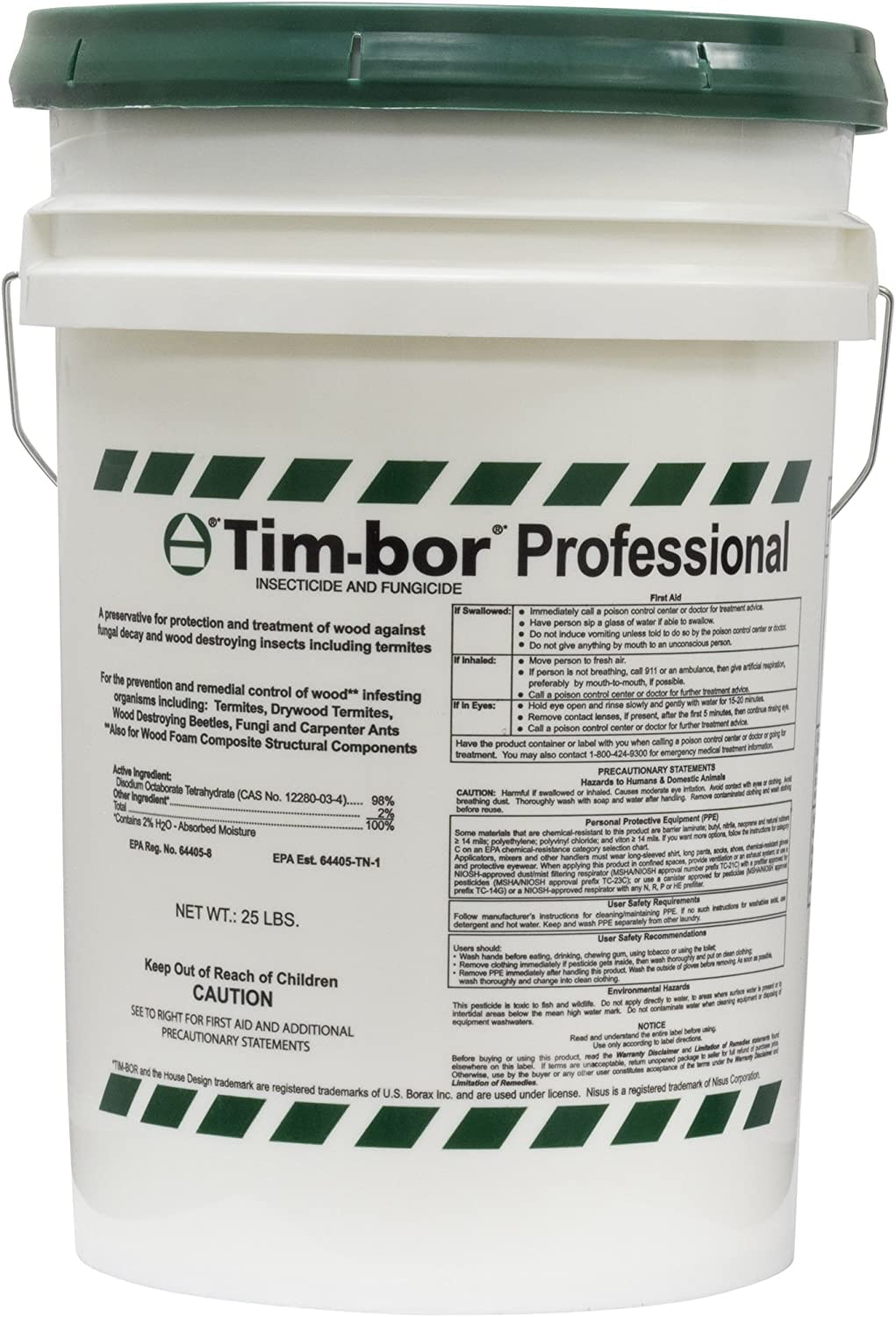
Nisus Tim-BOR Professional Borate Wood Treatment, 25 lb
| Item Form | Powder |
|---|---|
| Target Species | Fungus |
| Unit Count | 400 Ounce |
| Liquid Volume | 1.5 liters |
Tim-BOR Professional is a borate powder formulated to protect bare wood from decay fungi, drywood termites, carpenter ants, and other wood-destroying insects. It can be applied three ways — as a dust, mixed into a liquid solution, or foamed into hidden cavities — which makes it useful for both preventive treatment on new construction and spot remediation where insects are active. The active ingredient is a naturally derived borate that penetrates wood without staining or corroding fasteners, and when mixed to manufacturer recommendations it creates a long-lasting residual that resists re-infestation in treated areas. Practical benefits include versatile application methods for different access conditions and compatibility with untreated wood surfaces. Important limitations are that it must be applied to bare, unsealed wood to work properly and requires keeping treated wood dry; it is not a contact spray for exposed outdoor foliage and requires following label directions for safe handling and dilution.
Best for: Buyers focused on long-term, performance-driven control of wood-infesting pests who need a product that can be applied in multiple ways for preventive or remedial treatments.
Less Ideal for: Gardeners seeking a foliar or contact insect spray for surface ant trails or general outdoor pest control should choose a product formulated for above-ground, non-structural use instead.
- Three application options (dust, liquid solution, or foam) for flexible treatment of inaccessible voids or surface wood
- Effective against wood decay fungi, drywood termites, and carpenter ants
- Formulated from a borate mineral that does not stain wood or corrode fasteners
- Suitable for preventive use on new construction and remedial spot treatments
- Requires application only to bare, unsealed wood and will not work on painted or varnished surfaces
- Treated wood must remain dry to retain effectiveness
Verdict: Choose Tim-BOR Professional when you need a proven, multi‑application borate treatment to protect bare wood from carpenter ants and other wood‑destroying pests.
Terro Outdoor Liquid Ant Bait Stakes, 12-Pack

| Unit Count | 12 Count |
|---|---|
| Material Type | Plastic |
| Target Species | Ant |
| Power Source | manual |
These Terro Outdoor Liquid Ant Bait Stakes are simple, low-effort bait stations designed to intercept ant colonies outdoors before they reach the house. Each stake contains a sweet liquid bait with borax that worker ants feed on and carry back to the nest, which can eliminate the queen and much of the colony over a 2 to 4 week period. They are weather-resistant, see-through so you can monitor bait consumption, and install by cutting a tab and pushing the stake into soil or mulch near ant trails. For homeowners dealing with small common species such as little black, odorous house, pavement, and ghost ants, the stakes provide targeted perimeter protection without sprays or direct contact. Limitations are that baiting takes days to weeks to fully work and you may see increased ant activity at first as foragers discover the bait. Also they must be placed where children and pets cannot access them and replaced periodically to maintain protection.
Best for: Homeowners who want a low-effort, evidence-based way to stop small common outdoor ants at the source and prefer baiting over sprays, using visual confirmation of activity before replacing units.
Less Ideal for: People needing an immediate knockdown or single-visit solution for heavy indoor infestations or those who cannot place bait stations out of reach of children and pets.
- Colony-level control via borax bait that foraging ants share with the nest
- Ready-to-use stakes are easy to deploy by cutting the tab and inserting in soil
- See-through design lets you monitor bait consumption and know when to replace
- Weather-resistant stations suitable for yards, patios, and garden perimeters
- Works gradually and can take 2–4 weeks for complete colony control
- Not child- or pet-proof if placed in accessible areas and requires careful placement
Verdict: A practical, easy-to-use baiting solution that stops small outdoor ant colonies by getting worker ants to carry borax bait back to the nest.
TERRO Ant Killer Plus Granules, 3 lb Shaker Bag

| Item Form | Granules |
|---|---|
| Target Species | Insects |
| Active Ingredients | Lambda-cyhalothri (0.04%) |
| Specification Met | Epa Standards |
TERRO Ant Killer Plus is an outdoor granule insecticide designed for perimeter and spot treatments on lawns and around foundations. The product is applied directly from a resealable shaker bag so you can create a 3 to 10 foot barrier around a house, scatter over ant hills, or treat fire ant mounds with a measured amount and then water it in gently. Its active ingredient, lambda-cyhalothrin at 0.04%, works quickly on contact and offers short-term residual control to reduce reinfestation. Practical benefits include no need for a separate spreader, clear instructions for treating different mound types, and a compact 3 lb size that is easy to store and handle. Important limitations are that it is for outdoor, non-edible-use only, requires careful watering to be effective, and has buffer restrictions near water or sensitive habitats that you must follow for safety and compliance.
Best for: Buyers who want a straightforward, proven outdoor insecticide to reduce ant activity around a home and value easy application and clear usage guidance.
Less Ideal for: People needing an indoor solution, those treating edible gardens or near ponds and streams, or buyers who prefer non-chemical or organic pest control methods.
- Ready-to-use shaker bag simplifies application without a spreader
- Fast-acting formula that claims kill within 24 hours on contact
- Suitable for perimeter, lawn spot treatments, and targeted ant mound control
- Includes clear, specific instructions for fire ant and ant hill treatments
- Contains a synthetic pyrethroid active ingredient requiring careful handling and adherence to safety distances near water
- Not approved for use on edible crops or in/near aquatic habitats
Verdict: A compact, easy-to-apply granule treatment for homeowners who want a quick, visible reduction of outdoor ant populations around foundations and lawns.
BioAdvanced Carpenter Ant & Termite Killer Plus Concentrate (40 fl oz)

| Unit Count | 40 Fluid Ounces |
|---|---|
| Item Form | Concentrate |
| Target Species | Insects |
| Active Ingredients | B-Cyfluthrin (2.5%) |
| Specification Met | EPA |
This BioAdvanced concentrate is formulated for outdoor perimeter treatments to control wood‑infesting pests and a wide range of other insects. You dilute the concentrate into a pump sprayer or hose‑end applicator and apply it around foundations, decks, patios, wood piles and landscape areas to establish a protective barrier that the label says lasts up to three months. The active ingredient, β‑Cyfluthrin 2.5%, delivers quick contact kill against ants, termites, carpenter bees and many common crawling and flying pests, so you can treat entry points and likely nesting sites rather than chasing individual insects. Because it is a concentrate, one bottle covers more area than a ready‑to‑use product and is more economical for routine seasonal treatments. The product is intended for outdoor use only, so it is not suitable for indoor crack-and‑crevice applications, and users must follow the label for safe handling and environmental precautions. If you want a cost‑effective perimeter protector for preventing infestations around an average house, this concentrate performs that role well.
Best for: Homeowners who want an economical, season‑long outdoor perimeter treatment to prevent and reduce carpenter ant and termite activity around their house.
Less Ideal for: People seeking an indoor spray or a non‑chemical/organic solution should look at ready‑to‑use indoor products or alternative pest control methods.
- Concentrated formula extends coverage and is more economical than ready‑to‑use bottles
- Effective on contact against a broad list of pests including carpenter ants and termites
- Establishes a multi‑month perimeter barrier for preventive control
- Suitable for common outdoor treatment sites such as foundations, decks, wood piles and landscaped areas
- Concentrate is labeled for outdoor use only so it cannot be applied indoors
- Contains a synthetic pyrethroid active ingredient requiring careful handling and strict label compliance
Verdict: A cost‑effective concentrated perimeter treatment that quickly kills wood‑infesting pests and provides up to three months of outdoor protection.
Amdro Ant Killer for Outdoor Home Perimeter, 24 oz

| Item Form | Granules |
|---|---|
| Target Species | Insects |
| Special Features | Ant Killer for Outdoor Home Perimeter |
| Active Ingredients | Hydramethylnon |
This granular ant bait is formulated for outdoor perimeter control around foundations, lawns, and landscaped areas. You apply a 12-inch band around the house or sprinkle directly on visible trails and mounds; worker ants take the granules back to the colony so the active ingredient, hydramethylnon, can reach the queen and reduce the nest. The label claims protection up to three months and treatment coverage measured in linear feet, which makes it suitable for ongoing seasonal control rather than spot fixes. It works best when applied in cool morning or evening hours on dry ground and should not be used before rain or when temperatures are below 50°F. Practical benefits include simple shake-on application, broad efficacy against many common ant species, and residual activity that lowers repeat treatments. Important limitations are that it is a chemical bait requiring careful handling and adherence to safety directions and that results depend on ant foraging behavior so very large or established colonies may need follow-up treatments or combined tactics.
Best for: Buyers who prioritize strong, season-long perimeter control and want a targeted bait solution for lawns and landscaped areas rather than temporary surface sprays.
Less Ideal for: Those seeking non-chemical or immediate-kill surface treatments, or people who need a one-time indoor solution should consider other products or integrated approaches.
- Designed for outdoor perimeter use with instructions for 12-inch band application around the home
- Granular bait formulation is carried by foragers to the colony to target the queen
- Label lists effectiveness against a wide range of common ant species
- Offers residual control claimed up to three months reducing application frequency
- Contains hydramethylnon and requires careful handling and adherence to safety directions
- Performance depends on ants discovering and collecting the bait so results can vary by species and activity levels
Verdict: Choose this product if you want a proven granular perimeter bait that targets colonies to deliver longer-lasting outdoor ant control.
Ortho Home Defense Insect Killer for Indoor & Perimeter, 1.33 gal. with Comfort Wand

| Item Form | Spray |
|---|---|
| Target Species | Insects |
| Liquid Volume | 1.33 gallons |
| Active Ingredients | Bifenthrin 0.05%, Zeta-Cypermethrin 0.0125% |
This 1.33 gallon Ortho Home Defense spray is designed to treat both indoor problem spots and the outdoor perimeter of a home to reduce ants, roaches, spiders and many other crawling and flying insects. It comes with a battery-powered Comfort Wand that delivers a continuous spray so you can apply a uniform band around foundations, patios and entry points without bending or pumping. The formula with bifenthrin and zeta-cypermethrin is intended to kill on contact and establish a barrier that the manufacturer says lasts up to 12 months for ants, roaches and spiders on non-porous indoor surfaces. In real-world use that means fewer repeat treatments in busy yard perimeters and around doors and windows. The spray dries clear with minimal fumes which helps for indoor use near kitchens and living areas. Limitations are that this is a chemical insecticide so users should follow safety directions around children, pets and plants and it is not a specific solution for pests not listed on the label. For homeowners focused on strong, perimeter-level protection this product simplifies application and covers a large area per container.
Best for: Homeowners who want a performance-focused perimeter treatment to reduce recurring yard and entry-point insect problems and prefer a ready-to-use product that is easy to apply.
Less Ideal for: People seeking organic or non-chemical control methods or those who need a targeted solution for pests not listed on the label should consider alternative products.
- Includes battery-powered Comfort Wand for continuous, fatigue-free application
- Ready-to-use 1.33 gallon container covers large perimeters without mixing
- Formula creates a barrier claimed to provide up to 12 months protection against ants, roaches and spiders on non-porous indoor surfaces
- Dries clear and gives off minimal fumes, making indoor use more practical
- Contains synthetic insecticides so precautions are required around children, pets and ornamentals
- Protection claims are specific to certain species and surfaces so results vary by pest and conditions
Verdict: A powerful, ready-to-use perimeter and indoor spray for homeowners who want long-lasting, performance-oriented protection against common yard and household insects.
Choosing the Right Outdoor Carpenter Ant Killer: Key Factors to Consider
Application Method and Coverage
How you apply a carpenter ant treatment determines how effectively it reaches foragers and nest sites. Baits rely on foraging workers to carry toxicant back to the colony, so placement along trails, near wood structures, and close to mound entrances is essential. Liquid sprays and dusts can be applied directly to visible galleries in wood or into voids, offering more immediate contact but requiring careful targeting to avoid non-target areas.
Coverage matters in larger yards or properties with multiple likely harborages. Granules and perimeter sprays are useful for treating broad bands around foundations and landscape beds, while spot treatments or foam formulations are better for isolated nests. Think about how much area you need to treat and choose a method that delivers consistent coverage without excessive repetition.
Residual Activity and Weather Resistance
Residual protection is how long a material remains active after application, which affects the frequency of retreatment. In outdoor settings, UV exposure, rain, and irrigation can degrade some formulations quickly. Products formulated for outdoor use often include stabilizers or placement methods that shelter the active ingredient, like injecting dusts into voids or using granular formulations that sit on the soil surface.
Consider local rainfall patterns and seasonal watering when planning treatment. For short-term knocks down after heavy rain you may need a reapplication, while longer-lasting products reduce repeat work but require more careful placement to avoid non-target exposure.
Speed of Colony Control
Different modes of action affect how quickly a colony declines. Fast-acting contact treatments can reduce visible worker numbers rapidly but may not reach the queen or hidden brood. Slow-acting baits are designed so workers distribute the active ingredient through trophallaxis, increasing the chance of colony-level control, though results may take days to weeks.
Match the desired timeline to your situation. If you need immediate reduction of surface activity around a door or deck, use a contact option while deploying bait for longer-term suppression. Patience is often required when relying primarily on bait strategies.
Targeting and Accessibility of Nest Sites
Carpenter ants nest in wood, soil, and under structures. Some nests are visible in decayed wood while others are hidden in wall voids or deep in mulched beds. The best outdoor solutions allow targeted entry into galleries or cover a perimeter where ants forage.
Consider how accessible suspected nest sites are. Foam and dusts can be injected into voids and are useful for colony cavities in structural timbers. Granules and perimeter sprays work well where nests are in soil or mulch. If nests are high in trees or deep inside structures, professional inspection or combined tactics may be needed.
Impact on Beneficials and Pets
When treating outdoor areas you need to weigh risks to pollinators, earthworms, and pets. Some active ingredients have low toxicity to non-target species when used as labeled, while others can harm beneficial insects or aquatic life if applied near flowering plants or water features.
Apply baits in tamper-resistant stations or place treatments away from blooms and pollinator flight paths. Use pet-safe formulations and follow re-entry and withholding guidance. Minimizing broadcast applications and targeting treatments reduces non-target exposure while still controlling carpenter ant activity.
Ease of Monitoring and Follow-up
Controlling carpenter ants often requires follow-up checks to confirm the colony is suppressed. Products that integrate with simple monitoring-such as bait stations you can inspect or granular indicators-make it easier to judge when retreatment or additional tactics are necessary.
Plan a monitoring routine after treatment. Look for reductions in foraging trails, decreased worker numbers, and absence of new wood shavings or frass. If activity persists for several weeks after a properly applied treatment, reassess placement, consider alternate formulations, or escalate to a different tactic.
When to Use Baits Versus Contact Treatments
Baits and contact products play different roles in outdoor carpenter ant control. Baits are best when you can identify foraging trails or place stations near entry points because they rely on worker ants to transport toxicant back to the nest. Contact sprays or dusts provide faster visible knockdown and are useful for treating exposed galleries or structural wood.
In many cases a combined approach is most effective: use contact treatments for immediate reduction in high-traffic areas and place baits to attack the colony over time. Match the method to the problem: foraging ants on patios may call for bait stations, while visible nest galleries in a deck can be treated directly.
- Baits: slower colony-level results, lower non-target exposure when enclosed, best along trails
- Contact treatments: faster reduction of visible workers, requires careful wood or void access
- Combined tactics often give the best balance of speed and lasting control
Safe Placement in Landscapes and Near Foundations
Placement is critical to protect plants, pollinators, and pets. Avoid applying broad sprays to flowering plants or near bird baths and ponds. When using granular or liquid perimeter treatments, place products directly against foundations, under overhangs, or along anticipated travel routes rather than across planting beds.
Use physical barriers like bait stations or apply materials in cracks and crevices to reduce contact with beneficial insects. Keep records of where you applied treatments so follow-up inspections focus on treated zones.
- Treat the perimeter, not planting interiors when possible
- Use bait stations to limit exposure to non-targets
- Reapply according to label if heavy rain occurs in the first 24 to 48 hours
Non-Chemical Tactics That Complement Treatments
Cultural and mechanical controls reduce habitat and make chemical measures more effective. Removing rotting wood, trimming vegetation away from foundations, and reducing moisture sources helps reduce nesting opportunities. Sealing obvious entry points and replacing damaged structural wood removes harborages.
Physical removal of small satellite nests and routine monitoring can limit reinfestation. Non-chemical tactics rarely eliminate a large established colony alone, but they reduce suitable nesting sites and support longer-term control when used alongside targeted products.
- Remove or replace damp, decayed wood near structures
- Improve drainage and reduce excessive mulch depth
- Seal gaps where wood meets foundations or siding
Timing Treatments for Season and Ant Activity
Carpenter ant activity changes with season, which affects treatment success. Foraging typically increases in warm months and when colonies are producing winged reproductives. Treating when ants are actively foraging increases the chance baits will be discovered and carried back to the nest.
Avoid treating during heavy rain periods that will wash away residues or flood bait stations. Late spring through summer often provides the best window for outdoor interventions in temperate climates, but local phenology should guide timing.
- Apply baits when workers are actively foraging along trails
- Avoid treatments immediately before heavy rain
- Monitor during and after warm periods when activity spikes
Reading Labels and Following Outdoor Use Directions
Labels contain essential information about where and how a product can be used safely outdoors. They list application rates, required protective measures, environmental precautions, and restrictions near water or edible plants. Following label directions is both a legal requirement and the best way to protect beneficial organisms and pets.
If the label lists restricted sites or specifies professional application only, do not use the product in prohibited areas. When in doubt about compatibility with a particular landscape use, opt for targeted placement or consult a local extension resource.
- Check for explicit outdoor labeling and environmental precautions
- Adhere to re-entry intervals and pet safety guidance
- Do not apply near waterways unless label permits safe use
How We Chose the Best Outdoor Carpenter Ant Killer
We focused on products specifically formulated or labeled for outdoor carpenter ant control and prioritized properties that matter in real gardening and property contexts. Key evaluation criteria included application method and practical coverage, because ease of applying bait, liquid, or granule around foundations and landscape beds affects effectiveness. We assessed residual protection and weather tolerance to judge how long a product continues killing after rain or irrigation. Speed of colony suppression was considered to estimate how quickly foraging activity drops. Safety profile for outdoor use was reviewed, including risks to pollinators, pets, and soil organisms when used according to label guidance. Finally, product flexibility and targeting-ability to treat nests in wood, soil, or turf and compatibility with non-chemical options-was weighed. We excluded items intended only for indoor use or for unrelated ant species where control dynamics differ. We also removed fly-by products lacking clear outdoor labeling or that required professional application only. The remaining selections emphasize real-world performance, application practicality, and outdoor safety.
FAQ
How long after treatment will I see fewer carpenter ants outside?
It depends on the method. Contact treatments can reduce visible workers in hours to a few days, while bait strategies often take several days to a few weeks as the toxicant is shared through the colony. Environmental factors and nest size influence the timeline.
Are outdoor ant baits safe around pollinators and pets?
Many baits are designed to limit non-target exposure by being placed in tamper-resistant stations, but safety varies by formulation. Place stations away from flowering plants and follow label instructions to reduce risks to pollinators and pets.
Can I rely on non-chemical methods alone to stop carpenter ants?
Non-chemical tactics like removing decayed wood and improving drainage help reduce nesting sites and complement other measures, but they often do not eliminate established colonies on their own. Combining sanitation with targeted treatments gives better results.
Will rain wash away outdoor treatments?
Some formulations are vulnerable to wash-off, especially right after application. Granules and certain perimeter products have better weather tolerance, but heavy rain within 24 to 48 hours can reduce effectiveness and may require reapplication according to the product directions.
How do I find hidden carpenter ant nests outside?
Look for foraging trails, piles of wood shavings or frass, and increased ant activity near structural wood or tree bases. Follow worker ants back at dawn or dusk to locate entry points. When nests are inaccessible, professional inspection may be needed.
Final Verdict
Pick an outdoor carpenter ant strategy that matches where ants are nesting and how quickly you need control. Foraging trails and visible galleries call for targeted treatments and possibly a fast-acting contact option, while baiting is better for reaching the colony over time. Prioritize safe placement, weather-resistant formulations for your climate, and follow-up monitoring to confirm results. With the right method and realistic expectations about timing, you can suppress carpenter ant colonies while protecting beneficials and landscape health.
