

Note: This article contains affiliate links. If you click on these links and make a purchase, I may earn a small commission at no extra cost to you. This helps support my research and content. Read my full affiliate disclosure here.
Picking the right vegan fertilizer matters because it changes how your soil cycles nutrients and how reliably plants respond. For gardeners who avoid animal-derived inputs, a vegan fertilizer must supply complete nutrition while building long-term soil health. This guide covers seven shortlisted vegan fertilizers that work across vegetables, herbs, ornamentals, and container gardens. We evaluated each option for nutrient balance, how it releases nutrients, and how easy it is to use so you can match a product to your gardening style and goals.
Top Picks at a Glance
| Best Overall The best all-around choice for most situations | Smart Grower Plant Power Up Organic Vegan Plant Food (500 g) |  |
| Best Quality Built to a higher standard if you want something more solid | GS Plant Foods Grower's Honey Organic Plant-Based Liquid Fertilizer (1 Gallon) |  |
| Best Value The sweet spot between price and what you get | Smart Grower Plant Power Up Organic Plant Food with Beneficial Microbes | 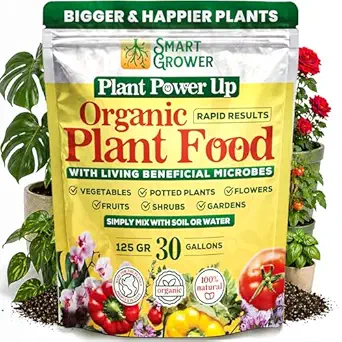 |
| Best Budget The cheapest option that still gets the job done reliably | Back to the Roots Organic All-Purpose Plant Food, 5 lb |  |
| Highest Rated A top-rated pick with lots of positive feedback | Growganica Kelp It Real Organic Seaweed Fertilizer Powder (1 lb) |  |
| Most Popular A crowd favorite that many people choose with confidence | Bloom City Seaweed & Kelp Liquid Fertilizer, 32 oz |  |
| Best Seller A high-volume bestseller chosen again and again | TPS NUTRIENTS Indoor Plant Food Liquid Fertilizer, 8 fl oz |  |
Smart Grower Plant Power Up Organic Vegan Plant Food (500 g)

| Item Form | Powder |
|---|---|
| Mixing Ratio | 1:931.5 |
| Target Species | houseplants, vegetables, and flowers |
| Ingredients | Beneficial bacteria 2.5×10⁸ CFU/gr; Humic 3.85%; Fulvic 4.65%; Organic matter 23.15%; N 1.00%; K 2.00%; P 0.07% |
Smart Grower Plant Power Up is a water‑soluble organic powder fertilizer designed to boost root health and overall plant vigor for indoor and outdoor plants. You mix the measured scoop into water at the indicated ratio and apply to potted plants, garden beds, or container vegetables to improve nutrient uptake and support stronger roots and fuller foliage. Notable features include a documented mix of beneficial Bacillus strains (2.5×10⁸ CFU/g), humic and fulvic acids, 23% organic matter, amino acids, and small amounts of N, P, and K. Those components make this product useful for improving soil biology as well as providing nutrition, which is particularly helpful for organic and vegan gardeners who want microbial support rather than synthetic salts. The powder format concentrates a lot of product in 500 g and the brand claims it makes up to about 120 gallons of feed, so a little goes a long way. Important limitations are the relatively low macronutrient numbers compared with conventional NPK fertilizers and the need to follow the mixing ratio for correct dosing, so users seeking rapid large nutrient pushes may prefer a higher NPK option.
Best for: Buyers who want an organic, vegan fertilizer that supports soil biology and steady plant health for houseplants, containers, and small vegetable or flower beds.
Less Ideal for: Growers seeking quick, high‑nitrogen pushes for rapid leaf growth or large-scale row-crop feeding should consider a higher NPK product instead.
- Contains multiple beneficial Bacillus strains to improve soil microbiology and root health
- Includes humic and fulvic acids plus amino acids and 23% organic matter to support nutrient uptake
- Water‑soluble powder concentrates into a small package and mixes for many gallons of feed
- Vegan and organic formulation suitable for gardeners avoiding animal‑derived inputs
- Low labeled NPK and macronutrient percentages compared with synthetic fertilizers
- Requires careful mixing to achieve the intended dilution and avoid under‑feeding
Verdict: Choose this product if you want a compact, vegan organic fertilizer that prioritizes beneficial microbes and steady, long‑term plant health.
GS Plant Foods Grower's Honey Organic Plant-Based Liquid Fertilizer (1 Gallon)

| Item Form | Liquid |
|---|---|
| Specific Uses For Product | Plant Growth |
| Application Method | hose end sprayer, backpack or hand held sprayer |
| Coverage | Up to 1000 sq ft per gallon |
| Mixing Ratio | 1:128 |
Grower's Honey is a concentrated, vegan liquid fertilizer designed to be diluted and applied with a hose-end, backpack, or handheld sprayer across lawns, vegetable beds, and ornamental plants. The formula centers on plant-derived amino acids plus a 4-3-3 NPK that supports chlorophyll production and helps plants shift energy toward growth rather than building their own amino acids. In practice that means easier foliar feeding and root drenches that are gentle enough for regular use and suitable for organic gardens and hydroponics. Notable features are the full solubility, clear mixing directions (3 to 4 ounces per gallon depending on use), and stated coverage up to 1,000 sq ft per gallon, which makes it straightforward to measure for larger areas. Limitations are that nutrient ratios are relatively low compared with concentrated synthetic fertilizers, so heavy feeders or growers chasing rapid, large nutrient inputs may need to supplement with other specific amendments for phosphorus or potassium during high-demand stages.
Best for: Buyers who prioritize organic, plant-based inputs and steady performance across edible and ornamental plantings and who want an easy-to-apply all-purpose liquid to support regular feeding.
Less Ideal for: Growers seeking rapid, high-dose nutrient pushes for heavy feeders or large-scale production where precise high NPK inputs are required.
- 100% plant-based, organic formula with 18 L-amino acids to improve uptake and photosynthesis
- Ready-to-dilute liquid that is fully soluble and works for foliar spray, root drench, or hydroponics
- Clear application rates and claimed coverage up to 1,000 sq ft per gallon for easy planning
- Suitable for use across lawns, vegetable gardens, trees, shrubs, and flowers
- Lower NPK concentration than many synthetic fertilizers, so may not meet high-demand nutrient needs
Verdict: Choose Grower's Honey if you want a reliable, 100% plant-based liquid fertilizer that makes foliar and root feeding simple while supporting steady organic growth.
Smart Grower Plant Power Up Organic Plant Food with Beneficial Microbes

| Beneficial microbes | Bacillus velezensis, subtilis, altitudinis, pumilus, licheniformis, megaterium |
|---|---|
| Microbe concentration | 2.5×10^8 CFU/gr |
| Humic acid | 3.85% |
| Fulvic acid | 4.65% |
| Organic matter | 23.15% |
Smart Grower Plant Power Up is a water‑soluble organic fertilizer formulated for both houseplants and garden beds. It mixes easily for feeding potted plants, vegetables, and flowers and supplies a balanced mix of humic and fulvic acids plus modest amounts of NPK and amino acids to improve soil structure and nutrient uptake. The standout feature is the included proprietary mix of Bacillus strains at a high CFU count, which can help microbial activity in the root zone and support healthier root development and nutrient availability. Practical benefits include safer use around people and pets because it contains no animal products or synthetic chemical fertilizers and can be used across indoor and outdoor growing situations. Limitations to note are the relatively low listed NPK numbers, so heavy feeders or plants with high fertility demands may need supplemental feeding, and specific application frequency is not detailed on the listing so you will need to follow label directions for dosing. For gardeners prioritizing an organic, microbe‑focused boost, this product is a straightforward option.
Best for: Practical plant owners who want a safe, organic daily or weekly feed that improves soil biology and is simple to apply to houseplants, containers, and small vegetable beds.
Less Ideal for: Growers who need high‑strength, fast‑acting fertilizers for heavy feeders or commercial-scale production should consider higher NPK or specialty formulations instead.
- Contains multiple Bacillus strains at high CFU to support soil microbial activity
- Includes humic and fulvic acids plus organic matter to improve nutrient uptake and soil structure
- Water‑soluble formula that is easy to mix and use on both indoor and outdoor plants
- Vegan and organic formulation without animal products or synthetic chemical fertilizers
- Low NPK numbers may be insufficient alone for heavy‑feeding vegetables or fruiting plants
- Listing does not specify detailed dosing schedules, requiring careful attention to label instructions
Verdict: Choose this vegan organic fertilizer if you want an easy, microbe‑focused feed that improves soil biology and supports healthier indoor and garden plants.
Back to the Roots Organic All-Purpose Plant Food, 5 lb

| Unit Count | 80 Ounce |
|---|---|
| Item Type | Organic All-Purpose Plant Food |
| Item Highlight | Vegan organic fertilizer with kelp, alfalfa meal, mycorrhizae, rock phosphate |
| NPK | 2-3-3 |
This 5 lb bag of Back to the Roots All-Purpose Plant Food is a plant- and mineral-based granular fertilizer designed for routine feeding of houseplants, herbs and edible container crops. It mixes easily with water (directions recommend 1 tablespoon per gallon applied every 2 to 4 weeks) and uses kelp, alfalfa meal, rock phosphate and mycorrhizae to supply slow-release nutrients and support stronger root growth. The no-burn formulation makes it forgiving for indoor use and for beginners who might overapply synthetic feeds. Because it is organic and free of synthetic chemicals and animal byproducts, it fits gardens where sustainable inputs are a priority. Limitations are that the NPK is relatively low at 2-3-3, so heavy-feeding or fast-growing plants may need more frequent applications or a complementary feed for quick nitrogen response. Also being a granular/tea-style feed it requires mixing and regular application rather than a one-and-done slow-release stake.
Best for: Practical indoor gardeners who want an easy-to-use, sustainable organic feed for houseplants, herbs and mixed container plantings and who prefer predictable, repeatable feedings over complex regimens.
Less Ideal for: People seeking a single-application slow-release fertilizer or those who need high-nitrogen quick-growth boosts for heavy-feeding vegetables.
- 100% plant and mineral based formula without synthetic chemicals
- Includes kelp, alfalfa meal and mycorrhizae to support root health and sustained nutrition
- No-burn recipe suitable for indoor plants and beginner-friendly application
- Value-sized 5 lb bag reduces trips to replenish supply for multiple pots
- Relatively low NPK (2-3-3) may not satisfy heavy-feeding or very fast-growing plants
- Requires regular mixing and application rather than a single long-term release product
Verdict: A practical, beginner-friendly organic feed that reliably supports indoor plants and herbs with plant-based nutrients and root-supporting mycorrhizae.
Growganica Kelp It Real Organic Seaweed Fertilizer Powder (1 lb)

| Item Form | Powder |
|---|---|
| Specific Uses For Product | Plant Growth |
| Target Species | Plants, Houseplants, Fruits, Vegetables |
| Unit Count | 16 Ounce |
| Mixing Ratio | 100% |
Kelp It Real is a concentrated cold-pressed kelp powder intended as an organic soil and root tonic for houseplants, vegetables, fruits and greenhouse crops. You mix the powder into water according to the product directions to create a solution that can be applied at the root zone or used as a general feed. The formula emphasizes expanded root development, balanced soil conditions and improved bloom size by supplying natural vitamins, minerals and enzymes rather than synthetic NPK. Practical benefits include a long coverage claim from a small package and suitability for many growing media including soil, coco and hydroponics. It is OMRI listed and vegan certified, which suits growers aiming for organic or vegan production. Important limitations are that this is a general biostimulant rather than a complete fertilizer so you may still need to supply macro nutrients separately for heavy-feeding crops, and handling requires care because it is a powder that can be dusty and irritant to skin or eyes.
Best for: Buyers who prioritize dependable organic and vegan inputs and want a biologically rich kelp tonic to support root health and flowering across a variety of indoor and outdoor plantings.
Less Ideal for: Growers seeking an all-in-one complete fertilizer for high-demand fruiting crops or those who prefer ready-to-use liquid feeds without mixing.
- OMRI listed and vegan certified for organic and vegan growing systems
- Cold-pressed kelp concentrate provides a broad spectrum of micronutrients and enzymes
- Small 1 lb package claims high dilution so one purchase covers many applications
- Versatile for use on houseplants, vegetables, fruits and across soil, coco and hydro systems
- Powder form can be dusty and requires gloves and a mask during handling
- Not a complete NPK fertilizer so additional macronutrients may be necessary for heavy feeders
Verdict: A reliable OMRI-listed, vegan kelp concentrate for growers who want a proven organic root and bloom stimulant rather than a standalone complete fertilizer.
Bloom City Seaweed & Kelp Liquid Fertilizer, 32 oz

| Item Form | Liquid |
|---|---|
| Specific Uses For Product | Lawn,Organic |
| Application Method | watering, root dips, foliar sprays, compost teas |
| Target Species | Plants |
| Mixing Ratio | 5mL per gallon (veg), 5-10mL per gallon (bloom) |
Bloom City Seaweed & Kelp Liquid Fertilizer is an organic, liquid kelp concentrate meant for regular use as a watering-can drench or foliar spray. You mix small amounts (roughly 1 teaspoon per gallon during vegetative growth and 1–2 teaspoons per gallon during bloom) and apply with each watering or use a stronger foliar ratio for weekly sprays. In practice it supplies trace organics and kelp-derived compounds that encourage stronger root development, reduce transplant shock, and can improve stress tolerance in pots, raised beds, and indoor plants. The product is versatile for small-scale gardens because it works with watering cans, hose-end sprayers, root dips, and compost teas. It is made from multiple algae species and is positioned as an all-organic supplement, which suits growers looking to avoid synthetic fertilizers. Limitations are that it is a supplement rather than a complete NPK feed so you will still need a balanced fertilizer for heavy feeding crops, and dosing requires attention since directions vary by application method.
Best for: A cautious gardener who prefers organic, proof-backed supplements and wants an easy-to-use kelp boost for houseplants, container gardens, or small vegetable plots.
Less Ideal for: Growers who want a single product to meet full macronutrient needs for high-demand crops should choose a complete fertilizer instead.
- Organic kelp formula suitable for foliar spray or soil drench
- Simple, low-dose mixing instructions for frequent use
- Multiple application methods: watering can, hose-end sprayer, root dips, compost teas
- Supports root growth and helps reduce transplant shock
- Not a complete NPK fertilizer so needs to be paired with base nutrients for heavy feeders
- Label gives several different dosing recommendations which can be confusing for first-time users
Verdict: A reliable organic kelp supplement that gives risk-conscious growers an easy way to boost root health and stress resilience when used alongside a basal fertilizer.
TPS NUTRIENTS Indoor Plant Food Liquid Fertilizer, 8 fl oz

| Item Form | Liquid |
|---|---|
| Specific Uses For Product | Plant Food |
| Application Method | Watering can |
| Mixing Ratio | 2:1 (oz/gallon) or 1:64 (tbsp/gallon) |
TPS NUTRIENTS Indoor Plant Food is a concentrated liquid fertilizer made for regular use with houseplants. You mix the measured dose into water and apply it with your usual watering can; the label gives an easy mixing ratio for household use. Its kelp-enriched formula is pitched at improving leaf color, encouraging steady new growth, and supporting root health, so expect glossier foliage and more frequent leaf production when plants are fed consistently. The 8 fl oz bottle is portable and fits on a plant shelf or utility area, and the liquid form dissolves readily for even application. It is intended for medium coverage and labeled as gentle for weekly feeding, which simplifies care for busy owners. Important limitations are that this is a small bottle meant for regular top-up feedings rather than long-term bulk use, and it assumes you will follow dilution directions to avoid overfeeding. Keep it away from children and pets and avoid skin or eye contact when handling.
Best for: Plant owners who want a simple, low-effort weekly fertilizer to keep indoor foliage vibrant and encourage steady new leaf growth. Good for people who prefer an easy liquid mix applied during regular watering routines.
Less Ideal for: Gardeners needing a bulk or multi-season fertilizer for outdoor beds or large collections should consider larger-capacity or specialized products instead.
- Liquid concentrate mixes easily for even application with a watering can
- Kelp-enriched formula aimed at improving foliage color and encouraging new growth
- Gentle enough for weekly feedings according to product guidance
- Clear mixing instructions for home use
- Small 8 fl oz volume limits how many plants you can feed before repurchasing
- Not formulated or labeled for outdoor or large-scale garden use
Verdict: A convenient kelp-enriched liquid concentrate that makes weekly feeding easy for anyone who wants healthier, more vibrant indoor foliage.
Choosing the Right Vegan Fertilizer: Key Factors to Consider
Nutrient Profile and Ratios
A vegan fertilizer must supply usable nitrogen, phosphorus, and potassium in ratios suited to the plants you grow. Leafy crops need higher nitrogen early on, while flowering and fruiting plants benefit from elevated phosphorus and potassium later in the season. Look for guaranteed analysis that lists N-P-K values and ideally secondary nutrients such as magnesium and calcium.
Beyond the headline N-P-K, consider the chemical forms: some plant- and mineral-derived sources are more readily available than others. Mixing strategies can compensate for weaker phosphorus availability by pairing with soil-building practices, but knowing the profile lets you plan feeding frequency and complementary amendments.
Release Rate and Timing
Release predictability determines how often you need to feed. Fast-release, water-soluble vegan fertilizers provide quick uptake for seedlings or to correct deficiencies, but require more frequent application and careful dosing to avoid burning tender roots. Slow-release or polymer-coated plant-based granules release nutrients over weeks to months, reducing labor but offering less immediacy when plants need a quick boost.
Consider your gardening schedule: if you water frequently or prefer low-maintenance feeding, a slow-release option is practical. For container growers and window-box gardeners who repot regularly, water-soluble formulas let you tailor feeding to each crop cycle.
Soil Biology and Microbial Support
Good vegan fertilizers do not just feed plants, they support the soil food web. Ingredients such as kelp extracts, composted plant matter, and fermented plant concentrates can provide carbon and micronutrients that stimulate beneficial microbes. Healthy microbial activity improves nutrient mineralization and long-term soil structure, which is especially important in vegetable beds and permanent planting areas.
Avoid products with high salt content or synthetic carriers that can stress soil life. If a fertilizer lists humic substances, soluble carbohydrates, or known microbial stimulants, it is more likely to contribute positively to soil biology over repeated applications.
Solubility and Application Methods
How a fertilizer dissolves and how it can be applied matters for different garden setups. Water-soluble vegan fertilizers are convenient for foliar sprays, root drenches, and drip systems. Granular or pelleted plant-based fertilizers suit broadcast feeding and top-dressing in beds. Some formulas are designed for starter feeds at planting while others are intended for regular monthly maintenance.
Match product form to your tools and garden scale. Containers and raised beds benefit from soluble feeds or mixed-in granular products that release predictably. For large beds, ease of broadcast and even spreading can save time and ensure uniform growth.
Ingredient Source Transparency
Since vegan fertilizer buyers avoid animal-derived inputs, clear ingredient labeling is critical. Look for products that list specific plant or mineral sources rather than vague terms like "organic matter." Transparency helps you confirm there is no hidden animal content and assess how each ingredient contributes to nutrition or soil health.
Manufacturers that disclose processing methods, source regions, or concentration ranges provide more confidence. When ingredient lists are sparse or ambiguous, plan to contact the maker for clarification or choose a better-documented option.
Compatibility With Crop and Growing Stage
Different crops and stages need distinct feeding approaches. Seedlings and young transplants prefer low-strength, high-availability nitrogen and gentle micronutrients so roots can establish without fertilizer shock. Flowering and fruiting stages often require a shift to fertilizers that emphasize phosphorus and potassium to support blooms and set.
Consider whether the fertilizer can be used across stages or if you will need multiple products. Some vegan fertilizers are formulated as all-purpose feeds, while others are explicitly for bloom promotion or leafy growth. Planning feeding transitions avoids nutrient imbalances and supports consistent yields.
Using Vegan Fertilizer in Vegetable Beds
In garden beds, think beyond a single feed. Incorporate a vegan fertilizer into a broader soil-building routine that includes compost, cover crops, and mulches. Apply soluble feeds during the growing season to correct visible deficiency or to support heavy-feeding crops like leafy greens and brassicas.
Top-dressed granular options work well in perennial vegetable beds where you want steady nutrient release. Pair any fertilizer with regular soil tests to monitor changes in pH and macronutrient levels so you can adjust applications through the season.
- Use lighter, frequent feeds for containers and heavier, slower-release applications for in-ground beds.
- Monitor for signs of deficiency before increasing rates to avoid overfertilizing.
Feeding Potted Plants and Small Containers
Containers have limited buffering capacity, so soluble vegan fertilizers are often the best fit. Feed at reduced strength compared with in-ground applications, and flush pots occasionally to prevent salt buildup. Quick-release feeds let you correct yellowing or poor growth rapidly without repotting.
For long-term container plantings, choose blends formulated for repeat feeding and watch for drainage and soil mix quality to maintain root health.
- Dilute water-soluble feeds to half strength for most containers unless instructions state otherwise.
- Leach containers with plain water every few months to prevent nutrient concentration.
Timing Feeds for Flowering and Fruit
Shift feeding priorities as plants move from vegetative growth to bloom and fruit set. Introduce fertilizers with higher phosphorus and potassium as buds form to support bloom development and fruit quality. Many vegan formulas designed for bloom contain seaweed or kelp extracts that provide growth regulators and micronutrients beneficial at this stage.
Avoid high-nitrogen applications when flowers are forming, as excess nitrogen can favor leaf growth at the expense of blooms.
- Begin bloom-formulated feeding at first bud set and continue on a schedule recommended for the product type.
- Complement fertilizer feeding with consistent watering to support flower retention and fruit development.
Storing and Handling Vegan Fertilizers Safely
Store products in a cool, dry place away from direct sunlight and moisture. Keep containers tightly sealed to preserve potency and prevent clumping. Label containers clearly and keep them out of reach of children and pets.
When mixing soluble fertilizers, measure carefully and use clean tools to avoid cross-contamination. Rinse application equipment after use to prevent residue buildup that can clog nozzles or drip lines.
- Avoid storing near high heat or open flame.
- Use gloves if handling concentrated powders to avoid skin irritation.
Pairing Vegan Fertilizers With Soil Amendments
Vegan fertilizers work best when combined with organic soil-building practices. Add compost and well-rotted plant matter to increase cation exchange capacity and nutrient-holding potential. Amendments like green sand, rock phosphate, or langbeinite can supply slow-release minerals compatible with a vegan approach.
Avoid layering too many slow-release mineral sources at once. Stagger applications across seasons and monitor plant response to fine-tune the combination.
- Integrate compost annually to maintain long-term fertility.
- Use mineral amendments selectively based on soil test recommendations.
How We Chose the Best Vegan Fertilizer
Our shortlist focused on products that supply plant-available nitrogen, phosphorus, and potassium from exclusively plant or mineral sources. We evaluated nutrient profiles to ensure growers could meet needs for foliage, flowering, and fruiting without resorting to animal-derived amendments. Release characteristics were important: we preferred formulas that offer predictable short-term feeding or clear slow-release behavior for less frequent applications. We applied practical handling filters: ease of measuring and applying in beds and containers, compatibility with foliar spray or soil drench methods, and clear mixing instructions. Environmental considerations included minimal synthetic fillers and ingredients that encourage microbial activity rather than harming soil life. We excluded any product listing animal-derived inputs, bone meal, blood meal, or fish-based ingredients. We also excluded fertilizer blends that lacked full disclosure of nutrient sources or complete guaranteed analysis. Editorial selection emphasized options that suit common garden situations-seedlings and transplants, established vegetable beds, potted herbs, and flowering perennials. The scoring criteria reflected nutrient completeness, release control, soil health benefits, ease of use, and ingredient transparency.
FAQ
Are vegan fertilizers as effective as conventional organic fertilizers?
Vegan fertilizers can be equally effective if they supply the needed nutrients in plant-available forms and support soil biology. Effectiveness often depends on correct application, matching fertilizer type to crop stage, and combining with good soil management.
Can I use vegan fertilizer on seedlings and young transplants?
Yes. Use diluted, water-soluble vegan feeds at low strength for seedlings to avoid root burn. Look for formulations labeled safe for young plants or follow lower dosage guidance.
Will vegan fertilizers build long-term soil fertility?
Some vegan fertilizers that include composted plant matter, humic substances, or kelp can support soil life and contribute to long-term fertility. However, building lasting soil structure also requires regular organic inputs and cover cropping.
How often should I apply vegan fertilizer?
Frequency depends on product form and release rate. Water-soluble feeds are typically applied every one to four weeks at reduced strength, while slow-release granules may be used once each season or every few months. Follow product directions and adjust based on plant response.
Can I make my own vegan fertilizer at home?
Yes. Gardeners can create vegan fertilizers using compost tea, fermented plant extracts, seaweed solutions, and plant-based meals. Homemade feeds require careful dilution and consistent preparation to ensure nutrient balance and avoid microbial issues.
Will vegan fertilizer affect soil pH?
Some inputs can influence pH over time, especially concentrated mineral amendments. Most plant-based organic fertilizers have minimal immediate pH impact, but regular soil testing helps you track changes and correct them with lime or sulfur if needed.
Final Verdict
Choose a vegan fertilizer that matches your crop needs and your preferred application routine. Prioritize a clear nutrient profile, predictable release behavior, and ingredients that support soil biology. For low-maintenance beds, slow-release or granular options reduce feeding frequency, while water-soluble formulas give more control for containers and seedlings. Balance short-term feeding goals with long-term soil-building practices. When you match fertilizer form and nutrient ratios to plant stage and growing conditions, a vegan approach can deliver reliable growth while aligning with your ethical preferences.
