

Note: This article contains affiliate links. If you click on these links and make a purchase, I may earn a small commission at no extra cost to you. This helps support my research and content. Read my full affiliate disclosure here.
If you grow fruit trees, choosing the right insecticide spray affects both yields and the long-term health of the orchard. You want treatments that knock down damaging insects quickly while minimizing impact on pollinators, beneficial insects, and fruit quality. This guide shortlists the top options for fruit-tree use and explains the practical tradeoffs of residual control, timing, and application method in a real garden or small orchard. We evaluate sprays on effectiveness against common tree pests, safety for beneficials and foliage, ease of use, and suitability for preharvest timing. Read on for the criteria we used and concise notes to help you pick the best spray for your fruit trees.
Top Picks at a Glance
| Best Overall The best all-around choice for most situations | BioAdvanced 3-in-1 Insect, Disease & Mite Control Spray, 32 fl oz |  |
| Best Quality Built to a higher standard if you want something more solid | Bonide Fruit Tree & Plant Guard 32 oz Concentrate |  |
| Best Value The sweet spot between price and what you get | BioAdvanced Fruit & Citrus Tree Insect Control Concentrate, 32 oz |  |
| Best Budget The cheapest option that still gets the job done reliably | Natria Neem Oil Ready-to-Use Spray, 24 oz |  |
| Highest Rated A top-rated pick with lots of positive feedback | Monterey Fruit Tree Spray Plus, 16 oz (Neem Oil & Pyrethrins) |  |
| Most Popular A crowd favorite that many people choose with confidence | Bonide Captain Jack's Citrus, Fruit & Nut Orchard Spray Concentrate, 32 oz |  |
BioAdvanced 3-in-1 Insect, Disease & Mite Control Spray, 32 fl oz
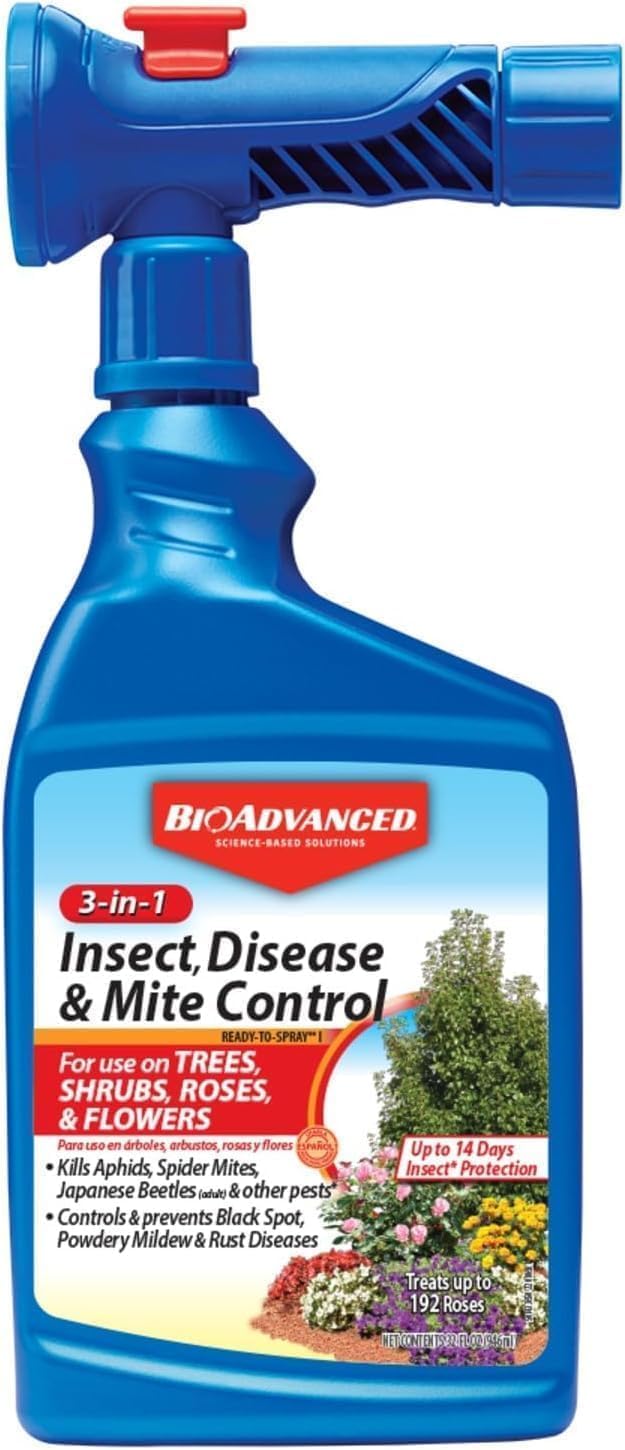
| Unit Count | 32 Fluid Ounces |
|---|---|
| Item Form | Spray |
| Target Species | Aphids, caterpillars, leafminers, whiteflies and other listed pests |
| Active Ingredients | Tau-fluvalinate 0.61%, Tebuconazole 0.65% |
This BioAdvanced 3-in-1 spray is a performance-focused ready-to-use treatment that kills common pests on contact while also preventing and curing listed fungal diseases and controlling spider mites. It attaches to a garden hose for broad, even coverage and is labeled to treat up to 192 rose bushes, making it practical for medium to large beds and multiple shrubs. Key features include systemic ingredients plus contact control, rainproof protection lasting up to 14 to 30 days depending on labeled claims, and active ingredients targeting aphids, caterpillars, whiteflies, and mites. In use you spray foliage including undersides, and the product provides both immediate knockdown of insects and longer residual control so follow-up applications are less frequent. Limitations: it is a chemical treatment so users must follow safety directions and keep children and pets away until treated areas have dried, and it is not sold for use in New York. For someone prioritizing reliable, one-step control of aphids and associated fungal problems on roses and ornamentals, this bottle delivers convenient, broad-spectrum protection.
Best for: Gardeners who want a fast, high-performance one-step solution to control aphids and related pests while also preventing common fungal diseases on roses and ornamental plants.
Less Ideal for: Organic gardeners or those seeking nonchemical options should look for botanical or soap-based aphid controls instead.
- Combines insecticide, fungicide, and miticide in one ready-to-use formula for streamlined treatment
- Attaches to a garden hose for fast coverage of many plants including up to 192 roses
- Provides knockdown on contact and residual protection between labeled reapplications
- Controls a wide list of pests including aphids, spider mites, whiteflies, and caterpillars
- Contains chemical active ingredients that require careful handling and adherence to safety directions
- Not approved for sale in all states which limits availability for some users
Verdict: For gardeners focused on performance, this ready-to-spray 3-in-1 formula delivers fast aphid knockdown plus disease prevention in one convenient application.
Bonide Fruit Tree & Plant Guard 32 oz Concentrate

| Item Form | Powder |
|---|---|
| Target Species | Insects |
| Liquid Volume | 32 fluid ounces |
Bonide Fruit Tree & Plant Guard is a ready-to-mix 32 oz powder concentrate designed to control a wide range of insect pests and fungal diseases on fruit trees, nuts, ornamentals and garden plants. You mix the powder with water, load it into a sprayer and treat foliage and fruit trees according to the label. The formula lists activity as an insecticide, fungicide, miticide, aphicide and scalicide, so it covers common problems such as aphids, Japanese beetles, powdery mildew, scab and leaf curl without needing multiple separate products. Practical benefits include broad-spectrum protection from both pests and disease and the economy of a concentrate that treats multiple plants. Important limitations are that it must be mixed and applied correctly for safety and effectiveness and that timing and coverage matter for disease control, so it is not a set-and-forget solution. Gardeners should follow label directions for application rates and intervals to avoid harm to beneficial insects and to ensure residue compliance on edible fruit.
Best for: Gardeners who prioritize effective, broad-spectrum protection for productive fruit trees and want a single concentrate that handles both pests and common fungal diseases.
Less Ideal for: Casual gardeners who prefer ready-to-use products or those who do not want to handle concentrated formulations and mixing.
- Multi-action formula treating insects, fungal diseases and mites in one product
- Concentrate form lets you mix the needed volume for several trees and shrubs
- Label lists control for common fruit-tree problems like aphids, scab and leaf curl
- Suitable for use on fruit, nuts, vegetables, ornamental trees and shrubs
- Requires careful mixing and correct application timing to be effective
- Powder concentrate needs measuring and may be less convenient than ready-to-use sprays
Verdict: Choose this concentrate when you need one versatile product to protect fruit trees from both insect pests and common fungal diseases.
BioAdvanced Fruit & Citrus Tree Insect Control Concentrate, 32 oz

| Unit Count | 32 Fluid Ounces |
|---|---|
| Item Form | Liquid |
| Target Species | Insects |
| Active Ingredients | avocado |
This BioAdvanced concentrate is designed to protect fruit and citrus trees by mixing and pouring at the plant base so the active ingredient is taken up through the roots and provides internal protection. It targets aphids, whiteflies, leafhoppers, scale and several other listed pests and claims up to two months of prevention after one application. Typical use is annual treatment of established fruit trees, or treating multiple small fruit plants and vegetable areas according to label rates; one 32-ounce bottle is advertised to treat up to nine trees or 640 square feet of vegetables. The practical benefits are no spraying, resistance to wash-off from rain, and a long residual that reduces repeat visits during the growing season. Important limitations are that it is a systemic insecticide with an imidacloprid active ingredient so users should follow label directions for edible plants and pollinator safety and note it is not available for sale in several states; it also does not provide immediate contact knockdown for heavy, visible infestations.
Best for: Gardeners who want an easy, low‑maintenance way to protect established fruit or citrus trees from sap‑feeding insects without foliar spraying and who prioritize season‑long coverage.
Less Ideal for: People needing immediate, contact control of visible outbreaks or those who avoid systemic neonicotinoid products for pollinator safety should consider alternative methods.
- Systemic root uptake gives internal protection that is not easily washed away by rain
- Controls a broad list of sap‑feeding pests including scale, aphids, whiteflies and leafhoppers
- Single annual application can protect trees for up to two months, reducing labor
- Concentrate format treats multiple trees or a larger vegetable area from one bottle
- Not a contact spray so it will not quickly knock down heavy, active infestations
- Contains imidacloprid which requires careful adherence to label restrictions for edible crops and pollinators
Verdict: Use this concentrate if you want a root‑applied, season‑lasting protection for fruit and citrus trees against scale and other sap‑feeding pests with minimal foliar spraying.
Natria Neem Oil Ready-to-Use Spray, 24 oz

| Unit Count | 24 Fluid Ounces |
|---|---|
| Item Form | Spray |
| Target Species | Insects |
| Active Ingredients | Clarified Hydrophobic Extract of Neem Oil – 0.9% |
Natria Neem Oil Spray is a 24 oz ready-to-use botanical spray formulated to kill common pests like aphids, whiteflies, spider mites and to suppress fungal diseases such as powdery mildew and black spot. You simply point and spray for spot treatments or broader coverage on roses, vegetables, ornamentals and houseplants without measuring or mixing. The product’s active ingredient is a clarified neem oil extract (0.9%) and the label allows use up to the day of harvest, which makes it practical for vegetable gardens and edible container crops. The spray combines insecticidal and fungicidal action, so it can reduce the number of separate products you need to keep on hand. Limitations to expect are that it is a contact product, so thorough coverage and repeat applications are required for good control, and it will be less effective against pests hidden in dense foliage or inside buds. For gardeners who prefer a low-toxicity botanical option and want a convenient ready-to-use format, this is an easy-to-use, multi-purpose choice.
Best for: Gardeners who want a low-toxicity, all-purpose spray they can use on vegetables, ornamentals and houseplants without mixing or juggling multiple products.
Less Ideal for: Growers needing a systemic or long-residual insecticide or those managing severe, established infestations that require professional-strength treatments.
- Ready-to-use trigger spray requires no mixing for quick application
- Controls both listed insects and several fungal diseases with a single product
- Label allows use up to the day of harvest, so safe for many edible crops when used as directed
- Active ingredient concentration is relatively low, so repeated applications may be needed for heavy infestations
- Effectiveness depends on thorough contact coverage and will be limited against hidden or systemic pests
Verdict: A convenient ready-to-use neem spray that delivers combined insect and fungal control for gardeners who want a low-toxicity, easy application.
Monterey Fruit Tree Spray Plus, 16 oz (Neem Oil & Pyrethrins)

| Unit Count | 16 Ounce |
|---|---|
| Brand | Monterey |
| Item Form | Oil |
Monterey Fruit Tree Spray Plus combines 70% neem oil with natural pyrethrins to deliver rapid knockdown of insects plus residual control, while also offering miticide and fungicide activity. It is typically applied as a foliar spray to trunks, branches and foliage on fruit trees to manage aphids, scales, whiteflies, caterpillars, mites and similar pests across egg, larval and adult stages. The high neem-oil content helps suffocate soft-bodied insects and provides some longer-lasting protection, while the pyrethrins give quick mortality where immediate knockdown is needed. Being OMRI listed makes it suitable for organic gardening and reassures gardeners who prefer approved inputs. Practical benefits include multi-target control in one product and simple spray application without mixing concentrates. Limitations are that it is an oil-based spray, so care with timing and coverage is required to avoid phytotoxicity on sensitive varieties and avoid spraying in hot sun, and it targets a broad range rather than a single pest so extreme infestations may still need integrated tactics or repeat treatments.
Best for: Gardeners who prioritize reliable, multi-purpose protection for backyard fruit trees and want an organic-compatible product that works quickly and provides ongoing control.
Less Ideal for: Those seeking a systemic or single-pest specialist treatment or commercial orchards that need large-volume concentrate solutions should look elsewhere.
- Combines neem oil and pyrethrins for both quick knockdown and residual activity
- OMRI listed so usable in organic home gardens
- Controls insects, mites and some fungal problems in one product
- Ready-to-use spray simplifies application for home gardeners
- Oil-based formulation can cause leaf burn if applied in hot sun or to sensitive varieties
- May require repeat applications for heavy or persistent infestations
Verdict: A dependable, OMRI-listed spray that gives fast knockdown and ongoing protection for home fruit trees without mixing concentrates.
Bonide Captain Jack's Citrus, Fruit & Nut Orchard Spray Concentrate, 32 oz

| Unit Count | 32 Ounce |
|---|---|
| Item Form | Spray |
| Target Species | Fungicide, Insecticide and Miticide |
| Active Ingredients | lemon |
| Included Components | Bonide Captain Jack's Citrus, Fruit & Nut Orchard Spray |
Bonide Captain Jack's Orchard Spray is a concentrated garden spray designed to control a broad mix of insects, mites and fungal diseases on fruit trees, citrus and many other edible and ornamental plants. One pint of concentrate dilutes to multiple gallons of finished spray, so it is typically mixed into a hose-end or tank sprayer and applied to foliage and fruit up to the day before harvest. Notable features include multi-target action as an insecticide, fungicide and miticide and a citrus-derived active ingredient. In practice it works as a convenient all-purpose protectant for homeowners who need to treat common pests such as caterpillars, beetles, scale and spider mites while reducing disease pressure like powdery mildew and leaf spot. The concentrate format is economical for larger yards or multiple trees, but it requires careful measuring and proper equipment to avoid over- or under-dosing. Users should follow label directions and protective precautions because broad-spectrum sprays can affect beneficial insects.
Best for: Home orchard owners who value proven results and want a single, versatile product to protect fruit trees from common pests and diseases while keeping applications economical.
Less Ideal for: Small-scale gardeners who prefer organic-only methods or those who want a product targeted at a single pest with minimal impact on beneficial insects.
- Multi-purpose formulation treats insects, mites and fungal diseases with one product
- Concentrated bottle dilutes into multiple gallons, making it economical for several trees
- Usable up to the day before harvest for many edible crops
- Works with common application methods such as hose-end or tank sprayers
- Broad-spectrum action can harm beneficial insects if not applied selectively
- Requires careful measuring and mixing since it is a concentrate
Verdict: A versatile, concentrate spray that gives orchard owners an economical way to control common pests and diseases on fruit trees.
Choosing the Right Insecticide Spray for Fruit Trees: Key Factors to Consider
Active Ingredient and Target Pests
Different active ingredients control different groups of pests and behave differently on trees. Some act as contact killers and require direct spray coverage, while systemic or translaminar actives move into plant tissues to affect chewing and sucking insects. Knowing which pests you are trying to manage on apples, peaches, citrus, or other fruit trees helps you choose a formulation that actually targets those pests.
Failure to match the active ingredient to the pest frequently leads to repeated applications, increased crop risk, and frustrated gardeners. Also consider resistance management by rotating actives with different modes of action across seasons.
Residual Activity and Reapplication Interval
Residual activity determines how long a spray continues to protect leaves and fruit after application. Short-residual contact sprays give fast knockdown but may require more frequent reapplications during heavy pest pressure. Longer-residual options reduce application frequency but can increase exposure risk to non-target insects if used during bloom.
Time between applications also affects labor and scheduling for backyard growers. Choose a spray with a residual profile that fits your pest pressure and your willingness to monitor and reapply when needed.
Safety for Pollinators and Beneficial Insects
Fruit trees rely on pollinators for good yields and on predators and parasitoids to suppress pest populations. Some insecticides are highly toxic to bees and lacewings, while others are selective or have shorter bee-toxic windows. Always consider label instructions about avoiding application during bloom, using evening sprays, and avoiding drift to flowering groundcovers.
Minimizing harm to beneficials helps maintain long-term biological control in the orchard and reduces the need for repeated chemical interventions.
Label Guidance for Preharvest Interval and Tree Safety
Labels provide legally required information on how long you must wait between application and harvest, allowable application rates, and any restrictions for specific fruit species. Preharvest intervals affect when you can treat in relation to picking and can eliminate some products from consideration for late-season use.
Labels also note phytotoxicity risks for tender foliage or certain varieties. Following label guidance protects fruit quality and prevents leaf damage that can reduce future yields.
Formulation and Ease of Application
Insecticide sprays come as emulsifiable concentrates, wettable powders, ready-to-use aerosols, and horticultural oils or soaps. Formulation affects how the product mixes, the sprayer setup you need, drift potential, and how thoroughly you can cover tree canopies. For small orchards, pump sprayers or hose-end options may be easiest. Larger trees may require backpack or nursery sprayers with good atomization for canopy penetration.
Consider tank-mix compatibility, the need for adjuvants or oils to improve coverage, and how comfortable you are handling concentrated formulations versus ready-to-use products.
Timing and Integration with Cultural Controls
Timing sprays to pest life cycles and integrating them with pruning, sanitation, and trapping reduces chemical use overall. Dormant or delayed-dormant oil sprays can disrupt overwintering pests and reduce spring pressure. Targeting vulnerable stages such as newly hatched caterpillars or early nymphs improves control and lessens the need for broader-spectrum interventions.
A product that fits into a season-long plan with minimal impact on beneficials and bloom is usually more valuable than repeated emergency applications.
Common Fruit-Tree Pests and When to Treat
Different pests require different timing. Sap-sucking insects such as aphids and leafhoppers increase in spring and early summer and respond best to treatments when populations are small. Caterpillars and borers often have specific vulnerable windows tied to egg hatch or new shoot growth. Identifying the pest stage helps you apply sprays when they will be most effective.
Monitoring is essential. Use sticky traps, visual scouting of new shoots, and inspection of fruit and leaf undersides to catch outbreaks early. Treating at the wrong time or waiting until heavy damage appears usually means you will need more applications to regain control.
- Scouting weekly during active growing season can detect early infestations
- Target sprays to vulnerable life stages for best results
- Consider dormant oil applications to reduce overwintering pests
Application Tips for Small Orchards and Backyard Trees
Good spray coverage is the single most important factor for contact insecticides. Aim to coat both upper and lower leaf surfaces and the developing fruit. For larger trees, a higher-volume sprayer or a directed nozzle helps reach inner canopy zones where pests hide.
Minimize drift and avoid spraying during windy conditions. Spray in the early morning or evening when pollinators are less active, and follow label timing to avoid bloom exposure. Clean sprayers thoroughly between different active ingredients to prevent chemistry conflicts.
- Use a nozzle that produces coarse droplets for reduced drift
- Calibrate your sprayer to apply the recommended rate per tree or per acre equivalent
- Rinse and flush tanks between different product classes
Managing Resistance and Rotating Modes of Action
Repeated use of the same mode of action encourages resistant pest populations. To slow resistance, rotate sprays with different active ingredient classes and use nonchemical methods such as mating disruption, sanitation, and biological controls where possible.
Consult the label for mode of action groupings and follow any stated limits on the number of sequential applications. Combining cultural practices with judicious chemical use preserves effectiveness over multiple seasons.
- Limit consecutive applications of the same chemistry
- Incorporate cultural and biological tactics to reduce spray frequency
- Rotate to a different mode of action after confirmed control
Minimizing Impact on Pollinators
Protecting pollinators starts with timing. Avoid spraying during bloom, and if treatment is unavoidable, apply in late evening when bees are less active and residual exposure is lower. Select products with shorter residual toxicity to bees when treating near bloom periods.
Maintain flower-rich buffer zones and avoid allowing drift onto flowering groundcovers. Where possible, use targeted applications to trunks and undersides of foliage rather than broadcast sprays.
- Never apply to blooming trees or nearby flowers
- Prefer evening applications outside peak pollinator activity
- Choose selective products or lower-toxicity options during bloom windows
Post-Application Care and Record-Keeping
Track application dates, rates, preharvest intervals, and observed results. Keeping records helps you evaluate what worked, informs resistance management, and ensures you meet harvest interval requirements. Note environmental conditions at time of application because heat or rain can affect efficacy.
Inspect treated trees regularly to confirm control and detect any phytotoxic symptoms. Adjust future timing or formulation if you see leaf burn, fruit spotting, or unexpected harm to beneficial insects.
- Record date, product code, rate, and weather conditions for each spray
- Check trees after applications for signs of stress or phytotoxicity
- Adjust future plans based on observed pest pressure and treatment success
How We Chose the Best Insecticide Spray for Fruit Trees
We prioritized products and formulations that address the pests most commonly found on backyard and small-scale fruit trees while minimizing collateral harm to pollinators and beneficial insects. Our evaluation focused on measurable, garden-relevant attributes: the active ingredient spectrum and documented efficacy on common tree pests, the residual activity and reapplication interval, safety profile for bees and natural enemies, and label guidance for preharvest intervals and foliage contact. We also considered application practicality: formulation type, tank-mix compatibility, and how straightforward the label makes timing and rates for different fruit tree species. Excluded items included general landscape sprays without clear fruit-tree instructions, products labeled only for ornamental use, and materials with restricted-use classifications that are not appropriate for most home gardeners. Final selection reflects a balance of quick knockdown, reasonable residual control, and clear, fruit-tree-specific labeling that supports safe timing around bloom and harvest. The criteria above guided which sprays made the shortlist and are reflected in our scoring metrics.
FAQ
When is it safe to spray insecticide on fruit trees during bloom?
Spraying during bloom is generally discouraged due to risk to pollinators. If control is critical, choose a product labeled for use during bloom, apply in the evening, and avoid spraying open flowers. Many home-garden options recommend waiting until flowering ends to protect bees.
How soon before harvest can I apply an insecticide spray?
Preharvest intervals vary by product and active ingredient. Some sprays have short intervals of a few days, while others require weeks. Always follow the label's preharvest interval to ensure residues are within legal and safety guidelines and to avoid fruit damage.
Can I tank-mix different insecticide sprays to broaden control?
Tank-mixing can increase spectrum but also raises the risk of chemical incompatibility and phytotoxicity. Check label compatibility guidance and perform a small jar test if labels do not explicitly allow mixes. When in doubt, apply sequential treatments with appropriate intervals.
Are horticultural oils a good choice for fruit-tree pests?
Horticultural oils are effective against many soft-bodied pests and eggs and are generally gentle on beneficial predators when used correctly. They are useful in dormant or delayed-dormant timings and as summer sprays when labels allow, but they can cause leaf burn on sensitive varieties if applied in hot conditions or at high rates.
How do I choose between contact sprays and systemic options?
Contact sprays require good coverage and are fast-acting but may lack long-lasting protection. Systemic or translaminar options move into plant tissue and can protect new growth, which helps with sap-suckers and borers. Match the choice to pest biology, desired residual, and label allowances for fruit trees.
What should I do if beneficial insects decline after spraying?
Stop unnecessary sprays and switch to more selective or reduced-toxicity options. Restore habitat with flowering cover crops or native plants to support pollinators and predators. Monitor pest populations closely to avoid reflexive blanket spraying and use targeted tactics when thresholds are reached.
Final Verdict
Choosing an insecticide spray for fruit trees is about matching the active ingredient and timing to the pest and the stage of the season while safeguarding pollinators and fruit quality. Prioritize products with clear fruit-tree instructions, appropriate preharvest intervals, and a safety profile that fits your orchard's pollinator needs. Focus on good scouting, proper application technique, and rotating chemistries as part of an integrated plan. That approach will give you reliable pest control with fewer unintended consequences and help maintain productive trees season after season.
