

Note: This article contains affiliate links. If you click on these links and make a purchase, I may earn a small commission at no extra cost to you. This helps support my research and content. Read my full affiliate disclosure here.
If you need to clear overgrown hedgerows, dense saplings, or tangled vines, the right chainsaw makes the work faster and safer. A chainsaw built for clearing brush behaves differently than one meant for occasional pruning: you are looking for responsiveness, bar and chain geometry that resists clogging, and controls that keep you steady during repetitive clearing cuts. This guide shortlists the top options specifically for clearing brush, then evaluates each pick on real gardener-focused criteria like cutting performance and operator safety. Read on to see which features matter most and why these options made the list.
Top Picks at a Glance
| Best Overall The best all-around choice for most situations | NovorikX 60V Cordless Electric Chainsaw with 18" and 16" Bars, 5.0Ah Battery |  |
| Best Quality Built to a higher standard if you want something more solid | EGO POWER+ CS1611 16" Cordless Chainsaw with 56V 2.5Ah Battery and Charger |  |
| Best Value The sweet spot between price and what you get | VEVOR 62cc Gas Chainsaw with 20/22 in Guide Bars |  |
| Best Budget The cheapest option that still gets the job done reliably | SUPMIXTOOLS 62cc 20" Gas Chainsaw (2-Cycle) |  |
| Highest Rated A top-rated pick with lots of positive feedback | Husqvarna 120 Mark III 16-inch Gas Chainsaw |  |
| Most Popular A crowd favorite that many people choose with confidence | SEESII 12-Inch Cordless Brushless Chainsaw |  |
NovorikX 60V Cordless Electric Chainsaw with 18" and 16" Bars, 5.0Ah Battery

| Power Source | Battery Powered |
|---|---|
| Horsepower | 2.3 hp |
| Chain Speed | 22m/s |
| Included Components | 18" & 16" bars, 5.0Ah battery, charger, goggles, gloves, earplugs, scrench |
The NovorikX 60V cordless chainsaw is built to deliver gas-comparable power without the fuss of fuel. It uses a 2.3 hp brushless motor and a high chain speed to tackle hardwood and storm cleanup, and the kit includes both 18" and 16" guide bars so you can switch between felling/bucking and more precise trimming. The 5.0Ah battery is rated for up to roughly 210 cuts on a 4×4, and the automatic 8.5 oz oiler keeps the bar and chain lubricated during extended runs. Safety features such as a chain brake, safety lock, and low-kickback design make it approachable for experienced homeowners who still value control. Practical advantages are the pro-grade bolt tensioning system that reduces chain loosening and the included goggles, gloves, and earplugs so you can start work right away. Expect typical cordless limitations though: runtime depends on cut type and aggressive use will require recharging or a spare battery, and an electric system may not match continuous heavy commercial use for long uninterrupted shifts.
Best for: Buyers who want near-gasoline cutting power in a cordless package for felling small trees, bucking firewood, and heavy homeowner storm cleanup and who value easy setup and included safety gear.
Less Ideal for: Contractors who need uninterrupted all-day use or operators who require professional gas-powered saw endurance should consider heavier commercial models instead.
- Brushless 2.3 hp motor and high chain speed designed to cut hardwood effectively
- Comes as a full kit with 18" and 16" bars plus a 5.0Ah 60V battery and charger
- Pro-grade bolt tensioning system reduces chance of chain loosening during heavy cuts
- Automatic 8.5 oz oiler maintains chain lubrication for longer continuous use
- Runtime is limited by a single 5.0Ah battery under heavy cutting and may require a spare
- Intended for homeowner and property maintenance rather than continuous commercial timber work
Verdict: A powerful cordless chainsaw kit that delivers near-gas cutting performance for homeowners who need a versatile tool for tree cutting and firewood preparation.
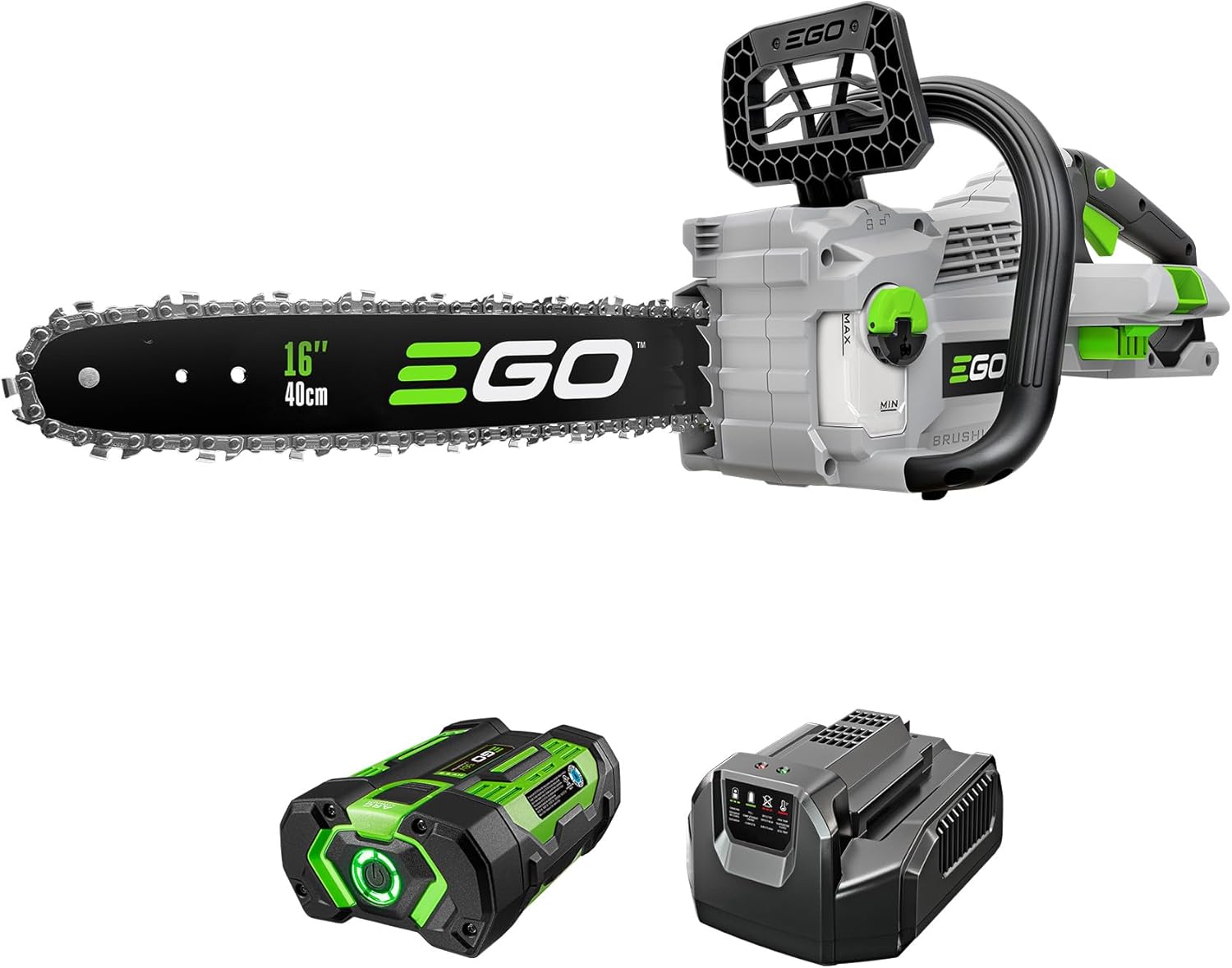
EGO POWER+ CS1611 16" Cordless Chainsaw with 56V 2.5Ah Battery and Charger
| Power Source | Battery Powered |
|---|---|
| Horsepower | 2.3 |
| Chain Length | 16 inches |
| Included Components | 2.5Ah Battery and Standard Charger |
| Chain Speed | 20 m/s |
The EGO POWER+ CS1611 is a battery-powered 16-inch chainsaw built to give prosumer-level cutting performance without gas. It uses a high-efficiency brushless motor rated as a 40CC equivalent and runs on the included 56V 2.5Ah ARC Lithium battery, which the manufacturer says delivers up to about 130 cuts through a 4×4 on a single charge. Notable features include a 20 m/s chain speed for efficient cuts, a tool-free chain-tensioning dial for quick on-the-job adjustments, automatic oiling with a spill-free reservoir, metal bucking spikes for secure cutting, and an IPX4 weather resistance rating. In real use this means quieter, low-maintenance operation compared with gas saws, fast setup between cuts, and enough runtime for routine property work like limb removal, small tree felling, and firewood prep. Limitations are battery runtime for very heavy or continuous commercial use and the saw’s 16-inch bar, which restricts maximum cut diameter compared with larger pro gas models.
Best for: Buyers wanting a low-maintenance, gas-free alternative that still delivers near-gas power for regular property maintenance, pruning, and medium-duty cutting tasks.
Less Ideal for: Users who need long uninterrupted runtime for commercial logging or must cut very large-diameter timber should consider larger gas or higher-capacity battery systems.
- Brushless motor with 40CC gas-equivalent power for strong cutting performance
- Includes 56V 2.5Ah battery and charger so it is ready to use out of the box
- Tool-free chain tensioning lets you adjust the chain quickly on site
- Automatic oiling with a spill-free reservoir keeps the chain lubricated during work
- IPX4 weather resistance and metal bucking spikes add durability and control in outdoor conditions
- 16-inch bar limits maximum cut diameter compared with larger pro chainsaws
- Runtime depends on battery capacity and may be insufficient for long, continuous heavy-duty jobs
Verdict: A ready-to-use cordless chainsaw that gives near-gas power and easy on-the-job adjustments, ideal for homeowners and pros doing regular medium-duty cutting.
VEVOR 62cc Gas Chainsaw with 20/22 in Guide Bars

| Power Source | Gas Powered |
|---|---|
| Horsepower | 3.8 hp |
| Chain Speed | 11800 RPM |
| Chain Length | 22 inches |
The VEVOR 62cc gas chainsaw is aimed at serious yard work and land clearing where power and run time matter. Its 3.8 horsepower two-stroke engine and top chain speed of 11,800 RPM make quick work of thick brush, fallen limbs, and medium-size logs, and the option of 20- or 22-inch guide bars increases reach for larger cuts. Practical features for field use include a throttle-synced choke intended to reduce flooding and faster starts, a reinforced pull rope and starter assembly built for repeated use, and safety elements such as a protective guard and lockout switch to lower accidental activation. The saw is supplied with an accessory kit and user manual to get you started, but as a gas tool it requires correct fuel mixing (40:1) and routine maintenance like chain sharpening and tensioning. Expect louder operation, routine noise and exhaust, and the need for basic mechanical comfort to keep it running reliably. For clearing brush and doing regular heavy pruning this saw delivers strong cutting performance, provided you maintain it and manage fuel and safety precautions.
Best for: Gardeners and landowners who prioritize efficient, powerful brush and small-tree clearing and who are comfortable with routine fuel mixing and basic chainsaw maintenance.
Less Ideal for: Urban users wanting low-noise, low-maintenance pruning or infrequent homeowners who prefer an electric or battery tool with simpler startup and no fuel handling.
- High 3.8 HP 62cc engine for fast cutting through hardwoods and thick brush
- Choice of 20- and 22-inch guide bars for extended reach and larger cuts
- Throttle-synced choke and reinforced starter components for easier starting in the field
- Safety guard and lockout switch reduce accidental activation and help control kickback risk
- Requires 2-stroke fuel mixing and regular mechanical maintenance
- Gas operation produces noise and exhaust compared with battery or electric options
Verdict: A high‑power gas chainsaw built to clear heavy brush and mid‑sized logs fast for buyers who value cutting speed and field durability.
SUPMIXTOOLS 62cc 20" Gas Chainsaw (2-Cycle)

| Power Source | Gas Powered |
|---|---|
| Horsepower | 4.2 hp |
| Chain Speed | 8500 Rpm/Min |
| Chain Length | 20 inches |
The SUPMIXTOOLS 62cc 20-inch gas chainsaw is a powerful 2-cycle saw built for homeowners and light pros who need strong cutting performance. It uses a 62cc 2-stroke engine that delivers high chain speed and roughly 4.2 horsepower, making it capable of cutting larger logs, limbing, and routine tree work. The saw ships with a 20-inch guide bar, low-kickback chain, basic toolkit, spare spark plug, and a fuel mixing bottle so you can get started after assembly. Practical benefits include strong cutting power for firewood and felling medium trees, an ergonomic balance that helps reduce fatigue during longer sessions, and a chain brake and safety switch for added protection. Note that it is a carbureted gas engine so you should expect routine maintenance such as mixing fuel, sharpening/adjusting the chain, and periodic tuneups; it is also heavier and louder than electric alternatives. If you need dependable, high-power cutting in areas without electricity, this model supplies the necessary performance but requires careful handling and upkeep.
Best for: Buyers who need a traditionally powered saw with strong cutting ability for firewood, tree trimming, and occasional felling and who prefer established gas-engine reliability over battery alternatives.
Less Ideal for: People who want the quietest, lowest-maintenance option or who primarily work in small yards with easy access to electricity should consider electric or battery chainsaws instead.
- Powerful 62cc 2-stroke engine suitable for demanding cutting tasks
- 20-inch guide bar and low-kickback chain for efficient cutting of larger logs
- Includes starter kit items useful for first-time setup (toolkit, spark plug, fuel bottle)
- Chain brake and safety switch for added operator protection
- Requires regular gas mixing, maintenance, and tuning typical of carbureted 2-stroke engines
- Heavier and louder than battery or electric chainsaws, which affects transport and noise
Verdict: Choose this saw if you need a robust gas-powered 20-inch chainsaw that delivers real cutting power for demanding outdoor jobs.
Husqvarna 120 Mark III 16-inch Gas Chainsaw

| Power Source | Gas Powered |
|---|---|
| Horsepower | 1.88 hp |
| Chain Length | 16 inches |
The Husqvarna 120 Mark III is a homeowner-focused gas chainsaw built to handle firewood cutting, light felling and pruning without complicated setup. It uses a 38-cc X-Torq two-stroke engine that delivers about 1.88 hp, a 16-inch chain and automatic oiler so you can get straight to work and keep the chain lubricated during use. Practical features include an air purge for easier starting, a combined choke/stop control to reduce flooding, a simple chain tensioning system for quick adjustments and an inertia-activated chain brake for added safety. LowVib dampening reduces operator fatigue and the Air Injection centrifugal cleaning helps keep large debris out of the air filter to extend service intervals. For a typical homeowner this saw offers a good balance of starting reliability, manageable power and comfortable handling. It is not aimed at heavy professional use and the user should be prepared for routine two-stroke maintenance and fuel mixing.
Best for: Homeowners who need a dependable, easy-to-start gas chainsaw for firewood, limb work and occasional small felling and who value manageable weight and user-friendly controls.
Less Ideal for: People who need a high-hour professional saw for commercial logging or landscapers who prefer electric models for low maintenance and quieter operation.
- Efficient 38-cc X-Torq engine provides reliable power for common homeowner tasks
- Air purge and combined choke/stop control make cold starts and restarting easier
- LowVib system reduces vibration for more comfortable handling during longer jobs
- Air Injection centrifugal system helps keep large debris out of the air filter to reduce maintenance
- Simple chain tensioning and automatic oiler make upkeep and on-the-job adjustments quick
- Designed for light to moderate work so it is not intended for prolonged professional logging
- Requires two-stroke fuel mixing and regular maintenance common to gas chainsaws
Verdict: A balanced, easy-to-start 16-inch gas chainsaw that suits homeowners who want reliable power and comfortable handling for routine yard work.
SEESII 12-Inch Cordless Brushless Chainsaw

| Power Source | Battery Powered |
|---|---|
| Horsepower | 1200 watts |
| Chain Length | 12 inches |
| Included Components | chainsaw |
The SEESII 12-inch cordless chainsaw is designed for homeowners and pros who need portable, high-power cutting without a generator. It pairs a 1200W brushless motor with two 4.0Ah batteries to deliver sustained cutting power for pruning, cutting storm debris, and working on small to medium logs. The tool-free chain tension system and automatic lubrication reduce downtime and routine maintenance, and the 60 mL oil tank helps keep the chain running smoothly during longer sessions. Because it is cordless and relatively lightweight for its class, it is easy to move around the yard or use at remote sites where cords are impractical. Important limits to note are the 12-inch bar, which constrains maximum log diameter compared with full-size saws, and battery reliance for very long jobs where alternating charged packs or a backup power source is needed. For straightforward woodcutting tasks this model balances cutting performance, convenience, and low maintenance.
Best for: Buyers who prioritize efficient, portable wood cutting for yard cleanup, pruning, and medium DIY projects and want a low-maintenance cordless saw they can move around the property easily.
Less Ideal for: Contractors or users who regularly need to fell large trees or process large-diameter logs should choose a full-size gas or professional electric chainsaw instead.
- 1200W brushless motor provides strong, efficient cutting power for hardwood and storm debris
- Two 4.0Ah batteries extend runtime for longer jobs and include a built-in charge indicator
- Automatic oiling with a 60 mL tank reduces frequent stops for lubrication
- Tool-free chain tensioning simplifies on-the-job adjustments
- Cordless, relatively lightweight design improves portability and use at remote sites
- 12-inch bar limits the maximum log diameter compared with larger professional chainsaws
- Runtime depends on battery swapping for extended heavy-duty cutting sessions
Verdict: A powerful, low-maintenance cordless 12-inch saw that maximizes portable cutting performance for homeowners and weekend woodworkers.
Choosing the Right Chainsaw for Clearing Brush: Key Factors to Consider
Engine or Motor Type and Power
The motor or engine determines how the saw performs under the frequent short bursts typical of brush clearing. Gas engines often provide high torque for thicker saplings and heavy vines, while battery models can deliver quick throttle response and lower maintenance. Look beyond peak horsepower to how the power is delivered in low-speed, high-resistance cuts. Consistent torque helps reduce stalls when the bar hits a knot or a dense tangle.
Consider how the power source affects run time, refueling or recharging logistics, and overall tool weight. For repeated clearing tasks, a slightly heavier unit with more torque can be less fatiguing than a light, underpowered saw that bogs down and forces you to make many more passes.
Bar Length and Chain Choice
Bar length influences reach and maneuverability in dense brush. Shorter bars, typically 12 to 16 inches, are easier to handle in tight spaces and reduce the risk of snagging on surrounding stems. Longer bars add reach but can be harder to control in tangles. Match bar length to the typical stem diameter you will cut most often.
Chain type and pitch are equally important. Low-kickback chains and narrower pitches resist clogging and are easier to tension in the field. For brush work, chains that shed debris and maintain a sharp bite under dirty conditions will keep cutting speed steady and reduce the number of stops for sharpening.
Weight, Balance, and Anti-vibration
Clearing brush means sustained periods of short cuts, often in awkward positions. A saw that is light but poorly balanced can increase shoulder and wrist strain. Balance matters more than absolute weight: a well-balanced unit positions the bar where your hands expect it and reduces corrective muscle work. Anti-vibration mounts and dampers reduce fatigue and make it easier to maintain accurate cuts during repetitive tasks.
Also consider handle shape and grip material. Comfortable, non-slip grips let you maintain control when sweat or brush debris makes surfaces slick. If you frequently work from a ladder or slope, prioritize models with reachable controls and a predictable center of gravity.
Safety Systems and Kickback Reduction
Brush clearing exposes you to twisted stems and unexpected contact, which raises the risk of kickback. Effective safety systems reduce that risk and make recovery easier if a kickback occurs. Look for reliable chain brakes, low-kickback chain designs, and inertia-based systems that stop the chain quickly. A clear, well-located kill switch and throttle interlocks help prevent accidental acceleration.
Training and personal protective equipment are still essential, but choosing a saw with robust mechanical protections lowers the chance of a serious incident during aggressive clearing work.
Ease of Field Maintenance
When you are deep in the yard or on a long clearing project, you will need to maintain chain tension, clean air and fuel filters, and sometimes replace spark plugs or batteries. Tools with tool-free chain tensioning, easy access to filters, and straightforward chain replacement save time and keep downtime low. Battery saws that allow quick battery swaps or gas saws with easily reachable service points are more practical for extended brush-clearing days.
Consider availability of common consumables like chains, bars, and air filters in your area. A saw that is finicky to service or requires special tools will slow progress and add frustration.
Chain Sharpening and Durability
Brush clearing often dulls chains quickly because of dirt, grit, and repeated contact with small knots. Chains that are easy to sharpen in the field and that hold an edge longer reduce maintenance stops. Look for chains with accessible cutter profiles and consider carrying a compact sharpening kit that matches the chain pitch. Durable guide bars and robust sprockets withstand repeated impacts from hidden stones and thick vines.
Longevity also includes corrosion resistance and protective coatings that help parts survive wet conditions commonly encountered when clearing overgrown areas.
When a Brush-Specific Saw Is Worth It
If you frequently deal with dense undergrowth, repeated sapling removal, or tangled vines, a saw tuned for brush clearing saves hours and reduces physical strain. These saws trade some finesse for robustness, with bar and chain setups that resist clogging and engines or motors that maintain torque under load.
Occasional pruning or light limb work does not require a brush-focused tool. But if you are removing dozens of stems, reclaiming a neglected fence line, or preparing a large area for restoration, the productivity advantages become clear.
- Best for repetitive short cuts and frequent stops
- Handles dirty, knotty wood better than trimming-only saws
- Often includes ergonomics for long sessions
Prep and Techniques for Safer Brush Clearing
Clear a working path before starting and remove hidden hazards like wire, rocks, and grown-in debris. Work from solid footing and keep bystanders well away. For heavy tangles, begin at the top of a patch and remove outward to avoid trapping limbs under tension.
Use controlled, shallow cuts rather than trying to force through large stems in a single pass. If a stem binds, release tension slowly and reposition the cut so the chain does not pinch. Regularly stop to check chain tension and clear debris from the bar groove and sprocket area.
- Cut tangles from the top down to avoid trapped limbs
- Make shallow, controlled cuts to reduce kickback risk
- Stop frequently to clear debris and check chain tension
Power Source Tradeoffs in Practice
Gas saws give longer continuous runtime and higher torque for thicker saplings, which matters if you are clearing a large area. They require fuel mixing in some two-stroke engines and periodic spark plug or carburetor attention. Battery saws offer quieter operation, instant starts, and less maintenance, but battery life and recharge logistics limit continuous heavy-duty use.
Electric corded saws are uncommon for remote brush work because of the need for extension power. Choose the power type that matches your typical project size, access to electricity, and tolerance for routine maintenance.
- Gas: best for long, remote clearing sessions
- Battery: lower maintenance and quieter, best with spare batteries
- Corded: limited to accessible sites with reliable power
Protective Gear and Site Safety
Always pair the saw with appropriate PPE. Eye protection, hearing protection, cut-resistant chaps, gloves, and sturdy boots are essential when clearing brush. A helmet with a face shield is useful when working in overhead tangles or near small falling limbs.
Plan for emergency procedures and keep a first-aid kit nearby. Ensure you have a communication plan if you work alone, and avoid clearing on steep slopes or unstable ground where slipping could cause loss of control.
- Wear hearing and eye protection plus cut-resistant chaps
- Check footing and clear trip hazards before cutting
- Carry a first-aid kit and a way to call for help
Maintaining Cutting Speed Between Sharpening
Keep a compact sharpening file and spare chain or a second battery in your kit. Dull chains increase strain and make kickback more likely. Regularly remove built-up sap and debris from the chain and bar to keep the saw cutting efficiently.
Use a chain dressing stone or file to remove corrosion and minor nicks that slow cutting. For longer jobs, plan short maintenance stops instead of pushing with a dull chain, which wastes time and increases wear on the tool.
- Carry a match-sized sharpening kit for field touch-ups
- Rotate spare chains or batteries to maintain continuous work
- Clean bar groove regularly to prevent binding
How We Chose the Best Chainsaw for Clearing Brush
We focused on tools and features that matter when you are clearing brush rather than doing fine pruning or felling large timber. Selection started with models and configurations that deliver consistent cutting through small-diameter saplings, vines, and dense undergrowth. We prioritized cutting performance, measured by chain speed and bar/chain combinations suited to brush work. Handling and control were key, including weight distribution, anti-vibration features, and throttle responsiveness for repeated short cuts. Safety features such as effective chain brakes, low-kickback chains, and easy-to-reach shutoffs were required. Serviceability and field maintenance were also considered, including chain replacement, tensioning, and filter access. We excluded tools designed primarily for occasional light pruning, multipurpose household trimmers, and specialized professional felling rigs that are overkill for brush clearing. Products that lacked basic safety systems or were notably difficult to maintain in the field were removed from consideration.
FAQ
What bar length is best for cutting dense brush?
For brush clearing, bars between 12 and 16 inches balance reach and maneuverability. Shorter bars are easier to handle in tangles, while longer bars help with slightly larger saplings. Choose based on the typical stem diameter you encounter.
Are battery chainsaws powerful enough for brush work?
Battery chainsaws can be effective for brush, especially with high-capacity batteries and when you can swap cells. They offer quick throttle response and low maintenance, but may struggle with long sessions or very thick saplings compared with gas models.
How often should I sharpen the chain when clearing brush?
Sharpening frequency depends on dirt and grit exposure, but expect to touch up the chain far more often than for clean-cut pruning. Check the chain every 20 to 30 minutes of heavy clearing and sharpen as soon as cutting slows or you need to apply extra force.
What maintenance matters most in the field?
Chain tension, bar groove cleaning, and keeping the chain lubricated are the most important field checks. For gas saws, quick checks of air filter condition and fuel mix help prevent stalls. For battery saws, monitor charge and have spare batteries ready.
Is a low-kickback chain worth choosing for brush?
Yes. Low-kickback chains reduce the likelihood of dangerous reactions when the nose of the bar contacts a stem or when cuts bind. They may cut a bit slower but increase safety during aggressive clearing tasks.
Final Verdict
Prioritize the features that match how and where you clear brush. If you work long stretches in remote areas, power and serviceability matter most. If you clear small patches near the house, weight, low noise, and quick starts may be more important. Balance cutting power, chain choice, handling, and safety systems to suit your typical conditions. Focusing on those tradeoffs will help you pick a chainsaw that keeps you productive and safer while reclaiming overgrown areas.
