

Note: This article contains affiliate links. If you click on these links and make a purchase, I may earn a small commission at no extra cost to you. This helps support my research and content. Read my full affiliate disclosure here.
Picking the right fertilizer for mustard greens matters because these leafy brassicas respond quickly to available nutrients and soil conditions. The wrong feed can burn tender roots, push too much leaf growth at the wrong time, or change flavor. This guide covers seven shortlisted fertilizers chosen for real garden situations-containers, raised beds, and in-ground rows-and explains why each option made the cut. You will see how we evaluated nutrient ratios, application ease, and soil health impact so you can match a fertilizer to your planting style and harvest goals. Read on for practical guidance before the product details.
Top Picks at a Glance
| Best Overall The best all-around choice for most situations | YARDi Brassicas & Greens Liquid Plant Food 32 oz (8-3-3) |  |
| Best Quality Built to a higher standard if you want something more solid | FoxFarm Grow Big Hydroponic Liquid Plant Food, 1 Pint |  |
| Best Value The sweet spot between price and what you get | True Organic Herb & Leafy Greens Food, 4 lb |  |
| Best Budget The cheapest option that still gets the job done reliably | Miracle-Gro Pour & Feed Singles Ready-to-Use Plant Food |  |
| Highest Rated A top-rated pick with lots of positive feedback | Tank's Green Stuff 100% Organic SuperMix Fertilizer, 10 lb |  |
| Most Popular A crowd favorite that many people choose with confidence | Miracle-Gro Water Soluble All Purpose Plant Food, 1.5 lb |  |
| Best Seller A high-volume bestseller chosen again and again | Miracle-Gro Watering Can Singles All Purpose Plant Food, 24 Packets |  |
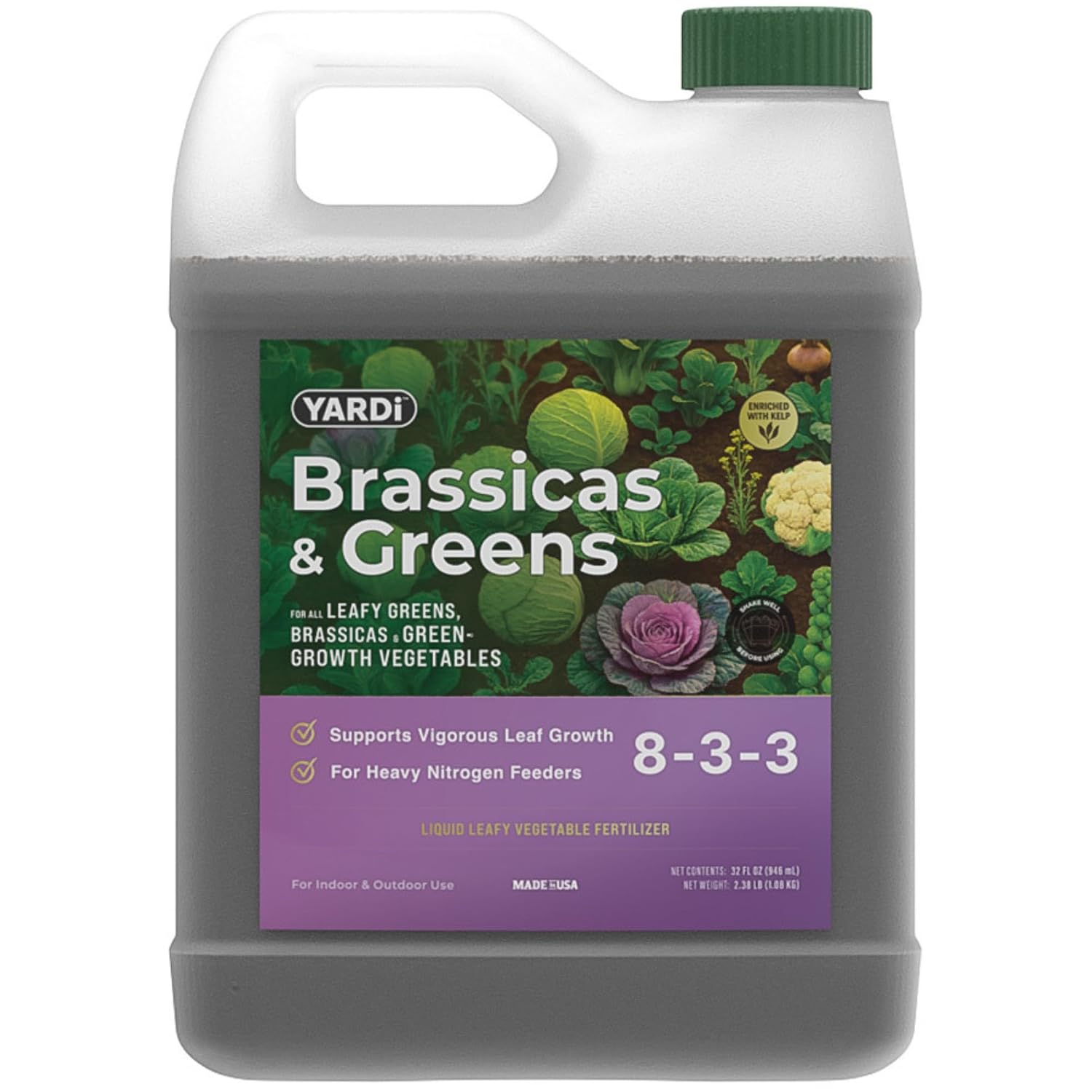
YARDi Brassicas & Greens Liquid Plant Food 32 oz (8-3-3)
| Item Form | Liquid |
|---|---|
| Specific Uses For Product | Leafy Greens |
| Target Species | Vegetables |
| Unit Count | 32 Fluid Ounces |
This 32-ounce YARDi liquid plant food is a nitrogen-forward 8-3-3 concentrate designed for outdoor brassicas and salad greens. It mixes easily with water (the label suggests 1–2 teaspoons per gallon) and can be applied as a soil drench, foliar spray, through drip irrigation, or with a hose-end applicator, making it flexible for beds, raised planters, and small-scale vegetable plots. The higher nitrogen ratio promotes lush, dark green foliage and sustained leafy growth in crops like kale, cabbage, broccoli, spinach and lettuce, and the formula includes micronutrients to support overall plant vigor. Practical benefits include straightforward dilution instructions and multiple application methods so you can feed regularly every 2–3 weeks during the growing season. Limitations are that the product is targeted to leafy vegetables and may be less appropriate for fruiting or flowering stages where balanced or phosphorus-heavy feeds are preferred, and frequent foliar or high-nitrogen use can require monitoring to avoid excess vegetative growth at the expense of yield.
Best for: Gardeners who prioritize big, healthy leaves on brassicas and salad greens and want a simple liquid feed they can use across beds and containers throughout the season.
Less Ideal for: Growers focused on flowering or fruiting crops or those who prefer granular slow-release fertilizers for low-maintenance feeding.
- High nitrogen 8-3-3 formula tailored for vigorous leafy growth
- Liquid concentrate that dilutes easily for foliar, soil drench, drip, or hose-end use
- Clear directions for regular feeding every 2–3 weeks during the season
- Includes micronutrients to support plant vigor beyond basic NPK
- Formulated specifically for leafy greens so not ideal as an all-purpose or bloom-promoting fertilizer
- Requires regular applications and careful dosing to avoid excessive leafy growth
Verdict: Choose this liquid 8-3-3 feed when your goal is consistently lush, vigorous leafy growth in brassicas and salad greens.
FoxFarm Grow Big Hydroponic Liquid Plant Food, 1 Pint

| Item Form | Liquid |
|---|---|
| Specific Uses For Product | Hydroponic |
| Liquid Volume | 16 fluid ounces |
| Mixing Ratio | 2-3 teaspoons per gallon |
FoxFarm Grow Big Hydroponic is a liquid concentrate designed to drive fast vegetative growth in hydroponic systems. You mix 2 to 3 teaspoons per gallon and feed throughout the vegetative phase to boost leaf and stem development, which is exactly what leafy crops like mustard greens need before heading into harvest. The 3-2-6 NPK balanced for growth, plus micronutrients and earthworm castings, supports strong cell expansion and greener foliage, and the product is formulated for quick uptake in recirculating and standalone setups. Practical benefits include easy dosing, compatibility with standard hydroponic feeding schedules, and guidance to switch to bloom formulas when flowering begins. Important limitations are that it is focused on vegetative performance rather than flowering or fruiting, and you should monitor EC/ppm and pH (recommended 5.8 to 6.3) to avoid nutrient lockout or overfeeding. For growers seeking predictable, growth-focused feeding for leafy greens, this is a straightforward option; those wanting an all‑in‑one grow-to-bloom program will need additional products for later stages.
Best for: Growers who prioritize strong, fast vegetative development in hydroponic setups and want a reliable, easy-to-dose product to maximize leaf growth for crops like mustard greens.
Less Ideal for: Gardeners who need a single fertilizer to cover both vegetative and flowering/fruiting stages or those who prefer soil-only organic amendments as their primary feed.
- Formulated for rapid vegetative growth with a 3-2-6 NPK ratio suited to leafy crops
- Contains micronutrients and earthworm castings to support healthier foliage
- Liquid concentrate mixes easily at 2–3 teaspoons per gallon for simple dosing
- Designed specifically for hydroponic systems for fast nutrient uptake
- Focused on vegetative stage only so you need separate bloom formulas for flowering
- Requires pH and EC/ppm monitoring to avoid nutrient imbalances
Verdict: Use this concentrated hydroponic grow formula when you want fast, reliable vegetative growth to bulk up mustard greens before harvest.
True Organic Herb & Leafy Greens Food, 4 lb

| Unit Count | 64 Ounce |
|---|---|
| Item Form | Granules |
| Mixing Ratio | 4-4-6 |
| Coverage | Large |
| Included Components | 100% Made in the USA with Organic Inputs |
True Organic Herb & Leafy Greens Food is a 4 lb granular organic fertilizer formulated for herbs and leafy greens, including lettuce. It supplies a balanced nutrient profile (4-4-6) with 3% of the nitrogen in a slow-release form plus added calcium and sulfur to support leafy vigor and reduce tip burn. The formula uses organic inputs such as seabird guano, shell meals, poultry manure and soybean meal, so it also contributes organic matter and supports soil biology. Use monthly during the growing season by working granules into the topsoil for in-ground beds or side-dressing containers; one bag covers roughly 70 sq ft. Practical benefits include steady, broad-spectrum nutrition suited to repeated applications and compatibility with both beds and pots. Expect gentler, longer-lasting feeding compared with synthetic salts, but realize nitrogen levels are modest so very heavy-feeding or rapid-growth scenarios may see slower responses. Also, as an organic granular product it requires regular application and soil contact to release nutrients, so it is not an instant foliar fix.
Best for: Gardeners who want an organic, soil‑building fertilizer for steady, reliable leafy green production and who plan monthly maintenance feeding.
Less Ideal for: Growers seeking fast, high‑nitrogen quick fixes for very rapid growth or those who prefer foliar or water‑soluble feeding methods.
- Balanced N-P-K suitable for leafy crops (4-4-6) with some slow-release nitrogen
- Contains calcium and sulfur which help leaf quality and reduce physiological disorders
- Made from organic inputs that build soil organic matter and support microbial activity
- Works for both in-ground beds and container lettuce with monthly applications
- Modest nitrogen percentage may produce slower green-up compared with high‑nitrogen synthetic feeds
- Requires soil incorporation and regular monthly reapplication to be effective
Verdict: Choose this organic granular fertilizer if you want a soil‑building, balanced feed that reliably supports healthy lettuce and leafy greens with monthly applications.
Miracle-Gro Pour & Feed Singles Ready-to-Use Plant Food

| Item Form | Liquid |
|---|---|
| Application Method | Pour |
| Coverage | Medium |
| Unit Count | 2 Ounce |
| Specific Uses For Product | Plant Food |
Miracle-Gro Pour & Feed Singles are single-use, pre-measured liquid doses that you snap open and pour onto the soil of container plants, so there is no mixing, measuring, or long-term storage. Each 2-ounce single is formulated for potted plants and is intended to feed 12 to 18-inch containers every 10 to 14 days, making it convenient for quick top-ups on vegetables grown in pots. The cap-measure instructions and pour application simplify regular feeding, and the ready-to-use format reduces the chance of over- or under-dosing. Practically, these work well for growers who rotate several small vegetable containers or need an easy solution when juggling many plants. Limitations are that the singles are sized for medium pots only, so very small or very large containers may need adjusted amounts or additional applications, and the format creates more single-use packaging than bulk concentrates. For gardeners prioritizing simplicity and predictable dosing, the product streamlines weekly feeding for container vegetables, but those managing large numbers of pots may prefer a concentrated liquid or granular option for lower per-application cost and less waste.
Best for: Ideal for hobby gardeners growing a few container vegetables who want a no-fuss, predictable feeding routine and value convenience over lowest cost.
Less Ideal for: Not the best choice for producers managing many pots or those focused on minimizing packaging waste or per-application cost.
- Ready-to-use pre-measured singles eliminate mixing and measuring
- Simple pour application designed for container plants
- Labels recommend a clear 10 to 14 day feeding schedule for consistency
- Portable single doses are convenient for spot feeding or travel
- Singles are sized for 12–18 inch pots and may not match very small or very large containers
- Single-use packaging generates more waste than concentrated formulas
Verdict: An easy, no-mix feeding solution that makes consistent fertilizing of medium container vegetables fast and foolproof.
Tank's Green Stuff 100% Organic SuperMix Fertilizer, 10 lb

| Item Form | Powder |
|---|---|
| Specific Uses For Product | Organic |
| Unit Count | 160 Ounce |
| Mixing Ratio | 1:0 |
Tank's Green Stuff SuperMix is an OMRI-listed powdered organic fertilizer sold in a 10 lb bag and intended for broad garden use. It is designed to be applied to vegetables, flowers, trees, fruits, succulents and cacti and is presented as easy to use in dry form. Typical use is top-dressing or mixing into potting media and garden beds to supply slow-release organic nutrients across a variety of plant types. Notable features include its organic certification and a simple mixing ratio listed by the manufacturer. Practical benefits are steady nutrient delivery suitable for mustard greens and other leafy vegetables, low handling fuss compared with liquid feeds, and compatibility with organic gardening systems. Important limitations are that the product listing gives minimal nutrient analysis or N-P-K values, so precise feeding rates and timing for high-yield mustard green production will require trial or supplemental information, and the powdered form can be dusty if not applied carefully.
Best for: Buyers who prioritize organic, low‑risk soil amendments for everyday vegetable beds and want a straightforward, general-purpose product to support leafy greens like mustard.
Less Ideal for: Growers who need precise, high‑nitrogen formulations or detailed nutrient analysis for commercial-scale mustard green production should consider a fertilizer with a published N-P-K and guaranteed analysis.
- OMRI-listed 100% organic formula suitable for certified organic gardens
- Powder form is easy to mix into soil or use as a top-dress
- Broad compatibility with vegetables, flowers, trees, fruits and succulents
- No detailed N-P-K or guaranteed analysis provided on the listing
- Mixing ratio and application guidance are minimal so users must determine ideal rates for heavy-feeding crops
Verdict: A reliable, OMRI-listed organic powder for gardeners who want a simple all-purpose fertilizer to support mustard greens and other vegetables.
Miracle-Gro Water Soluble All Purpose Plant Food, 1.5 lb

| Item Form | Powder |
|---|---|
| Application Method | Watering Can |
| Target Species | For all flowers, vegetables, trees, shrubs and houseplants |
| Mixing Ratio | 24-8-16 |
Miracle-Gro Water Soluble All Purpose Plant Food is a powder concentrate you mix with water to give a quick nutrient boost to flowers, vegetables, houseplants, shrubs and trees. It is typically dissolved in a watering can or used with a compatible garden feeder to soak soil at the base of plants, delivering nitrogen-heavy nutrition that shows effects faster than granular fertilizers. Notable features include an easy scooping method for indoor and outdoor dosing, compatibility with containers and in-ground planting, and clear directions for feeding every one to two weeks. In practice this makes the product a convenient option when you want visible growth and greener foliage quickly, and the 1.5 lb container covers roughly 600 sq. ft. Important limitations are that it is a fast-release, high-nitrogen formula best used as a regular quick feed rather than a long-term slow-release solution, and it requires careful measuring to avoid overfeeding. For routine maintenance combine with good watering and follow the label to avoid nutrient imbalance.
Best for: Buyers who prefer proven, easy-to-use feeding routines and want noticeable growth quickly for a variety of garden and houseplants, guided by established usage directions and broad user experience.
Less Ideal for: Gardeners seeking a single, long-term slow-release solution or those who prefer organic or low-nitrogen fertilizers for sensitive plantings should consider alternative products.
- Water-soluble powder starts working quickly at the roots when mixed and applied
- Clear, simple dosing for indoor and outdoor use with included scoop guidance
- Suitable for a wide range of plants including vegetables, flowers, shrubs and houseplants
- Covers a large area from a small container (about 600 sq. ft. per 1.5 lb)
- Fast-release formula means benefits are short-term compared with slow-release granular fertilizers
- Requires precise measuring and regular reapplication to avoid overfeeding
Verdict: A reliable, fast-acting water-soluble plant food for gardeners who want easy, repeatable feeding and quick visible results.
Miracle-Gro Watering Can Singles All Purpose Plant Food, 24 Packets

| Number of Packs | 24 |
|---|---|
| Unit Count | 10.24 Ounce |
| Item Form | SOLID |
| Application Method | watering can |
| Mixing Ratio | 1 teaspoon per 1 gallon of water |
Miracle-Gro Watering Can Singles are single-use, pre-measured fertilizer packets intended to make feeding roses and other garden plants simple and reliable. To use, tear a packet into a watering can, add the specified amount of water, then apply the solution while watering; the manufacturer recommends feeding every 7 to 14 days during active growth. The packets remove measuring errors and mess, which helps prevent accidental overfeeding. Because the formula is labeled for all flowers, vegetables, trees and shrubs, it fits into regular rose care routines for bloom and bush development. Practical benefits include instant solubility, clear application instructions for outdoor and indoor containers, and consistent coverage per packet for about 10 sq. ft. of garden. Limitations are that you must keep up with the every-1–2-week schedule for best results and that the product is sold as a general-purpose feed rather than a rose-specific bloom booster, so dedicated rosarians seeking targeted NPK ratios might prefer a specialized rose fertilizer.
Best for: Gardeners who want a low-risk, no-mess way to feed roses and mixed flower beds as part of routine watering and prefer simple, foolproof dosing.
Less Ideal for: Specialist rose growers seeking a targeted bloom-boosting formula or those who want a single, slow-release application instead of frequent liquid feedings.
- Pre-measured packets eliminate measuring and reduce mess and dosing errors
- Water-soluble formula mixes quickly in a watering can for immediate application
- Labeled for use on flowers, roses, shrubs, trees and vegetables so it suits mixed beds
- Clear directions for indoor and outdoor application and coverage per packet
- General all-purpose formula rather than a rose-specific NPK for bloom boosting
- Requires regular reapplication every 7–14 days to maintain results
Verdict: If you want a safe, fuss-free way to feed roses while you water, these pre-measured soluble packets make regular feeding simple and consistent.
Choosing the Right Fertilizer for Mustard Greens: Key Factors to Consider
Nutrient Ratio and Timing
Mustard greens are leafy vegetables that favor nitrogen for lush, tender leaves. Choosing a fertilizer with a higher first number in the N-P-K ratio supports leaf development, but you must balance that with adequate potassium and modest phosphorus so root development and stress tolerance are not neglected.
Timing matters because seedlings need a gentler feed while established plants benefit from regular, lighter boosts. Overapplying nitrogen early can force rapid growth with weak stems. Staggered, measured feeding aligned to planting stages reduces the chance of nutrient burn and maintains steady production.
Formulation and Release Pattern
Liquid feeds provide fast-acting nutrients and are useful for quick green-up or when growing in containers with limited soil volume. Granular soluble fertilizers deliver a measured dose when watered in and are convenient for side-dressing. Slow-release or coated granules reduce application frequency and lower the risk of spikes in nutrient availability.
Consider how often you want to feed and how easy it is to water in applications. Quick-release formulas are helpful when deficiency symptoms appear, while slow-release options suit gardeners who prefer lower-maintenance feeding across a season.
Soil and Microbial Health
Fertilizers interact with soil biology. Organic and mineral-based products affect microbial communities differently. Options that feed soil life support longer-term fertility and can improve nutrient cycling for successive crops. High-salt synthetic feeds can stress beneficial microbes and harm seedlings in light or shallow soils.
If you regularly amend beds with compost, choose fertilizers that complement organic matter rather than overwhelm it. In container gardening, where microbial buffering is limited, gentler feeds and careful dosing protect root systems.
Application Safety and Handling
Many garden fertilizers are concentrated and can cause burns to roots or foliage if misapplied. Clear label instructions, readily measured dosages, and low risk of splash damage matter for small vegetable plots. Ease of rinsing and the physical form during handling-powder, granule, or liquid concentrate-also affect safety.
Gardeners who share tasks with family or volunteers should favor products with simple, low-risk directions and obvious dilution rates to avoid accidental overapplication.
Suitability for Containers and Small Beds
Containers and small raised beds have different nutrient dynamics than in-ground rows. Limited soil volume in pots means nutrients are used or leached faster, so fertilizer type and frequency must compensate without causing salt buildup.
Choose formulas intended for container vegetables or apply reduced rates more frequently. Water-soluble feeds and foliar sprays can be practical in confined spaces, while slow-release beads may be preferable when you want to avoid weekly dosing.
Impact on Flavor and Leaf Texture
The nutrient mix influences not just yield but also flavor and leaf structure. Excessive nitrogen can create watery, mild-flavored leaves, while balanced feeding that includes sulfur and magnesium can sharpen typical mustard greens bite and color.
Think about your culinary goals. If you want punchy, peppery leaves, aim for a balanced approach that avoids pushing extreme vegetative growth at the expense of mineral-driven flavor compounds.
Feeding Schedules for Different Growing Setups
Establish a feeding rhythm that matches your planting method. For containers, plan lighter, more frequent feeds because pots drain salts and deplete nutrients quickly. For raised beds and in-ground rows, a pre-plant amendment with compost and a measured side-dressing during the growing season is often sufficient.
Seedlings and transplants need gentler formulations and lower concentrations to avoid root stress. Mature mustard greens respond to a mid-season boost when leaf production slows. Adjust schedules when weather is cool or hot, since nutrient uptake changes with temperature.
- Containers: low-dose liquid every 7 to 10 days or slow-release at planting
- Raised beds: compost at planting plus one granular side-dress mid-cycle
- Succession planting: lighter, regular feeds to maintain steady growth
Adjusting Fertilizer Use for Flavor Preferences
If you prefer milder leaves, lean toward slightly higher nitrogen and consistent watering to keep tissues tender. For more pungent, peppery mustard greens, include sources of sulfur and avoid overfeeding nitrogen late in the crop cycle.
Foliar sprays with micronutrients can correct subtle deficiencies that affect taste without dramatically altering growth patterns. Always test on a small patch before treating a whole bed.
- Promote mild flavor: steady nitrogen, even moisture
- Promote stronger flavor: balanced feed including sulfur, moderate nitrogen late season
Organic Vs Synthetic Options in Home Gardens
Organic fertilizers release nutrients more slowly and usually improve soil structure and microbial activity over time. They are forgiving in small garden plots but may not correct acute deficiencies as quickly as soluble synthetics. Synthetic feeds act fast and can be precisely measured, which is useful for quick corrections or container crops.
Gardeners who focus on long-term soil health often blend both approaches: organic amendments for baseline fertility and targeted soluble feeds when rapid uptake is needed.
- Organic: slower release, improves soil life
- Synthetic: fast correction, precise dosing
- Combined approach: baseline organic feeding with occasional targeted boosts
Testing Soil and Interpreting Results
A simple soil test helps you choose the right fertilizer rather than guessing. Look for nitrogen availability, pH, and levels of magnesium and sulfur when testing for leafy brassicas. Soil pH affects nutrient availability; mustard greens prefer slightly acidic to neutral soils.
Use test results to adjust both the form and amount of fertilizer. For example, low magnesium calls for a supplement rather than more nitrogen. Re-test annually or after major amendments to track changes.
- Check pH and macronutrients before choosing a feed
- Adjust application rates to correct specific deficiencies
- Retest after major amendments or seasonal rotations
Practical Tips for Application and Avoiding Common Mistakes
Apply fertilzers evenly and water them in so nutrients reach the root zone. Avoid direct contact between concentrated granules and young stems to prevent foliage scorch. When using liquid concentrates, follow dilution guidelines and apply during cooler parts of the day.
Do not double-dose after a missed feeding; instead, resume a normal schedule at the correct rate. Watch plants for signs of overfertilization such as leaf tip burn, yellowing, or stunted growth and flush the soil with water if salts build up.
- Water in granular applications to move nutrients to roots
- Dilute concentrates correctly and avoid midday application
- Flush containers periodically to prevent salt accumulation
How We Chose the Best Fertilizer for Mustard Greens
We prioritized fertilizers that reliably support leafy brassicas and fit a range of home garden setups. Evaluation centered on nutrient profile suitability for mustard greens, measured as N-P-K balance and presence of secondary nutrients like magnesium and sulfur that influence leaf color and flavor. We also weighed application method and timing because liquid feeds, granular side-dressings, and slow-release formulas behave differently in containers versus beds. Another key filter was soil-health compatibility: options that complement compost and do not disrupt microbial life scored higher. We excluded specialty blends aimed only at flowering ornamentals or high-phosphorus lawn feeds that do not align with leafy crop needs. Finally, we checked for reasonable handling safety and clarity of label directions, since confusing instructions increase risk of overapplication in small-scale vegetable plots. The resulting picks reflect those criteria: nutrient fit for leafy brassicas, predictable release patterns, ease of use in common garden setups, and minimal negative impact on soil biology.
FAQ
How often should I fertilize mustard greens?
It depends on the formulation and growing method. Containers often need low-dose liquid feeds every 7 to 10 days. In-ground mustard greens usually do well with a pre-plant amendment and a single side-dressing mid-season, or lighter monthly applications.
Can I use a general vegetable fertilizer for mustard greens?
Often yes. Choose a general vegetable feed with a nutrient balance favoring nitrogen and containing potassium and micronutrients. Match application rates to plant size and soil fertility. Avoid feeds designed mainly for flowering or fruiting crops that have high phosphorus.
Will too much nitrogen make mustard greens taste bad?
Excessive nitrogen can make leaves watery and reduce intensity of flavor. Balanced feeding that includes sulfur and magnesium helps maintain the peppery, characteristic taste of mustard greens while supporting healthy growth.
Are foliar feeds useful for mustard greens?
Foliar sprays can quickly correct micronutrient deficiencies and give a short-term boost, especially in cool weather when root uptake is slower. They are not a substitute for proper soil fertility but are a good supplemental tool.
How do I avoid fertilizer burn in seedlings?
Use low-strength feeds for seedlings, dilute liquid concentrates beyond label minimums, and avoid placing undissolved granules near young roots. Start with gentler organic options or light soluble feeds until plants are established.
Does soil pH matter for nutrient uptake in mustard greens?
Yes. Soil pH affects availability of many nutrients. Mustard greens prefer slightly acidic to neutral soil. If pH is outside the optimal range, some nutrients may become less available even if present in the soil, so adjust pH before making big changes to fertilization.
Final Verdict
Choosing the right fertilizer for mustard greens is about matching nutrient timing and form to your garden setup and flavor goals. Prioritize a nutrient balance that favors leafy growth while including potassium and sulfur for plant vigor and taste. Consider how often you want to feed and whether containers or beds will determine release patterns. Focus on predictable release, clear application instructions, and soil-health compatibility when deciding. With that approach you can pick a fertilizer that supports steady production and the flavor profile you want without risking plant stress or nutrient imbalances.
