

Note: This article contains affiliate links. If you click on these links and make a purchase, I may earn a small commission at no extra cost to you. This helps support my research and content. Read my full affiliate disclosure here.
Dealing with fire ants in a yard or near play areas means choosing treatments that stop colonies while keeping people, pets, and beneficial wildlife safe. In many home gardens you want a product that reduces sting risk without introducing lingering toxic residues or harming pollinators. This guide looks at the top shortlisted safe fire ant killer options, explains the practical tradeoffs between speed and environmental impact, and outlines how we evaluated each product. Use the evaluation criteria to match a control method to your outdoor setting and safety priorities.
Top Picks at a Glance
| Best Overall The best all-around choice for most situations | Syngreen Diatomaceous Earth Food Grade Powder with Peppermint, 1 lb |  |
| Best Quality Built to a higher standard if you want something more solid | Wondercide Outdoor Pest Control Spray — 32 oz Ready-to-Use |  |
| Best Value The sweet spot between price and what you get | EcoVenger Ant Killer & Nest Treatment, 32 oz |  |
| Highest Rated A top-rated pick with lots of positive feedback | NCSIFDD Ant Away Ant Repellent Gel, 6-Pack |  |
| Most Popular A crowd favorite that many people choose with confidence | Safer Home Ant & Crawling Insect Killer Diatomaceous Earth (7 oz) |  |
Syngreen Diatomaceous Earth Food Grade Powder with Peppermint, 1 lb

| Item Form | Powder |
|---|---|
| Target Species | Insects |
| Active Ingredients | Diatomaceous Earth Food Grade, Peppermint Oil |
This Syngreen diatomaceous earth combines food-grade silica powder with peppermint oil to control crawling insects like ants, roaches, fleas, and bed bugs without synthetic pesticides. Apply a fine dust along baseboards, under appliances, in pantry corners, or around doorways for indoor protection, or dust garden edges and planters outdoors. The powder works mechanically by abrading insect exoskeletons so pests dehydrate, while the peppermint helps deter pests and leaves a fresh scent. It is simple to use with a shaker, brush, or gloved hand and can begin reducing activity within 24 to 48 hours, lasting for weeks in dry conditions. Important limitations: it must stay dry to remain effective so reapply after cleaning or rain, and it is a contact killer rather than a bait so it will not eliminate nests or hidden colonies by itself. For use around pets and children follow the directions carefully and avoid applying where animals will inhale dust.
Best for: Pet owners and families who want a low-toxicity, non-chemical solution to reduce indoor ant activity and spot-treat problem areas while avoiding synthetic insecticides.
Less Ideal for: People who need a fast colony-level eradication method or who expect long-lasting control in wet environments without frequent reapplication should consider professional or bait-based options instead.
- Food-grade diatomaceous earth provides a non-chemical, mechanical mode of action against crawling insects
- Added peppermint oil helps deter pests and leaves a pleasant scent compared with plain DE
- Versatile for indoor and outdoor use including baseboards, pantries, planters, and perimeter barriers
- Easy application with a shaker, brush, or glove and begins working within 24–48 hours
- Effectiveness requires staying dry and will be reduced by moisture or cleaning
- Kills on contact but does not function as a nest-targeting bait to eliminate colonies
Verdict: A pet-safe, non-chemical powder that reduces indoor ant and crawling insect activity with the added deterrent of peppermint when kept dry and applied to targeted areas.
Wondercide Outdoor Pest Control Spray — 32 oz Ready-to-Use
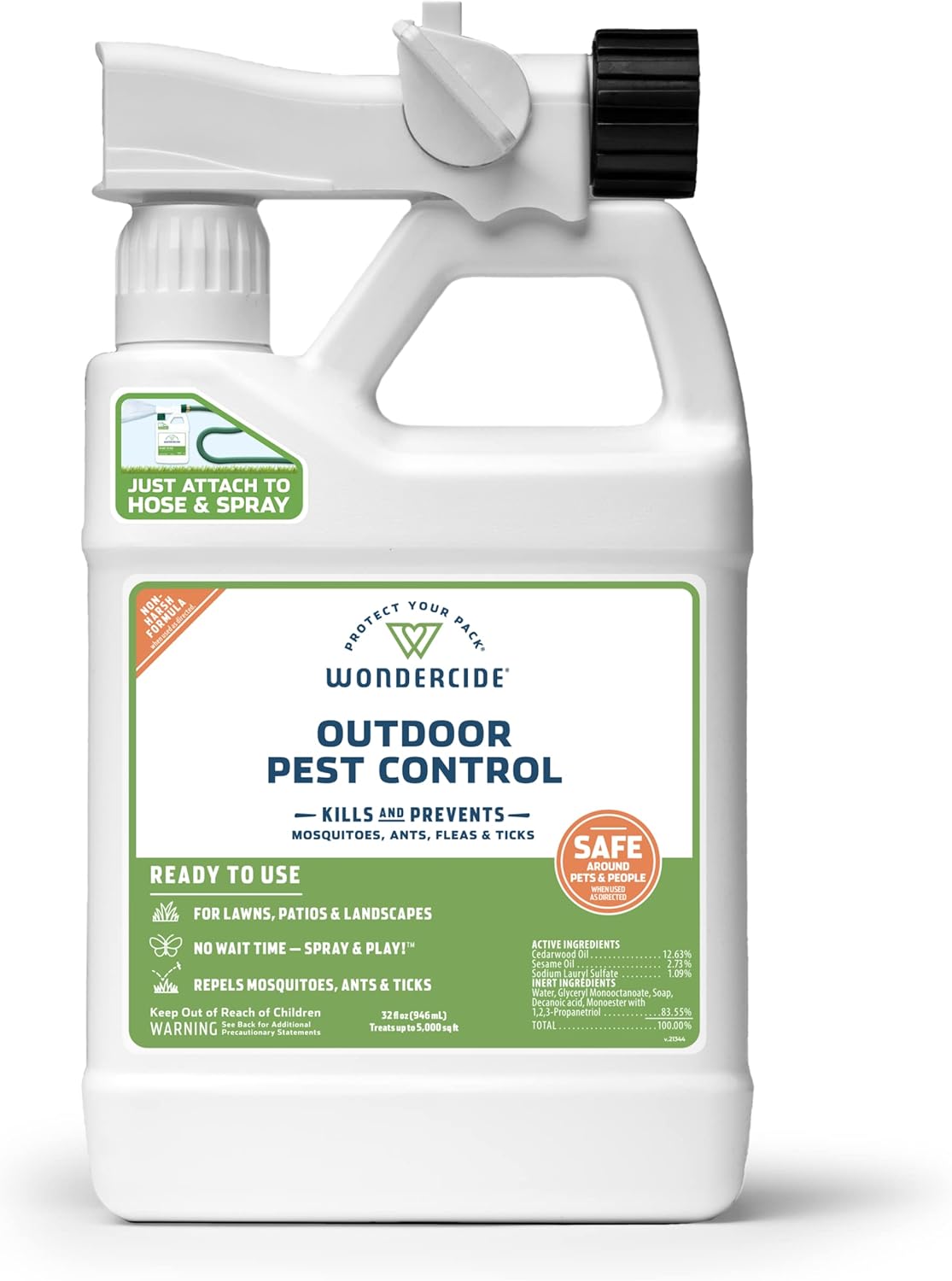
| Format | Pre-mixed, hose-end spray |
|---|---|
| Active ingredients | Cedarwood Oil 12.63%, Sesame Oil 2.73% |
| Coverage | Up to 5,000 sq ft (general); 2,500 sq ft (ticks/mosquito repel) |
Wondercide Ready-to-Use Outdoor Pest Control is a hose‑end spray designed for treating yards up to 5,000 sq ft for general pests and 2,500 sq ft for ticks and mosquito repellency. You attach the bottle to a garden hose, sweep the nozzle across lawns, patios, and foundation lines, and the cedarwood‑based formula delivers quick coverage with no dry time required. Notable features include plant-powered active ingredients (cedarwood and sesame oils), ready-to-use convenience, and instructions for both active infestations and preventative maintenance. Practical benefits are that it is safe to use around people and pets when directions are followed, residues are reported to be non-harmful to pollinators, and the hose attachment makes treating large areas fast. Important limitations are that effectiveness depends on water pressure, walking speed, and weather, heavy rain may require reapplication, and spraying in temperatures above 90°F or direct sun can cause plant burn. Users who need an all‑season, high‑durability pesticide for heavy infestations should plan on repeated applications and follow label precautions to protect sensitive plants.
Best for: Buyers who prioritize effective, plant‑based mosquito and tick control for medium to large yards and want a fast hose‑attached solution that is safe around families and pets when used as directed.
Less Ideal for: Gardeners who need a single, long‑lasting professional‑grade pesticide for severe, persistent infestations or who cannot reapply after rain should consider alternative, heavier‑duty treatments.
- Ready-to-use hose-end applicator for fast coverage of large yards
- Plant-based active ingredients (cedarwood and sesame oils) that target common yard pests
- No dry time required so kids and pets can re-enter treated areas quickly
- Covers up to 5,000 sq ft for general pest control and 2,500 sq ft for ticks/mosquito repellency
- May cause phytotoxic burning if applied in direct sun or temperatures above 90°F
- Performance depends on water pressure and user walking speed which can lead to uneven coverage
- Heavy rain can wash it away and requires reapplication
Verdict: If you want a fast, family- and pet-friendly plant‑based spray to reduce mosquitoes and ticks across a medium to large yard, this ready‑to‑use hose‑end formula delivers practical, repeatable results.
EcoVenger Ant Killer & Nest Treatment, 32 oz

| Unit Count | 32 Fluid Ounces |
|---|---|
| Item Form | Spray |
| Target Species | Odorous House Ants, Fire Ants, Roaches, Fleas, Spiders |
| Active Ingredients | Citronella Oil, Geraniol, Cedarwood oil, Sodium Lauryl Sulfate |
EcoVenger Ant Killer is a plant-extract spray formulated to kill house ants on contact, treat fire ant mounds, and leave a residual barrier that deters re-entry for up to four weeks. You use it like a standard ready-to-use spray: spot-treat visible trails, spray around entry points and saturate mound tops or nest openings to reach the colony. Notable features include a citronella/cedarwood/geraniol active blend, a user-friendly trigger sprayer and claims of university testing and professional use. In practice the product offers fast knockdown for foraging ants and the ability to deliver treatment down tunnels using the spray wand, which helps target queens in mounds. The botanical formulation is marketed as non-staining and safe to use around pets and children when directions are followed, and the light citrus scent dissipates quickly. Limitations are that efficacy details beyond labeled target species rely on manufacturer testing and heavier infestations may need repeated treatments or perimeter work; the nozzle has delicate parts so care is needed when handling.
Best for: Homeowners who prioritize effective, fast-acting ant control but want a pet- and child-friendly botanical option for indoor and outdoor use.
Less Ideal for: People needing an industrial-strength chemical treatment for very large or persistent infestations or those who prefer products supported by multiple independent field trials.
- Kills odorous house ants on contact and eradicates fire ant mounds when applied to the colony
- Botanical active ingredients (citronella, geraniol, cedarwood) offer a lower-toxicity alternative to conventional pesticides
- Provides residual repellency for up to four weeks to help prevent re-entry
- Suitable for indoor and outdoor use and formulated to be non-staining on carpets and fabrics
- Nozzle contains delicate parts that can be damaged and may require careful handling
- Manufacturer efficacy claims are based on internal or cited studies rather than independent third-party field trials
Verdict: A fast-acting, plant-powered ant spray that balances quick colony knockdown with a formulation designed for use around pets and children.
NCSIFDD Ant Away Ant Repellent Gel, 6-Pack

| Unit Count | 12 Count |
|---|---|
| Number of Pieces | 1 |
This ant repellent gel is a concentrated applicator product intended for targeted spot treatments around entry points, baseboards, window frames, and known ant trails. You remove the cap, attach the precision tip, and apply pea‑sized drops into crevices or along trails; the manufacturer notes it can take 3–5 days to work through a colony and helps keep ants away for up to 60 days in treated areas. Practical benefits include the narrow applicator for neat placement in tight gaps, suitability for both indoor and outdoor problem spots, and a formulation presented as family and pet safe when used as directed. Important limitations are that results are not instantaneous and multiple applications or placements may be needed to control larger or multiple colonies, and effectiveness depends on correctly locating trails and nest access points. For someone who wants a low‑mess, targeted solution rather than broad broadcast treatments, this gel is a convenient option.
Best for: Buyers who prioritize dependable, low‑mess spot treatment for recurring ant sightings and prefer a product they can place precisely where ants travel.
Less Ideal for: People needing rapid elimination of very large or widespread infestations or those who prefer broadcast sprays or professional colony eradication services.
- Precision applicator allows neat, pea‑sized placements in tight crevices and along ant trails
- Labeled for both indoor and outdoor use so the same product can treat kitchens, baseboards, and patios
- Formulation described as family and pet safe when used according to directions
- Single placements can provide protection in treated areas for up to 60 days
- Not an immediate knockdown—can take 3–5 days to affect a colony
- May require several placements and correct trail identification to fully control larger infestations
Verdict: Use this precision gel when you want a neat, family‑safe spot treatment that targets ant trails and entry points rather than a broad spray solution.
Safer Home Ant & Crawling Insect Killer Diatomaceous Earth (7 oz)
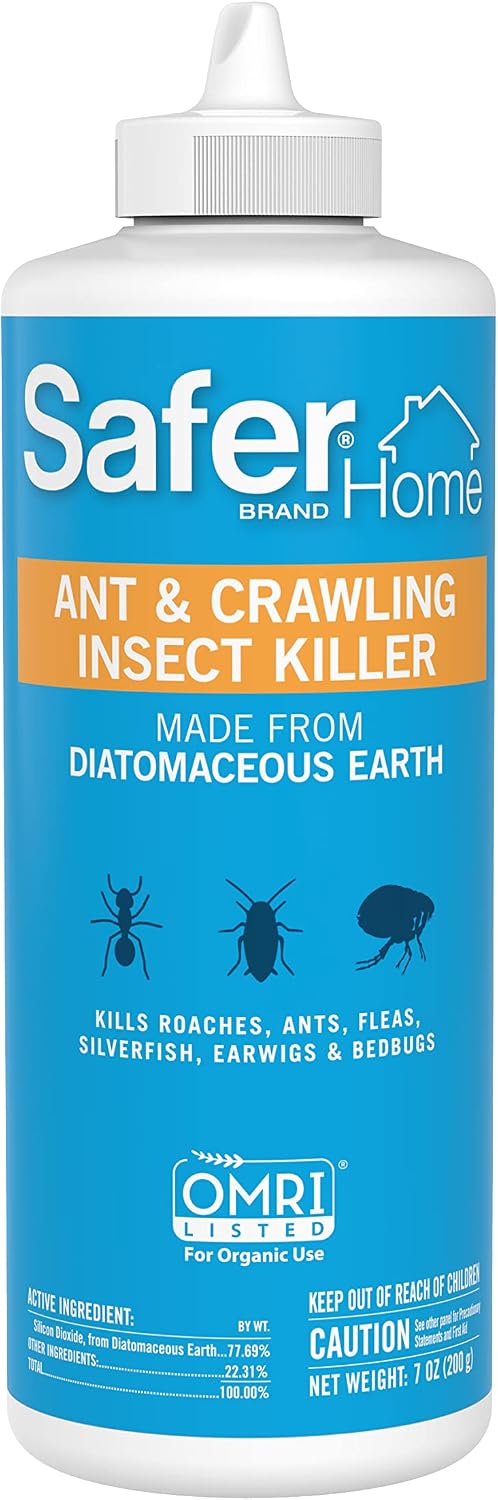
| Item Form | Powder |
|---|---|
| Target Species | Insects |
| Active Ingredients | Silicon Dioxide from Diatomaceous Earth 77.69% |
| Liquid Volume | 7 fluid ounces |
| Specification Met | EPA |
Safer Home Ant & Crawling Insect Killer is a 7 oz diatomaceous earth powder packaged in a puffer bottle for targeted application in cracks, along baseboards, and entry points. It works mechanically rather than chemically: microscopic silica particles abrade insect exoskeletons and desiccate pests that walk through or ingest the powder, with kills typically seen within 48 hours. The puffer makes it easy to place small amounts in tight spaces or to create a perimeter barrier outdoors, and the formula is OMRI listed for use in organic gardening. It is labeled for a broad range of crawling pests including earwigs, ants, roaches, fleas, and silverfish. Important limitations are that it must remain dry to be effective and needs reapplication after rain or watering, and larger infestations may take several days as insects must physically contact the powder. Use carefully to avoid dust inhalation and keep away from areas where fine powder could be spread by airflow.
Best for: Buyers who prioritize low-toxicity, evidence-backed solutions and want a product they can place precisely around the home or garden to control earwigs and other crawling pests.
Less Ideal for: People needing a fast surface spray for flying insects or those who prefer a single-application chemical barrier for heavy indoor infestations.
- Kills a wide range of crawling insects through a non-chemical, mechanical action
- Puffer bottle allows precise placement in cracks, crevices, and around entry points
- OMRI listed and suitable for use in organic gardening
- Effective within 48 hours after insect contact when kept dry
- Must stay dry and requires reapplication after rain or watering to remain effective
- Not an instant knockdown for large, established infestations since insects need to contact the powder
Verdict: A low-toxicity, OMRI-listed diatomaceous earth powder that gives precise, nonchemical control of earwigs and other crawling pests when applied and kept dry.
Choosing the Right Safe Fire Ant Killer: Key Factors to Consider
Active Ingredient and Mode of Action
Knowing the active ingredient is the first step to picking a safe fire ant solution. Some low-toxicity options use biological agents or insect growth regulators that interfere with reproduction rather than immediately killing foragers. Others rely on naturally derived oils or botanical extracts that repel or suffocate ants. Each mode of action affects how quickly visible activity declines and whether the queen and brood are controlled.
Assessing mode of action also helps predict non-target impacts. Broad-spectrum neurotoxins can affect beneficial insects and small wildlife more than targeted insect growth regulators. For a residential yard, prefer ingredients with short environmental persistence and documented safety labels for pets and children.
Application Method and Placement
How you apply a treatment changes both effectiveness and risk. Baits placed directly on or near a mound rely on foragers to carry toxicant back to the nest, which is effective at reaching queens when formulation and palatability are correct. Liquid drenches can collapse a mound quickly but may require larger volumes and could wash into soil where roots or water bodies are nearby.
Consider tools and user skill. Granules and baits are straightforward for homeowners; drenches and dusts require more care to avoid exposure. The ability to target individual mounds reduces overall chemical use and lowers the chance of affecting beneficial insects elsewhere in the yard.
Safety Around People, Pets, and Pollinators
Safety considerations should guide product choice and timing. Products that carry minimal exposure risk to children and pets and that do not persist on turf or flowering plants are preferable in family yards. Look for clear label guidance on reentry intervals, pet-safe statements, and recommended buffer times before allowing pollinator access to treated areas.
Also think seasonally. Treating when fewer pollinators are active, or avoiding broadcast treatments when flowers are present, reduces non-target exposure. Storage and mixing instructions matter too; many incidents occur during preparation and cleanup, so choose formulations that minimize handling of concentrated chemicals.
Speed Versus Long-Term Control
There is a tradeoff between rapid knockdown and durable colony suppression. Fast-acting contact products can reduce visible ants quickly but may leave the queen intact, allowing the colony to rebound. Slower-acting baits or growth regulators may take days to show results but can eliminate the reproductive capacity of the colony for longer-term control.
Decide whether you need immediate relief from stings or a longer-term management plan. In many yards, combining an initial mound collapse with follow-up baiting, timed according to label directions, gives the best balance between short-term safety and sustained reduction in infestation.
Environmental Persistence and Water Safety
Select products with low persistence in soil and minimal mobility toward waterways, especially if you have a pond, drainage ditch, or frequent irrigation. Some compounds break down quickly under sunlight and microbial activity, while others bind to soil and remain active longer. Longer persistence can mean extended protection but also greater risk to soil organisms and runoff.
Avoid broadcast treatments before heavy rain or irrigation events to limit runoff. Read label instructions about buffer zones near water and choose products with lower aquatic toxicity when water is nearby.
When to Use Targeted Mound Treatments
Treating individual mounds is the safest option for most home lawns and garden beds because it concentrates control where it is needed and reduces total chemical use. Targeted mound treatment is effective when infestation density is low to moderate and when you can locate the active nests.
Use mound-specific baits or drenches depending on whether you want slower systemic control or immediate reduction in forager numbers. Always follow label directions about how close to the mound to place bait and how much drench to apply to avoid excess runoff.
- Best for scattered infestations and yards with children or pets
- Reduces non-target exposure compared with broadcast applications
- Allows you to monitor and retreat only the mounds that persist
When Broadcast Treatments Make Sense
Broadcast treatments cover large areas quickly and are useful when infestations are widespread across a yard. Choose low-toxicity baits formulated for broadcast use and avoid applying when flowers are in bloom to protect pollinators.
Broadcast baits rely on foraging ants to find and distribute the product. Expect slower visible results than contact drenches, but broadcast baiting can suppress new colony formation across larger landscapes when done correctly.
- Useful for high-density infestations across lawns
- Follow timing guidance to reduce pollinator exposure
- Requires careful measurement to avoid overapplication
Integrating Cultural Controls
Non-chemical measures reduce reliance on active treatments and help prevent reinfestation. Practices such as reducing excessive mulch depth, sealing gaps around foundations, and managing irrigation to avoid standing water make yards less hospitable to fire ants.
Physical removal of small mounds with a shovel can be effective when used alongside safe chemical options. Encourage natural predators by maintaining diverse plantings and avoiding broad-spectrum insecticides that remove beneficial insects.
- Adjust irrigation and mulch to reduce suitable habitat
- Maintain healthy turf to limit exposed soil where colonies start
- Use mechanical mound removal for spot control where appropriate
Timing Treatments for Best Results
Fire ants are most active in warm months when foraging is strong. Baiting is most successful when ants are actively collecting food, typically in spring through fall depending on your climate. Treat during warm, dry weather when foragers are visible for best uptake.
Avoid treating when heavy rain or irrigation is expected, because moisture can dilute baits or move drenches off-target. If using growth regulators, understand that visible results may lag for several weeks while larvae and queen reproduction cycles are interrupted.
- Bait when ants are actively foraging for faster uptake
- Avoid application before heavy rain or watering
- Repeat treatments only as directed to prevent unnecessary exposure
Safe Storage, Handling, and Disposal
Even low-toxicity products require careful storage away from children and pets. Keep products in original containers with labels intact and store them in a locked cabinet or out of reach. Use gloves and avoid inhaling dusts or sprays during mixing and application.
Follow label instructions for disposal of unused product and empty containers. Never pour concentrated materials down drains or into storm sewers. Proper handling reduces accidental exposure and environmental contamination.
- Store sealed products out of reach and away from food
- Wear basic protective gear during mixing and application
- Dispose of leftovers according to local guidelines and the product label
How We Chose the Best Safe Fire Ant Killer
We shortlisted products and formulations that prioritize low human and pet toxicity while still delivering measurable colony suppression. Our editorial filters favored options with clear active-ingredient profiles, documented modes of action against fire ants, and application methods suitable for home yards, playgrounds, and patios. We prioritized products that allow targeted treatment to mounds or broadcast application with limited off-target impact. Concrete evaluation criteria used were speed of colony reduction, toxicity and safety profile, ease of application, longevity of control, and environmental impact including effects on non-target insects and soil. We excluded agricultural-only chemistries, professional-only fumigants, and products that lack clear usage instructions for residential settings. We also screened out options that require specialized equipment or that carry strong warnings against use around children and pets. The final list reflects safe, practical choices that balance effectiveness with responsibility in a home garden context.
FAQ
How long does it take for a safe bait to eliminate a fire ant mound?
Often baits take several days to a few weeks to show full effect because foragers must collect and distribute the product to the brood and queen. Expect visible reductions in worker ants within a week, with complete colony suppression taking longer depending on bait type and season.
Are biological control options effective against fire ants?
Biological controls such as pathogens or beneficial nematodes can reduce populations and are attractive for low-toxicity goals. They usually act slower than chemical options and perform best as part of an integrated approach rather than as a sole solution in heavy infestations.
Can I safely treat a mound near a playground or vegetable garden?
Targeted mound treatments with low-toxicity baits are generally the safest option near play areas or garden beds. Keep children and pets away during application and follow label buffer times. For vegetable plots, avoid treating directly on edible plants and consider mechanical removal when feasible.
Will treating one mound cause nearby colonies to move or split?
Disturbing a mound can cause some relocation or budding behavior in colonies. Using slow-acting baits that are carried into the nest reduces the chance of immediate disturbance and can lower the likelihood of split colonies compared with aggressive physical destruction alone.
How often should I reapply bait in my yard?
Reapplication frequency depends on product type and infestation level. Some baits are intended as single treatments per season, while others may require repeat applications every few weeks during peak activity. Always follow label instructions and monitor treated areas for remaining activity.
Final Verdict
Prioritize safety in family yards by choosing fire ant control methods that limit exposure while still reaching the colony. Match the application method to the infestation: targeted mound treatments or baits for most home situations, and broadcast baiting only for widespread problems. Balance speed and longevity by combining quick-acting mound measures with slower baits or cultural practices as needed. Focus on products and timing that protect people, pets, and pollinators while reducing long-term reinfestation risk.
