

Note: This article contains affiliate links. If you click on these links and make a purchase, I may earn a small commission at no extra cost to you. This helps support my research and content. Read my full affiliate disclosure here.
Outdoor flea pressure changes with season, landscape, and where pets and wildlife cross your yard. Choosing the right flea spray for outdoors matters because the wrong product can harm beneficial insects, damage plants, or fail to reach flea stages hiding in grass and leaf litter. This guide covers seven shortlisted products suited to common outdoor situations, from small patios to large lawns. We evaluate each option for how well it controls fleas and ticks, how it behaves around plants and pets, and practical use details like application method and coverage. Read on to find the spray style and features that match your yard and safety priorities.
Top Picks at a Glance
| Best Overall The best all-around choice for most situations | Ortho Home Defense Insect Killer for Lawn & Landscape Ready-to-Spray (32 fl oz) |  |
| Best Quality Built to a higher standard if you want something more solid | Absorbine UltraShield EX Insecticide & Repellent, 32 fl oz |  |
| Best Value The sweet spot between price and what you get | Cutter Backyard Bug Control Spray Concentrate, 32 oz (2 Pack) |  |
| Best Budget The cheapest option that still gets the job done reliably | Ortho BugClear Insect Killer for Lawns & Landscapes Ready-to-Spray, 32 oz |  |
| Highest Rated A top-rated pick with lots of positive feedback | Talstar One Insecticide 1 Gallon Concentrate (Bifenthrin) |  |
| Most Popular A crowd favorite that many people choose with confidence | Wondercide Flea & Tick Yard Spray, Ready-to-Use (32 oz) |  |
| Best Seller A high-volume bestseller chosen again and again | Atticus Talak 7.9% Indoor/Outdoor Bifenthrin Insecticide Concentrate (32 oz) |  |
Ortho Home Defense Insect Killer for Lawn & Landscape Ready-to-Spray (32 fl oz)

| Unit Count | 1 Count |
|---|---|
| Included Components | Ready-to-Use Insect Killer |
| Item Form | Spray |
| Liquid Volume | 32 fluid ounces |
Ortho Home Defense Ready-to-Spray is a garden hose‑attachment insecticide designed to kill outdoor pests quickly and provide residual protection. You connect the bottle to a standard garden hose, turn on the water, and slide the control to spray treated areas such as lawns, around the home perimeter, and on ornamentals and shrubs. The formula claims fast contact kill and lists control for up to 235 insects including fleas, ticks, ants, mosquitoes, and many common lawn pests, with protection lasting up to three months on certain pests. Practical benefits include easy application without mixing, wide coverage from a single 32 fl oz bottle, and non‑staining, low‑odor performance that is suitable for routine seasonal perimeter treatments. Important limitations are the need to keep people and pets off treated areas until dry and wearing protective clothing during application; it is not labeled for indoor use or for certain sensitive species like black widow spiders. As with any broad‑spectrum insecticide, follow label directions to avoid contact with desirable pollinators and to ensure correct coverage rates for lawns versus foliage.
Best for: Buyers who want a simple, low-effort perimeter treatment to reduce fleas and other outdoor pests across a typical yard and around the home.
Less Ideal for: Those needing indoor pest control, targeted specialist solutions for sensitive plants or pollinator-safe options, or users who prefer pump sprayers or concentrate formulations to treat very large properties.
- Ready-to-use hose attachment for fast, no-mix application
- Claims long residual control up to three months for listed pests
- Designed for versatile use: lawns, foundations, ornamentals, trees and shrubs
- Non-staining formula with low odor for easier post-application living
- Requires keeping people and pets away until treated areas are dry
- Not for indoor use and excludes some species from control lists
Verdict: An easy, no-mix hose-on spray that gives broad outdoor flea and tick control with multi-month residual protection for typical home yards.
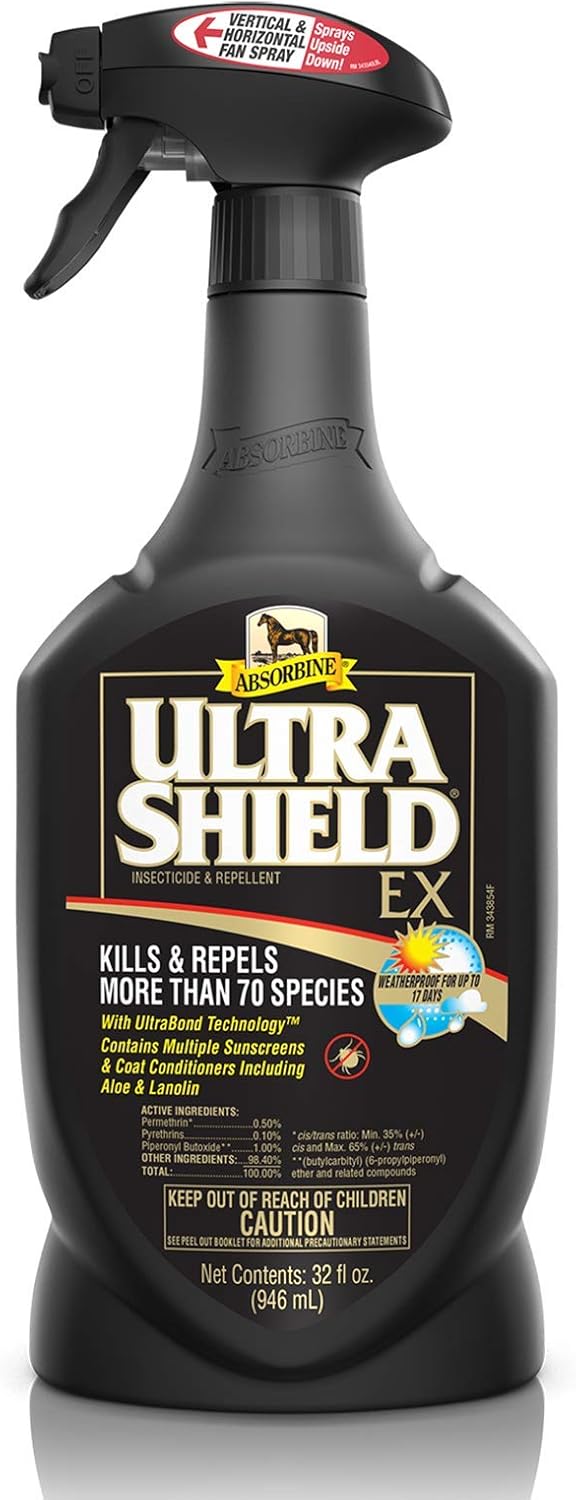
Absorbine UltraShield EX Insecticide & Repellent, 32 fl oz
| Unit Count | 32 Fluid Ounces |
|---|---|
| Item Form | Liquid |
| Scent Name | Unscented |
| Active Ingredients | Pyrethrins |
| Recommended Uses For Product | Fly Control |
Absorbine UltraShield EX is a 32 fl oz ready-to-use fly spray designed for horses, barns, premises, and approved for use on dogs where labelled. You spray it directly onto a clean coat or around doorways and barn areas to kill and repel flies, mosquitoes, ticks, gnats and other listed pests. The water-based formula contains pyrethrins and permethrin with piperonyl butoxide and is built to leave no greasy residue while adding sunscreens and coat conditioners for added protection. UltraBond Technology provides weatherproof residual activity that the label says can last up to 17 days between applications in some conditions, so it can cut down on reapplication compared with short-lived sprays. Because it is EPA-approved and ready to use there is no mixing, which simplifies regular use. Important limitations are that it contains synthetic insecticides so label precautions must be followed for animals and people, and frequency of reapplication will vary with activity, exposure, and weather, so results are not identical in every situation.
Best for: Buyers who need reliable, long-lasting outdoor pest control for horses, barns, and premises and who prioritize performance and reduced reapplication over purely natural formulas.
Less Ideal for: People seeking an all-natural or fragrance-free preventive for sensitive animals or users who prefer daily spot treatments instead of periodic residual protection.
- Ready-to-use water-based formula requires no mixing
- Kills and repels 70+ insect species including flies, mosquitoes and ticks
- Weatherproof UltraBond Technology can provide residual protection up to 17 days
- Includes sunscreens and coat conditioners to protect and condition animal coats
- Contains pyrethrins and permethrin which require following safety instructions for animals and people
- Effectiveness and reapplication interval depend on environmental conditions and animal activity
Verdict: Choose UltraShield EX when you want a ready-to-use, high-performance spray that kills and repels many outdoor pests and provides weatherproof residual protection.
Cutter Backyard Bug Control Spray Concentrate, 32 oz (2 Pack)

| Unit Count | 64 Fluid Ounces |
|---|---|
| Item Form | Spray |
| Target Species | Insects |
| Active Ingredients | Lambda Cyhalothrin |
This Cutter Backyard Bug Control concentrate is a hose-end spray formulation intended for treating lawns, shrubs, trees and other outdoor surfaces to reduce mosquitoes, listed ants, fleas and a variety of other insects. You attach the QuickFlip nozzle to a garden hose, walk the area and spray until surfaces are wet; the product mixes with water automatically so there is no measuring required. The active ingredient, lambda-cyhalothrin, delivers fast knockdown and the manufacturer claims up to 12 weeks of control on certain pests, making it useful for seasonal maintenance rather than spot treatments. It covers up to about 5,000 sq ft per bottle, so a typical yard can be treated without repeated mixing. Important limitations are standard pesticide precautions: do not enter treated areas until dry, avoid runoff to drains or water, and follow label directions for repeat applications and any vegetable/edible-plant restrictions. This is a practical, time-saving option for homeowners who want an efficient lawn-and-landscape treatment applied with a hose-end sprayer, but it requires careful handling and adherence to safety directions.
Best for: Homeowners who want a low-effort, whole-yard treatment to reduce fleas and other common outdoor pests and prefer a hose-end product that covers large areas quickly.
Less Ideal for: People who need pet-safe spot treatments near water features or those who prefer organic or non-synthetic pest control methods.
- Hose-end QuickFlip nozzle mixes automatically so no measuring is needed
- Formulated to treat lawns, shrubs and outdoor surfaces for broad yard protection
- Claims extended control up to 12 weeks on listed pests, reducing reapplication frequency
- Single bottle covers up to 5,000 sq ft, suitable for average to larger yards
- Contains lambda-cyhalothrin so requires strict adherence to safety and runoff restrictions
- Not suitable for use where runoff to water bodies or drains may occur
Verdict: A convenient hose-end concentrate for efficient, whole-yard flea and insect control when you need broad, low-effort seasonal protection.
Ortho BugClear Insect Killer for Lawns & Landscapes Ready-to-Spray, 32 oz

| Item Form | Aerosol |
|---|---|
| Target Species | Ant |
| Liquid Volume | 32 fluid ounces |
| Included Components | Ortho – 0448605 |
Ortho BugClear Ready-to-Spray is a hose-attach insecticide designed for DIY yard pest control; one 32 oz bottle treats up to a medium lawn and surrounding planting beds. You hook your garden hose to the built-in sprayer and apply a water-diluted stream across lawns, foundation perimeters, ornamental plants and select edible plants following the label. The formula contains bifenthrin and zeta-cypermethrin so it starts killing many listed pests within minutes and provides longer-lasting control than spot sprays. Practical benefits are quick coverage for up to about 5,300 sq ft of turf or concentrated perimeter treatment, no mixing measured by hand, and an odor-free nonstaining finish. Limitations to consider are the need to avoid spraying blooming plants to protect pollinators, following safety gear and runoff precautions, and that hose-end delivery can use more product on small targeted spots compared with a pump sprayer or granules. For outdoor flea control this product covers yard and perimeter areas effectively when applied per the label but expect to integrate it with household flea management for a full solution.
Best for: Homeowners who want a low-effort, budget-friendly way to treat an entire yard or perimeter for fleas and other outdoor pests without mixing chemicals by hand.
Less Ideal for: Gardeners who prioritize organic or pollinator-safe controls or those who only need precise spot treatments in small areas should look for alternative formulations.
- Ready-to-spray hose attachment for fast, no-mix application across lawns and perimeters
- Broad-spectrum formula that lists many outdoor pests including fleas, ticks and ants
- Covers a substantial lawn area from a single 32 fl oz bottle
- Non-staining and low odor for comfortable outdoor use
- Contains synthetic pyrethroid active ingredients that require safety precautions and avoidance of pollinators
- Hose-end application can be less precise than a hand pump for small or spot treatments
Verdict: If you want an inexpensive, no-mix hose-end spray to quickly treat a whole yard or perimeter for fleas and common outdoor pests, this ready-to-spray Ortho bottle is a practical pick.
Talstar One Insecticide 1 Gallon Concentrate (Bifenthrin)

| Active ingredient | Bifenthrin 7.9% |
|---|---|
| Formulation | Concentrate, water-based |
| Target pests | 75+ pests including fleas and ticks |
| Intended use | Indoor cracks and crevices and outdoor perimeter and structural surfaces |
Talstar One is a one-gallon bifenthrin concentrate designed for perimeter, structural, and spot treatments where reliable residual control is needed. You mix the concentrate with water and apply it to foundations, lawns, ornamental beds, shrubs, trees, and cracks and crevices indoors following label directions. The formula is water-based, low odor, and dries clear, which helps treated outdoor living areas and patios stay unobtrusive after application. Its broad-spectrum activity targets more than 75 pests including fleas, ticks, ants, spiders, and mosquitoes, and the product is presented as long-lasting so fewer reapplications are necessary for seasonal maintenance. Practical limits are the usual ones for a professional-strength insecticide: it requires careful dilution and safe handling, is not a ready-to-use spray, and must be applied per label restrictions for use around certain plants or sensitive areas. For homeowners prioritizing consistent, long-lasting perimeter protection, this concentrate provides scalable coverage for yards and multiple structures.
Best for: Homeowners and property stewards who want dependable, long-lasting perimeter and outdoor flea control for yards, foundations, and multiple structures and who are comfortable following label directions for mixing and application.
Less Ideal for: Casual users who prefer ready-to-use sprays or who do not want to handle concentrated pesticides should consider simpler, pre-mixed options instead.
- Broad-spectrum control covering fleas, ticks, ants, spiders, mosquitoes and 75+ listed pests
- Concentrate format allows mixing for large yards or multiple applications
- Water-based, low-odor formula that dries clear and is suitable for patios and outdoor living areas
- Requires proper dilution and handling since it is a concentrated professional-strength insecticide
- Not a ready-to-use product so an appropriate sprayer is needed for application
Verdict: Choose Talstar One when you need a scalable, long-lasting concentrate for reliable outdoor flea and perimeter pest control.
Wondercide Flea & Tick Yard Spray, Ready-to-Use (32 oz)

| Item Form | Spray |
|---|---|
| Target Species | Cat, Dog |
| Liquid Volume | 946 ml |
| Active Ingredient | 12.63% Cedarwood Oil |
This ready-to-use Wondercide yard spray is a hose-attached treatment formulated with cedarwood and other plant-derived oils to kill and repel fleas, ticks, and mosquitoes across lawns and outdoor surfaces. You attach the bottle to a garden hose, turn the dial and sweep the spray over the area you want protected; the maker says one bottle covers up to 5,000 sq ft for fleas and mosquitoes and 2,500 sq ft for ticks. Notable features include a pre-mixed formula so there is no measuring, a hose-end applicator for fast coverage, and an ingredient list led by cedarwood oil that is intended to be safer for pollinators when used as directed. In practice this means quick perimeter and lawn treatments for prevention or to reduce existing pest pressure, with repeat applications recommended until control is achieved. Important limitations are that heavy rain may require reapplication, spraying in hot, direct sun can harm some plants, and effectiveness depends on water pressure and application technique rather than a fixed dosage per area.
Best for: Buyers who want a quick, plant-based outdoor pest treatment with easy hose-end application and prefer products with wide user adoption and documented results.
Less Ideal for: Gardeners who need a precise, measured professional application or who frequently water or have persistent heavy rain where a longer-lasting residual product is required.
- Pre-mixed hose-end bottle for fast, no-mix application
- Plant-based active ingredients led by cedarwood oil
- Covers large areas (manufacturer states up to 5,000 sq ft for fleas/mosquitoes)
- Residue reported safe for pollinators when used as directed
- May need reapplication after heavy rain or frequent watering
- Can cause phytotoxic burn on plants if applied in full sun or when temperatures exceed 90°F
- Performance depends on correct sweeping technique and water pressure rather than a measured concentration
Verdict: If you want a convenient, plant-based hose-end yard spray that treats large areas and is built for quick preventive and spot treatments, this is a practical choice.
Atticus Talak 7.9% Indoor/Outdoor Bifenthrin Insecticide Concentrate (32 oz)

| Liquid Volume | 32 fluid ounces |
|---|---|
| Active Ingredients | Bifenthrin |
| Formulation | Suspension Concentrate |
| Item Form | Liquid |
| Specification Met | EPA |
Atticus Talak 7.9% is a water-based bifenthrin concentrate formulated for lawns, landscapes, hardscapes and interior perimeter treatments. You dilute the liquid with water per the label and apply it with a pump or hose sprayer to treat turf, plants, patios, eaves and baseboards. The product targets more than 75 pests including fleas and mosquitoes, kills on contact and claims up to three months of residual control when applied as directed. Notable features are the clear, odor-free formulation that dries without residue and the pre-marked bottle pour for easier measuring. In practical use it is versatile for spot treatments, perimeter barriers and mound drenches for fire ants, and one mixed gallon treats about 1,000 sq ft at typical rates. Important limitations: this is a professional-strength pesticide so users must follow label safety instructions, it cannot be used in foggers, mixed solutions should be used same day, and it is restricted in a few states. For risk-averse buyers, the EPA-listed active ingredient and clear application guidance help reduce uncertainty when used carefully.
Best for: Buyers who want a reliable, long-lasting outdoor insect control product they can use around lawns, landscaping and building perimeters and who prefer a labeled, EPA-listed solution with clear mixing instructions.
Less Ideal for: People seeking a ready-to-use spray or non-chemical flea options should consider alternatives, as this product requires dilution, equipment for application, and adherence to pesticide safety rules.
- Broad-spectrum control targeting 75+ indoor and outdoor pests including fleas and mosquitoes
- Water-based formula dries clear, leaves no residue and is odor-free
- Provides up to three months of residual protection when applied correctly
- Versatile for lawns, landscapes, perimeter barrier sprays and mound drenches
- Concentrate must be diluted and mixed immediately prior to use and cannot be stored
- Not approved for use in foggers and restricted for sale in some states
- Requires careful handling and strict adherence to label safety directions
Verdict: Choose this EPA-listed bifenthrin concentrate if you want a versatile, long-lasting outdoor treatment that handles fleas and many other pests when mixed and applied according to the label.
Choosing the Right Flea Spray for Outdoors: Key Factors to Consider
Active Ingredients and Targeted Life Stages
Different active ingredients act on adult fleas, larvae, or eggs with varying speed and residual action. Products with multiple modes of action can both knock down adults quickly and reduce reinfestation by interrupting development of larvae and eggs. Knowing which life stages a product affects helps set realistic expectations for how many treatments are needed and how quickly you will see population declines.
Active chemistry also determines safety handling and environmental behavior. Some actives bind to organic matter in leaf litter, limiting movement but reducing efficacy in dense mulch. Others persist longer on leaf surfaces and in grass. Read label directions about where the ingredient is effective so you target spray applications to areas where fleas develop, such as shady borders, under decks, and pet resting zones.
Application Method and Coverage
Spray delivery affects how evenly product reaches hiding places where fleas and larvae live. Hose-end and backpack sprayers are efficient for larger yards because they cover wide areas and often mix automatically for consistent dilution. Pump sprayers and ready-to-use bottles are better for spot treatments around foundations, kennels, or garden beds.
Consider nozzle type and spray pattern for getting under low vegetation and into leaf litter. A fine mist might drift and waste product, while a stronger jet may not penetrate groundcover. Application convenience also influences frequency: products that are easy to apply are more likely to be reapplied on the schedule required for long-term control.
Residual Duration and Reapplication Interval
Residual activity determines how long the spray continues to kill fleas after application. Short-residual products require more frequent reapplications to break the flea life cycle, while long-residual options reduce the number of treatments but may increase exposure risk to non-target organisms. Match residual expectations to your tolerance for repeat treatments and to seasonal conditions that affect reinfestation risk.
Also factor weather exposure: rain, irrigation, and heavy foot traffic shorten effective residual life. Label guidance on reapplication after rain and safe reentry intervals helps plan realistic maintenance schedules for your yard.
Environmental Impact and Non-Target Safety
Outdoor use raises the chance of contact with pollinators, beneficial insects, amphibians, and aquatic systems. Choose sprays with clear instructions to avoid blooming plants and water bodies or that degrade quickly outdoors if those constraints are critical. Some formulations include buffers or repellents to limit drift; others advise restricting applications to nonflowering periods.
Consider also how the product behaves in leaf litter and soil. Ingredients that bind tightly to organic matter may persist in shaded areas where beneficials forage. If you have nearby ponds or storm drains, prioritize products with low aquatic toxicity and clear runoff guidance.
Pet Safety and Label Restrictions
Pets are often the reason fleas arrive and reappear in yards, so their safety is a top concern. Labels vary on when pets can reenter treated areas and whether spot-on treatments for animals interact with yard sprays. Some formulations are safe for immediate reentry once dry, while others require hours or even days to pass.
Also check for restrictions around kennels, bird feeders, and areas where pets sleep outdoors. If you have sensitive or young animals, choose products with explicit pet-tolerant language and clear rinsing or reentry steps to minimize accidental exposure.
Plant Sensitivity and Landscape Placement
Certain active ingredients can discolor or stress tender foliage, especially on newly planted ornamentals or edible gardens. Apply sprays selectively to noncrop zones like turf, gravel pathways, and under decks whenever possible. For borders near ornamentals, spot-test a small area or choose formulations labeled safe for ornamental use.
Timing also matters. Avoid spraying during hot midafternoon hours or when pollinators are active. If you must treat near plants you intend to harvest, follow withholding period guidance or avoid treated areas entirely to prevent residue on edible produce.
Where Fleas Hide in the Yard
Fleas typically concentrate in shaded, humid microhabitats where hosts rest and where larvae find organic debris to feed on. Check beneath porches, in leaf piles, under shrub canopies, along fence lines, and near areas where pets nap. These are the primary targets for spot treatments because simply treating open lawn seldom reaches flea hotspots.
Understanding flea ecology helps you place applications strategically. Adult fleas jump onto hosts to feed but quickly return to protected crevices to lay eggs. Removing or reducing those sheltered spots through cleaning and targeted spraying improves control results without treating the entire landscape.
- Inspect shaded edges, compost piles, and under outdoor pet bedding.
- Focus treatment on junctions between lawn and landscape beds where flea activity concentrates.
- Keep mulch and leaf litter thin in high-traffic pet zones to reduce larval habitat.
Best Timing and Seasonal Strategy
Flea activity peaks when warm, humid conditions favor rapid development, but seasonality varies by region. In many climates spring and late summer bring the worst pressure. Start monitoring early and plan applications before populations spike to reduce the need for repeated treatments.
For ongoing control, rotate between an initial knockdown application and follow-up residual treatments according to label intervals. Time treatments to avoid rain and pollinator foraging times, and coordinate yard sprays with pet flea control measures to reduce reinfestation sources.
- Treat shady, pet-frequented zones at the start of warm seasons.
- Reapply after heavy rain if label directions indicate reduced efficacy.
- Avoid spraying during peak pollinator activity midmorning to midafternoon.
Safe Application Practices
Always follow the product label for mixing, protective equipment, and reentry intervals. Use gloves and eye protection when handling concentrates, and avoid applying when wind could carry spray onto flower beds or water features. For hose-end and backpack sprayers, check fittings for leaks and calibrate output to avoid overapplication.
Contain runoff by skipping applications before heavy irrigation or storms. When treating near vegetable gardens or decorative beds, use targeted spot applications on hard surfaces and turf edges rather than broadcast spraying across planting zones.
- Wear protective gear recommended on the label.
- Calibrate sprayers for accurate dilution and coverage.
- Avoid treating within setback distances from ponds or storm drains.
Combining Cultural Controls With Sprays
Nonchemical steps reduce flea habitat and make sprays more effective. Regularly remove leaf litter, rotate or relocate outdoor pet bedding, and manage rodent or wildlife entry points that can reintroduce fleas. Lawn maintenance that reduces dense shade and maintains good air circulation also makes the environment less hospitable to flea development.
Pair cultural measures with targeted spray applications rather than blanket treatments. This reduces chemical use and preserves beneficial organisms while addressing the core sources of infestation.
- Keep pet bedding clean and off the ground when possible.
- Trim vegetation to increase sun and air flow in shady spots.
- Address rodent harborage to cut off wildlife flea reservoirs.
Interpreting Label Directions
Labels contain legally binding instructions about application rates, allowable use sites, and safety precautions. Read the entire label before using a product outdoors. Pay attention to statements about last application before rain, restricted-entry intervals for pets, and specific landscape areas that should not be treated.
If a label lacks clear guidance for a particular landscape feature, such as around water features or edible gardens, avoid applying there or choose an alternative approach. Label compliance protects your plants, pets, and local ecosystem while ensuring effective pest control.
- Follow dilution and application rate instructions exactly.
- Observe any reentry or pet access restrictions after application.
- Consult the label for required personal protective equipment and environmental precautions.
How We Chose the Best Flea Spray for Outdoors
Our shortlist focused on products that balance measurable flea control with practical safety and ease of use in real outdoor settings. We prioritized proven active ingredients and labeled outdoor use, then filtered for application methods gardeners actually use, such as hose-end, pump sprayer, or ready-to-use bottles. Key evaluation dimensions included knockdown and residual efficacy against different life stages, environmental safety for beneficial insects and aquatic exposure, application coverage and required frequency, and user safety measures such as reentry times and pet tolerances. We excluded products labeled only for indoor use, lawn treatments that require professional equipment, and products lacking clear outdoor residue or runoff guidance. The final candidates scored well across efficacy, safety, and practical garden handling so gardeners can choose based on yard size, planting sensitivity, and preferred application style.
FAQ
Can I use flea spray around flowering plants?
Often you should avoid spraying blooming plants because many sprays harm pollinators. If label language permits use on ornamentals, wait until blooms fade or apply only to nonflowering parts and target ground-level zones. Choose low-toxicity options when treating near plants that attract bees.
How soon can pets return to treated areas?
Reentry intervals vary by product. Some sprays allow pet access once surfaces are dry, while others require several hours or longer. Always follow the label's specified waiting period and consider keeping pets off treated areas until fully dry to minimize exposure.
Will treating the yard alone eliminate fleas on my pet?
Treating the yard reduces environmental pressure but usually will not eliminate fleas on a pet by itself. Combining yard treatments with appropriate pet-focused flea control is usually necessary to break reinfestation cycles, especially in heavily infested situations.
What should I do if it rains shortly after I apply a spray?
Many products lose effectiveness if heavy rain occurs within a short window after application. Check the label for rainfastness guidance; you may need to reapply once weather permits and the area is dry. Avoid applying if heavy rain is expected within the label-specified interval.
Are natural or botanical sprays effective outdoors?
Botanical options can offer short-term knockdown but usually have shorter residual activity than synthetic actives, meaning more frequent reapplications are necessary. They may be suitable for low-pressure areas or where minimizing synthetic chemistry is a priority, but they often require careful timing and repeated use to maintain control.
Can I spray near a pond or stream?
You should avoid broadcasting sprays near water unless the label explicitly allows it. Many active ingredients have aquatic toxicity concerns, so maintain label-recommended setbacks from ponds, streams, and drains and use targeted, low-drift application methods near water.
Final Verdict
When choosing a flea spray for outdoors, prioritize efficacy against the life stages present in your yard and the environmental safety constraints of your landscape. Match the application method to yard size and access to hidden flea habitats, and plan reapplications based on residual duration and local weather patterns. Combining targeted sprays with cultural practices like removing leaf litter and managing pet bedding will give the most reliable, long-term control while limiting non-target impacts.
