

Note: This article contains affiliate links. If you click on these links and make a purchase, I may earn a small commission at no extra cost to you. This helps support my research and content. Read my full affiliate disclosure here.
A properly sized pond aerator can make the difference between a thriving water garden and a smelly, green pond. You want reliable oxygen circulation, durable outdoor components, and an energy profile that fits your maintenance style. This guide shortlists seven top-performing pond aerators chosen for real garden and backyard ponds, from small wildlife basins to larger decorative or fish ponds. Below we explain the evaluation criteria used and what to expect from each shortlisted option so you can match aeration capacity, noise, and installation style to your specific pond conditions.
Top Picks at a Glance
| Best Overall The best all-around choice for most situations | HQUA PAS20 Pond & Lake Aeration System (3/4 HP) with Two 100 ft Weighted Tubing and Two 10" EPDM Diffusers |  |
| Best Quality Built to a higher standard if you want something more solid | Hiblow HP-80 Linear Pond Aerator / Septic Air Pump |  |
| Best Value The sweet spot between price and what you get | AquaMiracle All-in-One Pond Aerator for Ponds up to 1000 Gal |  |
| Best Budget The cheapest option that still gets the job done reliably | NFESOLAR 3W Solar Pond Aerator with 2200mAh Battery Backup |  |
| Highest Rated A top-rated pick with lots of positive feedback | Hiblow HP-60 Pond and Septic Air Pump | |
| Most Popular A crowd favorite that many people choose with confidence | Aquascape 2-Outlet Pond Aeration Kit (Model 75000) |  |
| Best Seller A high-volume bestseller chosen again and again | Aquascape Pond Air 4 Quadruple-Outlet Pond Aeration Kit |  |
HQUA PAS20 Pond & Lake Aeration System (3/4 HP) with Two 100 ft Weighted Tubing and Two 10" EPDM Diffusers

| Power Consumption | 550 W (≈ 6 A) |
|---|---|
| Air Flow Rate | Max 4.7 CFM |
| Horsepower | 0.75 hp |
| Coverage Area | Up to 3 acres |
| Max Working Depth | Up to 65 ft (20 m) |
The HQUA PAS20 is a complete aeration system built to raise dissolved oxygen and improve circulation in medium to large ponds. The kit centers on a 3/4 HP oil-free piston air pump that delivers up to 4.7 CFM and is rated to work at depths to 65 feet, while two 100 ft self-sinking rubber hoses and two 10" EPDM membrane diffusers provide bottom aeration across a wide surface area. Typical use is straightforward: place the diffusers on the pond bottom where sludge accumulates, run the tubing to the shore, and power the pump from a grounded 110–120 V outlet. Notable features include durable EPDM diffusers, pressure-resistant tubing, and high-quality piston components intended for long life. Practical benefits you can expect are faster water clarity, reduced algae and odors, and healthier fish activity within one to two weeks. Limitations to consider are the pump's need for ventilation in warm or enclosed installations, periodic maintenance for filters and rebuild kits, and the electrical power requirement which may necessitate a nearby outdoor-rated circuit or heavy-duty extension cord.
Best for: Gardeners and pond owners who want a robust, proven aeration solution that improves water clarity and fish health across mid to large ponds and who are willing to perform routine maintenance.
Less Ideal for: Small backyard water features or users without access to a grounded outdoor power supply should consider lower-capacity or solar-powered alternatives.
- Complete kit includes pump, two 100 ft self-sinking hoses and two 10" EPDM diffusers for immediate setup
- Oil-free piston pump with quality piston cup and bearings designed for longer service life
- Rated coverage up to 3 acres and working depths to 65 ft for larger ponds
- Durable, thick-wall tubing and coated steel diffuser bases resist UV and make placement and retrieval easier
- Requires ventilation or optional housing for reliable long-term outdoor operation in hot or enclosed spaces
- Draws significant current (≈6 A) so a grounded outdoor outlet or suitably rated extension is needed
Verdict: Choose the PAS20 when you need a durable, ready-to-run aeration system that delivers strong bottom aeration and reliable oxygenation for ponds up to 3 acres.
Hiblow HP-80 Linear Pond Aerator / Septic Air Pump

| Flow Rate | 80 liters per minute |
|---|---|
| Maximum Lifting Height | 2.4 meters |
| Power Source | AC |
| Voltage | 120 volts |
| Material Type | Plastic, Stainless Steel |
The Hiblow HP-80 is a linear diaphragm air pump built to provide steady aeration for ponds and aerobic septic systems. It delivers about 80 liters per minute and is intended for ponds up to roughly half an acre at depths of 10 feet or less, making it suitable for keeping oxygen levels healthy and improving water clarity. Typical use is as a continuous outdoor-mounted aerator connected to tubing and medium-bubble diffusers to circulate water and oxygenate deeper zones. Notable features include oil-free operation, low vibration and low pulsation design, quiet running, and rebuildable diaphragms for extended service life. Practical benefits are reliable high flow, energy-efficient operation on standard 120V AC, and straightforward field servicing that can extend the unit's usable life. Limitations to consider are that its stated horsepower figure appears nonstandard for this class and it is a single-speed unit, so fine tuning output requires different tubing/diffuser layouts rather than electronic control. The pump is a good fit where consistent, high-capacity aeration and long-term maintainability are top priorities.
Best for: Buyers who prioritize reliable, high-capacity aeration and long service life for medium to large backyard ponds or aerobic septic systems and who plan to maintain the unit over time.
Less Ideal for: People who need variable or remote-adjustable airflow or who want a fully plug-and-play solution for very small decorative ponds.
- High continuous flow around 80 liters per minute suitable for medium to large ponds
- Quiet, low-vibration linear diaphragm design reduces noise and pulsation
- Oil-free and energy-efficient 120V AC operation
- Rebuildable diaphragms and simple serviceability extend lifetime
- Single fixed-output design with no built-in variable speed control
- Listed horsepower value is misleading for this pump class
Verdict: Choose the Hiblow HP-80 when you want a high-flow, quietly running pond aerator with rebuildable parts for long-term, performance-focused aeration.
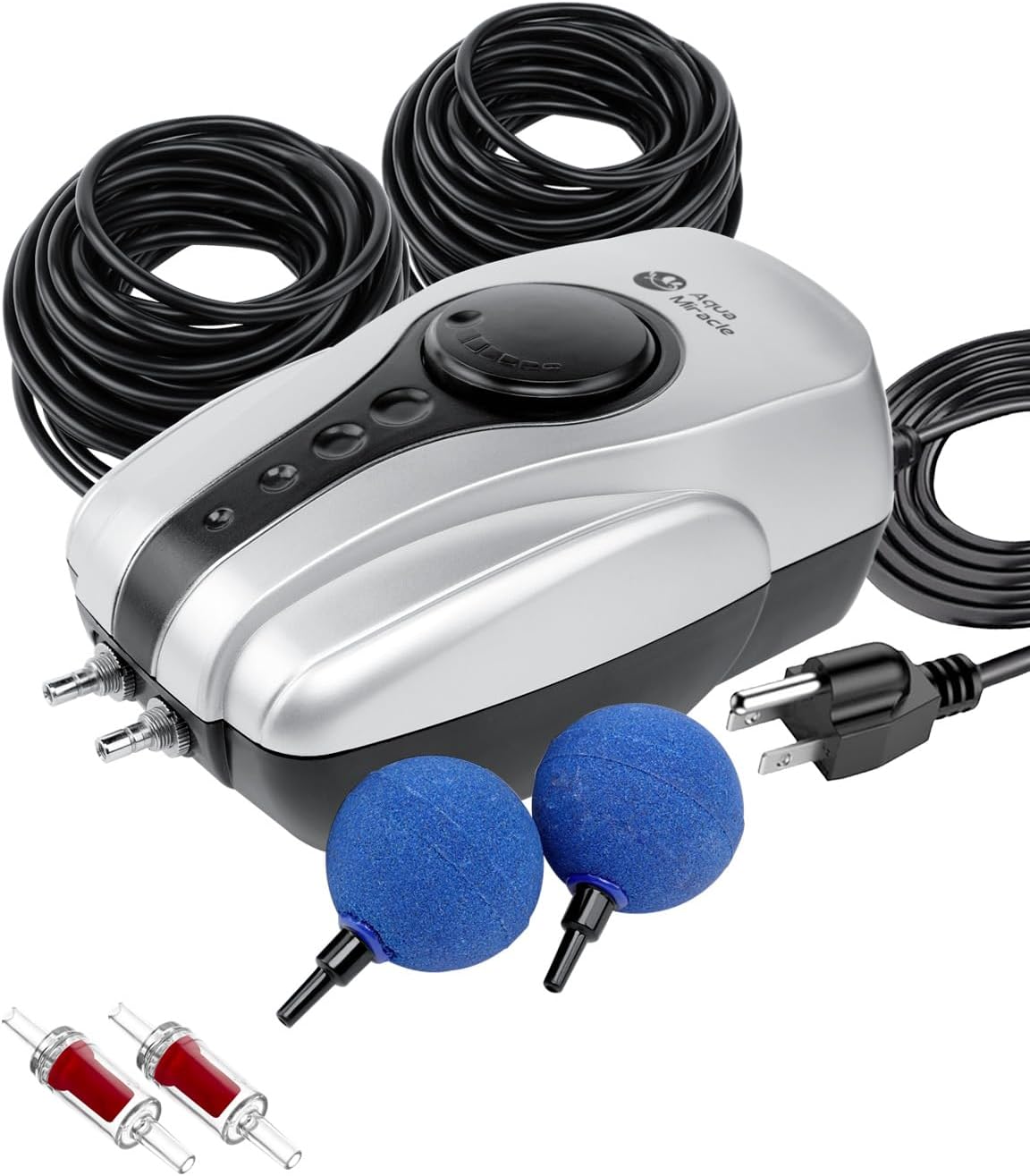
AquaMiracle All-in-One Pond Aerator for Ponds up to 1000 Gal
| Power Source | Corded Electric |
|---|---|
| Flow Rate | 1.6 gpm |
| Maximum Lifting Height | 2 feet |
| Voltage | 120 volts |
| Horsepower | 4 watts |
This AquaMiracle pond aerator is a small, corded air pump designed to oxygenate outdoor ponds and water gardens up to about 1000 gallons. It includes two 30 ft airline tubing rolls, two 2-inch air stones, check valves and replacement filter pads so you can install a two-diffuser setup right away. The unit delivers modest airflow (listed as 1.6 gpm / 0.21 CFM) from a 4-watt motor, and the top dial lets you reduce or increase output to match pond conditions. Its housing, rubber feet and a sulfurized diaphragm are built to reduce vibration and noise while chrome-plated outlets resist corrosion. In practice this makes it a low-energy, quiet solution for improving oxygen levels, supporting beneficial bacteria and keeping a small to medium koi pond healthy; it can also help maintain an open breathing hole in winter. Limitations are its modest pumping power and corded design, which mean it is best for smaller ponds or as part of a multi-diffuser layout rather than replacing a high-capacity aeration system.
Best for: Buyers who want a practical, low-energy aeration solution to maintain oxygen and biological balance in small to medium backyard ponds without complex installation.
Less Ideal for: Large ponds, commercial setups, or users who need very high airflow and remote or battery-powered placement should look for higher-capacity or portable aerators.
- Complete kit includes tubing, air stones and check valves for two diffusers
- Very low power draw at 4 watts for energy-efficient continuous operation
- Adjustable airflow dial lets you fine tune aeration to pond needs
- Rubber feet, textured housing and durable diaphragm reduce noise and vibration
- Airflow is modest and may be insufficient for ponds larger than the stated 1000 gallon capacity
- Corded design limits placement unless you have a nearby outdoor outlet
Verdict: An energy-efficient, ready-to-install aeration kit that quietly improves oxygenation in small to medium backyard ponds.
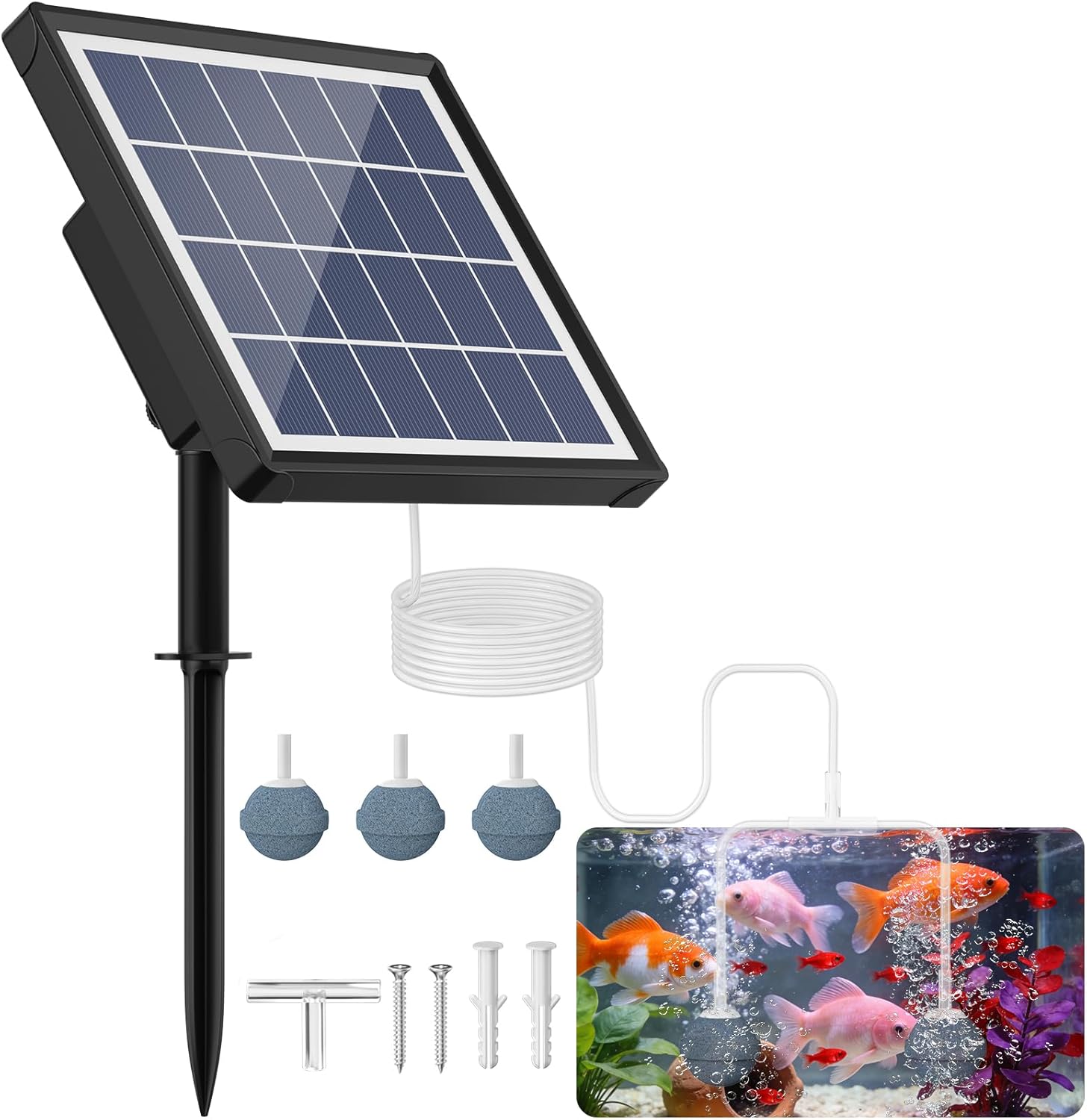
NFESOLAR 3W Solar Pond Aerator with 2200mAh Battery Backup
| Power Source | Battery Powered |
|---|---|
| Horsepower | 3 watts |
| Material Type | Acrylonitrile Butadiene Styrene (ABS) |
| Included Components | 3 Air Stones, 8.9ft PVC Tube with T connector, Ground Stake, Solar Air Pump |
The NFESOLAR 3W Solar Pond Aerator combines a solar panel and air pump into one portable unit that keeps small outdoor ponds and water features oxygenated around the clock. It charges by day and uses a 2200mAh internal battery to run at night or during cloudy periods. Installation is simple: stake or float the unit, run the included 8.9 ft PVC tubing to the supplied air stones, and choose among three modes—strong, soft, or intermittent—to match conditions and conserve battery when needed. The ABS housing and quiet operation make it unobtrusive in a garden setting. Because it is self-contained and battery powered there is no wiring or outlet required, which is ideal for remote pond locations. Limitations are its modest 3W output and suitability for small ponds only, so larger or heavily stocked ponds will need a higher-capacity pump or multiple units to achieve the same oxygenation level.
Best for: Practical pond owners looking to add continuous aeration on a tight budget for small to medium garden ponds, water features, or hydroponic systems who want a low‑maintenance, plug‑free solution.
Less Ideal for: Owners of large, deep, or heavily stocked ponds who need higher airflow and circulation should consider a larger-capacity aerator or a wired pump solution.
- Integrated solar panel with 2200mAh battery enables 24/7 operation without external power
- Three adjustable modes (strong, soft, intermittent) let you balance oxygen output and battery life
- Includes tubing and three air stones for immediate setup
- Quiet, compact ABS design fits unobtrusive garden or tank placement
- 3W power rating limits effective coverage to small ponds or shallow setups
- No explicit dry-run protection or detailed runtime specs under prolonged cloudy conditions
Verdict: An affordable, easy‑to‑install solar aerator that provides reliable 24/7 oxygenation for small ponds without needing electrical hookups.
Hiblow HP-60 Pond and Septic Air Pump
| Power Source | Ac/dc |
|---|---|
| Flow Rate | 3.6 cfm |
| Horsepower | 0.05 hp |
| Material Type | Stainless Steel |
The Hiblow HP-60 is a rugged, oil-less linear air pump made for continuous aeration of ponds up to about a quarter acre and for septic or wastewater systems. It delivers up to 3.6 cfm (about 100 L/min) at low power draw and runs quietly at roughly 35 dBA measured at 1 meter, which makes it suitable for residential installations where noise and reliability matter. The unit is UL rated for outdoor use, includes a 90 degree rubber hose connector and alarm fitting, and features thermal and overpressurization protection that helps prevent failure under common fault conditions. Routine maintenance is straightforward and the pump can be rebuilt multiple times, extending service life and lowering long-term ownership cost. Limitations are that it is a single-speed linear pump so you cannot modulate output without external controls, and its recommended pond sizing assumes shallow depths; larger or deeper ponds will need a higher-capacity system or multiple units. Overall it is a dependable choice when quiet, continuous aeration and long service life are the primary priorities.
Best for: Buyers who prioritize a low-maintenance, long-lasting aerator for a small to medium pond or septic system and want quiet, continuous operation without frequent replacements.
Less Ideal for: People with large or deep ponds that need higher airflow or adjustable aeration rates should consider higher-capacity or variable-speed systems.
- Oil-less design reduces contamination risk and simplifies maintenance
- Quiet operation around 35 dBA at 1 meter suitable for residential settings
- UL outdoor rating and built-in thermal and overpressure protection for reliability
- Can be rebuilt multiple times to extend service life and lower lifetime cost
- Fixed output with no built-in speed control for adjusting aeration rate
- Recommended for ponds up to 1/4 acre at shallow depth so may be undersized for larger or deeper ponds
Verdict: Choose the Hiblow HP-60 when you need a quiet, durable aerator that delivers reliable continuous oxygenation for small to medium ponds or septic systems.
Aquascape 2-Outlet Pond Aeration Kit (Model 75000)

| Power Source | AC |
|---|---|
| Maximum Pressure | 3.7 psi |
| Voltage | 120 volts |
| Horsepower | 6 watts |
| Hose Length | 25 feet |
The Aquascape 2-Outlet Pond Aeration Kit is a straightforward aeration system built to maintain oxygen levels in small to medium backyard ponds. The kit includes a compact AC compressor, two weighted 4-inch aeration discs, two 25-foot rolls of 3/16-inch silicone airline, and preassembled check valves for easy hookup. It runs quietly and uses only 6 watts, so it can operate continuously without adding much to energy use. Typical use is simple: place the discs on the pond bottom, route the tubing to the compressor placed in a sheltered spot, and use the check valves to prevent backflow. The unit helps improve water clarity and fish health by supporting gas exchange during warm months and can keep a small opening in winter ice. Limitations to note are its capacity ceiling of about 2,000 gallons and the need for protected placement of the compressor to avoid weather exposure; larger ponds will need a higher-capacity model. Overall it is a practical, low-energy option for keeping oxygen levels steady in modest ponds.
Best for: Buyers who want a low-energy, easy-to-install aeration solution to maintain oxygen and water quality in small to medium backyard ponds and who value quiet operation and included hardware.
Less Ideal for: Owners of large ponds or water gardens needing high-volume aeration or users who require fully weatherproof, outdoor-exposed compressors without additional shelter.
- Complete kit with aerator, weighted diffusers, tubing, and preassembled check valves for straightforward installation
- Quiet, energy-efficient operation at 6 watts suitable for continuous use
- Includes 25-foot airline rolls allowing flexible placement of compressor relative to pond
- Weighted aeration discs distribute bubbles along the pond bottom to improve oxygenation and circulation
- Rated for ponds up to about 2,000 gallons so not suitable for larger ponds
- Compressor must be installed in a protected location to avoid weather-related damage
Verdict: A quiet, energy-efficient aeration kit that provides an all-in-one, easy-install solution to keep oxygen levels healthy in ponds up to about 2,000 gallons.
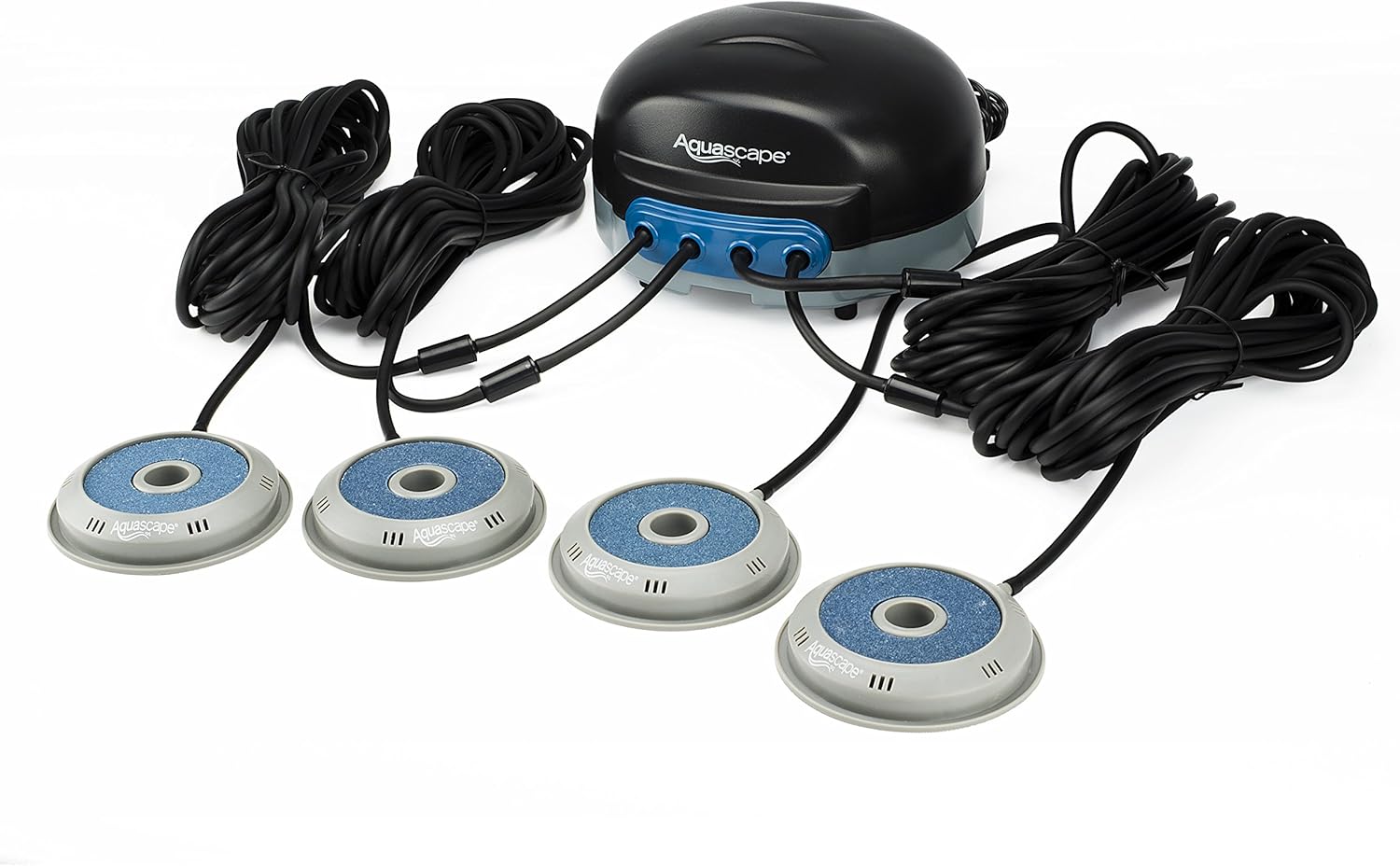
Aquascape Pond Air 4 Quadruple-Outlet Pond Aeration Kit
| Power Source | AC |
|---|---|
| Maximum Pressure | 3.98 psi |
| Voltage | 120 volts |
| Included Components | Aerator, tubing, and aeration diffusers |
| Unit Count | 4 Count |
The Aquascape Pond Air 4 aeration kit provides continuous oxygenation for small to medium backyard ponds by using a quiet AC compressor that powers four weighted air diffusers. Typical use is straightforward: connect the preassembled check valve and tubing to the compressor, place the discs across the pond bottom for even bubble distribution, and locate the compressor in a sheltered, dry spot. Notable features include energy-efficient operation, a durable outer housing that resists damage, and winter-ready components so you can keep a hole in the ice for gas exchange. The kit is supplied complete with tubing, weighted stones, and preinstalled check valves which reduces setup time and maintenance hassle. Important limitations are that it runs on 120V AC so it needs a nearby protected outlet and may require extension or GFCI-protected wiring for outdoor use, and the system is sized for smaller ponds so very large or deep ponds may need a more powerful model or multiple units.
Best for: Buyers who want a low-maintenance, reliable aeration solution for a backyard pond and prioritize quiet operation and year-round oxygenation.
Less Ideal for: Owners of very large or deep ponds, or those who need a battery- or solar-powered system for remote locations, should consider more powerful or off-grid alternatives.
- Provides four diffuser outlets for broader pond coverage
- Quiet, energy-efficient AC compressor suitable for continuous use
- Includes tubing, weighted air stones, and preassembled check valves for easier setup
- Durable outer housing and winter-ready components for year-round operation
- Requires a 120V AC outlet and appropriate outdoor electrical protection
Verdict: A dependable, easy-to-install four-outlet aeration kit that delivers quiet, year-round oxygenation for typical backyard ponds.
Choosing the Right Pond Aerator: Key Factors to Consider
Pond Size and Depth
Pond volume and maximum depth directly affect how much aeration you need. Larger or deeper ponds require higher oxygen delivery and multiple diffusers to prevent thermal layering and low-oxygen zones. A single small aerator may keep a shallow wildlife basin oxygenated but will be insufficient for a deep fish pond.
When estimating needs, think in terms of cubic feet or gallons rather than surface area alone. Deep pockets of low oxygen form because warm surface water does not mix with colder bottom water, so choose equipment rated for the total pond volume and consider multiple diffuser locations if the basin is irregularly shaped.
Oxygen Delivery Method
Aerators deliver oxygen either by surface agitation, diffused air with compressors and weighted air stones, or mechanical mixers. Diffused systems force air through tubing to bottom-mounted diffusers that create fine bubbles, which are very efficient for oxygen transfer and circulation. Surface agitators break the surface to increase gas exchange but may not mix deep water as effectively.
Select the method that matches your goals. For improving dissolved oxygen throughout the water column and controlling stratification, diffused aeration with bottom diffusers is usually best. For simple surface circulation or to power a fountain feature, a surface agitator may be sufficient.
Power Source and Energy Use
Aerators typically run for long periods, often continuously during warm months, so energy consumption matters. Compare wattage and typical run-time energy estimates. Low-consumption compressors can keep operating costs manageable, while higher-capacity units may be necessary for large ponds but will cost more to run.
Also consider available power at the pond. Solar-compatible or low-voltage options can reduce wiring needs for remote or small ponds. If winter aeration is needed, ensure the power source and equipment are rated for cold-weather operation to avoid failures when temperatures drop.
Durability and Weather Resistance
Pond equipment sits outside year round and is exposed to moisture, splashing, freezing temperatures, and sunlight. Look for compressors and housings with weather-resistant enclosures and corrosion-resistant fittings. Diffusers and weighted lines should resist clogging and biofilm buildup.
Long-lasting seals, replaceable diaphragms or air stones, and clear access for routine checks lengthen service life. For ponds in colder climates, frost-safe compressors or a winter maintenance plan can prevent damage during freeze-thaw cycles.
Noise Level and Location
Air compressors and surface motors produce mechanical noise and vibration that can be noticeable near patios or bedrooms. Noise varies widely between models, and units placed in unventilated sheds or on hard surfaces will transmit more sound. Consider placing compressors in insulated enclosures, on vibration-damping mounts, or farther from living areas.
If you need quiet operation, compare manufacturer noise ratings and choose equipment designed for low vibration. Diffused systems often move noisy components away from the pond surface, so placement flexibility can be an advantage for sound control.
Ease of Installation and Maintenance
Some aeration systems are plug-and-play with pre-sized tubing and weighted diffuser units, while others require assembly, trenching for lines, or periodic diaphragm replacement. Ease of access to compressor components and straightforward tubing layouts simplify seasonal maintenance.
Consider the availability of replacement parts, standard tubing sizes, and whether the system allows adding extra diffusers later. A design that supports simple cleaning and quick part swaps reduces downtime and long-term ownership effort.
Sizing an Aerator for Different Pond Types
Estimating the right capacity starts with pond volume and depth. For small wildlife ponds under a few hundred gallons, a single low-capacity diffuser can maintain oxygen levels. Larger garden ponds and koi ponds need higher air delivery and often multiple diffusers spaced across the bottom to prevent dead zones.
Depth matters: deep ponds benefit from bottom-mounted diffusers because bubbles rising from depth mix the water column. If your pond has abrupt depth changes, plan diffuser placement to target the deepest sections rather than relying on a single central unit.
- Measure pond length, width, and depth to calculate volume before selecting capacity
- Place diffusers at deep points and away from inlet or outlet turbulence for even circulation
- Plan for at least one extra diffuser port if you expect future expansion or stocking increases
Winter Operation and Surface Ice Management
If you want to keep a hole in the ice for gas exchange during cold months, choose a system rated for winter use or plan a circulation layout that prevents complete surface freeze. Compressors can be installed inside frost-protected housings with insulated tubing to prevent freezing at the equipment.
For ponds that will be allowed to freeze solidly in winter, consider shutting down the system and using seasonal protocols to protect equipment. For year-round fish ponds, aim for continuous low-flow aeration near the deepest areas to maintain oxygen without excessively disturbing the surface.
- Insulate or relocate compressors to reduce cold-related failures
- Use floating de-icers only where appropriate; they are not a substitute for deep-water mixing
- Schedule winter checks to clear snow and ice away from critical components
Placement and Tubing Layout
Tubing runs and diffuser placement influence how evenly the pond is aerated. Keep tubing as straight as practical to minimize pressure drop and avoid tight kinks. Weight diffusers to prevent them from drifting and position them to create circulation patterns that move water across the pond.
Shorter, balanced runs from the compressor to each diffuser improve air flow. If using multiple diffusers, use a manifold or balanced splitter so each diffuser receives a similar air volume.
- Avoid running tubing over sharp edges; protect with conduit if it must cross hard surfaces
- Label lines and maintain a simple layout for easier winter removal or seasonal maintenance
- Test diffuser placement by observing bubble patterns and adjusting to eliminate dead zones
Maintaining Good Water Quality Alongside Aeration
Aeration helps oxygenate water and reduce stratification, but it is not a cure-all for nutrient loading. Regular skimming of leaves, managing runoff, and limiting excess feeding or fertilization reduce the organic load that fuels algae growth. Aeration complements those practices by supporting aerobic bacteria that break down waste more efficiently.
Biological filtration and occasional partial water changes remain part of comprehensive pond care. Use aeration to support these systems rather than relying on aeration alone to correct chronic water-quality problems.
- Combine aeration with good debris management to limit nutrient buildup
- Monitor dissolved oxygen and ammonia periodically to understand system health
- Avoid overstocking fish; healthy stocking levels reduce oxygen stress and waste
Solar and Low-Voltage Options for Remote Sites
For ponds without easy access to mains power, solar and low-voltage aerators can provide effective oxygenation during sunny periods. These systems are advancing in efficiency but may require battery storage to run overnight or during extended cloudy spells if continuous operation is desired.
Evaluate local sun exposure and winter sunlight availability before relying solely on solar. Hybrid setups that use solar during the day and a small mains or battery backup at night offer a balanced approach for remote ponds.
- Assess daily sun hours and system draw to estimate actual run time
- Consider a battery or generator backup for critical fish ponds
- Solar units reduce wiring needs but may limit winter or nighttime performance
How We Chose the Best Pond Aerator
We focused on the practical, measurable traits that determine how well an aerator performs in an outdoor pond environment. Key evaluation criteria included oxygen delivery rate and diffuser coverage, which predict how effectively a unit will circulate water and prevent stratification. Energy efficiency and running cost were assessed so gardeners know typical electrical consumption for continuous summer operation. Durability of outdoor components and frost-safe operation were important for year-round ponds and winter aeration needs. Ease of installation and maintenance was considered to reflect homeowners who install gear themselves or prefer low-maintenance setups. Noise level and vibration were evaluated because pond aerators often run continuously near patios or bedrooms. Units were excluded if they lacked clear technical specs, had inadequate splash- or weather-protection ratings, or were designed only for ornamental fountain effects rather than true aeration. The shortlist favors transparent performance data and features that translate directly to healthier pond water and easier ownership.
FAQ
How do I know what size aerator my pond needs?
Size by pond volume and depth. Estimate total gallons or cubic feet, then choose aeration capacity and number of diffusers rated for that volume. Deep ponds often need more capacity or multiple diffusers to mix the entire water column.
Can aeration reduce algae outbreaks?
Aeration helps by increasing oxygen and supporting aerobic bacteria that break down organic matter, which can reduce nutrient availability for algae. It is most effective when combined with debris control and limiting nutrient inputs.
Is diffused aeration better than a surface pump?
Diffused aeration usually mixes deep water more effectively because bubbles rise from the bottom and create column circulation. Surface pumps agitate the top layer and can look attractive, but they often do not address low-oxygen deep zones.
Can I run an aerator year-round?
Many setups are designed for continuous operation and can be run year-round, especially for fish ponds that need oxygen under ice. Ensure the compressor and tubing are frost-rated or installed in protected locations if you plan winter operation.
How noisy are pond aerators?
Noise varies by compressor design and placement. Compressors located near living spaces can be noticeable unless mounted on vibration-damping material or placed in insulated enclosures. Diffused systems allow you to locate noisy components away from the pond.
How often do diffusers and tubing need maintenance?
Diffusers may require cleaning or replacement every season or two, depending on fouling and sediment. Inspect tubing and connections annually, clean or replace air stones as needed, and check compressor diaphragms per the manufacturer recommended interval.
Final Verdict
Choose a pond aerator by matching capacity to pond volume and depth, picking a delivery method that achieves full-water mixing, and selecting components built for outdoor, year-round use. Balance energy use and noise against circulation needs, and plan diffuser placement to eliminate dead zones. Prioritize oxygen delivery, durability, and ease of maintenance when deciding. With the right aeration layout and regular pond care, you will improve water clarity, reduce stress on fish, and create a more resilient pond ecosystem.
