

Note: This article contains affiliate links. If you click on these links and make a purchase, I may earn a small commission at no extra cost to you. This helps support my research and content. Read my full affiliate disclosure here.
Getting reliable soil information is one of the fastest ways to improve plant health in a home garden. The right soil test kit tells you pH, key nutrient levels, and sometimes texture or organic matter, so you can adjust lime, fertilizer, or amendments with confidence. This guide focuses specifically on kits designed for home garden use, covering options suited to patios, raised beds, lawns, and vegetable plots. We shortlisted seven top-rated kits and evaluated them on accuracy, ease of use, and the real-world information they deliver for common garden tasks. Below we explain what mattered in our picks and what to look for when choosing a kit for your own garden.
Top Picks at a Glance
| Best Overall The best all-around choice for most situations | MySoil Professional Mail‑In Soil Test Kit (1 Test) |  |
| Best Quality Built to a higher standard if you want something more solid | LaMotte Turf and Garden Soil Test Kit (pH, N, P, K) |  |
| Best Value The sweet spot between price and what you get | Garden Tutor Soil pH Test Kit – 100 Strips with AI Web Reader |  |
| Best Budget The cheapest option that still gets the job done reliably | Palinoia 2-in-1 Soil Test Kit for pH and Nitrogen, 100 Strips |  |
| Highest Rated A top-rated pick with lots of positive feedback | Jxikatx 7-in-1 Soil Test Kit with Dual Display (Moisture, pH, Fertility, Light, Temp, Humidity) |  |
| Most Popular A crowd favorite that many people choose with confidence | Luster Leaf Rapitest 40-Test Soil Test Kit (pH, N, P, K) |  |
| Best Seller A high-volume bestseller chosen again and again | Luster Leaf Rapitest Soil Test Kit (20 tests) |  |
MySoil Professional Mail‑In Soil Test Kit (1 Test)
| Number of Packs | 1 |
|---|---|
| Unit Count | 1 Count |
| Manufacturer | Predictive Nutrient Solutions, Inc |
| Item Weight | 4.6 ounces |
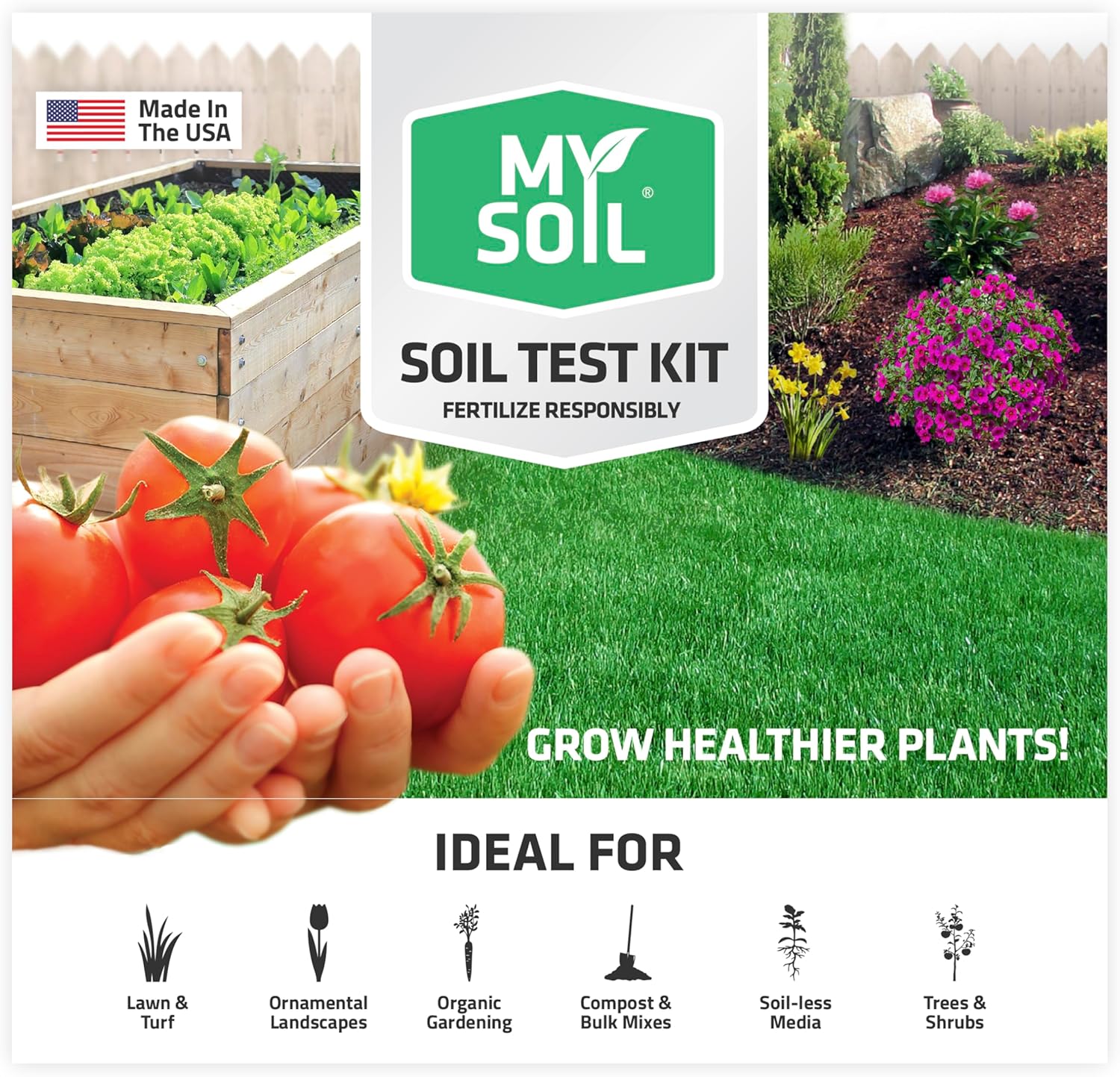
The MySoil kit is a single‑use mail‑in soil test designed to give a professional laboratory analysis rather than an instant at‑home reading. You collect a sample in the included jar, register the kit online, mail the prepaid envelope to the lab, and get a detailed report in about 6–8 days. Results cover pH plus 13 plant‑available nutrients and include step‑by‑step recommendations for what to apply, how much, and when, with both organic and conventional options. That makes it useful for diagnosing lawn problems, planning fertilization for turf or vegetable beds, or checking soil before planting. The kit contains everything needed for one test and saves time by replacing guesswork with specific advice, which can reduce unnecessary product use. The main limitation is that each kit covers only a single sample, so testing multiple areas or repeated checks requires buying multiple kits; turnaround also depends on mailing times. For a homeowner who wants accurate, lab‑grade guidance for improving grass and garden soil, MySoil provides actionable results without complex equipment.
Best for: Homeowners focused on improving lawn health who want reliable, lab‑grade soil data and clear amendment instructions rather than DIY meters or strips.
Less Ideal for: People who need rapid, repeated tests across many spots or instant field readings should consider multi‑test packs or handheld meters instead.
- Laboratory analysis of pH plus 13 plant‑available nutrients for accurate results
- Includes prepaid mail envelope and everything needed to collect and send one sample
- Custom, easy‑to‑follow recommendations for what, when, and how much to apply
- Works for any soil type and a wide range of uses including lawn and turf
- Single‑use kit covers only one sample location
- Results take several days since samples are mailed to a lab
Verdict: For reliable, lab‑grade soil diagnostics and clear fertilizer guidance to improve grass and garden performance, choose this single‑test MySoil kit.
LaMotte Turf and Garden Soil Test Kit (pH, N, P, K)

| Tests included | pH, nitrogen, phosphorus, potassium |
|---|---|
| pH tests | 30 tests |
| N/P/K tests | 15 tests each |
| Includes | Garden Guide manual and Soil Handbook |
The LaMotte Turf and Garden Soil Test Kit is a reagent-based kit designed to measure soil pH and the three primary macronutrients (N, P, K) with color-matching charts and step-by-step instructions. You collect representative samples from the area you plan to plant, follow the contained procedures for each parameter, and compare results to the included laminated charts and Garden Guide to decide on lime or fertilizer adjustments. The kit supplies more tests for pH (about 30) and roughly 15 tests each for N, P and K, which makes it useful for tracking multiple beds over a season. Its strengths are clear instructions, an educational handbook for interpreting results, and replaceable reagent-based chemistry that tends to be more accurate than simple reader strips. Limitations are that tests require careful sample prep and handling, they are not instant digital readouts, and interpreting borderline color matches can be subjective. For vegetable gardeners who want actionable guidance rather than a single quick reading, this kit delivers a thorough, repeatable soil picture.
Best for: Vegetable gardeners who want a practical, educational soil analysis to inform lime and fertilizer decisions and are willing to follow reagent-based procedures for repeatable results.
Less Ideal for: Gardeners who need a single fast digital reading or those unwilling to collect and prepare representative soil samples.
- Measures pH plus nitrogen, phosphorus and potassium for a rounded soil analysis
- Includes Garden Guide manual and Soil Handbook to interpret results and plan amendments
- Supplies multiple tests (about 30 pH tests and 15 tests each for N, P and K) for tracking over time
- Reagent-based chemistry typically gives more reliable results than basic test strips
- Color-matching requires careful technique and can be subjective on borderline readings
- Testing involves multiple steps and sample preparation rather than instant electronic readouts
Verdict: A thorough reagent-based kit that gives vegetable gardeners actionable pH and NPK results plus interpretive guidance for informed fertilizing and liming decisions.
Garden Tutor Soil pH Test Kit – 100 Strips with AI Web Reader

| pH range | 3.5-9.0 |
|---|---|
| Unit Count | 100 Count |
| Material Type | test strip litmus paper |
| Included Components | Instructions and AI Template Reader Card |
| Recommended Uses For Product | Soil Testing |
The Garden Tutor Soil pH Test Kit gives home gardeners a straightforward way to check soil acidity across beds and lawns. You get 100 three‑pad litmus strips, a full‑color handbook with adjustment charts, and an AI template card that lets you upload a photo to a web reader for a numeric pH result. Typical use is simple: mix a small soil sample with distilled water, dip a strip, compare color or use the web reader for a digital readout, then consult the handbook to choose lime or sulfur if adjustment is needed. The large strip count is useful for mapping different garden zones and repeating tests through the season. The web reader removes much of the guesswork from matching colors and helps produce consistent, repeatable readings. Limitations are inherent to strip tests: they are less precise than lab tests or electronic meters and rely on correct sampling and clean water for accuracy. Still, for routine home garden checks and planning soil amendments this kit is fast, practical, and easy to use.
Best for: Gardeners who want a practical, repeatable way to monitor and optimize soil pH across a home garden and prefer fast, actionable guidance over laboratory precision.
Less Ideal for: Users who need laboratory-grade accuracy or professional soil analysis for commercial production should choose a lab test or a calibrated electronic meter instead.
- Includes 100 strips for extensive testing across multiple beds or repeated season checks
- Web-based AI reader template offers a digital pH result without installing an app
- Full-color handbook and lime/sulfur adjustment charts help translate results into action
- Test strips are less accurate than laboratory analysis or a calibrated electronic pH meter
Verdict: A practical, high‑capacity pH strip kit with a web AI reader that makes routine soil testing and amendment planning fast and easy for home gardeners.
Palinoia 2-in-1 Soil Test Kit for pH and Nitrogen, 100 Strips

| Unit Count | 100 Count |
|---|---|
| Recommended Uses For Product | Soil Testing, pH Test |
| Sterility Rating | 0.0-14.0 |
The Palinoia 2-in-1 kit uses test strips to measure soil pH and nitrate-nitrogen, giving gardeners a fast way to check lawn soil health without lab work. To use it you mix a soil sample with water, let solids settle, dip a strip, and compare the resulting color to the included chart; the kit includes a sampling spoon, test tube, and resealable pouches so you can test multiple spots and store unused strips. With 100 strips, it is convenient for checking several areas across a yard or repeating tests over the season. The nitrate result reports plant-available nitrate-nitrogen only, not ammonium or urea, so it is useful for diagnosing nitrogen available to grass but not all fertilizer forms. Accuracy depends on careful sampling and following the color chart, so results are best seen as a quick diagnostic rather than a laboratory-grade measurement. For routine lawn monitoring or deciding whether to apply fertilizer or lime, this kit gives clear, inexpensive guidance.
Best for: Homeowners and lawn caretakers who want an affordable, easy way to monitor pH and available nitrogen across multiple lawn areas to guide fertilizer or lime decisions.
Less Ideal for: Users needing laboratory-grade nutrient analysis or a complete breakdown of all nitrogen forms should choose a professional soil test or a more comprehensive kit.
- Includes 100 strips for many tests across a lawn or repeated seasonal checks
- Measures both soil pH and plant-available nitrate-nitrogen in one kit
- Comes with a sampling spoon, test tube, and resealable pouches for organized testing
- Simple procedure suitable for beginners with quick color-chart results
- Nitrate test does not measure ammonium or urea forms of nitrogen
- Color-chart strip method is less precise than lab tests and sensitive to sampling technique
Verdict: A low-cost, easy-to-use option for routine lawn soil checks that delivers fast pH and nitrate-nitrogen guidance for smarter fertilizer and lime choices.
Jxikatx 7-in-1 Soil Test Kit with Dual Display (Moisture, pH, Fertility, Light, Temp, Humidity)

| Measurements | Moisture, pH, Fertility, Light, Soil temp, Air temp, Humidity |
|---|---|
| Display | Analog dial + LCD screen |
| Probe | Multi-metal single probe |
| Adjustable head | 90° rotating with 6 viewing angles |
The Jxikatx 7-in-1 Soil Test Kit is a compact handheld meter that gives you a quick snapshot of soil and microclimate conditions. It uses a single multi-metal probe with an analog dial for moisture, pH, fertility and light and an LCD for soil temperature plus air temperature and humidity. Typical use is simple: insert the probe into moist soil (about 5 inches recommended), angle the rotating head for easy viewing, and read the dial and screen to guide watering, fertilizing and siting decisions. Notable features are the dual-display layout that separates stable analog readings from digital temperature and humidity, the 90° adjustable head for ergonomic use, and a durable probe designed to minimize root disturbance. Practical benefits include faster, consolidated checks across multiple parameters and the ability to use it across houseplants, raised beds and lawns. Limitations to note are that it is designed for moist soil only, will not work accurately in very dry or waterlogged media or hydroponics, and some parameters are analog rather than precise numeric outputs which can reduce resolution for fine adjustments.
Best for: Gardeners who want a dependable, all-in-one meter for routine checks and practical decision-making on watering and fertilizing across houseplants, vegetable beds and lawns.
Less Ideal for: Users who need laboratory-grade numeric precision, continuous monitoring, or devices built for hydroponics and very dry or saturated media should look elsewhere.
- Measures seven relevant parameters in one compact tool for quick spot checks
- Dual display separates digital temperature/humidity from analog soil readings for clear viewing
- 90° adjustable head reduces bending and makes readings easier in beds and pots
- Single-probe design minimizes root disturbance during testing
- Not accurate in dry soil, waterlogged media, stones, or hydroponic setups
- Analog dial for pH, moisture and nutrients provides approximate ranges rather than exact numeric precision
- Probe should not be left in soil for extended periods to prevent damage
Verdict: Buy this if you want a reliable, easy-to-use multi-parameter soil tester for routine, practical gardening checks rather than lab-grade precision.
Luster Leaf Rapitest 40-Test Soil Test Kit (pH, N, P, K)

| Tests included | pH, Nitrogen, Phosphorus, Potash |
|---|---|
| Number of tests | 40 total (10 per test type) |
| Mounting type | Tabletop |
| Battery description | No batteries required |
The Luster Leaf Rapitest kit gives quick, at-home readings for soil pH and the three primary nutrients gardeners watch for: nitrogen, phosphorus and potash. It ships with reagents and a patented color comparator system plus instructions and a plant pH preference list, and is designed to perform 40 total tests (10 each for pH, N, P and K). Typical use is straightforward: collect small soil samples, add the provided capsules or solutions, and compare the resulting color to the chart to determine whether your lawn needs lime, fertilizer, or other amendments. The tabletop format and printed recommendations make it useful for routine checks through the growing season. Limitations are that results are qualitative rather than lab-accurate numbers and interpretation depends on correct sampling and careful color matching under good light. For gardeners who want fast, actionable guidance for lawn feeding and pH adjustment, this kit balances simplicity and coverage; it is less suitable when precise ppm measurements are required.
Best for: Buyers who want a practical, no-fuss way to monitor lawn soil health and adjust fertilizer or lime between seasons; ideal for homeowners who prefer actionable, easy-to-read guidance over laboratory testing.
Less Ideal for: Users who require laboratory-grade nutrient concentrations or professional soil reports for diagnostics or commercial turf management.
- Covers four key tests (pH, nitrogen, phosphorus, potash) in one kit for routine lawn checks
- Includes enough reagents for 40 tests, allowing multiple checks through a season
- Patented color comparator and clear instructions make results easy to interpret for beginners
- Includes plant pH preference recommendations to help translate results into amendment choices
- Provides color-based, qualitative results rather than lab-precise numeric readings
- Accuracy depends on sampling technique and consistent lighting when matching colors
Verdict: An affordable, easy-to-use kit for routine lawn and garden checks that delivers quick, actionable pH and nutrient guidance.
Luster Leaf Rapitest Soil Test Kit (20 tests)

| Brand Name | Luster Leaf |
|---|---|
| Unit Count | 20 Count |
| Item Type Name | Soil Test Kit |
| Model Number | 1602 |
The Luster Leaf Rapitest Soil Test Kit provides a simple, low-tech way to check garden soil pH and the three main nutrients gardeners track: nitrogen, phosphorus and potash. The kit includes reagents and comparators for 20 tests total (five tests per measurement), so you can sample several areas across a lawn or vegetable bed. Use involves mixing small soil samples with the provided capsules or solutions, then matching the resulting color against the included chart. That makes it fast and approachable for beginners and steady gardeners who want a practical snapshot before amending or fertilizing. The clear instructions and plant pH preference list for over 450 species are helpful for making actionable adjustments. Limitations are the coarse resolution of color-based readings and the limited number of tests compared with lab analysis, so it is best for routine spot checks rather than precise scientific monitoring.
Best for: Gardeners who want a straightforward, low-cost way to check soil health before amending and prefer practical, easy-to-follow results over lab-level precision.
Less Ideal for: Users who need laboratory-grade accuracy, quantitative nutrient concentrations, or frequent high-volume testing for professional soil management.
- Covers core measurements gardeners need: pH, nitrogen, phosphorus and potash.
- Includes materials for 20 total tests to sample multiple garden spots.
- Patented color comparator system makes results easy to read without special tools.
- Comes with detailed instructions and a plant pH preference list for many common species.
- Color-matching gives approximate results and is less precise than laboratory testing.
- Only five tests per measurement limits long-term or frequent monitoring without repurchasing.
Verdict: Buy this kit if you want an easy, affordable way to spot-check soil pH and basic nutrient levels across your garden before amending.
Choosing the Right Soil Test Kit for Home Garden: Key Factors to Consider
pH Range and Accuracy
Soil pH determines nutrient availability and affects which plants will thrive. A kit that measures a wide pH range with reliable increments helps you decide whether to apply lime to raise pH or sulfur to lower it. For home gardens, accuracy within one pH unit is often sufficient, but tighter accuracy lets you fine-tune inputs for acid-loving or alkaline-sensitive plants.
Consider kits that include a clear color chart or digital readout to reduce interpretation errors. Also check whether the kit instructs on proper sampling depth and mixing, because pH can vary with depth and location across beds.
Nutrient Detection (N, P, K and Secondary Nutrients)
Knowing relative levels of nitrogen, phosphorus, and potassium helps you choose the right fertilizer and avoid over-application. Kits that report at least N, P, and K in usable categories – such as low, medium, or high – give practical direction for common garden amendments. Some kits also test secondary elements like magnesium or calcium, which matter for specific crops or if you suspect deficiencies.
Understand that home kits estimate nutrient availability rather than providing lab-grade concentrations. Use their results as a guide for routine maintenance and targeted corrective actions rather than precise agronomic prescriptions.
Sampling Method and Representativeness
A test is only as good as the sample taken. Good kits include instructions on collecting composite samples from multiple spots, removing surface debris, and sampling at a consistent depth for lawns, beds, or containers. For home gardens with heterogenous soil patches, combining subsamples yields a result that reflects average conditions rather than a single anomaly.
Pay attention to whether the kit requires dry or moist samples and whether it provides tools for consistent depth control. Kits that are simpler to use in tight spaces or containers are preferable for patios and balcony gardeners.
Ease of Use and Instruction Quality
Home gardeners benefit most from kits with plain-language instructions, clear color charts or digital displays, and minimal steps that reduce user error. Complex reagent handling or multi-step titrations increase the chance of mistakes and are less suitable for casual users.
Look for kits that provide troubleshooting tips, example readings, and clear guidance on how to act on results. If the kit requires sending samples to a lab, consider how the collection and mailing process affects overall ease.
Result Timeliness and Reporting
Turnaround time matters because garden work is seasonal. Kits that deliver instant or same-day results let you act before a planting window closes, while lab-return kits require scheduling and may delay amendments. The format of results matters too: concise, actionable categories are more helpful than raw numbers that require interpretation.
Some kits include explanatory leaflets or online tools that translate readings into amendment suggestions. Those features can save time and reduce uncertainty when planning fertilization or pH adjustments.
Durability and Reagent Shelf Life
Home gardeners often use kits infrequently, so reagent stability and storage instructions affect long-term usefulness. Kits with longer shelf life and durable sampling tools are more cost-effective for occasional testing. Plastic components should resist cracking and color charts should remain legible after repeated use.
Check whether replacement reagents or refill packs are available, and whether the kit includes clear storage temperature and expiration guidance to keep results reliable over time.
When a Quick Home Test Is Enough
Not every garden task needs a lab report. Routine seasonal checks for pH and a basic NPK sense are often all you need to decide on lime, compost, or a balanced fertilizer. Quick kits can protect young transplants and vegetables from common nutrient stress and help maintain lawn color and vigor.
Use rapid tests as diagnostic tools: when you see poor growth, yellowing leaves, or uneven beds, a fast read can identify broad issues that merit corrective action or more detailed testing.
- Ideal for seasonal maintenance and simple corrective steps
- Works well for raised beds, container gardens, and small plots
- Not a substitute for professional lab testing when precise concentrations are needed
Interpreting Color Charts and Digital Readouts
Color-based kits require good lighting and careful matching to a chart. Natural daylight gives the most consistent results, while fluorescent or tinted light can skew perception. Always compare the test strip or vial next to the chart rather than holding them apart.
Digital readouts or smartphone-linked interfaces reduce interpretation error and often store past readings for trend tracking. If you plan to test repeatedly over a season, a digital option can simplify monitoring and show if amendments are producing the expected changes.
- Use consistent lighting when reading colors
- Rinse probes between samples to avoid cross-contamination
- Record results by bed or container for targeted action
Collecting Representative Samples From Diverse Garden Areas
Divide your garden into zones that share soil type and cropping history. For each zone, remove surface debris and take multiple subsamples at a consistent depth, then mix them to form a composite sample. This approach smooths out small-scale variability and yields a result that better informs zone-level amendments.
For container gardens and small raised beds, sample the potting mix separately from in-ground beds because the media and nutrient dynamics differ significantly.
- Composite sampling reduces misleading single-spot results
- Sample after the soil has dried slightly if the kit requires dry samples
- Label samples by zone and date to track changes over time
Using Test Results to Plan Amendments
Translate pH readings into specific actions: apply garden lime to raise pH or elemental sulfur to lower it, following recommended application rates for your soil type and plantings. For NPK, low nitrogen usually means applying a nitrogen-rich feed, while low phosphorus or potassium calls for targeted amendments or blends.
Combine test results with visual plant symptoms and seasonal timing. Some corrections are best done before planting, while others can be applied during the growing season in split applications to avoid burning roots.
- Match amendment type to the nutrient deficiency rather than guessing
- Adjust rates based on soil texture and organic matter
- Re-test after major amendments to confirm effectiveness
When to Send Samples for Professional Analysis
If you need exact nutrient concentrations, trace element analysis, or tests for contaminants such as heavy metals, professional laboratory testing is the appropriate route. Labs use standardized extraction methods and calibrated instruments that home kits cannot replicate.
Consider lab testing for new properties with unknown history, when planning permanent plantings like orchards, or when persistent plant health issues do not respond to standard corrections suggested by home tests.
- Lab tests are valuable for soil remediation and long-term planning
- Use professional analysis when legal or safety thresholds are a concern
- Combine lab results with home-kit monitoring for seasonal management
How We Chose the Best Soil Test Kit for Home Garden
We prioritized tests that deliver actionable results for common home-garden decisions such as pH correction, nitrogen-phosphorus-potassium balancing, and organic amendments. Accuracy under typical backyard conditions was a key filter: we looked for kits with repeatable pH readings and reliable nutrient detection across a range of soils from clay to sandy loam. Ease of use was essential for home gardeners, so we favored clear instructions, simple sampling procedures, and results that do not require lab interpretation. Other selection criteria included the range of analytes measured, test turnaround time, and the usefulness of the report for common garden tasks like planting lawns, vegetables, and ornamentals. Durability and the clarity of included tools and reagents were also considered. We excluded kits that only provide a single broad result without actionable detail or those intended solely for industrial or scientific use. The final list reflects kits that balance practical information, user accessibility, and reliability for everyday garden management.
FAQ
How often should I test my home garden soil?
For most home gardens, testing every one to three years is adequate. Test more frequently if you are correcting pH, trying new fertilizers, or establishing new beds, because those actions change soil chemistry faster than passive management.
Can a home kit detect soil contaminants or heavy metals?
Most home kits do not detect heavy metals or contaminants. If you suspect contamination from past land use, nearby industry, or demolished structures, send samples to a certified lab for comprehensive testing.
Do I need to prepare the soil sample before testing?
Yes. Remove plant debris, take multiple subsamples from the same zone, mix them, and follow the kit's instructions on whether the sample should be dry or slightly moist. Proper sampling reduces variability and improves the usefulness of the result.
Will organic matter affect test results?
High organic matter can influence nutrient availability and pH readings. Some kits include guidance on interpreting results in soils with rich compost content. When in doubt, note recent amendments on your sample record and re-test after the material has had time to integrate.
Can I use the same kit for containers and in-ground beds?
Yes, but treat them as separate zones. Potting mixes behave differently from in-ground soils, so test containers independently and adjust fertilizer schedules accordingly.
Final Verdict
Choose a kit that balances accuracy, ease of use, and the specific data you need for your garden zones. Prioritize pH accuracy and clear NPK guidance if you make routine fertilizer and lime decisions, and prefer kits with straightforward sampling instructions to avoid user error. For occasional in-depth questions or contamination concerns, pair a home kit with professional lab testing. Ultimately, a useful soil test kit is one you will use regularly and that gives clear, actionable results for the plants you grow. Focus on the decision criteria outlined here to pick a kit that fits your gardening habits and the scale of your home garden.
