

Note: This article contains affiliate links. If you click on these links and make a purchase, I may earn a small commission at no extra cost to you. This helps support my research and content. Read my full affiliate disclosure here.
If you want reliable soil data without buying equipment or learning complex tests, a mail in soil test kit simplifies the process. You collect samples at home, send them to a lab, and get a report that explains pH, nutrients, and common deficiencies. Picking the right kit matters because report accuracy, turnaround time, and the type of recommendations you receive directly affect planting plans, amendment timing, and fertilizer choices. This guide covers our top six shortlisted mail in soil test kits for varied garden situations. We evaluated how labs analyze samples, the clarity of recommendations, and how easy the sampling process is. Read on to understand what to expect from a kit and which features will matter most for your garden's goals.
Top Picks at a Glance
| Best Overall The best all-around choice for most situations | SoilKit Mail-In Soil Test Kit for Lawn and Garden (Mehlich III Laboratory Analysis) |  |
| Best Quality Built to a higher standard if you want something more solid | SimpleLab EPA 1633 PFAS Soil Test Kit (40-compound, Lab Analysis) |  |
| Best Value The sweet spot between price and what you get | EarthWorks for Home EW4H Standard Soil Test Kit |  |
| Best Budget The cheapest option that still gets the job done reliably | Whitetail Institute Soil Test Kit (Professional Results with Consultation) |  |
| Highest Rated A top-rated pick with lots of positive feedback | Yard Mastery Soil Testing Kit — Professional Grade, 13 Nutrient Analysis, Prepaid Return |  |
| Most Popular A crowd favorite that many people choose with confidence | MySoil Professional Mail‑In Soil Test Kit (1 Test) |  |
SoilKit Mail-In Soil Test Kit for Lawn and Garden (Mehlich III Laboratory Analysis)

| Item Form | Liquid, Sticks |
|---|---|
| Specific Uses For Product | Plant Growth |
| Coverage | Medium |
| Target Species | lawn, garden, landscape |
This SoilKit mail-in kit streamlines lab-grade soil analysis for home lawns and gardens. You collect a soil sample with the included bag, send it in the pre-paid mailer, register on the SoilKit365 website and receive detailed test results and amendment recommendations for your specific area. The kit uses the Mehlich III method to report pH, buffer pH, organic matter, cation exchange capacity, an estimate of nitrogen release and a broad set of macro and micronutrients including P, K, Ca, Mg, B, Zn, Mn and Fe. The online dashboard and QR-enabled workflow make registration and result access straightforward, and recommendations are scaled to the square footage you enter. Practical benefits include evidence-based fertilizer prescriptions and guidance to correct specific deficiencies rather than guesswork. Limitations are that it is intended for garden or landscape soil only and not potting mixes, and you must wait several days for lab processing and results rather than getting instant in‑field readings.
Best for: Home gardeners and lawn owners who want reliable, lab-quality nutrient analysis and clear, area-scaled fertilizer recommendations to correct specific soil deficiencies.
Less Ideal for: People who need instant in-field readings or who primarily test potting mixes should choose a handheld meter or a kit designed for container media.
- Lab-grade Mehlich III analysis covering pH, buffer pH, organic matter, CEC and multiple macro and micronutrients
- Includes sample bag and pre-paid mailer for simple collection and shipment
- Online dashboard with QR registration and acreage/square-footage calculators for customized recommendations
- Provides actionable, crop- and area-specific fertilizer prescriptions rather than generic advice
- Not suitable for potting soil samples
- Requires mailing and lab turnaround time so results are not immediate
Verdict: Get laboratory-quality, crop-specific soil nutrient analysis and clear fertilizer prescriptions delivered through an easy mail-in workflow.
SimpleLab EPA 1633 PFAS Soil Test Kit (40-compound, Lab Analysis)

| Test method | EPA 1633 |
|---|---|
| Compounds tested | 40 PFAS compounds |
| Analysis standard | ISO 17025 certified laboratory |
| Samples included | 1 soil sample |
| Report delivery | Digital and PDF report |
This mail-in kit is designed to detect per- and polyfluoroalkyl substances (PFAS) in a single soil sample using the full EPA 1633 compound list and ISO 17025 laboratory analysis. You collect soil with the supplied materials, send the sample using the prepaid label, and receive a science-backed digital and PDF report—typically within about 10 business days. Notable features are the comprehensive scope of 40 PFAS compounds, testing performed by an accredited lab, and included sampling supplies and prepaid shipping, which simplifies the process for nontechnical users. For gardeners, homeowners near industrial sites, or property managers who need definitive, defensible PFAS data, the kit delivers actionable results rather than qualitative at-home readouts. Limitations are that the kit covers only one soil sample and focuses exclusively on PFAS rather than other contaminants like heavy metals or nutrients, so multiple tests or different kits are needed for broader contamination screening or to map variability across a property.
Best for: Buyers who need definitive, laboratory-grade PFAS results for one location—such as homeowners near potential contamination sources, site managers, or gardeners seeking evidence-based data to inform remediation or land-use decisions.
Less Ideal for: People who want broad soil health information or multi-point mapping across a property; those users should choose multi-sample or multi-analyte kits instead.
- Comprehensive coverage of all 40 PFAS compounds listed in EPA 1633
- Analysis performed at ISO 17025 certified laboratory for reliable results
- Includes sampling materials and prepaid shipping for an end-to-end mail-in process
- Delivers an easy-to-understand digital and PDF report suitable for decision making
- Only intended for a single soil sample, so property-wide screening requires multiple kits
- Does not test for other common contaminants such as heavy metals or soil nutrients
Verdict: Choose this kit when you need a single-site, laboratory-verified PFAS soil test with full EPA 1633 coverage and clear results you can act on.
EarthWorks for Home EW4H Standard Soil Test Kit

| Special Features | Complete nutrient and pH analysis with lab-verified digital dashboard results and tailored fertilizer recommendations |
|---|---|
| Size | 1 Pack |
| Brand | EarthWorks for Home |
| Unit Count | 1 Count |
The EarthWorks for Home EW4H Standard Soil Test Kit is a mail-in kit that measures pH, organic matter, base saturation and a wide range of macro- and micronutrients to give a complete picture of soil health. You collect samples using the included bag, register the kit online, then send the prepaid mailer to a professional lab; results arrive in a digital dashboard with clear graphics and specific fertilizer recommendations. The practical benefits are straightforward: the lab analysis covers nutrients gardeners most often need to know about and the dashboard makes it easy to turn numbers into an action plan for lawns, vegetable beds, containers, and trees. The kit is convenient for anyone who prefers lab accuracy over DIY strips and the prepaid return envelope plus online tracking reduce hassle. Important limitations are that you must register the kit before mailing for processing and turnaround depends on the lab schedule, so this is not an instant solution for urgent problems.
Best for: Home gardeners and turf managers who want reliable lab-grade soil data to make targeted fertilizing and soil-improvement decisions rather than guessing from quick tests.
Less Ideal for: Someone who needs immediate on-the-spot readings or prefers a reusable in-field meter for frequent monitoring.
- Comprehensive lab analysis covering pH, organic matter, base saturation and over a dozen macro and micronutrients
- Digital dashboard with graphical results and tailored fertilizer recommendations
- All-inclusive sampling kit with collection bag and prepaid return mailer for simple shipping
- Lab processing provides professional accuracy compared with DIY test strips
- Requires online registration before mailing or the sample will not be processed
- Results are not instantaneous and depend on lab turnaround time
Verdict: Choose this mail-in kit when you want professional lab accuracy and clear, actionable fertilizer recommendations to optimize soil health.
Whitetail Institute Soil Test Kit (Professional Results with Consultation)

| Brand Name | Whitetail Institute |
|---|---|
| Set Name | Soil Test Kit |
| Manufacturer | Whitetail Institute of North America |
| Model Number | STK |
| Manufacturer Warranty Description | 1-Year Warranty |
This Whitetail Institute Soil Test Kit is a mail-in laboratory test geared toward food-plot success. You collect and send soil samples using the included kit, then receive lab results and specific lime and fertilizer recommendations by mail or email within roughly one week, plus professional consultation. The kit is straightforward to use and translates test data into clear, actionable guidance so you avoid over- or under-applying amendments. For someone managing deer food plots it helps target inputs to soil needs and can save money on unnecessary fertilizer and lime. Limitations are that it is not an instant in-field test and requires waiting for lab turnaround and shipping, and interpretations are focused on food-plot species rather than broad horticultural crops. The kit does not include on-site equipment beyond sample collection tools, so growers who want immediate readings or continuous monitoring should consider handheld meters as a complement.
Best for: Landowners and hunters planning or managing deer food plots who want lab-grade soil analysis and clear amendment recommendations to maximize plot performance without guesswork.
Less Ideal for: Home gardeners who need instant in-field measurements or continuous monitoring should choose a handheld meter or kits designed for general vegetable gardens instead.
- Laboratory analysis with professional consultation delivers reliable, interpretable soil recommendations
- Results provided by mail or email within about one week for relatively quick turnaround
- Helps determine exact lime and fertilizer needs so you do not overbuy or misapply amendments
- Kit includes everything needed to collect and send samples for testing
- Requires shipping samples and waiting for lab results rather than giving instant field readings
- Recommendations are targeted to food-plot management and may not cover every garden crop
Verdict: If you manage deer food plots and want clear, lab-backed lime and fertilizer recommendations, this kit gives professional results and timely guidance to improve plot success.
Yard Mastery Soil Testing Kit — Professional Grade, 13 Nutrient Analysis, Prepaid Return

| Included Components | Soil Test Kit |
|---|---|
| Material Type | Paper, Plastic |
| Sterility Rating | 3.0 To 10.0 |
| Recommended Uses For Product | Soil Testing |
The Yard Mastery Soil Testing Kit is a lab-return kit designed for homeowners who want reliable, detailed soil analysis for lawns and gardens. You collect a sample with the included materials, mail it using the prepaid postage, and receive a lab report that lists 13 essential nutrient levels plus tailored fertilizer recommendations. That makes it useful for diagnosing deficiencies in turf, vegetable plots, ornamental beds, and compost-amended soils. Notable features are the broad nutrient panel, clear fertilizer guidance tied to results, and the convenience of prepaid return postage which reduces setup friction. The kit is presented as professional grade yet aimed at DIY users, so it balances thorough lab-level data with simple sampling instructions. Limitations are typical of mail-in kits: you must wait for lab turnaround and you cannot get instant field readings, and accuracy depends on taking representative samples. For homeowners prioritizing dependable, lab-based guidance for lawn care, this kit delivers meaningful, actionable results.
Best for: Homeowners and lawn care-minded gardeners who want dependable, lab-quality nutrient analysis and specific fertilizer guidance to improve turf and garden health.
Less Ideal for: People who need instant in‑field readings or want to run frequent spot checks with handheld meters should consider rapid-test alternatives.
- Provides a comprehensive lab report covering 13 essential plant nutrient levels
- Includes prepaid return postage for simple sample submission
- Offers customized fertilizer recommendations tied to your soil results
- Presented as professional-grade testing while remaining accessible for DIY users
- Requires mailing samples to a lab so results are not immediate
- Accuracy depends on correct, representative sampling by the user
Verdict: Choose this kit if you want lab-grade, 13-nutrient analysis and clear fertilizer recommendations to reliably improve lawn and garden health.
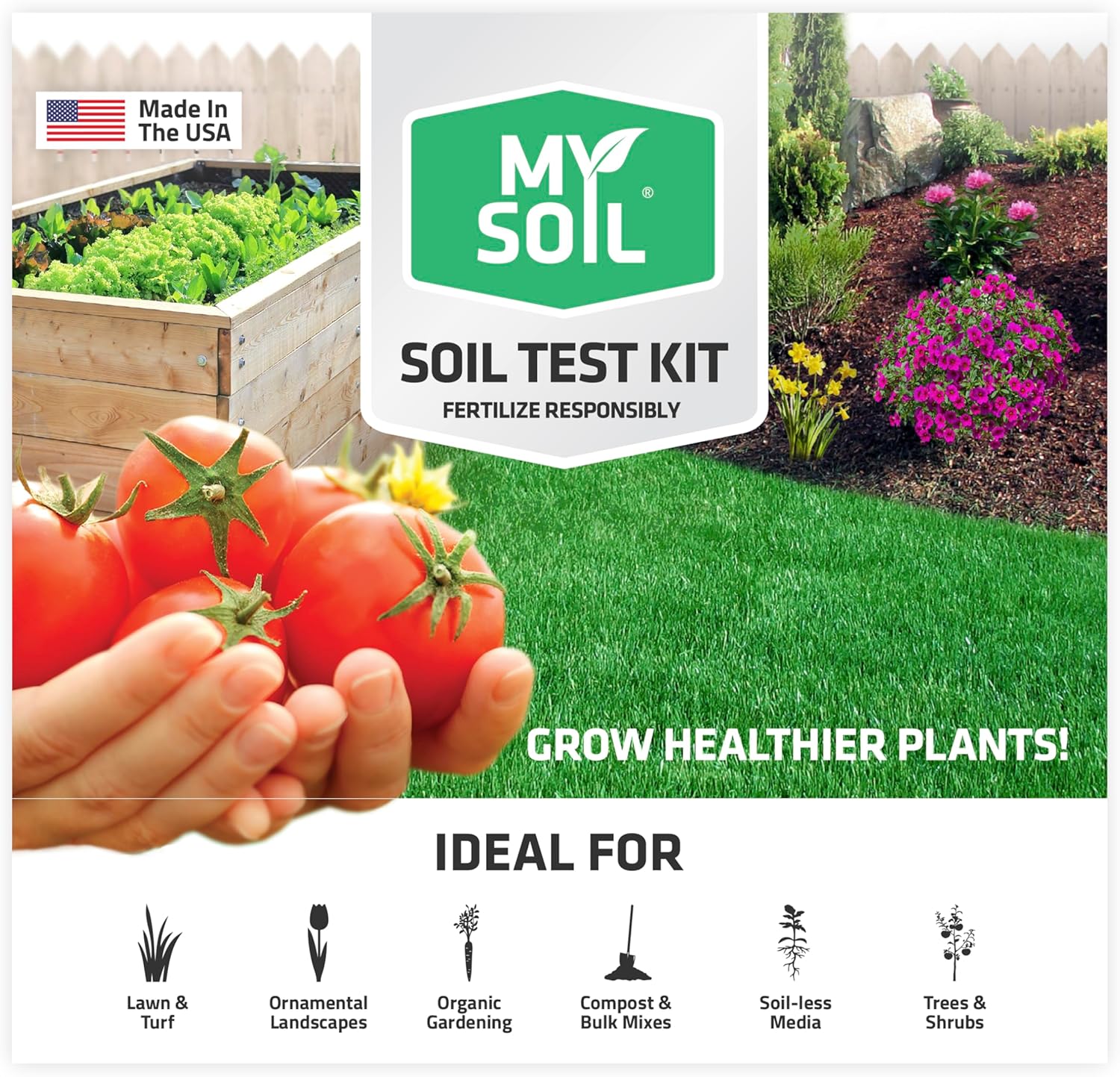
MySoil Professional Mail‑In Soil Test Kit (1 Test)
| Number of Packs | 1 |
|---|---|
| Unit Count | 1 Count |
| Manufacturer | Predictive Nutrient Solutions, Inc |
| Item Weight | 4.6 ounces |
The MySoil kit is a single‑use mail‑in soil test designed to give a professional laboratory analysis rather than an instant at‑home reading. You collect a sample in the included jar, register the kit online, mail the prepaid envelope to the lab, and get a detailed report in about 6–8 days. Results cover pH plus 13 plant‑available nutrients and include step‑by‑step recommendations for what to apply, how much, and when, with both organic and conventional options. That makes it useful for diagnosing lawn problems, planning fertilization for turf or vegetable beds, or checking soil before planting. The kit contains everything needed for one test and saves time by replacing guesswork with specific advice, which can reduce unnecessary product use. The main limitation is that each kit covers only a single sample, so testing multiple areas or repeated checks requires buying multiple kits; turnaround also depends on mailing times. For a homeowner who wants accurate, lab‑grade guidance for improving grass and garden soil, MySoil provides actionable results without complex equipment.
Best for: Homeowners focused on improving lawn health who want reliable, lab‑grade soil data and clear amendment instructions rather than DIY meters or strips.
Less Ideal for: People who need rapid, repeated tests across many spots or instant field readings should consider multi‑test packs or handheld meters instead.
- Laboratory analysis of pH plus 13 plant‑available nutrients for accurate results
- Includes prepaid mail envelope and everything needed to collect and send one sample
- Custom, easy‑to‑follow recommendations for what, when, and how much to apply
- Works for any soil type and a wide range of uses including lawn and turf
- Single‑use kit covers only one sample location
- Results take several days since samples are mailed to a lab
Verdict: For reliable, lab‑grade soil diagnostics and clear fertilizer guidance to improve grass and garden performance, choose this single‑test MySoil kit.
Choosing the Right Mail in Soil Test Kit: Key Factors to Consider
Lab Analysis Method and Accreditation
The chemistry and protocols a lab uses determine how accurate and interpretable results are. Tests run with established methods like colorimetry, atomic absorption, or ICP provide reliable readings for macronutrients and micronutrients.
Accreditation or use of university-affiliated labs is valuable because it indicates standardized procedures and quality control. Knowing the method also helps you compare results over time or between labs, since different extraction solutions can yield different reported nutrient levels.
Nutrient Panel Coverage
Check which nutrients the kit measures. Essential macronutrients such as nitrogen, phosphorus, and potassium are core, but many gardeners also need calcium, magnesium, sulfur, and key micronutrients like iron, manganese, zinc, and copper.
A broader panel helps diagnose persistent deficiency patterns and avoid over-applying fertilizers. If you grow sensitive crops, look for kits that include micronutrient analysis and organic matter content to build a fuller picture of soil fertility.
Sampling Guidance and Kit Completeness
Good results start with good sampling. Kits that provide clear, step-by-step instructions, a probe or tool suggestions, labeled sample bags, and guidance on sample depth and composite sampling reduce user error.
The kit should explain how many subsamples to take per planting area and how to mix them for a representative composite. Without clear guidance, samples can misrepresent variability across a garden bed and lead to poor amendment choices.
Report Clarity and Recommendation Usefulness
A useful report presents test results in clear units, explains what the numbers mean for plants, and gives specific amendment or fertilizer recommendations with rates and timing.
Gardening-focused reports translate raw nutrient numbers into actionable steps, such as pounds per 1,000 square feet or tablespoons per plant for common amendments. Reports that include regional context or crop-specific guidance are particularly helpful for making the next seasonal decisions.
Turnaround Time and Follow-up Support
Turnaround matters when you need to adjust soil before planting or during a growing season. Faster labs let you correct pH or nutrient issues in time for critical growth stages.
Also consider whether the service offers follow-up advice, phone or email support, or plans for re-testing. Access to a technician or extension specialist can clarify unusual results and recommend longer-term soil management strategies.
Data Format and Long-term Tracking
Look at how results are delivered and stored. Downloadable PDFs, raw data tables, and online result dashboards make it easier to track soil changes over years.
Consistent units and clear labeling let you compare tests from different seasons or beds. If you plan to monitor soil health over time, choose a service that keeps historical records and provides exportable data for your records.
When a Mail in Kit Is the Right Choice
Mail in soil testing is a strong option when you want laboratory-grade data without investing in meters or learning wet-chemistry techniques. It is especially useful for vegetable beds, new raised beds, lawns that need renovation, and orchard or vineyard blocks where management decisions have long-term consequences.
Kits are less useful for instant checks like spot pH readings while in the field, but they excel at providing a comprehensive baseline for fertilizer planning, lime applications, and long-term soil health strategies.
- Best for strategic planning before planting or renovation
- Useful when diagnosing persistent nutrient deficiencies
- Not intended for immediate in-field troubleshooting
How to Collect Representative Soil Samples
Take multiple subsamples across a uniform area and combine them into one composite sample. For garden beds, 6 to 10 subsamples per distinct area is common; for small lawns, increase the number. Avoid mixing soil from visibly different patches such as a shady corner and a sunny slope.
Sample to the depth appropriate for the crop. For annual vegetables, sample the top 6 to 8 inches. For turf or surface-rooted plants, 3 to 4 inches may be sufficient. Record the sampling depth and any bed-specific notes to help interpret results.
- Use a clean trowel or probe and remove surface debris
- Label samples with bed location and date
- Avoid sampling after recent fertilizer or lime applications unless you want post-application levels
Interpreting pH and Nutrient Numbers
Soil pH controls nutrient availability. Slight pH adjustments can unlock existing nutrients more effectively than adding fertilizer. Read reports for both pH and buffering capacity or lime requirement to understand how much amendment will change pH.
Pay attention to nutrient units and recommended application rates. Nitrogen is often reported differently from phosphorus and potassium, and recommendations may vary by crop. Use the report's suggested amendment rates rather than guessing from percent changes.
- Look for clear conversion to common application units
- Note whether the lab reports exchangeable or total nutrient pools
- Consider crop-specific optimum ranges rather than generic benchmarks
Using Results to Build a Seasonal Plan
Turn test results into an actionable schedule: lime in fall if pH needs raising, add phosphorus before planting heavy feeders, and schedule nitrogen applications during active growth. Prioritize changes that have lasting effects, such as organic matter additions, while timing quick fixes like soluble fertilizers to crop demand.
Keep a log of what you applied and when, then retest on a consistent schedule to measure impact. Gradual changes are often more sustainable than large, one-time corrections.
- Apply lime well before planting when possible
- Time nitrogen applications to growth phases
- Use organic matter to build long-term fertility
Common Limitations of Mail in Testing
Mail in tests rely on a representative sample. Small-scale variability within a bed can lead to mixed results if sampling is not done carefully. Very compacted or highly variable sites may require multiple discrete tests rather than one composite.
Some labs use extraction methods that are better for certain soil types. Interpreting results across different testing methods requires caution. Also, very recent amendments may skew results, so allow time between application and sampling when possible.
- Composite sampling can mask hot or cold spots
- Method differences affect comparability between labs
- Recent fertilizer application can distort nutrient readings
How We Chose the Best Mail in Soil Test Kit
We focused on practical lab and user factors that determine whether a mail in soil test kit will give actionable results for gardeners. Our filters prioritized laboratory analysis methods and accreditation to ensure report accuracy, the range of nutrients and pH measured, and whether the lab provides region-appropriate recommendations. We also weighed sample collection guidance and kit completeness since poor sampling creates misleading results. Turnaround time and result format mattered because quick, understandable reports let gardeners act in-season. Additional editorial criteria included the clarity of amendment or fertilizer recommendations and any options for follow-up consultation with a soil scientist. Kits were excluded if they only offered basic pH strips, required extensive at-home processing, or provided reports lacking clear nutrient numbers. We did not consider brand reputation alone; instead we verified that labs use standard testing chemistry and report nutrients in commonly used units. The final list balances lab accuracy, ease of sampling, report usefulness, and timing so gardeners can choose a kit that matches their scale and management style.
FAQ
How often should I send soil samples for testing?
It often depends on your goals. For a baseline before major planting or renovation, test once. For actively managed vegetable beds or to monitor lime effects, test every two to three years. Annual testing can be useful if you are troubleshooting persistent problems.
Can I test different beds with one kit?
Yes, but keep areas that differ in sunlight, cropping, or soil type as separate tests. Composite samples are appropriate for uniform areas; otherwise submit separate samples so recommendations match each bed's needs.
Will the report tell me exactly how much fertilizer to add?
Most mail in reports provide specific amendment rates and timing for common crops or per area units. Recommendations vary by lab, so follow the units and application guidance on the report and record what you applied for future comparison.
How much sample depth should I collect for vegetables?
For annual vegetables, sample the top 6 to 8 inches where most roots take up nutrients. Sampling deeper is useful for perennial systems or if you suspect subsoil issues.
Are micronutrients important for home gardens?
Often they are, especially if you grow high-yielding vegetables, fruiting shrubs, or sensitive ornamental species. Micronutrient deficiencies can limit growth even when macronutrients are adequate, so choose a kit that includes key micronutrients if symptoms persist.
Final Verdict
Mail in soil test kits give gardeners reliable, lab-grade data that make soil management decisions easier and more targeted. Prioritize kits that use established lab methods, include the nutrients you care about, and clearly explain recommended amendment rates and timing. Remember that good sampling and realistic turnaround expectations are essential. Use results to make incremental, documented changes and retest on a regular schedule to track progress and refine your plan.
