

Note: This article contains affiliate links. If you click on these links and make a purchase, I may earn a small commission at no extra cost to you. This helps support my research and content. Read my full affiliate disclosure here.
If you are deciding which 3 in 1 soil tester to add to your toolkit, choosing the right unit makes routine garden checks faster and more reliable. A solid soil tester helps you balance pH, understand moisture levels, and gauge light exposure so you can time watering, amend soil, and place plants more intelligently. This guide highlights six shortlisted 3 in 1 soil testers chosen for real garden performance across beds, containers, and lawns. Below we summarize how each tester performs on accuracy, build durability, and ease of use so you can quickly find the model that fits your planting style and maintenance routine.
Top Picks at a Glance
| Best Overall The best all-around choice for most situations | SSAWcasa 3-in-1 Soil Meter — Moisture, pH and Light Tester |  |
| Best Quality Built to a higher standard if you want something more solid | Buzzpoint 3-in-1 Soil Tester for Moisture, pH and Light |  |
| Best Value The sweet spot between price and what you get | Maxsolve 3-in-1 Soil Tester (2-Pack) — Moisture, Light and pH Meter |  |
| Best Budget The cheapest option that still gets the job done reliably | Soonkoda S-9 3-in-1 Soil Tester (Moisture, Fertility, pH) |  |
| Highest Rated A top-rated pick with lots of positive feedback | SONKIR MS02 3-in-1 Soil Moisture, pH and Light Tester |  |
| Most Popular A crowd favorite that many people choose with confidence | VIVOSUN 3-in-1 Soil Tester (Moisture, Light, pH) |  |
SSAWcasa 3-in-1 Soil Meter — Moisture, pH and Light Tester

| pH range | 3.5-8 pH |
|---|---|
| Moisture range | 1-10 |
| Light range | 0-2000 lux |
| Power | No battery required |
| Manufacturer | SSAWcasa |
This inexpensive 3-in-1 soil meter combines a moisture probe, analog pH gauge and light meter in a single handheld tool for quick checks around the garden or on a windowsill. It is used by switching the dial to the desired mode, inserting the slim probe 2 to 4 inches into the soil, and waiting about ten minutes for a stable reading. The moisture scale (1 to 10) helps tell when a pot or bed is dry, normal or wet so you avoid over- or underwatering. The pH range (3.5 to 8) gives a basic acidic-to-alkaline indication useful for choosing fertilizers or amendments. The light meter reports relative lux to compare locations for sun-loving or shade-tolerant plants. Notable strengths are its battery-free operation, portability and easy-to-read dial driven by double-needle detection for faster response. Limitations are that it provides broad ranges rather than lab accuracy, is not intended for testing water or very hard soils, and the probe should be kept clean and not left inserted long term to avoid damage. For routine, practical checks across houseplants, flower beds and veggie patches it gives fast, useful guidance at a low cost.
Best for: Gardeners who want a simple, low-cost way to monitor watering, soil acidity and light for a mix of houseplants, flower beds and vegetable patches without fuss or technical setup.
Less Ideal for: Users needing precise laboratory pH or moisture readings for professional soil analysis or for frequent testing of liquids and very hard-packed soils.
- Three functions in one tool: moisture, pH and light so you can assess multiple growing needs without extra devices
- Battery-free analog design for immediate use and no ongoing power cost
- Slim probe reaches root zone with minimal disturbance for more relevant moisture readings
- Easy-to-read dial and simple switch operation make it beginner-friendly
- Provides broad, qualitative ranges rather than laboratory-grade numeric accuracy
- Not suitable for testing pure water or very compact/rocky soils which can damage the probe
Verdict: An affordable, no-battery 3-in-1 tester that gives quick, practical moisture pH and light readings for everyday plant care.
Buzzpoint 3-in-1 Soil Tester for Moisture, pH and Light

| pH range | 3.5–8 |
|---|---|
| Light measurement | 0–2000 lux |
| Probe material | Stainless steel |
This compact analog soil tester gives immediate, no-fuss readings for moisture, pH, and light so you can make quick decisions about watering, soil amendments, and placement. Use it by inserting the stainless steel probe into potting mix or garden soil and reading the dial for moisture level, pH within a 3.5 to 8 range, and ambient light in lux. The battery-free design and corrosion-resistant probe make it convenient for frequent checks without charging or apps. It is especially useful for diagnosing overwatering, identifying strongly acidic or alkaline soils, and finding brighter or shadier spots for houseplants or vegetables. Limitations include the coarse analog scale, which is less precise than lab tests or digital meters, and the pH range that does not cover extremes below 3.5. The meter also requires clean probe insertion and stable soil contact for best results, so readings can vary in very rocky, compacted, or heavily amended soils.
Best for: Gardeners who prioritize practical, frequent testing to optimize plant performance and want a fast, no-electronics tool for routine checks around the house and garden.
Less Ideal for: Users who need laboratory-level accuracy, detailed pH logging, or measurements in extreme soils should choose a calibrated digital meter or professional testing service.
- Instant analog readings for moisture, pH (3.5–8) and light without batteries
- Stainless steel probe resists corrosion for repeated soil use
- Portable and simple to use for quick spot checks in pots and beds
- Covers common light levels up to 2000 lux to guide placement decisions
- Analog dial provides coarse, not lab-grade, precision
- pH measurement limited to a 3.5–8 range and may miss very acidic soils
Verdict: A straightforward, battery-free 3-in-1 meter that gives fast actionable readings for gardeners focused on improving plant performance with frequent spot checks.
Maxsolve 3-in-1 Soil Tester (2-Pack) — Moisture, Light and pH Meter

| Item Weight | 3.68 ounces |
|---|---|
| Manufacturer | Maxsolve |
| Functions | Moisture, Light, pH |
| Pack | 2 soil moisture meters |
This Maxsolve 3-in-1 soil tester is a simple, plug-and-play tool for checking soil moisture, sunlight exposure and approximate pH in garden beds and potted plants. You switch the function, insert the probe into the root zone and read an analog needle to see whether soil is dry, moist or wet, how much light the spot receives, and a rough soil acidity reading. The unit is lightweight and portable, comes as a two-pack for checking multiple locations, and needs no batteries which makes it convenient for quick spot checks indoors or outdoors. The color-coded dial and straightforward operation make it useful for preventing overwatering or under-lighting and for spotting large pH problems that need correction. Limitations are that the pH scale is coarse and not suitable for testing liquids, and the analog needle can be less precise than digital meters for fine pH or moisture calibration. For routine, fast checks across several plants this tester is an inexpensive, low-effort option, but gardeners who need laboratory-style precision should use a dedicated digital pH meter or send soil samples to a lab.
Best for: Gardeners who want a practical, low-effort way to check moisture, light and basic soil pH across multiple plants and avoid common watering and light mistakes.
Less Ideal for: Users who need laboratory-level pH accuracy or detailed moisture profiling for sensitive crops should choose a calibrated digital meter or lab testing instead.
- Three functions in one tool: moisture, light and soil pH for quick diagnostics
- No batteries required so it is always ready and easy to use in the garden
- Comes as a two-pack to test multiple pots or bed locations without moving a single unit
- Color-coded analog dial provides immediate, easy-to-read guidance for watering and light
- pH readings are coarse and not intended for testing liquids or high-precision measurements
- Analog needle can be less accurate and harder to calibrate than digital meters
Verdict: A low-cost, no-battery two-pack that gives fast, easy spot checks of moisture, light and basic soil pH for practical garden troubleshooting.
Soonkoda S-9 3-in-1 Soil Tester (Moisture, Fertility, pH)

| Brand Name | Soonkoda |
|---|---|
| Model | S-9 |
| Included Components | Soil Tester, English Manual, Paper Box |
| Unit Count | 1 Count |
The Soonkoda S-9 is a pocketable analog soil tester that checks moisture, nutrient level (fertility), and soil pH with a single probe. You use it by sliding the mode switch to MOIST, FERTILITY, or PH, inserting the probe about two thirds into the soil and reading the needle position after a few seconds. The meter gives color‑banded results (dry/ok/wet for moisture; low/ok/high for fertility; an acid-to-alkaline range for pH), which makes interpretation straightforward for casual gardeners. It is lightweight, requires no batteries, and comes with a manual and simple cardboard case. Limitations are that it provides approximate, relative readings rather than lab-accurate values, can struggle in very dry soils unless you moisten the sample first, and the single metal probe is not ideal for rocky or compacted beds. For a low-cost, entry-level tool it helps you spot watering mistakes and get a rough sense of soil condition before applying amendments.
Best for: Gardeners on a tight budget who want a quick, easy way to check soil moisture and get a rough sense of pH and nutrient level for lawns, raised beds, or potted plants.
Less Ideal for: Professional soil testing, precise pH management, or heavy clay/rocky sites where a single thin probe cannot be inserted reliably.
- Three-in-one function: moisture, fertility, and pH in one handheld unit
- Color-coded needle scale makes readings easy to interpret without training
- No batteries required and very lightweight for frequent spot checks
- Provides only approximate, relative values not lab-grade measurements
- Requires moist soil for reliable moisture readings in very dry conditions
Verdict: If you want the cheapest practical tool to spot-check moisture, pH, and fertility in the garden, this simple 3-in-1 tester gives fast, easy-to-read guidance.
SONKIR MS02 3-in-1 Soil Moisture, pH and Light Tester
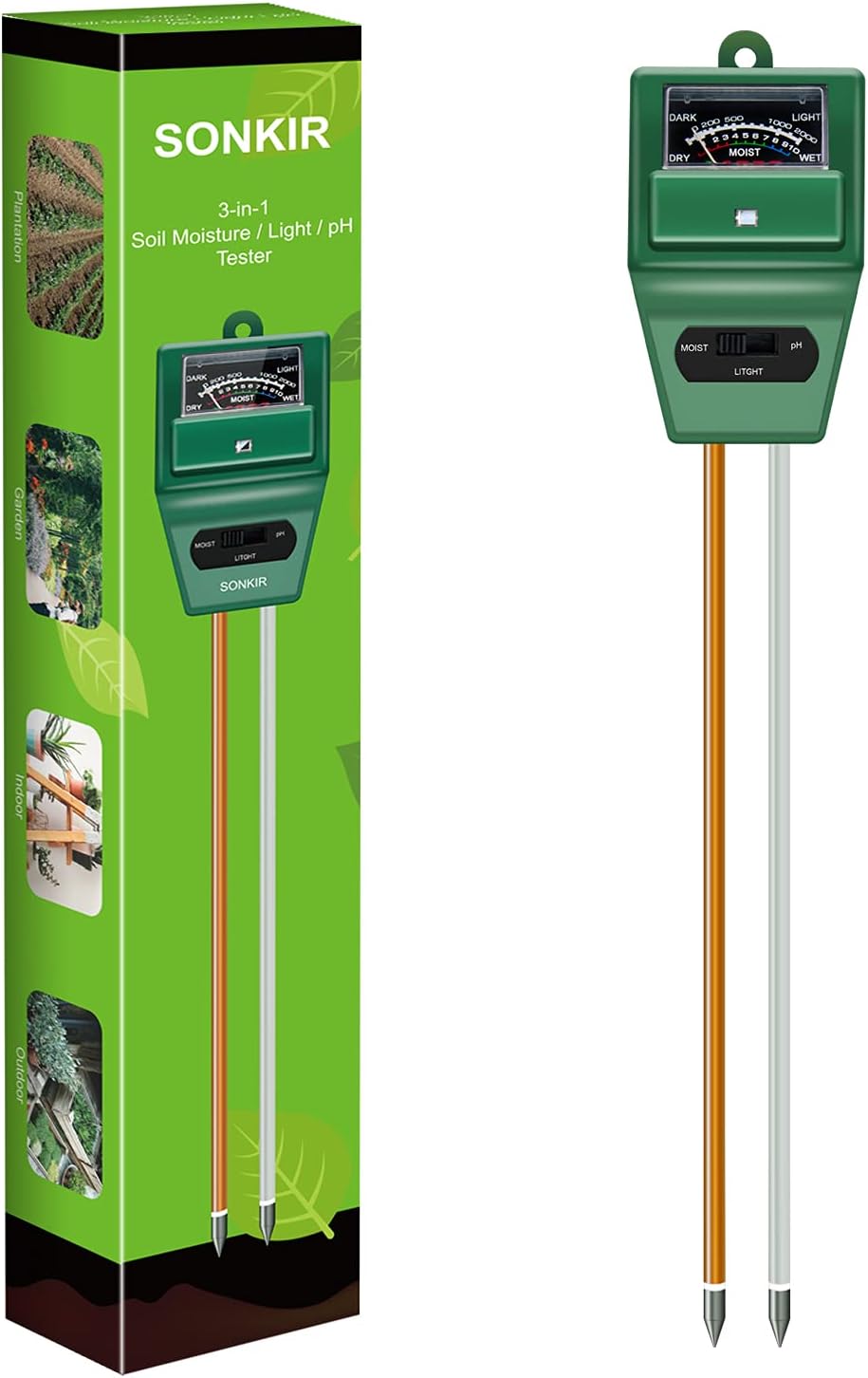
| pH range | 3.5-8 pH |
|---|---|
| Moisture range | 1-10 scale |
| Probe length | 7.9 inches |
| Power | No battery required |
The SONKIR MS02 is a handheld, no-battery soil meter that gives quick, visual readings of moisture, pH and sunlight to help you maintain healthier grass and garden plants. You switch the dial to the desired function, push the probe into the soil about 6 to 7 inches, wait roughly 10 minutes and read the needle on the analog display. The meter covers a practical pH range for lawns and gardens and shows moisture on a 1 to 10 scale so you can decide when to water. Its long probe and compact, lightweight body make it convenient for spot-checking multiple areas of a lawn or garden bed. Important limitations are that the pH probe is intended for soil only and the analog needle can be slow to move in very dry soils or close-to-neutral pH, so readings sometimes require rechecking after moistening the sample or testing several spots. The unit is best for gardeners who want an affordable, easy-to-use tool for routine soil checks rather than laboratory-accurate analysis.
Best for: Someone who wants an inexpensive, easy-to-use tool for routine soil checks across a lawn or garden and values practical, repeatable guidance over laboratory precision.
Less Ideal for: Users who need lab-grade pH or moisture measurements, continuous data logging, or digital readouts for precise record keeping should consider more advanced instruments.
- 3-in-1 functionality measures moisture, pH and sunlight without extra tools
- No battery required so it is always ready to use and low maintenance
- Long probe and compact form factor make spot checks across a lawn or garden quick
- Simple analog dial is straightforward for fast, at-a-glance decisions
- pH function is designed for soil only and cannot test water or other liquids
- Analog needle can be unresponsive in very dry soil or near-neutral pH, requiring repeated tests
Verdict: A straightforward, no-battery 3-in-1 tester that gives fast, practical soil moisture, pH and light checks for everyday lawn and garden care.
VIVOSUN 3-in-1 Soil Tester (Moisture, Light, pH)

| Functions | Soil moisture, light intensity, pH |
|---|---|
| pH range | 3.5–8 |
| Moisture range | 1–10 |
| Light range | 0–2000 |
The VIVOSUN 3-in-1 soil tester is a pocket-friendly, battery-free probe that gives quick, at-a-glance readings for soil moisture, light intensity and pH. You insert the probe into potting mix or garden beds, press the mode button to select moisture, light or pH, then read the numerical scale to decide when to water, adjust light exposure, or correct soil acidity. Its main benefits are ease of use and portability: no calibration gear or batteries are required and the compact probe is convenient to move between containers and beds. The pH range (3.5 to 8) and moisture scale (1 to 10) cover typical needs for houseplants, vegetables and ornamentals, while the light reading helps spot under- or over-lit locations. Limitations are that it is designed for soil only so it should not be used in pure water or nutrient solutions, and the accuracy is adequate for general gardening rather than lab-grade analysis. Expect simple diagnostics that help avoid overwatering and poor light placement without a steep learning curve or high cost.
Best for: Gardeners who want a low-cost, no-fuss tool to monitor soil conditions for houseplants, vegetables and outdoor beds and who prioritize quick practical guidance over laboratory accuracy.
Less Ideal for: Users who need highly precise or certified pH readings for hydroponics, scientific work, or nutrient solution testing should choose a calibrated digital meter instead.
- Battery-free operation for low ongoing cost and immediate use
- Three measurements in one compact probe for quick spot checks
- Wide pH and moisture ranges suitable for most garden and houseplant situations
- Portable and easy to use with a single-button mode switch
- Not intended for testing liquids or hydroponic solutions
- Not as precise as digital meters for laboratory-grade pH readings
Verdict: A very affordable, battery-free 3-in-1 probe that gives fast, practical soil pH, moisture and light checks for everyday gardeners.
Choosing the Right 3 in 1 Soil Tester: Key Factors to Consider
Measurement Accuracy
Accurate pH and moisture readings are the primary reason you buy a 3 in 1 soil tester. A pH sensor that drifts or gives wide variance from one spot to the next can lead you to apply unnecessary lime or sulfur. Moisture scales differ by manufacturer, so look for devices that give consistent relative readings across several checks rather than absolute numeric perfection.
In practice, accuracy affects daily gardening choices like watering frequency, fertilizer timing, and plant placement. A reliably accurate tester lets you build a watering routine and soil amendment plan based on actual conditions rather than guesswork.
Probe Length and Construction
Probe length determines how deep you can measure. Short probes are fine for shallow pots and seed trays, while longer, sturdier probes are needed for raised beds and deeper garden rows. Metal composition and joint strength affect longevity; thin, hollow probes can bend and corrode sooner when exposed to damp soil and fertilizer salts.
For regular outdoor use choose a probe that resists bending and is long enough to reach the root zone you care about. A replaceable probe or a robust one-piece design reduces the chance of breakage during routine checks.
Display Readability and Scale
A clear, readable display saves time and reduces mistakes. Analog dials are simple and usually battery-free, but can be harder to read in low light. Digital readouts offer precise numeric values but sometimes require batteries and can be affected by moisture. The scale itself matters; check whether the display uses a simple low-medium-high banding or gives fine-grained numbers for pH and moisture.
Good readability lets you take quick checks across multiple planting zones without returning to a manual or flashlight to interpret vague markings.
Durability and Weather Resistance
Garden tools get wet, dropped, and left outdoors. A 3 in 1 soil tester should resist corrosion, sealing issues, and loose components. Weather-resistant bodies and stainless or plated probes extend usable life. Units that are fragile or not sealed can fail after a single season exposed to rain and damp soil.
Durability also ties to maintenance. A well-built unit will need fewer repairs or replacements over time, making it more reliable for seasonal tasks like planting, feeding, and winter storage.
Maintenance and Calibration Needs
Some testers require periodic calibration or sensor cleaning to keep readings trustworthy. Devices without calibration needs or those that tolerate light maintenance are easier to integrate into routine garden care. If a tool calls for special calibration solutions or replacement sensors, factor that into long-term usability.
Maintenance affects whether you will use the tester regularly. If upkeep is complex or frequent, many gardeners stop testing and lose the benefits of regular soil checks.
Portability and Ease of Use
A lightweight, ergonomic tester encourages frequent checks across beds and containers. Consider how easy it is to carry, insert into compact container mixes, and read while kneeling or standing. Simple operation with no menus or buttons suits gardeners who want instant answers.
Portability also includes storage and transport between garden zones. A compact, tool-belt friendly design is practical for small urban plots and large properties alike.
When to Test Soil and What Each Reading Means
Testing at key moments in the season gives the most useful data. Test moisture before watering to avoid overwatering, and check pH before planting and after major amendments so you can track shifts. Light readings are especially helpful when moving container plants or evaluating new planting spots.
A low moisture reading usually means dig deeper into the root zone and adjust watering rather than surface wetness. A pH value outside the preferred range for a plant signals that a targeted amendment may be necessary, while repeated unusual readings could indicate contamination from fertilizer salts or poor drainage.
- Test moisture in the morning to capture overnight drainage patterns.
- Check pH when changing plant types or after heavy soil amendments.
- Use light measurements to position shade-tolerant versus sun-loving plants.
Using a 3 in 1 Tester in Containers Versus In-Ground Beds
Container mixes drain and heat differently than garden soil, so expect different moisture dynamics. A tester that reaches into the potting mix center helps avoid misleading surface readings from dry tops and wet bottoms. For shallow pots, probe length matters less, but for larger planters or deep raised beds a longer probe is essential.
When testing in-ground beds, push the probe to the depth where most roots develop for the type of plant you are evaluating. Avoid rocks and compacted zones that can bend probes. For both containers and beds, consistent testing locations and depths yield the most actionable trend data.
- Rotate testing spots in big beds to get a representative average.
- In small pots probe near the root ball edge rather than the center to avoid damaging roots.
Interpreting pH Readings for Common Garden Needs
Different plants prefer different pH ranges. Knowing whether your soil runs acidic, neutral, or alkaline helps you choose suitable plants and amendments. Small pH shifts can affect nutrient availability significantly, so use readings as a guide before committing to major treatments.
If pH readings vary across the garden, address problematic areas with localized amendments or raised beds with custom mixes. Regular checks during the growing season show whether amendments are taking effect or if additional adjustments are needed.
- Use pH readings to guide lime or sulfur applications rather than guessing.
- Track pH changes after an amendment to see if the treatment is moving the needle.
Extending Tool Life with Proper Care
Rinse probes with clean water after use to remove soil residues and fertilizer salts. Dry the unit thoroughly before storing to prevent corrosion and electronic issues. Avoid using steel wool or abrasive cleaners that can wear protective coatings on the probe.
Store testers indoors over winter and keep them away from prolonged UV exposure. If the unit uses batteries, remove them during long storage periods to prevent leakage. Regular visual inspections for bent probes, loose fittings, and cracked housings catch problems early.
- Wipe soil from probes after each use and dry before storage.
- Check seals and joints annually and replace units with irreparable corrosion.
How We Chose the Best 3 in 1 Soil Tester
We prioritized tools that deliver repeatable field readings gardeners can act on. Accuracy of pH and moisture measurements was an essential filter because inconsistent sensors create misleading care decisions. Durability under common outdoor conditions mattered as well; units that corrode, bend, or lose calibration are poor long-term investments for regular garden use. Ease of use and readability were applied as criteria so gardeners can take fast checks without fuss. Probe length and construction were considered because they determine whether the tester can reach container soils, raised beds, or deeper garden rows. Battery-free or low-maintenance designs scored higher since many gardeners prefer tools that work on the spot without frequent servicing. We excluded laboratory equipment and complex digital meters that require calibration solutions or replacement probes. Also removed devices lacking clear specification on pH range or moisture scale. The final selection emphasizes practical field performance across the key dimensions gardeners care about: measurement accuracy, sensor durability, readable display, probe length and strength, and low maintenance.
FAQ
How often should I use a 3 in 1 soil tester in my garden?
Often depends on planting intensity and season, but weekly checks during active growth provide useful trends. Monthly checks are usually sufficient for established beds outside peak growth periods.
Can a simple 3 in 1 tester replace lab soil tests?
Simple testers give quick field guidance on pH, moisture, and light but do not replace comprehensive lab analyses that measure nutrients and salts. Use a tester for routine monitoring and get lab testing for detailed nutrient planning.
Why do pH readings change after heavy rain or fertilizing?
Rain can temporarily dilute salts and shift surface pH, while fertilizers can change soil chemistry where they concentrate. For reliable tracking, take readings a few days after major rain or fertilization so the soil equilibrates.
Are digital or analog 3 in 1 testers better for gardeners?
Digital units provide precise numerical values but may require batteries and be sensitive to moisture. Analog testers are often more rugged and battery-free but give less precise increments. Choice depends on whether you prefer precision or simplicity.
Will probe length affect readings in raised beds?
Yes. Short probes may only sample the top layer, which can be drier and not reflect root-zone conditions. Longer probes let you measure moisture and pH where most roots grow in raised beds.
Final Verdict
Choose a 3 in 1 soil tester that balances reliable readings with a build that stands up to outdoor conditions. Prioritize pH accuracy and probe strength if you make frequent amendment decisions, and favor clear displays and simple maintenance if you plan regular checks. Remember tradeoffs: extreme precision often requires more care and calibration, while simpler units are easier to use but may offer broader ranges rather than exact values. Pick the tester that fits how you garden and the types of checks you will perform most often.
