

Note: This article contains affiliate links. If you click on these links and make a purchase, I may earn a small commission at no extra cost to you. This helps support my research and content. Read my full affiliate disclosure here.
A dependable soil tester helps you understand pH, moisture, and nutrient tendencies so you can make targeted adjustments and avoid wasted effort. For home gardeners, the right tester turns guesswork into small, actionable steps that improve plant vigor across beds, containers, and lawns. This guide shortlists seven top homeowner soil testers that perform well in everyday garden situations. We evaluated units on probe construction, sensor accuracy, ease of reading, and durability in real outdoor use. Read on to see which features matter most for your garden and which tester types match your routines.
Top Picks at a Glance
| Best Overall The best all-around choice for most situations | Luster Leaf Rapitest 40-Test Soil Test Kit (pH, N, P, K) |  |
| Best Quality Built to a higher standard if you want something more solid | Apera Instruments GroStar GS2 Soil pH Pen Tester Kit (Gen II) |  |
| Best Value The sweet spot between price and what you get | Buladeke 7-in-1 Digital Soil Tester Moisture Meter |  |
| Best Budget The cheapest option that still gets the job done reliably | Soonkoda S-9 3-in-1 Soil Tester (Moisture, Fertility, pH) |  |
| Highest Rated A top-rated pick with lots of positive feedback | MySoil Professional Mail‑In Soil Test Kit (1 Test) |  |
| Most Popular A crowd favorite that many people choose with confidence | SONKIR MS02 3-in-1 Soil Moisture, pH and Light Tester |  |
| Best Seller A high-volume bestseller chosen again and again | Luster Leaf Rapitest Soil Test Kit (20 tests) |  |
Luster Leaf Rapitest 40-Test Soil Test Kit (pH, N, P, K)

| Tests included | pH, Nitrogen, Phosphorus, Potash |
|---|---|
| Number of tests | 40 total (10 per test type) |
| Mounting type | Tabletop |
| Battery description | No batteries required |
The Luster Leaf Rapitest kit gives quick, at-home readings for soil pH and the three primary nutrients gardeners watch for: nitrogen, phosphorus and potash. It ships with reagents and a patented color comparator system plus instructions and a plant pH preference list, and is designed to perform 40 total tests (10 each for pH, N, P and K). Typical use is straightforward: collect small soil samples, add the provided capsules or solutions, and compare the resulting color to the chart to determine whether your lawn needs lime, fertilizer, or other amendments. The tabletop format and printed recommendations make it useful for routine checks through the growing season. Limitations are that results are qualitative rather than lab-accurate numbers and interpretation depends on correct sampling and careful color matching under good light. For gardeners who want fast, actionable guidance for lawn feeding and pH adjustment, this kit balances simplicity and coverage; it is less suitable when precise ppm measurements are required.
Best for: Buyers who want a practical, no-fuss way to monitor lawn soil health and adjust fertilizer or lime between seasons; ideal for homeowners who prefer actionable, easy-to-read guidance over laboratory testing.
Less Ideal for: Users who require laboratory-grade nutrient concentrations or professional soil reports for diagnostics or commercial turf management.
- Covers four key tests (pH, nitrogen, phosphorus, potash) in one kit for routine lawn checks
- Includes enough reagents for 40 tests, allowing multiple checks through a season
- Patented color comparator and clear instructions make results easy to interpret for beginners
- Includes plant pH preference recommendations to help translate results into amendment choices
- Provides color-based, qualitative results rather than lab-precise numeric readings
- Accuracy depends on sampling technique and consistent lighting when matching colors
Verdict: An affordable, easy-to-use kit for routine lawn and garden checks that delivers quick, actionable pH and nutrient guidance.
Apera Instruments GroStar GS2 Soil pH Pen Tester Kit (Gen II)

| pH range | 0 to 14.0 pH |
|---|---|
| Temperature range | 0 to 50 ℃ (32 to 122 ℉) |
| Resolution | 0.1 pH, 0.1 ℃/0.1 ℉ |
| Accuracy | ±0.1 pH, ±1 ℃/±1 ℉ |
| Waterproof rating | IP67 |
The GroStar GS2 is a handheld, grower-oriented soil pH meter that lets you test pH and temperature directly in soil, coco coir, rockwool and nutrient solutions. It uses a replaceable Swiss spear glass probe for high-accuracy direct readings and an automatic temperature compensation to keep results consistent. The 3-color backlit HD display and TruRead mode simplify field work by showing averaged, min and max values across multiple spots so you can judge zone variability quickly. The unit supports 1 to 3-point automatic calibration, provides probe condition and calibration reminders, and is IP67 rated for wet and dusty conditions. Practical benefits include faster, more reliable soil measurements compared with making slurries and a complete kit that includes the probe and accessories needed to start testing. Important limitations are that it runs on four AAA batteries and probe longevity will depend on soil type and maintenance, so you should plan for eventual probe replacement and periodic calibration to retain lab-grade accuracy.
Best for: Gardeners and small-scale growers who prioritize precise, repeatable pH control and want a rugged, field-ready meter that speeds up routine soil and solution testing.
Less Ideal for: Casual gardeners who only test sporadically or users seeking a rechargeable device with minimal ongoing maintenance requirements.
- Direct in-media pH and temperature measurement avoids time-consuming slurry tests
- Replaceable Swiss spear glass probe designed for accurate soil penetration
- TruRead averaging mode helps assess variability across multiple test spots
- IP67 waterproof and dust-proof rating suitable for outdoor use
- Fast 1–3 point automatic calibration with on-screen guidance
- Uses AAA batteries rather than a rechargeable battery
- Probe will wear over time and requires replacement and maintenance
Verdict: Choose the GroStar GS2 when you need fast, field-ready, lab-grade soil pH readings with a replaceable spear probe and features that reduce measurement guesswork.
Buladeke 7-in-1 Digital Soil Tester Moisture Meter

| Manufacturer | Buladeke |
|---|---|
| Battery type | 4 × 1.5V AAA (not included) |
| Functions | Moisture, pH, Temperature, Light, EC, TDS, Fertility |
This Buladeke 7-in-1 soil tester is a multi-function handheld meter designed for homeowners who want straightforward, data-driven plant care. You insert the probe into potting mix or garden soil and the large backlit LCD displays moisture, pH, temperature, light intensity and basic fertility indicators including EC and TDS within about 10 seconds. It is typically used to check when to water, whether soil acidity is appropriate, and whether plants are getting enough light. The bright screen and simple numeric readout make it accessible for beginners while the extra functions give practical guidance for vegetable beds, houseplants and succulents. It runs on four AAA batteries and warns when battery power is low. Limitations include the need to avoid forcing the probe into very hard or dry soil and that the device should not be used to measure liquids directly, so some delicate soils may need pre-moistening before testing. The meter gives quick, actionable readings but does not replace laboratory soil analysis for precise nutrient planning.
Best for: Homeowners who want an easy, data-focused tool to optimize watering, light and basic soil fertility for potted plants, beds and succulents without laboratory testing.
Less Ideal for: Professional growers or gardeners needing laboratory-grade nutrient analysis or users who require waterproof probes for measuring liquids directly.
- Measures seven parameters (moisture, pH, temperature, light, EC, TDS and fertility) in one handheld unit
- Large backlit LCD provides clear numeric readouts day or night
- Quick readings in about 10 seconds for fast, repeatable checks
- Battery low warning to prevent unexpected shutdown during use
- Probe can be damaged if forced into very hard or dry soil and may require pre-moistening
- Not intended for direct liquid measurement which limits some water-quality checks
Verdict: A compact, easy-to-read 7-in-1 meter that gives homeowners fast, practical soil and light data to optimize everyday plant care.
Soonkoda S-9 3-in-1 Soil Tester (Moisture, Fertility, pH)

| Brand Name | Soonkoda |
|---|---|
| Model | S-9 |
| Included Components | Soil Tester, English Manual, Paper Box |
| Unit Count | 1 Count |
The Soonkoda S-9 is a pocketable analog soil tester that checks moisture, nutrient level (fertility), and soil pH with a single probe. You use it by sliding the mode switch to MOIST, FERTILITY, or PH, inserting the probe about two thirds into the soil and reading the needle position after a few seconds. The meter gives color‑banded results (dry/ok/wet for moisture; low/ok/high for fertility; an acid-to-alkaline range for pH), which makes interpretation straightforward for casual gardeners. It is lightweight, requires no batteries, and comes with a manual and simple cardboard case. Limitations are that it provides approximate, relative readings rather than lab-accurate values, can struggle in very dry soils unless you moisten the sample first, and the single metal probe is not ideal for rocky or compacted beds. For a low-cost, entry-level tool it helps you spot watering mistakes and get a rough sense of soil condition before applying amendments.
Best for: Gardeners on a tight budget who want a quick, easy way to check soil moisture and get a rough sense of pH and nutrient level for lawns, raised beds, or potted plants.
Less Ideal for: Professional soil testing, precise pH management, or heavy clay/rocky sites where a single thin probe cannot be inserted reliably.
- Three-in-one function: moisture, fertility, and pH in one handheld unit
- Color-coded needle scale makes readings easy to interpret without training
- No batteries required and very lightweight for frequent spot checks
- Provides only approximate, relative values not lab-grade measurements
- Requires moist soil for reliable moisture readings in very dry conditions
Verdict: If you want the cheapest practical tool to spot-check moisture, pH, and fertility in the garden, this simple 3-in-1 tester gives fast, easy-to-read guidance.
MySoil Professional Mail‑In Soil Test Kit (1 Test)
| Number of Packs | 1 |
|---|---|
| Unit Count | 1 Count |
| Manufacturer | Predictive Nutrient Solutions, Inc |
| Item Weight | 4.6 ounces |
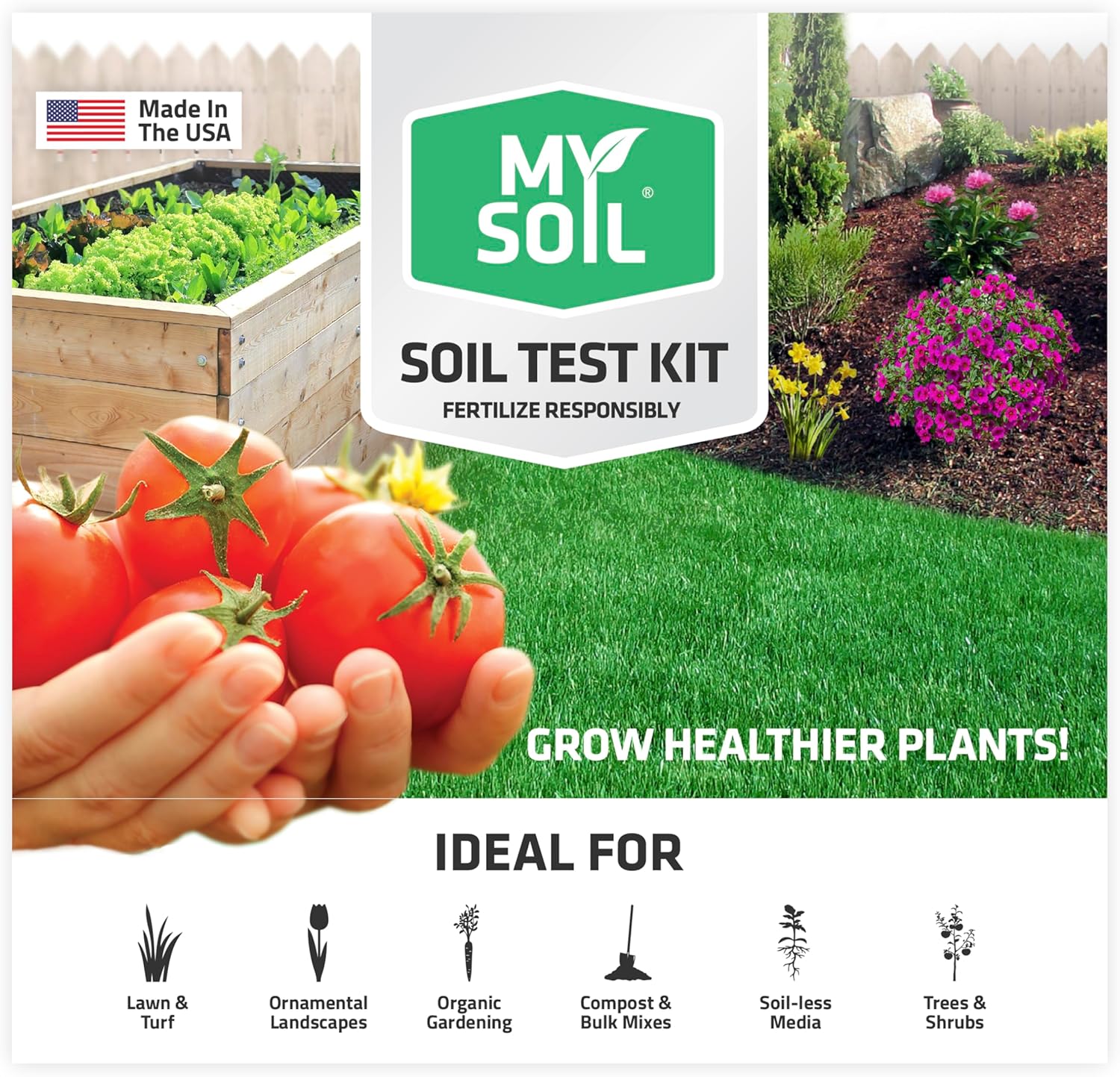
The MySoil kit is a single‑use mail‑in soil test designed to give a professional laboratory analysis rather than an instant at‑home reading. You collect a sample in the included jar, register the kit online, mail the prepaid envelope to the lab, and get a detailed report in about 6–8 days. Results cover pH plus 13 plant‑available nutrients and include step‑by‑step recommendations for what to apply, how much, and when, with both organic and conventional options. That makes it useful for diagnosing lawn problems, planning fertilization for turf or vegetable beds, or checking soil before planting. The kit contains everything needed for one test and saves time by replacing guesswork with specific advice, which can reduce unnecessary product use. The main limitation is that each kit covers only a single sample, so testing multiple areas or repeated checks requires buying multiple kits; turnaround also depends on mailing times. For a homeowner who wants accurate, lab‑grade guidance for improving grass and garden soil, MySoil provides actionable results without complex equipment.
Best for: Homeowners focused on improving lawn health who want reliable, lab‑grade soil data and clear amendment instructions rather than DIY meters or strips.
Less Ideal for: People who need rapid, repeated tests across many spots or instant field readings should consider multi‑test packs or handheld meters instead.
- Laboratory analysis of pH plus 13 plant‑available nutrients for accurate results
- Includes prepaid mail envelope and everything needed to collect and send one sample
- Custom, easy‑to‑follow recommendations for what, when, and how much to apply
- Works for any soil type and a wide range of uses including lawn and turf
- Single‑use kit covers only one sample location
- Results take several days since samples are mailed to a lab
Verdict: For reliable, lab‑grade soil diagnostics and clear fertilizer guidance to improve grass and garden performance, choose this single‑test MySoil kit.
SONKIR MS02 3-in-1 Soil Moisture, pH and Light Tester
| pH range | 3.5-8 pH |
|---|---|
| Moisture range | 1-10 scale |
| Probe length | 7.9 inches |
| Power | No battery required |
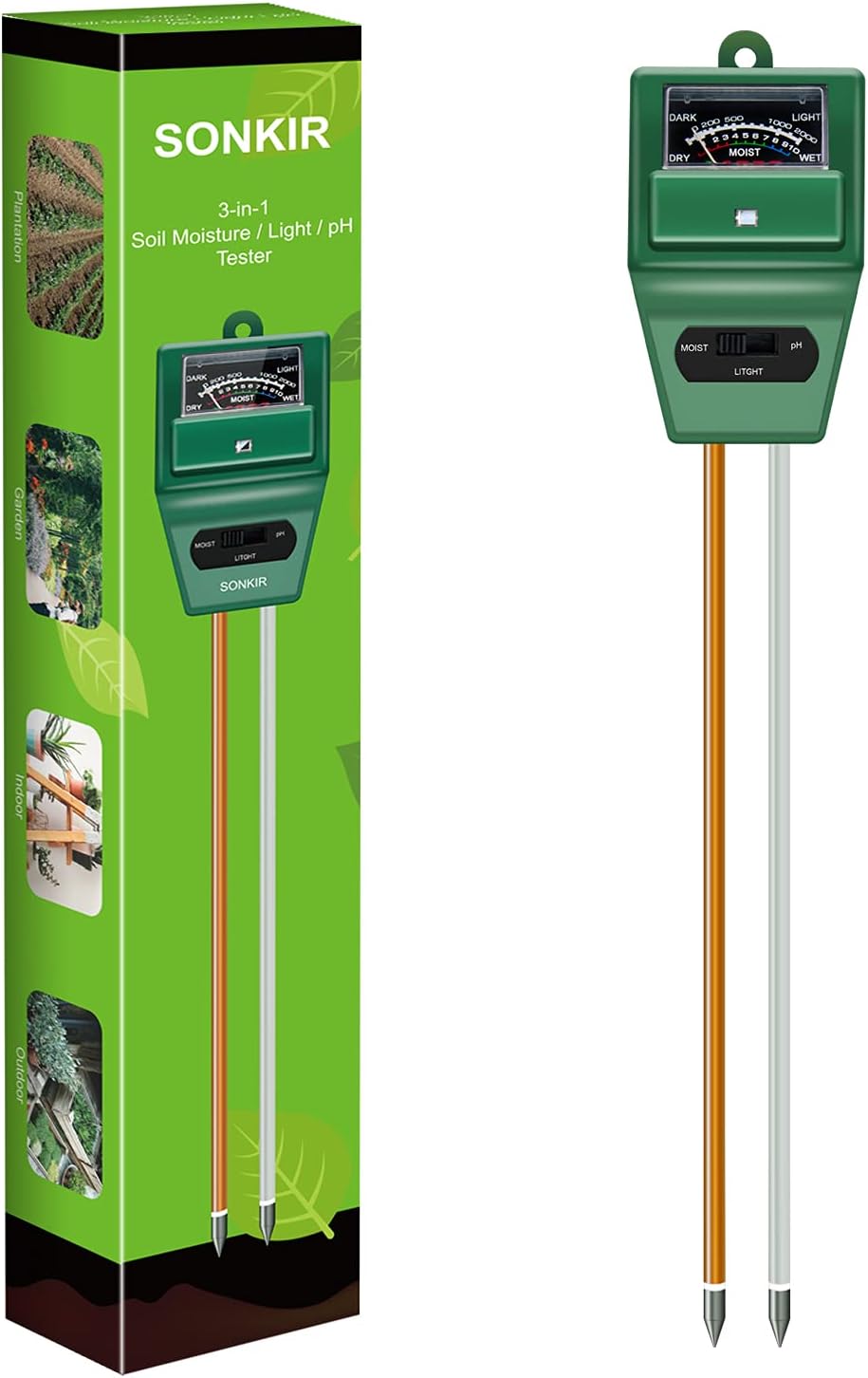
The SONKIR MS02 is a handheld, no-battery soil meter that gives quick, visual readings of moisture, pH and sunlight to help you maintain healthier grass and garden plants. You switch the dial to the desired function, push the probe into the soil about 6 to 7 inches, wait roughly 10 minutes and read the needle on the analog display. The meter covers a practical pH range for lawns and gardens and shows moisture on a 1 to 10 scale so you can decide when to water. Its long probe and compact, lightweight body make it convenient for spot-checking multiple areas of a lawn or garden bed. Important limitations are that the pH probe is intended for soil only and the analog needle can be slow to move in very dry soils or close-to-neutral pH, so readings sometimes require rechecking after moistening the sample or testing several spots. The unit is best for gardeners who want an affordable, easy-to-use tool for routine soil checks rather than laboratory-accurate analysis.
Best for: Someone who wants an inexpensive, easy-to-use tool for routine soil checks across a lawn or garden and values practical, repeatable guidance over laboratory precision.
Less Ideal for: Users who need lab-grade pH or moisture measurements, continuous data logging, or digital readouts for precise record keeping should consider more advanced instruments.
- 3-in-1 functionality measures moisture, pH and sunlight without extra tools
- No battery required so it is always ready to use and low maintenance
- Long probe and compact form factor make spot checks across a lawn or garden quick
- Simple analog dial is straightforward for fast, at-a-glance decisions
- pH function is designed for soil only and cannot test water or other liquids
- Analog needle can be unresponsive in very dry soil or near-neutral pH, requiring repeated tests
Verdict: A straightforward, no-battery 3-in-1 tester that gives fast, practical soil moisture, pH and light checks for everyday lawn and garden care.
Luster Leaf Rapitest Soil Test Kit (20 tests)

| Brand Name | Luster Leaf |
|---|---|
| Unit Count | 20 Count |
| Item Type Name | Soil Test Kit |
| Model Number | 1602 |
The Luster Leaf Rapitest Soil Test Kit provides a simple, low-tech way to check garden soil pH and the three main nutrients gardeners track: nitrogen, phosphorus and potash. The kit includes reagents and comparators for 20 tests total (five tests per measurement), so you can sample several areas across a lawn or vegetable bed. Use involves mixing small soil samples with the provided capsules or solutions, then matching the resulting color against the included chart. That makes it fast and approachable for beginners and steady gardeners who want a practical snapshot before amending or fertilizing. The clear instructions and plant pH preference list for over 450 species are helpful for making actionable adjustments. Limitations are the coarse resolution of color-based readings and the limited number of tests compared with lab analysis, so it is best for routine spot checks rather than precise scientific monitoring.
Best for: Gardeners who want a straightforward, low-cost way to check soil health before amending and prefer practical, easy-to-follow results over lab-level precision.
Less Ideal for: Users who need laboratory-grade accuracy, quantitative nutrient concentrations, or frequent high-volume testing for professional soil management.
- Covers core measurements gardeners need: pH, nitrogen, phosphorus and potash.
- Includes materials for 20 total tests to sample multiple garden spots.
- Patented color comparator system makes results easy to read without special tools.
- Comes with detailed instructions and a plant pH preference list for many common species.
- Color-matching gives approximate results and is less precise than laboratory testing.
- Only five tests per measurement limits long-term or frequent monitoring without repurchasing.
Verdict: Buy this kit if you want an easy, affordable way to spot-check soil pH and basic nutrient levels across your garden before amending.
Choosing the Right Homeowner Soil Tester: Key Factors to Consider
Probe Material and Length
Probe material determines how a tester holds up when pushed into coarse, rocky, or heavily amended soils. Stainless steel probes resist corrosion and bending better than thin plated metals, and solid one-piece probes transfer soil contact more consistently. Probe length matters because shallow probes only sample the top few inches, which can misrepresent root-zone conditions for deeper-rooted vegetables or established shrubs.
Longer, sturdier probes let you check below the surface layer where many crops draw moisture and nutrients. For container gardening, shorter probes are easier to use without damaging roots. Consider the typical planting depth in your garden and the kinds of soil you work with when prioritizing probe construction and length.
pH and Moisture Sensing Capability
Some homeowners need a simple moisture indicator while others need pH information to adjust lime or sulfur applications. Testers that combine pH and moisture sensors provide more context but require careful interpretation because moisture levels can influence pH readings. Look for testers that explicitly report both metrics or allow you to test pH with consistent moisture conditions.
If precise pH is important for fruiting crops, choose models known for stable pH readings. For irrigation management, moisture resolution and responsiveness are more important. Understand which metric you will use most and choose a tester with clear capability in that area.
Readout Type and Usability
The way results are displayed affects how quickly you can act. Analogue gauges and color scales are simple and fast in the field, while digital readouts can offer numeric precision and unit choices. Digital displays should be readable in bright sunlight and offer large, unambiguous numbers. Controls should be intuitive so you do not need a manual in the middle of a planting session.
Think about where and when you will read results. If you frequently test in bright outdoor conditions, prioritize strong contrast and backlit screens. For quick spot checks, a simple analog dial or clear color bands may be faster and less fussy.
Durability and Weather Resistance
Garden tools endure wet soil, sunlight, and repeated handling. A tester that corrodes, fogs, or develops loose fittings will quickly become unreliable. Check for sealed electronics, waterproof housings, and robust probe junctions that limit soil ingress. Build quality matters more than a few extra features when the device will live outside or in a potting shed.
Also consider protection against accidental bending or dropping. A replaceable probe or a tester with reinforced joints extends usable life and reduces long-term waste.
Calibration and Maintenance Needs
Accurate sensing requires occasional calibration and cleaning. Some testers come preset and remain stable for many months, while others benefit from periodic calibration with buffer solutions. Understand if a model requires calibration materials, how often, and whether you can perform maintenance without special tools.
Cleaning probes after testing acidic or heavy organic soils prevents cross-contamination between samples. Models with removable probes or smooth probe surfaces are easier to keep accurate. Factor maintenance needs into how frequently you will realistically check your garden.
Sampling Technique and Repeatability
A single spot test rarely represents an entire bed. Sampling technique influences how repeatable and useful results are. For consistent trend tracking, test at similar depth, moisture state, and locations across the bed each time. Some testers require moist soil for accurate pH readings while others work in a wider moisture range.
Plan a simple sampling routine that you can repeat: mix samples for a composite read if you need a bed-level view, or test multiple points for localized issues. Ability to get consistent readings from the same spot is as important as absolute accuracy.
When a Quick Read Is Enough
For routine watering and general soil health checks, a fast moisture and approximate pH reading is often all you need. These quick-read testers help you decide whether to water, top-dress, or check drainage without complex setup.
Use quick reads to monitor short-term changes after a heavy rain or when you suspect an irrigation problem. They are especially valuable for container gardens and small raised beds where conditions can change rapidly.
- Best for monitoring moisture trends and simple pH ranges
- Useful in containers, seed trays, and small vegetable patches
- Low maintenance and fast to operate
When to Use a More Precise pH Test
If you plan lime or sulfur amendments, or you grow pH-sensitive crops like blueberries or azaleas, aim for more precise pH readings. Consistent numeric pH values help you calculate amendment rates and judge the effect of treatments over time.
Precise pH tests often require stable moisture conditions and occasional calibration. Take readings from similarly moist spots and avoid mixing wet and dry samples for consistency.
- Required for amendment planning and long-term soil correction
- Best used after settling irrigation and moisture conditions
- Often paired with a sampling routine for repeatability
Interpreting Readings in Different Soil Types
Sandy, loamy, and clay soils behave differently and that affects readings. Sandy soils drain quickly and may show lower moisture readings even when plants are not stressed. Clay retains water and can give higher moisture readings while still restricting root oxygen.
Organic-rich potting mixes and amended beds can shift pH and buffer readings. When interpreting results, consider soil texture and organic content and adjust sampling depth accordingly.
- Match probe length to root zone depth for meaningful readings
- Repeat tests after moisture has stabilized when possible
- Combine visual inspection with sensor data for better decisions
Care and Storage Tips
Clean probes with water and a soft brush after testing acidic or sticky soils. Avoid harsh abrasives that scratch protective coatings. Dry probes before long-term storage to reduce corrosion risk.
Store testers in a dry, shaded place and remove batteries if storing for the off-season. Follow any manufacturer calibration recommendations before spring use to ensure accurate readings.
- Rinse and dry probes after use
- Store in a cool, dry location away from direct sun
- Calibrate periodically according to maintenance needs
Using Testers for Seasonal Planning
Schedule checks at key times: early spring before planting, after major soil amendments, and during peak growth periods. Seasonal testing helps you track changes from fertilizer, compost additions, and rainfall patterns.
For perennial beds, occasional pH checks every one to two years are usually sufficient unless you are actively adjusting soil chemistry. For annual vegetables, monitor moisture and pH more frequently during the growing season.
- Test before major planting or amendment events
- Monitor moisture more frequently during hot, dry spells
- Use trends rather than single readings to guide big changes
How We Chose the Best Homeowner Soil Tester
We focused on tools suited for typical homeowner gardens: beds, raised planters, container collections, and small lawns. Selection prioritized practical performance and long-term reliability over advanced lab functions. Key evaluation criteria were probe construction and contact consistency, sensor accuracy and repeatability, readout clarity including display and controls, physical durability against moisture and soil abrasion, and ease of routine use such as calibration and cleaning. We excluded lab-grade laboratory kits and single-use chemical strips that are impractical for frequent backyard checks. We also set aside devices that require complex calibration equipment or significant ongoing maintenance. The final shortlist favors testers that deliver consistent pH and moisture trends, durable probes that tolerate repeated insertion, clear and repeatable readouts, and straightforward user workflows for homeowners. These factors align with the scoring dimensions used throughout the guide.
FAQ
How often should I test soil pH and moisture with a homeowner tester?
For moisture, check as often as daily during hot weather or while establishing transplants. For pH, test seasonally-typically once in spring and again every year or two unless you are actively amending the soil.
Can moisture readings affect pH measurements?
Yes. Very dry or very wet conditions can skew pH readings. For consistent pH checks, take samples at similar moisture levels and avoid testing immediately after heavy rain or deep watering.
Are digital displays more accurate than analog gauges?
Digital displays give clearer numeric values but accuracy depends on the sensor, not the display. A digital readout with a poor sensor is less useful than a robust analog tester with consistent contacts.
How should I sample a raised bed for reliable results?
Take several readings at similar depths across the bed and average them or mix subsamples into a composite. Testing multiple spots reduces the chance of a misleading single-point result.
Do testers need calibration and how is that done?
Some testers are stable and require little calibration while others benefit from periodic checks with a buffer solution. Calibration steps vary, but most involve adjusting a small screw or button to match a known pH solution.
Will a soil tester work in heavy clay or rocky soils?
Sturdy probes work in clay and rocky soils, but very rocky ground can damage thin probes. In compacted clay, readings may reflect surface moisture rather than root-zone conditions, so test at multiple depths if possible.
Final Verdict
Choose a homeowner soil tester based on the measurements you need most. Prioritize probe construction and sensor consistency if you plan to test frequently, and select clearer readouts if you want repeatable numeric values. Expect tradeoffs between fast, low-maintenance units and more precise options that need calibration. Set a simple sampling routine and maintain the probe to keep readings meaningful. With sensible use and care, a good tester becomes a practical tool for improving watering habits and guiding amendment choices across beds, containers, and lawns.
