

Note: This article contains affiliate links. If you click on these links and make a purchase, I may earn a small commission at no extra cost to you. This helps support my research and content. Read my full affiliate disclosure here.
If spiders in and around your home make you uneasy but you want to avoid harsh chemicals, choosing a non toxic spider repellent matters for household safety and garden health. The right repellent keeps webs and hiding spots clear without harming pets, pollinators, or planted areas. This guide looks at six shortlisted non toxic spider repellent options suited to indoor and outdoor use, summarizing how they work, how long effects typically last, and which application styles fit different rooms and yards. Below you will find practical notes on effectiveness, safety, and convenience to help you pick an approach that fits your space.
Top Picks at a Glance
| Best Overall The best all-around choice for most situations | Mighty Mint Peppermint Oil Spider Repellent Spray, 16 oz |  |
| Best Quality Built to a higher standard if you want something more solid | Wondercide Indoor Pest Control Spray, Lemongrass, 16 oz |  |
| Best Value The sweet spot between price and what you get | Gardenix All Natural Peppermint Bug Spray with 1 oz Concentrate |  |
| Best Budget The cheapest option that still gets the job done reliably | STEM Plant-Based Bug Spray — Ants, Roaches & Spiders, 10 oz |  |
| Highest Rated A top-rated pick with lots of positive feedback | Aromovial Peppermint Oil Spider Repellent Spray, 16 oz |  |
| Most Popular A crowd favorite that many people choose with confidence | Mighty Mint Peppermint Oil Insect Repellent Spray, 16 oz |  |
Mighty Mint Peppermint Oil Spider Repellent Spray, 16 oz

| Size | 16 oz |
|---|---|
| Use areas | Indoor / Outdoor |
| Ingredients | Peppermint oil, geraniol, plant oils |
| Directions | Spray every few days for maintenance |
Mighty Mint Peppermint Oil Spider Repellent is a plant-based, ready-to-use 16 oz spray designed for quick, targeted pest control around the home. You use it by spraying baseboards, entryways, patios, and other problem spots a few times a week; the manufacturer also includes a microfiber cloth for precise application. The formula combines concentrated peppermint oil and geraniol to repel and kill spiders without harsh chemical fumes, making it suitable for households with pets or scent-sensitive people when directions are followed. Practical strengths are its ease of use, pleasant mint scent that is not overpowering, and versatility for both indoor and outdoor perimeter treatments. Limitations are typical for botanical repellents: it requires regular reapplication to maintain protection and may not offer the residual control or broad-spectrum knockdown of synthetic insecticides for heavy infestations. Also, like other sprays, direct contact is needed for best effect rather than system-wide elimination.
Best for: Buyers who want a low-odor, plant-based spider repellent for routine perimeter and spot treatments and prefer simple, ready-to-use solutions over chemical treatments.
Less Ideal for: People facing severe or widespread infestations who need long-lasting residual control or professional-strength pesticides should consider stronger alternatives.
- Plant-based formula using peppermint oil and geraniol for pest control
- Safe for use around people and pets when used as directed
- Ready-to-use spray with included microfiber cloth for targeted application
- Works indoors and outdoors on entryways, baseboards, patios, and similar areas
- Needs frequent reapplication to maintain effectiveness
- May be less effective than synthetic insecticides for heavy or established infestations
Verdict: A convenient, pet-friendly peppermint spray that keeps spiders away with regular spot treatments.
Wondercide Indoor Pest Control Spray, Lemongrass, 16 oz

| Item Form | Spray |
|---|---|
| Target Species | Ants, Roaches, Spiders, Flies, Fleas, Ticks, Mosquitoes, Silverfish, Moths, Gnats |
| Liquid Volume | 16 fluid ounces |
| Active Ingredients | 4.2% Cedar Oil; 2.2% Sodium Lauryl Sulfate; 1.5% Lemongrass Oil; 0.1% Sesame Oil |
Wondercide Indoor Pest Control is a ready‑to‑use lemongrass‑scented spray that targets flying and crawling insects around the home. You spray it on baseboards, entry points, under sinks, in cabinets and directly on visible pests to kill or repel ants, roaches, flies, fleas, mosquitoes and other common household bugs. The formula relies on essential oils (cedarwood and lemongrass) plus mild surfactants, so it can be used multiple times per week and is labeled safe around dogs and cats when directions are followed. Practical features include a trigger sprayer with adjustable mist or targeted stream and multi‑surface use in kitchens, bathrooms and living areas. Expect quick knockdown of insects you hit directly and ongoing repellent effect when applied to perimeter areas, but it is not a long‑term structural treatment for heavy infestations and it can irritate eyes or sensitive skin if mishandled. The natural scent may slightly tint very light fabrics, so spot testing is recommended. For everyday, preventive pest control in pet households this product is a convenient, lower‑toxicity option.
Best for: Buyers who want a practical, lower‑toxicity spray to reduce and repel common indoor insects around a home with pets and who prioritize easy, repeatable treatments over professional pest control.
Less Ideal for: People dealing with severe, long‑standing infestations or who need a residual, long‑term structural solution should consider professional pest control or stronger targeted products.
- Plant‑based active ingredients (cedarwood and lemongrass oils) that provide knockdown and repellent action
- Labeled safe for use around people and pets when directions are followed, suitable for frequent applications
- Adjustable trigger sprayer for full mist or targeted spray and multi‑surface use
- Kills and repels a wide range of indoor pests including flies, ants, roaches, fleas and mosquitoes
- Not intended as a professional structural treatment for heavy infestations
- Can cause eye or skin irritation if contact occurs and may slightly discolor very light fabrics
Verdict: A convenient plant‑powered indoor spray that practical buyers can use frequently around pets and living spaces to quickly kill and repel common flies and household pests.
Gardenix All Natural Peppermint Bug Spray with 1 oz Concentrate

| Ingredients | 94% water, peppermint oil, glycerin, rosemary oil, citronella oil, other minor oils |
|---|---|
| Intended use | Indoor and outdoor pest repellent |
| Includes | 16 oz ready-to-use bottle plus 1 oz concentrate |
| Manufacturer | Cyclone Brands LLC |
This all-natural peppermint bug spray is a simple, low-toxicity option for deterring ants, spiders, and other common household pests around doors, kitchens, basements, and patios. It comes ready to use in a spray bottle and includes a 1 oz concentrate you can mix into another 16 oz bottle to stretch the product. The formula is mostly water with peppermint oil and other essential oils such as rosemary and citronella, so it leaves a fresh mint scent rather than chemical odors. Because it is free from harsh synthetic pesticides, it is convenient for households with kids or pets when applied according to directions. Expect effective short-term repellency for small pest problems rather than long-term residual control against established infestations. For larger or persistent pest issues you will likely need a targeted insecticide or professional treatment, but for budget-focused prevention and light indoor/outdoor use this spray is an accessible, low-chemical choice.
Best for: Homeowners and renters looking for an inexpensive, low-chemical spray to deter common indoor and patio pests and who prioritize safety and a pleasant scent over industrial-strength results.
Less Ideal for: People facing large or persistent infestations or those who need a long-lasting residual insecticide should choose a stronger, targeted pest control solution.
- Natural essential oil formula avoids harsh synthetic pesticides
- Includes 1 oz concentrate to mix and extend total supply
- Suitable for indoor and outdoor spot treatments
- Fresh peppermint scent masks unpleasant odors
- Primarily a short-term repellent rather than a long-lasting kill or barrier
- Not formulated for heavy infestations or professional-grade control
Verdict: A low-cost, family-friendly peppermint spray that stretches farther with the included concentrate and works well for light, everyday pest deterrence.
STEM Plant-Based Bug Spray — Ants, Roaches & Spiders, 10 oz

| Item Form | Aerosol |
|---|---|
| Target Species | Ants, Roaches, Spiders |
| Unit Count | 10 Ounce |
| Active Ingredients | Geraniol 6.0%, Lemongrass Oil 0.5% |
This STEM plant-based bug spray is an aerosol insecticide formulated with geraniol and lemongrass oil to kill ants, roaches, and spiders while avoiding strong chemical odors or added fragrances. It is used like a conventional spray: aim at visible insects, crevices, or likely harborages and apply short bursts for spot treatments inside or around entry points outdoors. The botanical active ingredients make it suitable for households looking to reduce synthetic pesticide exposure and the product is labeled for use around people and pets when directions are followed. Practical benefits include a fresh, low-odor application, entomologist testing noted by the brand, and a compact 10 oz size that is convenient to store in a utility closet. Limitations are that it is a spot-treatment aerosol rather than a long‑lasting residual solution and botanical actives can require more frequent reapplication than some conventional synthetic insecticides for ongoing control of heavy infestations.
Best for: Buyers who want an inexpensive, low-odor spray for quick indoor and perimeter spot treatments and prefer plant-based formulations over conventional chemicals.
Less Ideal for: Those facing a heavy or persistent infestation who need a long‑lasting professional‑strength residual treatment should consider alternative products or professional services.
- Plant-based active ingredients (geraniol and lemongrass oil) that reduce harsh chemical odors
- Suitable for indoor and outdoor spot treatments when used as directed
- Compact 10 oz aerosol is easy to store and handy for quick use
- Formulation is marketed as safe around people and pets when directions are followed
- Provides spot control rather than long-lasting residual protection
- May require more frequent applications than stronger synthetic insecticides
Verdict: A budget-friendly, low-odor plant-based aerosol for quick spot control of ants, roaches, and spiders around the home.
Aromovial Peppermint Oil Spider Repellent Spray, 16 oz

| Volume | 16 oz |
|---|---|
| Active ingredients | Peppermint oil, geraniol |
| Intended use | Indoor and outdoor repellent |
| Formulation | Ready-to-use spray |
This 16 ounce ready-to-use spray delivers a plant‑based approach to spider control using pure peppermint oil and geraniol. It is applied directly to corners, windows, entryways, patios and garages by flipping the nozzle and spraying targeted areas where spiders appear or enter a home. The formula is non‑toxic and marketed as safe around children and pets when used as directed, which makes it suitable for scent‑sensitive households since it uses a natural mint fragrance rather than synthetic perfumes. The scent is noticeable and intended to linger as part of the deterrent effect. Practical benefits include easy targeted application, a fresh scent that most people find pleasant, and the ability to use the product both indoors and outdoors without staining surfaces. Limitations are that it is a repellent rather than a kill‑on‑contact insecticide so it may not remove an established infestation by itself, and effectiveness can vary with heavy infestations or in outdoor conditions where rain or wind will reduce residual action.
Best for: Buyers who prioritize a reliable, non‑toxic way to keep spiders out of living spaces and want an easy, ready‑to‑spray solution for routine prevention.
Less Ideal for: People facing an active, large spider infestation or professional pest controllers who need fast knockdown and long residual chemical control should consider stronger targeted treatments.
- Uses pure peppermint oil and geraniol rather than synthetic insecticides
- Ready-to-use spray for quick, targeted application
- Safe-for-home formulation intended for use around children and pets when used as directed
- Suitable for both indoor and covered outdoor areas without staining surfaces
- Designed as a repellent not an immediate kill, so it may not eliminate existing webs or large infestations
- Residual effectiveness outdoors can be reduced by weather exposure
Verdict: Aromovial’s peppermint oil spray is the easy non‑toxic choice for routine, reliable spider prevention around the home.
Mighty Mint Peppermint Oil Insect Repellent Spray, 16 oz
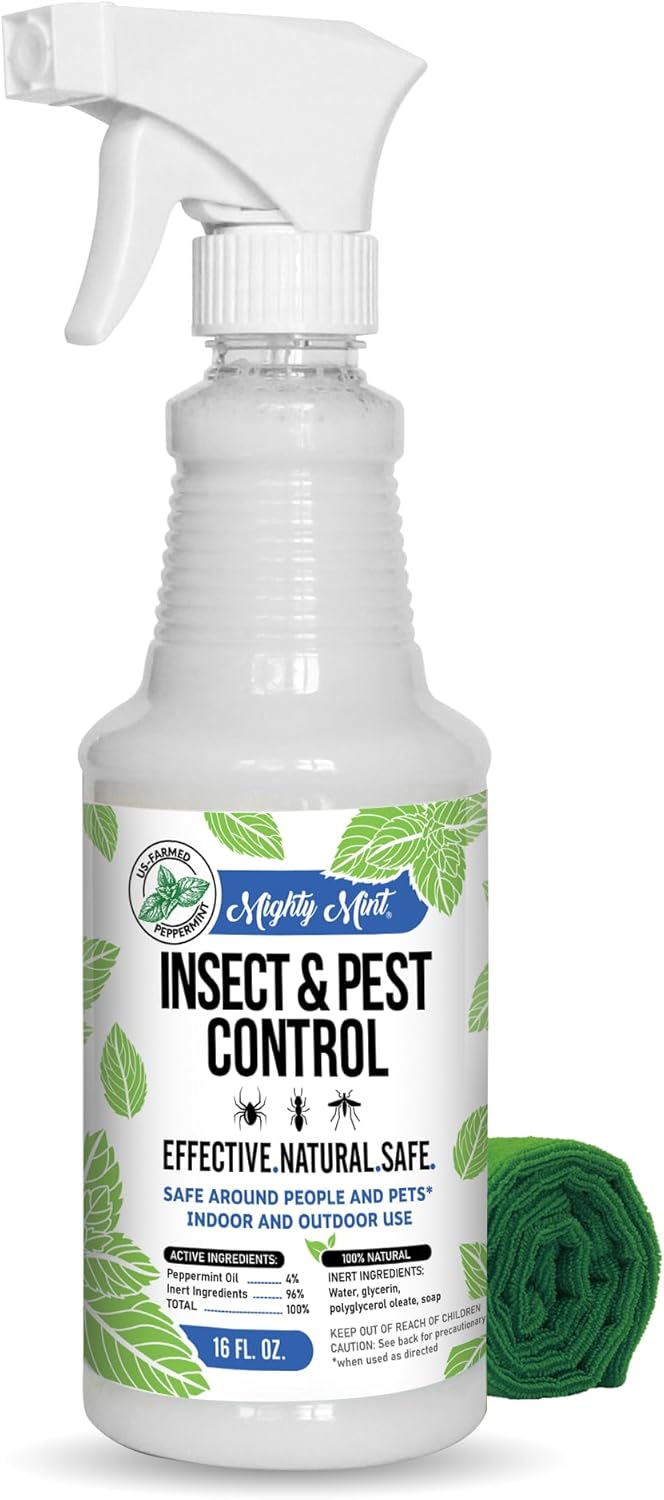
| Ingredients | Water, Glycerine, Polyglycerol oleate, Soap, Peppermint oil |
|---|---|
| Use Areas | Indoor / Outdoor |
| Size | 16 oz |
Mighty Mint is a plant-based, ready-to-use spray that uses concentrated peppermint oil to repel a broad range of household and patio pests. You apply it directly to problem areas such as baseboards, entryways, patios and around outdoor seating; the manufacturer recommends shaking and spraying until surfaces are covered and repeating applications two or more times per week for best results. Notable features include a peppermint-only scent profile, a formulation that avoids synthetic fragrances and the convenience of a 16 oz spray bottle for targeted spot treatments. Practical benefits are that it is safe to use around people and pets when dry and does not leave obvious stains on most surfaces, and the scent can make treated areas smell fresher than chemical alternatives. Important limitations are that it is a repellent rather than a pesticide so it works by discouraging pests rather than killing them, effectiveness depends on regular reapplication and it should not be applied when pollinators are present or to skin or food-contact surfaces.
Best for: Buyers who prioritize natural, low-toxicity solutions and want a targeted spray to reduce insects around patios and entryways while keeping family and pets in mind.
Less Ideal for: Anyone needing a one-time extermination or long-term residual pesticide for severe infestations should consider professional treatments or products formulated to kill pests rather than repel them.
- Plant-based peppermint formula that avoids synthetic fragrances
- Ready-to-use spray for quick, targeted indoor and outdoor applications
- Safe for people and pets when used as directed and allowed to dry
- Nonstaining on most surfaces and leaves a fresh mint scent
- Repels rather than kills insects so regular reapplication is needed to maintain protection
- Strong peppermint concentration may bother scent-sensitive individuals and requires keeping children and pets away until dry
Verdict: Choose Mighty Mint when you want a pet-friendly, plant-based spray to reduce patio and entryway insects with a fresh peppermint scent.
Choosing the Right Non Toxic Spider Repellent: Key Factors to Consider
Ingredient Safety and Toxicity
Look closely at active ingredients and any solvents or carriers. For non toxic products this means preferring botanical actives, food‑grade oils, or mineral-based repellents over synthetic pesticides. Ingredient labels tell you which species are at risk; even 'natural' compounds can irritate pets or degrade delicate foliage if used at high concentrations.
Consider whether an ingredient breaks down quickly in sunlight or rain. Faster breakdown reduces environmental persistence but may shorten the repellent window, requiring more frequent applications. Also check for respiratory or skin irritants that could be an issue indoors or around sensitive household members.
Repellent Duration and Coverage
Different formulations deliver different lengths of protection. Some contact sprays give immediate knockdown but fade within days, while barrier treatments or formulation with longer-acting carriers can last weeks. For sheltered spots like basements and attics, longevity is often more important than heavy-duty knockdown because ongoing exclusion is the goal.
Coverage matters practically: a product designed to treat decking and building exteriors should coat surfaces uniformly and resist light rain. For indoor use look for formulations that do not leave visible residue on walls, curtains, or furniture while still treating crevices where spiders hide.
Application Method and Convenience
How a product is applied determines whether you will use it correctly and often enough. Ready-to-use sprays are convenient for spot treatments; hose-end or pump sprayers work better for larger exterior perimeters. Some repellents come as concentrates that require mixing, which can save space and waste but demands careful dilution to remain non toxic.
Think about frequency and reach. Products that require frequent reapplication can become a maintenance chore. Also consider whether the application can be done safely inside without evacuating rooms or removing plants and linens.
Safety for Plants, Pets, and Beneficials
Because repellents are often used near entry points, on window frames, and around planted beds, confirm that the formulation is unlikely to burn foliage or harm soil life. Oils and surfactants can sometimes scorch tender leaves if applied in full sun or at high concentrations.
Assess the risk to pets and pollinators. Even low-toxicity products can be problematic if animals groom treated fur or if sprays drift onto flowering plants. Choose application timing and placement to minimize exposure of non-target animals.
Indoor and Outdoor Suitability
Match product form to the intended location. Some repellents are labeled safe for indoor use on baseboards, closets, and storage areas, while others are optimized for exterior perimeter treatments. Outdoor products should resist rain and sunlight; indoor products should avoid strong odors or residues.
Consider microclimates in your home and yard. Basements, garages, eaves, and porch areas often need different approaches than open garden beds. A versatile product can simplify maintenance when you have mixed spaces.
How Non Toxic Repellents Work
Non toxic repellents rely on behaviors and sensory disruption rather than killing spiders outright. Many use strong-smelling botanicals or oils that spiders find unpleasant, which encourages them to avoid treated areas. Others create physical barriers or alter microhabitats so spiders are less likely to build webs.
Understanding the mechanism helps set expectations. Repellents that mask prey scents or coat surfaces can reduce web-building in treated zones, but they rarely eliminate spiders from an entire property. Use them as part of broader exclusion and sanitation practices for best results.
- Olfactory repellents change the scent environment to discourage spiders
- Barrier treatments make surfaces less attractive for web attachment
- Habitat modification reduces available shelter and prey that draw spiders in
Practical Application Tips
Treat likely entry points and sheltered microhabitats where spiders hide: eaves, corners, window and door frames, storage areas, and under furniture. Apply products in calm weather for outdoor treatments to reduce drift and reapply according to label guidance or until the scent or residue fades.
When treating indoors, remove or cover food, linens, and pet bedding. Ventilate rooms after application and allow surfaces to dry before reoccupying. For plants, spray the soil surface or the non-flowering parts when possible to reduce pollen contact for pollinators.
- Spot-check treated areas weekly and reapply where coverage has faded
- Avoid spraying directly onto flowering plants or active garden beds
- Test a small inconspicuous surface first to check for staining or leaf scorch
Integrating Repellents with Habitat Management
Repellents work best when combined with habitat changes that reduce spider harborages. Clear away debris, seal cracks and gaps, and reduce outdoor lighting that attracts the insects spiders feed on. These actions lower spider pressure so non toxic repellents can maintain clear zones with less frequent reapplication.
For gardeners, keep mulch and tall groundcovers a moderate distance from foundation walls, and store firewood and compost away from buildings. Inside, reduce clutter in storage areas and vacuum webs and egg sacs before applying a repellent to cut local populations quickly.
- Seal gaps around windows, doors, and utility penetrations
- Move woodpiles and stacked materials away from building exteriors
- Use yellow or shielded outdoor lights to cut night-flying insect attraction
Seasonal Considerations
Spider activity varies by season and species. Spring and fall commonly bring increased movement as spiders search for mates or overwintering sites. Time perimeter treatments and indoor checks to these seasonal peaks to reduce encounters and reapply repellents proactively when activity rises.
In warm climates where spiders are active year-round, maintain a regular schedule of inspection and targeted treatment. During wet periods, outdoor repellents may rinse away more quickly, so plan for shorter protection windows and more frequent applications.
- Apply perimeter treatments before peak activity periods in spring and fall
- Expect shorter outdoor persistence after heavy rain
- Schedule indoor inspections monthly during active seasons
Safe Storage and Handling
Even non toxic products need sensible handling. Store concentrates in their original containers away from children and pets, and keep mixed solutions dated and out of direct sunlight. Follow label dilution guidance carefully when preparing sprays.
Dispose of leftover mixtures according to local guidance and avoid pouring concentrates into storm drains or garden soil. Clean application tools after use and wash hands thoroughly if you come into contact with concentrated formulas.
- Label and date any mixed spray bottles
- Keep all repellents out of reach of children and animals
- Rinse and store sprayers dry to prevent mold or residue buildup
How We Chose the Best Non Toxic Spider Repellent
We shortlisted six repellents that favor low-toxicity ingredients and practical use patterns gardeners and homeowners use around living spaces. Selection focused on formulations and delivery methods that reduce risk to children, companion animals, and beneficial insects while still addressing common spider behaviors. Key evaluation criteria included ingredient safety and environmental impact, demonstrated repellent duration and coverage, method of application for typical household and garden spots, and ease of reapplication or maintenance. Excluded from the list were products that rely on restricted pesticides, unverified homemade mixes with unclear concentrations, or delivery systems unsuitable for occupied homes. We also avoided options that require specialized protective equipment to handle. The dimensions that mattered most were clear: how safe the active components are for non-target species and people, how the product is applied and maintained in real living spaces, measurable longevity under normal conditions, and the product's ability to deter spiders without causing damage to plants, surfaces, or fabric.
FAQ
Are non toxic spider repellents safe to use around pets?
Often they are safer than synthetic pesticides, but safety depends on the specific ingredients and application. Avoid allowing pets to lick treated surfaces or pathways until products dry, and keep sprays away from pet bedding and food.
How long do non toxic repellents usually last outdoors?
It depends on formulation and weather. Many botanical or oil-based treatments last from a few days to a few weeks and may need more frequent reapplication after rain or heavy dew.
Can I use non toxic repellents directly on garden plants?
Some formulations are safe for non-flowering parts of plants, but others can scorch foliage or affect pollinators. Avoid treating blooms and follow label guidance; when in doubt, test on a small area first.
Will non toxic repellents kill spiders or just deter them?
Most non toxic options aim to deter spiders rather than kill them. They reduce web-building and presence in treated areas but work best combined with exclusion and sanitation for long-term control.
Are homemade remedies effective compared with commercial non toxic options?
Homemade mixes can help in small areas but vary widely in concentration and persistence. Commercial non toxic formulations are usually standardized for safer, longer-lasting application and clearer instructions for use.
Final Verdict
When choosing a non toxic spider repellent, prioritize ingredient safety, application method, and how long the treatment will last in your particular setting. Match the product form to where you need protection and pair repellent use with habitat changes like sealing entry points and reducing clutter. Accept tradeoffs between convenience and longevity: ready-to-use sprays are easy but may need frequent reapplication, while longer-lasting barrier treatments require careful placement. Focus on safety for people, pets, and pollinators, and choose an approach you can maintain reliably for best results.
