

Note: This article contains affiliate links. If you click on these links and make a purchase, I may earn a small commission at no extra cost to you. This helps support my research and content. Read my full affiliate disclosure here.
When you are preparing a food plot, knowing what is in your soil is the single most useful piece of information you can collect. A dedicated soil test kit for food plots helps you measure pH, available nutrients, and often organic matter so you can choose the right lime, fertilizer, and seed mix. That reduces wasted inputs and improves the chance of a productive, attractive plot. This guide looks at six shortlisted soil test kit options for food plots and explains the testing features that matter to hunters and land managers. We evaluate accuracy, practical ease of collecting samples in the field, and the clarity of recommendations you get back from test results. Read on to see which testing approaches fit your plotting style and maintenance plan.
Top Picks at a Glance
| Best Overall The best all-around choice for most situations | Whitetail Institute Soil Test Kit (Professional Results with Consultation) |  |
| Best Quality Built to a higher standard if you want something more solid | LaMotte Turf and Garden Soil Test Kit (pH, N, P, K) |  |
| Best Value The sweet spot between price and what you get | Soil Test Kit 140 Tests — pH, Nitrogen, Phosphorus, Potassium & Ammonia |  |
| Best Budget The cheapest option that still gets the job done reliably | Palinoia 2-in-1 Soil Test Kit for pH and Nitrogen, 100 Strips |  |
| Highest Rated A top-rated pick with lots of positive feedback | MySoil Professional Mail‑In Soil Test Kit (1 Test) |  |
| Most Popular A crowd favorite that many people choose with confidence | Luster Leaf Rapitest Soil Test Kit (20 tests) |  |
Whitetail Institute Soil Test Kit (Professional Results with Consultation)

| Brand Name | Whitetail Institute |
|---|---|
| Set Name | Soil Test Kit |
| Manufacturer | Whitetail Institute of North America |
| Model Number | STK |
| Manufacturer Warranty Description | 1-Year Warranty |
This Whitetail Institute Soil Test Kit is a mail-in laboratory test geared toward food-plot success. You collect and send soil samples using the included kit, then receive lab results and specific lime and fertilizer recommendations by mail or email within roughly one week, plus professional consultation. The kit is straightforward to use and translates test data into clear, actionable guidance so you avoid over- or under-applying amendments. For someone managing deer food plots it helps target inputs to soil needs and can save money on unnecessary fertilizer and lime. Limitations are that it is not an instant in-field test and requires waiting for lab turnaround and shipping, and interpretations are focused on food-plot species rather than broad horticultural crops. The kit does not include on-site equipment beyond sample collection tools, so growers who want immediate readings or continuous monitoring should consider handheld meters as a complement.
Best for: Landowners and hunters planning or managing deer food plots who want lab-grade soil analysis and clear amendment recommendations to maximize plot performance without guesswork.
Less Ideal for: Home gardeners who need instant in-field measurements or continuous monitoring should choose a handheld meter or kits designed for general vegetable gardens instead.
- Laboratory analysis with professional consultation delivers reliable, interpretable soil recommendations
- Results provided by mail or email within about one week for relatively quick turnaround
- Helps determine exact lime and fertilizer needs so you do not overbuy or misapply amendments
- Kit includes everything needed to collect and send samples for testing
- Requires shipping samples and waiting for lab results rather than giving instant field readings
- Recommendations are targeted to food-plot management and may not cover every garden crop
Verdict: If you manage deer food plots and want clear, lab-backed lime and fertilizer recommendations, this kit gives professional results and timely guidance to improve plot success.
LaMotte Turf and Garden Soil Test Kit (pH, N, P, K)

| Tests included | pH, nitrogen, phosphorus, potassium |
|---|---|
| pH tests | 30 tests |
| N/P/K tests | 15 tests each |
| Includes | Garden Guide manual and Soil Handbook |
The LaMotte Turf and Garden Soil Test Kit is a reagent-based kit designed to measure soil pH and the three primary macronutrients (N, P, K) with color-matching charts and step-by-step instructions. You collect representative samples from the area you plan to plant, follow the contained procedures for each parameter, and compare results to the included laminated charts and Garden Guide to decide on lime or fertilizer adjustments. The kit supplies more tests for pH (about 30) and roughly 15 tests each for N, P and K, which makes it useful for tracking multiple beds over a season. Its strengths are clear instructions, an educational handbook for interpreting results, and replaceable reagent-based chemistry that tends to be more accurate than simple reader strips. Limitations are that tests require careful sample prep and handling, they are not instant digital readouts, and interpreting borderline color matches can be subjective. For vegetable gardeners who want actionable guidance rather than a single quick reading, this kit delivers a thorough, repeatable soil picture.
Best for: Vegetable gardeners who want a practical, educational soil analysis to inform lime and fertilizer decisions and are willing to follow reagent-based procedures for repeatable results.
Less Ideal for: Gardeners who need a single fast digital reading or those unwilling to collect and prepare representative soil samples.
- Measures pH plus nitrogen, phosphorus and potassium for a rounded soil analysis
- Includes Garden Guide manual and Soil Handbook to interpret results and plan amendments
- Supplies multiple tests (about 30 pH tests and 15 tests each for N, P and K) for tracking over time
- Reagent-based chemistry typically gives more reliable results than basic test strips
- Color-matching requires careful technique and can be subjective on borderline readings
- Testing involves multiple steps and sample preparation rather than instant electronic readouts
Verdict: A thorough reagent-based kit that gives vegetable gardeners actionable pH and NPK results plus interpretive guidance for informed fertilizing and liming decisions.
Soil Test Kit 140 Tests — pH, Nitrogen, Phosphorus, Potassium & Ammonia

| Tests included | pH, Nitrogen, Phosphorus, Potassium, Ammonia |
|---|---|
| Total tests | About 140 |
| Manufacturer | Dewilde Trading Co |
This liquid soil test kit is built for routine fertility checks on lawns and gardens, offering about 140 individual tests across pH, nitrogen, phosphorus, potassium and ammonia. You use small soil samples, mix them with reagents, and compare color changes to supplied charts to get quick, on-site readings. The kit’s biggest practical benefit is coverage: multiple parameters in one kit mean you can diagnose common nutrient imbalances and pH issues without sending samples to a lab. That makes it handy for planning lime or fertilizer applications and for checking results after treatment. The instructions appear updated for 2026 which should ease setup, and the included volume of tests supports seasonal monitoring across a small to medium lawn. Expect the usual limitations of colorimetric kits: results are good for directional guidance but less precise than laboratory assays, and accurate interpretation depends on following sample timing and mixing steps closely. For users who want fast, repeatable checks rather than lab-grade precision, this kit is a practical, cost-effective choice.
Best for: Homeowners and lawn care hobbyists who monitor turf fertility regularly and want a single, economical kit to guide fertilizer and lime decisions without sending samples to a lab.
Less Ideal for: Users needing laboratory-accurate nutrient concentrations for commercial production or research should use professional lab testing instead.
- Tests five key soil parameters (pH, nitrogen, phosphorus, potassium, ammonia) in one kit
- Large test count (about 140) supports repeated seasonal checks
- Liquid colorimetric method gives quick on-site results without lab turnaround
- Updated instructions intended to simplify use and reduce user error
- Color chart readings are inherently less precise than laboratory analysis
- Accurate results depend on strict adherence to timing and mixing procedures
Verdict: A practical, all-in-one kit for regular lawn fertility checks that gives fast, actionable results without lab costs.
Palinoia 2-in-1 Soil Test Kit for pH and Nitrogen, 100 Strips

| Unit Count | 100 Count |
|---|---|
| Recommended Uses For Product | Soil Testing, pH Test |
| Sterility Rating | 0.0-14.0 |
The Palinoia 2-in-1 kit uses test strips to measure soil pH and nitrate-nitrogen, giving gardeners a fast way to check lawn soil health without lab work. To use it you mix a soil sample with water, let solids settle, dip a strip, and compare the resulting color to the included chart; the kit includes a sampling spoon, test tube, and resealable pouches so you can test multiple spots and store unused strips. With 100 strips, it is convenient for checking several areas across a yard or repeating tests over the season. The nitrate result reports plant-available nitrate-nitrogen only, not ammonium or urea, so it is useful for diagnosing nitrogen available to grass but not all fertilizer forms. Accuracy depends on careful sampling and following the color chart, so results are best seen as a quick diagnostic rather than a laboratory-grade measurement. For routine lawn monitoring or deciding whether to apply fertilizer or lime, this kit gives clear, inexpensive guidance.
Best for: Homeowners and lawn caretakers who want an affordable, easy way to monitor pH and available nitrogen across multiple lawn areas to guide fertilizer or lime decisions.
Less Ideal for: Users needing laboratory-grade nutrient analysis or a complete breakdown of all nitrogen forms should choose a professional soil test or a more comprehensive kit.
- Includes 100 strips for many tests across a lawn or repeated seasonal checks
- Measures both soil pH and plant-available nitrate-nitrogen in one kit
- Comes with a sampling spoon, test tube, and resealable pouches for organized testing
- Simple procedure suitable for beginners with quick color-chart results
- Nitrate test does not measure ammonium or urea forms of nitrogen
- Color-chart strip method is less precise than lab tests and sensitive to sampling technique
Verdict: A low-cost, easy-to-use option for routine lawn soil checks that delivers fast pH and nitrate-nitrogen guidance for smarter fertilizer and lime choices.
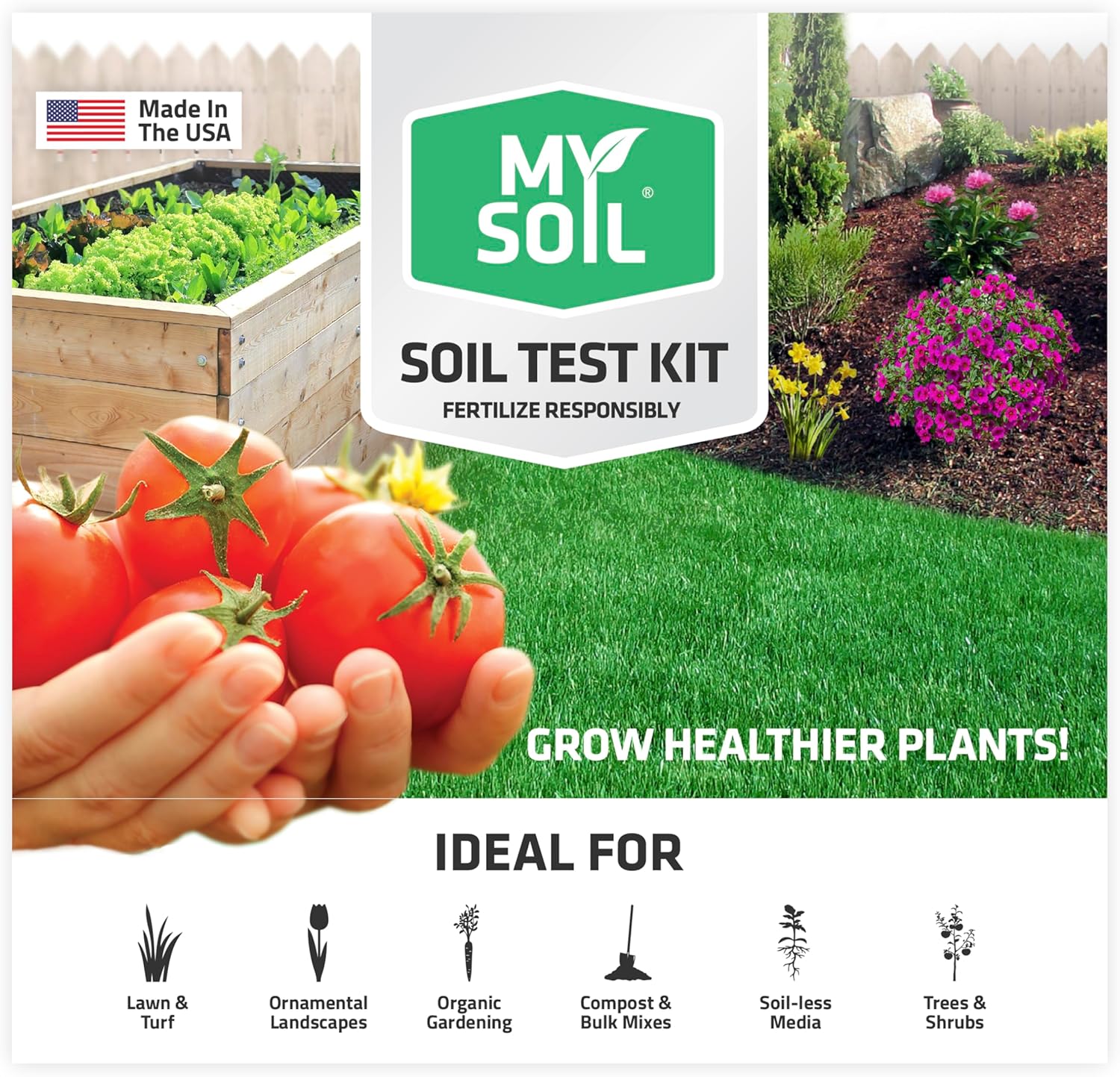
MySoil Professional Mail‑In Soil Test Kit (1 Test)
| Number of Packs | 1 |
|---|---|
| Unit Count | 1 Count |
| Manufacturer | Predictive Nutrient Solutions, Inc |
| Item Weight | 4.6 ounces |
The MySoil kit is a single‑use mail‑in soil test designed to give a professional laboratory analysis rather than an instant at‑home reading. You collect a sample in the included jar, register the kit online, mail the prepaid envelope to the lab, and get a detailed report in about 6–8 days. Results cover pH plus 13 plant‑available nutrients and include step‑by‑step recommendations for what to apply, how much, and when, with both organic and conventional options. That makes it useful for diagnosing lawn problems, planning fertilization for turf or vegetable beds, or checking soil before planting. The kit contains everything needed for one test and saves time by replacing guesswork with specific advice, which can reduce unnecessary product use. The main limitation is that each kit covers only a single sample, so testing multiple areas or repeated checks requires buying multiple kits; turnaround also depends on mailing times. For a homeowner who wants accurate, lab‑grade guidance for improving grass and garden soil, MySoil provides actionable results without complex equipment.
Best for: Homeowners focused on improving lawn health who want reliable, lab‑grade soil data and clear amendment instructions rather than DIY meters or strips.
Less Ideal for: People who need rapid, repeated tests across many spots or instant field readings should consider multi‑test packs or handheld meters instead.
- Laboratory analysis of pH plus 13 plant‑available nutrients for accurate results
- Includes prepaid mail envelope and everything needed to collect and send one sample
- Custom, easy‑to‑follow recommendations for what, when, and how much to apply
- Works for any soil type and a wide range of uses including lawn and turf
- Single‑use kit covers only one sample location
- Results take several days since samples are mailed to a lab
Verdict: For reliable, lab‑grade soil diagnostics and clear fertilizer guidance to improve grass and garden performance, choose this single‑test MySoil kit.
Luster Leaf Rapitest Soil Test Kit (20 tests)

| Brand Name | Luster Leaf |
|---|---|
| Unit Count | 20 Count |
| Item Type Name | Soil Test Kit |
| Model Number | 1602 |
The Luster Leaf Rapitest Soil Test Kit provides a simple, low-tech way to check garden soil pH and the three main nutrients gardeners track: nitrogen, phosphorus and potash. The kit includes reagents and comparators for 20 tests total (five tests per measurement), so you can sample several areas across a lawn or vegetable bed. Use involves mixing small soil samples with the provided capsules or solutions, then matching the resulting color against the included chart. That makes it fast and approachable for beginners and steady gardeners who want a practical snapshot before amending or fertilizing. The clear instructions and plant pH preference list for over 450 species are helpful for making actionable adjustments. Limitations are the coarse resolution of color-based readings and the limited number of tests compared with lab analysis, so it is best for routine spot checks rather than precise scientific monitoring.
Best for: Gardeners who want a straightforward, low-cost way to check soil health before amending and prefer practical, easy-to-follow results over lab-level precision.
Less Ideal for: Users who need laboratory-grade accuracy, quantitative nutrient concentrations, or frequent high-volume testing for professional soil management.
- Covers core measurements gardeners need: pH, nitrogen, phosphorus and potash.
- Includes materials for 20 total tests to sample multiple garden spots.
- Patented color comparator system makes results easy to read without special tools.
- Comes with detailed instructions and a plant pH preference list for many common species.
- Color-matching gives approximate results and is less precise than laboratory testing.
- Only five tests per measurement limits long-term or frequent monitoring without repurchasing.
Verdict: Buy this kit if you want an easy, affordable way to spot-check soil pH and basic nutrient levels across your garden before amending.
Choosing the Right Soil Test Kit for Food Plots: Key Factors to Consider
pH Measurement and Range
Soil pH controls nutrient availability for forage species commonly used in food plots. A kit that measures pH across the typical field range, roughly 4.5 to 8.5, gives you the information needed to decide on liming. Precision around ±0.1 to ±0.2 pH units is valuable when managing species-sensitive mixes.
Practical impact: If the test reads consistently high or low you may over- or under-lime, which affects plant establishment and nutrient uptake. Look for methods that minimize field interference from residue or moisture and that provide clear instructions for collecting a soil paste or slurry to standardize readings.
Macronutrient Reporting: P, K, and N Considerations
Phosphorus and potassium tests are essential because they influence root development and winter survival of many forage plants. Kits that report extractable P and K with numeric values let you plan targeted applications rather than blanket treatments.
Nitrogen testing in a single snapshot is often less reliable because soil N fluctuates rapidly. Kits that offer guidance on using P and K results alongside crop goals are more useful than those that give a single, possibly misleading nitrogen number. For food plots, focus on P and K plus a plan for regular N fertilization tied to growth stage rather than a one-off N test.
Sampling Tools and Protocols
Getting a representative sample across the food plot is arguably as important as the analytical method. Kits that include a soil probe or clear instructions for depth, number of subsamples, and how to combine them reduce sampling error. For food plots, most recommendations call for sampling the top 3 to 6 inches where seed and fertilizer interact with seedlings.
Also consider whether the kit expects dry or moist samples and how to package them. Field-ready sampling tools and easy-to-follow labeling reduce the chance of contaminating or misplacing samples before analysis.
Turnaround and Result Format
Turnaround time matters if you are planning a planting or a lime application on a narrow schedule. Instant field tests give immediate direction but may sacrifice accuracy; lab-return kits usually provide more precise numbers and specific fertilizer or lime recommendations.
Result format is equally important. Numerical values paired with recommended amendment rates per acre are most actionable. Color charts without numbers or vague guidance force you to guess application rates, which can lead to uneven plots and wasted inputs.
Durability and Field Conditions
Kits will be used outdoors, often in wet, muddy, or cold conditions. Components such as plastic scoops, cap seals, and storage bags should withstand repeated use without breaking or leaking. Field durability also covers whether reagents or strips are stable at expected temperatures during use.
A durable kit reduces repeat sampling and user frustration. For lab kits, stable packaging that protects samples during transport preserves accuracy and reduces the chance of discarded tests.
Interpretation and Management Guidance
Raw numbers are only useful when paired with guidance tailored to food-plot species and seeding goals. A kit that ties results to specific actions, for example how much lime per acre to raise pH by a given amount or recommended P and K application rates for common forage blends, is far more practical.
Good guidance also notes timing, such as applying lime well before seeding, and cautions about interacting inputs. If recommendations are generic, you may still need extension resources to convert numbers into an actionable plan.
Lab Kits Vs Instant Field Tests
Lab-return kits typically deliver more precise numerical readings and tailored amendment recommendations. They are useful when you need reliable baseline data before a major renovation, lime application, or seeding project.
Instant field tests provide quick directional feedback and are handy for spot checks while walking a plot. They are less precise but let you verify broad differences across areas and prioritize where to take lab samples.
- Choose lab kits for pre-plant planning and whole-plot decisions
- Use field tests for on-the-spot checks and to identify problem zones
- Combine both approaches: field screening followed by lab confirmation
How Many Samples and Where to Take Them
Take multiple subsamples across distinct areas of the food plot rather than a single grab sample. For small plots, 8 to 10 subsamples combined into a composite is common practice. Larger or variable terrain may require separate composites for ridges, low spots, or areas with different cropping history.
Avoid sampling right next to manure piles, feeding stations, or bare patches that are not representative. Record GPS points or a sketch so you can retest the same zones in future seasons and track changes after amendments.
- Sample at planting depth for seed mixes, usually 0 to 6 inches
- Combine and mix subsamples in a clean container before splitting for tests
- Label composites clearly with date, location, and recent treatments
Interpreting pH and Lime Recommendations
Soil pH affects nutrient availability and species selection. If the test shows acidic soil and you plan to seed legumes or brassica blends, lime is often needed to raise pH to the recommended range for those species.
Lime recommendations should be given as pounds per acre or tons per acre and tied to your current soil buffering capacity. Apply lime months before seeding when possible to allow the material to react and adjust pH.
- Match target pH to your seed mix rather than a single crop
- Factor in soil texture: heavier soils need more lime to change pH
- Consider splitting lime application if large quantities are required
Using Results to Build a Fertility Plan
Use P and K numbers to prioritize amendments. Low P often limits root development and establishment, while K affects winterhardiness and stalk strength. Base fertilizer type and rate on the test recommendation and your planting timeline.
Think of nitrogen as a managed, recurring input. Since soil N is dynamic, schedule in-season N applications based on growth stage rather than expecting a single pre-plant N number to be definitive.
- Apply phosphorus before seeding to support establishment
- Reserve a portion of nitrogen for post-emergence growth spurts
- Record applications and retest annually or biannually to track changes
Common Sampling Mistakes to Avoid
Not collecting enough subsamples or sampling only disturbed areas will give misleading results. Overlooking sampling depth is another frequent error; surface residues and tillage can change readings if depth is inconsistent.
Failing to dry or preserve lab samples per instructions can alter results. Follow kit directions for drying, packaging, and shipping samples to maintain integrity.
- Do not sample immediately after fertilizer application
- Avoid areas with recent lime, manure, or heavy organic debris unless those areas are representative
- Use clean tools to prevent cross-contamination
How We Chose the Best Soil Test Kit for Food Plots
We focused on tests and kits that provide data gardeners and land managers actually use when establishing and maintaining food plots. Selection started with tools and lab kit options that report key agronomic results: soil pH, available phosphorus and potassium, and either organic matter or a reliable estimate of cation exchange capacity. We prioritized methods that deliver reproducible results across multiple samples taken in a plot and that include clear sampling instructions so users can get representative data from irregular terrain. Practical handling mattered. We favored kits with straightforward field sampling tools and clear preservation or shipping instructions for lab-return kits. We excluded kits that only offer vague color charts without quantitative guidance or that fail to indicate detection ranges for common nutrient concentrations. Also excluded were single-parameter testers that do not report at least pH plus the main macronutrients. Final selection balanced analytical clarity, lab versus instant field tradeoffs, and the usefulness of any fertilizer or lime recommendations included with results. The criteria described here map directly to the scoring metrics used in individual product scorecards.
FAQ
How often should I test soil in a food plot?
Test annually or every two years for established plots to track changes from lime and fertilizer. More frequent testing may be useful in the first year after renovation or if you are troubleshooting persistent poor stands.
Can a quick pH test in the field replace a lab report?
A quick field pH test gives a useful directional read but usually lacks the precision and accompanying nutrient data of a lab report. Use field tests for screening and lab tests for planning amendments.
What depth should I sample for a mixed-seed food plot?
Sample the top 3 to 6 inches where seeds and most starter fertilizers interact with seedlings. For plots that will be disked or tilled, sample to the depth of incorporation to reflect the rooting environment.
Do I need to test for micronutrients for food plots?
Micronutrient deficiencies are less common in most soils used for food plots. Test for them if you have unusual symptoms, persistent poor growth, or if test results and recommendations indicate a potential deficiency.
How should I collect samples from uneven terrain?
Treat distinct landscape positions as separate sampling zones. Low spots, high ridges, wet areas, and spots near feeders often have different soil properties and should be sampled separately for accurate recommendations.
Final Verdict
A good soil testing approach is the foundation of a productive food plot. Prioritize reliable pH measurement, extractable phosphorus and potassium data, and sampling methods that give representative results across the plot. Balance the immediacy of field tests with the precision of lab-return kits depending on your planting schedule and the scale of the project. Focus on actionable recommendations in the results, and plan follow-up tests after you apply lime or fertilizer to measure progress. With a clear testing routine and a simple fertility plan, you can make more confident decisions and improve forage establishment over time.
