

Note: This article contains affiliate links. If you click on these links and make a purchase, I may earn a small commission at no extra cost to you. This helps support my research and content. Read my full affiliate disclosure here.
If flying insects are disturbing meals, naps, or indoor plants, the right spray can restore comfort without leaving strong fumes or sticky residues. You need a solution that incapacitates flies, gnats, and mosquitoes quickly while being appropriate for use around family, pets, and indoor foliage. This guide shortlists the top indoor flying bug sprays for common household situations and explains how each option performs on knockdown speed, indoor scent, re-entry time, and surface residue. Below you will find practical buying guidance and the evaluation criteria we used to select these six top-rated picks.
Top Picks at a Glance
| Best Overall The best all-around choice for most situations | ZEVO Flying Insect Aerosol Spray, 30 fl oz |  |
| Best Quality Built to a higher standard if you want something more solid | Ortho Home Defense Insect Killer for Indoor & Perimeter, 1.33 gal. with Comfort Wand |  |
| Best Value The sweet spot between price and what you get | STEM Plant-Based Bug Spray for Ants, Roaches and Flies, 12 fl oz |  |
| Best Budget The cheapest option that still gets the job done reliably | STEM Plant-Based Bug Spray for Flies, Mosquitoes & Gnats, 10 oz |  |
| Highest Rated A top-rated pick with lots of positive feedback | Raid Flying Insect Killer Spray, Outdoor Fresh Scent, 15 oz (Pack of 4) |  |
| Most Popular A crowd favorite that many people choose with confidence | Mighty Mint Peppermint Oil Insect Repellent Spray, 16 oz |  |
ZEVO Flying Insect Aerosol Spray, 30 fl oz

| Item Volume | 30 fluid ounces |
|---|---|
| Target Species | Fly, Fruit Fly, Gnat, Mosquito |
| Included Components | Sprays |
| Brand Name | ZEVO |
ZEVO Flying Insect Aerosol is a ready-to-use spray designed to kill common flying pests on contact. You use it as a targeted aerosol: wait for the insect to land or spot it in flight, then spray directly until the insect is wet and wipe away any residue if needed. The formula uses rosemary and cornmint oils rather than a heavy synthetic odor, so it smells milder than many conventional aerosols while still delivering quick knockdown of flies, fruit flies, gnats, and mosquitoes. The product is intended for indoor and outdoor spot treatments around kitchens, bathrooms, living spaces, and patios and comes in a large 30 fl oz can that reduces the need for frequent repurchase. Important limitations are that it must be applied directly to visible insects to be effective and should not be used near food, electrical wiring, people, pets, or plants; surfaces may stain and ventilation is recommended. For someone who wants a fast, aromatic alternative to harsher sprays, this performs well when used as directed.
Best for: Buyers who prioritize quick, reliable knockdown of visible flying insects and prefer a less harsh-smelling aerosol for spot treatments in and around the home.
Less Ideal for: People seeking long-lasting residual protection, broad-area fogging, or a product they can safely apply around food prep surfaces or sensitive plants should consider other options.
- Fast-acting contact kill for flies, fruit flies, gnats, and mosquitoes
- Formula powered by rosemary and cornmint oils gives a milder scent than many conventional aerosols
- Suitable for indoor and outdoor spot treatments around living spaces
- Large 30 fl oz size reduces how often you need to replace the can
- Requires direct spray on visible insects to be effective rather than providing residual control
- Not safe for use on or around food, people, pets, or plants and can stain porous surfaces
Verdict: Choose this spray if you want fast, on‑contact elimination of indoor mosquitoes and other flying pests with a milder, plant‑oil based scent.
Ortho Home Defense Insect Killer for Indoor & Perimeter, 1.33 gal. with Comfort Wand

| Item Form | Spray |
|---|---|
| Target Species | Insects |
| Liquid Volume | 1.33 gallons |
| Active Ingredients | Bifenthrin 0.05%, Zeta-Cypermethrin 0.0125% |
This 1.33 gallon Ortho Home Defense spray is designed to treat both indoor problem spots and the outdoor perimeter of a home to reduce ants, roaches, spiders and many other crawling and flying insects. It comes with a battery-powered Comfort Wand that delivers a continuous spray so you can apply a uniform band around foundations, patios and entry points without bending or pumping. The formula with bifenthrin and zeta-cypermethrin is intended to kill on contact and establish a barrier that the manufacturer says lasts up to 12 months for ants, roaches and spiders on non-porous indoor surfaces. In real-world use that means fewer repeat treatments in busy yard perimeters and around doors and windows. The spray dries clear with minimal fumes which helps for indoor use near kitchens and living areas. Limitations are that this is a chemical insecticide so users should follow safety directions around children, pets and plants and it is not a specific solution for pests not listed on the label. For homeowners focused on strong, perimeter-level protection this product simplifies application and covers a large area per container.
Best for: Homeowners who want a performance-focused perimeter treatment to reduce recurring yard and entry-point insect problems and prefer a ready-to-use product that is easy to apply.
Less Ideal for: People seeking organic or non-chemical control methods or those who need a targeted solution for pests not listed on the label should consider alternative products.
- Includes battery-powered Comfort Wand for continuous, fatigue-free application
- Ready-to-use 1.33 gallon container covers large perimeters without mixing
- Formula creates a barrier claimed to provide up to 12 months protection against ants, roaches and spiders on non-porous indoor surfaces
- Dries clear and gives off minimal fumes, making indoor use more practical
- Contains synthetic insecticides so precautions are required around children, pets and ornamentals
- Protection claims are specific to certain species and surfaces so results vary by pest and conditions
Verdict: A powerful, ready-to-use perimeter and indoor spray for homeowners who want long-lasting, performance-oriented protection against common yard and household insects.
STEM Plant-Based Bug Spray for Ants, Roaches and Flies, 12 fl oz

| Active ingredients | Geraniol 6.2%, Lemongrass Oil 0.5% |
|---|---|
| Other ingredients | White Mineral Oil, Isopropyl Myristate, (+)-Ethyl Lactate 93.9% |
| Form | Trigger spray |
| Use | Indoor and outdoor spot treatments |
This STEM bug spray is a trigger-spray insecticide formulated with plant-derived actives such as geraniol and lemongrass oil to kill ants, roaches and flies on contact. It is intended for targeted indoor and outdoor spot treatments: shake, hold about a foot from the insect and spray directly on or where insects congregate. The product’s botanical formula and absence of added dyes or strong chemical fragrances make it a reasonable choice for homes where users prefer less synthetic-smelling options. The trigger bottle gives control for spot application and repeated short bursts, and the directions note it is oil-based so spills should be cleaned promptly. Important limitations are that it is not for spraying on people, pets or plants and requires direct hits for best effect rather than long-range fogging. For persistent infestations you may need supplemental measures because this is designed for surface and contact kills rather than residual baiting or area-wide control.
Best for: Buyers who want an affordable, low-odor botanical spray for quick spot control of common household pests and who prioritize a simple, easy-to-use trigger bottle for targeted treatments.
Less Ideal for: People facing large or hidden infestations who need long-lasting residual control or bait-style solutions should consider professional products or integrated pest control approaches.
- Plant-based active ingredients (geraniol and lemongrass oil) that reduce strong chemical odor
- Trigger-spray bottle for controlled, targeted application
- Labeled for both indoor and outdoor spot treatments when used as directed
- No added dye or fragrance listed, which minimizes residue and scent
- Oil-based formula can leave slippery residue if spilled
- Requires direct spraying of insects for effectiveness and offers limited residual control
- Not safe to spray on people, pets or plants
Verdict: A budget-friendly, low-odor plant-based trigger spray that provides quick, targeted kills of ants, roaches and flies for everyday spot treatments.
STEM Plant-Based Bug Spray for Flies, Mosquitoes & Gnats, 10 oz

| Net volume | 10 oz |
|---|---|
| Active ingredients | Geraniol 1.47%, Lemongrass oil 0.10% |
| Intended use | Indoor and outdoor spot treatment |
STEM's 10 oz aerosol bug spray is a plant-based insecticide formulated to kill flies, mosquitoes and gnats around the home and patio. You use it like most aerosols: shake well, hold the nozzle 6–12 inches from target areas or visible insects, and mist surfaces or airspace where flying pests congregate. Notable features include geraniol and lemongrass oil as the active ingredients, no added dyes or harsh chemical odors, and directions that allow both indoor and outdoor spot treatments. In practice it is convenient for quick spot kills and temporary control around doorways, windowsills, potted areas and patios. Because it is formulated for people- and pet-occupied spaces when used as directed, it is a reasonable option for households that prefer botanical actives. Limitations are typical for short‑acting aerosols: protection is not long lasting so repeat applications are needed after rain or cleaning, and it is not for direct application to people, pets or edible plants.
Best for: Buyers who want an affordable, plant-based aerosol for quick spot control of gnats and other flying pests around living spaces and patios.
Less Ideal for: People seeking season-long residual protection or professional-grade control should consider products with longer-lasting actives or different application formats.
- Uses plant-based active ingredients (geraniol and lemongrass oil) rather than harsh synthetic chemicals
- Formulated for both indoor and outdoor spot treatments when used as directed
- No added dye or strong chemical fragrance, making indoor use less obtrusive
- Entomologist-tested formulation and clear directions for application
- Effect is short lived compared with long‑lasting residual insecticides
- Not intended for direct use on people, pets or edible plants
Verdict: A budget-friendly, plant-based aerosol that delivers fast, convenient knockdown of gnats and other flying pests for short-term control.
Raid Flying Insect Killer Spray, Outdoor Fresh Scent, 15 oz (Pack of 4)

| Net weight per can | 15 Ounce |
|---|---|
| Scent | Outdoor Fresh |
| Use | Indoor and outdoor |
| Pack quantity | 4 |
This Raid Flying Insect Killer is a ready-to-use aerosol spray designed to knock down flies, mosquitoes, and other flying insects quickly for both indoor and outdoor use. In practice you aim and spray directly at visible bugs or into corners and entry points where insects rest; it claims contact kill and the formulation is meant to minimize lingering chemical odor while leaving an outdoor fresh scent. The pack of four 15 ounce cans keeps a steady supply on hand, which is useful for regular spot treatments in kitchens, living areas, porches, and garages. Strengths are the fast-acting contact control and the no-lingering-odor claim, which makes it less intrusive inside the home. Limitations are that it is a short-term, direct-contact treatment rather than a residual surface barrier and it requires careful use around food, children, and pets following label directions. For someone who wants dependable immediate knockdown of visible flying insects, this is a practical, easy-to-use option.
Best for: Homeowners and renters who prioritize dependable, quick elimination of visible flying insects and want a low-odor spray suitable for indoor spot treatments.
Less Ideal for: People seeking long-term preventative control or those who prefer non-chemical methods for managing insects should consider alternatives.
- Fast contact kill of flies, mosquitoes and other flying insects
- Formulated to leave no lingering chemical odor for indoor use
- Ready-to-use aerosol is easy to apply for spot treatments
- Pack of four cans keeps a reliable supply for repeated use
- Provides immediate knockdown only and is not a long-lasting residual barrier
- Must be used with caution around food, children, and pets and requires following label instructions
Verdict: Choose this spray when you need a reliable, low-odor product for quick, on-the-spot elimination of flying insects indoors.
Mighty Mint Peppermint Oil Insect Repellent Spray, 16 oz
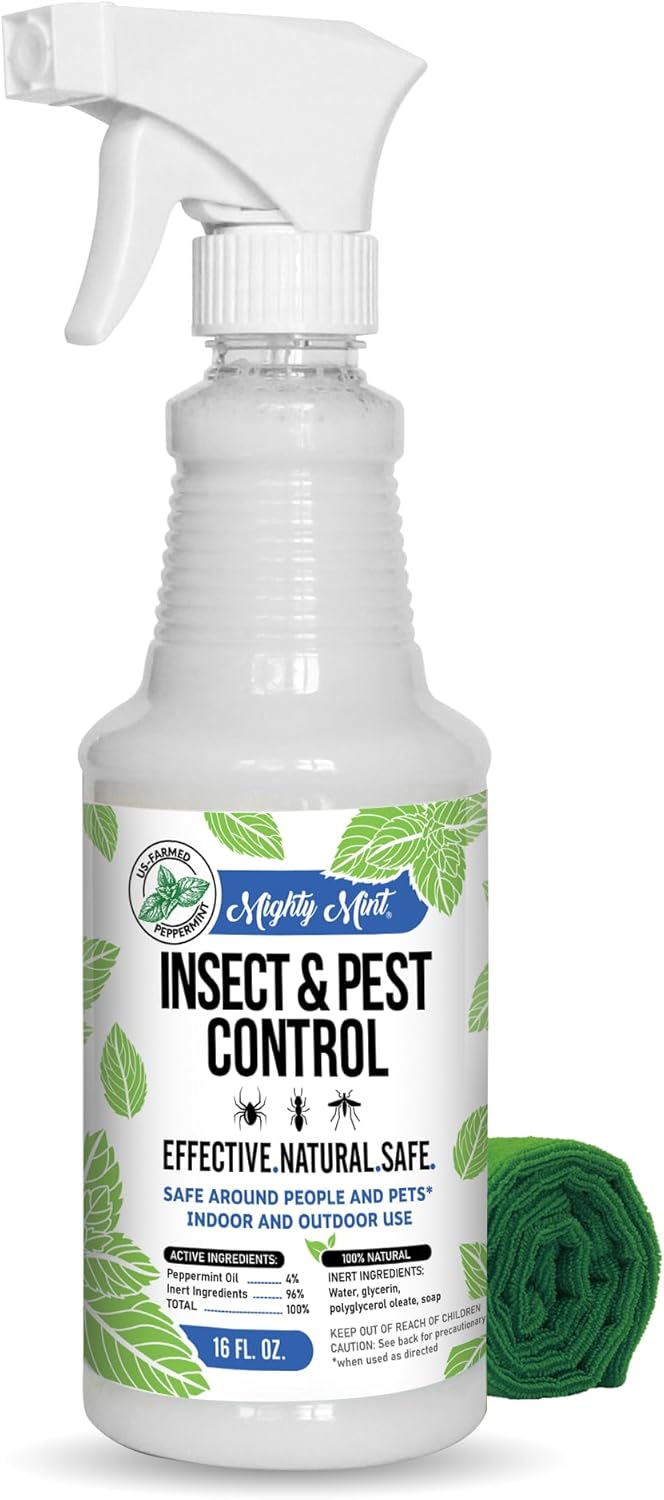
| Ingredients | Water, Glycerine, Polyglycerol oleate, Soap, Peppermint oil |
|---|---|
| Use Areas | Indoor / Outdoor |
| Size | 16 oz |
Mighty Mint is a plant-based, ready-to-use spray that uses concentrated peppermint oil to repel a broad range of household and patio pests. You apply it directly to problem areas such as baseboards, entryways, patios and around outdoor seating; the manufacturer recommends shaking and spraying until surfaces are covered and repeating applications two or more times per week for best results. Notable features include a peppermint-only scent profile, a formulation that avoids synthetic fragrances and the convenience of a 16 oz spray bottle for targeted spot treatments. Practical benefits are that it is safe to use around people and pets when dry and does not leave obvious stains on most surfaces, and the scent can make treated areas smell fresher than chemical alternatives. Important limitations are that it is a repellent rather than a pesticide so it works by discouraging pests rather than killing them, effectiveness depends on regular reapplication and it should not be applied when pollinators are present or to skin or food-contact surfaces.
Best for: Buyers who prioritize natural, low-toxicity solutions and want a targeted spray to reduce insects around patios and entryways while keeping family and pets in mind.
Less Ideal for: Anyone needing a one-time extermination or long-term residual pesticide for severe infestations should consider professional treatments or products formulated to kill pests rather than repel them.
- Plant-based peppermint formula that avoids synthetic fragrances
- Ready-to-use spray for quick, targeted indoor and outdoor applications
- Safe for people and pets when used as directed and allowed to dry
- Nonstaining on most surfaces and leaves a fresh mint scent
- Repels rather than kills insects so regular reapplication is needed to maintain protection
- Strong peppermint concentration may bother scent-sensitive individuals and requires keeping children and pets away until dry
Verdict: Choose Mighty Mint when you want a pet-friendly, plant-based spray to reduce patio and entryway insects with a fresh peppermint scent.
Choosing the Right Indoor Flying Bug Spray: Key Factors to Consider
Effectiveness Against Target Pests
Choose a spray labeled for the specific flying insects you see most often, such as house flies, fruit flies, drain flies, moths, and small mosquitoes. Different active ingredients and formulations vary in contact kill rate and residual control. A product that lists the pests by name on the label gives clearer expectations about how well it will perform in the rooms where you encounter them.
Effectiveness also affects how often you need to reapply. A fast-contact spray with little residual may stop a current infestation quickly but require more frequent use. A formulation with short, safe residual control can reduce reapplication frequency while still being appropriate for indoor environments.
Indoor Odor and Volatility
Indoor sprays range from nearly odorless to strongly perfumed or chemically sharp. Odor matters for comfort, especially in kitchens, bedrooms, or small apartments where fumes can linger. Look for low-odor or low-volatile formulations and read label recommendations about ventilation and how long the smell typically lingers.
Lower volatility usually means less airborne irritation for sensitive occupants. If anyone in the household has asthma, chemical sensitivities, or young children, prioritize sprays that explicitly state low odor or reduced fumes and follow label guidance on airing out the room after application.
Re-entry Time and Room Use Restrictions
Re-entry time is the period recommended after spraying before people or pets can return to the treated area. Shorter re-entry times make the product more convenient for quick household use. Some sprays require only a few minutes of ventilation, while others advise longer waits or keeping food and dishes covered.
Pay attention to whether the label allows use in kitchens, around food preparation areas, or near bedding. If the product restricts use on fabrics or near houseplants, plan for alternative control methods in those spaces or choose a spray with more permissive instructions.
Surface Residue and Staining
Sprays vary in the amount of residue they leave on walls, countertops, upholstery, and plant leaves. Sticky or oily residues can attract dust and require cleaning, while pigmented sprays might stain porous surfaces. Check label notes about visible residues and test any spray in an inconspicuous spot if you expect overspray on delicate finishes.
Residue also matters near houseplants. Some formulations advise avoiding direct application to foliage or rinsing leaves after treatment. If you plan to treat rooms with lots of indoor plants, select a product with minimal residue or clearly safe plant-use instructions.
Application Ease and Delivery Method
Consider whether the spray comes in a trigger bottle, aerosol can, pump mister, or other applicator. Trigger bottles and pump misters let you direct spray and avoid over-application, which is useful near food prep areas and plants. Aerosol cans offer broad quick knockdown but can disperse more widely and produce more airborne particles.
Also evaluate label guidance for room size and spray duration. A product that gives clear dosing instructions for small rooms or spot treatments will be more user-friendly and reduce the chance of unnecessary exposure.
When to Use Spot Treatment Versus Whole-Room Spray
Spot treatments are best for isolated infestations like a cluster of fruit flies near a trash bin or a single moth near a light fixture. They minimize exposure to people, pets, and plants by targeting where flies congregate. Use a directed nozzle or short burst from a pump mister to limit drift.
Whole-room sprays are useful when flying insects are widespread or when there is a heavy entry point, such as open doors or screens with large holes. For whole-room use, follow ventilation and re-entry guidance, remove or cover food and dishes, and keep pets out of the space until the specified time has passed.
- Spot treatment: lower exposure, targeted control, good for kitchens and around trash.
- Whole-room spray: broader coverage, useful for persistent infestations, needs more ventilation.
Safe Use Around Houseplants and Indoor Foliage
Many indoor sprays should not be applied directly to plant leaves. When treating rooms with plants, either remove plants temporarily or shield foliage and spray nearby surfaces instead.
If incidental contact occurs, rinse leaves with water once it is safe to do so and when label instructions permit. For sensitive or rare plants, choose sprays that specifically allow use near houseplants or opt for non-chemical controls in the plant area.
- Cover or move plants before whole-room sprays.
- Rinse foliage after treatment if label permits and residue is visible.
Minimizing Indoor Exposure and Ventilation Tips
Open windows and run fans when the label recommends ventilation. Even low-odor products benefit from brief airing to reduce lingering fumes. Use the shortest re-entry time recommended that still meets safety guidance.
For small apartments or when you cannot leave a room vacant for long, consider spot treatments during times when occupants can vacate briefly, such as when running errands or taking a walk. Remove food, cover dishes, and keep bedding and towels shielded from overspray.
- Ventilate for the full time suggested on the label.
- Use exhaust fans in kitchens and bathrooms to clear airborne particles.
Integrating Sprays With Nonchemical Controls
Chemical sprays are most effective when paired with sanitation and exclusion tactics. Remove breeding sites such as overripe fruit, fix leaky drains that attract drain flies, and use window screens or door sweeps to reduce incoming insects.
Sticky traps and UV traps can reduce adult populations without chemical use and are useful in food prep areas where spray application is limited. Use sprays for immediate knockdown and follow-up with nonchemical measures to reduce recurrence.
- Eliminate attractants to reduce reliance on sprays.
- Use traps and physical barriers for ongoing control.
Label Literacy: What Warnings and Directions Matter
Read the active ingredient section and the precautions for people, pets, and plants. Note the specified re-entry time, required ventilation, and any restrictions on use around food or kitchen surfaces.
Follow mixing and dosing instructions exactly. Overapplication increases exposure without improving effectiveness and can leave heavier residue that requires cleaning. When in doubt, use less product in a targeted spot rather than a broad, heavy spray.
- Check re-entry time and ventilation recommendations.
- Note any restrictions on use near food, bedding, or children.
How We Chose the Best Indoor Flying Bug Spray
We prioritized products built for indoor use and evaluated them against concrete, gardener- and homeowner-focused dimensions. Our selection filters focused on indoor safety and practical performance: effectiveness against common flying pests, low odor and minimal fumes, safe re-entry times for occupied rooms, and minimal residual staining or sticky deposits on surfaces. We reviewed product labels and technical sheets to verify active ingredients, suggested application rates, and recommended ventilation or re-entry intervals. We excluded outdoor-only formulations, aerosol foggers intended for structural fumigation, and products that require professional equipment or licensing. We also filtered out sprays with unclear or overly long re-entry warnings that make typical household use impractical. The criteria we used reflect what matters most for indoor deployments: how quickly the spray subdues flying insects, how noticeable the odor is after application, how surfaces and fabrics react to overspray, and whether the product instructions fit routine home use. We favored versatile sprays that can be used in kitchens, living rooms, bedrooms, and near houseplants when label directions permit.
FAQ
How long should I wait to re-enter a room after spraying?
Re-entry times vary by product and formulation but often range from a few minutes to an hour. Check the label for the specific re-entry interval and ventilate the room as recommended before allowing people or pets back inside.
Are indoor flying bug sprays safe around pets and children?
Many indoor sprays are safe when used as directed, but safety depends on following label instructions for re-entry time, ventilation, and surface contact. Keep children and pets out of treated areas until the recommended time has passed and avoid treating areas where pets eat or sleep unless the label allows it.
Can I spray directly on fruit flies near my kitchen sink?
Spot treatment near a sink is often acceptable, but avoid spraying directly onto food, dishes, or open food storage. Remove or cover food items and clean attractant sources like overripe fruit or organic buildup in drains to address the root cause.
Will sprays harm my houseplants if I treat the room?
Some sprays can leave residues that irritate foliage or dust-collecting films. To protect plants, move them out of the room or cover them during treatment and rinse leaves later if the label indicates it is safe to do so.
How often should I reapply an indoor spray?
Reapplication depends on the product residual claim and the level of infestation. For quick knockdown sprays with minimal residual, you may need to treat more frequently. For products with short, safe residual control, follow label intervals to avoid overuse.
Are there low-odor options for use in bedrooms or small apartments?
Yes, low-odor or reduced-volatility formulations are available and are preferable for small or frequently occupied spaces. Look for products that explicitly state low odor and follow ventilation guidance to minimize lingering smells.
Final Verdict
Prioritize sprays that match the scale of your problem and the sensitivities of your household. Quick knockdown matters for immediate comfort, while shorter re-entry times and low odor improve convenience for daily living. Consider application method and residue when treating rooms with fabrics or houseplants. Balance immediate control with sanitation and exclusion measures to prevent repeat infestations. Use targeted spot treatments when possible, reserve whole-room sprays for persistent problems, and always follow label directions to minimize exposure and keep indoor spaces comfortable and safe.
