

Note: This article contains affiliate links. If you click on these links and make a purchase, I may earn a small commission at no extra cost to you. This helps support my research and content. Read my full affiliate disclosure here.
Peonies respond well to steady nutrition and soil-friendly amendments rather than fast-release chemicals. Choosing the right organic fertilizer for peonies helps you encourage fuller spring blooms, stronger perennial crowns, and a more resilient root system over time. In this guide we narrowed the field to the top shortlisted options gardeners actually use around borders and beds, then evaluated each for nutrient profile, application ease, and long-term soil health. Below you will find practical notes on how these fertilizers perform in a real garden and the criteria we used to pick them, followed by targeted guidance to match a product to your planting situation.
Top Picks at a Glance
| Best Quality Built to a higher standard if you want something more solid | BuildASoil Organic Fertilizer for Vegetable Garden (10 lb) |  |
| Best Value The sweet spot between price and what you get | Espoma Flower-Tone Organic Fertilizer, 4 lb. Bag, 2-Pack |  |
| Best Budget The cheapest option that still gets the job done reliably | Jobe's Organics Granular Bone Meal Fertilizer, 4 lb |  |
| Highest Rated A top-rated pick with lots of positive feedback | Espoma Organic Rose-Tone 4-3-2 Granular Rose Fertilizer (4 lb, 2-Pack) |  |
| Most Popular A crowd favorite that many people choose with confidence | FoxFarm Big Bloom Liquid Plant Food, 16 fl oz |  |
| Best Seller A high-volume bestseller chosen again and again | Neptune's Harvest Fish & Seaweed Liquid Fertilizer (2-3-1) 36 oz |  |
BuildASoil Organic Fertilizer for Vegetable Garden (10 lb)

| Item Form | Granules |
|---|---|
| Specific Uses For Product | Plant Growth, Soil Conditioning |
| Mixing Ratio | 1:400 (nutrient tea); 1:12 to 1:6 (soil amendment) |
| Coverage | Full |
BuildASoil Organic Fertilizer is a hand-crafted granular blend designed to boost vegetable garden performance by improving soil fertility and feeding plants. It is typically used as a top-dress, soil amendment, or brewed into a nutrient tea using the provided mixing ratios. Notable features include a 2-4-2 NPK ratio, rock dust and calcium for mineral support, and a multi-ingredient organic formulation aimed at improving vigor and flavor. In practice you can sprinkle 1/4 to 1 cup per plant as a top dressing or mix 2 to 4 cups per cubic foot to recondition depleted soil; the product also recommends 1/4 to 1 cup per 5-gallon bucket for teas. Benefits you will see are steadier, more balanced growth in vegetable crops and improved soil conditioning over time rather than a sudden chemical push. Limitations are that precise NPK needs for specific crops like potatoes may require complementary potassium-heavy inputs at certain stages, and results depend on existing soil conditions and proper application rates rather than instant corrective action.
Best for: Gardeners who prioritize steady, low-risk soil improvement and prefer organic, multi-mineral fertilizers for home vegetable plots, including those who want a simple top-dress or tea recipe.
Less Ideal for: Growers who need aggressive, fast-acting single-nutrient feeds or those growing potatoes in intensive commercial systems that require precise, high-K formulations.
- Organic granular formula suitable for top-dressing or soil amendment.
- Balanced 2-4-2 NPK with added rock dust and calcium to support overall plant and soil health.
- Clear mixing and application guidance for nutrient tea, top dress, and soil re-amendment.
- Not specialized for high-potassium feeding that some potato growers use during tuber bulking.
- Effects are gradual and rely on repeated application and good soil management rather than immediate visible change.
- Single bag size may be bulky for very small container growers.
Verdict: A dependable organic granular fertilizer that improves soil health and supports steady vegetable growth, making it a safe choice for risk-averse potato gardeners who want gradual, long-term improvement.
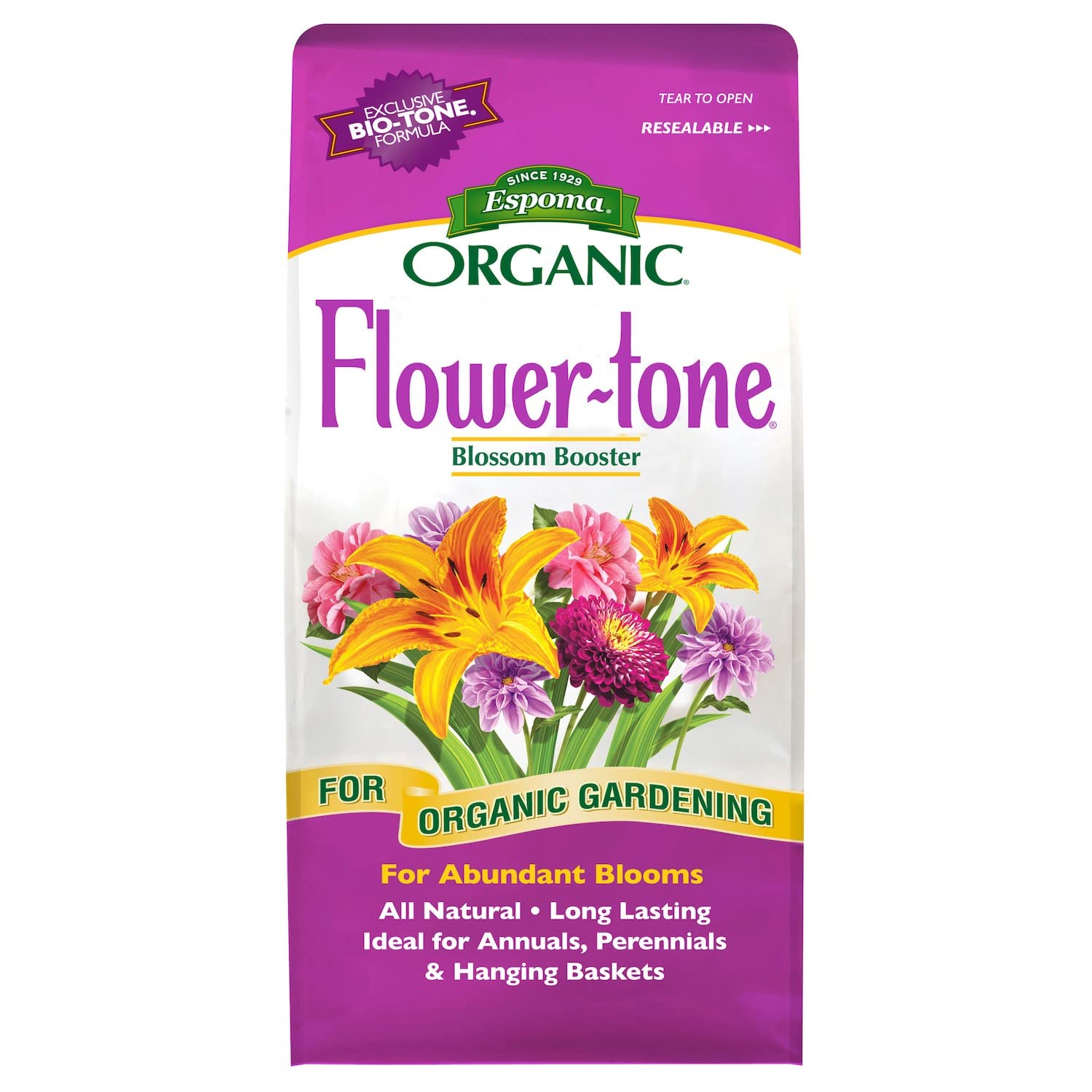
Espoma Flower-Tone Organic Fertilizer, 4 lb. Bag, 2-Pack
| Item Form | Granules |
|---|---|
| Specific Uses For Product | Gardening,Organic,Plant Food |
| Coverage | Medium |
| Target Species | flowers, annuals, perennials, roses |
| Mixing Ratio | 3:4:5 |
Espoma Flower-Tone is an organic granular plant food designed to promote abundant blooms in flowers, perennials, annuals and roses. It is applied directly to the soil around the plant drip line and watered in, with a recommended monthly application during the growing season. The 3-4-5 nutrient ratio with added calcium and the Bio-tone biological formula supply a balanced feed that supports flowering without high nitrogen that would favor foliage over blooms. Because it is granular and labeled for organic gardening, it works well for mixed perennial beds where you want steady, natural nutrient release and compatibility with organic practices. The product comes in convenient 4 pound bags sold as a two-pack for repeat applications. Limitations are that it is a medium-coverage granular feed rather than a fast-acting liquid, so results accumulate over weeks, and you must follow monthly repeat applications for sustained bloom performance.
Best for: Gardeners who want an easy, organic monthly feed to boost blooms in mixed perennial and flower beds and prefer a product that supports soil biology.
Less Ideal for: Growers who need immediate, fast-acting nutrient results or who are managing very large beds where concentrated coverage per application is the priority.
- Organic formula approved for organic gardening and safe for use around flowers and perennials
- Balanced 3-4-5 NPK with added calcium supports bloom production rather than excess leaf growth
- Granular form is easy to apply around drip lines and provides steady nutrient release
- Includes Espoma's Bio-tone biological formula to support soil biology and root health
- Medium coverage means larger beds will require multiple bags for full-season feeding
- Slower to show results compared with liquid or soluble fertilizers
Verdict: A dependable organic granular fertilizer that steadily promotes bigger, healthier blooms in perennial and flower beds when used as a monthly feed.
Jobe's Organics Granular Bone Meal Fertilizer, 4 lb

| Item Form | Granules |
|---|---|
| Application Method | Soil |
| Unit Count | 64 Ounce |
| Mixing Ratio | 2-14-0 |
Jobe's Organics Granular Bone Meal is a prilled, dust-reduced source of phosphorus and calcium aimed at strengthening root systems and improving blooms and tuber development. It is typically worked into the soil at planting for bulbs or applied around established plants every eight weeks during the growing season to support root- and flower-focused crops. The 2-14-0 NPK profile makes it especially useful where phosphorus is needed, and the granulated form is compatible with spreaders or hand application with minimal mess. Being OMRI-listed and made from 100 percent bone meal means it fits organic garden plans and is safe to use around children and pets when handled properly. Important limitations are that it supplies little to no nitrogen, so it should be paired with a balanced or nitrogen-rich amendment for leafy growth, and local regulations may restrict phosphorus use on lawns or near waterways. Also, results depend on existing soil phosphorus levels so a soil test is recommended before use.
Best for: Gardeners growing bulbs, tubers, flowering vegetables, or onions who want an organic phosphorus boost and prefer a low-dust granular product backed by positive user feedback.
Less Ideal for: Growers who need a complete all-purpose fertilizer for rapid leafy growth or those managing phosphorus-restricted turf or sites near sensitive waterways.
- High phosphorus and calcium content supports strong root development and better blooms
- Granulated prilled form reduces dust and works well with spreaders or hand application
- OMRI-listed and made from 100 percent organic bone meal suitable for organic gardens
- Directions recommend regular application every eight weeks for season-long support
- Contains little to no nitrogen so not sufficient alone for leafy growth
- Phosphorus fertilizers can be restricted in some areas because of runoff concerns
Verdict: A reliable organic bone meal to boost root development and bulb or onion bloom potential when soil phosphorus is needed.
Espoma Organic Rose-Tone 4-3-2 Granular Rose Fertilizer (4 lb, 2-Pack)

| Item Form | Granules |
|---|---|
| Specific Uses For Product | Plant Growth |
| Coverage | Medium |
| Target Species | Roses, Viburnum, Bougainvillea, Clematis |
| Mixing Ratio | 4-3-2 |
Espoma Rose-Tone is a ready-to-use granular organic fertilizer designed specifically for roses and other flowering shrubs. You apply it around the drip line and water it in, typically once a month during the growing season, to feed plants with a 4-3-2 nutrient balance and added calcium. The formula combines feather meal, poultry and bone meals, alfalfa and greensand, so it releases nutrients gradually to encourage steady green growth, stronger stems and more abundant blooms rather than a quick flush. It is approved for organic gardening and has a medium coverage rating, making it suitable for beds and individual shrubs. Practical benefits include ease of use, a slow-release feed that lowers the risk of burn, and organic inputs that improve soil over time. Limitations are that results are slower compared with synthetic quick-release fertilizers and monthly application is needed through the season for best performance. This is primarily a soil-applied maintenance feed rather than a fast corrective treatment for severely deficient plants.
Best for: Gardeners who prioritize consistent bloom performance and soil health and prefer an organic, low-risk monthly feed for roses and flowering shrubs.
Less Ideal for: Gardeners seeking rapid correction of acute nutrient deficiencies or immediate green-up should consider a faster-acting synthetic product instead.
- Specifically formulated for roses and common flowering shrubs so nutrient balance targets bloom production
- Organic, slow-release ingredients that feed steadily and help build soil health
- Ready-to-use granular form that is easy to apply around the drip line and does not require mixing
- Contains added calcium which can improve cell strength and reduce blossom problems
- Slower to show results compared with synthetic fast-release fertilizers
Verdict: Choose this if you want an easy, organic monthly feed that promotes steady growth and better blooms in roses and flowering shrubs.
FoxFarm Big Bloom Liquid Plant Food, 16 fl oz

| Item Form | Liquid |
|---|---|
| Specific Uses For Product | Organic |
| Application Method | watering can, sprayer, or drip system |
| Liquid Volume | 16 fluid ounces |
| Mixing Ratio | 4 |
Big Bloom is a concentrated liquid bloom fertilizer aimed at boosting flowers and fruit by supplying readily available organic nutrients. It mixes into water (manufacturer recommends 4 tablespoons per gallon) and can be applied with a watering can, sprayer, hose-end siphon, or through drip systems, so you can feed potted plants, beds, or containers without changing your routine. Notable features are its OMRI listing for organic use and the inclusion of bat guano and earthworm castings, which provide phosphorus and organic matter to encourage blooms and seed set. Because it is liquid and fast-acting, you can expect visible perk-up within a short time after feeding, and it is suitable for regular use at watering times to extend flowering. Limitations to consider are the small 16 fl oz size for larger gardens and the presence of phosphorus, which may be restricted in some locales and requires careful application to avoid runoff.
Best for: Gardeners focused on maximizing blooms and fruit who want an organic, fast-acting feed they can add to routine watering for container and bed-grown flowering plants.
Less Ideal for: Large-scale landscapers or very large perennial beds who need bulk fertilizer solutions or want to avoid phosphorus-based products due to local regulations.
- OMRI-listed organic formula with natural inputs like bat guano and earthworm castings
- Liquid concentrate allows fast nutrient uptake and flexible application methods
- Works with watering cans, sprayers, hose-end siphons, and drip systems for easy integration
- Small 16 fl oz bottle may require frequent repurchasing for larger flower beds
- Contains phosphorus so local restrictions on phosphorus fertilizers may apply
Verdict: Choose Big Bloom when you want an OMRI-listed, easy-to-apply liquid fertilizer that delivers fast organic nutrients to boost flowering and fruiting.
Neptune's Harvest Fish & Seaweed Liquid Fertilizer (2-3-1) 36 oz

| Item Form | Liquid |
|---|---|
| Mixing Ratio | 2:3 |
| Specific Uses For Product | Plant Growth |
| Liquid Volume | 946 ml |
Neptune's Harvest Fish & Seaweed Liquid Fertilizer is a concentrated organic plant food that mixes with water for use as a soil drench or foliar feed. It is typically diluted (manufacturer directions give roughly 1 fl oz per gallon for outdoor use and 1 tablespoon per gallon for houseplants) and applied every 1 to 3 weeks depending on the crop. The formula combines hydrolyzed fish and seaweed to deliver nitrogen, micronutrients, and seaweed-derived growth compounds in a plant-ready form, which helps green growth, flowering color, and vegetable flavor. Because it is a liquid concentrate it is easy to measure and applies evenly, and regular use can improve soil biology and structure over time. Limitations are that it is low in phosphorus and potassium relative to some specialty bloom or fruit formulas and it has an odor typical of fish-based fertilizers that some users may find strong. This product suits gardeners who want an effective, organic regular feed that supports both potted houseplants and garden beds.
Best for: Gardeners seeking a reliable, organic everyday fertilizer that simplifies feeding for a mixture of houseplants, vegetables, flowers and shrubs and who value soil health as well as plant vigor.
Less Ideal for: Growers who need a high-phosphorus bloom booster or a fertilizer formulated specifically for fruit set or lawns should look for a targeted specialty product instead.
- Organic concentrate blending hydrolyzed fish and seaweed for plant-ready nutrients
- Versatile application as soil drench or foliar feed for indoor and outdoor plants
- Supports soil biology and structure with regular use
- Easy-to-measure mixing ratios for routine feeding
- Has a strong fish odor that some users may find unpleasant
- Lower phosphorus and potassium compared with specialized bloom or fruit formulas
Verdict: A dependable organic liquid concentrate that provides balanced, plant-ready nutrients and improves soil health for routine feeding of mixed garden and houseplants.
Choosing the Right Organic Fertilizer for Peonies: Key Factors to Consider
Nutrient Ratio and Bloom Needs
Peonies bloom best when they receive a nutrient profile that supports bud formation more than excessive leaf growth. Look for organic fertilizers that provide modest nitrogen with a stronger emphasis on phosphorus and potassium in the grow-to-bloom transition. A balanced source prevents foliage-dominant growth while giving developing flower buds the phosphorus they need.
Understanding the N-P-K numbers on organic products helps you decide when and how much to apply. Remember that organic phosphorus often becomes available more slowly than in synthetic blends, so timing applications in autumn or very early spring ensures availability when buds form.
Release Pattern and Timing
Slow-release feeding is generally better for peonies because it delivers nutrients over weeks to months, reducing the risk of late-season soft growth that can flop or be frost-damaged. Granular organics, composted manures, and pelleted blends differ in how quickly their nutrients mineralize. Choose a product whose release schedule matches your climate and local soil temperature patterns.
If you fertilize in early spring, pick a feed that begins making nutrients available as the crown awakens. For autumn applications, select materials that will continue to feed soil microbes through winter to support early spring nutrient cycling.
Soil Biology and Organic Matter
Peonies benefit from healthy, living soil because microbes help convert organic inputs into plant-available nutrients. Fertilizers that also add organic matter or stimulate microbial activity improve long-term soil structure and water retention around crowns and roots. Products containing composted materials, kelp, or humates are useful contributors to soil biology.
Avoid relying solely on synthetic quick fixes that bypass the soil food web. Over time, building organic matter reduces the need for larger fertilizer doses and supports stronger perennial health.
Application Method and Labor
Consider how the product is applied. Fine-grain powders and soluble meals can be worked into the soil more easily around delicate crowns, whereas coarse manures or large pellets may need extra spreading equipment or longer incorporation time. Ease of measuring, spreading evenly, and rinsing product from foliage matters for backyard gardeners maintaining multiple clumps.
Also think about odor and dust during application. Some organic materials require gloves and a mask for comfort, while others are low-odor and straightforward to broadcast by hand or with a spreader.
Salt Content and Perennial Safety
High-salt fertilizers can stress perennial roots and damage crowns, particularly in confined root areas or in poorly drained soils. Organic options vary in soluble salt levels depending on source materials. Look for formulations labeled as low-salt or check the guaranteed analysis and recommendations to avoid crown scorch and root burn.
When in doubt, apply at lower rates and monitor plants for stressed foliage. Always water in after applying dry feeds to move nutrients into the root zone and dilute surface salt concentrations.
Timing with Dormancy and Growth Stages
Peony nutrient needs change through the seasons. During dormancy the plant needs minimal input, but a late-autumn application of slow-release organics can support spring growth. Early spring when shoots are a few inches tall is the critical feeding window for setting flowers. Avoid feeding late in the season when new shoots could be encouraged that will not harden off before frost.
Match fertilizer timing to your local frost schedule and the peony growth calendar so that nutrients are available during bud formation rather than during post-flower leaf flushes.
Timing Applications for Best Bud Set
Aim to provide the bulk of the peony's yearly fertilizer in late autumn or early spring. An autumn top-dressing of compost or low-rate organic granular material helps rebuild soil biology, while a measured spring feed supports bud development as shoots emerge.
In colder regions, delay spring feeding until the soil warms enough to restart microbial activity. In milder climates an autumn application followed by a light spring touch-up usually gives consistent bloom performance.
- Apply compost or slow-release organics in fall to feed microbes.
- Feed again in early spring when shoots are 2-4 inches tall.
- Avoid high-nitrogen feeds after flowering to prevent late growth.
Incorporating Fertilizer Without Disturbing Crowns
Peony crowns sit close to the soil surface and can be damaged by deep cultivation. Use surface applications and gentle raking to move granular blends into the top inch or two of soil around the root zone, keeping material away from direct contact with the crown itself.
Liquid or water-soluble organic concentrates can be applied as a drench to the root zone and reduce the need for any soil disturbance, making them a good option for established clumps.
- Keep fertilizers off the crown to prevent rot.
- Work materials only shallowly into the topsoil.
- Consider liquid drenches for minimal disturbance.
Soil Testing and Adjusting Applications
A simple soil test reveals phosphorus, potassium, pH, and organic matter levels so you can match the fertilizer to actual needs rather than guessing. Many peony issues stem from pH extremes or nutrient imbalances rather than a straightforward lack of fertilizer.
If your soil test shows adequate phosphorus, opt for a maintenance-level nitrogen source and focus on organic matter additions. Conversely, low phosphorus calls for a product that supplies available phosphorus without overwhelming soluble nitrogen.
- Test pH and nutrient levels every few years.
- Adjust rates based on measured phosphorus and potassium.
- Use lime or sulfur only when tests indicate a need.
Combining Fertilizer with Mulch and Compost
Mulch and compost work alongside fertilizers to improve moisture retention and supply slow nutrients. A light compost top-dress in autumn provides both immediate microbial food and a reservoir of nutrients that become available in spring.
Keep mulch away from the crown to prevent rot and apply compost in a thin layer that will integrate naturally into the soil over winter.
- Apply 1-2 inches of compost around roots in fall.
- Use organic mulches to conserve soil moisture and moderate temperature.
- Avoid thick mulch against crowns to reduce rot risk.
Managing Common Issues After Fertilizing
If peonies produce lots of leafy growth but few flowers, you may be using too much available nitrogen or feeding at the wrong time. Scale back nitrogen-heavy inputs and emphasize phosphorus and potassium ahead of bud set. Also check for shading or overcrowding, which can limit bloom despite correct feeding.
If you see scorch or odd leaf margins after applying a product, flush the area with water to dilute surface salts and reassess application rates and product salt content for future feeds.
- Reduce soluble nitrogen if foliage outpaces blooms.
- Water-in granular feeds to reduce salt stress.
- Thin crowded clumps to improve air and light for blooms.
How We Chose the Best Organic Fertilizer for Peonies
We selected products that suit established peony culture and common planting situations such as in-ground borders, raised beds, and older clumps. Our process prioritized fertilizers formulated with nutrient ratios and release patterns suited to a spring-flowering, herbaceous perennial like peony. Key evaluation criteria included nutrient balance and source, release timing and longevity, impact on soil biology, ease and safety of application, and packaging that supports correct dosing. We excluded fast-release synthetic formulas and products aimed solely at lawns or annual vegetables because they do not match peony nutrient timing. Also removed blends with high soluble nitrogen spikes that can encourage foliage at the expense of flowers. The final shortlist focuses on organic sources that supply phosphorus for bud development, adequate potassium for overall plant vigor, and slow-release nitrogen from natural materials to support steady growth without forcing late-season flushes. Editorial filters also considered availability of usage instructions for peonies, clear nutrient analysis on the label, and gardener feedback on odor and handling. These criteria align with the practical score labels used in our per-product breakdowns.
FAQ
How often should I feed peonies with an organic fertilizer?
Often a single well-timed feed in late autumn plus a light application in early spring is enough. Frequency depends on soil fertility and the product's release pattern, with slow-release organics typically needing fewer repeat applications.
Can I use compost instead of a packaged organic fertilizer for peonies?
Yes. Compost supplies organic matter and a broad range of nutrients slowly. It is especially useful for long-term soil health, though compost may not provide targeted phosphorus levels that some peony plantings benefit from.
Will organic fertilizers change soil pH around my peonies?
Most organic fertilizers have limited immediate effect on pH, though some inputs like composted manures or certain mineral amendments can shift pH gradually over time. Use a soil test to decide if separate lime or sulfur adjustments are needed.
Is there a risk of overfeeding peonies with organic products?
Yes. Overapplication of any fertilizer, even organic, can stress roots, increase disease risk, or promote excessive foliage. Follow label rates and err on the conservative side when first applying a new product to established clumps.
Are liquid seaweed or kelp products useful for peonies?
They can be helpful as a foliar feed or root drench to supply micronutrients and biostimulants that support bud set and stress resilience. These products usually complement, rather than replace, a soil-based organic fertilizer program.
When should I avoid fertilizing peonies?
Avoid fertilizing late in the growing season after flowering, since that can encourage soft new growth that will not harden off before frost. Also avoid feeding during drought stress until normal watering is restored.
Final Verdict
Choose an organic fertilizer for peonies that matches the plant's seasonal needs: modest, slow-release nitrogen with adequate phosphorus for bud formation and potassium for overall vigor. Prioritize products that support soil biology and low salt levels, and time applications to late autumn or early spring rather than late in the season. Balancing release timing, application method, and nutrient ratio will help you get fuller blooms and healthier crowns. Focus on soil testing and conservative rates to reduce risk and make a confident, long-term feeding plan for your peony beds.
