

Note: This article contains affiliate links. If you click on these links and make a purchase, I may earn a small commission at no extra cost to you. This helps support my research and content. Read my full affiliate disclosure here.
Spring is the critical window for stopping grassy and broadleaf weeds before they emerge. Picking the right pre emergent fertilizer for spring means understanding when to apply, how long protection lasts, and how the product fits your lawn type and local climate. This guide covers our top shortlisted options and explains the practical criteria we used to evaluate them, including application timing, residual effectiveness, and compatibility with common turf grasses. Read on to learn which features matter most for effective spring weed control and how to schedule treatment for best results.
Top Picks at a Glance
| Best Overall The best all-around choice for most situations | Scotts Turf Builder Halts Crabgrass Preventer with Lawn Food (covers 5,000 sq. ft.) |  |
| Best Quality Built to a higher standard if you want something more solid | GreenView Premium Formula Spring Lawn Fertilizer with Crabgrass Preventer (34 lb) |  |
| Best Value The sweet spot between price and what you get | The Andersons Crabgrass Preventer Plus Lawn Food 26-0-6 (covers 6,000 sq ft) |  |
| Best Budget The cheapest option that still gets the job done reliably | GreenView Crabgrass Control Plus Lawn Food, 13.5 lb |  |
| Highest Rated A top-rated pick with lots of positive feedback | AgChimp 18-0-9 Pre-Emergent Herbicide & Precision Lawn Fertilizer, 15 lb |  |
Scotts Turf Builder Halts Crabgrass Preventer with Lawn Food (covers 5,000 sq. ft.)
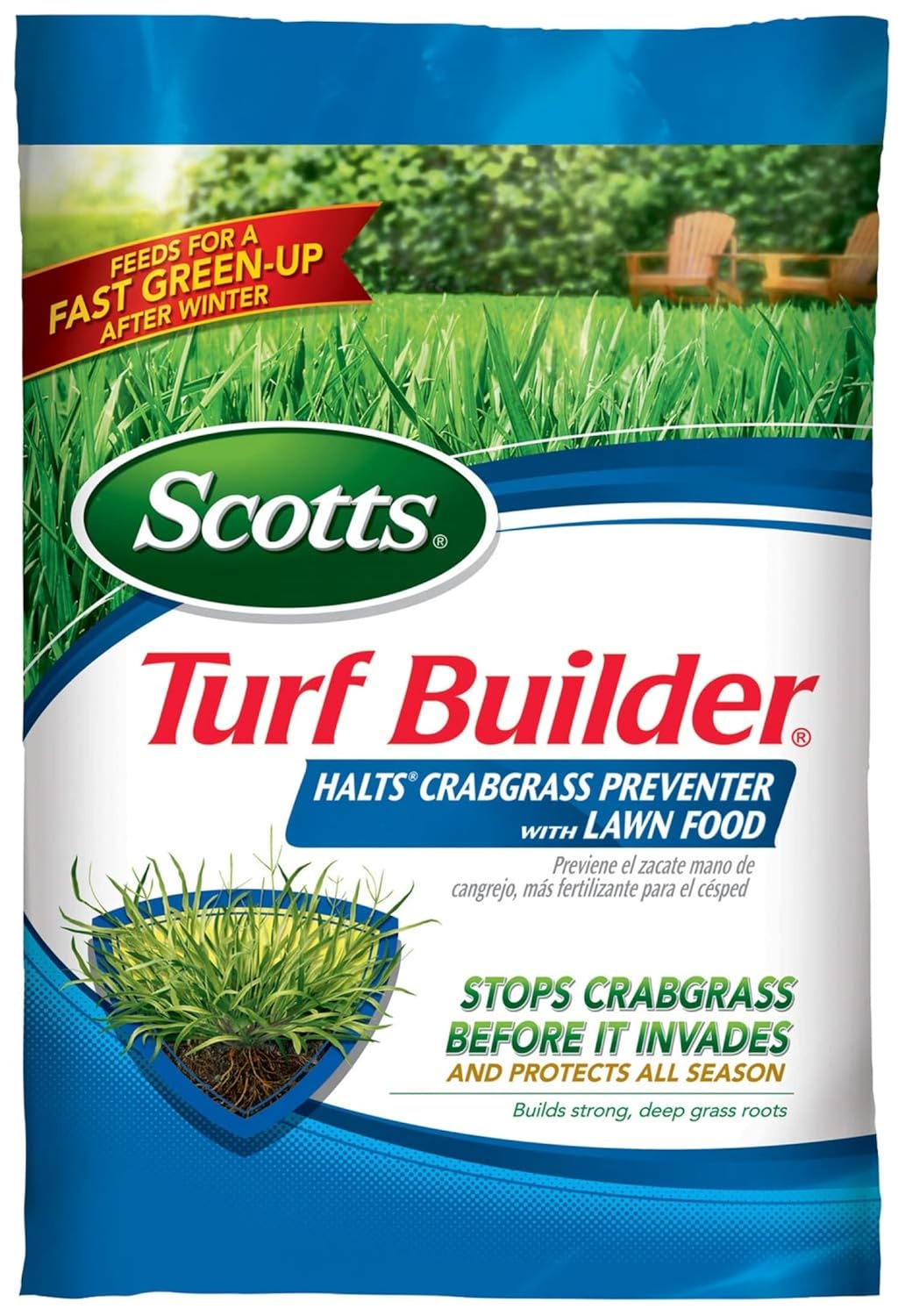
| Item Form | Granule |
|---|---|
| Coverage | 5000 square feet |
| Unit Count | 213.6 Ounce |
| Fertilizer analysis | 30-0-4 |
Scotts Turf Builder Halts combines a pre-emergent crabgrass preventer with a granular lawn fertilizer to protect and feed an established lawn through the spring. You apply it once in early spring to a dry lawn before regular hot weather, using a broadcast or drop spreader and then water the lawn lightly within 2 to 3 days so the active ingredient forms a barrier in the soil. The product covers 5,000 sq. ft. per bag and is formulated to prevent several grassy and broadleaf weeds while the 30-0-4 fertilizer helps grass green up quickly and build deeper roots. Practical benefits include season-long prevention of new crabgrass and simultaneous feeding, which reduces extra steps in spring lawn care. Limitations are that it will not kill mature crabgrass or existing weeds and it is not suitable for certain turf types like dichondra or bentgrass. Also, correct spreader settings and post-application watering are important for reliable performance, so casual or inexperienced applicators should follow directions closely.
Best for: Homeowners who prioritize reliable, season-long prevention and want a simple spring treatment that both blocks new crabgrass and feeds the lawn.
Less Ideal for: People needing a post-emergent weed killer for existing crabgrass or those managing dichondra or bentgrass turf should choose a different product.
- Pre-emergent formula prevents crabgrass and several other grassy weeds when applied correctly
- Includes fertilizer (30-0-4) for fast green-up and stronger root development
- Single-application coverage for 5,000 sq. ft. reduces repeat treatments in spring
- Granular form works with common broadcast and drop spreaders for even application
- Does not control established or mature crabgrass or existing weeds
- Not safe for use on dichondra and bentgrass lawns
Verdict: Choose this product if you want a dependable one-time early-spring treatment that prevents new crabgrass while feeding and strengthening your lawn.
GreenView Premium Formula Spring Lawn Fertilizer with Crabgrass Preventer (34 lb)

| Item Form | Granules |
|---|---|
| Specific Uses For Product | Lawn |
| Coverage | Full |
| Target Species | Lawn Grass |
| Unit Count | 544 Ounce |
This 34 lb GreenView Premium Formula product pairs a high percentage of slow‑release nitrogen with Dimension pre‑emergent herbicide to give lawns sustained nutrition and crabgrass prevention from a single spring application. It is intended to be applied with a standard spreader at 1.5 lb per 1,000 sq ft and watered in to activate the weed barrier. The triple‑release nitrogen mix claims up to six months of feeding and gradual green‑up while the pre‑emergent blocks crabgrass germination for about 120 days and can affect early seedlings for a few weeks after they sprout. Practical benefits include coverage for up to 10,000 sq ft from one bag, reduced need for repeated applications, and no micro‑plastic coatings in the slow‑release component. Limitations to consider are the seasonal timing requirements—apply when soil temperatures reach about 55°F—and that pre‑emergent ingredients will prevent seed establishment, so overseeding or spring seeding is not compatible without waiting the recommended interval. Follow label safety directions and watering instructions for best results.
Best for: Buyers who prioritize season‑long performance and want a single spring treatment that both feeds turf and prevents crabgrass across medium to large lawns.
Less Ideal for: People who plan to overseed or establish a new lawn in spring, or those wanting a fertilizer without any herbicide component.
- Combines slow‑release fertilizer and pre‑emergent crabgrass control in one product
- Covers up to 10,000 sq ft from a single 34 lb bag at the recommended rate
- 65% slow‑release nitrogen formulation feeds turf for up to six months
- Triple‑release technology provides staged nutrient delivery to avoid surge growth
- No micro‑plastic coatings in the slow‑release granules
- Pre‑emergent action prevents seeding so it is not suitable for immediate overseeding
- Requires careful timing with soil temperature and watering to activate weed control
Verdict: For homeowners who want a single spring application that delivers extended feeding and proven crabgrass prevention across a large lawn, this product delivers both in one bag.
The Andersons Crabgrass Preventer Plus Lawn Food 26-0-6 (covers 6,000 sq ft)

| Item Form | Granules |
|---|---|
| Coverage | 6000 sq ft |
| Specific Uses For Product | Lawn |
| Target Species | lawn grasses |
This product combines a pre-emergent herbicide (Dimension) with a balanced lawn fertilizer so you prevent crabgrass and other common grass and broadleaf weeds while giving turf a spring green-up. It is applied in early spring before weed seeds germinate and can also be used in fall; application requires mowing first and watering in with about 0.5 inch of irrigation or rainfall within two weeks. The active ingredient provides up to four months of protection against a broad list of weeds while the quick- and slow-release nitrogen blend promotes both immediate greening and extended feeding. It is suitable for most cool- and warm-season turf types but should not be used on dichondra or bentgrass and must not be applied within 16 weeks of reseeding or overseeding. For gardeners focused on strong seasonal performance, this product saves time by combining weed prevention and fertilization in a single application, though users needing protection beyond four months or wanting post-emergent control will need additional products or treatments.
Best for: Gardeners who prioritize season-long lawn performance and want a single product to both prevent common grassy weeds and feed turf during spring or fall applications.
Less Ideal for: People managing small specialty lawns (for example pure bentgrass or dichondra) or those who need post-emergent weed removal or protection beyond four months.
- Combines pre-emergent weed control and fertilizer in one granular product
- Active ingredient (Dimension) offers up to four months of protection against many grass and broadleaf weeds
- Fertilizer includes both quick- and slow-release nitrogen for fast green-up and extended feeding
- Covers up to 6,000 square feet so one bag treats a typical medium lawn
- Not safe for dichondra or bentgrass lawns
- Cannot be applied within 16 weeks of reseeding or overseeding
Verdict: Use this if you want a performance-focused spring or fall product that prevents crabgrass while supplying fast and sustained lawn nutrition in one application.
GreenView Crabgrass Control Plus Lawn Food, 13.5 lb

| Coverage | 5000 sq ft |
|---|---|
| NPK | 26-0-4 |
| Form | Granules |
| Controlled release duration | Up to 8 weeks |
GreenView Crabgrass Control Plus Lawn Food is a spring-focused granular product that combines pre-emergent crabgrass prevention with a slow-release 26-0-4 fertilizer to feed lawns for up to eight weeks. It is applied with a rotary or drop spreader to a dry lawn, then activated by rainfall or irrigation; follow label timing by applying before crabgrass germinates or within four weeks after germination. The MESA controlled-release nitrogen helps steady green-up without causing a surge of growth and supports deeper root development for improved drought tolerance. Practical benefits include one-pass coverage for about 5,000 square feet and a zero-phosphate formula to reduce runoff concerns. Important limitations are that it must be watered in to perform reliably and you should avoid reseeding or overseeding for at least 10 weeks after application, so it is not suitable when establishing new turf. For gardeners who want simple spring crabgrass prevention and steady feeding in established lawns, this product simplifies the job, but timing and activation by rain or irrigation are essential for effectiveness.
Best for: Homeowners with an established lawn who want a budget-friendly, single-application spring product that prevents crabgrass while providing multiweek feeding.
Less Ideal for: People establishing new lawns, frequently overseeding, or those who need immediate post-application germination for seed; also not the best choice if you cannot water the lawn after application.
- Pre-emergent crabgrass control combined with fertilizer for one-step spring treatment
- Controlled-release MESA nitrogen feeds the lawn for up to 8 weeks for steady green-up
- Covers up to 5,000 sq ft, suitable for medium to large established lawns
- Zero phosphate formula reduces risk of nutrient runoff impacting waterways
- Requires activation by rainfall or irrigation for reliable weed control
- Not safe to use when reseeding or overseeding for at least 10 weeks
Verdict: A cost-effective one-step crabgrass preventer and slow-release lawn food for established lawns needing simple spring weed control and steady feeding.
AgChimp 18-0-9 Pre-Emergent Herbicide & Precision Lawn Fertilizer, 15 lb

| Item Form | Granules |
|---|---|
| Active Ingredient | Prodiamine |
| NPK | 18-0-9 |
| Slow-Release Nitrogen | 30% Polymer-coated |
| Coverage | Up to 5,000 sq ft |
This AgChimp 18-0-9 granular formula mixes pre-emergent weed protection and controlled-release fertilization in a single broadcast application. It is applied with a spreader in early spring or fall and watered in to form a soil surface barrier that prevents annual weeds such as crabgrass and chickweed from germinating while the polymer-coated nitrogen supplies steady feeding. Notable features include 0.29% prodiamine for pre-emergent control, 30% slow-release nitrogen for long-lasting nutrition, potassium for stress resistance, and 2% iron to deepen green color. The combination simplifies lawn maintenance by reducing the need for separate herbicide and fertilizer steps and covers roughly 5,000 square feet per 15 lb bag. Practical limitations are that it targets prevention rather than post-emergent weed removal, so established weeds will need separate treatment, and proper timing and irrigation are required for the pre-emergent to form an effective barrier. For those who prioritize consistent, season-long results, this product offers a dependable, low-hassle preventative approach.
Best for: Homeowners and property managers who want a reliable, low-fuss preventive program and prefer one product to both reduce weeds and deliver steady seasonal nutrition.
Less Ideal for: Those needing fast post-emergent weed removal or who require a product formulated specifically for spot treatment or established broadleaf weeds.
- Combines pre-emergent herbicide and fertilizer in one granular application
- 30% slow-release nitrogen provides steady feeding and avoids growth spikes
- 0.29% prodiamine forms a barrier that prevents common annual weeds from germinating
- Includes potassium and iron to improve turf stress tolerance and color
- Covers up to 5,000 sq ft from a single 15 lb bag
- Does not control established weeds since it is a preventive pre-emergent
- Requires correct timing and watering-in to be effective
Verdict: Buy this if you want a dependable, single-step granular product that prevents annual weeds while delivering steady, long-lasting lawn nutrition.
Choosing the Right Pre Emergent Fertilizer for Spring: Key Factors to Consider
Application Timing and Local Climate
Timing is the single most important factor for a spring pre-emergent. These products work by preventing weed seeds from germinating, so applying too early or too late reduces effectiveness. You need to align application with soil temperatures and local phenology: many crabgrasses germinate when soil at 1 to 2 inches depth consistently reaches the high 50s to low 60s Fahrenheit.
Gardeners in cooler regions should delay slightly later in spring, while those in mild-winter zones may need an earlier application. Also consider the forecast for heavy rains; excessive runoff immediately after application can reduce residual activity and move active ingredients off-target.
Residual Control Duration
Different pre-emergents provide protection for varying lengths of time, typically from eight to sixteen weeks. Longer residuals reduce the need for repeat applications during the spring germination window but can limit overseeding options because they prevent desirable seed from establishing.
Decide whether you need month-long coverage or a longer season of control based on your weed pressure and lawn renovation plans. If you plan to overseed cool-season grasses in spring, choose a product with shorter persistence or delay application until after seeding has established.
Active Ingredient and Environmental Considerations
Active ingredients determine spectrum of control and environmental behavior. Some chemistries bind tightly to soil and pose lower runoff risk, while others are more mobile. Look for labels that describe persistence, mobility, and restrictions near water features.
Also account for pollinator and soil health concerns. Although pre-emergents target germinating seeds rather than flowering plants, follow label precautions to avoid unnecessary exposure to non-target plants, and avoid application right before heavy rain that could carry residues into planting beds or waterways.
Turf Compatibility and Stress Risk
Not all pre-emergents are equally safe on every turf type. Cool-season grasses and warm-season grasses can respond differently to the same chemistry, especially when applied during active growth or drought stress. Check whether a product is recommended for your turf species and whether label language advises against use under heat or drought.
Applying when grass is actively growing and well watered reduces stress. If your lawn has recent repairs, new sod, or thin areas, account for those when deciding whether to treat; some pre-emergents restrict seeding and sod installation for a defined period.
Application Method and Equipment
Even coverage is crucial because missed strips leave gaps for weeds. Consider whether you will use a broadcast spreader, drop spreader, or hose-end applicator, and choose a formulation compatible with that equipment. Granular products usually pair with broadcast spreaders and need calibration for rate; liquid formulations may require tank mixing and attention to spray droplet size.
Ease of application also affects whether homeowners follow label rates closely. If you prefer lower handling complexity, choose a pre-emergent with straightforward spreader settings and clear re-entry intervals.
Post-application Lawn Management
What you do after applying a pre-emergent affects performance. Many products require light irrigation to move the active ingredient into the seed zone; others rely on rainfall. Overwatering immediately after application can wash product away, while no irrigation can leave it stranded on leaf surfaces.
Maintain regular mowing and avoid aggressive dethatching or mechanical disturbance that could bring buried weed seed up into contact with the active barrier. If you plan fertilization, coordinate product labels that allow combined applications to save passes across the lawn.
When to Apply Pre Emergent in Your Region
Soil temperature and local climate drive the correct timing for spring pre-emergent applications. Measure soil at about 1 to 2 inches deep several mornings in a row. When the temperature consistently reaches the germination threshold for target weeds, schedule treatment. In many temperate zones this falls as buds swell on local trees and early spring flowers open.
In southern or mild-winter regions the window can open earlier, so watch for local cues rather than calendar dates. For gardens with high weed pressure, apply just before the expected germination spike to maximize prevention.
- Check soil temperature with an inexpensive probe.
- Observe local phenological signs like flowering maples or forsythia.
- Adjust timing for microclimates such as south-facing slopes or urban heat islands.
How to Calibrate Spreaders for Even Coverage
Calibrating your spreader ensures you apply the labeled rate across the entire lawn. Start by reading the product label for recommended settings and then test on a measured section of turf. Walk at a consistent pace and overlap swaths slightly to avoid missed strips.
If using a liquid applicator, mark spray width and maintain even nozzle pressure. After a test pass, measure product used and adjust settings until coverage matches label rate. Good calibration reduces waste and improves efficacy.
- Use a measured test area to confirm coverage.
- Follow label spreader charts and adjust walking speed for consistency.
- Keep a record of settings for future applications.
Combining Fertilizer and Pre Emergent Treatments
Many gardeners prefer to combine a spring pre-emergent with a light fertilizer application to support lawn green-up. Check label compatibility before tank-mixing or blending granular products. When compatible, a combined approach can reduce lawn traffic and improve early-season turf vigor.
If labels prohibit mixing, apply fertilizer a few weeks before or after the pre-emergent as directed. Avoid heavy nitrogen at the same time if the turf is under stress, since that can exacerbate damage.
- Confirm label permissions for mixing and co-application.
- When in doubt, space fertilizer and pre-emergent applications by two to four weeks.
- Use slow-release fertilizer to steady early growth without excessive top growth.
Managing Overseeding and Lawn Renovation
Pre-emergents inhibit seed germination, so plan renovations around their persistence. For spring overseeding of cool-season grasses, either delay pre-emergent application until after seedlings have established or choose a product with a short residual that allows seeding within the same season.
If you need both weed prevention and renovation, consider splitting tasks: renovate first and apply a targeted post-establishment program, or renovate in a later season when pre-emergent residues are no longer active.
- Check label restrictions for seeding and sod installation timelines.
- If overseeding, prefer mechanical methods and species compatible with the chosen timing.
- Record application dates and residual windows to plan future renovation work.
Situations Where a Pre Emergent May Not Be the Best Choice
If your lawn is newly seeded, newly sodded, or being renovated, a pre-emergent can prevent desirable grasses from establishing. Similarly, if the predominant weed problem is already visible as established plants, a pre-emergent will do little; post-emergent measures are needed instead.
High-slope or heavy-rainfall sites also pose runoff risks where applying a pre-emergent could move residues off-site. In such locations focus on cultural controls like improving turf density and manual removal until conditions are safer for chemical barriers.
- Avoid application immediately before heavy rain in runoff-prone areas.
- Delay treatment when planning immediate seeding or sod work.
- Use cultural methods where seedbeds or runoff make chemical control impractical.
How We Chose the Best Pre Emergent Fertilizer for Spring
Our shortlist focuses on products formulated specifically for spring pre-emergent use and on attributes that matter to backyard gardeners and lawn care enthusiasts. We prioritized formulations with clear label guidance for spring timing and measurable residual control periods. Application ease and spreader compatibility were evaluated because accurate coverage in spring prevents gaps where weeds can establish. Turf compatibility was weighed to avoid stress on cool- or warm-season grasses during early growth. Environmental impact and runoff risk were assessed by looking for products with targeted active ingredients and clear turf-safe instructions. Longevity of control and whether the product pairs with fertilization needs were also considered since many gardeners prefer a combined approach. We excluded summer-only herbicides, contact-only products that do not prevent emergence, and products lacking clear timing instructions for spring applications. The result is a set of options that balance effective season-start weed prevention with safe, practical use in typical home lawns.
FAQ
When exactly in spring should I apply a pre-emergent?
Apply when soil at 1 to 2 inches depth reaches the germination temperature for target weeds, often in the high 50s Fahrenheit. Local plant cues and a soil probe provide better timing than a calendar date.
Can I overseed after applying a pre-emergent?
Often not. Many pre-emergents prevent grass seed germination for several weeks to months. Check the product label for recommended wait times or choose a formulation with a short residual if you plan to overseed in spring.
Will a pre-emergent harm my flower beds or vegetable garden?
Pre-emergents are intended for turf and labeled areas. Avoid application near beds or follow label instructions and buffer zones to prevent drift or runoff. If you need weed prevention in beds, use targeted methods recommended for those plant types.
Do I need to water after applying a granular or liquid pre-emergent?
Many products require light irrigation to move the active ingredient into the seed zone, but some rely on rainfall. Follow label instructions for the recommended timing and amount of watering to ensure proper activation without washing the product away.
How often should I reapply pre-emergent in a season?
Reapplication depends on the product's residual duration and local weed pressure. Some gardeners need only one spring application, while others with extended germination periods may apply a follow-up according to label intervals. Always follow labeled maximum annual rates.
Final Verdict
A successful spring pre-emergent strategy starts with correct timing, appropriate residual length for your renovation plans, and careful application to protect turf and the surrounding landscape. Prioritize products with clear label guidance for spring timing, compatibility with your grass type, and spreader or applicator instructions you can follow precisely. Balance the desire for long-lasting control against the need to overseed or renovate. With the right timing and application technique you can significantly reduce spring weed establishment and set your lawn up for a healthier growing season.
