

Note: This article contains affiliate links. If you click on these links and make a purchase, I may earn a small commission at no extra cost to you. This helps support my research and content. Read my full affiliate disclosure here.
Blueberry bushes need more than generic garden feed to produce well and stay healthy. The wrong fertilizer can raise soil pH or push too much leafy growth at the expense of flowers and fruit. This guide narrows the field to the top fertilizer choices for blueberry bushes, focusing on formulas and application methods that support acid-loving plants in home gardens and containers. We evaluated options for nutrient balance, pH management, and release profile so you can pick a feed that fits your soil and schedule. The shortlist covers granular and soluble forms as well as slow-release choices suited to different planting situations and maintenance habits.
Top Picks at a Glance
| Best Overall The best all-around choice for most situations | Espoma Holly-Tone Organic Plant Food for Acid-Loving Plants, 36 lb bag |  |
| Best Quality Built to a higher standard if you want something more solid | FoxFarm Happy Frog Acid Loving Plants Fertilizer (4 lb) |  |
| Best Value The sweet spot between price and what you get | Espoma Berry-tone Organic Fertilizer for Berries, 4 lb bag |  |
| Best Budget The cheapest option that still gets the job done reliably | ASTEVORA 8-4-8 Granular Fertilizer for Acid-Loving Plants (12 oz) |  |
| Most Popular A crowd favorite that many people choose with confidence | Down To Earth Organic Acid Mix Fertilizer 4-3-6, 1 lb |  |
Espoma Holly-Tone Organic Plant Food for Acid-Loving Plants, 36 lb bag

| Item Form | Granules |
|---|---|
| Specific Uses For Product | Acid-loving plants |
| Application Method | Sprinkle around the drip line and water thoroughly |
| Coverage | Acid-loving plants (hollies, azaleas, camellias, evergreens, dogwoods, rhododendrons) |
Espoma Holly-Tone is a long-standing organic granular fertilizer designed for acid-loving shrubs and fruiting plants. You apply it by sprinkling around the plant drip line and watering it in, typically in spring and fall or before bloom and fruit set for blueberries. The 4-3-4 NPK formulation plus about 5% sulfur helps maintain soil acidity while feeding plants slowly over time, and the included Bio-tone microbes support soil biology that can improve nutrient uptake. Because it is ready to use and contains no synthetic fillers, it is convenient for routine maintenance of blueberry bushes and other ericaceous plants. The main practical trade-offs are that results are gradual rather than immediate and a single large bag is heavier to handle for small gardens. It is approved for organic production, so it fits in organic management plans, but gardeners needing a fast, soluble boost for rapid leafing or emergency nutrient correction may still want a supplemental product.
Best for: Gardeners growing blueberry bushes and other acid-loving shrubs who prioritize organic, soil-building fertilizers and want a convenient, seasonal maintenance feed.
Less Ideal for: Growers who need fast-acting soluble feeds for immediate correction or who manage only a very small container garden where a large bag would be impractical.
- Formulated specifically for acid-loving plants, suitable for blueberries and rhododendrons
- Organic granular formula with Bio-tone microbes supports soil life and slow nutrient release
- Ready-to-use granules that are easy to apply around the drip line
- Contains sulfur to help maintain or lower soil pH for ericaceous plants
- Slow-release action means it will not correct acute nutrient deficiencies quickly
- Large 36 lb bag can be cumbersome for one person to carry and spread
Verdict: Choose this if you want an organic, slow-release fertilizer that supports soil biology and is tailored to blueberries and other acid-loving plants.
FoxFarm Happy Frog Acid Loving Plants Fertilizer (4 lb)

| Item Form | Powder |
|---|---|
| Application Method | Granular |
| Coverage | Medium |
| Target Species | Acid-loving plants |
| Mixing Ratio | 1/16 cup per gallon |
FoxFarm Happy Frog Acid Loving Plants Fertilizer is a slow‑release granular formula made for low‑pH crops like azaleas, blueberries, rhododendrons and similar acid‑loving shrubs. You apply it to new plantings or established beds following the package mixing ratios or by applying granules around the root zone; the product description and directions give simple measurements for potting mixes and transplanting. Notable features include a powder/granular form for easy broadcast or incorporation, an OMRI‑listed friendly formulation, and added soil microbes and mycorrhizal fungi intended to improve nutrient and water uptake. For blueberry growers this means steady, gentle feedings that help maintain vigor without burning sensitive roots. Limitations to consider are the single 4 lb package size if you have many bushes and that specific nutrient analysis percentages are not listed on the provided details, so exact N‑P‑K rates and reapplication intervals must be confirmed from the label before precise feeding schedules.
Best for: Home gardeners growing a few blueberry bushes who prioritize steady, gentle nutrition and want a product tailored to low‑pH soils.
Less Ideal for: Commercial growers or anyone needing exact nutrient concentrations and precise feeding programs should consider a fertilizer with full N‑P‑K labeling and larger package sizes.
- Formulated specifically for acid‑loving plants like blueberries
- Slow‑release granular form provides steady feeding without overwhelming roots
- Contains mycorrhizal fungi and soil microbes to potentially improve nutrient and water uptake
- No complete nutrient analysis (N‑P‑K) listed in the provided product details
- Single 4 lb bag may be small for larger plantings
Verdict: A practical choice for backyard blueberry growers who want a slow‑release, microbe‑boosted fertilizer made for low‑pH soils.
Espoma Berry-tone Organic Fertilizer for Berries, 4 lb bag

| Item Form | Granules |
|---|---|
| Application Method | Sprinkle |
| Coverage | 40 square feet |
| Target Species | berries |
| Mixing Ratio | 10:100 (new beds), 5:100 (established beds) |
Espoma Berry-tone is an organic granular fertilizer made specifically for berry crops such as blueberries, strawberries, raspberries, and blackberries. You apply it by sprinkling around the root zone at planting or during scheduled feedings, with recommended mixing ratios for new and established beds. The 4-3-4 NPK and added sulfur make it suitable for acid-loving berries like blueberries, while the Bio-tone formula aims to support root development and steady growth. It is ready to use without complex dilution for routine applications and is registered as an organic input, so it fits organic garden plans. Practical benefits include predictable coverage for small beds and simple application timing twice a year for most berry types. Limitations are that ingredient details and exact nutrient release rates are not listed on the label, so gardeners who want highly specific nutrient management or controlled-release formulations may need a supplement or lab testing to match soil needs precisely.
Best for: Gardeners growing blueberries and other berries who want an easy, organic fertilizer tailored to berry needs and prefer straightforward twice-yearly feeding.
Less Ideal for: Growers seeking precise, lab-style nutrient control or long-term slow-release formulations for large commercial plantings should consider specialized fertilizers or soil testing-based programs.
- Formulated specifically for berries with a 4-3-4 NPK suited to fruiting shrubs
- Contains sulfur and a Bio-tone root support blend helpful for acid-loving plants
- Granular, ready-to-use form requires no complex mixing for routine applications
- Approved as an organic input, compatible with organic gardening practices
- Full ingredient breakdown and nutrient release profile are not specified on the packaging
Verdict: A simple, organic granular fertilizer tailored to berries that delivers berry-focused nutrients and easy twice-yearly application for home gardeners.
ASTEVORA 8-4-8 Granular Fertilizer for Acid-Loving Plants (12 oz)

| Item Form | Granules |
|---|---|
| NPK | 8-4-8 |
| Application Method | Spread evenly to soil and water thoroughly |
| Target Species | Azaleas, camellias, hydrangeas, blueberries, gardenias, rhododendrons |
| Unit Count | 12 Fluid Ounces |
ASTEVORA 8-4-8 is a granular, slow-release fertilizer made for acid-loving plants such as blueberries, azaleas, hydrangeas, and gardenias. You apply it by sprinkling the granules under the plant canopy, lightly mixing into the topsoil, and watering to activate the nutrients; the maker recommends three applications per year (spring, summer, early fall). Notable features include an 8-4-8 NPK balance, added micronutrients like iron and manganese to help prevent chlorosis, and a bio-solid component that introduces live beneficial microbes to support soil biology. In practice this means sustained feeding with fewer applications and improved bloom color and berry development for plants that prefer acidic soil. The package is compact and suited to spot treatments or small plantings, but the 12 ounce unit will not cover large beds or multiple mature bushes for a full season. Also follow safety guidance during handling and keep product away from children and pets. For gardeners with a small blueberry patch this product offers an easy, low-effort way to support acid-loving shrubs.
Best for: Home gardeners with a few blueberry bushes or a small berry patch who want a budget-friendly, low-maintenance fertilizer targeted to acid-loving plants.
Less Ideal for: Large-scale growers or gardeners with many mature blueberry bushes who need bulk coverage and lower per-plant cost should consider larger commercial-size options.
- Formulated specifically for acid-loving plants including blueberries
- Slow-release 8-4-8 NPK with added iron, magnesium, and manganese to reduce chlorosis
- Contains bio-solid beneficial microbes to support soil biology
- Simple application method requires only three feedings per year
- Small 12 oz package limits coverage for larger gardens or multiple mature bushes
- Contains concentrated fertilizer and requires protective handling to avoid skin or eye contact
Verdict: A compact, easy-to-use slow-release fertilizer that gives small blueberry plantings targeted acid-loving nutrition and soil biology support.
Down To Earth Organic Acid Mix Fertilizer 4-3-6, 1 lb
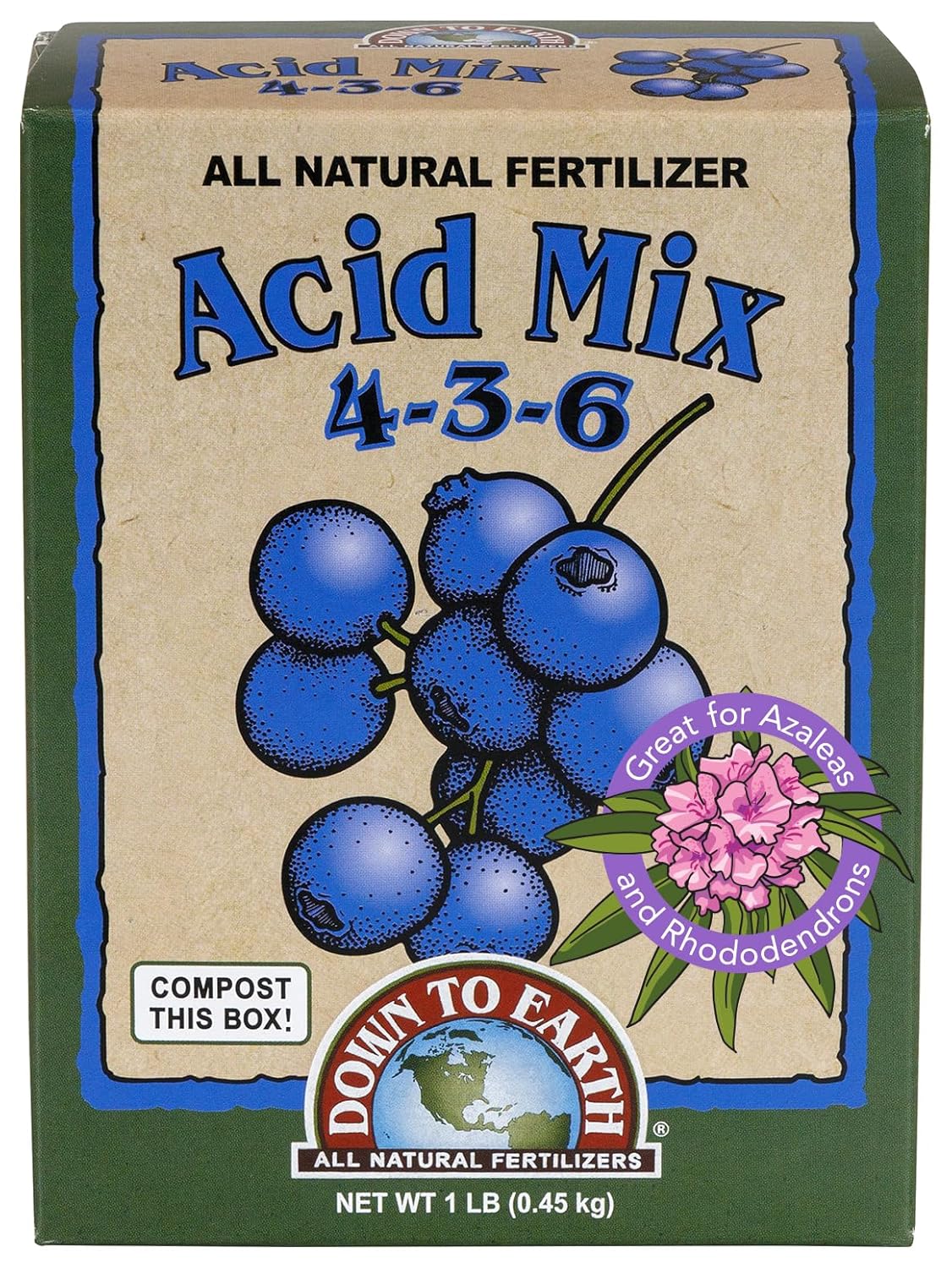
| N-P-K | 4-3-6 |
|---|---|
| Item Form | Granules |
| Specific Uses For Product | Acid-loving plants |
| Target Species | rhododendrons, azaleas, hydrangeas, evergreens, blueberries, raspberries |
| Mixing Ratio | 4:3:6 |
Down To Earth Acid Mix 4-3-6 is a small-package, slow-release granular fertilizer made for acid-loving plants such as blueberries, rhododendrons, azaleas and hydrangeas. It is typically applied to the soil surface or worked into the soil at planting and watered in; the brand recommends applications in early spring, at bloom and again in fall to support roots. The formula combines feather meal, fish bone meal, kelp, humates and mineral sources to deliver nitrogen, phosphorus and potassium over time while feeding soil biology. Practical benefits include steady nutrient release that reduces the need for frequent feeding and an OMRI-friendly ingredient list for organic gardeners. Because it does not change soil pH directly, gardeners aiming to lower pH should pair it with sulfur if needed. The one-pound size is convenient for small plantings or potted blueberries but means you will need larger quantities for a big patch. For growers who prioritize organic inputs and predictable, gentle feeding, this is a reliable option that works well as part of a seasonal feeding plan.
Best for: Gardeners growing a few blueberry bushes or other acid-loving shrubs who want an organic, slow-release fertilizer and prefer products with a proven track record.
Less Ideal for: Large-scale growers or anyone who needs rapid correction of soil pH or immediate, high-dose nutrient boosts should consider bulk or specialty products instead.
- Organic, slow-release granules feed plants gradually and support steady growth
- Formulated specifically for acid-loving species, matching nutrient needs of blueberries
- Contains diverse natural ingredients (feather meal, fish bone, kelp, humates) that feed soil biology
- Clear seasonal application guidance for spring, bloom and fall feeding
- Does not by itself lower soil pH so a separate amendment is needed to acidify soil
- Small 1 lb package requires multiple purchases for larger gardens
Verdict: A dependable organic slow-release fertilizer tailored to feed and support blueberry bushes and other acid-loving plants.
Choosing the Right Fertilizer for Blueberry Bushes: Key Factors to Consider
Nutrient Ratio and Formulation
Blueberries tend to respond best to fertilizers designed for acid-loving shrubs. Look for a nutrient ratio that favors moderate nitrogen with accessible phosphorus and potassium to support bloom set and fruit development. The chemical form matters too: ammonium-based nitrogen and sulfate sources of sulfur help maintain acid soil conditions, while nitrate-heavy feeds can raise pH over time.
Granular blends, water-soluble powders, and liquid concentrates deliver nutrients differently. Granular slow-release formulas provide steady feeding with fewer applications, while soluble feeds let you correct deficiencies quickly. Choose the form that fits your watering habits and how quickly you need results.
Effect on Soil pH
Maintaining acidic soil is central for blueberry health. Some fertilizers include acidifying components like sulfur or ammonium sulfate that help lower pH, while others are pH-neutral or can even raise pH with repeated use. Consider the existing soil pH and how aggressive the fertilizer is at modifying it.
If your garden soil already leans acidic, choose a balanced feed that will maintain pH rather than dramatically shift it. For alkaline or neutral soils, an acidifying fertilizer can be helpful but may require more frequent monitoring and supplemental soil amendments.
Release Profile and Application Frequency
How quickly nutrients become available affects plant growth and maintenance schedule. Slow-release granular fertilizers reduce the need for repeated applications and lower the risk of fertilizer burn, which is helpful in established beds and containers. Fast-acting soluble feeds are ideal for correcting deficiencies or supporting heavy bloom years.
Think about seasonal timing as well. Many gardeners apply a controlled-release product in early spring and supplement with light soluble feeds during bloom and fruit set. Match the release profile to your time available and how responsive you need the plants to be.
Salt Index and Root Safety
High-salt fertilizers can damage shallow blueberry roots, especially in containers or poorly drained soils. A product's salt index and recommended application rate directly affect the risk of root burn and water stress. Lower-salt, slow-release options are gentler and safer for frequent feeding, while concentrated soluble feeds require careful dilution and accurate measurement.
When planting young bushes or growing in pots, prioritize fertilizers with low salt risk and follow label directions closely. Leaching with extra water after feeding can reduce salt buildup in containers and compacted soils.
Suitability for Containers Versus In-Ground Beds
Container-grown blueberries have less buffering capacity and can show nutrient swings more quickly than those in the ground. Fertilizers that work well in beds might be too concentrated for pots unless rates are adjusted. Conversely, slow-release granules placed in the root zone of in-ground bushes can provide season-long feeding with minimal disturbance.
Consider root volume, potting mix composition, and watering frequency when selecting a product. Some slow-release formulas are labeled specifically for containers and include lower rates to prevent overfeeding.
Micronutrients and Iron Availability
Blueberries can show chlorosis if iron and other micronutrients are not available in acid form. A fertilizer that includes chelated iron or formulations that enhance iron uptake can prevent yellowing leaves and support healthy growth. Manganese and zinc are other micronutrients that occasionally become limiting in certain soils.
If you notice persistent yellowing despite correct pH, consider products or soil amendments that supply available micronutrients. Foliar applications can offer a quick fix, but long-term soil amendments are better for sustained health.
Testing and Adjusting Soil Before Feeding
Start with a simple soil pH and nutrient test before choosing a fertilizer. Knowing the pH and baseline nutrient levels tells you whether to prioritize an acidifying feed, a micronutrient supplement, or just a balanced maintenance formula.
If pH is above the ideal range for blueberries, plan to use acidifying fertilizers and consider adding elemental sulfur or ericaceous compost over time. Re-test after a season to track changes and avoid overcorrecting.
For container plants, test both the potting mix and runoff water. Containers can develop higher salt levels quickly, so monitoring helps prevent fertilizer buildup and root stress.
- Test pH in spring and late summer to track seasonal shifts
- Collect samples from multiple spots in large beds
- Adjust application rates based on soil organic matter and drainage
Application Timing and Seasonal Feeding
Timing fertilizer applications to the blueberry growth cycle improves results. Apply the main feeding in early spring as buds break and new shoots emerge, then provide light supplemental feedings during bloom and fruit set if needed.
Avoid heavy late-season nitrogen that encourages tender growth going into winter. For established plants, a single slow-release application combined with a midseason soluble boost often balances convenience and plant need.
- Early spring for main application
- Light feed at bloom or fruit set if leaves look pale
- Stop heavy feeding 8 to 10 weeks before expected first frost
Feeding Young Plants Versus Established Bushes
Young blueberry transplants need gentler feeding and lower rates to avoid root burn. Start with diluted soluble feeds or lower-rate granular products and increase as the plant establishes a larger root system.
Established bushes tolerate stronger feeding and benefit from products with longer release profiles that supply nutrients through a full growing season. Adjust based on growth habit and berry production rather than calendar dates alone.
- Use lower rates and frequent light feeds for the first 1 to 2 seasons
- Move to season-long slow-release feeding for mature plants
- Monitor growth and fruiting to fine-tune rate and frequency
Organic Versus Synthetic Options
Organic fertilizers such as composted manures, fish emulsion, and sulfate of ammonia offer long-term soil-building benefits and often include micronutrients in natural forms. They tend to release nutrients more slowly and improve soil structure over time.
Synthetic fertilizers deliver predictable, measured nutrients and can be formulated specifically to maintain acidity. They are useful when you need a quick correction or precise N-P-K ratios, but they do not contribute organic matter to the soil.
- Choose organic when improving soil health is a priority
- Choose synthetic for quick correction or precise nutrient ratios
- Combine approaches if you want both immediate feed and long-term soil improvement
Managing Nutrient Deficiencies and Leaf Symptoms
Yellowing between veins or overall chlorosis can indicate iron deficiency or high pH, while stunted growth may point to phosphorus limitations. Use visual symptoms together with a soil test to decide whether to adjust pH or add targeted micronutrients.
Foliar sprays can temporarily alleviate symptoms, but soil-applied corrections provide longer-lasting results. For persistent issues, re-evaluate irrigation, drainage, and root health as these factors influence nutrient uptake.
- Match symptoms to tests before changing fertilizer strategy
- Use foliar feeds for quick green-up, soil fixes for lasting change
- Inspect roots and drainage if deficiencies persist despite correct pH
How We Chose the Best Fertilizer for Blueberry Bushes
We focused on product attributes that directly influence blueberry health and fruiting habit. Key evaluation points were nutrient ratio and form, ability to support or maintain acidic soil, release profile and longevity of feeding, salt load and risk of root burn, and suitability for container versus in-ground plantings. We checked label guidance for recommended application rates and seasonal timing to ensure each pick works with common home garden practices. We excluded any formulations designed primarily for lawns or high-nitrogen feeds that encourage shoot growth over flowering. Products lacking clear instructions for use with acid-loving shrubs or with ambiguous nutrient information were also removed. The final list favors fertilizers that supply available forms of iron and ammoniacal nitrogen when needed, demonstrate reasonable salt index for blueberry roots, and offer predictable results across typical garden soils.
FAQ
How often should I fertilize blueberry bushes?
Frequency depends on the product. Slow-release granular fertilizers are usually applied once in early spring, while soluble feeds may be applied every 4 to 6 weeks during active growth. Adjust frequency for containers and young plants, which need gentler, more frequent feeding.
Can I use a general-purpose garden fertilizer on blueberries?
You can, but general-purpose feeds may not maintain the acidic soil blueberries prefer and could encourage leafy growth over fruiting. If you use a general fertilizer, monitor soil pH and consider supplemental acidifying amendments.
What pH should soil be for blueberry bushes?
Blueberries perform best in acidic soil, typically between pH 4.5 and 5.5. If your pH is higher, choose an acidifying fertilizer and consider long-term amendments like elemental sulfur or ericaceous compost to lower pH gradually.
Should I feed container blueberries differently than those in the ground?
Yes. Containers have limited soil volume and can accumulate salts faster. Use lower-rate fertilizers or more dilute soluble feeds and flush pots periodically to prevent buildup. Slow-release formulas labeled for containers can simplify maintenance.
Are micronutrients important for blueberry feeding?
Micronutrients like iron, manganese, and zinc can be critical, especially if soil pH is borderline. Iron deficiency is common in nonacid soils. Look for fertilizers that include chelated iron or plan for supplemental micronutrient applications when needed.
Final Verdict
Prioritize a fertilizer that supports acid soil conditions while supplying balanced nutrients for bloom and fruit development. Match the product form and release profile to your planting situation: gentle, low-salt options for containers and young plants, longer-release feeds for established beds. Focus on nutrient balance, pH impact, and safe application rates when choosing a feed for blueberry bushes. With those tradeoffs in mind, you can select a fertilizer that boosts fruiting without causing salt stress or unwanted vegetative growth.
