

Note: This article contains affiliate links. If you click on these links and make a purchase, I may earn a small commission at no extra cost to you. This helps support my research and content. Read my full affiliate disclosure here.
If you want weed control that protects pollinators, soil life, and ornamental plants, the right eco friendly weed killer matters. Different formulas behave very differently in a real garden: some kill broadleaf weeds while leaving grass mostly unharmed, others work best on young seedlings, and some rely on repeat applications rather than a single decisive treatment. This guide shortlists six top options suited to sustainable yards, vegetable plots, patios, and container gardens. We evaluated each option for how well it controls common species, how it affects surrounding plants and soil, and how easy it is to apply. Read on to understand the tradeoffs and pick the approach that fits your gardening style and site conditions.
Top Picks at a Glance
| Best Overall The best all-around choice for most situations | Natural Elements Ready-to-Use Weed Killer (1 Gallon) |  |
| Best Quality Built to a higher standard if you want something more solid | BioSafe Systems Weed & Grass Killer Concentrate, 1 Gallon |  |
| Best Value The sweet spot between price and what you get | Natures Wisdom 20% Vinegar Weed & Grass Killer, 1 Gallon |  |
| Best Budget The cheapest option that still gets the job done reliably | Earth's Ally Weed & Grass Killer Spray, 32 fl oz |  |
| Highest Rated A top-rated pick with lots of positive feedback | Natural Elements Ready-to-Use Weed Killer, 4 Gallons |  |
| Most Popular A crowd favorite that many people choose with confidence | Spruce Weed & Grass Killer Power Wand Kit with 64 oz Refill |  |
Natural Elements Ready-to-Use Weed Killer (1 Gallon)

| Unit Count | 128 Fluid Ounces |
|---|---|
| Item Form | Spray |
| Coverage | Most broadleaf weeds and grasses |
| Active Ingredients | Sodium Chloride, Salt Water, Commercial Vinegar, Soap |
This one-gallon ready-to-use bottle is a vinegar- and salt-based herbicide intended for spot treatment of unwanted weeds, grasses, moss and algae on hardscape and landscaped areas. You spray targeted plants until wet and they wilt within a short period, which makes it useful for patios, driveways, gravel, fence lines and mulched beds. The formula contains commercial vinegar, sodium chloride and soap, so there is no synthetic herbicide to mix and no special application equipment required. Practical benefits include immediate ease of use, a large volume for treating multiple areas, and a product description that highlights pet and child safety after the treated surface has dried. Important limitations are that it will also kill desirable grass and can damage nearby plants if oversprayed, and it is not an EPA‑registered conventional herbicide which may affect expectations for long-term control compared with systemic products.
Best for: People who want a simple, low-chemical option to remove visible weeds from hard surfaces and non-lawn areas and who prioritize quick results and ease of use.
Less Ideal for: Homeowners seeking long-term root-level control of weeds in lawns or gardeners who need a selective herbicide for beds with desirable plants should consider alternative products or targeted mechanical removal.
- Ready-to-use spray requires no mixing or special equipment
- Large one-gallon volume covers multiple treatment areas
- Active ingredients are vinegar and salt rather than synthetic herbicides
- Works on a broad range of broadleaf weeds, grasses, moss and algae
- Non-selective and will damage desirable turf and nearby plants if not applied carefully
- Provides contact burn rather than long-term systemic control
Verdict: Choose this ready-to-use vinegar-based spray when you need an easy, pet-friendly option to quickly remove visible weeds from driveways, patios and non-lawn areas.
BioSafe Systems Weed & Grass Killer Concentrate, 1 Gallon

| Unit Count | 128 Ounce |
|---|---|
| Item Form | Spray |
| Coverage | 200 square_feet |
| Active Ingredients | Herbicide |
This BioSafe Systems concentrate is an organic, contact herbicide intended to quickly burn down annual and perennial broadleaf weeds and grasses. You mix the concentrate with water and spray it on unwanted plants in areas like patios, walkways, garden paths, and along edgings; it destroys plant cells on contact and produces visible results within hours. Notable features include OMRI listing and EPA registration, a water-soluble nonvolatile formula that gardeners can replant over after four days, and a high-concentration gallon that treats up to 200 square feet from just 2 fl oz per application. Practical benefits are fast knockdown, minimal residual soil activity, and suitability for use around people and pets when directions are followed. Limitations are that it is nonselective so it will damage desirable plants if contacted, it works by contact so thorough coverage is required for good control, and repeated treatments may be needed for persistent perennial roots.
Best for: Gardeners who prioritize effective, fast weed control with organic-certified products and who are careful to avoid spray contact with desirable plants.
Less Ideal for: People who need a selective systemic herbicide for deep root kill without repeat treatments or those who cannot control spray drift around delicate plantings.
- OMRI-listed and EPA-registered for organic gardening use
- Fast-acting contact formula that shows results within hours
- Concentrated gallon covers a lot of ground using small doses
- Water-soluble, nonvolatile formula that allows replanting after four days
- Nonselective contact action will harm any desirable plants it touches
- Requires good spray coverage to be effective against established weeds
- May need repeat applications to control deep-rooted perennials
Verdict: A concentrated, OMRI-listed contact herbicide that delivers fast, eco-friendly knockdown for gardeners who want effective organic weed control.
Natures Wisdom 20% Vinegar Weed & Grass Killer, 1 Gallon

| Liquid Volume | 1 gallons |
|---|---|
| Item Form | Liquid |
| Active Ingredients | Herbicide, vinegar |
| Coverage | 1 gallon |
This 1 gallon bottle of Natures Wisdom 20% Vinegar Herbicide is a ready-to-use, non-glyphosate option for spot-treating unwanted weeds and grasses. It delivers a concentrated acetic acid formula intended to brown and desiccate foliage within hours and usually shows full effect in under 24 hours when applied in direct sunlight. Typical use is direct spraying with a single-nozzle sprayer or hand-gun applicator without dilution, making it straightforward for driveways, sidewalks, garden beds, and small agricultural patches. The product is certified organic and formulated from ethanol distilled from USA-grown corn, so it breaks down quickly in soil and avoids persistent chemical residues. It works well on a wide list of annual and perennial broadleaf weeds and many grasses, though tough perennial roots may require repeat applications. Users should avoid contact with desirable plants and follow safety guidance because the 20% acetic acid is harsh on skin and foliage. For someone prioritizing strong, fast performance from an organic herbicide, this is a practical, effective choice for spot control.
Best for: Buyers who want a fast-acting, organic alternative to synthetic herbicides for targeted spot treatments and who prioritize visible performance over convenience of broad broadcast use.
Less Ideal for: Those needing a long-term soil residual or a broadcast herbicide for very large lawns and fields should consider other solutions.
- High-strength 20% acetic acid formula acts quickly to desiccate foliage within hours
- Certified organic and glyphosate-free, formulated from USA-grown corn ethanol
- Ready-to-use liquid that requires no dilution for direct spot spraying
- Effective on a broad list of annual and perennial broadleaf weeds and many grasses
- May require repeated applications for deep-rooted perennial weeds
- Harsh on skin and non-target plants so careful application and PPE are required
Verdict: If you want a fast, organic spot-treatment that visibly kills weeds within a day without using glyphosate, this 20% vinegar formula delivers strong performance.
Earth's Ally Weed & Grass Killer Spray, 32 fl oz
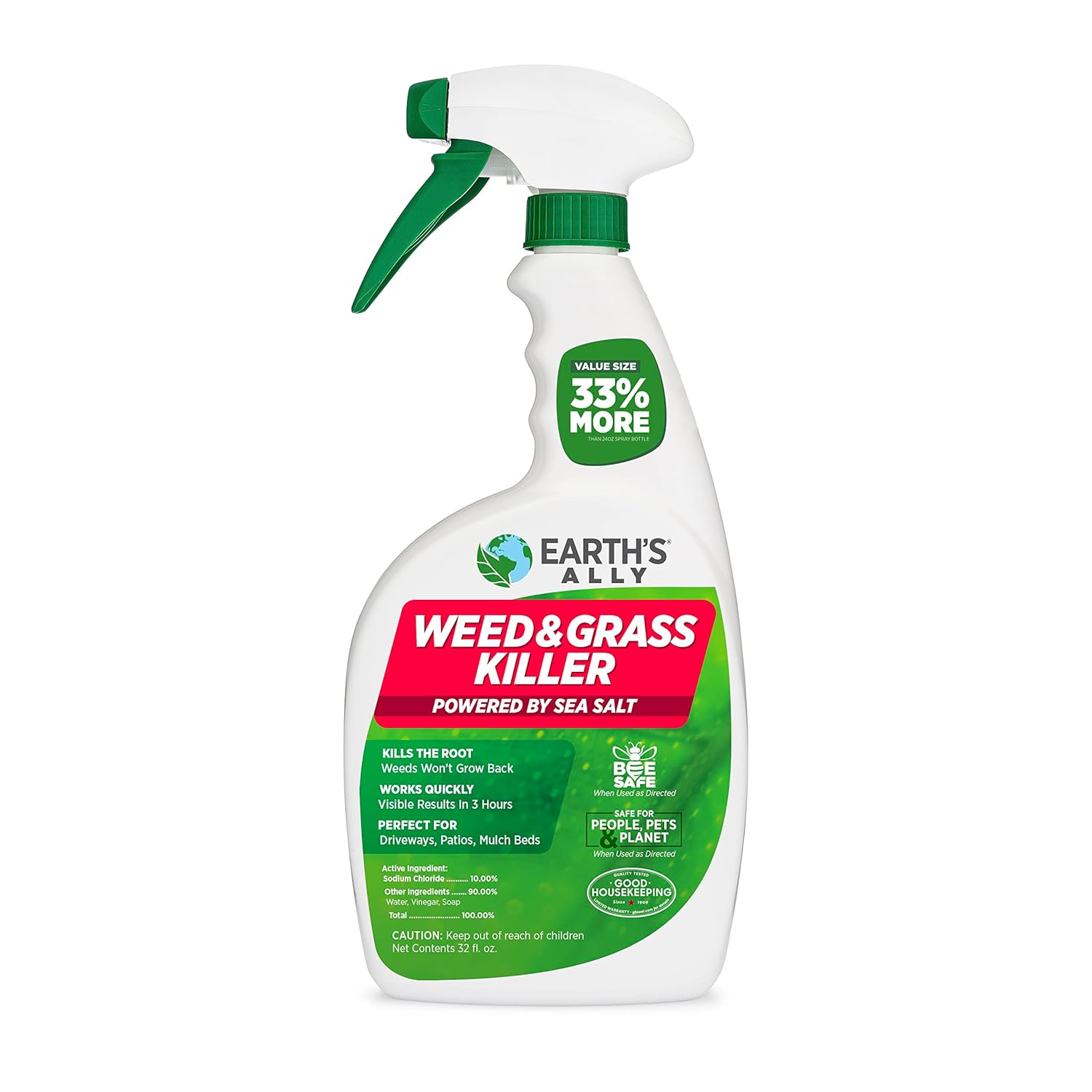
| Unit Count | 32 Fluid Ounces |
|---|---|
| Active Ingredient | Sodium Chloride (10.00%) |
| Item Form | Spray |
| OMRI Listed | Yes |
| Safe for Bees | Yes |
Earth's Ally Weed & Grass Killer is a ready-to-use spray that relies on sea salt, vinegar, and soap to kill common broadleaf and grassy weeds on contact and to the root when applied generously. It is typically used on hardscape and high-traffic areas such as patios, driveways and sidewalks; for larger beds the brand recommends mixing in a pump or backpack sprayer. Notable features include an OMRI-listed formulation, pet- and pollinator-safe testing when used as directed, and visible wilting often within a few hours. Practical benefits are straightforward: no mixing of toxic concentrates, safer handling around people and pets, and an easy spray application that requires saturating leaves and base to reach roots. Important limitations are that it is non-selective so it will damage desirable plants if oversprayed, it requires repeat saturating applications compared with synthetic herbicides, and results depend on dry, sunny conditions for best effect rather than working in wet or overcast weather.
Best for: Buyers who prioritize a safer, low-toxicity option for spot-treating weeds on patios, driveways, sidewalks and other high-traffic hardscape areas and who prefer convenience over industrial-strength persistence.
Less Ideal for: Gardeners who need a selective lawn herbicide or long-term residual control across large turf areas should consider products formulated for those specific uses.
- Ready-to-use spray requires no measuring or harsh concentrate handling
- Sea-salt based formula avoids glyphosate and other synthetic herbicides
- Shown to produce visible wilting within hours when applied on a sunny, dry day
- OMRI-listed and independently tested for pollinator and pet safety
- Non-selective formula will harm any plant it contacts so careful application is required
- Less persistent than some synthetic herbicides so repeated or saturated applications may be necessary
Verdict: Choose this product if you want an easy, ready-to-use weed killer that avoids harsh synthetics and is designed for safe spot treatment on hard surfaces.
Natural Elements Ready-to-Use Weed Killer, 4 Gallons

| Item Form | Liquid |
|---|---|
| Coverage | Broad Spectrum Coverage |
| Active Ingredients | Acetic Acid (concentrated vinegar-based formula) |
| Unit Count | 512 Fluid Ounces |
This ready-to-use Natural Elements weed killer uses commercial-grade acetic acid to burn foliage on contact, causing rapid wilting and browning often visible within an hour and substantial dieback within 24 hours. It is typically applied with a garden sprayer directly onto unwanted weeds, driveways, patios, gravel and fence lines where you want vegetation removed rather than saved. The product arrives in four gallons of liquid, so it suits repeated treatments across a medium to large property without mixing. Key features include a concentrated vinegar formula that adheres to leaves and a broad-spectrum label covering grasses, broadleaf weeds, moss and algae. Practical benefits are quick visual results, no complex mixing, and a formula that is described as biodegradable and safe for people and pets after the spray dries. Limitations are that it is a contact herbicide so it does not translocate into roots for long-term control of perennial weeds, will damage desirable turf if misapplied, and the concentrated acetic acid can irritate skin and eyes during handling so protective gear and good ventilation are required.
Best for: Buyers who prioritize a reliable, fast-acting nonselective weed control for hard surfaces, landscaping edges, and repeat spot treatments and who want a ready-to-use product that covers a lot of ground between purchases.
Less Ideal for: Those seeking a systemic long-term solution for deep-rooted perennial weeds or a selective lawn-safe herbicide should consider alternative products.
- Fast contact action with visible wilting within an hour and heavier damage by 24 hours
- Large 4-gallon volume supports multiple treatments without reordering
- Derived from acetic acid so formula breaks down quickly and is described as biodegradable
- Ready-to-use liquid requires no mixing or dilution before application
- Contact-only action does not reliably kill deep-rooted perennials or prevent regrowth
- Will kill grass and desirable plants if sprayed casually near lawns or garden beds
- Concentrated acetic acid can irritate skin and eyes and requires protective handling
Verdict: Choose this product if you need a large-volume, ready-to-use vinegar-based weed killer that delivers fast, reliable contact control across hardscape and landscape areas.
Spruce Weed & Grass Killer Power Wand Kit with 64 oz Refill

| Unit Count | 64 Fluid Ounces |
|---|---|
| Coverage | 1 bottle treats up to 400 weeds |
| Item Form | Multiple |
| Liquid Volume | 64 fluid ounces |
This kit combines a 64 oz ready-to-use herbicide with a battery-powered Power Wand for fast, targeted spot treatments. The formula is non-mixing and designed to work on contact, dehydrating leaves so you can see darkening or wilting within an hour and complete die-off by about 24 hours when used as directed. The wand is reusable and comes with two AA batteries so you can spray cracks, edges, mulch beds, driveways, and walkways without pouring or measuring. Practical benefits include ease of use, rainproofing within 10 minutes, and a formula advertised as safe around people, pets, and bees when directions are followed. Limitations are that it is non-selective so it must be applied carefully to avoid desirable plants and grass, it is intended for spot treatment rather than broadcast lawn application, and best results require spraying in dry, warm conditions above 60°F with no immediate rain forecast.
Best for: Buyers who want a fast, easy-to-use spot weed killer for driveways, cracks, mulch beds, and edges and who prioritize quick visible results and minimal setup.
Less Ideal for: Those needing large-area lawn herbicide or selective weed control within turf should look for products made for broadcast lawn treatments or selective formulas.
- Ready-to-use 64 oz refill eliminates measuring or mixing
- Visible results in about one hour and full effect around 24 hours
- Includes battery-powered reusable wand for precision spot treatments
- Rainproof within 10 minutes so light showers are less likely to wash it off
- Formulated for use around people, pets, and bees when directions are followed
- Non-selective formula can damage desirable plants if oversprayed
- Designed for spot treatments not for broadcasting over large lawns
- Performance depends on spraying in recommended weather conditions
Verdict: A convenient, no-mix spot-treatment kit that delivers fast visible weed kill with a reusable powered wand for precise, low-fuss applications.
Choosing the Right Eco Friendly Weed Killer: Key Factors to Consider
Mode of Action and Target Species
Different eco friendly weed killers work in different ways, and that determines which weeds they handle best. Some act as contact desiccants that burn foliage on contact and are most effective on small, young weeds. Others disrupt plant physiology more systemically and can control larger established weeds but often require time to translocate. Knowing whether the product targets broadleaf weeds, grasses, or both helps you pick a solution that matches the species in your beds.
Matching mode of action to the weed stage also matters. Contact options often need repeat applications to control persistent root-sprouting perennials, while systemic approaches may reduce regrowth when used correctly. Understanding this lets you plan timing and follow-up treatments for the least environmental load and best long-term control.
Selectivity and Risk to Nearby Plants
Gardeners often apply weed control close to desirable plants, so selectivity is a crucial consideration. Some eco friendly formulas are non-selective and will damage any green tissue they contact; they are best for paths, driveways, and planting bed edges where drift and splash are unlikely to reach ornamentals. Other products are labeled as selective for certain turf types or as safe to use around woody ornamentals when applied carefully.
Application technique influences risk. Spot treatments, shielded wands, and painting a product directly onto weed foliage reduce the chance of harming nearby plants. Always consider the proximity of vegetable seedlings, delicate groundcovers, or newly planted perennials when choosing a product and application method.
Environmental Persistence and Soil Health
The whole point of choosing an eco friendly option is to reduce harm to soil life and water bodies, so persistence is an important factor. Biodegradable contact herbicides typically break down quickly and pose less risk to soil microbes, while systemic active ingredients may persist longer in the soil or root zone. Persistent residues can affect subsequent plantings and microbial activity.
Also consider runoff and proximity to water. If you garden near a pond, stream, or drainage swale, choose options with low aquatic toxicity and follow application timing and buffer recommendations to minimize movement off-site. Minimizing dose and avoiding overhead application before heavy rain are practical ways to protect soil and water.
Application Practicality and Timing
Ease of use affects how consistently a gardener will apply a product correctly. Ready-to-use sprayers and simple mix rates reduce the chance of error, while concentrates require careful measuring and mixing. Some eco friendly weed killers require multiple applications spaced over weeks to achieve acceptable control, which affects labor and calendar planning.
Timing matters for both effectiveness and safety. Many low-toxicity products work best on actively growing weeds in warm conditions and lose effectiveness in dormancy or extreme heat. Plan applications when weeds are young and conditions favor uptake or when drift risk is low. Consider whether an application method fits your typical gardening routine and available equipment.
Effect on Pollinators and Beneficial Insects
Protecting pollinators and beneficial insects is a core goal for many gardeners choosing eco friendly weed control. Foliar sprays applied when pollinators are active can expose bees visiting nearby flowers. Some formulations have low acute toxicity to pollinators but can still coat pollen or nectar if they drift onto flowering plants.
To reduce risk, avoid spraying during bloom, use spot applications rather than broadcast treatments, and choose formulations with low residual contact toxicity. Also consider how long treated foliage remains unattractive or unsafe to insects and follow label guidance on reentry periods for managed pollinator work if relevant.
Legal and Label Restrictions
Even low-impact products have label instructions and local regulations that affect where and how you can use them. Labels may include buffer distances from water, restrictions for use in certain planting areas, or rules about application equipment. Some municipalities also restrict certain herbicide ingredients regardless of product marketing.
Always read the label for allowable uses and follow local guidance. Labels are legally binding application instructions and the best source for safe timing, required protective equipment, and disposal instructions. Considering label constraints ensures you pick a product that is legal and practical for your landscape setting.
Non-Chemical Alternatives To Consider
Physical and cultural controls should be part of any low-impact weed management plan. Hand-weeding, hoeing, and thermal methods such as steam or flame weeding work well for small areas, young weeds, and spaces where you want to avoid any chemical input.
- Mulching with organic materials suppresses weed emergence and improves soil at the same time.
- Dense planting and crop rotation reduce open niches where weeds establish.
- Regular shallow cultivation removes seedlings before they set seed and is effective in vegetable beds.
How to Apply Spot Treatments Safely
Spot treatments limit exposure to desirable plants and lower the total amount of active ingredient applied. Use a shielded nozzle or a foam roller to isolate spray, or switch to brush-on applicators when treating individual broadleaf weeds near ornamentals.
- Work on calm days to reduce drift.
- Avoid application when pollinators are visiting nearby flowers.
- Wear basic protective gear like gloves and eye protection, even with low-toxicity products.
Integrating Eco Friendly Products Into a Wider Plan
Eco friendly weed killers are most effective when part of an integrated approach. Combine targeted products with mulching, hand removal, and scheduled cultivation to reduce the need for repeat chemical treatments. Track treated areas and mark where follow-up is needed so you can retreat before weeds set seed.
- Use preemptive mulch in new beds to lower weed pressure before sowing.
- Rotate approaches between physical and chemical methods to avoid repeated reliance on one tactic.
- Monitor for regrowth from roots and treat early for best results.
Managing Weeds Near Vegetables and Containers
Vegetable beds and container plantings require special care because young crops and root zones are sensitive. For containers, remove weeds by hand or use a targeted contact treatment only on weed foliage, avoiding soil drench applications that could affect roots of container plants. In vegetable plots, restrict sprays to pathways and bed edges or use spot treatments only when crops are established and not flowering.
- Avoid broadcast sprays in beds with emerging seedlings.
- Consider physical barriers like landscape fabric under pathways to reduce future weed pressure.
- Apply treatments when crop foliage is dry and bloom has ended to protect pollinators.
Storage, Disposal, and Responsible Use
Even reduced-risk products need thoughtful storage and disposal. Keep containers sealed and stored out of direct sunlight and reach of children and pets. Follow label directions for empty container handling and local guidelines for disposing of unused concentrate or contaminated rinse water.
- Triple-rinse containers and use rinse water in the area being treated when permitted by the label.
- Do not pour surplus product down drains or into storm sewers.
- Record the date and location of applications in a garden log to avoid overuse in the same area.
How We Chose the Best Eco Friendly Weed Killer
We focused on products and formulations that prioritize reduced environmental harm while still delivering reliable weed control in home gardens. Our selection filters excluded any herbicides that contain persistent synthetic residuals or ingredients known for high aquatic toxicity. We also removed options that require specialized licensing or commercial-only equipment, since most home gardeners need practical, readily usable solutions. We evaluated candidates across multiple concrete dimensions. Effectiveness against common garden weeds was judged by typical kill rates for broadleaf weeds and grasses and by speed of symptom development. Selectivity and safety considered how treatments affect desirable plants, turf, and container plantings when used as directed. Environmental impact measured biodegradability, known aquatic risk, and persistence in soil. Application practicality looked at ease of mixing, need for repeat treatments, and equipment required. Finally, user handling and safety covered personal protective gear requirements and odor or drift potential. These criteria reflect the real tradeoffs gardeners face when choosing a lower-impact weed control method.
FAQ
Are eco friendly weed killers safe to use around bees?
Often they are lower risk, but safety depends on timing and formulation. Avoid spraying during bloom, use spot treatments, and prevent drift onto flowering plants to minimize exposure to bees.
Will an eco friendly weed killer control deep-rooted perennials?
It depends. Contact-based options typically struggle with deep-rooted perennials and may require repeated applications or mechanical removal. Systemic, low-impact options can reduce regrowth but may take longer to work.
Can I use eco friendly weed killers in vegetable gardens?
Usually you can if the label permits, but it is safest to avoid broadcast sprays in production beds. Use spot applications in pathways and bed edges or apply only when crops are not flowering and are well established.
How soon can I replant after using an eco friendly product?
Replant intervals vary by formulation and label instructions. Some biodegradable contact products allow quick replanting, while systemic treatments with longer persistence may require waiting days to weeks. Consult the product label for specific replant guidance.
Do eco friendly weed killers work in cold or wet weather?
Most perform best when weeds are actively growing in warm, dry conditions. Cold or waterlogged soils slow plant metabolism and reduce uptake, so effectiveness is usually lower during such periods.
Final Verdict
When choosing an eco friendly weed killer, prioritize the factors that matter for your garden: whether you need contact or systemic action, how close desirable plants and water are to the treatment area, and how the product fits into a broader cultural control plan. Expect tradeoffs between immediate knockdown and longer-term persistence; pick a method that matches the species you face and the level of follow-up you can commit to. A practical approach combines targeted eco friendly products with hand weeding, mulching, and timely cultivation to keep weed pressure down while protecting soil life and pollinators. With a clear plan and correct application techniques, you can achieve effective weed control with minimal environmental impact.
