

Note: This article contains affiliate links. If you click on these links and make a purchase, I may earn a small commission at no extra cost to you. This helps support my research and content. Read my full affiliate disclosure here.
Keeping noncrop areas, paths, fences, and gravel drives free of weeds requires a herbicide that delivers predictable, long-lasting results without frequent reapplication. The right bare ground herbicide reduces labor, prevents erosion from aggressive weeds, and keeps utility strips and mulch lines tidy. You will find a short list of vetted options below that perform well in real gardens and outdoor spaces. This guide covers the top shortlisted bare ground herbicides for the use case above and explains how we evaluated residual control, application technique, and site restrictions so you can choose the best fit for your outdoor maintenance plan.
Top Picks at a Glance
| Best Overall The best all-around choice for most situations | RM43 Total Vegetation Control 43% Glyphosate Plus Weed Preventer, 2.5-Gallon |  |
| Best Quality Built to a higher standard if you want something more solid | Ranger Pro Glyphosate Herbicide Concentrate, 2.5 gal |  |
| Best Value The sweet spot between price and what you get | Compare-N-Save Glyphosate Concentrate Grass & Weed Killer, 2.5 Gallon |  |
| Best Budget The cheapest option that still gets the job done reliably | Ortho GroundClear Year-Long Vegetation Killer2 Concentrate, 32 fl oz |  |
| Highest Rated A top-rated pick with lots of positive feedback | Control Solutions Eraser Max 2.5 Gallon Super Concentrate Weed Killer |  |
| Most Popular A crowd favorite that many people choose with confidence | RM43 Concentrated Extended Control Weed Killer (1 gallon) |  |
| Best Seller A high-volume bestseller chosen again and again | Roundup Weed & Grass Killer with Comfort Wand, 1.33 gal. |  |
RM43 Total Vegetation Control 43% Glyphosate Plus Weed Preventer, 2.5-Gallon
| Unit Count | 320 Fluid Ounces |
|---|---|
| Liquid Volume | 320 fluid ounces |
| Coverage | 243 243 square feet |
| Active Ingredients | Glyphosate isopropylamine salt, Imazapyr isopropylamine salt |
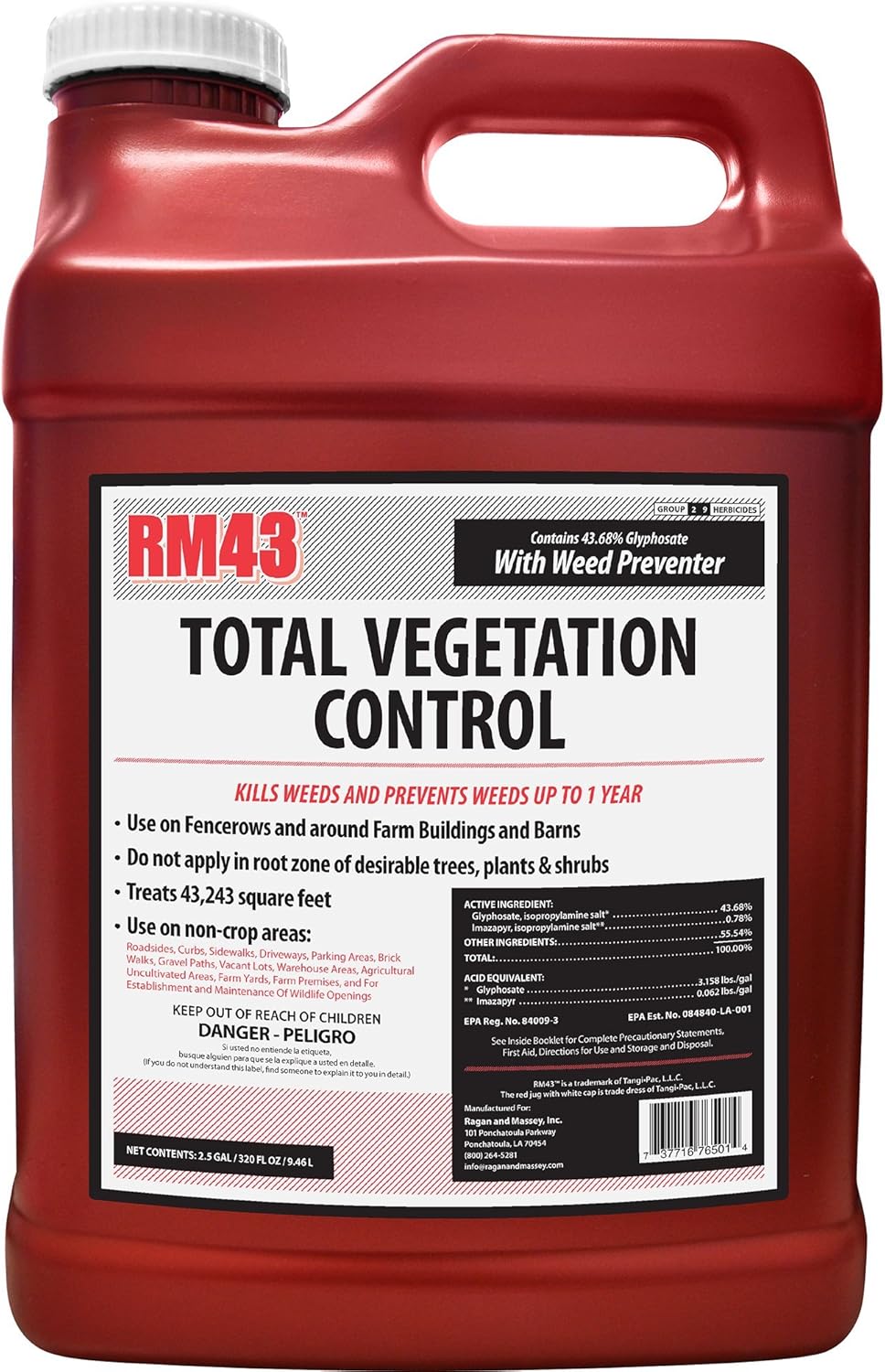
RM43 Total Vegetation Control is a concentrated 2.5‑gallon herbicide intended for killing existing growth and preventing regrowth for up to a year on areas where no vegetation is desired. You mix it into spray solution and apply to hardscape edges, gravel driveways, fence rows, and around buildings as either spot treatments or blanket applications on bare ground. The formula pairs glyphosate and imazapyr with a surfactant so it kills grasses, broadleaf weeds, vines, brush and some woody growth and becomes rainfast in about two hours. Practical benefits for driveway use include long residual control that reduces repeat spraying and a large coverage rate that treats many square feet from one container. Important limitations are that it is for non‑crop areas only and will damage desirable plants if sprayed over roots or drift occurs, and the active ingredient blend makes it persistent so care is required where you may later want vegetation to return. Follow label directions for mixing, application timing and safety precautions when using near soil that will be planted later.
Best for: Gardeners, property owners, and maintenance crews who prioritize strong, long‑lasting weed eradication on gravel driveways and other non‑crop hardscape areas and want to minimize repeat applications.
Less Ideal for: Homeowners planning to replant treated areas soon or those needing selective weed control near desirable plants should choose a less persistent or more targeted product.
- Combination of glyphosate and imazapyr for both knockdown and long residual control
- Concentrated 2.5‑gallon container covers large areas without frequent refills
- Rainfast in about two hours so light rain soon after application is less likely to reduce effectiveness
- Suitable for total vegetation control on gravel driveways, fence rows and other non‑crop areas
- Persistent active ingredients that can prevent desirable vegetation from reestablishing for an extended period
- Not safe for use where desirable plant roots may be exposed or where drift could contact nearby plants
Verdict: Choose RM43 when you need a single, heavy‑duty application that delivers broad spectrum kill and up to a year of weed prevention on gravel driveways and other non‑crop surfaces.
Ranger Pro Glyphosate Herbicide Concentrate, 2.5 gal

| Unit Count | 320 Fluid Ounces |
|---|---|
| Liquid Volume | 2.5 gallons |
| Item Form | Liquid |
| Active Ingredients | Glyphosate |
| Coverage | Annual |
Ranger Pro is a professional-strength glyphosate concentrate formulated for large-area weed control. You dilute 2 to 3 ounces per gallon of water and apply with standard sprayers to target foliage; the product is non-selective so it kills most exposed plants, including persistent vines like morning glory when sprayed thoroughly. The 41% glyphosate formulation delivers reliable systemic control, which means treated plants typically brown and die back over several days as the active ingredient translocates to roots. Practical benefits include a high-concentration formula that reduces the frequency of trips to refill and a large 2.5 gallon container suited to yards, parks, or contractor use. Important limitations are that it is non-selective and will damage desirable plants on contact, and it requires careful handling and protective gear due to skin and eye irritation warnings. Do not apply on windy days and follow label directions to avoid runoff and off-target damage.
Best for: Gardeners or property managers who prioritize a dependable, professional-strength chemical solution for eradicating persistent weeds and vines across larger areas.
Less Ideal for: Casual gardeners wanting selective control around ornamentals or people unwilling to use protective equipment should choose a more targeted or non-chemical option instead.
- High glyphosate concentration (41%) for effective systemic control
- Large 2.5 gallon volume reduces refill frequency for big jobs
- Dilutable concentrate compatible with standard sprayers for flexible coverage
- Non-selective formula will damage any plant it contacts
- Requires personal protective equipment and careful handling due to irritation risks
Verdict: Choose Ranger Pro when you need a concentrated, professional-strength glyphosate product that reliably kills persistent weeds like morning glory over large areas.
Compare-N-Save Glyphosate Concentrate Grass & Weed Killer, 2.5 Gallon
| Liquid Volume | 2.5 gallons |
|---|---|
| Active Ingredients | glyphosate |
| Item Form | Spray |
| Coverage | 630000 square feet |
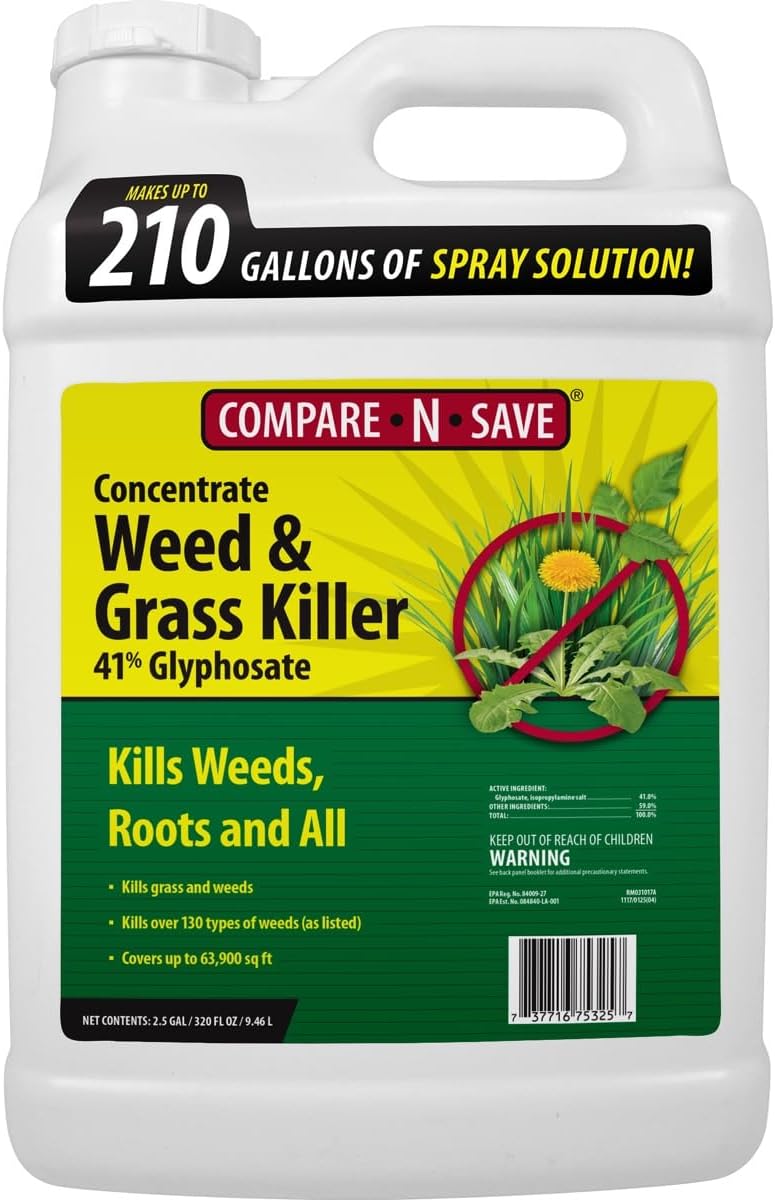
This 2.5 gallon concentrate contains 41% glyphosate and is formulated to be mixed with water to make ready-to-use spray for large bare-ground jobs. It is typically used to clear driveways, walkways, fence lines, landscape beds, and areas being prepared for replanting or renovation. The product mixes easily and claims to make up to 210 gallons of spray, allowing treatment of very large areas without frequent repurchasing. Glyphosate is absorbed through foliage and moves to the root, so treated plants usually show visible dieback in 2 to 4 days and complete control after a single application in many cases. Practical benefits include fast activity, broad-spectrum control of annual and perennial weeds, and the ability to replant ornamental areas soon after application because there is no long residual. Important limitations are that it kills any green plant it contacts so careful application and drift control are required, and it provides no soil residual control so follow-up treatments or preemergent measures may be necessary to prevent new seedlings.
Best for: Buyers who need a cost-effective, large-volume solution to clear weeds and grasses from bare ground, driveways, or sites being prepared for planting and who plan applications with care to avoid desirable plants.
Less Ideal for: People who need a selective herbicide that will spare lawn or garden plants or those who require long-lasting soil residual control without repeat treatments.
- High concentration (41% glyphosate) for effective systemic control
- Large 2.5 gallon container mixes into a lot of ready-to-use spray for treating extensive areas
- Visible results in 2 to 4 days, often after a single application
- No long soil residual so treated ornamental areas can be replanted quickly
- Nonselective and will kill any green plant it contacts requiring precise application
- No residual control of new seedlings so may need repeat treatments or complementary preemergent products
Verdict: A high-concentration, large-volume glyphosate concentrate that efficiently clears weeds and grasses across large bare-ground areas.
Ortho GroundClear Year-Long Vegetation Killer2 Concentrate, 32 fl oz

| Liquid Volume | 32 fluid ounces |
|---|---|
| Coverage | 300 square feet |
| Item Form | Liquid |
| Active Ingredients | Imazapyr; Isotropylamine Salt; Pelargonic Acid |
Ortho GroundClear is a fast-acting concentrate designed for homeowners who need long-term suppression of weeds and grasses on hardscape areas. Mix 24 fl. oz. per gallon of water and apply with a tank sprayer to driveways, patios, gravel, fence lines, and other spots where you do not want any plant growth. The formula starts working immediately and becomes rainproof in about an hour, so light showers shortly after application are less likely to reduce effectiveness. A single 32 fl. oz. bottle makes roughly 1.33 gallons of spray and can treat about 300 to 400 square feet depending on label directions. Active ingredients include imazapyr and pelargonic acid, giving both systemic and contact action for thorough kill and up to 12 months of prevention. Important limitations are that it is non-selective so it will kill desirable plants on contact and must be used only where no vegetation is wanted, and it requires careful handling and follow of safety instructions. For budget-focused buyers it delivers long coverage per bottle, reducing how often you need to reapply compared with short-term products.
Best for: Homeowners who need a low-cost, long-lasting herbicide to keep driveways, patios, walkways, and gravel areas free of weeds without frequent reapplication.
Less Ideal for: Gardeners who need to selectively remove weeds from planted beds or who prefer ready-to-use sprays for spot treatments should look for a selective or RTU product instead.
- Year-long prevention of regrowth reduces frequency of reapplication
- Fast-acting and rainproof in about one hour so treatments hold up in changing weather
- Concentrate format treats several hundred square feet from one bottle
- Effective on hardscape and gravel where no plants are desired
- Non-selective formula will damage or kill any desirable plants it contacts
- Requires mixing and a sprayer rather than ready-to-use convenience
Verdict: If you want one concentrated bottle that treats several hundred square feet and keeps hardscape areas weed-free for up to a year, this product delivers strong long-term value.
Control Solutions Eraser Max 2.5 Gallon Super Concentrate Weed Killer

| Unit Count | 320 Fluid Ounces |
|---|---|
| Item Form | Liquid |
| Coverage | 43242.5 square feet |
| Active Ingredients | Glyphosate, Imazapyr |
Control Solutions Eraser Max is a concentrated glyphosate and imazapyr liquid herbicide designed for persistent control of grasses, broadleaf weeds, vines, brush, and unwanted vegetation in non-crop areas. Typically mixed and applied as a spot treatment or broadcast to bare ground, one application is labeled to suppress weeds for up to a year, which makes it useful for gravel driveways, fence lines, sidewalks, and parking areas. Notable features include a high coverage rating and a formula active on both grasses and woody plants, so it handles annual weeds and tougher perennial brush. Practical benefits are extended control with fewer applications and versatility on a range of surfaces where plant regrowth is a recurring problem. Important limitations are that it is intended for non-crop settings only, requires careful handling and protective gear, and will kill desirable plants it contacts, so precise application and avoidance of drift are essential.
Best for: Buyers who need dependable, long-term vegetation control on non-crop surfaces and prefer fewer applications to keep gravel driveways and similar areas clear.
Less Ideal for: Gardeners who need selective spot treatment near desirable plants or anyone wanting an herbicide safe for lawns, edible gardens, or crop areas.
- Concentrated formula covers a large area from a single container
- Active combination (glyphosate and imazapyr) controls both grasses and woody vegetation
- Label claims up to one year of control after a single application
- Suitable for common non-crop sites like gravel driveways, fence rows, and sidewalks
- Not selective and will damage or kill desirable plants on contact
- Requires safety precautions and proper protective equipment during mixing and application
- Not labeled for use in crop or lawn areas where desirable vegetation exists
Verdict: Choose this concentrated, dual‑action herbicide when you want reliable, long‑lasting clearance of weeds and brush from gravel driveways and other non‑crop areas.
RM43 Concentrated Extended Control Weed Killer (1 gallon)

| Unit Count | 128 Fluid Ounces |
|---|---|
| Item Form | Spray |
| Coverage | 17297 square feet |
| Active Ingredients | glyphosate |
RM43 is a concentrated glyphosate‑based weed killer blended for broad, long‑lasting vegetation control on noncrop areas. You mix it with water and apply through a sprayer to drive down perennial weeds, fence lines, gravel areas, and other places where you want no plant growth. The formula pairs glyphosate with a second herbicide and a surfactant so it kills to the root and claims prevention of new growth for up to a year while becoming rainfast in about two hours. A single gallon treats a large area, making it suitable for larger properties or professional use. Important practical limits are safety and site restrictions: it must not be used near desirable plants or crops and requires cautious handling to avoid drift and contact with skin and eyes. For routine spot treatments it is concentrated enough that careful measuring is needed, and it is intended only for areas where total vegetation removal is acceptable.
Best for: Buyers who need a powerful, long‑lasting solution for clearing and keeping large nonplant areas free of vegetation, including property managers and professional landscapers focused on durable results.
Less Ideal for: Gardeners who need selective weed control around ornamentals or vegetable beds or those who want an organic or low‑toxicity option should choose a different product.
- Concentrated one‑gallon formula treats large areas, reducing trips to refill
- Combination of glyphosate and a second herbicide for deeper, longer control
- Rainfast in about two hours so results are less affected by light rainfall
- Designed for total vegetation control and claims up to 12 months of prevention
- Not selective so will kill desirable plants and must be applied only to noncrop areas
- Requires careful mixing and handling because of strong active ingredients
Verdict: Choose RM43 when you need a concentrated, professional‑strength herbicide that kills to the root and provides long‑term vegetation control on noncrop areas.
Roundup Weed & Grass Killer with Comfort Wand, 1.33 gal.

| Item Form | Liquid |
|---|---|
| Coverage | 400 sq. ft. |
| Liquid Volume | 1.33 gallons |
This Roundup package pairs a 1.33 gallon liquid formulation with a Comfort Wand for easier spraying around beds, walkways, and foundations. It is formulated to kill common broadleaf weeds and grasses down to the root, with visible wilting in hours and rainfast protection in about 30 minutes, so treated areas are less likely to wash away after a brief rain. The wand offers one-touch continuous spray, which reduces hand fatigue during spot treatments and makes edging and targeted applications simpler than using a separate sprayer. Coverage is listed at about 400 sq. ft., appropriate for small yards, beds, or multiple spot-treatment sessions. Important limitations are that this is a nonselective herbicide so it will damage desirable plants if contacted and the product directions include replanting wait times of 1 to 30 days depending on use. Users should follow label precautions about keeping people and pets away until spray has dried and applying only in calm conditions to avoid drift.
Best for: Buyers who want a straightforward, ready-to-use herbicide for targeted spot treatments and edging where quick, reliable weed control is the priority and minimizing application fuss matters.
Less Ideal for: Large properties or users who need selective lawn-safe control should consider professional application methods or products formulated specifically for turf.
- Fast visible results in hours and rainproof in as fast as 30 minutes
- Comfort Wand with one-touch continuous spray reduces hand fatigue and improves targeting
- Kills a wide range of broadleaf weeds and grasses to the root
- Ready-to-use liquid requires no mixing and covers up to 400 sq. ft.
- Nonselective formula will damage desirable plants if contacted
- Container and wand limit treatment area per refill compared with larger tank sprayers
Verdict: A convenient, ready-to-use herbicide with a Comfort Wand that delivers fast, reliable spot control of broadleaf weeds and grasses for homeowners who want an easy, low-fuss solution.
Choosing the Right Bare Ground Herbicide: Key Factors to Consider
Residual Control Duration
How long a product prevents new weed emergence is the single biggest operational factor for bare-ground work. Longer residual control means fewer return visits to treat the same area, which saves time and labor on long runs like fence lines and driveways. Residual life can vary with soil type, organic matter, and rainfall, so gardeners should match product label guidance on expected duration to local climate and the priority of treated areas.
Understand that longer residuals increase restrictions on planting or disturbing treated soil. If you plan to establish desirable plants or seed later, select a shorter-residual option or plan treatment timing accordingly.
Spectrum of Weeds Controlled
Different herbicides target mostly grasses, broadleaves, or both. For mixed weed problems in gravel or compacted soil, choose a product labeled for both grassy and broadleaf species to avoid follow-up spot treatments. If you are managing a specific invasive species, confirm the product lists that species or its family on the label.
Knowing the typical weeds in the treatment area helps pick a chemistry with appropriate control. Some products excel on perennial grasses, others on annual broadleaves; matching spectrum to weed pressure reduces wasted treatments.
Application Ease
Ease of use affects whether you can apply correctly and safely. Look for clear mixing and rate instructions, compatibility with common pump sprayers, and whether the product needs special adjuvants. Pre-mixed or easy-to-measure concentrates reduce chances of mixing errors that produce poor control or safety hazards.
Consider nozzle size, spray droplet recommendations, and whether spot treatments or broadcast spraying are intended. Simpler application reduces time on long runs and lowers the risk of off-target drift.
Environmental Restrictions and Buffer Requirements
Label restrictions about proximity to water, desirable plants, or storm drains determine where a product can be used. Some chemistries bind tightly to soil and pose low runoff risk while others require buffer zones. If your property has nearby landscape beds, ornamental plantings, or water features, choose a product with compatible restrictions or be prepared to set physical barriers during application.
Local regulations may also limit use of certain active ingredients. Check label restrictions carefully for re-entry intervals and allowed sites to avoid unintended damage or regulatory issues.
Safety, Handling, and Cleanup
Personal protective equipment recommendations, cleanup instructions for sprayers, and guidance for pets and people returning to treated areas are practical issues that influence use. Clear, conservative safety guidance reduces operator risk and helps you plan application timing to avoid exposure.
Also consider disposal instructions for leftover product or rinse water. Products with straightforward rinse procedures simplify maintenance of equipment and reduce the potential for contamination of desirable plants.
Flexibility of Use Rates and Sites
Products that offer different labeled rates for spot treatment versus broadcast application are more versatile in garden use. Flexibility matters if you alternate between small targeted patches and long runs along driveways or fences. Some labels also permit use in gravel driveways, stone paths, walkways, and industrial sites while others restrict applications to nonporous surfaces.
Choosing a product with multiple labeled sites and adjustable rates lets you adapt treatments without switching chemistries for each task.
Preparing the Area for Treatment
Proper site preparation improves herbicide performance. Remove heavy debris and mow or pull tall weeds so spray contacts soil and low-growing foliage. On dense weed growth consider an initial contact treatment followed by a residual application once weeds have died back.
Check the weather forecast and avoid applications before heavy rain or high winds. Cool, calm conditions with moderate soil moisture generally improve uptake and reduce drift.
- Clear loose mulch and surface debris for better soil exposure
- Treat when weeds are actively growing and not under drought stress
- Avoid treating before predicted heavy rain to prevent wash-off
Application Equipment and Spray Technique
Selecting appropriate spray equipment makes a difference for consistent coverage. For narrow strips and spot work a hand-pump or battery sprayer provides control. For long fence lines or driveways a larger compressed-air or backpack sprayer increases efficiency.
Use a low-pressure, coarse-droplet nozzle to minimize drift and ensure droplets reach the soil surface. Walk at a steady pace and apply overlapping swaths to avoid missed zones.
- Rinse sprayers thoroughly after use following label directions
- Calibrate sprayer output so the labeled rate is applied per area
- Wear recommended protective gear during mixing and application
Timing Treatments for Best Results
Timing affects both immediate control and residual performance. For many annual weeds apply before seed set and while plants are actively growing. For perennial weeds, target treatments during active growth phases when carbohydrate movement is high so systemic activity is maximized.
Consider staging treatments for large areas: an initial broadcast residual application to prevent new germination, with follow-up spot control for any survivors later in the season.
- Treat young, actively growing weeds for more reliable control
- Schedule applications outside of blooming periods if pollinator exposure is a concern
- Plan follow-up inspections several weeks after application to catch escapes
Managing Risks Near Desirable Plants and Water
Protecting nearby plantings and water requires attention to buffer zones and runoff prevention. Use physical barriers like plastic sheeting or cardboard to shield soil adjacent to ornamental beds. Avoid application on steep slopes or before heavy rain, which increases runoff risk.
If treatment sites are close to water bodies, select products with low aquatic mobility and follow all label buffer requirements to minimize environmental impact.
- Create physical barriers to protect neighboring soil and plants
- Follow label-specified buffers from water features and drains
- Consider spot treatment to reduce off-site movement
Post-Application Monitoring and Follow-Up
After treatment, inspect the area periodically for seedlings or regrowth. Some products prevent emergence for months, but no herbicide is guaranteed; timely spot treatments of escapes reduce long-term workload. Record application dates and rates so future reapplications follow label guidelines.
If you plan to plant nearby later, follow label planting intervals to avoid damage to seedlings. Mechanical control or targeted spot treatment can complement residual herbicides where planting is planned.
- Keep a treatment log with dates, rates, and weather conditions
- Perform spot treatments on escapes sooner rather than later
- Respect labeled planting intervals before establishing desirable plants
How We Chose the Best Bare Ground Herbicide
We focused on criteria that matter to gardeners and landscape maintainers who need dependable control of weeds on noncrop surfaces. Primary evaluation points included residual control duration to judge how long treated areas stay weed-free, the herbicide's mode of action and its effectiveness against common grassy and broadleaf weeds, and application ease including spray equipment compatibility and rate clarity. We also assessed environmental considerations such as soil binding and runoff risk, label restrictions for use near desirable plants or water, and the flexibility of treatment rates for spot versus broadcast applications. Availability of clear safety and cleanup instructions was important for safe handling around pets and people. Exclusions included products formulated only for turf or for in-crop use and any options whose labels prohibit typical bare-ground sites like driveways, gravel, or fence lines. These filters produced a shortlist of products that balance effective residual control with practical application and acceptable environmental precautions. The scoring labels reflect these evaluation priorities to help you compare performance, ease of use, and safety at a glance.
FAQ
How long does a typical bare ground herbicide keep weeds from coming back?
Residual duration varies by product and site. Many labeled options provide several weeks to months of control under average conditions, while soil texture, organic matter, and rainfall can shorten or lengthen that window.
Can I use a bare ground herbicide next to flower beds or shrubs?
It depends on the product label. Some chemistries require buffer zones or physical protection for desirable plants. If you must treat close to ornamentals, create a physical barrier and choose a product with low soil mobility.
Is it safe to apply these herbicides around pets and people?
Safety depends on the active ingredient and label instructions. Most labels specify re-entry intervals and recommend keeping pets off treated areas until the spray has dried. Always follow the product's PPE and re-entry guidance to minimize exposure.
Do I need a special sprayer to apply bare ground herbicides?
No special sprayer is required for many products, but calibration is important. Hand-pump, backpack, or larger sprayers are all commonly used. Use low pressure and coarse nozzles to reduce drift and ensure even coverage.
Can one application eliminate perennial weeds permanently?
Perennials are harder to control and often need repeated treatments or integrated approaches. A single application can suppress or kill many perennials if timing and coverage are correct, but follow-up monitoring and spot treatments are usually necessary.
Final Verdict
Choose a bare ground herbicide by balancing how long you need treated areas to stay weed-free with application safety and site restrictions. Prioritize residual duration and weed spectrum for the problem you face, and pick a product whose label matches the surfaces you will treat. Plan applications with good site prep, correct equipment, and follow-up scouting to catch escapes. That approach minimizes repeat work and reduces the chance of damage to nearby desirable plants while keeping noncrop areas neat and low-maintenance.
