

Note: This article contains affiliate links. If you click on these links and make a purchase, I may earn a small commission at no extra cost to you. This helps support my research and content. Read my full affiliate disclosure here.
Yellow nutsedge is a persistent, grass-like weed that can quickly overrun lawns and garden beds if left unchecked. Choosing the right herbicide matters because some act quickly but damage desirable turf, while others suppress nutsedge more selectively with repeated applications. This guide covers seven shortlisted herbicides for yellow nutsedge and explains how they perform in real garden and lawn situations. We evaluate products across efficacy against nutsedge, residual control, turf compatibility, and ease of application so you can match a solution to your lawn type and maintenance routine. Read on for practical buying guidance and usage considerations before you pick an option.
Top Picks at a Glance
| Best Overall The best all-around choice for most situations | PBI/Gordon Arkon Nutsedge and Kyllinga Killer Liquid Concentrate, 32 fl oz |  |
| Best Quality Built to a higher standard if you want something more solid | Atticus Empero Nutsedge Killer, Halosulfuron Herbicide Concentrate (1.33 oz) |  |
| Best Value The sweet spot between price and what you get | Bonide Sedge Ender Concentrate 16 oz |  |
| Best Budget The cheapest option that still gets the job done reliably | Spectracide Weed Stop for Lawns Concentrate, 32 oz Ready-to-Spray |  |
| Highest Rated A top-rated pick with lots of positive feedback | Sedgehammer Nutsedge Herbicide 1.33 oz (makes ~40 gal) |  |
| Most Popular A crowd favorite that many people choose with confidence | Sedgehammer Plus Turf Herbicide Nutsedge Killer, 13.5 g Packet |  |
| Best Seller A high-volume bestseller chosen again and again | Ortho Max Nutsedge Killer RTU, 24 fl. oz. (2-Pack) |  |
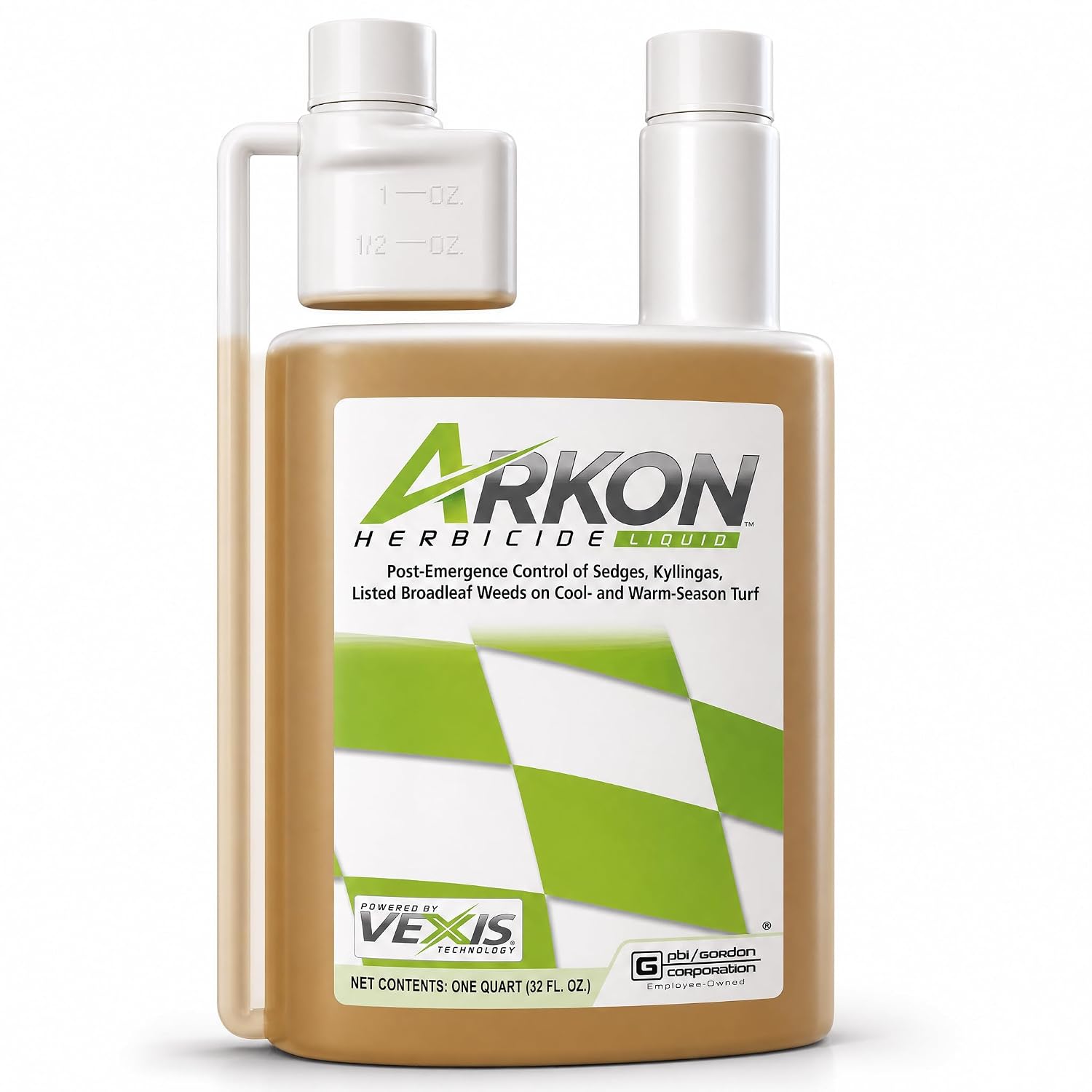
PBI/Gordon Arkon Nutsedge and Kyllinga Killer Liquid Concentrate, 32 fl oz
| Unit Count | 32 Fluid Ounces |
|---|---|
| Coverage | Up to 26,600 sq. ft. |
| Formulation | Liquid |
| Active Ingredients | Pyrimisulfan |
PBI/Gordon Arkon is a concentrated liquid herbicide designed specifically to get at nutsedge and kyllinga by reducing underground tubers and rhizomes rather than only burning back foliage. It is mixed in a pump or backpack sprayer at 1.2–1.7 fl oz per 1,000 sq ft and can treat large areas from a single quart. Typical use is one application for yellow nutsedge or two applications 4–6 weeks apart for tougher purple nutsedge and kyllinga. Notable features include a formulation that stays suspended in the tank to avoid settling or clogged nozzles, labeled tolerance for common cool- and warm-season turfgrasses, and university trial data showing substantial reductions in tuber counts and rhizome regrowth. Practical benefits are durable suppression of re-sprouting sedges, broad site labels that include residential lawns and athletic fields, and tank-mix compatibility with many partners. Important limitations are that it is a selective chemical requiring careful mixing and application within label rates, treated areas must be kept off until dry, and it is not registered for sale in certain states so local availability may vary.
Best for: Gardeners and turf managers who prioritize high-performance, long-term control of nutsedge and kyllinga in lawns and sports turf and who are comfortable following label mixing and application procedures.
Less Ideal for: Casual users seeking a nonchemical or spot-only solution or those unwilling to follow safety and re-entry precautions or to manage herbicide resistance.
- Targets underground tubers and rhizomes for longer-lasting control of nutsedge and kyllinga
- Concentrated liquid treats large areas from one quart when mixed at label rates
- Formulation stays mixed in tank to reduce settling and nozzle clogging
- Labeled for use on many common cool- and warm-season turfgrasses and a variety of sites
- Requires precise mixing and follow-up timing for toughest weeds
- Contains an ALS-inhibitor active ingredient so rotation with different modes of action is needed to manage resistance
Verdict: Choose Arkon when you need professional-strength, tuber-targeting control of nutsedge and kyllinga across large lawns and turf areas.
Atticus Empero Nutsedge Killer, Halosulfuron Herbicide Concentrate (1.33 oz)

| Item Form | Granule |
|---|---|
| Coverage | 1 Acre |
| Active Ingredients | halosulfuron-methyl |
| Unit Count | 1 Count |
Empero is a concentrated granular herbicide that dissolves in water to make a spray for targeted nutsedge control. You measure one level scoop per 1,000 sq ft, mix with water and a nonionic surfactant, then spray actively growing nutsedge in lawns, golf turf, sports fields, and woody landscape areas. The formulation contains halosulfuron-methyl, which moves to the plant tubers for root-level control so treated nutsedge deteriorates from the root up rather than just burning foliage. Practical benefits include a small, easy-to-store bottle with a measuring scoop, rapid-dissolve granules for convenient mixing, and label directions that allow reentry by pets and people once spray has dried. Limitations are that it is a selective herbicide so it will not control every weed type, repeat applications may be needed for heavy infestations, and it should not be used on newly seeded or stressed turf. Users must add their own surfactant and follow label restrictions about turf types and site approvals.
Best for: Gardeners and turf managers who want a reliable, selective solution to remove nutsedge from established lawns and landscape turf while preserving desirable grasses.
Less Ideal for: People seeking a broad-spectrum, one-step weed killer for mixed broadleaf and grassy weeds or for treating newly seeded or stressed lawns should look elsewhere.
- Selectively targets yellow and purple nutsedge and Kyllinga for root-level control
- Rapid-dissolve granules mix easily for fast preparation of spray solution
- Includes a measuring scoop for consistent, repeatable dosing
- Approved for use on many established warm- and cool-season turf species and several non-crop sites
- Requires addition of a nonionic surfactant which is sold separately
- May require repeat applications for large or established nutsedge infestations
Verdict: Buy this if you need a focused, professional-strength nutsedge treatment that works down to the tubers while being safe on most established turf.
Bonide Sedge Ender Concentrate 16 oz

| Unit Count | 16 Ounce |
|---|---|
| Item Form | Spray |
| Liquid Volume | 16 fluid ounces |
| Active Ingredients | Herbicide |
Bonide Sedge Ender is a concentrated lawn herbicide designed specifically to control sedges and other grassy weeds such as yellow nutsedge, crabgrass, goosegrass, and foxtail. Sold as a 16 oz concentrate, it is mixed according to label rates and applied with a sprayer for spot or broadcast treatments across warm and cool season lawns. Notable features include pre- and post-emergent activity, a formula that starts working on contact, and rainproofing within hours after drying so treatments remain effective through light weather. The concentrate format makes it economical for treating areas from a few hundred to several thousand square feet depending on dilution. Important limitations are that it is labeled for lawn use only so it should not be used on ornamental beds, and users must follow safety directions for protective clothing and keep children and pets away until treated areas are dry; handling a concentrated herbicide also requires careful measuring and mixing. For someone managing stubborn grassy weeds in turf, it offers targeted control without killing desirable grasses when applied correctly.
Best for: Homeowners focused on getting rid of persistent grassy weeds in established lawns who prefer a concentrated, economical product with proven effectiveness.
Less Ideal for: Gardeners who need a non-lawn solution for ornamental beds or those unwilling to handle a concentrated chemical or follow protective and mixing instructions.
- Concentrated formula yields economical coverage when mixed properly
- Effective against hard-to-kill grassy weeds including yellow nutsedge and goosegrass
- Works both pre-emergent and post-emergent for flexible timing
- Becomes rainproof within hours after drying so treatments are less likely to wash away
- Labeled for use on lawns only so not suitable for flower beds or many ornamentals
- Requires careful mixing and protective gear because it is a concentrated herbicide
Verdict: Choose Bonide Sedge Ender when you need a concentrated, lawn-safe herbicide that reliably kills goosegrass and other grassy weeds down to the root.
Spectracide Weed Stop for Lawns Concentrate, 32 oz Ready-to-Spray

| Coverage | 8,000 square feet |
|---|---|
| Liquid Volume | 32 fluid ounces |
| Item Form | Liquid |
| Active Ingredients | 2,4-D, Mecoprop-P, Dicamba, Sulfentrazone |
Spectracide Weed Stop for Lawns is a hose-attach ready-to-spray concentrate designed to control broadleaf weeds across common turf types. It kills by contact and down to the root, listing over 460 weeds such as clover, dandelion and chickweed, and promises visible browning in around three hours. The QuickFlip sprayer makes treatment fast for larger yards and the formula is labeled for use on bluegrass, fescue, Bermuda and perennial rye, though you should avoid zoysiagrass coming out of dormancy and not spray above 90°F. Practical benefits include quick application without mixing and one-hour rainproofing so treatments are less weather-dependent. Important limitations are temperature restrictions for safe use, the need to keep people and pets off the lawn until dry, and the usual reseeding wait time of three to four weeks. For homeowners focused on routine clover control, this product offers a straightforward, time-saving option, but follow label directions closely to protect desirable turf and nearby plants.
Best for: Homeowners who want an inexpensive, no-mix solution to knock back clover and other broadleaf weeds quickly across a typical lawn and value fast application.
Less Ideal for: Gardens that need constant reseeding, very young lawns or yards with delicate ornamentals close to treatment areas should consider more targeted options.
- Ready-to-spray QuickFlip hose attachment speeds up application for medium to large lawns
- Kills broadleaf weeds including clover, dandelion and chickweed with visible results in about three hours
- Rainproof in one hour which reduces the chance of losing treatment to light rain
- Works on a variety of common turf types when used as directed
- Should not be applied when daytime temperatures exceed 90°F which limits use in hot weather
- Requires waiting 3–4 weeks before reseeding treated areas
Verdict: A convenient ready-to-spray concentrate that quickly controls clover and other broadleaf weeds for budget-minded homeowners who want fast, low-effort treatments.
Sedgehammer Nutsedge Herbicide 1.33 oz (makes ~40 gal)

| Unit Count | 1.33 Ounce |
|---|---|
| Item Form | Granule |
| Coverage | 1,000 sq ft per gallon of mix |
| Active Ingredients | Halosulfuron-methyl |
Sedgehammer is a concentrated post-emergent herbicide designed specifically for nutsedge control in lawns and large turf areas. You mix a measured scoop into a gallon of water (measuring spoon included), add a non-ionic surfactant, and spray to cover about 1,000 sq ft per gallon; one 1.33 oz bottle makes roughly 40 gallons of spray. The active ingredient, halosulfuron-methyl, translocates to tubers and nutlets so treated nutsedge typically yellows in 10 to 14 days with full decline in about 3 to 4 weeks. It is labeled for many common turfgrasses and is suitable for homeowner and commercial use where selective control of nutsedge is needed. Practical benefits include low use rate for treating large areas, clear mixing and timing guidance, and reasonable rainfastness once dry. Important limitations are that the product must be mixed fresh and used the same day, needs a surfactant to work properly, and requires careful timing around mowing and rain; it is not intended for putting greens or non-listed turf types.
Best for: Buyers who prioritize a reliable, turf-safe solution for persistent nutsedge across medium to large lawns or commercial turf and value a product with proven, targeted activity.
Less Ideal for: People with very small yards who prefer ready-to-use sprays or those treating sensitive turf types not listed on the label should consider other options.
- Formulated to reach nutsedge tubers and nutlets for longer-term control
- Very concentrated so one bottle makes about 40 gallons of spray, covering large areas
- Includes measuring scoop and has clear mixing directions for consistent application
- Selective on many established turfgrass species when used as directed
- Rainfast after about 4 hours, allowing some scheduling flexibility
- Must be mixed fresh and will degrade within 24 hours so leftover spray cannot be stored
- Requires adding a non-ionic surfactant for effective uptake through waxy leaves
- Not labeled for golf course putting greens and may be unsuitable for unlisted turf types
Verdict: Choose Sedgehammer when you need a concentrated, turf-safe nutsedge killer that reaches tubers for dependable long-term control across large lawns.
Sedgehammer Plus Turf Herbicide Nutsedge Killer, 13.5 g Packet

| Item Form | Powder |
|---|---|
| Coverage | 1000 sq ft |
| Liquid Volume | 1 gallons |
| Active Ingredients | Herbicide |
Sedgehammer Plus is a single-use 13.5 gram powder packet designed to mix into one gallon of water and spray as a selective post-emergent herbicide for lawns. It targets yellow and purple nutsedge, kyllinga and a broad list of other weeds, moving into tubers and nutlets so regrowth is reduced; users often see leaf yellowing in 10 to 14 days and full control within a few weeks. The packet contains a built-in nonionic surfactant so no extra additives are required, and one packet treats about 1,000 square feet which makes coverage simple to plan. Directions call for spraying actively growing nutsedge and avoiding mowing for 48 hours before and after application; mixed solution should be used immediately and discarded within 24 hours. Important practical limits are that it is a chemical herbicide requiring PPE and caution around people and pets until spray dries, and repeat treatments may be needed for heavy infestations. For established turf types listed on the label it is selective, but it is not suitable for putting greens.
Best for: Homeowners who want a proven, selective chemical solution for persistent yellow or purple nutsedge and value a product with clear usage instructions and visible results within weeks.
Less Ideal for: People who prefer nonchemical or preventative approaches, owners of sensitive turf areas like putting greens, or users unwilling to follow PPE and application safety guidelines.
- Specifically formulated to reach nutsedge tubers and nutlets for longer-lasting control
- Contains built-in nonionic surfactant so no additional adjuvant is required
- One packet mixes with 1 gallon to treat about 1,000 sq ft, simplifying coverage calculations
- Selective on many common turfgrasses when used as directed
- Requires handling precautions and personal protective equipment during mixing and spraying
- Mixed solution degrades within 24 hours so unused spray cannot be stored
- May require repeat applications for heavy or widespread infestations
Verdict: If you need a targeted, ready-to-mix chemical that reaches nutsedge tubers and gives visible control within weeks, this packeted herbicide is a practical solution.
Ortho Max Nutsedge Killer RTU, 24 fl. oz. (2-Pack)

| Unit Count | 48 Fluid Ounces |
|---|---|
| Number of Packs | 2 |
| Item Form | Liquid |
| Coverage | Yellow and purple nutsedge, kyllinga, wild onion, garlic, broadleaf plantain, purslane, redroot, pigweed, dandelion, spurge |
This ready-to-use Ortho Max Nutsedge Killer is a liquid herbicide formulated specifically to control yellow and purple nutsedge plus a long list of other tough weeds in both northern and southern turfgrasses. It comes in a sprayer-ready 24 fl. oz. bottle and is applied directly to the weeds when foliage is dry. The product becomes rainproof in two hours and is designed to kill the weed without harming established lawns when used as directed. Practical benefits include no measuring or mixing, targeted coverage of common nutsedges and broadleaf intruders, and clear label directions for safe application. Important limitations are that it must be sprayed carefully to avoid contact with desirable plants, and repeat applications or follow-up may be needed for heavy infestations since perennial nutsedge can regrow from tubers. Users should follow safety instructions for handling and keep pets and children away until treated areas are secure.
Best for: Homeowners who prefer a low-hassle, ready-to-use solution to tackle yellow nutsedge in established lawns and who want clear label guidance and quick rainfast protection.
Less Ideal for: People looking for an all-in-one landscape herbicide for broad garden beds or for those who need a systemic professional-strength treatment for large commercial infestations.
- Ready-to-use formulation requires no measuring or mixing
- Specifically labeled to kill yellow and purple nutsedge plus over 50 other tough weeds
- Rainproof within two hours so treatment holds up after brief weather changes
- Pack of two 24 fl. oz. bottles provides extended coverage for multiple applications
- Must be applied carefully to avoid contact with desirable plants
- May require repeat treatments for heavy or established nutsedge populations
Verdict: A convenient, ready-to-use option for homeowners who want a straightforward, rainproof treatment that targets yellow and purple nutsedge in lawns.
Choosing the Right Herbicide for Yellow Nutsedge: Key Factors to Consider
Mode of Action and Target Specificity
Understanding how an herbicide works is central to choosing one for yellow nutsedge. Different active ingredients disrupt various plant processes such as cell division, fatty acid synthesis, or root growth. Matching mode of action to nutsedge biology improves the chance of complete control and helps avoid repeated, ineffective treatments.
Target specificity matters because some modes of action affect a broad range of grassy and broadleaf species while others are more selective. A selective herbicide reduces collateral damage to desirable turf and ornamentals, which is important when treating patchy infestations in mixed plantings.
Turfgrass Type and Safety
Your lawn species determines which herbicides are safe to use. Some active ingredients can injure certain warm-season or cool-season grasses, causing yellowing, thinning, or dieback. Always check label lists of tolerant and susceptible turf types before applying.
Application timing and rate also affect turf safety. Lower rates and spot treatments reduce risk but may require repeat applications. If you maintain high-quality turf, prioritize options labeled specifically for your grass and follow re-entry and mowing guidance to minimize stress.
Residual Activity and Follow-up Needs
Residual control describes how long an herbicide continues to suppress nutsedge after application. Products with longer soil activity reduce the need for frequent re-treatment but can limit planting or overseeding windows and may affect sensitive ornamentals.
Shorter-residual options require more attentive follow-up applications but give you greater flexibility for post-treatment landscape work. Consider how often you can monitor the lawn and whether you prefer a single long-lasting application or an integrated schedule with monitoring and spot treatments.
Application Method and Equipment Compatibility
Herbicides come in ready-to-use, concentrated liquid, granular, or soluble packet forms. Your choice should match the equipment you have and the scale of the problem. Spot-spraying works well for small patches and reduces product use, while broadcast application is more efficient for widespread infestations.
Compatibility with pump sprayers, hose-end applicators, or handheld bottles, and whether a surfactant or adjuvant is needed, affects ease of application. Consider drift risk, spray droplet size, and weather conditions to avoid off-target injury to plants and hardscapes.
Environmental and Safety Considerations
Think about runoff potential and impacts on nearby desirable plants, water features, and pollinators. Some herbicides bind tightly to soil and have low leaching potential; others require buffer zones near water. Choose products with label directions that fit your site to reduce environmental risk.
Personal protective equipment needs, re-entry intervals, and storage/handling instructions are practical safety factors. If you have pets, children, or edible plantings nearby, select formulations and application approaches that minimize exposure and follow waiting periods before allowing access.
Timing and Seasonal Factors
Yellow nutsedge is most vulnerable during active growth, typically late spring through summer depending on your region. Applying when plants are young and actively growing increases herbicide uptake and improves control outcomes.
Avoid treatments during plant dormancy or stress from drought, as uptake is reduced. Plan treatments around mowing and irrigation schedules to optimize contact time and avoid washing the product away before it is absorbed.
Understanding Yellow Nutsedge Growth and Why It Resists Control
Yellow nutsedge grows from tubers and rhizomes as well as seed, which makes it resilient and capable of re-sprouting after superficial treatments. Its C4 physiology and rapid early-season growth give it a competitive edge in warm, moist sites where irrigation or poor drainage exist. That biology explains why a single low-dose treatment often fails to eradicate it.
Knowing that nutsedge spreads from below-ground structures explains why residual soil activity or repeated applications timed to emerging shoots are often necessary. Cultural fixes like improving drainage, reducing overwatering, and hand-digging small patches can complement chemical control to reduce the seed and tuber bank over time.
- Forms dense clumps with triangular stems that distinguish it from turf grasses
- Reproduces via tubers, making complete control slower than for many weeds
- Favors moist, compacted soils and overwatered lawns which encourages spread
When to Treat and How to Time Follow-up Applications
Treat when nutsedge is actively growing and visibly green, typically during warm months. Early season application to young shoots increases translocation into tubers. If control is incomplete, plan follow-up treatments at intervals recommended on the product label because repeat applications target later-emerging shoots and depleting tuber reserves.
- Avoid treating drought-stressed plants or immediately after mowing
- Allow adequate leaf area before spraying for best uptake
- Use label intervals to schedule repeat treatments rather than guessing
Combining Cultural Practices with Chemical Control
An integrated approach produces the best long-term results. Improve drainage and reduce shallow, frequent watering that favors nutsedge. Aerating compacted areas and overseeding with dense turf species can reduce sites where nutsedge establishes readily.
For small infestations, hand removal can be effective if you dig out entire tuber clumps. For larger problems, combine targeted herbicide applications with cultural changes to lower the chance of reinfestation.
- Adjust irrigation to deep, infrequent cycles
- Repair bare spots promptly to prevent re-colonization
- Use targeted spot treatment to limit herbicide exposure
Application Safety and Best Practices
Read and follow the label for mixing rates, PPE, and re-entry or watering restrictions. Calibrate your sprayer to deliver the correct amount per area, and avoid spraying on windy days to prevent drift onto desirable plants. When treating near beds or water, use physical barriers or low-drift nozzles and respect buffer zone instructions.
Store concentrates in original containers out of reach of children and pets, and dispose of rinsate according to local regulations. Rinsing equipment immediately after use prevents contamination of future mixes or unintended herbicide carryover.
- Wear gloves, eye protection, and clothing per label instructions
- Calibrate sprayer and measure accurately to avoid over-application
- Avoid irrigation for the period specified on the label after treatment
Spot Treatment Strategies for Patchy Infestations
For small, isolated clumps, spot treating reduces overall chemical use and limits turf stress. Apply a small, measured volume directly to the nutsedge foliage and avoid overspray onto turf. Repeat spot treatments on any new emergence rather than applying a broadcast treatment prematurely.
Consider marking treated patches and tracking treatment dates so you can perform follow-ups at appropriate intervals. Spot treatment also lowers the chance of damaging sensitive ornamentals adjacent to infested zones.
- Use a pump-up sprayer for precise small-area applications
- Mark treated areas with flagging to monitor regrowth
- Combine with hand removal where feasible to reduce tuber population
How We Chose the Best Herbicide for Yellow Nutsedge
We focused on herbicides that are labeled for yellow nutsedge control and have documented field performance in turf or garden settings. Our selection filters prioritized products with clear application guidance, labeled turf or bed compatibility, and active ingredients known to target nutsedge physiology. Key evaluation criteria included nutsedge kill rate and speed, residual activity in soil, safety for common turfgrasses and ornamentals, and application flexibility for spot treatment or broadcast use. We also considered formulation stability, ease of mixing and applying, and availability in formats suitable for homeowners and landscape pros. We excluded products lacking specific nutsedge labeling, herbicides that are strictly pre-emergent with no post-emergent activity on nutsedge, and experimental tank mixes without established usage directions. The final list emphasizes options that balance effective nutsedge suppression with practical, garden-focused safety and handling considerations.
FAQ
Can I use a standard lawn herbicide to control yellow nutsedge?
Often standard broadleaf herbicides will not control nutsedge because it is a sedge, not a broadleaf. Use products specifically labeled for sedge control or with active ingredients known to affect nutsedge physiology. Check your turf type on the label to ensure safety.
How many treatments are usually needed to eliminate nutsedge?
It depends on infestation size and tuber bank depth. Many gardeners need multiple applications over a season or two to deplete tuber reserves. Combining chemical control with cultural measures speeds results and reduces the number of treatments required.
Will treating nutsedge harm my turf or ornamentals nearby?
That depends on the product and your turf species. Some herbicides are selective and safe on certain grasses but can damage others or nearby broadleaf plants. Follow label directions, use spot treatments when possible, and avoid drift to reduce the risk of injury.
Is timing important for nutsedge control?
Yes. Treat when nutsedge is actively growing and not under drought stress so herbicides are readily taken up and translocated to underground tubers. Avoid treatment during dormancy or immediately after heavy stress to the lawn.
Can cultural fixes replace herbicides for nutsedge control?
Cultural practices like reducing overwatering, improving drainage, repairing bare spots, and hand-digging small clumps help a lot but may not eliminate established tuber banks alone. Combining cultural and chemical methods gives the most reliable long-term control.
Final Verdict
Choosing the right herbicide for yellow nutsedge requires balancing control strength with turf safety and site constraints. Prioritize products labeled for nutsedge and for your turf species, and plan for follow-up applications or integrated cultural changes when needed. For patchy infestations, spot treatments and hand removal minimize turf stress, while longer-residual options reduce retreatment frequency in larger problem areas. Focus on timing, correct mixing and application, and safety precautions to protect desirable plants and the environment. With a clear plan that matches herbicide mode of action to your lawn conditions, you can bring nutsedge under control while preserving overall turf health.
