

Note: This article contains affiliate links. If you click on these links and make a purchase, I may earn a small commission at no extra cost to you. This helps support my research and content. Read my full affiliate disclosure here.
Controlling leafy spurge is a long-term project that often demands a herbicide choice focused on root systems and careful timing. If you are managing infested pastures, roadside patches, or a large home landscape, the wrong product or application window can leave roots intact and let the patch rebound. This guide presents six shortlisted herbicides suited for leafy spurge situations. We focus on how each option behaves in the field, what application timing matters, and how to protect desirable plants and soil health. Use the evaluation criteria to match a product to your site and season before moving to application.
Top Picks at a Glance
| Best Overall The best all-around choice for most situations | Monterey Spurge Power Herbicide Concentrate, 1 Pint (16 fl oz) |  |
| Best Quality Built to a higher standard if you want something more solid | Trimec 992 Broadleaf Herbicide, 2.5 Gallons |  |
| Best Value The sweet spot between price and what you get | Southern Ag Amine 2,4-D Liquid Weed Killer, 32 oz |  |
| Highest Rated A top-rated pick with lots of positive feedback | Corteva Agriscience Remedy Herbicide |  |
| Most Popular A crowd favorite that many people choose with confidence | T-Zone Turf Herbicide (1 Quart) by PBI Gordon |  |
| Best Seller A high-volume bestseller chosen again and again | Roundup Weed & Grass Killer4 with Pump 'N Go 2 Sprayer, 1.33 gal |  |
Monterey Spurge Power Herbicide Concentrate, 1 Pint (16 fl oz)

| Unit Count | 16 Fluid Ounces |
|---|---|
| Item Form | Liquid |
| Coverage | 16000 square feet |
| Included Components | Measuring Spoon |
Monterey Spurge Power is a concentrated liquid herbicide designed to target spurge and a wide range of broadleaf weeds in lawns. It mixes using the included measuring spoon and is applied with a handheld or tank sprayer to treat areas such as patches of dandelion, oxalis, creeping charlie, clover, and wild violet. Notable features are the three active ingredients — MCPA, triclopyr, and dicamba — and a stated coverage of up to 16,000 square feet from a 16 fl oz bottle, which makes it efficient for treating larger lawns. It is labeled for use on both warm- and cool-season turf varieties, which adds flexibility for many yards. Important limitations are that it is a nonselective broadleaf control for target weeds only and must be applied carefully to avoid contact with desirable plants; follow label directions for timing and buffer zones. Users should plan spray applications when weeds are actively growing for best uptake and keep pets and people off treated areas until safe per label guidance.
Best for: Buyers who want a cost-effective, concentrated herbicide to tackle persistent spurge and other broadleaf weeds across large lawns and different turf types. Ideal for homeowners who plan targeted spray applications and follow label safety and timing instructions.
Less Ideal for: People who need an all-purpose weed-and-feed product or who prefer non-chemical weed control methods. Not a fit for users who will be spraying near desirable ornamentals or mixed flower beds.
- Three active ingredients (MCPA, triclopyr, dicamba) for broadleaf weed efficacy
- Concentrated 16 fl oz formula covers up to 16,000 sq ft, reducing how often you need to buy product
- Labeled for use on both warm- and cool-season lawns for wide turf compatibility
- Includes measuring spoon to help mix accurate application rates
- Contains multiple strong active ingredients that require careful handling and strict label adherence
- Not selective for non-target broadleaf plants so risk of damage if overspray occurs
Verdict: A concentrated, three-ingredient herbicide built to quickly knock back spurge and other broadleaf lawn weeds across large warm- or cool-season lawns.
Trimec 992 Broadleaf Herbicide, 2.5 Gallons

| Unit Count | 320 Fluid Ounces |
|---|---|
| Item Form | Liquid |
| Coverage | About 975 square feet |
| Active Ingredients | Herbicide, Trimec |
Trimec 992 is a professional-strength liquid herbicide designed to kill a variety of broadleaf lawn weeds such as dandelion, clover, chickweed and plantain. It is supplied as a 2.5 gallon concentrate intended for dilution and application with a garden or professional sprayer, and the label gives spray volume guidance and safety precautions for turf use. The formula combines three active ingredients to deliver reliable control when used on labeled turf areas including residential lawns, sports turf and golf fairways. Practical benefits are straightforward: a single container treats a substantial area and the multi-ingredient mix improves control of hard-to-kill broadleaf species. Important limitations are that it is a chemical selective herbicide so it must not be used on certain grasses like Floratam St. Augustine, it requires careful handling and protective measures, and you must avoid application in windy conditions and allow an eight hour rain-free window. Follow the manufacturer directions exactly for proper mixing rates, sprayer setup and post-application precautions.
Best for: Buyers who prioritize dependable, professional-style weed control for established lawns and turf and who follow label instructions and safety practices.
Less Ideal for: Gardeners seeking an all-purpose or organic weed solution or those who need an immediate rain-safe option for spot treatments.
- Concentrated 2.5 gallon supply treats about 975 square feet, reducing reapplication frequency
- Three active ingredients broaden control across many common broadleaf weeds
- Labelled for multiple turf settings including residential lawns, sports turf and golf course fairways
- Clear application and safety instructions for sprayer use and post-application waiting period
- Not safe for all turf types—do not use on Floratam St. Augustinegrass
- Requires careful handling and personal protective equipment during mixing and spraying
- Must avoid application in wind and wait after treatment for rain which limits flexible timing
Verdict: Pick this product when you want a proven, concentrated broadleaf herbicide that delivers consistent control across a wide range of lawn weeds.
Southern Ag Amine 2,4-D Liquid Weed Killer, 32 oz

| Item Form | Liquid |
|---|---|
| Coverage | 5000 Square Feet |
| Liquid Volume | 32 quarts |
| Active Ingredients | Dimethylamine salt of 2,4-D-Dichlorophenoxyacetic acid |
Southern Ag Amine 2,4-D is a concentrated liquid herbicide formulated to control many broadleaf weeds and woody plants in lawns, pastures, rangeland, ditch banks, fences, and similar non-crop sites. It is mixed with water at modest rates (manufacturer guidance suggests roughly 2 to 3 tablespoons per 1,000 sq ft in typical small-spray mixes) and applied as a coarse, low-pressure spray to reduce drift. The active ingredient is the dimethylamine salt of 2,4-D, a well-established selective herbicide for broadleaf control. Practical benefits are its economical use rate, broad application range, and compatibility with common spray equipment. Limitations include the need to take drift precautions around desirable plants, the potential for injury to broadleaf ornamentals or sensitive crops, and the requirement to follow safety and local use restrictions for synthetic herbicides. This product is a straightforward choice when you need a proven, cost-effective tool to reduce broadleaf weed pressure over larger turf or non-crop areas, provided you apply it carefully and observe label safety directions.
Best for: Gardeners and land managers who prioritize effective, economical broadleaf weed control over larger turf or non-crop areas and who are comfortable following label mixing and application steps.
Less Ideal for: Homeowners with small, diverse ornamental beds or vegetable gardens near the treatment area should avoid this product and consider more targeted or non-chemical options.
- Proven active ingredient for broadleaf weed control
- Concentrated liquid with low recommended use rates for economical coverage
- Suitable for a wide range of non-crop and turf sites
- Designed for coarse, low-pressure spray to limit drift when applied correctly
- Can damage desirable broadleaf plants if spray drifts or is applied incorrectly
- Not suitable for use where 2,4-D-sensitive crops or ornamentals are nearby
- Requires careful handling and adherence to safety directions due to being a synthetic herbicide
Verdict: A concentrated, cost-effective 2,4-D amine concentrate for gardeners and land managers who need reliable broadleaf weed control across turf and non-crop areas.
Corteva Agriscience Remedy Herbicide

| Manufacturer | Corteva Agriscience |
|---|---|
| Part Number | Remedy |
| Coverage | 1 acre |
Corteva Remedy is a targeted herbicide designed for controlling woody plants and broadleaf weeds on rangeland, permanent grass pastures, CRP acres, fence rows, and non-irrigation ditch banks. It is typically mixed and applied with standard ground equipment by land managers, ranchers, or contractors to treat large areas up to the labeled coverage. Notable features include professional-grade formulation and one-acre coverage per unit as stated by the manufacturer, plus labeled directions for specific noncropland uses. In practice Remedy delivers effective broadleaf and woody plant control when applied according to label directions, and the product's concentrated form reduces the number of trips required to treat a field. Important limitations are that it is intended for noncropland settings only and requires protective equipment during application, so it is not suitable for casual home-garden use and needs someone comfortable with herbicide handling and compliance with label restrictions.
Best for: Buyers who need a reliable, professional herbicide for managing weeds and woody plants across pasture, rangeland, or conservation acres and who follow labeled application practices.
Less Ideal for: Casual gardeners, homeowners, or anyone seeking a multipurpose home garden weed killer or a product for irrigated turf should look for consumer-labeled alternatives.
- Professional-strength formulation for woody plant and broadleaf weed control
- Labeled for large-area uses such as rangeland, pastures, and CRP acres
- Concentrated product covers one acre per unit as indicated by manufacturer
- Clear label directions for the specified noncropland applications
- Not formulated or labeled for general home or ornamental garden use
- Requires use of protective equipment and familiarity with herbicide handling
Verdict: Choose Remedy when you need a dependable, professional-strength herbicide for managing woody plants and broadleaf weeds on pasture and rangeland.
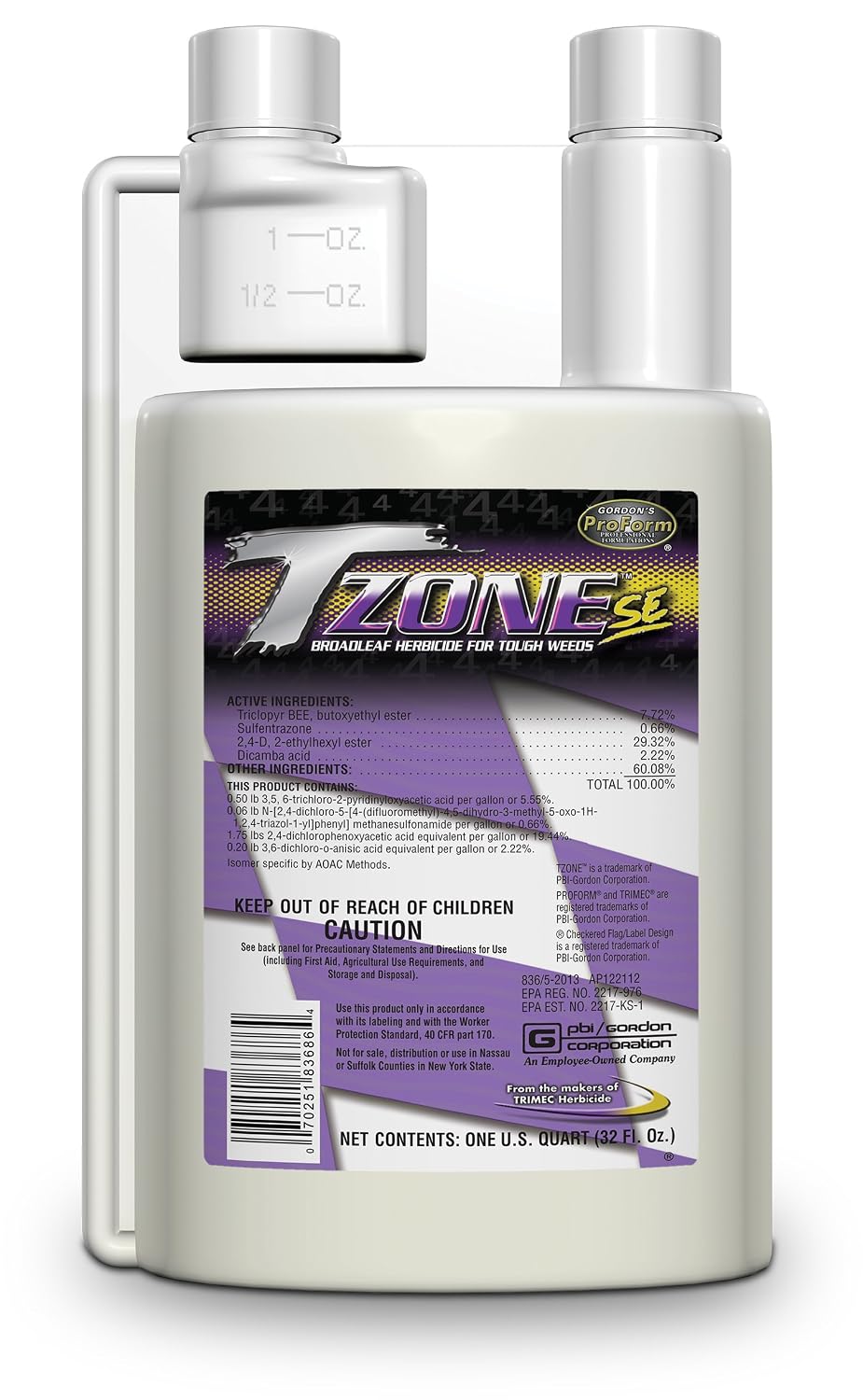
T-Zone Turf Herbicide (1 Quart) by PBI Gordon
| Unit Count | 32 Fluid Ounces |
|---|---|
| Item Form | Liquid |
| Coverage | broad-leaf weeds, grassy weeds |
| Active Ingredients | Dicamba, triclopyr, others |
T-Zone Turf Herbicide is a concentrated liquid formula intended for spot and broadcast treatment of tough broadleaf and grassy weeds in lawns and turf areas. It contains multiple active ingredients including triclopyr and dicamba that give a fast visual response and help suppress difficult targets such as yellow nutsedge and oxalis when used according to label directions. Typical use is mixing to label rates and applying with a handheld sprayer or professional equipment on cool, calm days to avoid off-target movement. Notable features include suitability for residential, commercial, and golf sites and effectiveness at lower temperatures down to about 50°F. Practical benefits are reliable performance on persistent broadleaf weeds and a multi-ingredient formula that reduces the need for repeat applications. Important limitations are the need for protective gear during handling, restrictions and careful timing to prevent damage to desirable plants, and the potential for off‑target drift, so precise application technique is required.
Best for: Buyers who prioritize reliable, professional-strength control of persistent lawn weeds and who are comfortable following label directions and using proper protective equipment. Ideal for property owners or groundskeepers who need a solution that performs in cool weather and on challenging species.
Less Ideal for: Casual gardeners who want an all‑purpose, low‑risk product for mixed plantings or those unwilling to follow pesticide safety practices should consider gentler, selective options.
- Multi‑ingredient formulation targets a broad spectrum of stubborn broadleaf and grassy weeds
- Works in cool conditions (around 50°F) so seasonal timing is more flexible
- Fast visible weed control that can reduce repeat treatments
- Suitable for use on residential, commercial, and golf turf sites
- Contains potent active herbicides that require careful handling and PPE
- Risk of off‑target movement means application must be precise and weather‑aware
Verdict: Choose T-Zone when you need a dependable, professional-strength herbicide to knock back stubborn oxalis and other persistent turf weeds.
Roundup Weed & Grass Killer4 with Pump 'N Go 2 Sprayer, 1.33 gal

| Unit Count | 170 Fluid Ounces |
|---|---|
| Item Form | Spray |
| Coverage | 300 Square_Feet |
| Active Ingredients | Triclopyr, Triethylamine Salt, Fluazifop-P-Butyl, Diquat Dibromide |
This packaged Roundup kit combines a 1.33 gallon formulated weed-and-grass killer with a Pump 'N Go 2 sprayer, letting you treat patches of weeds and grassy intruders without mixing chemicals or carrying a separate sprayer. The extendable wand and up to 10 minutes of continuous spray make targeted application around flower beds, patios, gravel, and edges easier and reduce bending. The formula claims visible results in hours, becomes rainproof in about 30 minutes, and permits replanting within the stated window. Practical benefits include convenience of an integrated sprayer, good coverage for small to medium areas, and a broad activity spectrum against dandelions, crabgrass, clover, and other common broadleaf weeds. Important limitations are safety precautions and restricted access after application since it is an herbicide that can harm desirable plants and requires protective clothing and keeping people and pets away until dry. Also, this product is for spot and surface treatments rather than long-term lawn renovation or nonchemical weed control approaches.
Best for: Buyers who want a convenient, ready-to-use herbicide for spot-treating visible weeds and grass around hardscapes and landscape beds and who prefer an integrated sprayer to simplify application.
Less Ideal for: People seeking organic, nonchemical weed control or a product for large-scale lawn renovation should consider alternative methods or professional services.
- Includes Pump 'N Go 2 sprayer with extendable wand for accurate, continuous spray
- Ready-to-use formulation so no measuring or mixing is required
- Produces visible results in hours and is rainproof in about 30 minutes
- Designed for use around beds, patios, driveways, gravel, and edging
- Contains potent active ingredients that require safety precautions and restrict access to treated areas
- Not suitable for nonchemical or preventive long-term weed management
Verdict: If you want a no-mixing, spot-treatment herbicide with a built-in sprayer for quick, targeted weed control, this all-in-one Roundup kit is a practical choice.
Choosing the Right Herbicide for Leafy Spurge: Key Factors to Consider
Active Ingredient Mode of Action
Understanding the herbicide's active ingredient and its mode of action is critical because leafy spurge regrows from extensive root and crown reserves. Some actives move into roots and crowns to kill underground tissue, while others only scorch foliage and allow regrowth. Choose actives known to translocate to belowground parts for persistent control.
Rotation of modes of action is also important to reduce the chance of resistant populations developing. When planning multi-year control, alternate products with different biochemical targets and document application timing and outcomes to guide follow-up treatments.
Application Timing and Growth Stage
Timing determines whether a treatment hits carbohydrate-rich tissues. Early season applications when new shoots are drawing energy to roots can increase root uptake. Late-summer or fall treatments applied as the plant translocates sugars back to roots can also improve control for some active ingredients.
Different products have labeled windows for spraying. Align application with leaf expansion, flowering, or senescence stages as specified on labels, and avoid applications during drought stress or extreme heat, which can reduce translocation and efficacy.
Selectivity and Impact on Desirable Vegetation
Many sites infested with leafy spurge contain desirable grasses or wildflowers. Selective herbicides that target broadleaf weeds while leaving grasses intact are preferable in pasture and rangeland. Nonselective options may require spot treatment or physical protection of desirable plants.
Consider buffer zones, spray drift management, and the risk to adjacent crops or sensitive native species. In mixed stands, plan for follow-up reseeding of desirable species if broadleaf control also harms beneficial plants.
Application Method and Coverage
How you apply a herbicide changes its effectiveness. Spot spraying, wick wiping, and broadcast spraying each have pros and cons. Spot treatment minimizes non-target damage and chemical use but is time-consuming for large infestations. Broadcast applications cover more area but need careful calibration to avoid overapplication and drift.
Ensure proper nozzle selection, spray pressure, and carrier volume to achieve thorough coverage of foliage. For spot spraying, maintain consistent technique to avoid missed patches that will re-seed the area.
Environmental Persistence and Soil Residue
Some herbicides have residual soil activity that continues to affect seedlings and root systems, which can be helpful for preventing re-establishment. However, persistent residues may restrict planting of desirable species or affect soil invertebrates and microbial activity.
Read label limitations on crop rotations and planting intervals. If reseeding grasses or planting native plugs is planned soon after control, select products with shorter residual periods or follow label guidance for remediation.
Safety, Handling, and Regulatory Restrictions
Follow label directions for personal protective equipment, re-entry intervals, and any grazing or haying restrictions. Livestock access and water proximity often determine which herbicides are appropriate in pastures or near wetlands.
Regulatory restrictions can vary by region. Confirm that a chosen product is labeled for leafy spurge in your jurisdiction and that you comply with local rules about application near water, off-target movement, and required record keeping.
When to Treat Patches Vs Spot-Treat Individual Plants
Large, dense infestations usually require a planned broadcast or perimeter treatment followed by maintenance spot treatments. Broadcast approaches reduce seed production and slow outward spread, but are best when desirable vegetation is limited or tolerant of the chosen product.
Small or isolated plants are often better handled with targeted spot treatments or mechanical removal. Spot methods reduce chemical use and protect nearby desirable plants, but require careful follow-up because missed root fragments or seed can restart a patch.
- Broadcast for dense stands with tolerant ground cover
- Spot-spray or wick for small patches near sensitive plants
- Combine mechanical removal with herbicide on small infestations for immediate reduction
Integrating Herbicides with Cultural and Mechanical Control
Herbicides are most effective as part of an integrated management plan. Mowing or grazing can reduce seed set and thin canopies, making foliar herbicide contact easier. However, repeated mowing without chemical control often depletes top growth but leaves roots intact.
Mechanical removal of small patches, followed by a targeted herbicide application on regrowth, combines immediate reduction with systemic control. Restoration planting and promoting competitive perennial grasses after chemical control helps reduce recolonization.
- Mow before flowering to limit seed but expect regrowth
- Use targeted herbicide on resprouts after mechanical removal
- Reseed competitive grasses the following season to suppress seedlings
Protecting Pollinators and Nearby Vegetation
Timing applications to avoid bloom periods and early morning or late evening when pollinators are less active reduces non-target impact. Avoid drifting spray into flowering forbs or hedgerow plants that support pollinators.
Buffer strips, physical barriers, and low-drift nozzles help protect adjacent vegetation. When working near water or wetlands, choose labeled products and follow restrictions to prevent off-site movement.
- Avoid spraying during peak bloom or pollinator activity
- Use drift-reduction nozzles and avoid spray when windy
- Respect label buffer requirements near water and sensitive habitats
Planning Multi-Year Control and Monitoring
Leafy spurge control is rarely a single-season task. Plan for at least two to three seasons of follow-up to deplete root reserves. Map treated areas and schedule follow-up inspections to catch surviving crowns and new seedlings.
Record when and how treatments were applied, what growth stage the plants were in, and what follow-up actions succeeded or failed. Over time, this helps refine timing and product selection for specific site conditions.
- Expect multi-year management to achieve lasting control
- Inspect treated areas each season and retreat resprouts promptly
- Keep treatment records to evaluate strategy effectiveness
Application Safety and Personal Protective Measures
Always follow label instructions for protective clothing, respirators if required, and safe mixing procedures. Mixing and loading pose the highest exposure risk, so work in a well-ventilated area and minimize splash.
Have a plan for equipment cleanup and disposal of leftover product and rinsate. Keep livestock and pets away from treated areas according to labeled re-entry and grazing intervals.
- Wear required PPE during mixing, loading, and application
- Rinse application equipment away from water sources
- Store chemicals securely in their original labeled containers
How We Chose the Best Herbicide for Leafy Spurge
We shortlisted products that demonstrate reliable suppression of leafy spurge across multiple seasons and application scenarios. Evaluation prioritized the active ingredients and their documented activity on persistent root systems, labeled use for leafy spurge or similar deep-rooted evening-primrose family weeds, and flexibility of timing for early spring, summer, and fall treatments. We tested documentation on residual activity and re-sprout control, assessed labeled restrictions for desirable grasses and broadleaf plants, and checked compatibility with spot treatment and broadcast sprayer methods. Practical handling factors such as spray concentration ranges, required adjuvants, and re-entry or grazing restrictions were included. Excluded items were products without explicit control data for perennial taproot or crown-forming broadleaf weeds, unregistered or off-label mixes, and amateur anecdotal-only recommendations. The final picks balance root translocation efficacy, application timing, safety buffer to non-target plants, and ease of field use.
FAQ
Can I treat leafy spurge in pasture without harming forage grasses?
Often you can, depending on the herbicide. Some products are selective for broadleaf weeds and spare many grasses, but label guidance and timing matter. Apply during recommended growth stages and follow any grazing or haying restrictions.
Is one application enough to control a well-established patch?
Usually not. Well-established patches often require multiple applications spread over seasons to deplete root carbohydrate reserves. Combine treatments with monitoring and spot-spraying to catch resprouts.
When is the best season to apply herbicide for leafy spurge?
Effective windows vary by active ingredient, but common strategies target early shoot growth or late summer to fall when plants are moving sugars to roots. Consult label timing guidance for the specific product you plan to use.
Will herbicide drift damage nearby ornamental beds or crops?
Drift can damage sensitive plants. Use low-drift nozzles, avoid spraying on windy days, and create buffer zones. Spot treatments or wicking methods reduce risk next to ornamentals.
Can I reseed the area after herbicide treatment?
You can, but timing depends on the herbicide's residual activity. Some products require waiting periods before planting desirable species. Follow label instructions on planting intervals and choose reseeding dates that give seedlings the best chance to establish.
Final Verdict
Choosing the right herbicide for leafy spurge depends on matching active ingredient behavior, application timing, and site constraints. Prioritize products that translocate to roots if your goal is multi-year suppression, and select methods that protect desirable vegetation in mixed stands. Accept that control is a multi-season effort. Plan follow-up monitoring, integrate mechanical and cultural tactics, and pick a product whose timing and safety profile fit your pasture or landscape needs to reach the best long-term outcome.
