

Note: This article contains affiliate links. If you click on these links and make a purchase, I may earn a small commission at no extra cost to you. This helps support my research and content. Read my full affiliate disclosure here.
If you manage acreage, maintain windbreaks, or handle storm cleanup, a 3 point hitch wood chipper can drastically cut the time you spend turning branches into manageable chips. Choosing the right hitch-mounted chipper matters because mismatch with your tractor or wrong capacity can cause frequent jams, slow work cycles, or unsafe handling. This guide shortlists seven top-performing 3 point hitch wood chippers suitable for different tractor sizes and jobs. We evaluated models for throughput, hitch compatibility, safety features, durability, and maintenance ease so you can match a chipper to your tractor and workload. Read on for the decision points that matter and what to prioritize for reliable chipping in the field.
Top Picks at a Glance
| Best Overall The best all-around choice for most situations | Farmer-Helper 7" 3-Point Hitch Wood Chipper FH-BX62S |  |
| Best Quality Built to a higher standard if you want something more solid | MechMaxx WC68H 6" 3-Point PTO Hydraulic Wood Chipper (for 20–50 HP Tractors) |  |
| Best Value The sweet spot between price and what you get | HUOHUATHREE BX42S 3-Point Hitch PTO Wood Chipper for Tractors up to 45 HP |  |
| Best Budget The cheapest option that still gets the job done reliably | Sinolink 4-Inch PTO Wood Chipper for Category 1 Tractors (3-Point Hitch) |  |
| Highest Rated A top-rated pick with lots of positive feedback | BILT HARD 6" PTO Wood Chipper for 40–80 HP Tractors, Category 1 3-Point Hitch |  |
| Most Popular A crowd favorite that many people choose with confidence | MechMaxx BX42S 4" PTO-Powered 3-Point Wood Chipper Attachment (PTO Shaft Included) |  |
| Best Seller A high-volume bestseller chosen again and again | Titan Attachments 3-Point PTO Wood Chipper with 25" Rotor for Tractors up to 40 HP |  |
Farmer-Helper 7" 3-Point Hitch Wood Chipper FH-BX62S

| Maximum chipping capacity | 6.5” x 12” material |
|---|---|
| PTO horsepower range | Min 25 HP to Max 45 HP |
| Flywheel | 30” diameter x 3/4” thick, 205 LBS |
| Number of blades | 4 reversible + 1 rotor |
This Farmer-Helper FH-BX62S is a heavy-duty 3-point hitch wood chipper intended to mount to a tractor and run from the PTO. It uses a large 30-inch flywheel with four reversible blades and twig-breaker paddles to reduce clogging, and a hinged gravity-feed hopper that folds for more compact transport and storage. Setup and operation are straightforward for operators familiar with PTO implements: hook the Series 05 shearbolt driveline to a Cat-I hitch and match the tractor horsepower to the recommended 25 to 45 HP range. The adjustable 360-degree discharge chute and substantial flywheel mass help produce consistent chips for mulch or bedding, while the pinch-and-pull feeding system handles limbs efficiently. Important limitations are that it requires a compatible tractor with enough PTO power and a three-point hitch, and its folded dimensions and mass mean it is not suitable for frequent hand-moving or small compact tractors. For properties with regular heavy pruning or storm cleanup, it brings commercial-style capacity without requiring a separate engine.
Best for: Best for owners of compact farm or acreage tractors who need a durable, tractor-powered chipper for regular pruning, storm cleanup, and mulch production and who value capacity over portability.
Less Ideal for: Not a good choice for gardeners without a compatible tractor or for urban homeowners who need a lightweight, towable, or engine-powered chipper for occasional use.
- Mounts directly to tractor 3-point hitch for easy transport and power via PTO
- Large 30-inch flywheel and four reversible blades for consistent chipping
- Twig breaker paddles and pinch-and-pull feed reduce clogging and help process irregular branches
- 360-degree adjustable discharge for directing chips where you need them
- Hinged foldable hopper reduces storage footprint and balances weight for transport
- Requires a tractor with 25–45 HP and a Cat-I 3-point hitch so not usable as a standalone unit
- Heavy and bulky to move by hand or fit on very small tractors
Verdict: If you have a compatible tractor and need a rugged, high-capacity PTO chipper for frequent heavy pruning and cleanup, this unit delivers commercial-style performance mounted to your three-point hitch.
MechMaxx WC68H 6" 3-Point PTO Hydraulic Wood Chipper (for 20–50 HP Tractors)
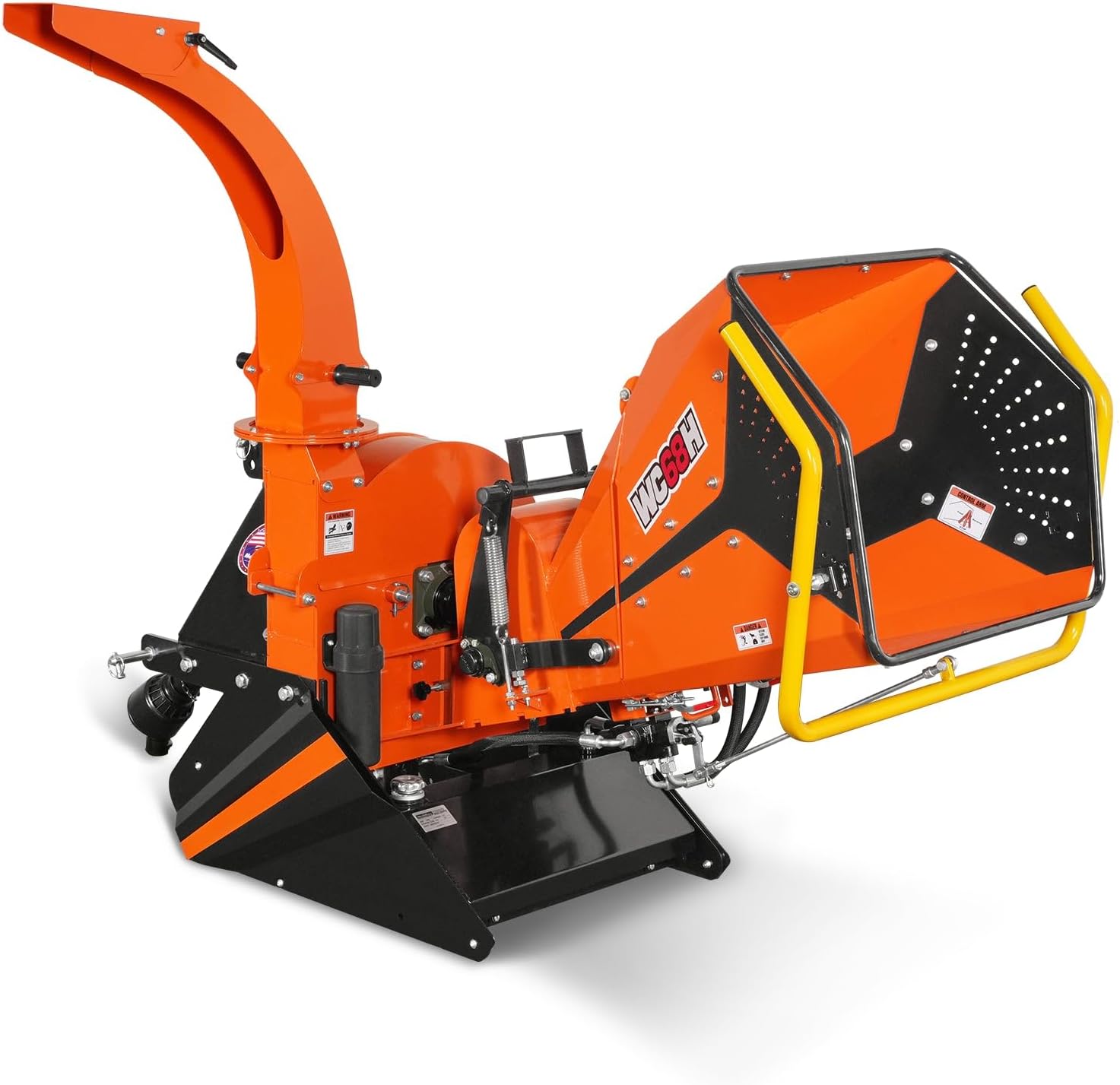
| Engine / Power source | PTO-driven (for 20–50 HP tractors) |
|---|---|
| Cutting capacity | 6-inch maximum |
| Feed system | Hydraulic infeed |
| Mount type | 3-point hitch |
The MechMaxx WC68H is a PTO-driven 6-inch wood chipper built to pair with 20–50 HP tractors for clearing brush, storm debris, and trail maintenance. It uses a hydraulic infeed system combined with a direct-drive PTO connection to deliver consistent pulling force so the operator can feed branches and tangled material steadily without frequent stalling. In practice this yields uniform chips useful for mulch or reducing volume before hauling. The machine’s construction and tractor-mounted 3-point hookup make it a practical choice for landowners and small farms that need production-grade results without a tow-behind setup. Important limitations are its minimum tractor power requirement and the fixed 6-inch maximum chip diameter, so it will not accept very large logs and needs a compatible tractor with sufficient PTO output. Assembly, hitching, and routine blade maintenance are standard chores but the unit’s hydraulic feed and robust build cut down on operator fatigue and clogging compared with gravity-fed chippers.
Best for: Buyers who prioritize reliable, production-capable chipping on small to mid-sized properties and already own or plan to use a 20–50 HP tractor for regular brush and debris management.
Less Ideal for: If you need to process large diameter logs, prefer a self-powered towable chipper, or do not have a tractor with the required PTO capacity, choose a different machine.
- Hydraulic infeed provides steady, controllable feeding and reduces operator effort
- PTO direct-drive design converts tractor power into consistent torque for heavy-duty chipping
- Built for 20–50 HP tractors which fits many compact and utility tractors used on small farms
- Produces uniform wood chips suitable for mulch or composting
- 6-inch maximum chipping diameter limits work on larger logs
- Requires a compatible tractor with adequate PTO power and 3-point hookup
Verdict: A performance-focused 3-point PTO chipper that turns a 20–50 HP tractor into a consistent, heavy-duty chipping machine for routine brush and debris management.
HUOHUATHREE BX42S 3-Point Hitch PTO Wood Chipper for Tractors up to 45 HP

| Power drive | 540 RPM PTO |
|---|---|
| Tractor compatibility | Category 1, 16–45 HP |
| Max branch capacity | 4 inches |
| Rotor | 26-inch rotor, 4 hardened steel blades |
The BX42S is a straightforward PTO-driven wood chipper designed for compact tractors and routine land-clearing tasks. It mounts to a standard Category 1 three-point hitch and uses a 540 RPM PTO input, so setup requires only connecting the included PTO shaft and hitch points. A gravity-fed, self-feed hopper and a 26-inch rotor with four hardened steel blades let it process branches up to 4 inches into usable chips for mulch or compost. The 360° rotatable discharge chute with an adjustable deflector makes it easy to direct chips where you want them, and the rotor design emphasizes strong air flow to reduce jams during continuous work. Because it avoids hydraulic complexity, maintenance is simpler and operating costs are lower, but you should expect a heavy, tractor-mounted unit that needs a tractor in the 16 to 45 HP range to run properly. This makes the BX42S a practical, no-frills choice for farmers, landscapers, and homeowners with a compatible tractor who want efficient chipping without elaborate systems.
Best for: Buyers who already own a compact tractor and want a low-maintenance, PTO-powered chipper for regular yard, farm, or landscaping cleanup.
Less Ideal for: People who need a lightweight, towable, or standalone gas-powered chipper or those without tractor access should consider other options.
- PTO-driven Category 1 hitch design fits standard 3-point tractors for stable power delivery
- Self-feed hopper and 26-inch rotor with four hardened steel blades enable continuous chipping up to 4-inch branches
- 360° rotatable discharge chute with adjustable deflector for precise chip placement
- Gravity-feed, nonhydraulic design reduces maintenance complexity and operating costs
- Requires a compatible tractor (16–45 HP) so not usable as a standalone machine
- Heavy unit that may be difficult to transport or mount without proper equipment
Verdict: If you have a compatible compact tractor and want a rugged, low-maintenance PTO chipper for efficient on‑farm or landscape chipping, the BX42S delivers reliable performance.
Sinolink 4-Inch PTO Wood Chipper for Category 1 Tractors (3-Point Hitch)

| Tractor compatibility | Category 1, 3-point hitch, 16–45 HP |
|---|---|
| PTO speed | 540 RPM |
| Maximum branch diameter | 4 inches |
| Hopper | 20 x 20 inch gravity self-feed |
| Knives | 4 reversible hardened steel |
This Sinolink 4-inch PTO wood chipper mounts to Category 1 three-point hitches and runs off a standard 540 RPM PTO, making it a straightforward chipper for small tractors from about 16 to 45 HP. It uses a high-performance rotor with four reversible hardened-steel knives and a large 20" x 20" gravity-fed hopper so branches are pulled in with minimal manual feeding. The 360-degree rotating discharge hood and adjustable deflector let you direct chips where you need them for windrows or a chip pile. Construction in carbon steel suggests decent durability for farm or orchard cleanup, and the included PTO shaft simplifies hookup. Important limitations are its 4-inch cutting capacity and reliance on tractor power, so it is only suitable for light-to-moderate woody debris and requires a compatible tractor and routine blade maintenance. For buyers prioritizing a budget-friendly PTO unit that reduces manual feeding and handles common pruning waste, this is a practical choice; those needing larger diameter capacity or a self-powered chipper should look elsewhere.
Best for: Practical small-farm or acreage owners who already have a Category 1 tractor and want an affordable PTO-driven chipper to process pruning waste and small branches with minimal manual feeding.
Less Ideal for: Homeowners without a compatible tractor or users who need to chip large-diameter wood or want a self-powered standalone machine.
- PTO-driven design fits Category 1 3-point hitches for tractors 16–45 HP
- Gravity self-feed 20" x 20" hopper reduces manual pushing and speeds feeding
- Rotor with four reversible hardened-steel knives for effective chipping
- 360-degree rotating discharge hood with adjustable deflector for precise chip placement
- Carbon steel construction for heavier-duty farm and orchard use
- Maximum branch capacity limited to 4 inches in diameter
- Requires a compatible tractor with 540 RPM PTO and a PTO shaft connection
- Lacks onboard engine so cannot operate independently from a tractor
Verdict: If you have a compatible small tractor and need an economical PTO chipper for routine pruning and orchard cleanup, this model delivers efficient gravity-fed chipping and easy chip placement.
BILT HARD 6" PTO Wood Chipper for 40–80 HP Tractors, Category 1 3-Point Hitch

| PTO HP Required | 40-80 HP |
|---|---|
| Max Chipping Dia. | 6 Inch |
| Rotor Diameter | 30 Inch |
| PTO Shaft RPM | 540-1000 RPM |
| PTO Spline | 1-3/8 in. (6-Spline) |
This BILT HARD PTO wood chipper mounts to a Category 1 three-point hitch and uses tractor power to chip branches up to 6 inches in diameter. It is designed for 40–80 HP tractors and a 540–1000 RPM PTO range, so setup is straightforward for most medium-duty farm and property tractors. The 30-inch rotor with four reversible dual-edged blades and a 180 lb flywheel stores momentum for steady chipping and reduced vibration, while the self-feeding angled hopper and twig breaker help keep material moving and reduce clogs. Safety features include a feed-chute safety curtain and a shear-bolt PTO protection system. Practical maintenance is simplified by an easy-open rotor housing for blade changes and a storage tube for tools and the manual. Downsides are the machine mass and pallet shipping requirement, which mean you need proper lifting or unloading equipment and a tractor with adequate lift capacity for safe transport and installation. For regular property cleanup and converting woody waste into chip mulch this unit delivers durable, low-maintenance performance.
Best for: Buyers who prioritize a durable, low-maintenance chipper that integrates with a medium-duty tractor for regular property cleanup and mulch production.
Less Ideal for: Small-tractor owners without 40+ HP or users who need a lightweight, towable chipper for occasional residential yard work.
- Compatible with 40–80 HP tractors and Category 1 three-point hitches for broad tractor fit
- 30-inch rotor with reversible dual-edged blades extends service life and reduces sharpening frequency
- Self-feeding hopper and twig breaker bar reduce jams and make continuous chipping easier
- 360° rotating discharge chute with adjustable deflector for controlled chip placement
- Shear-bolt PTO protection and a safety curtain in the feed chute enhance operator safety
- Very heavy and ships on a pallet, requiring lifting equipment or assistance to unload and position
- Requires a tractor with sufficient lift capacity and correct PTO specifications to operate
Verdict: A robust PTO-mounted chipper built for reliable, low-maintenance chipping on 40–80 HP tractors.
MechMaxx BX42S 4" PTO-Powered 3-Point Wood Chipper Attachment (PTO Shaft Included)

| Recommended tractor power | 18-45HP |
|---|---|
| Chipping capacity | Up to 4 inch diameter |
| Rotor diameter | 26 inches |
| Includes | PTO shaft |
The MechMaxx BX42S is a heavy-duty 3-point wood chipper that hooks to a tractor PTO to convert tractor power into high-speed chipping for branches up to 4 inches in diameter. It uses a 26-inch rotor with four hardened steel blades and a counter knife to produce consistent shred sizes of roughly 3/4 to 1 1/2 inches while rotor winglets and branch breakers reduce jams. The self-feeding hopper and included PTO shaft make hookup and operation straightforward for routine clearing and farm chores, and the 360° discharge chute with adjustable deflector lets you direct chips into a trailer or pile. Practical benefits include robust cutting performance for medium timber, minimal standalone maintenance because it runs off the tractor, and simple transport using the tractor’s three-point hitch. Important limitations are that it requires a compatible tractor in the 18–45 HP range and some users will need to maintain blade sharpness and check linkage regularly; it is not a self-powered unit for operators without a tractor.
Best for: Buyers who need a durable, tractor-mounted chipping solution for regular farm or acreage cleanup and who prioritize equipment that integrates with existing tractor power and hitch systems.
Less Ideal for: Gardeners or homeowners without a compatible tractor or small-plot users who need a compact, engine-driven chipper for occasional light yard work.
- PTO-driven design leverages tractor power so no separate engine or fuel system is required
- 26-inch rotor with four hardened tooling steel blades for consistent chipping of up to 4-inch branches
- Self-feeding hopper and branch breakers reduce manual feeding and help prevent jams
- 360° rotary discharge chute with adjustable deflector for precise chip placement
- Requires a compatible tractor in the 18–45 HP range so it is not usable as a standalone chipper
- Heavy attachment weight necessitates proper tractor lift capacity and safe handling during hitching
Verdict: If you have a compatible tractor and need dependable, tractor-powered chipping for medium-size branches, the MechMaxx BX42S delivers strong, low-maintenance performance.
Titan Attachments 3-Point PTO Wood Chipper with 25" Rotor for Tractors up to 40 HP

| Power source | gasoline-powered (PTO-driven) |
|---|---|
| Rotor diameter | 25" |
| Maximum branch capacity | Up to 4" diameter |
| Tractor compatibility | Fits tractors up to 40HP |
This Titan Attachments 3-point wood chipper is a tractor-mounted PTO-driven mulcher built for routine chipping of branches and brush up to 4 inches across. It hooks to a standard 3-point hitch and runs off your tractor PTO at 540–1,000 RPM, using a large 25 inch rotor with integrated vents to keep operation smooth and reduce vibration. The self-feeding chute speeds work by pulling material in so you can drop one branch after another, and the adjustable discharge lets you direct chips where you need them. Reversible blades and twig-breaker paddles extend service life and help clear smaller material that would otherwise clog the rotor. Because it is PTO-powered and heavy-duty, expect industrial-style performance but plan for tractor compatibility, regular blade maintenance, and secure mounting. This is a practical choice when you need consistent, high-capacity chipping on acreage or for forestry cleanup, but it requires a properly rated tractor and basic mechanical upkeep to keep it running reliably.
Best for: Buyers who need a robust tractor-mounted chipper for regular acreage, forestry or landscaping cleanup and who prioritize dependable, mechanical performance over compact convenience.
Less Ideal for: Casual homeowners with only a pickup or small yard equipment or anyone who needs a small electric or tow-behind chipper for occasional use.
- PTO-driven design delivers high, continuous power when paired with a compatible tractor
- Self-feeding chute increases throughput and reduces operator effort
- 25" rotor with integrated vents reduces vibration and improves chipping efficiency
- Reversible blades and twig-breaker paddles extend blade life and help prevent clogs
- Requires a tractor up to 40 HP and proper 3-point hitch setup, so not plug-and-play for homeowners without tractors
- Heavy-duty construction means it is large and requires space for storage and safe transport
Verdict: If you have a compatible tractor and need heavy-duty, continuous chipping on acreage, this PTO-driven 3-point chipper delivers reliable, high-capacity performance.
Choosing the Right 3 Point Hitch Wood Chipper: Key Factors to Consider
Tractor Horsepower and PTO Match
Matching the chipper to your tractor horsepower and PTO speed is the most important factor. A chipper rated for higher PTO horsepower than your tractor can deliver will bog down the tractor, increase wear, and create safety risks during heavy feeds. Conversely, using an overpowered tractor on a small chipper can overstress the chipper's driveline if it exceeds the unit's design limits.
Check the chipper's recommended PTO speed and horsepower range, and confirm your tractor's continuous and peak power figures. Also consider how often you will run at higher loads. If you frequently need to chip larger-diameter limbs, step up to a chipper sized for that workload rather than relying on short bursts of high tractor power.
Chipper Feed and Rotor Design
Feed design and rotor geometry dictate how material is pulled in, sized, and expelled. A robust rotor with replaceable knives or hardened hammers performs differently depending on whether you are chipping green saplings or dry, brittle branches. Feed rollers or gravity feed infeed openings change how easily you can push difficult pieces into the rotor and affect the tendency to clog.
Think about the typical branch diameter and type you will process. For frequent larger-diameter work you want a rotor and feed system rated for those sizes and with aggressive feed action to reduce manual pushing. For lighter yard work a simpler gravity feed and knife-style rotor may be sufficient and easier to service.
Hitch Category and Mounting Fit
Three-point hitch categories and mounting geometry determine whether a chipper will attach safely and operate with your tractor's range of motion. Category mismatches can cause improper alignment, extra stress on lift arms, or interference with tractor components. Some chippers offer adjustable hitch brackets to fit multiple tractors, which improves versatility across different machines.
Confirm the chipper's hitch category, required lift capacity, and any necessary stabilizers. Also check clearance requirements for PTO driveline angles and whether a top link or additional reinforcements are recommended for safe operation. Proper mounting reduces vibration and helps the chipper feed consistently.
Safety Systems and Operator Controls
Built-in safety features are critical because chipping work can throw debris and presents pinch points at the feed and rotor. Stop gates, emergency feed-stops, rotor guards, and clear labeling reduce the likelihood of operator injury. Lockout systems for maintenance and guarded PTO drivelines prevent accidental starts while a technician is working on the unit.
Evaluate how quickly an operator can stop the feed, whether there are remote or easily reachable controls, and if chip deflectors and screens are present to direct ejected material. Safety systems that are simple to use and inspect will be relied on more often in daily work than complex controls.
Durability and Wear Components
Chippers face abrasive contact with wood, grit, and occasionally nails or wire. Rotor construction, knife or hammer metallurgy, and replaceable anvil or shear surfaces determine long-term durability. Look for chippers that use hardened, replaceable cutting edges and offer straightforward access to replace those parts.
Consider the availability and cost of replacement knives, bearings, and belts, along with how often routine service is required. A heavier, more rugged rotor assembly will usually outlast lightweight designs under frequent professional use, though it may add weight to tractor handling.
Maintenance Access and Serviceability
Regular maintenance keeps a chipper reliable. Easy access to blades, bearings, and grease points reduces downtime and makes routine checks practical. Quick-release covers, straightforward belt tensioning systems, and well-marked lubrication points are features that save time in the field.
Think beyond initial setup: how long will routine tune-ups take, can you change knives without special tools, and does the chipper provide simple access to the rotor and gearbox? Good serviceability lowers lifetime ownership effort and keeps the machine working when you need it most.
Sizing a Chipper for Typical Jobs
Estimate the work you will do by listing the most common branch diameters and the volume of material per day. A chipper sized for occasional limb cleanup on a small acreage differs from one meant for clearing fence lines or handling regular storm debris.
Consider duty cycle as well as maximum capacity. A chipper that can swallow a large limb once might not be designed to do so repeatedly. Choose a unit with a continuous throughput rating that meets your daily workload, not just the advertised maximum.
- Measure typical branch diameters and note toughest material
- Compare continuous throughput rather than peak size alone
- Account for transport and storage when selecting chipper size
Transport, Storage, and Weight Considerations
Hitch-mounted chippers add weight to the rear of the tractor and can change handling. Check the unit weight relative to your tractor's lift capacity and rear ballast needs. Heavier units may require additional counterweights or front ballast for safe on-road transport.
Also plan for storage. A compact, low-clearance chipper is easier to keep under a lean-to or in a shed. If you will frequently move the chipper between fields, look for models with foldable or detachable chutes to save space.
- Verify tractor lift and ballast requirements
- Look for detachable or foldable components for storage
- Consider trailer or trailer hitch transport if moving between distant sites
Common Maintenance Routines
Set up a simple maintenance schedule that includes daily inspection of knives or hammers, weekly greasing of bearings, and monthly checks of belts and gearbox oil. Clean chip build-up from the housing and inspect for cracks or loose fasteners after heavy use.
Keep a small toolkit and spare knife set accessible. That reduces downtime when a blade needs turning or replacement in the field. Also monitor PTO driveline universal joints for wear and ensure safety shields remain intact.
- Daily: blade check and housing cleanout
- Weekly: grease points and fastener torque check
- Monthly: gearbox oil level and belt tension inspection
Safe Operation Practices
Train every operator on proper feed techniques and the location of emergency stops. Use push tools rather than hands when feeding awkward pieces and never attempt to clear a jam while the rotor can move.
Wear appropriate protective gear including eye and ear protection, and ensure bystanders are well clear of the discharge path. Position chippers so the discharge deflector sends chips to a safe pile or container.
- Always stop the PTO and lock out before maintenance
- Use push tools and never reach into the feed opening
- Confirm chip discharge path before operating
Adapting a Chipper to Different Tractors
If you plan to use the chipper on more than one tractor, check for adjustable hitch brackets and recommended stabilizers. Some chippers provide multiple mount settings to align centerlines and PTO angles across tractor sizes.
Use correct driveline length and disconnect the PTO when moving the tractor away from the chipper. Adapters that change PTO speed or geometry should be avoided unless they are approved by the chipper manufacturer because improper driveline setup can cause failure.
- Confirm adjustable mounting brackets for multi-tractor use
- Use matching PTO shaft length and safety shields
- Avoid unapproved driveline adapters that alter speed or torque
How We Chose the Best 3 Point Hitch Wood Chipper
We focused on practical, field-oriented criteria that predict real-world performance for hitch-mounted wood chippers. Key evaluation dimensions included throughput capacity and feed design to estimate how quickly each chipper clears typical brush; compatibility with standard three-point hitch categories and PTO speed ranges so the unit matches common tractors; safety systems such as rotor guards, feed-stop mechanisms, and mechanical locking to reduce operator risk; durability of wear parts and rotor assemblies that determine how long the machine lasts under woody debris duty; ease of maintenance including access to blades, bearings, and grease points; and material-handling features like chute orientation and deflector adjustability that affect where chips go. We excluded units that required nonstandard hitch adapters or tractors with uncommon PTO setups. We also filtered out designs that lacked essential safety features or had maintenance demands that would be impractical for typical farm or acreage use. The resulting selections prioritize dependable throughput, tractor compatibility, operator safety, and serviceability.
FAQ
What tractor horsepower do I need for a hitch chipper?
It depends on the chipper's rated range and the diameter of material you will process. Small yard chippers often require modest PTO horsepower, while larger units for regular brush and small trees need higher continuous PTO output. Check the chipper's recommended horsepower and match it to your tractor's continuous rating rather than just peak numbers.
How do I reduce jamming when chipping mixed material?
Feed material by size, avoid overly long sections that wrap around the rotor, and use a chipper with an aggressive feed design or feed rollers for difficult pieces. Regularly clear the housing when buildup occurs and keep knives sharp to reduce the chance of jams.
Are knives or hammers better for a 3 point hitch chipper?
Knives give cleaner chips and are easier to sharpen or flip, while hammer-style rotors tolerate tougher, frozen, or dirty material and require less frequent reshaping. The best choice depends on the kind of wood you process and how often you will maintain cutting edges.
Can I use a hitch chipper on slopes or uneven ground?
Operation on slopes is possible but requires caution. Ensure the tractor is stable with proper ballast, keep the chipper level as much as possible, and avoid feeding when the tractor or chipper is on a steep incline. Sloped conditions increase the risk of rollaway and uneven feeding.
How often should I replace knives or cutting edges?
Replacement frequency depends on workload and the types of wood processed. Light yard use may only require occasional flipping and sharpening, while heavy or abrasive work will need more frequent replacement. Inspect edges regularly and replace when they no longer cut cleanly or require excessive force to feed material.
What maintenance should I do before storing a chipper for winter?
Clean out all chips and debris, inspect and lube bearings, and protect cutting edges with a light oil to prevent corrosion. Drain or check gearbox oil if recommended by the manufacturer and store the unit under cover to minimize moisture and freeze damage.
Final Verdict
Choose a 3 point hitch wood chipper that matches your tractor power, the branch diameters you will process, and the expected daily throughput. Prioritize tractor compatibility, a rotor and feed design that suits your material, and strong safety and serviceability features. Tradeoffs are common: larger, more durable rotors handle heavier work but add weight and maintenance needs. Focus on the combination of throughput capacity, safe operation features, and ease of maintenance to select a chipper that will be dependable for the tasks you do most often.
